Joint Distant and Direct Supervision for Relation Extraction
Truc-Vien T. Nguyen and Alessandro Moschitti Department of Information Engineering and Computer Science
University of Trento 38123 Povo (TN), Italy
{nguyenthi,moschitti}@disi.unitn.it
Abstract
Supervised approaches to Relation Extrtion (RE) are characterized by higher ac-curacy than unsupervised models. Unfor-tunately, their applicability is limited by the need of training data for each rela-tion type. Automatic crearela-tion of such data using Distant Supervision (DS) provides a promising solution to the problem. In this paper, we study DS for designing end-to-end systems of sentence-level RE. In particular, we propose a joint model be-tween Web data derived with DS and man-ually annotated data from ACE. The re-sults show (i) an improvement on the pre-vious state-of-the-art in ACE, which pro-vides important evidence of the benefit of DS; and (ii) a rather good accuracy on ex-tracting 52 types of relations from Web data, which suggests the applicability of DS for general RE.
1 Introduction
Automatic Relation Extraction (RE) as defined in ACE (Doddington et al., 2004) achieves the high-est accuracy when supervised approaches are ap-plied, e.g., (Zelenko et al., 2002). Unfortunately, they require labeled data and tend to be domain-dependent as different domains involve different relations. Distant supervision (DS), e.g., using Wikipedia (Banko et al., 2007; Mintz et al., 2009; Hoffmann et al., 2010), can be applied for auto-matically acquiring relation types and their train-ing data.
The main idea behind DS is to exploit (i) rela-tion repositories, e.g., theInfobox,x, of Wikipedia to define a set of relation typesRT(x)and (ii) the
text of the page associated withxto produce the training sentences, which are supposed to express instances ofRT(x).
Previous work has applied DS to RE atcorpus level, e.g., (Banko et al., 2007; Mintz et al., 2009): relation extractors are (i) learned using such not completely accurate data and (ii) applied to extract relation instances from the whole corpus. The multiple pieces of evidence for each relation in-stance are then exploited to recover from errors of the automatic extractors. Additionally, a recent approach, i.e., (Hoffmann et al., 2010), has shown that DS can be also applied at level of Wikipedia article: given a targetInfoboxtemplate, all its at-tributes1can be extracted from a given document
matching such template.
Sentence-level RE (SLRE) has been typically modeled with the traditional supervised approach, e.g., using the data manually annotated in ACE (Culotta and Sorensen, 2004; Kambhatla, 2004; Bunescu and Mooney, 2005; Zhang et al., 2005; Zhang et al., 2006; Bunescu and Mooney, 2007; Nguyen et al., 2009). The resulting extractors are very valuable as they find rare relation instances that might be expressed in only one document. For example, the relation President(Barrack Obama, United States) can be extracted from thousands of documents thus there is a large chance of acquiring it. In contrast,President(Eneko Agirre, SIGLEX)
is probably expressed in very few documents (if not just one sentence), increasing the complexity for obtaining it.
In (Nguyen and Moschitti, 2011), we firstly used DS from Wikipedia for SLRE by exploiting state-of-the-art models based on Support Vector Machines (SVMs) and kernel methods (KM). The experiments showed that our approach is robust to Web documents and can achieve high accuracy, i.e., an F1 of 74.29% on 52 YAGO relations.
In this paper, to accurately assess the benefit of using DS for SLRE, we manually mapped rela-tions from YAGO to ACE based on their
descrip-1This is a simpler tasks as one of the two entity is fixed.
tions. Then, we designed a joint RE model com-bining DS and ACE data and tested it on ACE gold standard. This way the results are validated with the data provided by the expert linguistic annota-tors of ACE. The improvement produced by DS in these tests provides a strong evidence of the bene-fits of our joint model.
Additionally, since our aim is to produce RE for real-world applications, we experimented with end-to-end systems, which use Named Entity Rec-ognizers (NERs). For this purpose, we also ex-ploited Freebase for creating DS data for our ro-bust NER (Nguyen et al., 2010). The results show that our RE systems can be applied to any doc-ument/sentence achieving an appreciable F1 of 67%.
In the remainder of this paper, Section 2 presents the related work, Section 3 describes the datasets for distant and direct supervision and the mapping between ACE and YAGO relations, Sec-tion 4 illustrates our RE models, including the joint ACE-Wikipedia model, Section 5 reports on all experiments with our models and finally Sec-tion 6 summarizes the conclusions.
2 Related Work
The extraction of relational data from text has drawn popularity for its potential application in a broad range of tasks. It refers to the automated extraction of relational facts, or world knowledge from the Web (Yates, 2009). To identify seman-tic relations using machine learning, three learn-ing settlearn-ings have mainly been applied, namely su-pervised methods (Zelenko et al., 2002; Culotta and Sorensen, 2004; Kambhatla, 2004; Zhou et al., 2005), semi supervised methods (Brin, 1998; Agichtein and Gravano, 2000), and unsupervised methods (Hasegawa et al., 2004; Banko et al., 2007).
Early work on Relation Extraction has mostly employed kernel-based approaches (Zelenko et al., 2002; Culotta and Sorensen, 2004; Bunescu and Mooney, 2005; Zhang et al., 2005). Structural kernels on parse trees were proposed in (Collins and Duffy, 2001) for parse reranking and (Culotta and Sorensen, 2004) extended them for RE us-ing augmented dependency trees. Recent litera-ture has shown that efficient and appropriate ker-nels can be used to solve the RE problem, ex-ploiting constituency trees (Zhang et al., 2006) and their combination with dependency trees (Nguyen
et al., 2009)
Traditional relation classifiers use only labeled data for training. However, these are expensive to obtain, as they require efforts of experienced hu-man annotators. In contrast, unlabeled data is rel-atively easy to collect, but its use is still an open problem. (Bunescu and Mooney, 2007) proposed a way of using a handful training set for RE. How-ever, such model was applied to very few rela-tion types. Distant supervised learning (Mintz et al., 2009) addresses this problem by using large amount of data to build classifiers.
The DS algorithm creates training data by se-lecting sentences that probably contain the target relation type. For example, suppose thatr(e1, e2)
expresses one relation between pair of entitiese1
ande2, then all sentences containing bothe1and
e2could be useful training examples. (Riedel et al., 2010) improved the DS assumption by only requiring that at least one of the sentences contain-inge1ande2expressesr(e1;e2). They achieved a substantial improvement in extraction perfor-mance.
The most similar model to our DS algorithm is the method in (Hoffmann et al., 2010), which ex-tracts relations from Wikipedia pages by using su-pervision from the page’s infobox. In contrast, our approach allows for acquiring training data for re-lations defined in different sources.
3 Resources for designing and evaluating Generalized Distant Supervision
The resources we used to implement DS are YAGO, a large knowledge base of entities and re-lations, and Freebase, a collection of Wikipedia news articles. Our procedure uses entities and facts from YAGO to provide relation instances. For each pair of entities that appears in some YAGO relations, we retrieve all the sentences of the Freebase documents that contain such entities. Additionally, as DS data is noisy, for accurately evaluating our extractors, we (i) manually anno-tated a small dataset and (ii) mapped some YAGO relations to ACE. This way we can measure the impact of Wikipedia training data on the ACE data.
3.1 ACE (Automatic Content Extraction)
data includes the entities being mentioned, the relations among these entities that are directly expressed, and the events in which these entities participate. Moreover, data includes various source types (image, audio, text) and languages (English, Arabic). We use the ACE 2004 corpus with seven relation types: Physical (PHYS), Per-son/Social (PER-SOC), Employment/Member-ship/Subsidiary (EMP-ORG), Agent-Artifact (ART), PER/ORG Affiliation (Other-AFF), GPE Affiliation (GPE-AFF), and Discourse (DISC). These relationships are explicitly described in the ACE document guidelines.
RE, as defined in ACE, is the task of finding rel-evant semantic relations between pairs of entities in texts. For example, the following sentence from the ACE 2004 corpus:
Tara Singh Hayer, editor ofThe Indo-Canadian Times.
expresses the employee/organization relation (EMP-ORG) between the first entity, i.e., Tara Singh Hayer (of type person) and the second entity, i.e., The Indo-Canadian Times (of type
organization).
3.2 YAGO
This is a huge semantic knowledge base derived from WordNet and Wikipedia. It comprises about more than 2 million entities (like persons, orga-nizations, cities, etc.) and 20 million facts con-necting such entities. These include the taxonomic Is-A hierarchy as well as semantic relations be-tween entities. The facts of YAGO have been ex-tracted from the category system and theInfoboxes
of Wikipedia and have been combined with taxo-nomic relations from Wordnet.
We use the YAGO ontology and the knowledge base, version 2008-w40-2, whose validation has shown an accuracy of 95% for 99 relations. How-ever, some of them are (a) rather trivial, e.g. fam-ilyNameOf orgivenNameOf; (b) describe numer-ical attributes that change over time, e.g. hasBud-get,hasGDPorhasPopulation; (c) symmetric, e.g.
hasPredecessor and hasSuccessor; and (d) used for data management and do not convey semantics, e.g.describesorfoundIn. Therefore, we removed trivial relations, unstable relations, and those used for data management. We obtained 1,489,156 in-stances of 52 relation types to be used with our DS approach. Some examples are shown in Table 1.
Algorithm 3.1: ACQUIRE LABELED DATA()
DS=∅
Y AGO(R) : Instances of Relation R for eachhW ikipedia article:Wi ∈F reebase
do
S ←set of sentences f rom W for eachs∈ S
do
E ←set of entities f rom s for eachE1∈ EandE2∈ Eand
R∈Y AGO do
if R(E1, E2)∈YAGO(R)
then DS←DS∪ {s, R+
} else DS←DS∪ {s, R−}
return(DS)
3.3 Freebase
To access to the Wikipedia documents, we used Freebase (version March 27, 2010), which is a dump of the full text of all Wikipedia articles. It has been sentence-tokenized by Metaweb Tech-nologies. For our experiments, we used 100,000 articles of which only 28,074 contain at least one relation for a total of 68,429 of relation instances. These connect 744,060 entities, 97,828 dates and 203,981 numerical attributes. Statistics are shown in Table 2.
In Freebase articles, Wikipedia entities like Per-son,OrganizationorLocationare marked whereas numbers or dates are not. This prevents to extract interesting relations between entities and dates, e.g. John F. Kennedy was born on May 29, 1917
or between entities and numerical attributes, e.g.
The novel Gone with the wind has 1037 pages. Thus, we designed 18 regular expressions to ex-tract dates and other 25 rules to exex-tract numeri-cal attributes, which range from integer numbers to ordinal numbers, percentage, monetary, speed, height, weight, area, time, and ISBN.
3.4 Distant Supervision
DS for RE is based on the following assump-tion, if (i) a sentence is connected in some way
Relation name Size Example
actedIn 28,836 George Clooney, Batman & Robin bornIn 36,189 Alan Turing, London
created 95,248 Apple Inc., Dylan
diedIn 13618 Leonhard Euler, Saint Petersburg directed 23,723 Mel Gibson, Braveheart hasChild 4,454 Nero Claudius Drusus, Claudius hasSuccessor 55,535 Jimmy Carter, Ronald Reagan isAffiliatedTo 13,038 George W. Bush, Republican Party isCitizenOf 4,865 Paul C´ezanne, France
livesIn 14,710 Isaac Newton, England locatedIn 60,261 Philadelphia, Pennsylvania
[image:4.595.169.431.60.196.2]produced 41,747 Francis Ford Coppola, Apocalypse Now
Table 1: Some of selected YAGO relation types and their number of instances.
link http://en.wikipedia.org/wiki/James Cameron
refers to the entityJames Cameron.
A simplified version of our approach is the fol-lowing: for any YAGO relation instance, scan all the sentences of all Wikipedia articles to test point (ii). Unfortunately, this procedure is impossible in practice since there are millions of relation in-stances in YAGO and millions of Wikipedia ar-ticles in Freebase, i.e. an order of magnitude of
1014iterations2. Thus we use a more efficient
pro-cedure formally described in Alg. 3.1: for each Wikipedia article in Freebase, we scan all of its NEs. Then, for each pair of entities seen in the sentence, we query YAGO to retrieve the relation instance connecting these entities.
It should be noted that, our approach solves most of the problems for DS pointed out in (Bunescu and Mooney, 2007). Indeed, such issues are due to the sampling method used to acquire DS sentences: NEs were used as query to a search en-gine, whose weighting schemes introduce a bias. As, we utilize whole documents randomly drawn from Freebase and extract from them all possible positive and negative relation instances, no artifi-cial feature (e.g. word) distribution is generated.
Docs Entities Relations ACE 443 Entities 12,037 5,784
[image:4.595.322.514.359.709.2]DS 28,074 EntitiesDates 744,06097,828 68,429 Numbers 203,981
Table 2: Statistics on the ACE and the DS datasets.
3.5 Mapping relations between YAGO-ACE
The YAGO knowledge base created from Word-net and Wikipedia contains 99 relations whereas the ACE 2004 corpus only defines 7 relation types
2Assuming 100 sentences for each article.
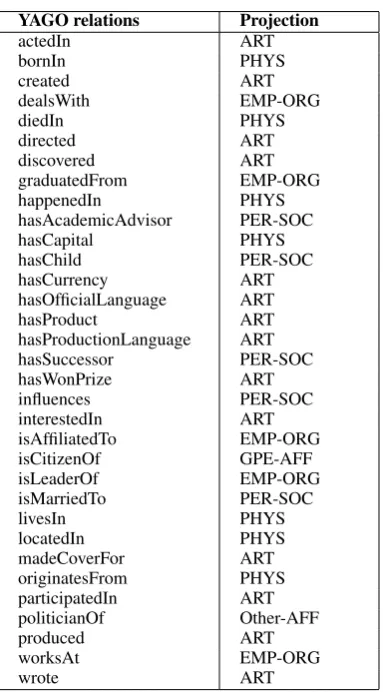
between 7 entity types. To further measure the impact of our Wikipedia dataset and the relations learnt, we mapped 33 relations of YAGO into those of ACE 2004. Surprisingly, we have found a fair correlation between the two different sources, which can help to validate our DS approach. The projection is shown in Table 3.
YAGO relations Projection
actedIn ART
bornIn PHYS
created ART
dealsWith EMP-ORG
diedIn PHYS
directed ART
discovered ART
graduatedFrom EMP-ORG
happenedIn PHYS
hasAcademicAdvisor PER-SOC
hasCapital PHYS
hasChild PER-SOC
hasCurrency ART
hasOfficialLanguage ART
hasProduct ART
hasProductionLanguage ART
hasSuccessor PER-SOC
hasWonPrize ART
influences PER-SOC
interestedIn ART
isAffiliatedTo EMP-ORG
isCitizenOf GPE-AFF
isLeaderOf EMP-ORG
isMarriedTo PER-SOC
livesIn PHYS
locatedIn PHYS
madeCoverFor ART
originatesFrom PHYS
participatedIn ART
politicianOf Other-AFF
produced ART
worksAt EMP-ORG
wrote ART
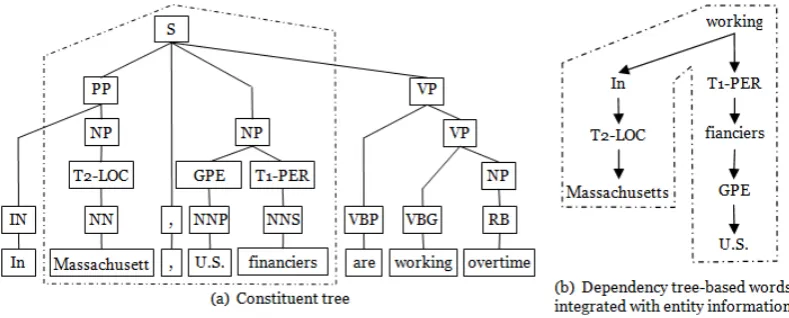
[image:4.595.78.284.589.643.2]Figure 1: The constituent and dependency parse trees integrated with entity information
4 Direct, distant and joint supervised learning
We model RE using state-of-the-art kernel meth-ods: syntactic structures are used to represent re-lation instances whereas kernel functions measure the similarity between pairs of them. Such func-tions correspond to scalar products between im-plicit feature vectors in the space of substructures. Additionally, we define a joint model between the RE classifier trained on ACE and trained on DS data such that we can merge together the informa-tion from the two datasets on similar relainforma-tion type.
4.1 RE based on Kernel Methods
State-of-the-art ACE RE, i.e. (Zhang et al., 2006; Nguyen et al., 2009), uses tree kernels applied to constituent and dependency syntactic structures, extracted from the sentences expressing the target relations. Given a parse tree, the path-enclosed tree (PET) is used as input of a tree kernel func-tion. PET is the smallest common subtree includ-ing the two entities of a relation. Figure 1.a shows the constituent tree and figure 1.b shows a frag-ment of the dependency tree of the sentence: In Massachussets, U.S. financiers are working over-time. The dashed frame in Figure 1.a surrounds PET associated with the two mentions,financiers
and Massachussets. Moreover, to improve the representation, two extra nodes T1-PER and T2-LOC, denoting the type PERSON and LOCA-TION, are added to the parse tree, above the two target NEs, respectively.
In our experiments, we use the model defined in (Zhang et al., 2006), which combines a syntactic tree kernel applied to constituent parse trees and a polynomial kernel over feature extracted from the
entities:
CK1=α·KP + (1−α)·T K, (1)
whereα is a coefficient to give more or less im-pact to the polynomial kernel,KP, andT Kis the syntactic tree kernel (Collins and Duffy, 2001) ap-plied to PET.
We also use the best model in (Nguyen et al., 2009), which combines the advantages of the two parsing paradigms by adding six sequence kernels. These are applied to paths derived from the depen-dency tree and enriched with node labels of the constituent tree as follows:
CSK=α·KP + (1−α)·(T K+
X
i=1,..,6
SKi),
(2) whereSKiare the sequence kernels applied to the structureidefined in (Nguyen et al., 2009).
In our application domain there are many differ-ent categories of name differ-entities, e.g. Editor, Pres-ident, Employer, and so on. Thus the typically available NE types, e.g. Person, Organization, Lo-cation, Time, Numbers, do not provide much se-lective information. For this purpose, we also pro-vide adapted kernels by simply removing the cat-egory label in the nodes of the trees and in the se-quences. This data transformation corresponds to define different kernel functions (Cristianini and Shawe-Taylor, 2000).
4.2 Joint Model for Distant and Direct Supervision
annotated dataset of ACE to accurately measure the impact of DS data. For this purpose, we de-fine a joint model as follows: first, we select the portion of hand-labeled ACE 2004 corpus contain-ing common relations (see the mappcontain-ing in Sec-tion 3.5).
Second, we create a huge labeled dataset under distant supervision assumption (described in Sec-tion 3.4) from Wikipedia news articles and YAGO knowledge base. Thanks to the projection from YAGO to ACE relations, we generate the two datasets under the same set of labels. This way, labeled data can be automatically acquired from a huge corpus and used to enrich ACE relation ex-tractors.
Third, we train (i) theMace RE model on ACE dataset and (ii) theMmixedmodel on ACE dataset mixed with the labeled data from Wikipedia (by using for exampleCSK).
Next, as standard SVM classifiers do not pro-vide calibrated posterior probabilities we apply Platt transformation (Platt, 2000) improved by (Lin et al., 2007) with an additional sigmoid func-tion. This allows us to map the SVM outputs of the two modelsMaceandMmixedinto probabilities.
Finally, we linearly combine the probability of the two classifiers as follows:
P(C|r) =α·P(C|r, C1) +β·P(C|r, C2), (3)
whereCi is the output of classifieri,αandβare the weights learned from a validation set to encode the importance of the classifier for detecting the relationr. This combination provides a more ro-bust model with respect to domain change.
5 Experiments
The aim of the experiments is to demonstrate that our DS produces reliable and practical us-able relation extractors. For this purpose, we test SLRE trained with DS and with the joint DS and ACE data. We also test end-to-end RE, which also requires the experimentation of our automatic Named Entity Recognizer.
5.1 Experimental setting
We used the English portion of the ACE 2004 corpus including 443 documents, annotated with seven entity types and seven relation types. We obtained 5,784 positive and 55,650 negative ex-amples when generating pairs of entity mentions
as candidate relations. We employed the Stan-ford Parser (Klein and Manning, 2003) to produce parse trees. The candidate relations are generated by iterating all pairs of entity mentions in the same sentence.
Regarding the DS data extraction (see Table 2), we used two PCs, one with Intel X5270 3.50GHz CPU, 32GB RAM, another with 3.40GHz CPU and 8GB RAM to run the Algorithm 3.1. We pro-cessed about 25,000 Wikipedia documents per day per machine. When we added the generation of structures and features, the whole procedure re-quired one day to process 5,000 Wikipedia doc-uments (per machine). Thus, it took about 10 days to create the dataset and the computational learn-ing files.
To train and test our binary relation classifier, we used SVMs, where relation detection is formu-lated as a multiclass classification problem. We employedone vs. rest, selecting the instance with largest margin as the final label. We used the Tree Kernel toolkit3(Moschitti, 2004; Moschitti, 2006;
Moschitti, 2008) as SVM platform to implement CK1 and CSK (see Section 4.1). The training
phase with convolution kernels on syntactic parse tree and diverse sequence kernels on the large DS data took 3 days.
For testing on ACE data, we applied 5-fold cross-validation and evaluated single classifiers with the average of Precision, Recall and F1 on the 5-folds. The overall accuracy is measured with the mean of the Micro-Average (All) over the 5-folds. For testing on Wikipedia, as DS data may be incorrect, we created a test set by sampling 200 articles from Freebase (these articles are not used for training). An expert annotator then examined one sentence at a time and took all possible pairs of entities, where the latter were already marked in the sentence. For each pair of entities, the con-sidered 52 relations from YAGO (and used in our RE system) are marked as positive or negative, re-spectively. The annotator obtained 2,601 relation instances used for evaluation.
Regarding NE recognition, we applied CRFs to Wikipedia data but we could not use the whole amount of data. Thus we sampled 18,198 Wikipedia articles, selecting 4/5 for training and the rest for testing. The training phase took 14 hours and 30 minutes, whereas the classification took less than 10 minutes.
Class PHYS EMP-ORG GPE-AFF All Precision 72.06 72.46 85.71 90.00 78.95 83.33 72.41 80.16
[image:7.595.144.458.61.106.2]Recall 67.12 68.49 80.00 81.82 75.00 75.00 75.54 72.66 F1 69.50 70.42 82.76 85.71 76.92 78.95 73.94 76.23
Table 4: RE from ACE 2004 of three relations between named entities: for each PHYS, EMP-ORG and GPE-AFF, the left and right columns report our best relation extractor only using ACE and ACE+Wikipedia data.
Class PHYS PER-SOC EMP-ORG ART Other-AFF GPE-AFF DISC All ACE data
Precision 56.28 88.12 80.82 80.68 62.73 76.55 80.15 74.47 Recall 44.51 59.80 76.73 39.20 17.11 32.32 59.85 57.26
F1 49.71 71.25 78.72 52.76 26.89 45.45 68.53 64.74
ACE + Wikipedia data
Precision 58.22 91.06 81.76 80.68 62.73 78.49 80.15 77.65 Recall 48.44 64.74 76.66 37.14 17.11 32.26 59.85 59.84
F1 52.88 75.68 79.13 50.86 26.89 45.73 68.53 67.59
Table 5: Results on ACE 2004 considering all the type of entities and all the 7 ACE relations.
5.2 Using Wikipedia Relational Extractors to improve on ACE
In the ACE program, relations are defined between pairs of entities. These not only refer to NEs but also to mentions, e.g. indicated by a com-mon noun or noun phrase, or represented by a pronoun. In contrast, Wikipedia instances mainly refer to NEs, e.g. Leonardo Da Vinci, Canada
or Titanic, and we do not use pronominal refer-ences for building RE instances. Thus, we car-ried out two kinds of experiments: using (i) RE task as defined in ACE with all kind of ties and (ii) only relations between named enti-ties. We have observed that the NE relations only exist for the classes: Physical (PHYS), Employ-ment/Membership/Subsidiary (EMP-ORG) and GPE Affiliation (GPE-AFF).
Table 5 presents the combination results. Over-all, using Wikipedia data improves the state-of-the-art of standard RE from 64.74% to 67.59%. Moreover, if we focus onproperNE relations, i.e. of the type indicated in point (ii), the relation ex-tractors improve from 73.94% to 76.23%. These results are interesting as show that (a) we can im-prove the best systems with DS and (b) relations learned from Wikipedia can be mapped into those defined by expert linguists on ACE. We also tested a model learned from only DS data. For space reason, we do not report the complete results: as expected, its overall F1 is lower than the model trained on only ACE (about 10 absolute percent points less).
5.3 End-to-end Relation Extraction
In this section, we describe the experiments us-ing automatic NEs. Previous work, e.g. (Zhang et al., 2006; Zhou et al., 2007; Nguyen et al., 2009) performed extraction using gold entity features such as entity types (Person,Location, Organiza-tion), entity subtypes (Nation, Population-Center
forGPE). For example, in the sentenceBush went to Washington, the type of the first named entity,
Bush, is PERSON and for the second named en-tity,Washington, is LOCATION. When accurate, such features improve performance. In case of fully automatic systems they introduce noise and in Wikipedia they are not available. Thus, we re-moved all gold entity features (entity type, entity subtype, mention type, and LDC mention type) from ACE annotations. We modeled tree and se-quence kernels based on constituent and depen-dency parse trees along with a few features that can be extracted automatically such as the string and the head word of the entity. Note that in (Nguyen et al., 2009; Zhou et al., 2007; Zhang et al., 2006), even for tree kernels, the tree structures were also integrated with entity types (see Figure 1 as an example). Therefore, in the parse trees in Figure 1, we replaced entity types PER, ORG, LOC with a generic type ETYPE.
5.3.1 Entity Extraction from ACE and Wikipedia
For entity extraction, we followed the design in (Nguyen et al., 2010) by applying CRF++4. We
[image:7.595.97.498.167.264.2]Corpus ACE Wikipedia Precision 77.84 68.84
Recall 70.26 64.56
[image:8.595.115.248.63.105.2]F1 73.85 66.63
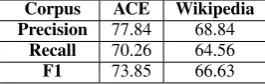
Table 6: Results of entity extraction from ACE and entity detection from Wikipedia.
performed automatic entity extraction from seven classes from ACE 2004 and entity detection from Wikipedia. While ACE documents have been annotated with seven classes Person, Organiza-tion, Facility, LocaOrganiza-tion, GPE, Vehicle, Weapon, for Wikipedia, we used Freebase as learning source, where entities have been annotated in each Wikipedia article. Note that for Wikipedia, the en-tity detection has been done for only entities, like
Person, Organization, Location. For dates and nu-merical attributes, we used the extraction patterns described in Section 3.4. The results reported in Table 6 are rather lower than in standard NE recog-nition. We should consider that our NER also tags mentions in ACE, which is a hard task whereas for Wikipedia, the entity instances from YAGO potentially belong to thousands of different cate-gories. Although we do not categorize entities, it makes the complexity of detecting of NE bound-aries higher.
5.3.2 RE from Automatic Entity Extraction
Web data entities are often not annotated and not available as in hand-labeled corpora like ACE or in Wikipedia pages. In this new experiment, we move to a novel task where entities are detected and classified automatically from a classifier. This way, we aim at designing an end-to-end RE sys-tem, where entities are not known beforehand. We also introduce a new task, that is the extraction of Wikipedia relations from any web text, i.e.
de-Setting Features/Gold Features/No gold Features/No gold Gold NEs Gold NEs Auto NEs Precision 76.60 74.47 70.27
Recall 67.00 57.26 47.52
[image:8.595.80.282.596.662.2]F1 71.50 64.74 56.70
Table 7: Results on end-to-end RE from ACE.
tection of Wikipedia instances from any web page and not only from Wikipedia articles (where links often exist for Wikipedia instances).
The results are shown in Table 7 and Table 8. We note that the gold entity features lead to very
Setting Gold NEs Automatic NEs Precision 91.42 82.16
Recall 62.57 56.57
F1 74.29 67.00
Table 8: Results on end-to-end RE from Wikipedia.
good F1. When we remove these, the F1 de-creases from 71.50% to 64.74%. Nevertheless, without gold entity features, RE from Wikipedia still achieves very good performance, i.e. an F1 of 74.29%.
6 Conclusion
In this paper, we proposed a study on novel train-ing methods ustrain-ing semi-structured resources such as Wikipedia. As the NLP field always requires new methods to leverage the ever-increasing amounts of user-generated data available on the web, ours is a particularly important achievement for RE. We presented adaptation and experimen-tation of state-of-the-art RE models also exploit-ing a mappexploit-ing between Wikipedia and ACE re-lations. We also extensively experimented with end-to-end systems applicable both to Wikipedia pages as well as to any natural language text. Our method is general and we suggest that it could be applicable to other external resources or other NLP tasks.
Acknowledgments
This research has been partly supported by the European Community Seventh Framework Pro-gramme (FP7/2007-2013) under the grant 247758: Trustworthy Eternal Systems via Evolving Soft-ware, Data and Knowledge (EternalS).
References
Eugene Agichtein and Luis Gravano. 2000. Snow-ball: Extracting relations from large plain-text col-lections. InProceedings of the Fifth ACM Interna-tional Conference on Digital Libraries.
Michele Banko, Michael J. Cafarella, Stephen Soder-land, Matt Broadhead, and Oren Etzioni. 2007. Open information extraction from the web. In Pro-ceedings of IJCAI, pages 2670–2676, San Francisco, CA, USA. Morgan Kaufmann Publishers Inc.
Razvan Bunescu and Raymond Mooney. 2005. A shortest path dependency kernel for relation extrac-tion. In Proceedings of HLT-EMNLP, pages 724– 731, Vancouver, British Columbia, Canada, October.
Razvan Bunescu and Raymond Mooney. 2007. Learn-ing to extract relations from the web usLearn-ing minimal supervision. In Proceedings of ACL, pages 576– 583, Prague, Czech Republic, June.
Michael Collins and Nigel Duffy. 2001. Convolu-tion kernels for natural language. In Proceedings of NIPS, pages 625–632.
Nello Cristianini and John Shawe-Taylor. 2000. An Introduction to Support Vector Machines and Other Kernel-based Learning Methods. Cambridge Uni-versity Press, Cambridge, United Kingdom.
Aron Culotta and Jeffrey Sorensen. 2004. Dependency tree kernels for relation extraction. InProceedings of ACL, pages 423–429, Barcelona, Spain, July.
George Doddington, Alexis Mitchell, Mark Przybocki, Lance Ramshaw, Stephanie Strassel, and Ralph Weischedel. 2004. The automatic content extrac-tion (ACE) programtasks, data, and evaluaextrac-tion. In
Proceedings of LREC, pages 837–840, Barcelona, Spain.
Takaaki Hasegawa, Satoshi Sekine, and Ralph Grish-man. 2004. Discovering relations among named en-tities from large corpora. In Proceedings of ACL, pages 415–422, Barcelona, Spain, July.
Raphael Hoffmann, Congle Zhang, and Daniel S. Weld. 2010. Learning 5000 relational extractors. In
Proceedings of ACL, pages 286–295, Uppsala, Swe-den, July.
Nanda Kambhatla. 2004. Combining lexical, syntac-tic, and semantic features with maximum entropy models for information extraction. InProceedings of ACL, pages 178–181, Barcelona, Spain.
Dan Klein and Christopher D. Manning. 2003. Accu-rate unlexicalized parsing. InProceedings of ACL, pages 423–430, Sapporo, Japan, July.
Hsuan-Tien Lin, Chih-Jen Lin, and Ruby C. Weng. 2007. A note on platts probabilistic outputs for support vector machines. Machine Learning, 68(3):267–276.
Mike Mintz, Steven Bills, Rion Snow, and Daniel Ju-rafsky. 2009. Distant supervision for relation ex-traction without labeled data. In Proceedings of ACL-AFNLP, pages 1003–1011, Suntec, Singapore, August.
Alessandro Moschitti. 2004. A study on convolution kernels for shallow statistic parsing. InProceedings of ACL, pages 335–342, Barcelona, Spain, July.
Alessandro Moschitti. 2006. Efficient convolution ker-nels for dependency and constituent syntactic trees. In Proceedings of ECML, pages 318–329, Berlin, Germany, September.
Alessandro Moschitti. 2008. Kernel methods, syntax and semantics for relational text categorization. In
Proceedings of CIKM, pages 253–262, New York, NY, USA. ACM.
Truc Vien T. Nguyen and Alessandro Moschitti. 2011. End-to-end relation extraction using distant super-vision from external semantic repositories. In Pro-ceedings of ACL-HLT, pages 277–282, Portland, Oregon, USA, June.
Truc-Vien T. Nguyen, Alessandro Moschitti, and Giuseppe Riccardi. 2009. Convolution kernels on constituent, dependency and sequential structures for relation extraction. InProceedings of EMNLP, pages 1378–1387, Singapore, August.
Truc-Vien T. Nguyen, Alessandro Moschitti, and Giuseppe Riccardi. 2010. Kernel-based rerank-ing for named-entity extraction. In Proceedings of COLING, pages 901–909, Beijing, China, August. John C. Platt. 2000. Probabilities for sv machines.
Advances in Large Margin Classifiers, pages 61–74. Sebastian Riedel, Limin Yao, and Andrew McCallum. 2010. Modeling relations and their mentions with-out labeled text. InProceedings of ECML-PKDD, pages 148–163.
Alexander Yates. 2009. Extracting world knowledge from the web.IEEE Computer, 42(6):94–97, June. Dmitry Zelenko, Chinatsu Aone, and Anthony
Richardella. 2002. Kernel methods for relation ex-traction. InProceedings of EMNLP, pages 71–78, July.
Min Zhang, Jian Su, Danmei Wang, Guodong Zhou, and Chew Lim Tan. 2005. Discovering relations be-tween named entities from a large raw corpus using tree similarity-based clustering. InProceedings of IJCNLP, pages 378–389.
Min Zhang, Jie Zhang, Jian Su, and GuoDong Zhou. 2006. A composite kernel to extract relations be-tween entities with both flat and structured features. In Proceedings of COLING-ACL, pages 825–832, Sydney, Australia, July.
GuoDong Zhou, Jian Su, Jie Zhang, and Min Zhang. 2005. Exploring various knowledge in relation ex-traction. In Proceedings of ACL, pages 427–434, Ann Arbor, USA, June.