itself. Please refer to the repository record for this item and our
policy information available from the repository home page for
further information.
To see the final version of this paper please visit the publisher’s website.
Access to the published version may require a subscription.
Author(s): Dan Anderberg and Carlo Perroni
Article Title: Time-Consistent Policy and Politics: Does Voting Matter
When Individuals Are Identical?
Year of publication: 2003
Link to published version:
Time-Consistent Policy and Politics: Does
Voting Matter When Individuals Are Identical?
Dan Anderberg
∗
Carlo Perroni
†
∗University of Stirling, [email protected] †University of Warwick , [email protected]
Abstract
We consider the implications of a lack of policy commitment when policies are chosen through a political process and individuals are ante identical. We show that politics, by allowing ex-post distributional tensions to shape policy, can make it possible to sustain non-trivial equilibria in which the commitment problem is alleviated or fully eliminated. How effective politics can be at countering collective commitment problems in homogeneous groups depends on the nature of the political process and on the extent to which private choices are public information.
1
Introduction
A vast literature, initiated by Kydland and Prescott (1977) and others, has doc-umented that equilibrium outcomes in dynamic environments can be extremely inefficient when policy makers cannot commit to policy. The literature has pointed out numerous potential credibility problems, with applications rang-ing from capital taxation and education policies to tax evasion and criminal sanctions.1
Much of this literature abstracts from political mechanisms of policy for-mation. Implicit in this omission is the idea that, if one can abstract from population heterogeneity, then how policy choices are made is largely immate-rial: any collective choice procedure that respects the Pareto criterion should produce the same outcome as that which obtains from a benevolent planner’s maximization of a representative agent’s welfare.
This paper shows this line of argument to be deceptive; the reason is that, even in the absence of population heterogeneity, if ex-ante identical individuals engage in different actions, the resulting ex-post heterogeneity can give rise to redistribution through the political process. Then, if sufficiently powerful policy instruments are available, it can become rational for an individual to conform with the choices of others, so as to be in the group that benefits from redistribution at the ex-post stage.
It is thus important to recognize that ex-ante homogenous individuals do not necessarily remain homogeneous, even along an equilibrium path; as a re-sult non-trivial equilibria can, through political incentives, obtain, in which credibility problems are alleviated or even fully eliminated. The implication of this result is then that, when characterizing time-consistent policies in large economies, even if one elects to abstract from population heterogeneity, one cannot abstract from politics; doing so can significantly bias conclusions.
The idea that individuals do not have to be different in order for politics to shape time-consistent policies has been overlooked in the literature. There is a literature on the implications of politics for policy credibility,2 but, in all
1One of the earliest contributions to the literature on time-consistent capital taxation is Fischer (1980), who analyzed a general two-period version of the capital-levy problem where policy is chosen by a benevolent planner. The literature on time-consistent education policies is more recent, and includes, e.g., Boadway, Marceau, and Marchand (1996a), and Konrad (2001). Boadway, Marceau, and Marchand (1996b), and Boadway and Keen (1998) look at policy credibility problems in the context of criminal sanctions and tax enforcement respectively.
ex-of those contributions, politics matter only insex-ofar as individuals are different ex ante. In the mechanism we describe, politics do not affect equilibrium pol-icy outcomes because of the way ex-ante differences are reconciled by a certain political process; rather, it is the very presence of a political process of policy formation that generates heterogeneity, making possible an equilibrium combi-nation of policies and private choices that would not otherwise be sustainable.3
Wefirst briefly illustrate this argument by applying it to a familiar capital-levy problem (Section 2), in a model where distortionary labour and capital taxes are selected by majority voting and investment choices are fully observable. We demonstrate that “reasonably good” subgame-perfect equilibria may exist in this case, where capital income is not fully taxed and a majority of individuals select a high level of investment.
The capital-levy problem, while useful for illustrating our general point, is not ideal for exploring the above mechanism more fully. The reason is that the problem exists in this case only because of an exogenous constraint on the struc-ture of that instruments that can be used for ex-post redistribution. It could be argued, however, that a majority has broader discretion in designing policy instruments; the only relevant constraints should be those that stem directly from an inability to observe private choices (and thus to condition policies on them). Allowing for such endogeneity in the choice of policy instruments, in dependence of the amount of information that is publicly available, allows us to illustrates our second main point: that public information about private choices generally has a positive value in the sense that it can help support more efficient equilibria.
To this end, we present, in Section 3, a second application. We consider a social insurance problem where risk-averse individuals face idiosyncratic earn-ings risk; the probability of favourable earnearn-ings outcomes can be increased by means of private costly investments in education. After education choices have been completed, a social insurance scheme (a redistributive tax scheme) must be agreed upon before earnings uncertainty is resolved. In this model, the pro-vision of social insurance runs against a moral-hazard problem, which gives rise to a policy credibility problem: from an ex ante point of view, in order to generate incentives to invest in education, less than full insurance should be provided. However, this would imply ex-post inefficient risk-sharing. In contrast to the capital-levy problem, in this application the set of available policies is constrained only by information. Moreover, the mapping from private choices to earnings outcomes is stochastic, generating a standard inference problem.
We show that the more public information is available about private choices, the more private effort can, in general, be supported. As a consequence, the
indi-policy choice stage, efficiency can be enhanced by stipulating that tax changes must garner the support by a super-majority. Gradstein (1999a) considers the value of public education when there is ex-post voting over taxes.
viduals have a common incentive to invest in a public information infrastructure prior to making the private decisions. This result on the value of information is in stark contrast with the conclusion we would reach if, absent heterogeneity, we assumed politics away: then, we would conclude that more information might very well lead to more inefficient outcomes.
Proofs of results (unless outlined in the text) are provided in an appendix.
2
Time-Consistent Capital Taxation under
Ma-jority Voting
Consider an economy with a continuum of ex-ante identical individuals living for two periods. All individuals have an endowment of one unit of consumption in thefirst period and one unit of time in the second period. Each agent chooses savings,k, in thefirst period, and labour supply, l, in the second period. We shall assume that there are only two feasible levels fork: an agent can either “spend” or “invest”,k∈{0,1}. For simplicity, we assume separable and quasi-linear preferences over first- and second-period consumption, c1 and c2, and
second-period leisure,z2:
(1) u(c1, c2, z2)≡c1+
1
(1 +β)(c2+f(z2)),
where f is increasing and concave, and where β ≥ 0 represents the rate of time preference. Denote the net return to investment byr > 0 and the wage rate by w. In the second period the government must collect a revenue G per capita through a proportional tax on interest income, τK ∈ [0,1], and a proportional tax on labour income, τL ∈ [0,1]. Then c1 = 1−k, c2 =
k[1 + (1−τK)r] + (1−τL)wl, andz2= 1−l.
Given the above preferences, whether an agent invests (k= 1) or does not (k= 0) only depends the net-of-tax return to investment. Let eτK ≡1−β/r; an individual will strictly prefer to “invest” (alt. “spend”) if τK < eτK (alt.
τK >eτK), and will be indifferent between the two actions when equality holds. We shall assumer > β; hence saving is the efficient action andeτK>0.
Similarly, labour supply depends only on the net-of-tax wage. A worker chooseslso as to maximize the net income from labour income, less the disutility of labour; thus define
(2) v(τL)≡max
l ((1−τL)wl+f(1−l))
as the net indirect utility from labour. The associated first-order condition,
(1−τL)w = f0(1−l), implicitly defines labour supply as a function of the
tax on labour income, l(τL). We shall assume that the elasticity of labour supply with respect to the labour income tax, εlτL ≡l0(τL)τL/l(τL) ≤ 0is monotonically decreasing inτL.
Labour taxation is also distortionary in this model; in this case, however, the as-sociated deadweight loss is increasing inτL. We shall assume thateτKr < G < r; the second inequality implies that a one-hundred percent tax on interest income would be enough to meet the revenue requirement if all individuals save; how-ever, the first inequality implies that the required tax would exceed eτK. This means that, since capital tax revenues are zero for anyτK >eτK, a distortionary labour tax must also be used alongside a nondistortionary capital tax. If policy commitment were possible, the optimal tax structure would then have a very simple structure: the capital tax would be set at the highest non-distortionary level, i.e. eτK, and labour taxes would be used residually to meet the revenue requirement.
Suppose now that policy commitment is not feasible. Specifically, consider a sequential game where, first, agents make investment decisions; then, a tax policy is determined by majority voting; finally, agents make labour supply decisions. The game trivially has a pure-strategy subgame-perfect equilibrium in which no agent invests.4 On the other hand, no pure-strategy equilibrium
in which all agents invest can be sustained: if all agents invested, then, at the ex-post stage, capital income would befixed, and all agents would unanimously agree to fund G first by capital taxes; hence the capital tax would be τK =
G/r >eτK, which contradicts that agents would rationally invest.
This still leaves open the possibility of asymmetric equilibria where a fraction
θ∈(0,1) of the population choose to invest — or, equivalently, mixed-strategy equilibria where each agent chooses to invest with probabilityθ.5 Such an
equi-librium requires that agents be indifferent between spending and investing, i.e. it must involveτk =eτK. This cannot occur if the interim majority consists of “spenders” (θ <1/2). Since spenders have no capital income, their continuation utility is simplyv(τL). Therefore, their ideal policy would involve taxing capital incomefirst, implyingτK = min{1, G/(rθ)}; labour income taxes would, if nec-essary, be residually determined. Hence, ifθ <1/2, the political process would select a capital tax τ >eτK. Hence we can rule out mixed-strategy equilibria withθ∈(0,1/2).
This leaves one possible scenario: the “investors” may be in majority in the interim (θ >1/2). At the ex-post stage, investors face a trade-offbetween efficiency and redistribution: since the capital tax base isfixed ex post, capital income taxation generates no deadweight loss whereas labour taxation does; however, taxing capital has an adverse redistributive effect on the investors themselves. Their ideal policy is that which maximizes their continuation utility
1 + (1−τK)r+v(τL), subject to the revenue requirementτLwl(τL) +θτKr≥
G. This yields the necessary condition 1 +εlτL = θ, which implicitly defines
4If all agents spend in the first period, there is no capital to tax in the second period. Hence anyτKis optimal; anyτK>eτKsupports an equilibrium. Perfecting the equilibrium (see Section 3 below) givesτK= 1. Alternatively, one could augment the model by assuming that there is some exogenous capital income in the second period in addition to that generated by endogenous investment; then, a choiceτK= 1would be an actual equilibrium strategy.
a monotonically decreasing relationship, τL(θ), between the investors’ ideal labour tax andθ. τL(θ)>0for allθ <1but approaches zero asθapproaches unity. The investors’ ideal capital tax is determined residually as
(3) τK(θ)≡ G−τL(θ)θrwl(τL(θ)).
Note thatτK(θ)approachesG/r asθ approaches unity.
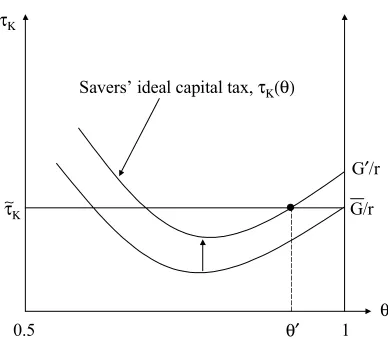
Consider then how τK(θ) changes as we lower θ from unity. On the one hand, labour taxation rises from zero, reducing the residual revenue to be raised through capital taxes; on the other hand, there is less capital income to tax. Provided thatεlτL does not respond too sharply with the introduction of labour taxation, thefirst effect dominates, andτK(θ)will be less thanG/r(and keep decreasing over some interval asθis further decreased towardsθ= 1/2). Then, if there is a θ0 > 1/2 such that τK¡θ0¢ = eτK, a mixed-strategy equilibrium where a majority of agents invest can be supported.
Figure 1 shows what happens as G is increased from the critical revenue requirement G ≡ eτKr = r−β (the largest revenue that can be raised by nondistortionary capital income taxes alone). AsGis increased toG0 > G, it is
no longer possible to sustain an equilibrium withθ= 1. However, a new mixed-strategy equilibrium withθ=θ0, close to unity, appears. If everyone saves with probabilityθ0, then, ex post, investors are in majority, and will optimally vote for the capital taxτK¡θ0¢=eτK, which, when rationally expected, makes everyone indifferent between investing and spending, and hence willing to randomize.
Such a mixed-strategy equilibrium is not fully efficient, but it dominates the pure-strategy equilibrium with θ = 0, as it features a lower labour tax rate — hence a lower deadweight loss from labour taxation — and higher investment — hence a lower deadweight loss from capital taxation. Thus, a “nearly effi -cient” outcome can still be supported if tax policies are selected by majority voting, although very inefficient outcomes, where capital income would face a one-hundred percent tax, are still possible. Yet, if we abstracted from voting on the grounds that agents are ex-ante identical, we would reach the conclusion that the full taxation of capital is theonly time-consistent equilibrium policy.
dis-τΚ
θ
0.5 1
G′/r
θ′ τΚ
∼
Savers’ ideal capital tax, τΚ(θ)
[image:9.595.200.394.138.312.2]G/r
Figure 1: Mixed-strategy equilibrium in the capital-levy problem.
tributed and are revealed to agents after investment choices have been made and policy platforms have been chosen. Then, whether an agent votes for candidate
Aor candidateBwill depend on each candidate’s announced policy as well as on the taste shocks: an agentiwho has not invested in thefirst period will vote forA if and only if v(τAL)> v(τBL) +σi+δ; and an agenti who has invested will vote forAif and only if (1−τAK)r+v(τAL)>(1−τBK)r+v(τBL) +σi+δ.
In this scenario, each candidate will choose the tax policy platform that max-imizes the probability of electoral success, given the policy announced by the other candidate, and givenθ. It can be shown that, when theσis are identically distributed, in a symmetric equilibrium, each candidate chooses the platform that maximizes the sum of the continuation utilities of all the agents in the economy; in other words, this political process implies that the interim utilitar-ian optimum will be implemented. This leads to capital being taxedfirst, i.e.
τK = min{1, G/(θr)}> eτK. But this removes investment incentives: in the unique equilibrium no one invests. The problem here is that the electoral un-certainty moderates the policy: the political process does not strongly privilege the majority, and hence weakens the tendency to conformity.
How effective politics can be at sustaining non-trivial policy equilibria in homogeneous groups also depends on the extent to which policies can favour the majority at the expense of the minority. This, in turn, depends on which policy tools are available. In the capital-levy example, the limited set of tax instruments at the majority’s disposal limits their ability to redistribute, and therefore reduces the pressure toward conformity which makes high-investment outcomes possible.6 However, more generally, the set of available policy tools
should depend on what information is available about private choices. This raises the question if more information is generally a good thing. In order to consider this we turn to a second application.
3
Education, Social Insurance, and Information
Our second application which is chosen to highlight the positive role played by information involves a moral-hazard problem stemming from redistributive taxation. We shall describe a model where individuals face idiosyncratic earn-ings risk, and where the probability of unfavourable earnearn-ings outcomes can be reduced by costly private investment in education (the ex-ante stage). After private education choices have been made, there is still scope for social risk pooling, which can be realized through a system of redistributive taxes (social insurance, chosen at the ex-post stage). In this scenario, unless a system of redistributive taxes can be committed to at the ex-ante stage, incentives on education choices will be disregarded by ex-post risk sharing decisions.
3.1
Education and Earnings Insurance
In the first period each agent chooses an education level or “effort” level h∈
{h1, h2}, where h2 > h1. In the second period the agents work, inelastically
supplying one unit of labour. Earnings in the second period are a random vari-ablew∈{w1, w2}, withw2> w1, whose probability distribution is independent
across consumers but is conditional onfirst-period effort. Specifically, denoting the probability ofwi given efforthk byπik ∈(0,1), i, k= 1,2, we shall assume that π2
2 > π12, i.e. a higher level of first-period effort raises the probability of
experiencing earnings w2. Agents derive utility from consumption and
disu-tility from effort: given consumption c and effort hk, an agent obtains utility
u(c)−gk, whereuis increasing and concave, and where gk denotes the utility cost of efforthk. We shall assume that the high effort is more costly —g2> g1— but efficient under perfect risk-sharing —Pi(π2i −π1i)wi> g2−g1. Henceforth, an agent’s “type” in the second period will refer to herfirst-period effort choice, i.e. a type-kagent is an agent who has exerted efforthk, k= 1,2.
Social pooling of income risk is realized in practice through redistributive taxes and transfers; for the purpose of our analysis, however, it is convenient to model social insurance directly in terms of state-contingent consumption levels. Under such a scheme, consumption can be conditioned on earnings, which are assumed to be fully observable, as well as on any other observable signals that are received ex post along with earnings realizations, and which may be correlated with effort.
Such auxiliary information will be modelled as generally as possible, relying
on the notion of signal structure, which associates a probability to a certain signal being sent by an agent of a certain type. A signal structureσthus consists of a combination of a finite signal space, S, and a probability distribution, f, over signals, wherefjk represents the probability that a type-kagent sends the signal sj ∈ S. We shall also use the notation Sk to denote the support of the signal distribution given effort hk — i.e. the smallest subset of S that has probability one given efforthk. The signal structureσ≡(S, f)can be thought of as being exogenous, or, alternatively, as being the result of a costly investment in collective infrastructure (see below).
Given the above definitions, aninsurance contract,C, can then be described as a mapping assigning a consumption levelcij to each possible earnings/signal combination(wi, sj). In principle, more than one contract may be offered as part of a social insurance scheme, with each agent having a choice amongst contracts; asocial insurance systemcan thus generally be described as a menu of contracts. Since the social insurance system is put in place before any signals or earnings outcomes are realized — when agents are indistinguishable from each other — we shall impose a basic anonymity requirement: all agents must be offered the same menu of contracts. Also, in order to be feasible, a social insurance system must satisfy an aggregate resource constraint. Since the economy is large and all risk is idiosyncratic, there is no aggregate uncertainty; therefore, we can simply require that the economy’s resource constraint must hold in expectations. Using
¯
wk ≡P
iπkiwi to denote the expected income for a type-k agent, θk to denote
the probability that an agent chooses effort hk in a symmetric outcome, and
Ck to denote the contract chosen by type-kagents (from the available menu of
contracts), the resource constraint can be expressed as
(4) X
k
θk¡w¯k−X j
X
i fk
jπkickij¢≥0.
3.2
Policy Preferences and Voting
We restrict our attention to a scenario where decisions on social insurance at the ex-post stage — i.e. after education choices — are taken by majority voting. At that stage, there can only be two voter types, low-effort individuals and high-effort individuals. Then, each agent can do no better than to vote for the menu of insurance contracts that maximizes her type’s continuation utility, given the distribution of types in the economy; consequently no menu of contracts can defeat the menu that is optimal from the point of view of the interim majority type.7
Given that there are at most two ex-post types, we can, without loss of generality, restrict the number of contracts in a menu to two. Hence, assume that each agent votes for a menu consisting of one contract, Ckk, intended for
her own type, and one,Ckk0, intended for the other type. Let the menu favoured by type-kagents be denoted byCk ≡(Ckk, Ckk0). Effort is private information at the voting stage — no signals have yet been observed — and so the menuCk must induce typek0 to self-select.8,9
Let
(5) vk(C)≡X j
X
i fk
jπkiu(cij)
denote the expected utility of consumption for a type-k agent in a contractC. Given beliefs θ = (θ1, θ2) concerning the composition of the population, the optimal menu from the point of view of a type-k agent is then a solution to
(6) max Ck
vk¡Ckk¢ s.t. (4) and vk0¡
Ckk0¢
−vk0¡Ckk¢≥0.10
Denote the solution by Ck(θ) = ³Ckk(θ), Ckk0(θ)´. Two observations can
immediately be made aboutCk(θ). First, pooling is not optimal; this follows immediately from the fact that the two types have different probability distrib-utions over earnings/signal combinations. Second, the self-selection constraint is binding at the optimum: if it were not, then typek0 would be offered zero
consumption. Moreover, type k0 is always offered full insurance. The menu
Ck(θ)then induces expected consumption utilities vkk(θ)≡ vk¡Ckk(θ)¢ and
vkk0
(θ)≡vk0³Ckk0(θ)´(thefirst superscript refers to the type casting the vote and the second superscript to the type affected).
Any type’s ideal menu always provide her type with a higher continuation utility than that provided to the other type. The proof is omitted.11
Lemma 1 vkk(θ)> vkk0(θ)for any distribution of types θ andk= 1,2.
In general, voters will trade offconsumption risk for higher expected con-sumption, but as the fraction of any type approaches unity, the contract that agents of a certain type would choose for themselves approaches full insurance: the only reason why type-kagents would choose, for themselves, a contract with
8The own self-selection constraint can easily be shown never to bind.
9We abstract from interim participation constraints, i.e. from the possibility that agents may opt out of the social insurance scheme if it leaves them with a lower expected consumption utility than if they remain fully uninsured. The presence of an interim participation constraint, if anything, weakens the redistributive power of social insurance, and hence the pressure toward conformity that majority voting can exercise on the minority. Nevertheless, it can be shown that results analogous to those we obtain for the no opt-out case (Propositions 1-3 below) apply to a scenario where individuals can opt out.
1 0The problem is one of provision of insurance under adverse selection with two risk groups. Indeed, Problem (6) can be viewed as characterizing a particular constrained Pareto-efficient allocation: the allocation that maximizes the utility for typek.
consumption risk is that doing so may relax the self-selection constraint for the other type and thus allow them to obtain a higher expected level of consump-tion; but, asθk approaches unity, the gain to doing so vanishes. The contract
Ckk therefore converges to a constant consumption level, which, by the budget
constraint, must equalw¯k. Note, however, that a positive level of consumption need only be offered to agents who send type-k compatible signals, i.e. signals in the setSk. For any other signal it is optimal fork-type agents to assign zero consumption.
3.3
Comparing Signal Structures
The redistributive power of a social insurance system — and hence the pressure toward conformity that majority voting can generate — hinges on what infor-mation is available about private choices. To study the role of inforinfor-mation, we need a way of characterizing the informativeness of a certain signal structure. Two such measures are relevant for our purposes: one measures how often an agent’s action is completely revealed; the second is a more general measure of informativeness.
Letkk0(σ)≡
P
sj∈Skfk
0
j , fork06=k. In words,kk0(σ)is the probability that
a type-k0 agent sends a signal that is also sent with positive probability by a type-kagent. Since an agent is revealed as being of typek0 if she sends a signal that is never sent by a type-k agent, we say that the signal structure σ is at least as revealing as σˆfor type k0 ifk
k0(σ)≤kk0(ˆσ).
To see the relevance of this definition for our analysis, consider the contract that typekagents prefer for themselves, Ckk(θ). As noted earlier, this always optimally involves zero consumption on all signals not compatible with effort
hk. It then also follows (from the binding self-selection constraint) that the
expected consumption utility of the other type will depend on how revealingσ is; specifically,vkk0(θ)approaches
(7) ¯vkk0(σ)≡kk0(σ)u
¡ ¯
wk¢+³1−k k0(σ)
´
u(0)
asθk approaches unity. Moreover, since typek0is always offered full insurance, the utility levelv¯kk0(σ) also pins down a limiting constant consumption level for type k0, which depends inversely on how often k0 is revealed, i.e. on the
probability 1−kk0(σ). When θk is exactly unity, the own contract Ckk is
undefined for signals not compatible with efforthk; neither is the contractCkk0 defined. It is still, however, useful to assume that the agents vote for a social insurance system that is the limit ofCkk(θ)asθk approaches unity.
The “at least as revealing as” criterion fails to rank signal structures that never unambiguously reveal actions. A more general (and well-known) measure of informativeness is the Blackwell criterion:
Definition 1 The signal structureσ={S, f}is(Blackwell) more informative thanσˆ={S,ˆ fˆ}if there exists a Markov matrix[βˆj]such that, for eachsˆ∈Sˆ,
we havefˆˆk =Ps
If σ is more informative than ˆσ, it is also at least as revealing as σˆ for both types, although the converse is not necessarily the case. As a standard result it can then be shown that the more (Blackwell) informative is the signal structure, the higher is the expected consumption utility that the type selecting the menu can secure for themselves. Formally including the signal structure as an argument in the indirect utility, we have
Lemma 2 If σis more informative thanσˆ, thenvkk(θ;σ)≥vkk(θ; ˆσ)for any distribution of typesθ andk= 1,2.
3.4
Equilibria and Information
We next characterize the set of equilibria of the game, conditional on a sig-nal structure,σ. The main results can be summarized as follows. If σreveals a low-effort agent with sufficient accuracy, then there exists a pure-strategy high-effort equilibrium with full insurance (corresponding to the fully efficient outcome). Furthermore, there may exist, conditional on any signal structure, mixed-strategy equilibria in which a majority of agents choose high effort, al-though there will also always exist a pure-strategy low-effort equilibrium. In general, the more informative isσ, the more effort can, in general, be supported. Recall the timing of choices: agents first choose education efforts, possibly by randomizing; they then vote over social insurance schemes;finally, earnings and signals are realized and taxes and transfers are carried out. A behavioural strategy for an agent thus consists of a probability distributionθ=¡θ1, θ2¢over low and high effort, together with a rule describing how to vote depending on her effort choice (and beliefs). The relevant equilibrium concept is Nash equilibrium (since there are no proper subgames): in equilibrium each agent holds correct beliefs about the actions of the other agents and chooses a behavioural strategy that is a best response to the other agents’ behavioural strategies. To refine the equilibrium set, ruling out potentially “unreasonable” limiting equilibria, we shall also apply a simple perfection argument: each agent is required to choose each effort level with at least probabilityε; we then letεapproach zero.12 We
can start by noting the following:
Proposition 1 Conditional on any signal structureσ:
1. There exists a perfect pure-strategy Nash equilibrium where all agents choose low effort,θ1= 1.
2. There does not exist any mixed-strategy Nash equilibrium withθ2∈(0,1/2).
Part 1 says that a pure-strategy low-effort equilibrium always exists; hence if any effort is to obtain in equilibrium, there have to be multiple equilibria. Part
2 rules out equilibria where a strict minority choose high effort. The reason is simple: if the low-effort agents are in majority, the resulting social insurance system will provide a higher expected consumption utility to low-effort agents than to high-effort agents. Anticipating this, no one would rationally choose the more costly high effort at the ex-ante stage.
We are left with the possibility of either a mixed-strategy equilibrium or a pure-strategy high-effort equilibrium. For the agents to randomize over effort levels, they must be indifferent between h1 and h2. This is compatible with
θ2>
1/2, since the social insurance system selected by the high-effort majority then gives a larger expected consumption utility to high-effort agents than to low-effort agents: v22(θ)> v21(θ)(see Lemma 1). The following result is then
immediate:
Proposition 2 If, for some θ2 ∈ (1/2,1), v22(θ)−v21(θ) = g2−g1, then there exists a perfect symmetric mixed-strategy Nash equilibrium, where each agent chooses high effort with probability θ2.
To understand this result, note that if all agents choose high effort with probabilityθ2, then, ex post, the social insurance systemC2(θ)is implemented
through the political process. Rationally anticipating this, each agent is indif-ferent between high and low effort at the ex-ante stage, and hence optimally randomizes. Finally, since the agents are randomizing over efforts, the equilib-rium is also perfect.
It may also be possible to support pure-strategy high-effort equilibria — the fully efficient outcome; however, this requires that a low-effort agent be revealed sufficiently often. Note the intuition behind this result: if all agents choose the high effort, they will vote, at the ex-post stage, for full insurance over all signals that are compatible with high effort. However, they can credibly vote for a very low consumption level over all signals that arenot compatible with high effort. This discourages an agent from choosing low effort if the probability of sending such signals is sufficiently high. Also note that, if such an equilibrium exists, it is also perfect.
Proposition 3 There exists, conditional on σ, a pure-strategy Nash equilib-rium in which all agents choose high effort with probability one if and only if
(8) (u( ¯w2)−u(0))(1−21(σ))≥g2−g1.
If the above inequality is strict, the equilibrium is also perfect.
Thus, given a generic signal structureσ, three types of symmetric equilib-ria may obtain: a low-effort equilibrium, a mixed-strategy equilibrium where individuals choose high effort with a probability greater than 1/2, and a high-effort equilibrium. The symmetric high-effort equilibrium requires that low-effort agents be sometimes fully revealed.
σ ∆v2(θ;σ)
θ ∆g
0.5 1
[image:16.595.183.428.143.305.2]σ
Figure 2: How more information can affect equilibrium effort.
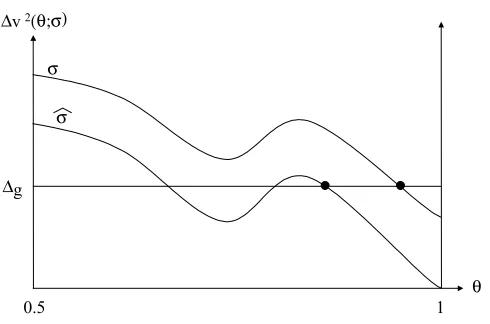
larger is the difference in the consumption utilities of the type choosing the menu and of the other type, i.e. suppose that vkk(θ)−vkk0(θ) is larger (for eachkandθ) the more informative isσ.13 In that case, we can show that the intuition is correct. To see this, consider two signal structures,σ andˆσ, where
σ is more informative than σˆ. Recall that σ is then also at least as reveal-ing (for each type) asσˆ. It then immediately follows from Proposition 3 that, if σˆ supports a pure-strategy high-effort equilibrium, σ does so too. On the other hand, ifσˆdoes not support any high effort at all, thenσcannot support less effort. Finally, suppose thatσˆsupports a mixed-strategy equilibrium with
θ2>1/2. Then, as shown in Figure 2 (where ∆v2(θ;σ)≡v22(θ;σ)−v21(θ;σ),
and∆g ≡g2−g1), σ will either support a mixed-strategy equilibrium with a
larger fraction of high-effort agents or a pure-strategy high-effort equilibrium. The above results point to a second key point: just like public information is valuable when commitment to policy is feasible, public information is valuable when policy is selected through a political process after private actions have been carried out. The reason is, however, quite different: information has a positive value because it enables the majority to divert more resources in its own direction; this generates a tendency to conformity with the result that agents may be able to coordinate on a reasonably good outcome, despite the lack of policy commitment. This, e.g., reverses a result described by Konrad (2001) for a scenario very similar to our second application, where redistributive taxes are chosen by a utilitarian social planner after the individuals invest in human capital. His analysis shows that some incentives for investment can be preserved if the returns from the human capital investment arenot fully observed by the planner.
4
Discussion
The preceding analysis has shown that renegotiation of policy through a po-litical process can help overcome the problems that arise from a lack of policy commitment, even in economies with ex-ante identical agents. This is because, when there is interim heterogeneity, the political process may allow a majority to divert resources in their direction. This makes it attractive to belong to the interim majority, or, stated differently, it generates a tendency to conformity.
The mechanism we have characterized relies centrally on the quasi-dictatorial nature of majority voting, whereby the minority’s preferences are given no weight in collective choices. This is the very feature that makes majority voting a potentially inefficient procedure in a static context; in the scenario we have described, thisflaw becomes a virtue. The enforcement role played by majority rule in the presence of policy-renegotiation bears some conceptual similarity to the idea of social norms promoting conformism (Akerlof, 1980); what makes it distinct is that with voting-based renegotiation the pressure to conform to the choices of others does not come from an exogenous norm, but is channelled through the collective social contract.
Throughout our discussion we have stressed the idea that politics can matter in dynamic environments even in the absence of population heterogeneity. This does not mean that ourfindings are only relevant in situations where individuals are identical in all respects. In practice, individuals are different and have dif-ferent policy preferences; yet, if individuals have reasonably similar preferences along a certain policy dimension, it may well be legitimate to examine policy choices in that dimension while abstracting from heterogeneity along other di-mensions. What our analysis has shown is that politics remain relevant even in such cases.
The argument has been formalized by focusing on binaryfirst-period choices; this modelling strategy makes majority voting robust and consistent with a broad class of political processes. With more than two possible voter types, ex-istence of a voting equilibrium under direct democracy may be a problem; how-ever, many other models of political competition, such as, e.g., citizen-candidate models, have better equilibrium existence properties and could be used in these cases. Even with more than two available choices, however, a political process will generate an incentive towards conformity whenever the political power of a relatively large group exceeds its relative size.14 This is indeed a feature of most
models of political choice mechanism, with majority voting of course being the extreme example.15
Our second application has also highlighted the key supporting role of infor-mation: the more observable private choices are, the easier it is for the majority to extract surplus from the minority by conditioning taxes and transfers on any observable characteristics that are correlated with private actions. This has two implications. First, if individuals can costlessly choose amongst a set of feasible information structures at the ex-ante stage, they will have a strategic incentive to select one that is revealing as discussed.16 Second, at the ex-ante stage,
indi-viduals may unanimously choose to adopt an informative signal structure even if it is not revealing and even if it is costly. More generally, an improvement in the economy’s information technology, in the sense of an expansion of the set of available signal structures, will if anything enhance welfare (measured as the common ex-ante level of expected utility).17
Colophon
Thefirst draft of this paper was prepared in May of 2000.
We are grateful to seminar participants at Warwick University and at the University of St. Andrews for comments and suggestions. Two anonymous referees also provided helpful comments.
Correspondence should be addressed to Carlo Perroni, Department of Eco-nomics, Warwick University, Coventry, CV4 7AL, UK, [email protected]
Appendix
Proof of Lemma 2. The argument follows Grossman and Hart (1983). The solution to problem (6) givenσˆinvolves one contract,Cˆkk, which provides con-sumption ˆckkiˆ on (wi, sˆ), and a second contract, Cˆkk
0
, which offers constant consumption, ¯c. Suppose then that, when σ is available, type k votes for a menu ³Ckk, Ckk0´, where, conditional on(wi, sj), Ckk offers consumption ˆckkiˆ
with probabilityβjˆ, andCkk0 offers a constant consumption ¯c on all earnings
thefirst period — and in the absence of interim participation constraints — for any possible investment or effort choice there exists a signal structure such that that particular choice can be supported as an equilibrium pure strategy.
1 5Note that the probabilistic voting political model described at the end of Section 2 is the other extreme example where the property fails to hold: in that case the equilibrium policy maximized the sum of utilities, thus implicitly giving equal weight to all agents.
1 6In the context of education choices, a revealing information structure could consist of a system of public examinations of academic attainment.
and signals. If a type-lagent, l= 1,2, picks Ckk, she obtainsˆckkiˆ with proba-bility πliPsj∈Sβˆjfjl =πlifˆˆl, while if she picksCkk
0
she receives the constant consumption ¯c. Thus, by using a stochastic contract, the allocation chosen by type k given σˆ can be perfectly replicated when the more informative sig-nals structure σ is in place. Consequently, vk(θ;σ) ≥vk(θ; ˆσ). The outcome can, however, be further improved. Ckk maps each realization (wi, sj)into a lottery with expected utility Ps
ˆ
∈Sˆβjˆu(ˆckkiˆ); then, if Ckk is replaced with a
non-stochastic contractCekkthat offers the same utility on each realization, i.e.
u(˜ckkij ) =Ps ˆ
∈Sˆβˆju(ˆckkiˆ)for alli, j, typek’s utility is unchanged (while
keep-ing the self-selection constraint satisfied), but the expected consumption is less; this relaxes the budget constraint, thus allowing further improvement. From this, we can also conclude that stochastic contracts are never optimal. ¤
Proof of Proposition 1. Part (1). Suppose all agents choose h1. Holding
correct beliefs, each agent then optimally votes for the menuC1(1,0)and obtains
the expected payoffu¡w¯1¢−g1. An agent who deviates and choosesh2obtains
a constant consumptionc¯12≤w¯1 (see the discussion in Section 3.3); moreover
g2 > g1; hence the agent is better off not deviating. Thus there is a Nash
equilibrium where all agents chooseh1with probability one and vote forC1(1,0).
This equilibrium is also perfect. Suppose that each agent choosesh1 with the
largest possible probability,θ1= 1−ε. A type-kagent then optimally votes for
Ck(1−ε, ε). Sinceεis small, low-effort agents are in majority; by Lemma 1 they vote for a social insurance system such thatv11(θ)> v12(θ). Since high effort is also more costly,g2> g1it is indeed a best response for each agent to minimize the probability of choosingh2. In other words, the described choices constitute a Nash equilibrium in the perturbed economy; moreover, asεapproaches zero, this Nash equilibrium approaches the symmetric low-effort equilibrium in the original economy.
Part (2). Suppose the agents randomize over effort levels withθ1∈(0.5,1). In the interimC1(θ)is then the winning menu. The expected consumption utility
for a low-effort agent then exceeds that for a high-effort agent,v11(θ)> v12(θ)
(Lemma 1). But, then since effort is costly,g2> g1, the expected lifetime utility
of a high effort agent is lower than that of low effort agent, contradicting that the agents optimally randomize over effort levels. ¤
Proof of Proposition 3. Suppose all agents chooseh2 with probability one.
Each agent then optimally votes for C2(0,1), which generates ex-ante utility
u( ¯w2)−g2 for each agent. An agent who instead deviates and chooses h1
obtains expected consumption utility v¯21(σ) defined in (7). Straightforward calculations then show that an agent is better off not deviating if and only if (8) holds. To see that this equilibrium is also “perfect”, suppose all agents choose h2 with maximum probability, θ2 = 1
−ε. Each type-k agent then votes for Ck(ε,1−ε). If (8) is satisfied with inequality, then by continuity,
v22(ε,1−ε)−v21(ε,1−ε) > g2−g1; hence it is optimal for each agent to
maximize the probability of choosingh2. Moreover, asε approaches zero, this
equilibrium in the original economy. ¤
References
Akerlof, G.A. (1980) ‘A theory of social custom, of which unemployment may be one consequence.’ Quarterly Journal of Economics 94, 749-775. Boadway, R., and M. Keen (1998) ‘Evasion and time consistency in the taxation
of capital income.’ International Economic Review 39, 461-476.
Boadway, R., N. Marceau, and M. Marchand (1996a) ‘Investment in education and the time inconsistency of redistributive tax policy.’ Economica 63, 171-189.
Boadway, R., N. Marceau, and M. Marchand (1996b) ‘Time-consistent criminal sanctions.’ Public Finance51, 149-165.
Dixit, A., and J. Londregan (1998) ‘Ideology, tactics, and efficiency in redis-tributive politics.’ Quarterly Journal of Economics 113, 497-529.
Fischer, S. (1980) ‘Dynamic inconsistency, cooperation, and the benevolent dissembling government.’ Journal of Economic Dynamics and Control 2, 93-107.
Fudenberg, D., and J. Tirole (1989)Game theory, MIT Press.
Fudenberg, D., and J. Tirole (1990) ‘Moral hazard and renegotiation in agency contracts.’ Econometrica58, 1279-1319.
Gradstein, M. (1999a) ‘An Economic Rationale for Public Education: The Value of Commitment.’ CESifo working paper No. 209.
Gradstein, M. (1999b) ‘Optimal taxation andfiscal constitutions.’ Journal of Public Economics 72, 471-485.
Grossman, S.J., and O. Hart (1983) ‘An analysis of the principal-agent problem.’ Econometrica 51, 7-45.
Kydland, F.E., and E.C. Prescott (1977) ‘Rules rather than discretion: The inconsistency of optimal plans.’ Journal of Political Economy 85, 473-491.
Konrad, K.A. (2001) ‘Privacy, time consistent optimal labor income taxation and education policy.’ Journal of Public Economics 79, 503-519.
Lindbeck, A., and J. Weibull (1987) ‘Balanced-budget redistribution and the outcome of political competition.’ Public Choice 52, 273-297.
Persson, T., and G. Tabellini (1994) ‘Representative democracy and capital taxation.’ Journal of Public Economics 55, 53-70.