Bachelor’s Thesis
Mindset Matters but can it be
changed
–
using video to change
an unfavourable Stress Mindset
Clemens Cholewa
Positive Psychology and Technology
First supervisor: Drs. Tessa Dekkers
Second Supervisor: Dr. Marijke Schotanus-Dijkstra
Department of Behavioural Sciences
Abstract
Background: Stress mindset can be seen beliefs that people use to guide them with
expectations to a specific response (Crum, Salovey, & Anchor, 2013). It impacts the
motivation, well-being and learning of a person and thus changing the mindset of a person can
improve mental health as well as their general well-being. The aim of the current study is to
examine whether an educational video with information on the positive effects of stress can
change someone’s mindset. Furthermore, the study examines whether the manipulation is
weaker one week after the manipulation and if age moderates of the condition on the mindset
change from baseline assessment to the post-test in any way.
Method: 136 German-speaking participants were recruited to partake in a randomized control
trial using convenience sampling. After baseline, participants were assigned to the
experimental group (n = 50) or a group control group (n = 49 )which received a video about
Immanuel Kant and the experimental group, which received an educational video about the
positive effects of stress and a "stress-is-enhancing" mindset. The data were collected, directly
after the video and one week later. All data was gathered with online questionnaires.
Results: A repeated measures analysis showed that the experimental group scored
significantly higher, by showing a more "stress-is-enhancing" mindset than the control group
in at the post-test (p < .05). Furthermore, a decline after the manipulation was recorded at the
follow-up test. However, the change in mindset from baseline to follow-up test remaining
significant (p<0.001), indicating a more “stress-is-enhancing” mindset. No moderation of the
agegroup on the relationship of the condition to the outcome was found.
Discussion: Overall, a small and simple intervention showed remarkable effects in changing
the stress mindset, at least temporarily. Since age did not affect the manipulation, the video
was suitable for every age group. However, the long-term effects time on the strength of the
Introduction
Consequences of stress
Stress is viewed as being unhealthy due to its negative consequences on the
psychological level as well as the physiological level (Vitett, Anton, Cortizo, and Sali, 2006).
Past research has shown that a high level of chronological stress leads to a decrease in
physical health such as cardiovascular diseases, hypertension or the reduction of the
efficiency and productivity of the immune system (Cohen et al., 2007; Glaser &
Kiecolt-Glaser, 2005; Quick & Horn, 1987; Schneidermann, Ironson, & Siegel 2005). Besides the
physiological threat to health, stress has psychological consequences as well. Some
consequences of stress on a psychological level are depression, burn out, eating disorders,
anxiety disorders and substance abuse (Schneidermann et al., 2005). Thus, distress is usually
defined as a person’s perception of the demands the environment has on themselves to exceed
their own belief of what one’s capacity is (Cohen, Janick-Deverts, Brody, Chen, & Miller,
2007). This is similar to Greenberg, Garr, and Summers (2002), who explain that stress is
defined by the situation in which an individual experiences real or perceived stress.
Individuals experience stress when they have trouble meeting a real or perceived personal
need, for example, food, social interaction or a deadline for a project.
Potential positive consequences of stress
The view that stress is unhealthy is partly reinforced by the news, such a newspaper
giving tips on reducing stress, and most research being focused on how to handle stress or
eliminate the effect on the individual (Lazarus & Folkman, 1984). But besides the negative
consequences of stress, a certain level of stress can also be beneficial for one’s health. Stress
can boost performance and productivity when combined with relaxation exercises such as
listening to music (Linnemann, Dietzen, Strahler, Doerr, & Nater, 2015). The areas in the
brain that distribute hormones and attention are influenced by stress, which in turn allows
people to increase their focus on the task and thus work more efficiently (Fay & Sonnentag,
2003). The potential benefits of stress together with the threats to individual’s health
underlines the need to investigate stress as an important factor in helping individuals become
more effective and focused without having to suffer from the negative effects and thus
keeping overall well-being to a maximum. Thus, finding a way to reduce the negative effects
Eustress
To help make the difference in stress clearer, Selye (1974) implemented the term
“eustress” which is defined as the opposite of “distress”. Eustress is associated with a healthy
bodily state and a positive feeling, while distress results in negative feelings and a disturbed
bodily state (Lazarus, 1993). Crum, Salovey, and Achor (2013) suggest that eustress leads the
body and brain to an increased focus which in turn allows the person to perform better.
Besides the positive bodily implication, eustress was shown to be positively related to hope
and meaningfulness (Lazarus, 1993), and seen being as a motivator for challenges that an
individual wants to overcome by enhancing self-esteem (Crum et al., 2013; Swann,
Chang-Schneider, & Larsen McClarty, 2007). The distinction between eustress and distress is crucial,
as stress can be perceived positively and negatively. The positive view and effects enhance
one’s life while distress can inhibit life and thus the stress mindset of a person impacts the
way people experience stress. Consequently, taking a look into possible ways to emphasis
eustress in people’s mindset might be a way to alter the stress mindset.
Stress mindset
A mindset can be conceptualized as a mental frame that helps to guide an individual to
certain expectations which in turn results in specific responses (Crum et al., 2013). For
example, when a person is thinking about the upcoming tasks they have to finish in little time,
they might feel panic and thus work less accurate which could be partly due to the negative
view on stress. Dweck (2006) distinguished two types of mindsets: The Fixed versus Growth
Mindset. She defined a fixed mindset as viewing some personal characteristics such as
intelligence as not changeable but rather permanent. In contrast, the “Growth Mindset” views
these characteristics as being changeable. As seen in a study by Dweck (2006), where
students who exhibited a growth mindset, were considered more challenge seeking and more
curious, but both mindsets impacted the learning motivation. Research indicates that having a
fixed intelligence mindset leads to less effort while a growth mindset resulted in positive
strategies in achieving, learning goals and positive effort beliefs (Blackwell, Trzesniewski, &
Dweck, 2007; Hochanadel & Finamore, 2015). When looking at the results of the previously
mentioned research, the mindset on intelligence can be viewed as changeable. As shown by
previous research mindsets appear to be changeable, indicating that the mindset of stress
might be able to change as well, which might indicate a possible starting point for improving
This fixed and growth mindset theory was applied to stress by Crum et al. (2013), who
developed the Stress Mindset Model. Their research indicated that there were two mindsets
regarding stress. The first one being "stress-is-enhancing", which was defined as "the extent
to which one holds the belief that stress has enhancing consequences for various stress-related
outcomes such as performance and productivity, health, and well-being, and learning
growth”(p. 716) and the second mindset being “stress-is-debilitating” which was defined as “holding the belief that stress has debilitating consequences for those outcomes” (Crum et al.,
2013, p. 716). The results from Crum’s study on the different stress mindsets also indicate
that the “stress-is-enhancing mindset” of individuals scored higher in physiological and
psychological health due to a higher level of energy and satisfaction with their life in
comparison to the stress-is-debilitating mindset, which appeared to facilitate psychological
and physiological negative consequences (Crum et al., 2013). Thus, research shows that stress
has not only negative consequences and holding a “stress-is-debilitating” mindset can impact
one’s personal life negatively, a “stress-is-enhancing” mindset, on the other hand, might lead
to better mental and physical health. Besides the positive mental and physical improvements,
stress-is-enhancing mindset can boost one’s efficiency by filling the body with energy to
complete, for example, unfinished tasks (Park & Helgeson, 2006, Crum et al., 2013).
However, it is not yet known whether people with a debilitating mindset can change this
negative view towards a stress-is-enhancing one. Therefore, finding the factors that can
impact the possible change in one's mindset is necessary for designing future interventions, so
that the stress-is-debilitating mindset can be changed to a stress-is-enhancing mindset to
increase people’s general well-being.
Changeability of mindset
After establishing the existence of mindsets, it is necessary to understand that different
factors can influence the degree of mindset change. For example, the “stress-is-debilitating”
belief that can arise from the overwhelming stress that can be experienced without the proper
ability to deal with stress is one of the stress mindsets. When inspecting the
“stress-is-debilitating” mindset, the question arises how this mindset can be changed (Le Fevre,
Matheny, and Kolt, 2003). Studies on the changeability of mindset were conducted by Good,
Aronson and Inzlicht (2002), Aronson and Inzlicht (2003) and Crum and colleagues (2013)
indicating that videos or workshops can be used to change the mindset. For example, some
students were part of a pen-pal program in which they had to convince another person, their
They had students with two different types of mindsets based on intelligence, with the first
one being that “intelligence is malleable” and the second one being “intelligence is fixed”.
These mindsets were reinforced by the researchers by providing information that fitted each
mindset accordingly. The results indicate that students who had the “intelligence is
malleable” worked harder and had higher grades than those students with the “intelligence is
fixed” mindset (Aronson, Fried, and Good, 2002). In addition, Good, Aronson, and Inzlicht
(2003) conducted a study to examine whether these mindsets could be changed by
high-school students being mentored by college students. The results suggest that intelligence is
variable and not fixed by gender or race. Next, the students were tested in math and reading
achievements to see whether a reinforcement of a different mindset can influence the students'
academical achievement by not sticking to the “intelligence is fixed” mindset. This was done
by letting the mentor colleague students emphasise either a fixed or growth mindset in their
students. The students who were prompted with a new mindset scored significantly higher
than the control group, indicating that a change in their mindset had an impact on their
academic level of learning, by changing from “intelligence is fixed” to the “intelligence is not
fixed” mindset. The fixed mindset appeared to reduce the pupil’s motivation for learning. In
conclusion, it appears that a positive mindset provides overall better well-being as well that a
mindset can be altered to a degree.
Crum et al. (2013) provided some evidence that stress mindsets can also be changed.
For example, in their research, videos were shown to the participants that contained scientific
information about the effects of stress on performance, learning, and health. The effects of
showing videos of the reaction from the body to stress on the stress mindset of the participant
were tested. The study demonstrated that both the information provided in the different
videos, stress-is-enhancing and stress-is-debilitating, had an impact on the mindset of the
person watching by exposing the participants with information about eustress or distress. The
participants that changed their mindset from a debilitating” mindset to a
“stress-is-enhancing” mindset reported an increased quality of life, for example, the positive effects on
performance, learning and health were most predominant in the people that changed their
mindset to stress-is-enhancing. Thus, indicating that their life overall appeared to be better.
By also showing a decreased level of depression and anxiety was a positive effect that came
with a “stress-is-enhancing” mindset, and an increase in the participants overall quality of life
was reported (Crum et al., 2013). Other studies that aimed at control of stress in the own life
by providing a stress management course indicated a change in the stress mindset when
Research indicates that it is possible to change the mindset of a person by using
different methods all aiming at focusing the information to fit a certain type of mindset. Thus,
keeping the influences on a person that can impact the level of change from a negative to a
positive mindset in mind when designing an intervention seems beneficial.
Possible Influences on the Changeability of the Stress Mindset
A stress mindset is not fixed but can be changed as seen by the previous studies such
as Crum and colleagues (2013). However, the way of changing this mindset is important and
thus finding a good and effective way of doing this is crucial. Finding a suitable medium to
deliver information to participants is important for finding the most effective intervention.
Crum suggests that the medium of video is effective and allows to provide information in a
fast but informative way (Crum et al.,2013). The possibility nowadays to be able to watch a
short video almost anywhere, due to mobile phones and tablets and other personal
technological gadgets strengthens this view. Furthermore, a video allows for audio, text and
visual cues to be present if wanted, thus allowing to provide multiple inputs of information
using one medium. Besides the medium, other aspects might influence the strength of an
intervention.
Thus, finding the aspects that influence the stress mindset is necessary. Different
psychological studies suggest that personality may change with age (Damian, Spengler, Sutu,
&Roberts, 2019; Srivastava, John, Gosling, & Potter, 2003). Both pieces of research suggest
that personality does not remain the same once adulthood is reached but rather continues to
evolve and change over time through experience and outer influences. According to Lucas
and Donnellan (2008), older people score lower on the trait of openness, suggesting that age
can predict the level to which people are inclined to change their views and ideas based on
what they experienced. Thus, this difference in traits might have an influence when trying to
change a person’s mindset. This is also in line with findings by Tulviste, Kall, and Rämmer
(2016), who also found that people over 30 valued openness to experience less than people
under the age of 30. As older people are more experienced with life and the levels of stress an
average day lays on oneself might suggest that their view on how they perceive stress is
different from that of younger people.
Another aspect that might influence the level of mindset change is the time that
passes. For an intervention, the effect is most often strongest immediately at the manipulation
but digresses over the course of several days or weeks and is strongly depended on the
minutes length, over one week repeatedly to induce a mindset change. However, the results
did not show whether the participants kept the change in their mindset when not receiving the
videos anymore. Consequently, figuring out a way to permanently change someone’s mindset
is a factor that influences intervention design.
Present Research
The aim of the current study is to examine the use of a video to change someone’s
stress mindset towards a “stress-is-enhancing” mindset. Furthermore, this paper aims to
contribute to research by providing more insight into the changeability of the stress mindset
by using educational video and testing its effectiveness in transferring information to
participants on a mindset. Furthermore, this study aims to see to which extent do people over
the age of 30 change their stress mindset to a stress-is-enhancing mindset compared to under
the age of 30 and to what extent is the intervention effective over three weeks.
The first aim of this study is to investigate the effectiveness of the video on the mindset
change. Thus, I hypothesise:
H1: People in the experimental condition score significantly higher on stress-is-enhancing
mindset, after watching an educational video about eustress, at post-test than the control
condition.
Another aim is to distinguish the effectiveness by agegroups, to check whether age plays a
significant role in designing future interventions. Thus, I hypothesis that:
H2: People who are older than 30 (≤30) show a lower level of a mindset change than people
under the age of 30
Method
Design
This study used a parallel double-blind randomised controlled trial with one
experimental condition and one control condition and allocating the same ratio of participants
to each group. The study used online questionnaires to determine wellbeing at baseline,
post-test and follow-up (one week after the post-post-test). The study was approved by the Ethics
Committee of the University of Twente (nr: 191189). All participants gave their consent
Participants and Procedure
The study had the restriction of only German-speaking adults that were 18 years or
older and owned a legitimate email address with a sufficient internet connection to partake in
the online assessments. The participants were free to answer the questionnaires whenever and
wherever they liked, within a set timeframe of several days and their participation was
voluntary. To recruit the participants, a self-selection method via a message on social media
as well as a referral system by face-to-face recruitment were used. The recruitment message
can be found in Appendix A. Out of the 184 recruited participants, 136 completed the
baseline questionnaire. However, out of the 136 participants, only 99 completed all
questionnaires resulting in a complete sample size of 99 participants. At baseline, participants
first gave informed consent and then completed demographical information such as gender,
age, education, and employment, as seen in Table 1.
Table 1
Mean Characteristics of the Sample with Total Sample Size (N=99)
Characteristic Experimental
Group
(N=50)
Control
Group
(N=49)
P
Age, years M (SD) 36.16 (16.36) 37.32 (16.09) .51
Gender, N (%) .50
Female 30 (50) 30 (50)
Male 18 (48.4) 20 (52.6)
Preferred not to give 1
Education, N (%)
Lower 11 (64.7) 6 (35.3) .92
Intermediary 16 (53.3) 14 (46.6)
Higher 23 (44.2) 29 (55.8)
Employment, N (%) .60
Full-Time 34 (50.7) 33 (49.3)
Intervention Procedure
At T1, participants were randomly assigned to one of the two groups
“stress-is-enhancing-video” (n=50) and “control video-categorical imperative” (n=49). Next,
participants received an email with the control or manipulation video. The participants of the
experimental group received information about the stress-is-enhancing mindset in the form of
a video that was created by the researchers based on the video material used by Crum et al.
(2013) but translated into German. The information was about the positive nature of stress
and how it can be beneficial to have a stress-is-enhancing mindset on personal performance
and health, such as the heightened adrenaline increasing one’s performance. A transcript of
the video can be found in Appendix B.
The control condition received an informational video about the categorical
imperative, which is an ethics designed by Immanuel Kant that deals with the question of the
moral law such as ”do not steal if you like to be popular”, which was in similar length to the
control video and contained no information regarding stress. After the video, a short
information check was conducted, in which participants were asked to paraphrase the content
of the video. This information was used to help assess that the participant understood the
information in the text or video. After the last questionnaire, the participants were debriefed
by explaining the real goal of the study and giving them the possibility to see both videos.
Measures
To measure stress mindset, the 8-item Stress mindset measures-general (SSM-G) was
used to assess participant’s attitude towards stress (e.g. “The effects of stress are negative and
should be avoided”) (Crum et al.,2013).
The participants were asked to answer the questions based on a 5-point Likert scale that
ranged from strongly disagree (0) to strongly agree (4). Since four items (1,3,5,7) were
negatively formulated, they were reversely coded. Afterwards, the mean scores were
calculated with a higher score indicating a more “stress-is-enhancing” mindset while lower
scores indicating a more “stress-is-debilitating” mindset. The SMM questions had an internal
consistency (α =.86) with the responses following a normal (Crum et al., 2013). The current
sample had a Cronbach’s alpha range of (α=0.89 to .91) over all measuring points, which
Statistical analysis
SPSS version 24 and A significance level of <0.05 were used for the statistical
analysis. Participants were excluded if they were not 18, didn’t speak German or didn’t
complete all questionnaires. Firstly, the data were cleared for missing values as these were
missing at random. Following, a missing values analysis (Little’s MCAR test) was used to
check whether the data were missing completely at random. The test results indicate the
missing data in the post-test and the follow-up test as completely missing at random (χ2
=53,09; DF=40; p=0.08) while using the expectation-maximization algorithm which is highly
valid and reliable (Blankers, Koeter, & Schippers, 2010). Data were chosen to be discarded
when the participants who had missing data failed to fill out complete time-points, for
example, missing post-test values. Out of the 136 participants who completed the baseline 37
were removed due to missing data at random and in one case, the person did not see a video
thus not receiving the manipulation. Thus, an overall sample size of N = 99 was used for the
data analysis.
To ensure that the randomisation was successful, and the stress mindset at baseline
were compared between both groups using an independent sample t-test and chi-square. To
test for the effectiveness of the intervention on the participant's stress mindset, a repeated
measure general linear model (GLM) was used with two groups and three time-points.
Improvements from baseline to post-test and from post-test to follow up were considered a
change to “stress-is-enhancing” mindset from a “stress-is-debilitating” mindset when the
scores of the SMM-G increase.
To examine for the interaction effect of agegroups on the relation between the
condition and the stress mindset change, a multiple linear regression approach was used from
the PROCESS macro created by Hayes and Preacher (2014). To examine the moderation of
age on the level of changing a stress mindset, multiple linear regression was conducted using
the PROCESS macro created by Hayes and Preacher. Condition was entered as the
independent variable, agegroups (<30, >30) as the moderator variable and the SMM-G score
change (post-test T2 – baseline T0) as the dependent variable. To prevent any non-normality
concerns, bootstrapping sample of 5000 was used when analysing the models. Hayes and
Preacher (2014) support this procedure and a more confident moderation analysis can be
applied. If the 95%Bias Corrected and the accelerated confidence interval for the interaction
Results
The first aim of this study was to test whether a stress mindset can be changed through the use
of an educational video. For this, both groups were compared through the baseline
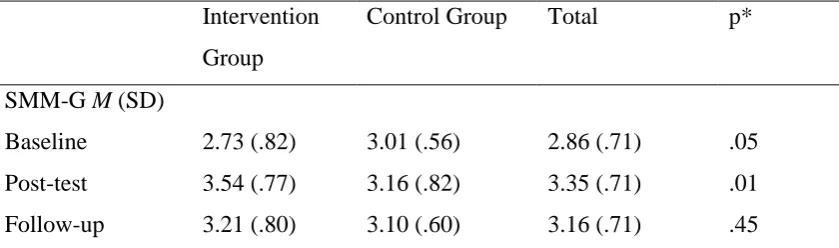
assessment, post-test and the follow up in their stress mindset. The descriptive data on the test
results are shown in Table 2. While the experimental group showed a more
"stress-is-debilitating" mindset, the control group showed a neutral mindset. However, both conditions
showed an improved mindset, which was shifted towards "stress-is-enhancing" when
comparing the baseline scores with the post-test and follow-up score. The experimental group
shows a significant higher score (p< 0.05) than the control group at the post-test indicating
[image:12.595.74.494.351.475.2]that the intervention had a positive effect on the group.
Table 2
Means and standard deviation for stress mindset at all measuring points.
Intervention
Group
Control Group Total p*
SMM-G M (SD)
Baseline 2.73 (.82) 3.01 (.56) 2.86 (.71) .05
Post-test 3.54 (.77) 3.16 (.82) 3.35 (.71) .01
Follow-up 3.21 (.80) 3.10 (.60) 3.16 (.71) .45
*. Independent-sample t-tests were computed cross-sectionally for comparing both groups at
each measuring time on their stress mindset.
Repeated Measures GLM for the Stress Mindset Change
To test whether a significant difference in the stress mindset change after the intervention. A
repeated measures GLM was used to determine this change through the three measuring
points. Mauchly's test of sphericity indicated that sphericity was not assumed χ2(2) =15.43, p
< .001. Thus, a Greenhouse-Geisser correction was used (ε = .87) in order to adjust the
repeated measures GLM.
Time appears to have a main effect on the stress mindset. This is indicated by the
post-test scores being significantly higher compared to the baseline scores for both conditions,
F(1.74, 168.92) = 42.50, p < .001, with a partialη2=.31. The post hoc tests showed a
statistically significant increase in the participant's stress mindset from a
"stress-is-debilitating" to a "stress-is-enhancing" mindset from the baseline assessment to the post-test
comparing the post-test to the follow-up results (-.19), p < 0.001. This indicates that both
conditions decreased again from a enhancing" mindset towards a
"stress-is-debilitating" one. Furthermore, a significant interaction effect of time with the condition on
the stress mindset change was found F(1.74, 169.92) = 19.37, p < 0.001 indicating that the
positive change of the stress mindset over time was stronger in the intervention group than the
control group. When looking at the result, it can be stated that the intervention has a better
effect in the first part, from baseline to post-test. Figure 1shows the stress mindset change
[image:13.595.82.479.261.606.2]during the three measuring points indicated per condition.
Figure 1. The Stress mindset over time per condition (N = 99, nexperimtenal = 50, ncontrol = 49).
Moderation Analysis
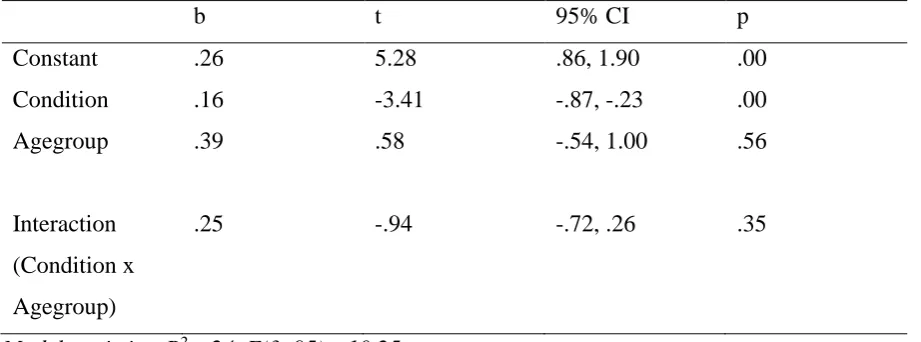
To check whether age had a moderating effect on the intervention, a moderation
analysis was performed using the PROCESS tool of Hayes, as seen in Table 3. Overall the
model was found to be significant (p < 0.001), but no moderation was found as the interaction
effect was not significant (p = .35). Thus, the interaction between the condition and the
agegroup did not have an impact on the effect on the degree of stress mindset change by this
[image:14.595.70.531.197.368.2]intervention.
Table 3
Linear model of predictors of stress mindset (Agegroup)
b t 95% CI p
Constant .26 5.28 .86, 1.90 .00
Condition .16 -3.41 -.87, -.23 .00
Agegroup .39 .58 -.54, 1.00 .56
Interaction
(Condition x
Agegroup)
.25 -.94 -.72, .26 .35
Model statistics. R2=.24, F(3, 95)= 10.25
Discussion
This study aimed to test whether the change from a stress-is-debilitating mindset to a
stress-is-enhancing mindset with the use of an educational video was possible. Furthermore,
the study aimed at answering whether time affects the strength of the intervention and
whether age moderates the outcome of the intervention. To do this, an RCT with a sample of
136 German-speaking participants was conducted by assessing them over the course of three
weeks.
This study showed that a simple intervention such as providing people with a short video
containing information about the productive use of stress could improve their stress mindset.
As the results indicate, the experimental group showed a shift in their view on stress from a
debilitating to an enhancing one. These findings are supported by previous studies, for
example, that a stress mindset is not a fixed matter but can rather be changed easily with
interventions (Crum et al., 2013). When comparing the results of the present study to findings
in other similar studies, the overall mindset change was not as strong in this intervention than
others (Crum et al., 2013; Wegmann et al., 2017). While the present study found a significant
difference at the manipulation, one week later the difference was not significant anymore. In
This difference in outcomes and strength after one week might be accounted for by the
different study designs. When comparing the manipulation designs of Crum and the present
study, it becomes clear that the manipulation was not repeated multiple times within the
present study, while Crum showed the video multiple times, which can influence the level of
change. Another aspect is the level of manipulation. In this study, the manipulation used a
short three to a four-minute-long video while Wegmann used a stress management training.
Thus, a smaller effect of the mindset change can be expected compared to Wegmanns
intervention. This indicates that exposing the participant more often or by giving them more
organised ideas and practical knowledge to handle stress can enhance the impact on the
mindset change. Nevertheless, the level of change that the present study provided with such a
short informational video is remarkable.
Another aspect that is important to mention is the effect of time on the strength of the
intervention. Time is a reoccurring factor that has to be taken into account when designing
interventions. This was also the case for this intervention. Directly after the manipulation, the
change in mindset in the experimental condition is quite high but reverts after one week.
Although it is important to state that the change from the beginning to the last timeslot was
still an improvement. However, it is not possible to predict whether the participants will stay
at that level or whether the mindset will revert to the starting point. Nevertheless, the
differences between the baseline and the follow-up test indicate that although there is a loss of
strength of the effect over time the intervention, in general, was effective as it changed the
mindset even after one week towards a “stress-is-enhancing” mindset. People might have
watched the video and were influenced how they completed the questionnaire, but once they
returned to their life without the video in mind, they don't have the video in mind when
feeling stressed.
When looking at the groups, it can be stated that surprisingly the experimental group scored a
slightly more stress-is-debilitating mindset at the baseline than the control group, who had a
more neutral view on stress. This already negative mindset might be harder to change or even
easier to change than a neutral mindset, which was not tested within this study. However, a
stress-is-debilitating mindset is more common, which is in line with Crum et al. (2013), who
had both groups start out with a baseline that was more stress-is-debilitating. This means that
the participants felt stress as unfavourable, which is also in line with another study, which
indicates that the more prevailing mindset on life was that it was hard and short (Norton,
Besides the change of mindset over the course of this study, the effect of the
participants' age on the strength of the mindset change was measured. The outcome of this
study, which shows that older people are not less likely to change their mindset than younger
people, is contradicting to literature found. These findings contradict findings that people
above the age of 30 appear to be less likely to change their attitudes and values (Krosnick &
Alwin, 1989). This shows that older people are not less likely to change their mindset than
younger people. When comparing these results, the question of whether just the
stress-mindset changes easily or whether values and attitudes do. A study suggests that the values of
a person appear to remain rather stable over time, while the people’s attitudes change based
on outside factors such as a job or the situation one is in (Luskin, Fishkin, &Jowell, 2002).
This indicates that there might be other possible mindsets than can be changed and thus
maybe help change other aspects of people’s lives too. To be more precise it is important to
establish whether stress is a value or an attitude since it can be influential in designing
interventions that are not just based on attitude but values as well and allow to apply
interventions in broader areas of people's lives. Consequently, finding out whether mindsets
consist of specific values or attitudes is possible.
Strength and Limitations
The study makes some contribution to current literature about the stress mindset and
its implication in interventions, by providing more data on the changeability of a stress
mindset as well as the effectiveness of video as a medium to provide information. One major
strength this study shows is the information it provides on the stress mindset and the
corresponding measures such as the SMM-G and its possible combination with interventions.
As the SMM-G is a short questionnaire that does not take a lot of time to answer but keeps
being validated, might be useful for future designs, so that more data on the stress mindset can
be found. Thus, these outcomes can provide feedback and insight into possible ways of
improving people’s general well-being by taking steps into finding the best way to change
someone’s mindset. Another positive aspect was the randomisation of the study, as it was
conducted by another independent researcher, who neither recruited participants nor analysed
the data gathered from the participants. Consequently, there was no bias in allocating the
participants in the groups. Another strength of this study was the sample. Although a larger
sample would have been preferred, the descriptive were diverse. The age mean was around
sample represents the general population more than just a sample of students and
consequently making the findings more generalizable.
However, the study also shows some limitations. For one, the manipulation used was
simple and was only shown once during the whole intervention and showed either a
enhancing video or a neutral video. A repeated manipulation, together with a
stress-is-debilitating video might have made the contrast between the groups stronger in the end and
would have provided more insight into the changeability of the mindset in both directions
positive and negative. Crum and colleagues (2013) indicated that a change towards
“stress-is-debilitating” mindset was also possible when shown videos with information about distress.
Another aspect to consider is that the video and the questions were translated and proofread
by the researchers and some writing errors and a swapped Likert scale were included and the
difficulty of understanding the information was not tested. Thus, the effectiveness of the
video might not be at an optimal level, which results in a weaker manipulation. Furthermore,
a video that was validated might provide a stronger belief in the information provided.
Although Crum's video was used to design the video for this intervention, the video might be
different to understand.
Future Research
To improve the findings and to use the insight gathered from this study, there are some
aspects that future research might consider. Firstly, the question arises whether a video is the
best solution for providing information to change someone's mindset. Since this study only
provided videos, it might be easier or more effective to use text or audio together with a video
to maximize the effectiveness and the sensory input. Finding an easy but effective way might
help that future research and intervention designs work as good as possible. Thus future
research can differentiate between different types of providing the information to the
participant such as a seminar or a detailed text to help find a way of distributing the
possibility of changing someone's mindset so that everyone can do so if they want to.
Furthermore, a more in-depth study might provide more feedback on the overall improvement
of the mindset. This study collected the data over the course of one month and although the
last timeslot shows that the experimental condition still exhibited a more stress-is-enhancing
mindset compared to their baseline measure, they might revert to the baseline level after
another weeks or month. Thus, the usage of repeated exposure to the information and whether
that might affect the decrease of effectiveness over time is interesting to investigate. As the
intervention that allows for the mindset change to be for a long period of time is important.
This might increase the value the society sees in the intervention. Since the idea of having to,
for example, watch a video or read a text several times a week to maintain a different mindset
can be seen as annoying and thus fewer people might be inclined to partake in an intervention.
However, if future research finds a method that allows for a persistent mindset change, it can
be impactful in the mental health of people in society. As mentioned, a "stress-is-enhancing"
mindset provides more mental health benefits as well as overall better quality of life. Thus, a
good intervention can prove beneficial for so society in general.
Conclusion
This study provides evidence that it is possible to change someone’s stress mindset from a “stress-is-debilitating” towards a “stress-is-enhancing” one, regardless of their age, by
showing them an educational video of the positive effects of stress. This means that showing a
video that provides information on the positive side of stress to participants helps to change
their stress mindset for a short period. Thus, future research can determine whether there are
more suitable or effective ways of providing a stress mindset change. The mindset change
appears to be influenced by the time that passes from the manipulation, thus resulting in the
participants decreasing towards a “stress-is-debilitating” mindset after the manipulation but
remained improved in total.
Furthermore, this study gives insight into the changeability of mindsets based on the
age of a person and that the mindset does not appear to be more fixed for older people than
assumed, but rather remained similar between younger people and older ones. This indicates
that an intervention is possible for all age groups. So overall, the study provides a good basis
that allows future research to improve the concept and design to more effectively change the
mindsets of people and thus give possible ways of improving the overall well-being of the
References
Aronson, J., Fried, C. B., & Good, C. (2002). Reducing the effects of stereotype threat on
African American college students by shaping theories of intelligence. Journal of
Experimental Social Psychology, 38(2), 113-125. doi:10.1006/jesp.2001.1491
Blackwell, L. S., Trzesniewski, K. H., & Dweck, C. S. (2007). Implicit theories of
intelligence predict achievement across an adolescent transition: A longitudinal study
and an intervention. Child development, 78(1), 246-263. doi:
10.1111/j.1467-8624.2007.00995.x
Crum, Alia J., Peter Salovey, and Shawn Achor. "Rethinking stress: The role of mindsets in
determining the stress response." Journal of personality and social psychology 104.4
(2013): 716. Doi: 10.1037/a0031201
Damian, R. I., Spengler, M., Sutu, A., & Roberts, B. W. (2019). Sixteen going on sixty-six: A
longitudinal study of personality stability and change across 50 years. Journal of
Personality and Social Psychology, 117(3), 674. doi:10.1037/pspp0000210
Donnellan, M. B., & Lucas, R. E. (2008). Age differences in the big five across the life span:
evidence from two national samples. Psychology and aging, 23(3), 558. doi:
10.1037/a0012897
Dweck, C. S. (2006). Mindset: The New Psychology of Success. New York, New York:
Ballantine Books.
Glaser, R., & Kiecolt-Glaser, J. K. (2005). Stress-induced immune dysfunction: implications
for health. Nature Reviews Immunology, 5(3), 243. doi:10.1038/nri1571
Good, C., Aronson, J., & Inzlicht, M. (2003). Improving adolescents' standardized test
performance: An intervention to reduce the effects of stereotype threat. Journal of
Applied Developmental Psychology, 24(6), 645-662.
Doi:10.1016/j.appdev.2003.09.002
Greenberg, N., Carr, J. A., & Summers, C. H. (2002). Causes and consequences of stress.
Integrative and Comparative Biology, 42(3), 508-516. Doi:10.1093/icb/42.3.508
Hayes, A. F. (2017). Introduction to mediation, moderation, and conditional process
analysis: A regression-based approach: Guilford Publications.
Hochanadel, A., & Finamore, D. (2015). Fixed and growth mindset in education and how grit
helps students persist in the face of adversity. Journal of International Education
Research, 11(1), 47-50.
Krosnick, J. A., & Alwin, D. F. (1989). Aging and susceptibility to attitude change. Journal of
Lazarus, R. S. (1993). From psychological stress to the emotions: A history of changing
outlooks. Annual Review of Psychology, 44(1), 1-22.
doi:10.1146/annurev.ps.44.020193.000245
Lazarus, R. S., & Folkman, S. (1984). Coping and adaptation. The handbook of behavioral
medicine, 282325.
Le Fevre, M., Matheny, J., & Kolt, G. S. (2003). Eustress, distress, and interpretation in
occupational stress. Journal of managerial psychology, 18(7), 726-744.
Doi:10.1108/02683940310502412
Linnemann, A., Ditzen, B., Strahler, J., Doerr, J. M., & Nater, U. M. (2015). Music listening
as a means of stress reduction in daily life. Psychoneuroendocrinology, 60, 82-90.
Doi: 10.1016/j.psyneuen.2015.06.008
Luskin, R. C., Fishkin, J. S., & Jowell, R. (2002). Considered opinions: Deliberative polling
in Britain. British Journal of Political Science, 32(3), 455-487.
Doi:10.1017/S0007123402000194
Maron, B. J., Thompson, P. D., Ackerman, M. J., Balady, G., Berger, S., Cohen, D., . . .
Hutter Jr, A. M. (2007). Recommendations and considerations related to
preparticipation screening for cardiovascular abnormalities in competitive athletes:
2007 update: a scientific statement from the American Heart Association Council on
Nutrition, Physical Activity, and Metabolism: endorsed by the American College of
Cardiology Foundation. Circulation, 115(12), 1643-1655.
Doi:10.1161/CIRCULATIONAHA.107.181423
Miller, G. E., Cohen, S., Janicki-Deverts, D., Brody, G. H., & Chen, E. (2016). Viral
challenge reveals further evidence of skin-deep resilience in African Americans from
disadvantaged backgrounds. Health Psychology, 35(11), 1225.
Doi:10.1037/hea0000398
Norton, M. I., Anik, L., Aknin, L. B., & Dunn, E. W. (2011). Is life nasty, brutish, and short?
Philosophies of life and well-being. Social Psychological and Personality Science,
2(6), 570-575. Doi:10.1177/1948550611401425
Quick, J. D., Horn, R. S., & Quick, J. C. (1987). Health consequences of stress. Journal of
Organizational Behavior Management, 8(2), 19-36. Doi:10.1300/J075v08n02_03
Park, C. L., & Helgeson, V. S. (2006). Introduction to the special section:
Growth following highly stressful life events—Current status and futuredirections.
Journal of Consulting and Clinical Psychology, 74, 791–796.
Schneiderman, N., Ironson, G., & Siegel, S. D. (2005). Stress and health: psychological,
behavioral, and biological determinants. Annu. Rev. Clin. Psychol., 1, 607-628.
Doi:10.1146/annurev.clinpsy.1.102803.144141
Selye, H. (1974). Stress sans détresse: Lippincott.
Sonnentag, S. (2003). Recovery, work engagement, and proactive behavior: a new look at the
interface between nonwork and work. Journal of applied psychology, 88(3), 518.
Doi:10.1037/0021-9010.88.3.518
Srivastava, S., John, O. P., Gosling, S. D., & Potter, J. (2003). Development of personality in
early and middle adulthood: Set like plaster or persistent change? Journal of
Personality and Social Psychology, 84(5), 1041. Doi:10.1037/0022-3514.84.5.1041
Swann Jr, W. B., Chang-Schneider, C., & Larsen McClarty, K. (2007). Do people's self-views
matter? Self-concept and self-esteem in everyday life. American psychologist, 62(2),
84. Doi:10.1037/0003-066X.62.2.84
Tulviste, T., Kall, K., & Rämmer, A. (2017). Value priorities of younger and older adults in
seven European countries. Social Indicators Research, 133(3), 931-942.
Vitetta, L., Anton, B., Cortizo, F., & Sali, A. (2005). Mind‐body medicine: stress and its
impact on overall health and longevity. Annals of the New York Academy of Sciences,
1057(1), 492-505. doi:10.1111/j.1749-6632.2005.tb06153.x
Wegmann, J., Moshman, R. A., & Rubin, L. (2017). Is it Possible to Change the Way College
Appendices
Appendix A: Recruitment message.
Appendix B: Transcript of the video.
1 Die meisten Menschen nehmen an, dass sie ruhig und stressfrei sein müssen, um auf höchstem Niveau funktionieren zu können.
2 Aber tatsächlich treibt uns Druck zu Bestleistungen an
3 Bei Stress wird Adrenalin durch den Körper gepumpt.
4 Es versorgt unser Gehirn und unseren Körper mit Blut und Sauerstoff
5 Es erhöht die Konzentration und die Aufmerksamkeit
6 Diese Stressreaktionen verbessern Ihre:
6.1 Konzentration, Entscheidungsfindung, Erinnerungsvermögen, Leistungsfähigkeit
7 Denken Sie über folgende Beispiele nach:
8 Unter normalen Umständen verarbeitet das Gehirn 40 Bilder pro Sekunde
9 Unter Stress nehmen wir die Zeit langsamer wahr. Dadurch kann unser Gehirn in der gleichen Zeit mehr Reize verarbeiten.
10. Die beeindruckendsten Leistungen werden in den stressigsten Momenten vollbracht:
11. Operationen
12. Kampffliegen (eig Kampfflieger aber passt semantisch nicht)
14. Forschungsergebnisse zeigen, dass die Stressreaktionen des Körpers das Erinnerungsvermögen und die geistige Leistungsfähigkeit steigern.
14.1 Cahill et al. (2003). Journal of Learning and Memory
15. Eine Studie aus Harvard zeigt:
Stärkere körperliche Erregung während einer Aufnahmeprüfung steigert die Leistung
16 Die einflussreichsten Anführer trafen ihre besten Entscheidungen während großer Krisen.
17 Lincoln
18 Ghandi
19 Churchill
20 Denken Sie über Ihr eigenes Leben nach:
20.1 Als Sie Ihre persönlichen Bestleistungen erbracht haben... 20.2 War es nicht Stress, der Sie dazu angetrieben hat?
21 Die Stressreaktion erhöht Ihre geistige Leistungsfähigkeit.
22 Besonders wenn es am meisten darauf ankommt.
23. Stress ist leistungsfördernd.
24. Nutzen Sie ihn.
25. Lassen Sie Stress Ihre Leistungen verbessern
Eine Studie aus Yale und Cambridge zeigt:
Wenn Menschen von den positiven Effekten von Stress wissen, sind diese Effekte noch größer.
Die Überzeugung, dass Stress positiv ist, verbessert die Leistung
Gesundheit Zufriedenheit
Menschen, die Stress als einen notwendigen und positiven Aspekt des Lebens betrachten, sind im Durchschnitt erfolgreicher und glücklicher.
Sehen Sie Stress als positive Herausforderung,
dann produziert Ihr Körper eine optimalere Menge des Stresshormons Kortisol.
Das ist besser für Ihre Gesundheit. Und dadurch können Sie mehr leisten.