Available Online At www.ijpret.com
INTERNATIONAL JOURNAL OF PURE AND
APPLIED RESEARCH IN ENGINEERING AND
TECHNOLOGY
A PATH FOR HORIZING YOUR INNOVATIVE WORK
IMAGE FUSION USING WAVELET TRANSFORM OF MULTI-FOCUSED IMAGES
JAYANT KEWATE, M. S. PAWAR
Department of Electronics Engineering, Yashwantrao Chavan College of Engineering, Nagpur, India.
Accepted Date:
27/02/2013
Publish Date:
01/04/2013
Keywords
Multi-Focused Images, Wavelet Transform, Image Fusion,
Match Threshold Degree
Corresponding Author Mr. Jayant Kewate
Abstract
Available Online At www.ijpret.com
1. Introduction
Multi-focused images are important part in
multi-sensor images for fusion. Sensors like
camera can’t capture all things only one
picture of camera’s scene. We always take
numbers of picture. If fused them through
some fusion methods then we get more
clear and visible. It is applicable in various
field as multi-focused CCD visual images,
multi-spectrum and panchromatic remote
sensing images and functional anatomical
medical images. The approach of fusion
method concentrated towards some
important properties of picture such as
detection, recognition and visual
properties. Maximum selection, weighted
average and average method such are some
fusion methods which are called as
common method. If we use individual
method among these fusion methods then
there will cause information lost and
reduction in contrast. Burt’s method is
advantageous in some manners. Burt’s
method is combination of weighted average
and maximum selection. In fusion
researcher give attention on rules of fusion
such as energy, variance, gradient, fuzzy set
and wavelet transform used in common
methods. Image fusion is a term which
having a function combining multiple
images to get more information than that of
individual images can be revealed. For the
remotely sensed images, some have good
spectral information and the high geometric
resolution. These are integrated all
information from two kinds of information
to one kinds of information which called as
image fusion.
In this paper Burt’s method based on
wavelet transform multi-resolution fused by
match degree and get better result than
any common methods.
2. Wavelet Transform And Common
Fusion Method
a. Wavelet transform and decomposition
Wavelet transform provides
multi-resolution solution based on time scale
analysis used in image fusion. Each
sub-band processed at different resolution,
capturing, localized time-frequency data of
image to provide unique directional
information useful for image representation
& feature extraction across different scale.
Available Online At www.ijpret.com
filtering & subsequent nyquist sampling. In
each level we get three components of
high-frequency and one of low-frequency.
The source image decomposition in row and
column by low pass and high pass filtering
and down sampling at level LL, HH, HL, HH
are coefficient components. These
components are included LH (horizontal
information), HH (diagonal information), HL
(vertical information). LL component
describes picture. These next level LL
decomposition having frequency
components are LH1, HH1, LH1 and HL1
respectively. The next level LL1
decomposition having frequency
components are LH2, HH2, LH2 and HL2
respectively. And remaining next levels are
same as above.
Source image
b. Maximum Selection, Weighted average
And Average method
Maximum selection is used for
approximation while square & averaging
filter mask are applied to detail coefficient
and combine coefficients. LL (Low pass
filter to row, followed by low pass filter to
column), HL (Low pass filter to row,
followed by high pass filter to column), LH
(high pass filter to row, followed by low
pass filter to column), HH (high pass filter to
row, followed by high pass filter to column).
3. Multi-resolution images to manage
different image resolution. Multi-scale
information can be useful in number of
images processing applications including
image fusion.
4. Discrete wavelet transform (DWT) allow
images decomposition in different kind
of coefficients preserving the image
information.
5. Coefficient coming from different
images can be combined to obtain new
coefficient which gives information in
original image is collected.
L
H 2
2
L
L
H
H
L
H
Available Online At www.ijpret.com
6. Once coefficients are merged then final
fused image is achieved through inverse
discrete wavelet transform (IDWT).
Common methods for image fusion using
wavelet transform by following equations.
Equation (1) & (2), (3) and (4) are used for
maximum selection method, weighted
average method and average method
respectively.
(
)
(
)
, , max , , , (1)
m n
LH HL HH LL M N LL M N
D
= D
D
(
)
(
)
_max max , , , (2)
m n
LL imum LL M N LL M N
D
= D
D
( ) ( ) ( ) ( )
(
)
(
)
(
)
(
)
, , _ , , , , (3) , , m m LL LL m n LL LLM N M N LL weight
M N M N
m m LL LL m n LL LL D D D D
M N M N
M N M N
D
D
D
D
D
× = × + × × (
)
(
)
_ , , (4) 2 m n LL LL LL averageM N M N
D
D
D
×
=
7. Burt’s Fusion Method
Burt’s method is combination of maximum
selection with weighted average method to
fuse then as per match degree. Match
degree is calculated by following equation.
( ) ( ) ( )
(
)
( )(
)
( ), ,
2 2
2 , ,
, (5)
, ,
, ,
k k
k d A d B
d
i j i j
i j
k i j k i j
d A d B
E
E
M
E
E
× × = ×Where ,
( )
,k d A i j
E
and ,( )
,k d B i j
E
aresub-images having row i and column j with k level. And d is frequency component.
( ) ( ) ( ) ( ) ( ) ( ) ( ) , , , , , , , , , , , , , , , ,
k k k
d A d B d A
k
d F k k k
d A d B d B
i j i j i j
i j
i j i j i j
C
E
E
C
C
E
E
≥
=
<
Where
( )
,k d i j
M
is match degree whichlower than fixed threshold in this Burt’s
fusion method and always select bigger
Available Online At www.ijpret.com ( ) ( ) ( ) ( ) ( ) ( ) ( ) ( ) ( )
max , m in ,
, ,
,
max , m in ,
, ,
, ,
, ,
, (6)
, ,
, ,
k k
d A d B
k k
d A d B k
d F k k
d B d A
k k
d A d B
i j i j
if i j i j
i j
i j i j
if i j i j
w
C
w
C
E
E
C
w
C
w
C
E
E
× + × ≥ = × + × < Where ,
( )
,k d A i j
C
and ,( )
,k d B i j
C
arewavelet coefficient of source image A and B
with fusion coefficient ,
( )
,k d F i j
C
.( )
min max min
1 ,
1 1
, 1
2 2 1
k d i j
T
M
w
= − × − −w
= −w
Where
w
max andw
min are weight.8. Experimental Results
In the following experiment shows which
method is best on basis of PSNR (peak
signal to noise ratio), SNR (signal noise
ratio) and MSE (mean squared error). These
are calculated by following equations.
( ) ( )
21 1
,
,
M N i j MSE M NS i j
F i j
− − = ×
−
∑∑
2 1010
log
255
PSNR MSE =
( )
( ) ( )
2 1 0 1 2 1 11 0
lo g
,
,
,
M
i M N
i j S N R
S i j
S i j
F i j
− − − =
∑
−
∑ ∑
The first experiment is multi-focused
images “Statue” shown in fig.1:
Fig.(1a) Fig.(1b)
In above fig.(1a) and fig.(1b) are right
Available Online At www.ijpret.com
having input respectively. Size of image
filter window is 3* 3 and 1 decomposition
level.
Fig.(1c) Fig.(1d)
Fig.(1e) Fig.(1f)
When fig.(1a) and fig.(1b) fused on basis
common methods then we get fig.(1e)
maximum selection method. The fig.(1d)
average method and fig.(1c) weighted
average method. Given example showing
better visibility & clarity in fig.(1f) and
contain much information as compare to
common methods. Table (1) shows result of
fused image on the basis of values of MSE,
PSNR & SNR.
measurement
figure
MSE SNR PSNR
Fig.(1c) 36.4598 16.8701 65.0253
Fig.(1d) 16.3631 23.8291 71.9843
Fig.(1e) 6.4398 31.9290 80.0842
Available Online At www.ijpret.com
Table (1)
The second experiment is multi-focused
images “Man” shown in fig.2:
Fig.(2a)
Fig.(2b)
In above fig.(2a) and fig.(2b) are right
focused and left focused image which
having input respectively. Size of image
filter window is 3*3 and 1 decomposition
level.
Fig.(2c)
Fig.(2d)
Available Online At www.ijpret.com
Fig.(2e)
Fig.(2f)
When fig.(2a) and fig.(2b) fused on basis of
common methods then we get fig.(2e)
maximum selection method. The fig.(2d)
average method and fig.(2c) weighted
average method. Given example showing
better visibility & clarity in fig.(2f) and
contain much information as compare to
common methods. Table (2) shows result of
fused image on the basis of values of MSE,
PSNR & SNR.
Table (2)
measurement
figure
MSE SNR PSNR
Fig.(2c) 22.5410 21.0682 69.2021
Fig.(2d) 6.7149 31.5869 79.7208
Fig.(2e) 1.5542 44.2975 92.4315
Fig.(2f) 0.9650 48.4366 96.5706
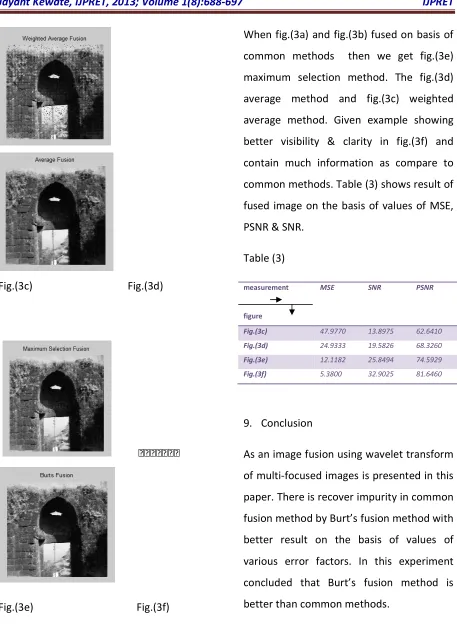
The third experiment is
multi-focused images “Wall” shown in fig.3: Fig.(3a)
Fig.(3b)
In above fig.(3a) and fig.(3b) are
right focused and left focused image which
having input respectively. Size of image
filter window is 3*3 and 1 decomposition
Available Online At www.ijpret.com
Fig.(3c) Fig.(3d)
Fig.(3e) Fig.(3f)
When fig.(3a) and fig.(3b) fused on basis of
common methods then we get fig.(3e)
maximum selection method. The fig.(3d)
average method and fig.(3c) weighted
average method. Given example showing
better visibility & clarity in fig.(3f) and
contain much information as compare to
common methods. Table (3) shows result of
fused image on the basis of values of MSE,
PSNR & SNR.
Table (3)
measurement
figure
MSE SNR PSNR
Fig.(3c) 47.9770 13.8975 62.6410
Fig.(3d) 24.9333 19.5826 68.3260
Fig.(3e) 12.1182 25.8494 74.5929
Fig.(3f) 5.3800 32.9025 81.6460
9. Conclusion
As an image fusion using wavelet transform
of multi-focused images is presented in this
paper. There is recover impurity in common
fusion method by Burt’s fusion method with
better result on the basis of values of
various error factors. In this experiment
concluded that Burt’s fusion method is
Available Online At www.ijpret.com
References
1. Soma Sekhar and Dr. M. N. Giri Prasad “A
Novel Approach Of Image Fusion On MR
And CT Image Using Wavelet Transform”,
IEEE 2011, pp. 978-1-4244-8679-3/11.
2. Ting Zhou and Binijie Hu, “Adaptive
Fusion Method of Multi-focused Images
Based on Wavelet Transform”, image
processing, IEEE 2010, pp.978
-1-4244-3709-2/10.
3. P. Burt and R. Kolczynski, “Enhanced
Image Capture Through Fusion”, on
computer vision,pp.173-182,1993.
4. Yao-Hong Tsai-Han Lee, “Wavelet-based
Image Fusion by Adaptive Decomposition”,
on image processing, IEEE 2008,
pp.978-0-7695-3382-7/08.
5. Guozhang Geng,Hao Chen, Yanying Lui
and Yanjie Wang, “Image Fusion Method of
9/7 Wavelet Transform Based On Lifting
Scheme”, IEEE, pp. 522-524, 2008.
6. Z. Zhang, R.S. Blum, “A Categorization Of
Multiscale Decomposition-based Image
Fusion Sceme”, with a performance study
for a digital camera application, Proc. IEEE
87 (8) (1999) 1315-1326.
7. D. A. Yocky, “Image Merging and Data
Fusion by Mean of Discrete Two–
dimensional Wavelet Transform”, J. opt.
Soc. Am. A: opt. image Sci. Vision 12 (9)