Please cite this article as: V. Tahmasbi, M. Ghoreishi, M. Zolfaghari,Temperature in Bone Drilling Process: Mathematical Modeling and Optimization of Effective Parameters, International Journal of Engineering (IJE), TRANSACTIONS A: Basics Vol. 29, No. 7, (July 2016) 946-953
International Journal of Engineering
J o u r n a l H o m e p a g e : w w w . i j e . i rTemperature in Bone Drilling Process: Mathematical Modeling and Optimization of
Effective Parameters
V. Tahmasbi*a, M. Ghoreishia, M. Zolfagharib
a Department of Mechanical Engineering, K.N. Toosi University of Technology, Tehran, Iran. b Department of Mechanical Engineering, Arak University, Arak, Iran
P A P E R I N F O
Paper history:
Received 20 March 2016
Received in revised form 24 April 2016 Accepted 02 June 2016
Keywords: Machining Bone Drilling Temperature Thermal Necrosis Response Surface Method Biomechanics
A B S T R A C T
Bone drilling process is the most prominent process in orthopedically surgeries and curing bone breakages. It is also very common in dentistry and bone sampling operations. Due to complexity of the material that is machined, bone, and the sensitivity of the process, bone drilling is one of the most important, common and sensitive processes in biomedical engineering field. The most critical problem which can occur during bone drilling is increasing the process temperature above the allowable limit (47oC) which causes thermal necrosis or cell death in the bone tissue. In this study, an empirical model
is developed to enable the surgeon to predict the temperature of the process based on tool’s rotational speed, feed rate, tool diameter and effective interactions between these parameters. Experiments were designed and modeled using response surface methodology and to ascertain operation conditions, optimization was performed. Results show that within the range of the investigated variables, with an increase in the tool diameter and cutting speed, the rate of temperature change increases. It is noted that the behavior of the feed rate is complex; in this paper it is investigated precisely. The response surface model is able to predict temperature behavior based on the input parameters. The allowable range of parameters in bone drilling operation is introduced to obtain a quick and swift desirable operation.
doi: 10.5829/idosi.ije.2016.29.07a.09
1. INTRODUCTION1
1. 1. Bone Drilling Process During curing bone breakage, it is attempted to help the broken parts recover their exact original location. Therefore, broken parts should be placed accurately and then become fixed. Bolts can be used to hold broken parts fixed. In the bone operation, the temperature must not exceed an allowable value. Higher increase in temperature causes bone burn, cell death which is generally called as thermal necrosis [1-3]. Undesired temperature rise in bone drilling location changes the state of the bone Phosphates alkaline which consequently causes thermal necrosis and cell death and causes the death of the bone tissue and decrease in material stiffness in the vicinity of the drilling operation [4]. This leads to a loss in the applied bolts in the operation [5] and also results in the
1*Corresponding Author’s Email: [email protected](V.
Tahmasbi)
long breakage curing period which in some cases is very difficult to be compensated. Thermal necrosis phenomenon in bone occurs due to temperature increase which hinders the blood flow to the bone. Thus, it leads to the cell death and local loss of the bone tissue and weakening of its structure [6].
The level of damage to the bone has a direct relation with the increase in temperature and exposure time to the heat [7]. Based on different studies, thermal necrosis is probable to happen in the wide range of temperature (44 to 100oC). When temperature passes 70oC, thermal necrosis occurs immediately [2]. Increase in temperature from 47 to 50oC in one minute influences bone tissue. However when temperature is below 44oC, thermal effect is negligible if the exposure time is equal to, or less than a minute [8]. Nevertheless, most of the researches revealed that increasing the temperature from 47oC within a minute causes thermal necrosis in bone tissue [9].
1. 2. Effective parameters on bone drilling process
1. 2. 1. The Effect of Rotational Speed and Feed Rate The most effective parameters in bone drilling process are rotational speed and feed rate. Many studies have investigated the effect of these two variables on the performance of bone drilling process. It is interesting that the reported findings diverge considerably [9]. Thompson observed that an increase in rotational speed from 125 to 2000 rpm, the temperature of the bone increases in the pin insertion process [10]. Vaughn et al. reported an increase in process temperature with raising drilling rotational speed [11]. Matthews et al. reporting on human femur bone drilling process, observed that increasing rotational speed from 345 to 2900 rpm does not have a discernible effect on process temperature [12]. Augustin et al. reported that the maximum machining temperature reduces with increasing feed rate [13]. A report by Brisman shows that with increasing either rotational speed from 1800 to 2400 rpm, or compressive force from 1.2 Kg to 2.4 Kg independently, in bovine bone drilling process the temperature increases. However, simultaneous change in rotational speed and compressive force does not alter process temperature [14].
Hillery and Shuaib reported that with an increase in rotational speed from 400 to 2000 rpm with a drill with diameter of 3.2 mm the drilling temperature decreases [15]. Bachus et al. studying drilling on human corpse
femur bone observed that maximum process
temperature decreases with increasing axial
compressive force when rotational speed is 820 rpm [4]. Nam et al. studying on bovine ribs drilling reported that with increase in each of rotational speed from 600 to 1000 rpm and feed force from 500 to 1000 gr, process temperature increases [16]. In another investigation by Sharawy et al. working on pig jaw bones, drilling at three rotational speeds of 1225, 1667 and 2500 rpm and locating four thermocouples for precise measurement of the temperature found that with an increase in rotational speed bone’s mean temperature increases [17]. Karaca et al. recently investigated the effect of tool rotational speed and compressive force on orthopedic bone (bovine femur bone) surgeries. Experiments and statistical analysis revealed that with increasing feed force and tool rotational speed the process temperature decreases. Furthermore, the quality of the hole was an effective parameter on time period needed for regeneration [18]. Lee et al., investigating on bovine femur bone, concluded that the maximum temperature bone increases with increase spindle’s speed and decreases with increasing feed rate [19]. Karaca et al. in another investigation using high quality thermocouples observed that with an increase in rotational speed, bone’s temperature increases. Moreover, decreasing feed rate and compressive force lead to an increase in the process temperature [20]. Pandey and Panda used
Taguchi method, though it was reported not to possess an acceptable reliability in analysis of these experiments [21], and Fuzzy algorithm suggested a decrease in tool rotational speed and feed rate to improve temperature and compressive force [22]. Shakouri et al. also reported that increasing rotational speed up to 7000 rpm reduces the process maximum temperature [23].
1. 2. 2. Effect of Tool Diameter on Bone Drilling Process The effect of drill diameter on process temperature has been widely studied. Generally, it was reported that tool diameter has an influential effect on drilling temperature. Kalidindi using three different tool diameters of 2, 3.5 and 4.3 mm, feed rate of 0.42 mm/s and rotational speed of 1200 rpm reported that with increasing tool diameter the process temperature increases in an exponential trend [24]. Augustin et al. focusing on pig’s bone drilling, introduced that with an increase in drill bit diameter the contact surface between bone and tool increases and due to the frictional forces the produced heat increases. Moreover increase in hole diameters cause less bone stiffness and higher time period of recovery [13]. Hufner et al. investigated the effect of drill diameter and length on the deviation of the actual location of the tool during surgery. They observed that a drill bit with small diameter and long length tends to slope from its exact location in bone drilling process [25].
1. 2. 3. Influential Parameters Analysis As can be inferred from available literature, it is hard to converge to a united conclusion considering rotational speed and feed rate. Nevertheless, regardless of considerable number of experimentations, up to now, an accurate design of experiments and statistical modeling in order to optimize parameters for process temperature control based on accurate statistical modeling has been missed. Furthermore, the interaction of these two parameters has not been scrutinized. In this paper in addition to process modeling using response surface method, experimental evaluations, the effect of variable, governing empirical model and optimization of the thermal process were taken into account.
governing mathematical model of the experiments, developing interaction diagrams of input variables, experiments optimization and assuring the exact correspondence of the developed model are some of the advantages of RSM [28]. Furthermore, this method is able to model the relation between the inputs and outputs of an experiment and represent it as a second order linear integration equation [29].
2.MATERIALS AND METHODS
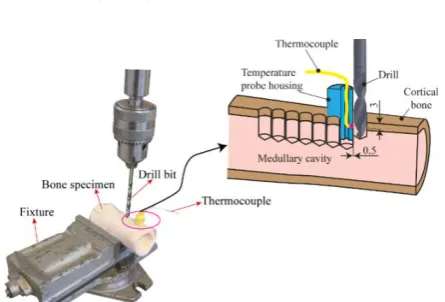
2. 1. Experiments In this study rotational speed of the tool (V), feed rate (F) and tool diameter (D) are considered as input parameters in bone drilling analysis. The most prominent output variable is the maximum process temperature (T). The drill bits made of HSS and automatic drilling machine were employed. The depth of the holes in the analysis was 8 mm. To measure the temperature, K-type thermocouples were implemented and measurement was performed in the depth of 3 mm and distance of 0.5 mm from the hole wall [30]. Figure 1 illustrates the typical set up of the experiments.
The maximum measured temperature is reported in Table 2. In experiments bovine femur cortical bone was used which is similar to the human cortical bone. To make experiments closer to what occurs in a real surgery, it must not take more than few hours from when the bone tissue was alive. The location of thermocouples is shown in Figure 2.
2. 2. Mathematical Modeling and Experimental Procedures Rotational speed, feed rate and tool diameter were selected as input variables and a 33 full factorial experiments were performed. RSM and Central Composite Design (CCD) was employed to develop the model. In Table 1, input variables and their range of variation are listed based on three coded units.
Figure 1. Bone drilling process and temperature measurement in the absence of cooling system.
Figure 2. Thermocouple positioning in bone drilling process
TABLE 1. Coded units of input variables in bone drilling process
1 0
-1 Factors
2500 1500
500 V (rpm)
50 30
10 F (mm/min)
5 4
2.5 D (mm)
The values of output variables are listed in Table 2 for 27 experiments. Minitab software package v16 was used to analyze the results and obtain the coefficients of the governing empirical equation.
Using RSM and data analysis, a second order linear regression equation was derived for the output variable based on input variables. Interpretation of results and model optimization was also performed.
3. RESULTS
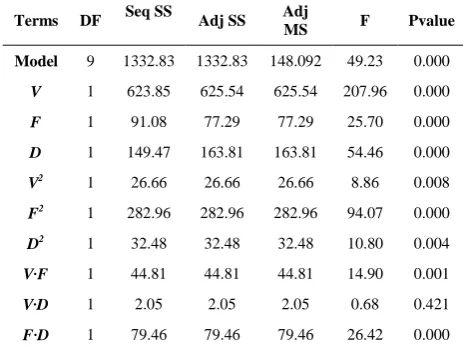
3. 1. Data Analysis and Process Modeling Interpretation Based on the results of temperature, ANOVA is presented in Table 3. Considering the reliability of 99% in precise engineering experimentation P-value less than 0.01 is to ascertain the effectiveness of different model terms [31].
PRESS value for this second order linear model is 136.470 and second order linear regression equation governing the temperature behavior is presented in Equation (1)
(1)
Considering the values, R-sq= 96.31%, R-sq
(pred)= 90.12% and R-sq (adj)= 94.35% and
TABLE 2. Implemented experiments and maximum measured temperature
Experiment No.
V (rpm)
F (mm/min)
D (mm)
Temprature
(0C)
1 -1 -1 -1 42.50
2 0 -1 -1 51.70
3 1 -1 -1 52.14
4 -1 -1 0 45.42
5 0 -1 0 49.23
6 1 -1 0 54.02
7 -1 -1 1 44.50
8 0 -1 1 51.70
9 1 -1 1 52.15
10 -1 0 -1 37.52
11 0 0 -1 43.23
12 1 0 -1 47.70
13 -1 0 0 37.53
14 0 0 0 42.92
15 1 0 0 46.20
16 -1 0 1 41.59
17 0 0 1 51.38
18 1 0 1 53.72
19 -1 1 -1 38.70
20 0 1 -1 50.63
21 1 1 -1 56.93
22 -1 1 0 42.80
23 0 1 0 54.18
24 1 1 0 60.27
25 -1 1 1 53.13
26 0 1 1 60.67
27 1 1 1 66.52
TABLE 3. ANOVA on temperature based on effective parameters in bone drilling process.
Pvalue F
Adj MS Adj SS Seq SS
DF Terms
0.000 49.23 148.092 1332.83
1332.83 9
Model
0.000 207.96 625.54
625.54 623.85
1 V
0.000 25.70 77.29
77.29 91.08
1 F
0.000 54.46 163.81 163.81
149.47 1
D
0.008 8.86
26.66 26.66
26.66 1
V2
0.000 94.07 282.96 282.96
282.96 1
F2
0.004 10.80 32.48
32.48 32.48
1 D2
0.001 14.90 44.81
44.81 44.81
1 V·F
0.421 0.68
2.05 2.05
2.05 1
V·D
0.000 26.42 79.46
79.46 79.46
1 F·D
Figure 3. Residuals distribution versus fitted value
4. DISCUSSION
4. 1. Analysis and Investigation of the Effect of Input Variables on Bone Drilling Temperature
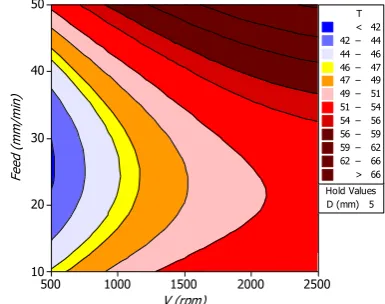
In this section, considering the developed model in terms of significant terms, it is attempted to identify the effect of rotational speed, feed rate and tool diameter on the process temperature. Therefore, first contour plot curve of significant interaction of tool rotational speed and feed rate is presented in Figure 4 and the effect of the significant main effects tool diameter depicted in Figure 5.
4. 1. 1. Analysis of Drill Rotational Speed
Interaction plot of the temperature changes based on feed rate and rotational speed is illustrated in Figure 4 for different tool diameters. As can be seen, this plot shows a second order surface with a saddle point. This saddle point possesses a maximum in the direction of the rotational speed and a minimum in the direction of feed rate. So, the behavior of the temperature in the vicinity of this point is different. The differences in the reported results of previous researches might be attributed to the temperature variation in the vicinity of this saddle point. For instance, in a constant feed rate, at first with increasing the rotational speed temperature increases and after passing this saddle point it decreases. Therefore, both contradicting reports of improvement in machining in low or high rotational speeds can be explained. Thus, noticing this critical point is crucial which was out of attention of the researchers due to lack of precise modeling.
Based on Figure 4, it can be observed that with an increase in rotational speed, the maximum temperature increases. It can be implied that the least damage to the bone from thermal necrosis view point, can be achieved in low rotational speeds. Due to the existence of the saddle point in plots of Figure 4, it is predicted that in high speed machining (passing the saddle point) temperatures below 47oC can be achieved. As can be seen in Figure 5, the slope of the rotational speed-temperature diagram decreases gradually and that is
70 65 60 55 50 45 40 35 3
2
1
0
-1
-2
-3
Fitted Value
Re
si
du
attributed to the ease of chip removal from the hole. Thiswas studied in the recent studies and current results show that doing high speed drilling decreases the possibility of thermal necrosis and the rate of temperature rise [31].
4. 1. 2. Effect of Drill Diameter Tool diameter, considering F-value and the coefficient of the regression equation, in the range of the performed experiments is very influential on generated heat and development of the thermal necrosis. It can be implied from plots of Figures 4 and 5 that with an increase in tool diameter, process temperature increases.
As can be seen in plots of Figures 4 and 5, an increase in drill diameter causes a rise in the process maximum temperature. With an increase in tool diameter, the contact surface between the bone and tool increases, which in turn frictional forces raise and consequently the generated heat increases. Furthermore, increasing tool diameter makes higher drilling forces to be imposed on bone and drill which leads to an increase in the temperature (Figures 4 and 5).
With increasing tool diameter, the rate of temperature increase, raises remarkably. As can be observed in plots of Figure 4, the allowable range in which no thermal necrosis would happen for tool diameter of 5 millimeters is much less than those for tool diameter of 4 and 2.5 mm.
Figure 4. Effective interaction diagram of feed rate and rotational speed in different tool diameters
Figure 5. Main effect plots of tool diameter
It should be mentioned from the biomedical point of view, the less tool diameter, the less time period of recovery [13].
4. 1. 3. Feed Rate The effect of feed rate on process temperature behaviour is intricate, because in lower feed rates, firstly the applied force on the bone, friction between the tool-bone and thickness of the deformed chip is lower. So, chip can easily find its way out of the hole which leads to the lower generated heat and less process temperature. Secondly, the time of tool-bone contact increases which leads to an increase in heat transfer rate from tool to the bone, and consequently a rise in bone temperature conversely with an increase in feed rate. Thirdly, the applied force on bone increases remarkably, and finally, the thickness of non-deformed chip increases while the time of tool-bone contact decreases. Hence, it is possible that the minimum heat generated is in the lower or higher or in between ranges of feed rate, considering the range of the experiments variables.
Therefore, the effect of feed rate on process temperature depends on the conditions of the experiment and the range of variables. As can be seen
V (rpm) Fe ed ( m m /m in ) 2500 2000 1500 1000 500 50 40 30 20 10
D (mm) 2.5 Hold Values > – – – – – – – – – – < 51 53 53 55 55 36 36 38 38 40 40 42 42 44 44 46 46 47 47 49 49 51 T V (rpm) Fe ed ( m m /m in ) 2500 2000 1500 1000 500 50 40 30 20 10
D (mm) 4 Hold Values > – – – – – – – – – – < 55 56 56 58 58 38 38 40 40 42 42 44 44 46 46 47 47 49 49 51 51 55 T V (rpm) Fe ed ( m m /m in ) 2500 2000 1500 1000 500 50 40 30 20 10
from Figure 5 and the effect of feed rate, within the presented range of the experiments, the minimum rate of the temperature increase occurs in the middle of the range of feed rates. In this state, it is two instantaneous improvements are obtained: a) the time of tool-bone contact is less than that with lower feed rates, and b) the applied and frictional forces between tool and bone is less than that with higher feed rates. These improvements can be seen clearly in Figure 4. In plots of Figure 4 with increasing feed rate in a constant rotational speed, at first maximum temperature decreases then it increases again. Increasing feed rate at first eases the escape of the bone brittle chip and develops less friction due to shorter time period of bone-tool contact, but then due to thicker non-deformed chip and increase in imposing and frictional forces leads to an increase in process temperature.
4. 2. Optimization In this section process optimization will be followed to achieve the minimum temperature. The optimization results using Dringer and Suich method is presented in Table 4.
This method uses the simultaneous optimization technique popularized by Dringer and Suich. Their procedure makes use of desirability function. In this approach each response is converted into an individual desirability function that varies over the range . Where if the response is at its goal or target, then and if the response is outside of acceptable region, . Then the design variables are chosen to maximize the overall desirability
( ) ⁄
[21].
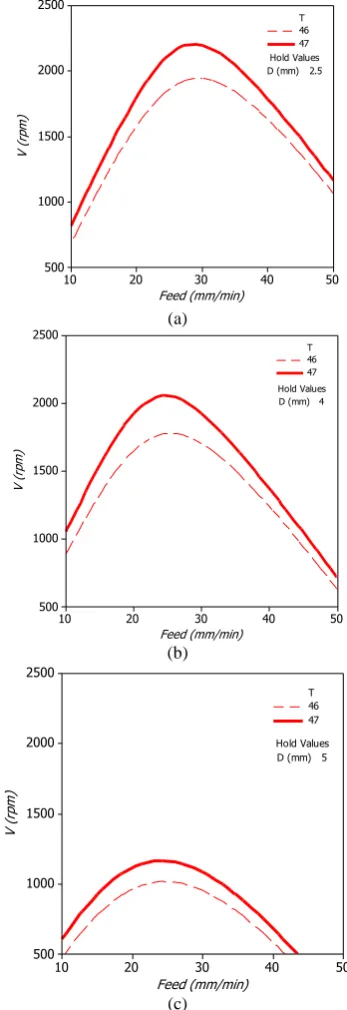
As can be seen from Table 4, the accuracy of optimizationis acceptable and reliable. The minimum temperature (37oC) occurs when tool diameter is 2.5 mm and feed rate and rotational speed are 30 mm/min and 500 rpm, respectively. The allowable range of operational parameters is illustrated in Figure 6. The red curve in the picture belongs to temperature 47oC and all the area beneath it can be considered as allowable. To alert the user the curve for temperature of 46oC is also depicted with dashed line.
In Figure 6 the area which leads to the temperature below 47oC is considered to be safe in terms of thermal necrosis. However, to assure that thermal necrosis is avoided, the area beneath the curve for 46oC might be used. It can be observed that the allowable area decreases with increasing tool diameter.
TABLE 4. Process optimization to achieve minimum temperature
T (0C)
D (mm) F (mm/min)
V (rpm) optimization
35.18 2.5
30 500
Model
37.52 2.5
30 500
Experiment
-6% -
- -
Error%
These diagrams allow the surgeons to do a surgery operation quickly and swiftly, without thermal necrosis occurring. For example, using tool diameter of 2.5 mm for maximum allowable rotational speed of 1000 rpm, the feed rate can be increased up to 50 mm/min; or, when tool diameter and feed rate are 4 mm and 25 mm/min, respectively, rotational speed can be raised up to 1700 rpm.
(a)
(b)
(c)
Figure 6. The allowable range of variables in bone drilling based on the temperature threshold for thermal necrosis for tool diameter of 2.5 mm (a), 4 mm (b) and 5 mm (c)
Feed (mm/min)
V
(r
pm
)
50 40 30 20 10 2500
2000
1500
1000
500
D (mm) 2.5 Hold Values 46 47 T
Feed (mm/min)
V
(r
pm
)
50 40
30 20
10 2500
2000
1500
1000
500
D (mm) 4 Hold Values 46 47 T
Feed (mm/min)
V
(r
pm
)
50 40
30 20
10 2500
2000
1500
1000
500
The allowable area considerably reduces for tool diameter of 5 mm so that the highest allowable rotational speed for feed rate of 25 mm/min is 1000 rpm. Moreover, feed rate can be increased to 40 mm/min if rotational speed remains at its minimum value (500 rpm).
5. CONCLUSION
In this study modeling and optimization of bone drilling process were presented using RSM. Here, a mathematical model was introduced based on input parameters including tool diameter, feed rate and rotational speed. After evaluating the suitable
correspondence of the presented model and
experimental data, analysis of the effect of process input parameters and optimization was performed in order to achieve the allowable process temperature.
The interaction diagram of tool rotational speed and feed rate yields a second order surface with a saddle point which explains contrary results proposed by other researchers about temperature behavior. Within the range of parameters implied in this study, with an increase in rotational speed temperature increases, and the minimum temperature (37oC) is achieved when tool diameter, rotational speed and feed rate are 2.5 mm, 500 rpm and 30 mm/min, respectively.
With an increase in tool diameter, temperature increases and rate of temperature rise considerably increases with increasing tool diameter.
In the selected range of the parameters in this paper, temperature increases with rotational speed. Considering decrease of the slope of the rotational speed diagram and also saddle-like surface diagrams of feed rate and rotational speed interaction, it can be predicted that high speed machining causes lower rate of temperature rise, and so lower probability of thermal necrosis occurrence.
The effect of feed rate is complicated: a) the time of tool-bone contact is less than that with lower feed rates, and b) the applied and frictional forces between tool and bone is less than that with higher feed rates.
Considering the optimization results, it can be said that minimum temperature (37oC) is achieved when tool diameter, rotational speed and feed rate are 2.5 mm, 500 rpm and 30 mm/min, respectively.
For a surgeon, in bone drilling process, the allowable area for parameter selection to avoid thermal necrosis and to achieve highest possible process speed is presented in Figure 6.
6. REFERENCE
1. Eriksson, R., Albrektsson, T. and Magnusson, B., "Assessment of bone viability after heat trauma: A histological, histochemical
and vital microscopic study in the rabbit", Scandinavian journal of plastic and reconstructive surgery, Vol. 18, No. 3, (1984), 261-268.
2. Moritz, A.R. and Henriques Jr, F., "Studies of thermal injury: Ii. The relative importance of time and surface temperature in the causation of cutaneous burns", The American Journal of Pathology, Vol. 23, No. 5, (1947), 695-702.
3. Lundskog, J., "Heat and bone tissue. An experimental investigation of the thermal properties of bone and threshold levels for thermal injury", Scandinavian Journal of Plastic and Reconstructive Surgery, Vol. 9, (1971), 1-80.
4. Bachus, K.N., Rondina, M.T. and Hutchinson, D.T., "The effects of drilling force on cortical temperatures and their duration: An in vitro study", Medical Engineering & Physics, Vol. 22, No. 10, (2000), 685-691.
5. FG, P., " Histological change in bone after insertion of skeletal fixation pins", Journal of Oral Surgery, Anesthesia and Hospital Dental Service, Vol. 18, (1960), 9-16.
6. F. Bronner, M.C.F.-C., J. Rubin, S. D. Bain, "Bone resorption Springer, Vol. 2, (2005).
7. Eriksson, A. and Albrektsson, T., "Temperature threshold levels for heat-induced bone tissue injury: A vital-microscopic study in the rabbit", The Journal of Prosthetic Dentistry, Vol. 50, No. 1, (1983), 101-107.
8. Eriksson, R. and Albrektsson, T., "The effect of heat on bone regeneration: An experimental study in the rabbit using the bone growth chamber", Journal of Oral and Maxillofacial Surgery, Vol. 42, No. 11, (1984), 705-711.
9. Pandey, R.K. and Panda, S., "Drilling of bone: A comprehensive review", Journal of Clinical Orthopaedics and Trauma, Vol. 4, No. 1, (2013), 15-30.
10. Thompson, H., "Effect of drilling into bone", Journal of Oral Surgery, Vol. 16, No. 1, (1958), 22.
11. Vaughn, R. and Peyton, F., "The influence of rotational speed on temperature rise during cavity preparation", Journal of Dental Research, Vol. 30, No. 5, (1951), 737-744.
12. Matthews, L.S. and Hirsch, C., "Temperatures measured in human cortical bone when drilling", The Journal of Bone and Joint Surgery American, Vol. 54, No. 2, (1972), 297-308. 13. Augustin, G., Davila, S., Mihoci, K., Udiljak, T., Vedrina, D.S.
and Antabak, A., "Thermal osteonecrosis and bone drilling parameters revisited", Archives of Orthopaedic and Trauma Surgery, Vol. 128, No. 1, (2008), 71-77.
14. Brisman, D.L., "The effect of speed, pressure, and time on bone temperature during the drilling of implant sites", International Journal of Oral & Maxillofacial Implants, Vol. 11, No. 1, (1996), 35-37.
15. Hillery, M. and Shuaib, I., "Temperature effects in the drilling of human and bovine bone", Journal of Materials Processing Technology, Vol. 92, (1999), 302-308.
16. Nam, O., Yu, W., Choi, M.Y. and Kyung, H.M., "Monitoring of bone temperature during osseous preparation for orthodontic micro-screw implants: Effect of motor speed and ressure", in Key Engineering Materials, Trans Tech Publ. Vol. 321, (2006), 1044-1047.
17. Sharawy, M., Misch, C.E., Weller, N. and Tehemar, S., "Heat generation during implant drilling: The significance of motor speed", Journal of Oral and Maxillofacial Surgery, Vol. 60, No. 10, (2002), 1160-1169.
18. Karaca, F., Aksakal, B. and Kom, M., "Influence of orthopaedic drilling parameters on temperature and histopathology of bovine tibia: An in vitro study", Medical Engineering & Physics, Vol. 33, No. 10, (2011), 1221-1227.
Medical Engineering & Physics, Vol. 34, No. 10, (2012), 1510-1520.
20. Karaca, F. and Aksakal, B., "Effects of various drilling parameters on bone during implantology: An in vitro experimental study", Acta of Bioengineering and Biomechanics, Vol. 15, No. 4, (2013), 116-122.
21. Myers, R.H., Montgomery, D.C. and Anderson-Cook, C.M., "Response surface methodology: Process and product optimization using designed experiments, John Wiley & Sons, (2016).
22. Pandey, R.K. and Panda, S., "Optimization of bone drilling using taguchi methodology coupled with fuzzy based desirability function approach", Journal of Intelligent Manufacturing, Vol. 26, No. 6, (2015), 1121-1129.
23. Shakouri, E., Sadeghi, M. and Maerefat, M., "Experimental investigation of thermal necrosis in conventional and high speed drilling of bone", (2013).
24. Kalidindi, V., "Optimization of drill design and coolant systems during dental implant surgery", (2004).
25. Hufner, T., Geerling, J., Oldag, G., Richter, M., Kfuri Jr, M., Pohlemann, T. and Krettek, C., "Accuracy study of computer-assisted drilling: The effect of bone density, drill bit characteristics, and use of a mechanical guide", Journal of Orthopaedic Trauma, Vol. 19, No. 5, (2005), 317-322.
26. Ghoreishi, M. and Tahmasbi, V., "Optimization of material removal rate in dry electro-discharge machining process", Modares Mechanical Engineering, Vol. 14, No. 12, (2015), 9-16.
27. Montgomery, D., "Design and analysis of experiments”, john wiley & sons, USA", (1996).
28. Hou, T.-H., Su, C.-H. and Liu, W.-L., "Parameters optimization of a nano-particle wet milling process using the taguchi method, response surface method and genetic algorithm", Powder Technology, Vol. 173, No. 3, (2007), 153-162.
29. Assarzadeh, S. and Ghoreishi, M., "A dual response surface-desirability approach to process modeling and optimization of al2o3 powder-mixed electrical discharge machining (pmedm) parameters", The International Journal of Advanced Manufacturing Technology, Vol. 64, No. 9-12, (2013), 1459-1477.
30. Staroveski, T., Brezak, D. and Udiljak, T., "Drill wear monitoring in cortical bone drilling", Medical Engineering & Physics, Vol. 37, No. 6, (2015), 560-566.
31. Shakouri, E., Sadeghi, M.H., Maerefat, M. and Shajari, S., "Experimental and analytical investigation of the thermal necrosis in high-speed drilling of bone", Proceedings of the Institution of Mechanical Engineers, Part H: Journal of Engineering in Medicine, (2014), 330-341.
Temperature in Bone Drilling Process: Mathematical Modeling and
Optimization of Effective Parameters
TECHNICAL NOTE
V. Tahmasbia, M. Ghoreishia, M. Zolfagharib
a Department of Mechanical Engineering, K.N. Toosi University of Technology, Tehran, Iran. b Department of Mechanical Engineering, Arak University, Arak, Iran
P A P E R I N F O
Paper history:
Received 20 March 2016
Received in revised form 24 April 2016 Accepted 02 June 2016
Keywords: Machining Bone Drilling Temperature Thermal Necrosis Response Surface Method Biomechanics
ديكچ ه
خارَس سٌیآزف یگتسکض ىاهرز ٍ یسپَترا یحازج لاوعا رز سٌیآزف يیزتوْه ىاَرتسا یراک
رز يیٌچوّ ٍ تساّ
ًَِوً ٍ یکضشپًاسًز يیضاه سٌیآزف تحت ُزاه یگسیچیپ تْج ِب ٍ زراز یًاٍازف ززبراک ىاَرتسا سا یراززب
ٍ یراک
ی ،سٌیآزف تیساسح نْه سا یک
ساسح ،يیزت ززبراکزپ ٍ يیزت
رز یکیًاکه یاّسٌیآزف يیزت .تسا یکضشپ یسسٌْه ُسَح
نْه ِضراع يیزت خارَس سٌیآزف یاهز يتفر لااب ،زَض زاجیا رَکذه یحازج لوع رز تسا يکوه ِک یا
ُزٍسحه سا یراک
( ساجه 74 ای یترازح سٍزکً زاجیا ٍ )زازگ یتًاس ِجرز ٍ یلَلس گزه
گتذَس یه ىاَرتسا تفاب رز یعضَه ی رز .سضاب
صیپ رَظٌه ِب مٍز ِبتزه یطذ ىَیسزگر یضایر لسه کی ِلاقه يیا لوع يیح رز حازج طسَت سٌیآزف یاهز راتفر یٌیب
خارَس نّزب ٍ راشبا زطق ،یٍزطیپ خزً ،راشبا ىارٍز تعزس بسحزب یحازج تابر اب ىاَرتسا یراک صٌک
اًْآ زثؤه یاّ
.تسا ُسض ِئارا صیاهسآ
لسه ٍ یحازط دساپ حطس شٍر ساسا زب اّ ُسض یساس
يییعت رَظٌه ِب مسلا یساس ٌِیْب ٍ سًا
ب جیاتً .تسا ِتفزیذپ ترَص یحازج لوع طیازض ِ
تسا ترَص يیسب ُسهآ تسز ِک
صیاهسآ ُزٍسحه رز صیاشفا اب اّ
صیاشفا سٌیآزف یاهز صیاشفا خزً شزب تعزس ٍ راشبا زطق یه
تفر رز ٍ سبای رازق یسرزب زرَه تقز ِب یٍزطیپ خزً را
.تسا ِتفزگ صیپ یزٍرٍ یاّرَتکاف تاویظٌت ِب ِجَت اب ار اهز راتفر تسا رزاق ُسض ِئارا دساپ حطس لسه
.سیاوً یٌیب
خارَس یحازج لوع زتهاراپ زییغت ساجه ُزٍسحه قیقحت يیا رز ،زتطیب ِچزّ لوع تعزس مٍشل ِب ِجَت اب ىاَرتسا یراک
ض ِئارا .تسا ُس