18
DEVELOPING ADVANCED INSTRUCTIVE
FRAMEWORK AND PERSONALIZED E-LEARNING
PLATFORM BY EMPLOYING INFORMATION MODEL
LINKED TO MBTI IN PREDICTING STUDENT
PERSONALITY AND PREFERENCES: LEARNING
MANAGEMENT SYSTEM (LMS)
Rahul Garg
Bachelor of Engineering (B.E.), ECE
Thapar Institute of Engineering & Technology, Patiala- 147004 (Punjab), India
ABSTRACT
E-learning turn into a primary factor in the advanced instructive framework. In the present assorted understudy populace,E-learning must perceive the distinctions in understudy identities to make the learning procedure progressively customized. The target of this investigation is to make an information model to recognize both the understudy identity type and the overwhelming inclination dependent on the Myers-Briggs Type Indicator (MBTI) hypothesis. The proposed model uses information from understudy commitment with the learning the board framework (Moodle) and the interpersonal organization, Facebook. The model enables understudies to end up mindful of their identity, which thus makes them increasingly productive in their examination propensities. The model additionally gives necessary data to instructors, outfitting them with a superior comprehension of every understudy's identity. With this information, instructors will be progressively fit for coordinating understudies with their separate learning styles. The proposed model has associated on precedent data assembled from the Business College at the German school in Cairo, Egypt (240 understudies). The model was tried to go at using ten data mining request computations which were Naïve Bayes, BayesNet, Kstar, Random woods, J48, OneR, JRIP, KNN/IBK, RandomTree, and Decision Table. The results exhibited that OneR had the best precision dimension of 97.40%, trailed by Random backwoods 93.23% and J48 at 92.19%.
I.
INTRODUCTION
knowledge of the course material. Personalized e-learning platforms seek to improve student satisfaction and motivation throughout thecourse. To achieve this result, methods and techniques from several scientific fields and application areas are used. The most well-known techniques are: Data Mining, Knowledge Discovery, User Modelling, Web Mining, User Profiling, Artificial Intelligence and Agent Technologies, etc. These techniques utilize data generated from student engagement on all forms of web-based learning systems to provide a high degree of personalized education.
A. Learning Style
People have different learning styles, through which their cognitive, affective, personal and psychological traits interact together to formulate the way learners perceive, and interact with the learning environment. In the traditional classroom a competent instructor is able to differentiate and adapt learning strategies to the existing needs of the students. One way of doing so is to identify the individual learning styles and preferences of the learners. The instructor is guided by their own experience in the traditional classroom. Similarly, e- learning can also be supported by various models intended to measure learning styles based on different theories that can be applied to the e-learning system. For example, Meyers-Briggs Type Indicator (MBTI), Kolb's "experiential learning theory", and others.
B. The Myers-Briggs Type Indicator
Carl Jung's hypothesis of Psychological Types (1921) thought about that people are either introverts or extraverts, and their habits come from these common natural psychological types. Individuals take in and process information in different ways, usually based on their personality traits. Variation in an individual’s behaviour is due to the essential differences in the manner of the persons rather than using their perception and judgment. Individuals take in information either by sensing or by intuition, and they organize this information either by thinking about them or by feeling. Myers- Briggs used and applied the bases of Carl Jung's theory of Psychological Types (1921) to create their personality inventory (The Myers-Briggs Type indicator).
Based on the Jungian’s psychological types, Myers-Briggs evaluates personality types and preferences through four aspects of personality:
1. Extraversion (E) or Introversion (I)
2. Sensing (S) or Intuition (N)
3. Thinking (T) or Feeling (F)
4. Judging (J) or Perceiving (P)
20 The combined sets of these different preferences provide 16 distinctive identity types and are regularly symbolized by four letters to speak to an individual's movement on the four scales. For example, ESTP stands for Extroversion, Sensing, Thinking, and Perceiving, which show the four preferences of highest occurrence for this person. The MBTI assessment highlights the distinct nature of each learner’s preference.
C. Dominant Preferences
D. E-learning and Social Network
Recently, social networks have become an important part of our daily lives. Social networks connect individuals and groups of similar interests. The most popular Social networks are Facebook, Twitter, LinkedIn, MySpace,and Google+.Facebook has more than 845 million active users, and is a standout amongst the most prevalent social networking among college studies. Students usually use these social networks for their social chatting, debating public issues and reviewing coursework related material with colleagues. E-learning uses the social network as one of its tools to provide and improve the communication in the learning process. Instructors are able to create closed groups for each class to improve the communication between the instructor and students and among the students themselves. We selected Facebook for the present study as it is the most popular form of social networking amongst the student population.
E. Educational Data Mining
Data mining (DM) is a method of discovering useful information from large amounts of data through extracting patterns that helps in solving problems that face different sectors of society. As of late, there has been an expanding enthusiasm for the utilization of DM to examine the training segment. Instructive Data Mining (EDM) is worried about creating strategies and dissecting instructive substance to empower a superior comprehension of understudies' identities and inclinations, just as improving educating and learning forms.
The advancement in educational technology accompanied by the massive use of the internet has created a new well- known approach known as e-learning or web-based education, which generates a vast amount of data about learners and learning. All this information provides a gold mine of educational data. EDM uses this massive amount of data to better understand learning and learners, hence, developing different computational techniques that associate data with theories that turn the practice into something that can benefit the learners. In the past few years, EDM has been an emerging and highly interesting area of research to many researches along with its related research areas like e-learning and LMS. E-learning helps in providing guidance to learners and LMS provides the platform of communication, collaboration, administration and reporting tools. The log files and data stored in the databases of these systems are being manipulated and tested using DM techniques.
F. Data Classification
22 methods, decision tree, neural networks, and rule-based calculations. Below are three of the algorithms used in this research which have proved to achieve the highest accuracy:
• J48: is the standard Decision Tree induction algorithm for learning approach particularly
pattern recognition and machine learning. J48 is based on the ID3 algorithm.
• OneR: is an accurate simple classification algorithm that creates one rule for each
predictor in the data, and then matches it with the most accurate rules.
• Random Forest: is a group of classification or regression trees made from the random
selection of samples of the training data. Prediction is made by grouping the forecast of the collection.
II.
PROPOSED MODEL
A. The Data Model of Student Engagement from Adopting LMS and Social Networks Into E-learning
The primary goal of this examination is to enhance the quality of teaching and learning forms in the e-learning framework by methods for data and communication innovations.In this study, students had access to their online courses introduced over the LMS (Moodle). Some instructors introduce their courses on social network as a supplement in the learning process. due to the popularity of online social networks among college students. The data generated from the student’s engagement with these tools was so vast and enriching. The data can help us create a model that predicts and classifies the student’s personality and preferences using data mining tools, in which researchers can test our model with different classification methods.
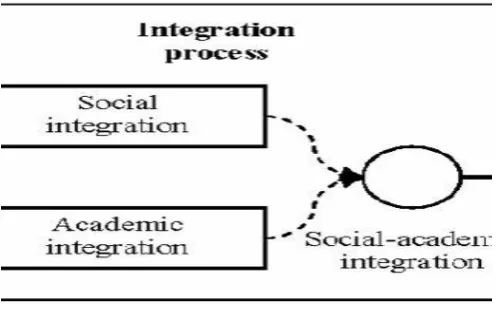
Fig 1: Integration Process B. Data Collection
an open-source LMS that help instructors create effective online learning communities. The data was collected for the academic year 2014-2015 from 240 students having 10 attributes as shown in Table III. Each of these students took about 6 courses per semester. Students were opening resources and doing activities related to these courses through Moodle and Facebook groups.
C. Data Pre-processing
Data Pre-processing is one of the important steps in DM. In this step, the dataset goes throw many stages as data cleaning, data integration, and data transformation. The gathered data was saved as Excel spreadsheets. The cleaning procedure is important so as to examine the information dependent on chosen classifier calculations, in which information with missing details are removed, incompatible data is remedied, exceptions are recognized, and copied information is evacuated.The data was represented by numbers and stored in the form of a CSV file so it can be imported to the data mining tool.
D. Modelling
24 E. Proposed Model Flowchart
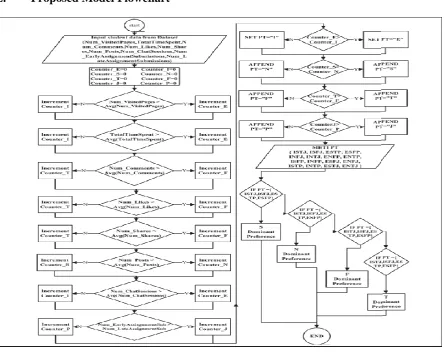
Fig 2: Flowchart
The flowchartshows how the data model predicts the student MBTI personality type (PT) and dominantpreference type (DP) via the behaviour of the student over the LMS (Moodle) and the social network (Facebook).
The first phase is to predict student PT; we defined and initialized our counter of 8 preferences measured in the MBTI model. Then each student behaviour measures one of the four preferences scales of the MBTI (i.e. Extraversion/Introversion, Sensing/Intuition, Thinking/Feeling, and Judging/Perceiving). In the first seven student behaviours (i.e. visited pages, time spent, comments, likes, shares, posts, and chat sessions). If the number of a certain behaviour is greater than the average number (avg) of this behaviour, the value of the corresponding preference counter will be incremented. The last two attributes (i.e. Number of Early Assignments Submissions, Number of Late Assignments Submissions) will be compared and the highest will increment the value of the corresponding preference counter. After all student behaviours have been measured, we will compare the counters to find the greater ofeach of the four Jungian psychological types preferences. The greater preference counter of each of the four Jungian psychological type’s preferences will be represented by one letter in the student PT.
S = {ESFP, ISFJ, ESTP, ISTJ} N = {ENTP, INFJ, ENFP, INTJ } F = {ENFJ, ISFP, ESFJ, INFP} T = {ENTJ, ISTP,ESTJ, INTP } So, the dominant preference is assigned according to the predicted student PT. For example, if student PT is one found in either “ISTJ”, “ISFJ”, “ESTP”or
ESFP, then the student DP is “Sensing”.
III.
EXPERIMENTAL RESULTS
The experiment used 10 classification algorithms in order to determine the highest classification accuracy. The algorithms were Naïve Bayes, Kstar, J48, OneR, Random forest, KNN/IBK, RandomTree,BayesNet, JRIP, and Decision Table.
In order to measure the model performance, the dataset was split into two groups: the training set (20%) which was utilized to train the model, and the test set (80%) used to test the model in order to measure its accuracy, precision, recall, F-value, true positives (TP) rate, and false positives (FP) rate, which are defined by equations by means of a confusion matrix.
-Accuracy: is defined as the ratio of correctly classified instances which is equal to the sum of TP and TN to total number of instances.
---(1)
- Recall: is determined as absolute number of genuine positives divided by absolute number of genuine positives + absolute number of false negatives.
---(2)
- Precision: is calculated as absolute number of genuine positives divided by absolute number of true positives + total number of false positives.
---(3)
- True-positive rate (TP Rate) value: is the percentage of positive instances correctly classified.
---(4)
26 ---(5)
- F-Measure: is a combination of recall and precision. It is also defined as harmonic mean of precision and recall.
---(6)