© 2018 IJSRST | Volume 4 | Issue 2 | Print ISSN: 2395-6011 | Online ISSN: 2395-602X Themed Section: Science and Technology
Biometric Identification Using Artificial Neural Network
Gagan Madaan1, Chahat Monga2
1Assistant Professor S.U.S. Panjab University Constituent College, Guruharsahai, Punjab, India
2Assistant Professor Guru Nanak College, Ferozepur, Punjab, India
ABSTRACT
Artificial Neural Networks (ANN) are the efficient means of prediction and recognition. The ability of the ANN to learn given patterns makes them suitable for such applications. Fingerprint, Face and Retina Recognition are the areas that can be used as a means of biometric verification where the ANN can play a critical rule. But faces of two twins can be of same look, so Fingerprint & Retina (F&R) are unique biometric pattern that can be used as a part of a verification system. An ANN can be configured and trained to handle such variations observed in the texture of the fingerprint & Retina. The specialty of the work is associated with the fact that if the ANN is configured properly it can tackle the variations in the fingerprint& retinal images and that way provides the insights for developing a system which requires the samples for verification and authorization. A system designed to provide authentication decision using the input can be a reliable means of verification. Such a system designed using ANN and using retina input is described here. Experimental results show that the system is reliable enough for considering it as a part of a verification mechanism.
Keywords: Artificial Neural Network; Fingerprint; Minutiae Retina; Blood Vessel.
I.
INTRODUCTION
Biometrics Identification is the recent used technology used authenticate the person's identity. Biometric identification has eventually a much broader relevance as computer interface becomes more natural. Biometrics identification is preferred over Conventional passwords and PIN based methods because we need not to remember Complex passwords and we can also check whether the person is physical present there or not. A biometric system is essentially a pattern recognition system special feature such as face, retina, handwriting, veins, voice, iris, fingerprint and signature etc. fingerprint & Retina are the unique biometric patterns that can be used as a part of a verification system. Both Fingerprint & Retina identification is mainly used in artificial intelligence. fingerprint identification systems are widely used because of easy access of fingerprints, low price of fingerprint sensors, non-intrusive scanning, and relatively good performance. No two persons have the
same set of fingerprints and remains unchanged & unique over a lifetime. This property makes fingerprints an excellent biometric identifier. A fingerprint is formed from an impression of the pattern of ridges on a finger. A ridge is defined as a single curved segment and a valley is the region between two adjacent ridges. Typically, there are two prominent types of minutiae (ridge ending and ridge bifurcation) that constitute a fingerprint pattern. The minutiae which are the local discontinuities in the ridge flow pattern provide the features that are used for identification. Details such as the type, orientation and location of minutiae are taken into account when performing minutiae extraction
Retina is a unique biometric pattern that can be used as a part of a verification system.
Artificial Neural Network (ANN)s are efficient means of prediction and recognition. An ANN can be configured and trained to handle such variations observed in the texture of the retina. if the ANN is configured properly it can tackle the variations in the fingerprint & retinal images. This way the approach provides the insights for developing a system which requires these samples for verification and authorization. Such a system based on ANN and designed using fingerprint & retina input is described The rest of the paper is organized as follows: Section II provides basic theoretical aspects related to generic fingerprint & retina recognition system. Section III provides the background principles related to the working of the proposed model. Section III provides design and implementation of the proposed systemAll experimental results and related discussion is provided in Section V. This paper is concluded by summing up the work in Section VI.
II.
BASIC THEORITICAL ASPECTS RELATED
TO THE PROPOSED SYSTEM
Here we briefly cover the basic theoretical aspects related to the work.
A. Fingerprint & Retina
Fingerprint: These are graphical flow-like ridges and valleys present on the surface of human fingers A ridge ending is defined as the ridge point where it ends abruptly. A ridge bifurcation is defined as the ridge point where a ridge diverges into branch ridges. A fingerprint can be represented by the minutiae locations, types and attributes like orientation. A good quality fingerprint image typically has about 40 to 100 minutiae, but a dozen of minutiae are considered sufficient to identify a fingerprint pattern.
Retina: Retina is the vascular pattern of the eye which is not easy to change and replicate. The patterns are different for right and left eye. The retina of an individual is unique and remains unchanged over a lifetime.
B. Fingerprint & Retina Recognition
Fingerprint Recognition: It is one of the popular biometric techniques. It refers to the automated method of verifying a match between two fingerprint images. It is formed by the ridge patterns of the finger.
Retina Recognition: Such a system captures and analyzes the patterns of blood vessels on the thin nerve on the back of the eyeball that processes light entering through the pupil. Retinal patterns are highly distinctive traits. Every eye has its own totally unique pattern of blood vessels. Even the eyes of identical twins are distinct.
Figure 1
C. Artificial Neural network
their parallel nature (b) A neural network learns and does not need to be reprogrammed.(c) It can be implemented in any application.(d) It can be implemented without any problem.
III.
SYSTEM MODEL
A generic retina based biometric identification
system in block diagram form is shown in Figure 2.
Figure 2. Process logic of the complete system
It involves the following modules:
Image acquisition: It is required to capture a sequence of input images.
Image preprocessing: It includes various stages which should be taken for making an image suitable for manipulation and interpretation by subsequent stages. The steps include removal of noise and variation of intensity recorded, sharpening, improving the contrast and strengthening the texture of the image. Another important aspect is image restoration which extracts image information from a degraded form to make it suitable for subsequent processing and interpretation [5].
Feature extraction: It is a process through which certain vital information and details of an image section is captured for subsequent interpretation.
Classification: This is the key component of fingerprint recognition system and determines the system's performance to a large extent. In this proposed model an Artificial Neural Network is used as classifier for recognition. It can generate multiple classes and decision boundaries and it produces the correct result by classifying the feature extracted
templates and matching these features with known patterns in the feature database
IV.
DESIGN AND IMPLEMENTATION OF THE
PROPOSED SYSTEM
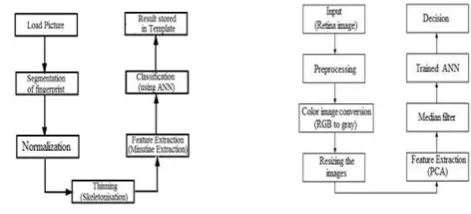
In this work the focus is to implement the system that provides reliability, accuracy and reduced overall match speed.The steps of the algorithm of the system model is shown in Figure 3.
Fingerprint model design: in Figure 3.1: Fingerprint model design a multi stage approach is used. These stages are image acquisition, image preprocessing, thinning, feature extraction, classification and decision.
to standardize the intensity values in an image by adjusting the range of gray-level values so that it lies within a desired range of values.
After normalization, we have done the thinning process. Thinning is a morphological operation that successively erodes away the foreground pixels until they are one pixel wide. A standard thinning algorithm is employed, which performs the thinning operation using two sub iterations. This algorithm is accessible in MATLAB via the „thin‟ operation under the „bwmorph‟ function. The application of the thinning algorithm to a fingerprint image preserves the connectivity of the ridge structures while forming a skeletonised version of the normalized image.
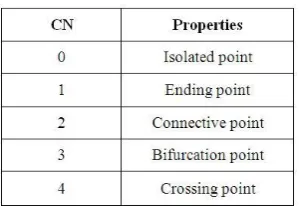
The thinned images are next considered for the minutiae feature extraction. The minutiae feature extraction algorithm which extracts the main minutiae features required for matching two fingerprints. Here, Crossing Number (CN) method is used for minutiae extraction of fingerprints [8]. The ridge pixel can be divided into bifurcation, ridge ending and non-minutiae point based on it. The CN algorithm is working on pixel representation „1‟ or „0‟, but the decision of minutiae point can be selected for each pixel value. CN method extracts the ridge endings and bifurcations from the skeleton image by examining the local neighborhood of each ridge pixel using a 3x3 window. The CN for a ridge pixel P is given by:
P4 P3 P2
P5 P P1
P6 P7 P8
CN= , ………. (1)
Where is the pixel value in the neighborhood of P. For a pixel P, its eight
neighboring pixels are scanned in an anti-clockwise direction as Shown:
Table 1. Properties of CN
After the CN for a ridge pixel has been computed, the pixel can then be classified according to the property of its CN value. With this formula, if CN=1 it corresponds to the end point and if CN=3, it corresponds to Bifurcation point of minutiae. Other properties of CN are described in Table I. In applying this algorithm, border area may be ignored, since there is no need to extract minutiae point on border area of the image that will gives more false minutiae points
After a successful extraction of minutiae, they are stored in a template, which may contain the position, direction, type and quality of the minutiae. In this proposed model ANN is used as classifier for recognition. Here, a feed forward back propagation neural network is configured for the classification of the fingerprints. For the fingerprint approach, the ANN input layer has 160 neurons and is trained for 200 to 3000 epochs. The results obtained are average values of atleast fifteen trails for the epochs considered.
captured by the Fundus camera are pre-processed for subsequent manipulation.
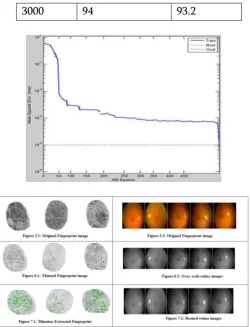
Retina image preprocessing includes gray image conversion, resizing the original images into required size. Original retina images, gray scale retina images, resized retina images are shown in figures 4 to 6 respectively. The next stage is feature extraction. Retina features include patterns of blood vessels [2]. In this proposed model, we are using Principal Component Analysis (PCA) to extract the retina features.
PCA is a way of identifying patterns in data, and expressing the data in such a way as to highlight their similarities and differences. Since patterns in data can be hard to find in data of high dimension, where the luxury of graphical representation is not available, PCA is a powerful tool for analyzing data. The other main advantage of PCA is that once you have found these patterns in the data, and you compress the data, i.e. by reducing the number of dimensions, without much loss of information. Principal Components Analysis (PCA) reduces the data into two dimensions.
The median filter is a nonlinear digital filtering technique used to remove noise. Such noise reduction is a typical pre-processing step to improve the results of later processing. Median filtering is very widely used in digital image processing because under certain conditions, it preserves edges while removing noise. The function medfilt2 ( ) performs 2-D median filtering. The syntax b=medfilt2 (A, [m n]) performs median filtering of the matrix A in two dimensions.
In this proposed model, ANN is used as classifier for recognition. Here, a feed forward back propagation ANN is configured for the classification of the retina. For this retina based system, the feature length is 300 which determine the size of the input layer of the ANN. The ANN considered have two hidden layers and its key specifications are provided in Table 1.
We have considered an SNR variation of 0 to 3 dB. The ANN is trained for 200 to 4000 epochs. The results obtained are average values of at least fifteen trials for the epochs considered.
V.
EXPERIMENTAL DETAILS AND RESULTS
Table 2. ANN specifications
The performance of Fingerprint & Retina identification System is analyzed in terms of computational speed and reliability. The overall computational time taken by the system is reduced to a greater level. A total of 40 identical fingerprint & Retina images have been provided to the system for training, validation and testing of the system. After extensive training, the system is subjected to certain variations with signal to noise ratio (SNR) range between 0 to 3dB to achieve robustness and proper recognition. The ANN considered is configured using the specifications shown in Table 2.
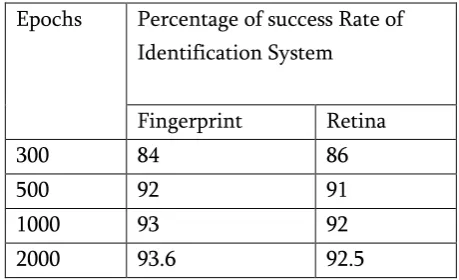
Table 3. Average success rates achieved between a few numbers of training epochs.
Epochs Percentage of success Rate of Identification System
Fingerprint Retina
300 84 86
500 92 91
1000 93 92
3000 94 93.2
Figure 4: MSE convergence plot of the ANN
Original, thinned and minutiae extracted fingerprints are shown in Figures 5.1, 6.1, &7.1 to 7. The tested results of recognition for various training epochs for the Fingerprint Recognition System is shown in Table III. The epochs are between a few hundreds to a few thousands and the success rate is around 84 to 94%. The training time required is between 35 to 38 seconds for a set of ten samples each.
For retina images, features are extracted using principal component analysis (PCA). The average test results of recognition for various training epochs for the RRS is shown in Table III.The epochs are between a few hundreds to a few thousands and the success rate is around 85 to 95%. The training time required is between 35 to 55 seconds for a set of ten samples each. The results are derived by performing fifteen trials for the sample sets and the average results are quoted. The strength of the proposed system is its speed, computational efficiency, robustness, dual track decision and high precision which shall make it suitable for certain application.
VI.
CONCLUSION
Here we described a fingerprint and a retina based biometric system where the ANN forms a critical decision support system. The specialty of the work is associated with the fact that if the ANN is configured properly it can tackle the variations in the fingerprint images & retinal images and that way provides the insights for developing a system which requires the samples for verification and authorization. A system designed to provide authentication decision using the input can be a reliable means of verification as has been observed from experimental results. The system proposed here is reliable and efficient enough to be a part of a biometric verification system. The overall performance of the system can be enhanced further by considering more number of samples and variations and by using of statistical and hybrid systems together with ANN based blocks.
VII.
REFERENCES
[1]. Jain, A., Hong, L., Pankanti, S., and Bolle, R. "An identity authentication system using fingerprints. In Proceedings of the IEEE (September 1997), vol. 85, pp. 1365–1388. [2]. R. Thai, "Fingerprint Image Enhancement and
Minutiae Extraction", 2003.
[3]. A. K.Jain, S. Pankanti and R. Bolle, Biometrics: Personal
[4]. Identification in Networked Society[M]. Boston: Kluwer Academic Publishers, 1999.
[5]. A. K.Jain, L. Hong, S. Pankanti and R. Bolle, "On-line Fingerprint verification".
[6]. N.K.Ratha, S.Chen and A.K. Jain " Adaptive Flow
[7]. Orientation Based Feature Extraction in Fingerprint Images".
[9]. Fingerprint recognition using artificial neural network tripti rani borah1, kandarpa kumar sarma2 & pran hari talukdar3 2013
[10]. Artificial neural network aided retina based biometric identification system tripti rani borah1, kandarpa kumar sarma2 & pran hari talukdar3 2013
[11]. Guo,Z., and hall, R.W., " Parallel thinning with two-subiteration algorithms.", Communications of the ACM 32,3(March 1989), 359-373.
[12]. D. Maltoni, D.Maio, A.K.Jain and S. Prabhakar, Handbook of Fingerprint Recognition, Springer Professional Computing, Berlin, 2nd ed. 2009. [13]. R. B. Hill, "Apparatus and method for
identifying individuals through their retinal vasculature patterns," US Patent No. 4109237, 1978.
[14]. R. B. Hill, Retina Identification, Biometrics, Springer, 2003.
[15]. S. Haykin, "Neural Networks- A Comprehensive Foundation", Pearson Education, 2nd ed., New Delhi, 2003.
[16]. A. K.Jain, S. Pankanti and R. Bolle, Biometrics: Personal Identification in Networked Society, Kluwer Academic Publishers, Boston, 1999. [17]. R. Bolle, J. Connell, S. Pankanti, N. Ratha and A.
Senior, Guide to Biometrics, Springer, 2004. [18]. Z.W.Xu, X.X. Guo, X.X. Guo, X.Y.Hu, X. Cheng,
" The Blood Vessel Recognition of Ocular Fundus", in proceedings of the 4th International Conference on Machine Learnin g and Cybernetics(ICMLC05),pp.4493-4498,
Guangzhou, China, August 2005.