A COMPARATIVE STUDY OF POTTERY FROM
ARABIA IN THE PRE-ISLAMIC PERIOD
500 BC to AD 600
BY
MOHAMMED SALEH MOHAMMED YOUSUF GAZDAR
VOLUME I
Thesis submitted to the University of London
for the Degree of Doctor of Philosophy
the pre-Islamic period from Arabia, and the present thesis is a
preliminary attempt in this direction, based primarily on the
material excavated at the site of Zubaida, Qasim District.
Pottery from other sites in the Eastern and Central Provinces of
Saudi Arabia, from North and South Yemen, and from Bahrain has also
been studied, some by means of publications only but wherever
possible through the actual handling of the material. Pottery from
South East Arabia has, for a number of reasons, had to be excluded
from the study. The pottery has been classified into 119 Form
Types and 11 Ware Types, many of which are further divided into
sub-types. The Types are discussed under each excavated or surveyed
site, the sites then grouped into Ceramic Regions, and each region
then discussed separately, to try and establish its ceramic
characteristics. All of the pottery from Zubaida is described and
discussed in the Catalogue and illustrated by drawings at a scale of
1:4 in the Plates. Some samples of pottery from a number of sites
have been petrographically analysed, and are discussed and illustrated
in this thesis.
By way of summary, the overall distribution of the different Form
and Ware Types is discussed, as well as the similarities and
dissimilarities between the various Ceramic Regions of the
CON TEN T S
ABSTRACT
ACKNOWLEDGEMENTS
ABBREVIATION
LIST OF MAPS AND TABLES
LIST OF PLATES
INTRODUCTION
CHAPTER I
THE SITE OF ZUBAIDAH
GENERAL BACKGROUND OF THE SITE
LOCATION OF THE SITE
DESCRIPTION OF THE SITE
o
ARCHAlfOGICAL WORKS
EXCAVATION AND THE STPATIGRAPHY
THE RELIABILITY OF THE ZUBAIDAH POTTERY
THE POTTERY FROM ZUBAIDAH
Method of Manufacture
Form Typology
Fabric Types
Tempers
Surface Finish
Decoration
General Remarks and Final Discussion of Zubaidah
SOUTH WESTERN ARABIA 135
GENERAL BACKGROUND OF THE REGION 135
THE ANCIENT SITES IN SOUTH WES'1'ERN REGION
139
1. HAJAR BIN HUMEID 140
LOCATION OF THE SITE 140
DESCRIPTION OF THE SITE 142
HISTORY OF THE EXCAVATION 143
THE EXCAVATION "AND THE STRATIGRAPHY 143
THE RELIABILITY OF THE POTTERY 144
THE POTTERY FROM HAJAR BIN HUM~tO 145
Method of Manufacture 145
Form Typology 145
Fabric Types 148
Tempers 151
Surface Finish 155
Decoration 157
General remarks of Hajar Bin - Humeid Pottery
159
CHRONOLOGY 160
2. HUREIDHA (Hadhramaut)
LOCATION OF THE SITE
DESCRIPTION OF THE SITE
HISTORY OF THE EXCAVATION
The Moon Temple
The Tombs
The Farmstead
166
166
167
167
168
169
THE RELIABILITY OF THE POTTERY
THE POTTERY FROM HUREIDHA
Method of Manufacture
Form Typology
Fabric Types
Surface Finish
Decoration
General remark of Hureidha Pottery
3. HARDING'S SURVEY SITES
THE LIST OF THE SITES
THE RELIABILITY OF THE POTTERY
THE POTTERY
Method of Manufacture
Form Typology
Fabric Types
Surface Finish
Decoration
CHRONOLOGY
GENERAL CONCLUSION ON THE SOUTH WESTERN_POTTERY
CHAPTER III
CENTRAL ARABIA
GENERAL BACKGROUND
THE LOCATION AND THE DESCRIPTION OF THE AREAS
203
ARCHAEOLOGICAL WORKS 202
THE RELIABILITY OF THE POTTERY OF CENTRAL ARABIA 205
THE POTTERY FROM CENTRAL ARABIA 205
l . KHARJ POTTERY 206
Form Typology 207
Fabric Types 207
Surface Finish 214
Decoration 214
Method of Manufacture 214
Conclusion 215
2. LAYLA-AFLAJ POTTERY 215
Form Typology 216
Fabric Types 216
Surface Finish 221
Decoration 222
Chronology 222
Conclusion 223
3. WADI DAWASIR POTTERY 224
Form Typology 224
Fabric Types 225
Surface Finish 230
Decoration 230
Chronology 230
Conclusion 231
CHAPTER IV
EASTERN REGION OF THE ARABIAN PENINSULA
GENERAL BACKGROUND OF THE EASTERN REGION
THE ANCIENT SITES OF THE EASTERN REGION
1. BAHRAIN
GENERAL BACKGROUND
ARCHAEOLOGICAL WORKS
QALA'AT AL BAHRAIN
THE EXCAVATION
THE RELIABILITY OF THE POTTERY OF CITY V
(Qala' at al Bahrain)
THE POTTERY
Form Typology
Fabric Types
Tempers
Surface Finish
Decoration
Method of Manufacture
Conclusion
CHRONOLOGY
2. FAILAKA
234
234
234
239
239
239
239
239
240
240
240
241
241
242
248
249
250
250
251
252
GENERAL BACKGROUND 252
TELL SA'AID (Eastern Tell) 252
DESCRIPTION AND THE EXCAVATION 252
3.
Form Typology
Fabric Types
Surface Finish
Decoration
The Method of Manufacture
Chronology
Conclusion
THE EASTERN PROVINCE OF SAUDI-ARABIA
GENERAL BACKGROUND
THE ANCIENT SITES
A. THAJ
LOCATION AND THE DESCRIPTION OF THE SITE
THE ARCHAEOLOGICAL WORKS
THE EXCAVATION
THE RELIABILITY OF THAJ POTTERY
THE POTTERY
Form Typology
Fabric Types
Tempers
Surface Finish
Decoration
Method Manufacture
CHAPTER V
B. THE OTHER SMALL SITES
Ain Jawan
The Excavation
The Reliability of the Pottery of Ain Jawan
and the other small sites in Eastern Arabia
THE POTTERY
Form Typology
Fabric Types
Surface Finish
Decoration
Conclusion
CHRONOLOGY
THE SITE OF TUWAIR (North Arabia)
THE LOCATION AND THE DESCRIPTION OF THE SITE
THE SOUNDING AND THE STRATIGRAPHY
THE POTTERY
Form Typology
Fabric Types
Tempers
Surface Finish
Decoration
Method of Manufacture
Chronology
General Remarks
CHAPTER VI
THE SITES, KHURAIBAH AND KHEIF EZ ZAHRAH OF THE
AL-ULA OASIS (North West Arabia)
THE LOCATION AND THE DESCRIPTION OF THE SITE OF KHURAIBAH
THE LOCATION AND THE DESCRIPTION OF THE SITE OF KHEIF EZ ZAHRAH
THE ARCHAEOLOGICAL WORKS
THE POTTERY FROM KHURAIBAH AND KHEIF EZ ZAHRAN
Form Typology
Fabric Types
Surface Finish
Decoration
Method of Manufacture
General Remarks of Al-Ula pottery
CHRONOLOGY
CHAPTER VII
SUMMARY AND CONCLUSION
309
309
309
309
309
313
313
314
311
311
318
318
319
320
320
1. Distribution of Pottery Types and Wares 320
2. General Characteristic of the Pottery, by Regions 343
NOTES 354
LIST OF FORM DESCRIPTIONS AND THE PARALLELS 363
CATALOGUE 478
BIBLIOGRAPHY 575
GLOSSARY 581
excavation at Zubaida in Qasim District with the help of a
scholarship from the Department of Antiquities and Museum of Saudi
Arabia.
My supervisor, Peter
JParr, suggested itA Comparative Study of
Pottery from Arabia in the Pre-Islamic Period 500 BC to AD 600" to
be the topic of my research. Through his guidance, encouragement
and valuable advice, I was able to complete this study. For this
I am deeply indebted to him.
A special gratitude is owed to my Saudi Arabian Government and
Dr Abdullah H.al_Masri for having given me the opportunity to pursue
my postgraduate work.
Dr Geoffrey T. Bibby was most helpful and informative in our discussion
of the problems of the possible trade link between the Arabian sites,
and kindly gave me the opportunity to examine and draw the materials
from Bahrain, Failaka, at the University of Aarhus, Denmark.
He also
permitted me to take some pottery samples for analysis.
I am also indebted to Miss Mary D.Craster of the University Museum of
Archaeology and Anthropology in Cambridge for showing me material from
South Arabia.
I am very grateful to Mr Peter Dorrell of the Institute of Archaeology,
London who gave me great help with producing all the illustrations in
this thesis.
drawing and helped me in many other ways.
I also wish to express my appreciation to Miss Lea Jones,
Mrs Rosalind Lloyd and Mrs K.Tubb of the Institute of Archaeology and
to all my colleagues in the Department of Antiquities and Museums in
Riyadh for their valuable efforts and help.
I owe particular thanks to my wife for her valuable assistance in this
work.
Sites Ad.s Am.J Am.Q A.Jn Bhr. Bnn. F.A. Flk. Grh. HBH H.Br. HbA. Hrd. H.U. Kar. Kh. KZ. Mkn. Mar. Msh. NqH. N.H. Qrt. Rh.
Adiat al Sultan
Am Jabalain
Am Qurnain
Ain Jawan
Bahrain
Al Banna
Fariq al Akhrash
Failaka
Gerrha
Hajar Bin Humeid
Hajar al Burairah
Haid bin Aqyl
Hureidha
Husn al Urr
Karish
Khuraibah
Kheif ez Zahrah
Makainan
Mar yam ih
Mashgha
Naqb al Hajar
Near Hainan
Al QUraiyat
Raibun
Sites
Shq.
Sb.
Th.
TW.
Uq.
Zb.
Regions
SWR
ER
CR
N
NW
Authors
DB
DP
GCT
JZ
MG
PJP
UMN
VB
Shuqa
Subr
Thaj.
Tuwair
Uqair
Zubaidah
South Western Region
Eastern Region
Central Region
North
North West
Brian Doe
Daniel Potts G. Caton Thompson
Juris Zarins
Mohammed Gazdar
Peter J Parr
Mohammed Nasir al Uboodi
Publications
AAP
At
BASOR
FR
HBH
LD
MGBQ
PSEA
PSNWA
SEH
TMTH
Archaeology in Aden protectorates,~~
G. Lankester Harding.{London 1964 \
Atlal (The Journal of Saudi Arabian Archaeology)
Bulletin of American SchoolS of Orient Research
Failaka Report. Archaeological Investigations
in the Island of Failaka. lKuwait,1958-l96l.
Hajar Bin Humeid (Investigations at the Pre-Islamic
site in South Arabia) Van Beek,(Baltimore ',The John
Hopkins pressj 1969)
Looking for Dilmun. Geoff~ey Bibby. (London,1970).
Al Mugam al Giograt'j L\ B',lad al Qasim (Dar
preminary Survey in East Arabia (Reports of the
Danish Archaeological Expedition to the Arabian
Gulf 1968) Volume Two. (T.G. Bibby., 1973,C.ore.."heA~'1\).
Preminary Survey in North West Arabia 1968
Bulletin Nos 8 and 9. Institute of Archaeology,
University of London",\1~ ~.j". P~,"I") C;;.L ."o.~~\"1\~ Q,,,,~ j .
e. .
DCl~tc", .Social and Economic History of the Hellenistic World~
b~ M.l.. ~ostovt:'l.e.H· (Oll~""~ , \q .... I).
The Tombs and Moon Temple of Hureidhah (Hadhramant) .1\r~
Convention No(s) P PP B BS J H I.B. Misc. R.d. Bs.d. B.th. Bs.th.
an
MM M I<l:n RN T Fig. Ex. Ph. lIM Vol. PI. Number(s) Page Pages Bowl Base Jar HandleIncense Burner
Miscellaneous
Rim diameter
Base diameter
Body thickness
Base thickness
Centimetre
Millimetre
Metre
Kilometre
Registration number
LIST OF MAPS
Fig. 1.
Fig. 2.
Fig. 3.
Fig. 4.
Fig.
s.
Fig. 6.
Fig. 7.
Fig. 8.
LIST OF TABLES
1. 2. 3. 4. 5. .6. 7. 8. 9. 10.
The Ancient Sites in the Arabian Peninsula
and the Ancient Trade Routes
Geological formation in Qasim District
and the location of the site of Zubaidah
General Plan of the Site of Zubaidah
The Ancient Sites in South Western Arabia
The Ancient Sites in Central Arabia
The Ancient Sites in Eastern Arabia
IA
The Location of the Site of rr;awai
The Location of the Al-Ula Region
Zubaidah,Bowl Typology
Zubaidah,Jar Typology
zubaidah.Base and Handle, Incense Burners
Zubaidah,Fabric Types
Zubaidah.Surface Finish and Decoration
A.B.C. and D. Hajar Bin Humeid,Form Typology
u
A.B. and C. Hajar Bin rymeid.FabtiC Types,
Surface Finish and Decoration
Hureidha,Form TypOlogy
Hureidha,Fabric Types, Surface Finish and
Decoration
Tuwair, Bowl Types
11. TUwair,Jar, Base and Handle Types
12. TUwair,Fabric Types
13. Tuwair Surface Finish and Decoration ,
14. Thaj Bowl Types
15. Thaj Jar, Base, Handle and Incense Burner
16. A.B. and C. Thaj Fabric Types, Surface Finish
and Decoration
17. Arabian peninsula/Bowl Typology
18. Arabian Peninsula,Jar Typology
19. Arabian Peninsula,Base Types
20. Arabian Peninsula,Fabric Types
21. Arabian Peninsula,Surface Finish and
Decoration
22. ZUbaidah,Chronology diagram
300
300
300
270
270
270
321
328
333
I
Bowl Type Series
Bowl Types 1-2a
585
I I
Bowl Types 2b-3c
586
III
Bowl Types 3d-4a
587
IV
Bowl Types 4b-4f
588
V
Bowl Types 5-6b
589
VI
Bowl Types 6c-7b
590
VII
Bowl Types 7c-8b
591
VIII
Bowl Types 8c-9b
592
IX
Bowl Types 9c-9f
593
X
Bowl Types 10a-11a
594
XI
Bowl Types 11a-11e
595
XII
Bowl Types 11f-12d
596
XIII
Bowl Types 13a-13d
597
XIV
Bowl Types 13e-14a
598
XV
Bowl Types 14b-14d
599
XVI
Bowl Types 14e-15c
600
XVII
Bowl Types 16a-18a
601
XVIII
Bowl Types 18b-19d
602
XIX
Bowl Types 1ge-21b
603
XX .
Bowl Types 22-24
604
XXI
Bowl Types 25-28
605
XXII
Bowl Types 29-33a
606
XXIII
Bowl Types 33b-35
607
XXIV
Bowl Types 36-38b
608
XXV
Bowl Types 38c-41a
609
XXVI
Bowl Types 41b-42
610
XXIX
Bowl Types 48-50a
613
XXX
Bowl Types 50b-51
614
XXXI
Bowl Types 52-55
615
XXXII
Bowl Types 56-59
616
XXXIII
Bowl Types 60-62
611
XXXIV
a. Bowl Type Miscellaneous
b.
Jar Type Series
Jar Types 1a-1b
618
XXXV
Jar Types 1c-2a
619
XXXVI
Jar Types 2b-4
620
XXXVII
Jar Types 5-6c
621
XXXVIII
Jar Types 1-8a
622
XXXIX
Jar Types 8b-8c
623
XL
Jar Types 8c-8d
624
XLI
Jar Types 9a-9c
625
XLII
Jar Types 9d-11a
626
XLIII
Jar Types 11 a-12a
621
XLIV
Jar Types 12a-12b
628
XLV
Jar Types 13-15b
629
XLVI
Jar Types 16-19
630
XLVII
Jar Types 19b-22
631
XLVIII
Jar Types 23-25
632
XLIX
Jar Types 26-28a
633
L
Jar Types 28b-30
634
LI
Jar Types 31a-33
635
LII
Jar Types 34-31
636
LIII
Jar Types 38-40
631
LVI
Jar Types 48-50a
640
LVII
Jar Types 50b-52
641
LVIII
Jar Types 53-56
642
LIX
Jar Type 57
Jar Type Miscellaneous
Base Type Series
Base Type 1
643
LX
Base Types 2-3
644
LXI
Base Types 4-6
645
LXII
Base Types 7-9a
646
LXIII
Base Types 9a-10
647
LXIV
Base Types 11-14
648
LXV
Base Types 15-18
649
LXVI
Base Types 19-21
650
LXVII
Base Types 22-24
651
LXVIII
Handle Type Series
Handle Types 1-4
652
LXIX
Handle Types 5-8
653
LXX
Lid Type Series
654
Lid Types 1-4
LXXI
Lid Types 5-7
655
LXXII
Lid Type 8
656
.
LXXIII
Incense Burners
Incense Burner Types 1-2
Incense Burner Types 3-4
Spout
Spout Type
657
LXXIV
Objects
Bosses
U-Shape
Body Sherds
Decorated
658
LXXV
Decorated
Technique of Manufacture
LXXVI
LXXVII
Different Sherds
a. View of Abandoned Palm Groves
b.
View of Recent Palm Groves
c. Embankment Wall on South Side of
Stream Ded
LXXVIII-
Method of Manufacture
LXXXII
LXXXIII-
Fabric Type A
LXXXV
LXXXVI-
Fabric Type Bl
LXXXIX
XC
Fabric Types BI and BII
XCI-XCIV
Fabric Type BII
XCV-XCVI
Fabric Type BIll
XCVII
Fabric Types BIll and CII
XCVIII
Fabric Types CII and DI
XCIX
Fabric Types DII
C
Fabric Type E
CI
Fabric Types FII (a, b, c) and FI (d)
CII
Fabric Type
K
CIII
Fabric Type Miscellaneous
CIV
Fabric Type
E
and Surface Finish
Slip
CV-CVl
Slip and Wash
--CVIl
Burnish
CVIIl
Glaze and Incision
CIX-CX
Incision
CXI
Incised and Applied Decoration
CXII-CXIII Incision
CXIV-CXV
Painting
eXVII
Petrography
Fabric Type A
701eXVIII
Fabric Type B1
702eVIX
Fabric Types B1 and BII
703exx
Fabric Types BIII and B1V
704eXXI
Fabric Type e1
705eXXII
Fabric Types ell and 01
706eXXIII
Fabric Type DII
707eXX1V
Fabric Types 01 and 011
708exxv
Fabric Type OIl
709eXXVI
Fabric Types DI and E
710eXXVII
Fabric Types
Eand FI
711eXXVIII
Fabric Type F1
712eXXIX-
Fabric Type FII
713-exxx
714eXXX1
Fabric Types F1II and HI
715eXXXI1
Fabric Type K
716INTRODUCTION
1. During the past few years wide work has been done in Arabian
Archaeology, particularly in Bahrain, Failaka, Qatar, Oman and in the
south west, including the comprehensive survey of the Department of
Antiquities of Saudi Arabia. (Figl)
Although much of the material still comes from surface survey, and
a great amount is not yet published fully, it is possible now to make
a first attempt at a comparative study of the pottery of the latter
pre-Islamic period (roughly 500 BC - AD 600) of the Peninsula.
The only previous pottery typology study of this period was that
boas ed on the material from Hajar Bin Humeid in the south west, done
by Van Beek. (1) But even this dealt only with the south western
region itself and not the whole of Arabia, since at the time of this
work, little was known of the archaeology of the sites of the Peninsula.
The central part of the present thesis is the pottery from
the site of Zubaidah located on the banks of Wadi er Ri~ah between
Buraidah and Unaizah in Qasim district. This site was discovered in
1977 during the Saudi Arabian Comprehensive Survey and was first
(2)
reported in Atlal 2. Trial excavations were undertaken during a
few weeks in the spring of 1979 and a report on these works has been
published in Atlal 4 (Peter J.Parr and M. Gazdar pp 107-117, 1980).
The other materials used for this comparative study come
from Khuraibah (and Kheif~z-Zahrah) (North west Arabia); Tuwair (north
Arabia), Bahrain, Failaka, Thaj, Ain Jawan and other unnamed sites
in Eastern Arabia; Kharj, Layla-A laj, Wadi Dawasir and al-Fau in
Central Arabia; and Hajar Bin Humeid, Hureidha and the sites of
Pottery from the sites of Madain Saleh (North West Arabia) and
Sakaka and al-Jauf (North Arabia) is not included in this thesis,
since so far as it is known at present, it is primarily Nabataean, or
Roman, and is more related to Syria and Palestine than to Arabia.
For similar reasons, the pottery from Teima and Qurtayah and a few
related Midianite sites in the North West is ignored since this also
raises problems of interpretation which are more relevant to the
Levant than to Arabia.
Material from Qatar, Abu Dhabi and Oman is also not included,
since most of the archaeological work in the above mentioned areas
is recent and unpublished, and I have not got the opportunity to see
it.
It is important to stress that only a very small portion of the
Arabian material is published, and even when it is, there are in most
cases no complete descriptions. Therefore, it has been necessary
to collect the information personally by visiting the related
sources such as the Riyadh Museum in Saudi Arabia, the University
Museum of Archaeology and Anthropology in Cambridge and Prehistoric
Museum at Moesgaard and Arhus University in Denmark. Unfortunately,
I have not got the opportunity to look at the material from Hajar Bin
Humeid in Washington.
During these visits much of the material was studied and drawn,
and some samples were taken (with permission) and later were analysed
petrographically.
However, none of the other pottery incorporated into this thesis
has been studied in as much detail as that from Zubaidah where all of
the nearly 600 sherds recovered from the excavation have been studied
other sites may well necessitate revision of the information and
conclusions presented here.
2. A Note on Terminology
When the site of Zubaidah was first discovered in 1977, it was
assigned, on the basis of general pottery comparisons with better
dated sites in North and East Arabia, and of the first C14 determinations,
to the "Late Hellenistic" period, a term which, although clearly
unsuit-able as a cultural designation for this part of the Near East, seemed
the only conveniently short and reasonably unambiguous way in which
to indicate the few centuries before and after the beginning of the
Christian era. Since the primary purpose of the research embodied in
this thesis was a comparative study of the Zubaidah pottery, the
term "Hellenistic" was also originally incorporated in the title of the
thesis. However, as the research progressed it became apparent that
the material covered a wider chronological range than had been
envisaged, and this was confirmed by the new Cl4 dates which recently
became available from Zubaidah: dates which suggest that the earliest
occupation found at the site may date to between the 12th and the 15th
centuries BC (see below, p 1 3 1 ) . The dates given in the title, therefore,
1
should be understood as giving no more than a general indication of the
probably chronological range of the bulk of the material. Further
precision will only be possible when much more evidence is available.
3. The Methods of Classification of the Arabian Pottery
There are, in fact, several methods or systems for the classification
of pottery and obviously any system that yields chronologically and
upon such a system is no easy task; it must be chosen with great
care and it must be applicable to the whole of one's research, if
one is to avoid the necessity of its abandonment mid-way through the
work on finding that it does not prove entirely suitable. There is
as yet, no universally applicable system, but there are some in regular
use. There are five major aspects that distinguish the characteristics
of a ware. These are:
a. Form (shape of the vessel).
b. Fabric: This connotes the quality of the clay used, the process
of purification or levigation employed, the impurities accidentally or
intentionally included in the raw paste, and the quality of firing.
c. Method of manufacture: This is the criterion by which the
vessels can be divided into hand-fashioned or hand-turned, wheel-made
or mould-made wares.
d. Surface finish.
e. Decoration.
Initially, it was thought that a classification based on criterion
(b) ,Fabric, would be satisfactory and all the pottery was, therefore,
classified on this basis. Although this classification showed some
good results, it was subsequently deemed unsatisfactory because it
soon appeared that most of the published pottery from the Arabian sites
has an identifiable form but no detailed description of the fabric.
It was, therefore, impossible to include such pottery under any
classification based on fabric. It was therefore decided, that form
would be far more satisfactory as the basis of the major classification.
After all, form types can embrace even such pottery as cannot be
described in terms of fabric. This system is undoubtedly more suitable
examining the form or shape that comparisons can be made and parallels
found. This is particularly true for the period under concentration
since some of the comparisons are with well-known Hellenistic pottery
forms.
Unfortunately, all the pottery from Zubaidah is fragmentary. Not
*
a single complete vessel has been yielded by the excavations which
could give a true picture of the finished article and thus be helpful
for the accurate identification of the complete form-type. Therefore,
this system of form classification is based on such fragments of rims
and bases, as far as the material allows. Through this system, an
attempt has been made to reach a general idea or mental picture of
the kind of results the pottery may be expected to produce.
First, all the sherds were divided into major categories e.
9
bowls, jars, bases, handles, lids etc. Then the various shapes within
each category were given a serial number, for example, Bowl 1, Bowl 2
and Jar 1, Jar 2 and so on. Then each group being given a type number,
for example, Bowl Type 1 and Bowl Type 2 and so on; and then, if the
case so required, each type was divided into sub-types, a, b or c
e'9 Bowl Type la, Bowl Type lb etc. In this way jars, bases, handles
and other objects were classified. This system was also used, as
has been explained, for pottery from other sites in Arabia, allotting
the same type number to similar shapes, irrespective of site; for
example, Bowl Type 1 at Zubaidah is of the same shape as Bowl Type 1
at Thaj or at Huraida. If a new type is discovered at another site,
that new type is given a new number; thus, as there are 24 Bowl Types
*
Except for two jars (jar 8d Pl. LXXXVII AB and jar with missingbase, PL. LXXXVII). Both jars were found during the agricultural
activities at Zubaidah in 1977.
-at Zubaidah, new types from other sites are given the number 25 and so
on, and the same applies to the Jar Type series and Base Type serieR.
However, this method of pottery classification has the one
disadvantage that there are some sherds of various fabrics which are
certainly useful for the study of fabric-types and also for comparisons
with pottery from other sites, but, because they are simple body-sherds
and have no special form, cannot be included in classificatory system
on the basis of form. In view of this disadvantage, it was thought
that it would be sufficient if the fabric type also was described.
All the pottery has also been classified on the basis of the
fabric, mainly in accordance with the type and size of the temper,
but this classification has been kept in a secondary position. The
main classificatory system on the basis of form has been maintained
but instead of numbers, Roman letters are used to classify the fabrics.
The major types are given capital letters - Fabric Type A, Type B
and so on. Then, if need be, each major type is divided into sub-types
Ai and Aii, Bi, Bii, Biii, Biv and so on. This classification is
made on the basis of the Zubaidah pottery and arises from the data of
the Zubaidah site. A similar or fairly similar type from another site
has been given the same letter as that from Zubaidah, for example Bl
from Zubaidah and also from HBK or at al-Tuwair. If a new type is
discovered at another site, the new type is given a new letter if,
and only if, it is clearly different. As A-F and K are the major
fabric types at Zubaidah, new types from other sites are given the
letters G, H and so on and if there is a new sub-type it is given a
new Roman number and so on.
It is important to note that all the sherds have been catalogued
has 3 bowls and given numbers 1, 2 and 3, Bowl Type 2a has 12 bowls,
and is given numbers starting from 4 to 15 and Bowl Type 2b is given
number 16 and so on, and same applies to jar type series, bases and
so on.
All the illustrations have been placed in the plates in
accordance with the Form-types and the serial numbers in the catalogue.
The description of each Fabric-type from each site is given separately
under the fabric type, but the description of each Form type from each
site is given separately: in the Form list the Form-type number
is given under the relevant Fabric types from each site, so on the
basis of these Form type numbers one can refer to the catalogue, list
and plate.
Major charts of the Form and Fabric Typology of all the Arabian
sites have been prepared for comparisons and on each chart the type
series of the vessel has been placed vertically and the sites placed
horizontally. Individual Form and Fabric charts for some excavated
sites have also been prepared by occupation levels or phases. As has
been indicated, the Fabric classification of the other Arabian sites
has been based on that of the Zubaidah pottery, but it is well to note
here that the matrix of the clay is probably fundamentally similar in
most cases, but that the dissimilarities are greater than the similarities
in the final products, owing to the local dissimilarities in inclusion
of the clay, technique, workmanship, skill and artistry.
It is important to point out that the discussion of the Form
Typology of each site individually is not given under the Form Typology
as it is in the matter of Fabric; this is because this matter is being
discussed in the general discussion of the pottery. Each discussed
in the end of this text and the reader is referred to this discussion
o
•
CIT y
UlIQITIE, IlTEI
l~'DE ~OUTE
- '
, ,
"
. . . II,
- - - ---• .!. ":.. 1_' ~ . #
,
,
\. ... 'T
"
•• 1111 •..
'?
';,
~ M . . . . ,,, '.~\"
~-':~;
:"."
\,
' \ , ,
\
" " , , , I ,'" ."fl!l~/
~o--.
, ,
.--... ..
.. .. ",0" !~~ ' ..
, , .. , \ , , , , ,
'---'
...."-.
... . . r • • "
" '.~
~-\ \
·0 ••• ·•
. "'-6,.I,adh
I , I , I I I I
.. ~."' • • III_.,. t l l . '11
---
...~'" V.",.""" I
' ... ·K·,. .. nt--_ .. _____ ...
---~
:
..
.
---Mi,. •• , ...• • • • If "'I,r
·0
f l . t 1 )
"
'.f'''' .. .t''!.~. ~ II"
~. ..
• • ,.111
Of:
"'-':"
~
~
\
~
~
~
~
tlD", IJJ ....... I. • W '..., ''''; 'wr 'Zjwe.l)t1 __ '..," _ ..
<::?
CHAPTER 1
THE SITE OF ZUBAIDAH
The site of Zubaidah is within the district of Qasim which itself
is part of the Najd (Figure 5). In order to study the site and its
pottery, it is important to know something of the general environment
of the area as a whole.
Qasim lies in the heart of the Najd. It is bordered on the
east and south east by the region of Washm and Wadi as Sir, on the
south and west by a rocky volcanic region a short distance from Ar-Rass;
and on the north and north west by the Halil border (Shammer Mountains)
(Figure 2).
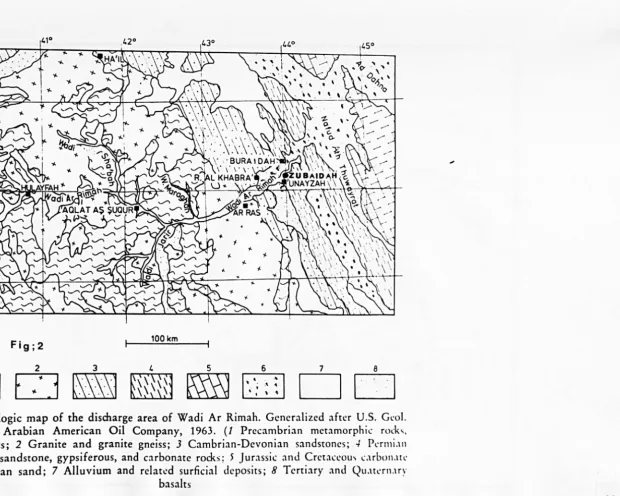
The main and the most impressive feature of the area is the
Wadi Qr-Rimmah. (3) A small part of this wadi, from the west side to
the upper part, lies in the pre-Cambrian Shield, whilst the largest
section, with its tributaries, is a part of the Arabian Shelf. It
continues towards the east to the Mesozoic cuesta landscape where a
large part of the old wadi area is covered by sand dunes (Nafud al
Thuwairat and the Dahna), of the later Quaternary and Holocene period.
(Figure 2). Over a long period the wadi filled up with alluvial
deposits, and much of the flood plain in the area of Buraidah and
Unaizah, including the site of Zubaidah, was covered by sand. The
present wadi is about 4 kms wide; water collects here after winter
storms and is then dispersed beneath the Nafud al Ghamis and Nafud
al Thuwairat.
The sediment on the wadi floor consists mainly of fine elastic
clay with silt-sized particles prevailing in the granite regions.
27°
1\
\L
~)(. I 7(!Z-,I (<J , ]1C
;.¢; ." \ h / " \ g \s . ' y \ ", '-'" . \ \ '\ V .\ '\ ~ ;;-- . • , " ,. . \
,~.
'.~ :~.
"Q '
-260
I.
"'
..
~YFAH"f-11. •• " " . n
250 ' " ~;.). )(r-lC) --" ~l-l'\l ~-4!t~"\~2:: ... "..~
-./:::;t,
\
.
'
.
\
'
.
\
'
k
"
.
~1
~
~
Fig;2
2 3
~
r\\-\\l
~~
100kmI. 5 7 8
~~~'~~~1
~
DO
Fig. 56. Geologic map of the discharge area of Wadi Ar Rimah. Generalized after
u.s.
Gwl.Survey and Arabian American Oil Company, 1963. (1 Precambrian metamorphic ro(k~,
mainly schists; 2 Granite and granite gneiss; 3 Cambrian-Devonian sandstones; -I Pl'rmi,lll
,and Triassic sandstone, gypsiferous, and carbonate rocks; 5 Jurassic and Crctaccau'i (,lrban.H\.'
rocks; 6 Eolian sand; 7 Alluvium and related surficial deposits; 8 Tertiary and Qu,ltl'rIl.lrY
basalts
'"
CAl
s A N D D U N E s
...
. STONE
•
PILES •
AIJAItDOItED
PAL If
Ii II 0 V C S
T R A C C S o F ... A L L S
~ S TIICAIf
---,
,
_ _ _ J
SIT E 2 0 6·7 IUBAYOA Of •
General pun of site Fi9.3
SURFAC(
SHERDS
• fl."
...
...
i
\
\
!
II TRENCH 111
}
-,,/..
,--."
,
If
s
.~
..
• '.H
..
,.,re"
.
')'Ii II 0 V E S
seen in certain places. In addition to the elastic components, there
is also quartz and felspar with small quantities of clay minerals. In
some areas, the sediment is covered by a salt crust. Salty clay
(Wadi Sabkah soil) is found in the area of Riyadh al Khabra and Unaizah
where the main wadi channel is being covered by sand dunes to an ever
increasing extent.
Qasim is referred to as a fertile area by both early and recent
writers and visitors, and by European travellers and explorers.
Al Hamadani, 5 for instance (ninth century AD) described Al Qasim as
having many date palm groves and plenty of water, and Ash Sheikh
Ubood~
also states that many early Moslem writers comment on the fertilityof the area and on the delicious flavour of the fruit grown. They also
mention running springs of water such as An-Nibba and Al.Qariatain.
In evidence of this, the water in Qasim lies near the surface,
and although some of it is slightly salty, there are nevertheless
today a large number of date palm groves, orchards and fields.
Agriculture is of course totally dependent on irrigation.
It would seem that farming and animal husbandry, involving the
care of sheep, goats, camels, horses, donkeys, and probably cattle, were
of great importance to the area. The best areas for tillage are amongst
the dunes, where rain water is easily absorbed and remains near the
surface for plants. There are a number of grasses that grow well
and which are well known to the Arabs in ancient times, for instance
7 As Sa'dan, Ar Ribla and Al Qafra.
As far as animals are concerned, the camel is the most important.
The largest camel market, not only in the Arabian peninsula, but also
in the world is in the Buraidah. 8
on the Haj caravan route between Mecca and Mesopotamia. The merchants
of Qasim travelled to Yemen via the Wadi Dawasir and Wadi Najran
routes in order to import coffee and later export it with other
goods to Kuwait, Basra, Baghdad and Syria. 9
Description of the Site
The site of Zubaidah lies directly on the banks of the Wadi
Ar-Rimmah about 1 km. west of the modern bridge which carried the road
from Unaizah to Buraidah, and 11 kms. from Unaizah itself. (Figure 3).
This is one of the most fertile areas in the region and is surrounded by
date palm groves and gardens (See Plate LXXVII ABC). From the east and
south east of Jadallah Nakheel (Garden) to the south, is an old dried-up
stream, (No. C) perhaps related to the ancient site itself, but this is
not known as studies were not carried out in this area. To the west is
an abandoned palm grove and some disused buildings. To the north are
the dunes and to the north west is a large flat area cut out of the
alluvium and forming bays. In some places these bays were revetted with
rough stone and mud-brick walls, especially near an old, disused well.
During the survey, bulldozing was being carried out in the area
to prepare the ground for the planting of date palms. Most of the
ancient buildings had been destroyed and much of the property and other
remains lay exposed, the deposits being heaped on the eastern and
south-western sides of the grove.
The site near the stream has been destroyed by the planting of
palm groves. Here and there are many scattered sherds and stones from
buildings, but there are some stones in straight lines which may indicate
some kind of walling or structure.
and were sent by local people. The local writer Al Uboody 10 describes
the site, when he says that this site is a palm grove and spring situated
on the north bank of Wadi Ar-Rimmah at the distance of 800 m of the bridge
of Buraidah Unaizah Road on the right hand side. He describes it as an
ancient city which existed before Islam because of the presence of
scattered pot sherds, as traces of what looks like a long street
about 40 m in length, with traces of the smithy with its ashes and
particularly because of the discovery of a human body in a large jar.
He guesses that Zubaidah could be one of the two ancient villages "Al
Qaryatan" which belonged to Tas.im and Jadis (very ancient tribes in
Arabia) and which tradition placed somewhere in this area. One of
t/a
"
IIthese villages was ancient Dha 1 Abwab~IGtewith gates) which perhaps
I
could be Zubaidah, because the village known during the Islamic history as
the recent Al Ayyariyah (ancient Al Askarah), lies just opposite
zubaidah on the other bank of Wadi Ar Rimmah.
An accurate estimate of the extent of the site of Zubaidah cannot
11
be determined, but it is probably some 300 m from east to west • The
extent to the north is uncertain because it is concealed by sand dunes
which are about 12 m above the level of the plantation. A further 200 m
to the north there are again scattered sherds,and since a thorough search
of the more distant dunes was not made, it is possible that still
more outlying scatters exist.
Thus evidence of occupation is far from clear. The structures
which were found in Trench III which are possibly graves are not part
of the main settlement, and there is evidence of a still earlier phase
of occupation beneath the dunes which must be taken into consideration
when estimating the original size of the site.
bank of the wadi, but also existed on the southern side as well. On
both sides of the wadi channel there are lines of standing walls, up
to 1.5 m high in places, so that the stream would probably have been
confined between the two occupation areas in time of flood. This part
of the site was overgrown by vegetation and there were very few sherds
on the ground. Mr. Parr 12 suggests that these structures are possibly
contemporary with the abandoned palm grove, but as the walls on the southern
bank of the stream are definitely earlier than the palm groves it is
impossible to say that these also are contemporary with the main
settlement.
The Archaeological Works at Zubaidah
The site of Zubaidah was found during the Saudi Arabian
Compre-hensive Survey inventory in 1977 by the Department of Antiquities and
Museums. In the time of the survey, two very small trenches were dug
13
(Trench I and II) (see below) •
The site was in the process of destruction by agricultural
activity and in view of this, and in order both to obtain a sequence of
architectural and cultural material and to investigate some of the
environmental aspects of the settlement, it was decided to carry out
more extensive sounding in 1979. Therefore, three more trenches were
dug (Trench II, IV and V). 14
The Excavation and the Stratigraphy
Trench I. This trench of sone 2 x 2 m and about 2.50 m deep was
dug at the north east site in the main settlement, just near the edge
of the abandoned palm groves (See Figure 3). The stratigraphy of this
building phase that associated with the mud-brick structure. The other
structural stratigraphy is not clear because of the very limited
sounding. After the destruction of this phase I building, this part
of the site seems to have been used as a rubbish dump.
Layer 5 produced a curious three-cornered pyrimidica1 stand
(Pl. LXXVI no. 36) ,which may be a support from a pottery kiln. This and the
presence of the numbers of wasters, suggest a pottery industry somewhere
in the vicinity of this area.
Trench II. Trench II about 1 x 1 m and about 1.60 m deep was dug
on the northern edge of the site on the gentle slope of a sand dune
(Figure 3). This trench revealed no building structures. The lower
part of the trench provided important evidence for the earlier history of
the site of zubaidah.
The stratigraphy sequence indicated the presence of two major
phases of occupation here, the lower (the earlier) represented by two
distinct layers of grey ashy earth associated with a few very coarse
pottery sherds of a very different type, the upper by what was probably
a stone-lined grave associated with the standard pottery ("Hellenistic").
These two major periods were separated by 8 em of clean wind-blown
sand, on the surface of which there was evidence for a buried soil-line.
Trench III. (8 x 2 m and about 3.60 m deep). Trench III was
dug nearby Trench lIon the upper slopes of the sand dunes overlooking
the site from the north. This trench revealed two major Phases separated
Phase 1
Phase 1 is the earliest phase found in the lowest layers of this
Trench III, consisted of a succession of layers of different coloured
sand, varying from grey through pink to purple. All had clearly
been subjected to intensive heat and all contained many patches
of black ash, pieces of slag and fragments of copper or bronze,
including some small round pellets, all these evidences indicate of
copper/bronze metallurgical activity of some sort. A thick mass
of stiff grey clay was thought to be a low wall or kerb. If so,
it could be some sort of surround for a pit or working area.
Intermediate Phase
The desertion of the early phase 1 was followed by a period of
abandonment (intermediate Phase) in which soft reddish sand
acc-umulated to about 1-1.25 m in thickness and is represented by layer
3 with several minor surfaces slightly harder and grittier than the
main body of the sand. (See Section 2 and 3 in Plate 71 in
Appendix). Within these surfaces several black ashy lenses occur,
which are taken to be the vestiges of burnt bushes. They and the
minor surfaces, are evidence for a series of stages in the
accumulation of the dune.
Phase 2
The intermediate Phase is followed by Phase 2 and is represented
by a rectangular structure built of yellowish-grey mud brick which
was erected on the surface of the dune (Layer 3) (See Appendix,
plate 71, Section 1). Nothing of the super structure has
appearance as the brick of the structure occur in the layers 1
and 2 and perhapd these fragments could be of this building. The
function of this building is obscure, but as it suggested by
it
Mr. parr,/may have been a "Watch Tower".
It seems that after the abandonment of this building, the foundation
and the ruins were covered by the deposition of sand (the present
dune) •
Trenches IV - V. (20 x 1-5 m and about 1-3 deep). Trenches IV and
V form together one area of excavation towards the southern end of the
main area levelled in 1977.
In the course of the excavation these Trenches, IV and V, three
main phases of occupation and several sub-phases were revealed (See
Appendix, Plate 73, south section of Trench IV-V) •
Phase 1
This is divided into two sub-phases (See Appendix, Plate 72, Plan
A).
phase la
The lower part of Trench IV-V provided important evidence for the
earlier history of the site of Zubaidah. Natural soil wasJreached
1\ot-however. Phase 1 is the earliest phase of occupation discovered
consisting of walls of unbacked brown mud brick (See Plan Plate 71)
and plate 75 in Appendix). A terrace (bench or platform) of
beaten clay can be assigned also .~o this phase. Several occupation
layers run between the walls but the interpretation is not clear
Phase lb
In a later stage, after a partial collapse, the walls of 1 (a)
were repaired and strengthened by the addition of a wall of the
same type of unbacked brown mud-brick as the walls of the Phase lao
In general, it can be said that in the early history of
Zubaidah buildings were built entirely of unbacked brown mud brick
and the walls were erected on the sand without any stone foundations.
Abandonment
At the end of the Phase lb this part of the site was abandoned
and fell into disuse. The ruins then suffered a certain amount of
erosion. The period of destruction is unknown but it looks as though
the ruins were left exposed over a period of time, because of the
formation of a hard crystalline crust on their upper surfaces of the
brick walls.
surfaces of the Brick Walls
During this interval, thick deposits (approximately 1m ) of
sterile sand accumulated covering the ruins of phase 1 building and,
its floors and occupation surfaces.
phase 2 (Plan B plate 72, Appendix)
The period of abandonment was followed by Phase 2. Two sub-phases
can also be distinguished within this Phase 3.
phase 2a
Only one of a structure wall of a distinctive greenish mud brick
phase 2a. This structure is set into the sand which filled the
ruins of the Phase 1. Probably one other wall is contemporary with
this wall, because it is of much the same material and built as
above mentioned wall, though with brown brick as well as green
and is on the same alignment.
Phase 2b
of
In a later stage,after a partial collapse, ,the wall of greenish
mud brick of Phase 2a, it was repaired by the. addition of a wall,
and is therefore to be assigned, not to Phase 2a but to phase 2b
it seems.
The other wall of the brown and green mud brick also was repaired
by addition of this wall. Therefore both additional walls were
a~signed to Phase 2b and not to Phase 2a.
Some of the structures and the surfaces belonging to Phase 2b in
this part of the trench perhaps have been removed, either by
recent bulldozing operations or by structures of Phase 3.
Phase 3 (Plan B, Plate 72, Appendix)
Several architectural remains which can be attributed to this
phase are the foundations of the walls, consisting of unworked or
roughly worked stones set in a light brown mud mortar. The
foundation cut through the debris resulting from the destruction
of walls of the phase 2a.
In the plan (Plan B, Plate 72, Appendix ) the stone structures
of Phase 3 can be traced over a greater area (approximately 15 x 5
m), than can those of the earlier periods. Two walls of the
courtyard approximately 8 m x 2 m in size, having a large area,
at least 8 m x 8 m on its north east side.
It is important to point out that only a few layers in Trench IV
are assigned to definite phases, while a great number of them are
uncertain and not assigned. This is because of the difficulties
and uncertainties of interpretation. None of the layers of
Trench V (which is the higher part of Trench IV) are assigned to
any phase, because they mostly appear to be disturbed by the recent
agricultural activity in the area. Some layers in Trench IV
are assigned to phases but only doubtfully and the.se are marked
by a question mark in the tables 1-5 and in the provenance list,
below.
Provenance List
Trench
Layer
Phase
I 1
2 Assumed to be of the
3 latest period
4 of the site
5
II 1 2
2 2
3 2
4 1
5 1
III 1 2
2 2
3 Intermediate Phase
4 1
5 1
6 1
7 1
8 1
9 1
10 1
IV 14 3
16 3
16a 3
19 3?
20 2B
21 3
22 2B
24 2A?
26 2B
28 2B
36 2A
38 3
39 2A
41 2A
42 2A
43 2A
47 2A
49 2A
50 2A
51 lB
52 lA
53 lB?
54 lB?
59 lB
60 lB
61 1A
64 lA
65 1A
66 1A
68 lA
69 1A
70
The Reliability of the Zubaidah Pottery
Although zubaidah is a large site, and gives the impression of being
an important one, by its scattered potsherds and its ruins, and although
the pottery yielded by the excavation was indeed largely associated with
the building structures and the occupation levels, it seems that accurately
datable material is by no means easily discoverable, and that it is in
fact not as reliable as might have been hoped, for the following reasons
in particular.
1. First of all, the excavated trenches were of very limited extent.
The main reason for this was that the time available was very short,
a very small and completely inexperienced workforce was employed and
the limited excavation was the unstable nature of the sands, which made
it impossible in certain areas to dig further down than about 50 cm
without the wall of the trenches caving in. For example, by the end
of the 1979 season, a depth of c 3m had been reached in a restricted area
in the centre of Trench III but only by sloping the sides and by
supporting them with a retaining wall of concrete blocks; arduous
operations which took up a great deal of the available time.
2. Secondly the excavation itself was largely in the nature of a
training excavation.
3. Thirdly, the accuracy of the stratigraphical elements was in doubt.
This again, was due to the smallness of the excavated areas, particularly
at the bottom of the trenches where these areas became progressively
smaller, causing problems for the interpretations of the layers and for
the determination of the true nature of the buildings; sometimes indeed
the small exposed areas did not produce any artefacts whatever.
4. Fourthly, neither the excavation nor the surface collection in
either season yielded the imported black glazed pottery as found at Thaj
and Bahrain. Accordingly, the position is that the only satisfactory
for the dating of the Zubaidah material is C14.
The pottery from Zubaidah
The most obvious aspect of the Zubaidah pottery is the paucity of
its excavated examples. Thousands of pot sherds lay scattered on the
surface of the site, but the excavated sherds here are probably very
much fewer in proportion to the surface sherds than at any other excavated
site in the Arabia. The sherds selected from the bulk of the Zubaidah
pottery for classificatory purposes number 587, but of this total number,
from the surface collection. These latter are included in this study
to ascertain, or if possible complete, the sequence of the pottery
throughout Zubaidah's history. Except for a few, all the sherds are
rim or base sherds, the few exceptions being handles with body sherds
and pottery objects. Only one complete jar (Plate LXXXVI A and B)and the
other semi complete jar were found during the agricultural activities.
(See Tables 3B and 4 for the distribution of the sherds by phases and
levels in each Trench). The majority of the sherds are in fact of bowl
rims - 51% while jar-rims amount to only 15-50%.
All the excavated pottery came from the occupation levels of the
different phases, but the amount differed from phase to phase and from
level to level; thus some of the levels yielded only one or two sherds.
It is important to realise at this point as it has already been
mentioned, that the excavated area at Zubaidah was relatively limited
and this fact clearly limited the amount of pottery, so that one cannot
depend on the figures given above having a more extended significance.
However, the amount of material investigated is not in itself an
unreasonable foundation for the study of Zubaidah pottery, and is about
enough to give some general ideas and perspectives regarding the pottery
types throughout Zubaidah's long history.
Technique
Method of Manufacture
Before studying individual types of ware, it is useful to look
at the methods of manufacture and technical qualities of the pottery
as a whole.
The majority of Zubaidah pottery so far studieQ is wheel-made, only
entirely hand-made, whilst .the pottery of Phases 2 and 3 is mainly
wheel-made, although some of the pottery of these phases from the later
occupation levels is also hand-made.
Large vessels are not necessarily hand-made; there are a great
many large jars from Zubaidah made on the wheel. There are equally some
examples of small pots that are hand-moulded with a very rough finish
(Plate LXXVIII-a). This illustrates the base of a small vessel made by
hand. The surface was very rough, so the potter attempted to smooth
it by placing a thin slip over it; he did not however, completely
succeed. On the outer surface, some finger impressions and lumps of
clay have been left. This indicates that the potter did not use a rag
or piece of wood or bone to smooth the surface but depended entirely on
his hands. Plate LXXVIIl·b is a section of the same base illustrating
an irregular surface because it is hand-made.
As has already been mentioned, the excavation at Zubaidah yielded
no complete vessels, only fragments, so it is difficult to say whether
the large jars were manufactured in separate parts and fitted together
after being dried, or whether they were built up in one piece.
With regard to rim thickening, whether on the exterior or interior,
the potter at Zubaidah seems to have used the both techniques of coiling
and folding. Some externally or internally thickened rims were made by
adding a coil to the plain rim of a vessel. Plate LXXVllI-c shows the
rim of a large storage jar which had been produced by folding its first
sample rim inward slightly (th.e. . arrow) and then addin;J a coil of
about 3-8 mm thick to the inside. The joint was disguised by the
application of slip on the inside and on the top of the rim. A tell-tale
hairline crack in the section (th.~ arrow) indicates the addition of