349 | P a g e
MODELLING AND OPTIMIZATION OF WIRE EDM
PROCESS PARAMETERS
K. Kumar
1, R. Ravikumar
2 1Research Scholar, Department of Mechanical Engineering, Anna University, Chennai,
Tamilnadu, (India)
2
Professor, Department of Mechanical Engineering, CMS College of Engineering,
Namakkal, Tamilnadu, (India)
ABSTRACT
Machining of Composite material creates demand for low weight to strength ratio for exclusive application in automobile and aerospace industries. The present work is aimed to optimize the Surface roughness and material removal rate of Magnesium and its composites addition considerably 5%,10% and 15% of Silicon carbide has been studied by drilling the composite plates under different parameters of Wire EDM process by considering the effect of input parameters viz. Wire Speed, Wire feed, Pulse time on and Pulse time off. Experiments have been conducted with these parameters in three different levels data related to process responses viz. Optimum machining condition for maximizing metal removal rate and minimizing the surface roughness is determined using desirability function approach. A comprehensive mathematical model for correlating the interactive and higher order influences of various machining parameters using Taguchi method with an L9 fractional factorial
design selected for the study. Grey relation theory is adopted to determine the best process parameters that optimize the response measures. The experimental results confirm that the proposed method in this study effectively improves the machining performance of WEDM process.
Keywords: GRA, Mg/SiC
p, Surface Roughness (R
a), Wire EDM, MRR,
I. INTRODUCTION
WEDM process involves the complex erosion effect by rapid repetitive and discrete spark discharges between
the wire tool electrode and work piece immersed in a liquid dielectric medium. As research work even in
WEDM much standard references are not available for the selection of the parameters and the level for
optimizing the performance characteristics. Hence it is necessary to conduct an extensive experimental
investigation to study the effect of different process parameters for the accuracy and surface finish of WEDM
machined components. An attempt is also made to obtain machinery performance with the RSM. GRA is
employed along with taguchi method, the percentage error between experimental values and predicted results
are found separately. Mathematical models are developed to correlate the process parameters and performance
350 | P a g e
1.1 Literature Review
The magnesium and silicon carbide composite are selected for the process. These metals have good mechanical
strength and are conductive (Neera Sharma, N., et al.,2013,Gao,C., et al.,2012). Due to their high mechanical
strength and high corrosion resistance properties, these are used in Marine, automotive and other applications (
Kamal jangra, D.,et al .,2013).
These metals are cast by stir casting at 10% and 20% wt ratios of silicon carbide. The increase in strength of the
composite relatively to the percentage of SiC present (Muthu Kumar, V., et al., 2010). The project involves
optimization of machining parameters of WEDM on magnesium silicon carbide composite. This study focused
on machining of magnesium silicon carbide using WEDM, in order to satisfy production and quality
requirement (Saurav Datta, D., et al.,2010).
The selection of optimum machining parameters in WEDM is an important step. Improperly selected parameters
may result in serious problems like short-circuiting of wire, wire breakage and work surface damage which is
imposing certain limits on the production schedule and also reducing productivity. The Material Removal Rate
and Surface Roughness are most important responses in WEDM (Kuo-WeiLin&Che-ChungWang.,2010).For
the optimal selection of process parameters, the Taguchi method has been extensively adopted in manufacturing
to improve the processes with single performance characteristic. However, traditional Taguchi method cannot
solve multi-objective optimization problem ( Kamal Jangra, et al., 2011).To overcome this, the Taguchi method
coupled with Grey relational analysis has a wide area of application in manufacturing processes. A grey
relational grade is obtained to evaluate the multiple performance characteristics (Singh, H., & Garg, R.,
2009).As a result, optimization of the complicated multiple performance characteristics can be converted into
the optimization of a single grey relational grade.
The Grey Taguchi method was established for combining both grey relational analysis and the Taguchi method.
This study investigated the multi-response optimization of WEDM process for machining of magnesium silicon
carbide using combination of Grey Relational analysis and Taguchi method to achieve higher Material Removal
Rate (MRR), lower surface roughness (Ra) and necessary confirmation tests were conducted to validate the
experimental results(Rao, R. V., & Pawar, P. J., 2014).
1.2 Problem Identification
The machining of magnesium silicon carbide is difficult in ordinary conventional method. The hardness of the
metal will damage the tool and creates the tool wear. Due to the friction, magnesium silicon carbide gets fired.
Wire cut edm is suitable for machining this type of composite material. So, SPRINT CUT 734 DI WATER CUT
351 | P a g e
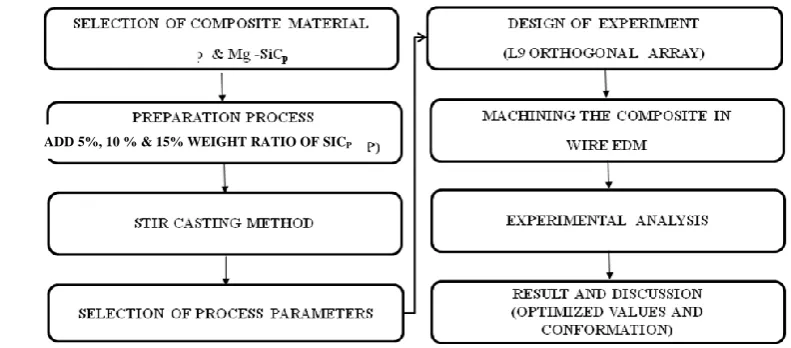
II. METHODOLOGY
III. EXPERIMENTAL WORK
Experiments are conducted in Mg SicP composites with three levels of control factors. Experimentation is
developed using DOE with input parameters as shown in table 1.
TABLE 1 Process Parameters and Levels
SYMBOL CONTROL
FACTOR UNIT LEVEL 1 LEVEL 2 LEVEL 3
A WIRE SPEED rpm 500 1000 1500
B WIRE FEED mm/min 1.0 1.1 1.2
C PULSE-ONTIME µs 120 124 128
D PULSE-OFFTIME µs 42 44 46
Holes of 5 mm diameter are drilled on 10 mm thick Mg-sic plate. WEDM using molybdenum wire of diameter
0.18 mm. The influence of process parameters on the machining of drilled hole is also analyzed. The average
surface roughness (Ra) value of drilled hole is determined using surface roughness tester. The material removal
rate (MRR) is evaluated as the average volume of material removed over the machining time in mm3/sec. The
experiments were performed on SPRINT CUT 734 DI WATER CUT WEDM is shown in fig.1. The
experimental set up is shown in figure. 2. The workpiece is shown in fig.3.The molybdenum wire as tool
electrode with flushed type dielectric fluid pressure 0.2 kgf/cm2 (distilled water) bath between work piece and
electrode. Electrical power and controlling system is controlled with servo controlled resistance capacitance
(Rc) circuit which ensures low discharge current with high frequency to control input process parameters.
352 | P a g e
Fig.1. Sprint Cut 734 Di Fig. 2. Machining Setup Fig. 3. Work Piece
Water Cut Wedm
IV. RESULT
TABLE2 Experimental Results of Mg SicP 5%
EXP.NO
CONTROL FACTORS RESPONSES
A B C D MRR (mm³/sec) Ra(µm)
1 1 1 1 1 6.68 3.8025
2 1 2 2 2 6.76 3.753
3 1 3 3 3 6.73 3.796
4 2 1 2 3 7.09 3.7095
5 2 2 3 1 7.56 3.7085
6 2 3 1 2 7.46 3.6575
7 3 1 3 2 7.76 3.6295
8 3 2 1 3 7.84 3.7855
9 3 3 2 1 7.43 3.908
TABLE 3 Experimental Results Of Mg SicP 10%
EXP.NO
CONTROL FACTORS RESPONSES
A B C D MRR(mm³/sec) Ra (µm)
1 1 1 1 1 6.33 4.1295
2 1 2 2 2 6.48 3.769
3 1 3 3 3 6.58 3.7145
4 2 1 2 3 6.81 3.6605
5 2 2 3 1 6.73 3.607
6 2 3 1 2 6.99 3.7475
353 | P a g e
8 3 2 1 3 7.14 4.026
9 3 3 2 1 7.13 4.161
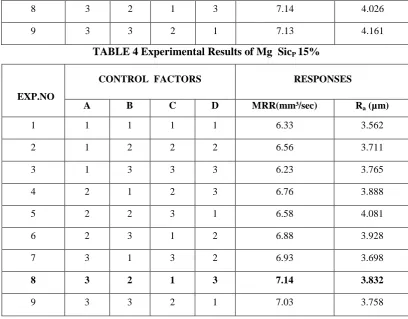
TABLE 4 Experimental Results of Mg SicP 15%
EXP.NO
CONTROL FACTORS RESPONSES
A B C D MRR(mm³/sec) Ra (µm)
1 1 1 1 1 6.33 3.562
2 1 2 2 2 6.56 3.711
3 1 3 3 3 6.23 3.765
4 2 1 2 3 6.76 3.888
5 2 2 3 1 6.58 4.081
6 2 3 1 2 6.88 3.928
7 3 1 3 2 6.93 3.698
8 3 2 1 3 7.14 3.832
9 3 3 2 1 7.03 3.758
4.1. Optimization Steps to Find Grey Relational Grade
TABLE 5 Grey Relational Co-Efficient and Grey Relational Grade of Mg 5%
Exp.no
Control factors Grey relational co-efficient Grey grade
A B C D MRR
(mm³/sec)
RA (µm) NO UNIT
1 1 1 1 1 1 0.37 0.4535
2 1 2 2 2 0.916 0.549 0.413
3 1 3 3 3 0.954 0.395 0.4505
4 2 1 2 3 0.628 0.705 0.4285
5 2 2 3 1 0.228 0.709 0.5495
6 2 3 1 2 0.311 0.896 0.487
7 3 1 3 2 0.065 1 0.6085
8 3 2 1 3 0 0.43 0.7685
354 | P a g e
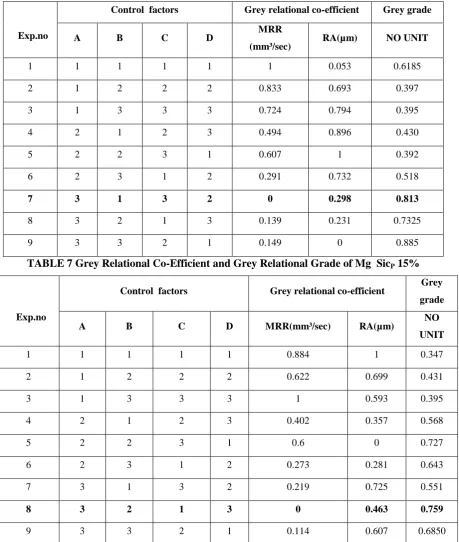
TABLE 6 Grey Relational Co-Efficient and Grey Relational Grade of Mg SicP 10%
Exp.no
Control factors Grey relational co-efficient Grey grade
A B C D MRR
(mm³/sec) RA(µm) NO UNIT
1 1 1 1 1 1 0.053 0.6185
2 1 2 2 2 0.833 0.693 0.397
3 1 3 3 3 0.724 0.794 0.395
4 2 1 2 3 0.494 0.896 0.430
5 2 2 3 1 0.607 1 0.392
6 2 3 1 2 0.291 0.732 0.518
7 3 1 3 2 0 0.298 0.813
8 3 2 1 3 0.139 0.231 0.7325
9 3 3 2 1 0.149 0 0.885
TABLE 7 Grey Relational Co-Efficient and Grey Relational Grade of Mg SicP 15%
Exp.no
Control factors Grey relational co-efficient Grey
grade
A B C D MRR(mm³/sec) RA(µm) NO
UNIT
1 1 1 1 1 0.884 1 0.347
2 1 2 2 2 0.622 0.699 0.431
3 1 3 3 3 1 0.593 0.395
4 2 1 2 3 0.402 0.357 0.568
5 2 2 3 1 0.6 0 0.727
6 2 3 1 2 0.273 0.281 0.643
7 3 1 3 2 0.219 0.725 0.551
8 3 2 1 3 0 0.463 0.759
9 3 3 2 1 0.114 0.607 0.6850
4.2 Optimum Levels of the Factors
Since the experimental design is orthogonal, it is possible to separate out the effect of each machining parameter
on the grey relational grade at different levels. The mean of the grey relational grade for each level of the other
machining parameters can be computed in a similar manner. The mean of the grey relational grade for each level
355 | P a g e
Table 8 Main Effects of the Factors on the Grey Relational Grade for Mg SiCP 5%
SYMBOL CONTROL
FACTORS LEVEL 1 LEVEL 2 LEVEL 3
A SPEED 0.439 0.488 0.7253*
B FEED 0.496 0.577 0.588*
C PULSE ON 0.496 0.5888* 0.521
D PULSE OFF 0.592* 0.496 0.521
*Optimum level
Table 9 Main Effects of the Factors on the Grey Relational Grade for Mg SiCP
10%
SYMBOL CONTROL
FACTORS LEVEL 1 LEVEL 2 LEVEL 3
A SPEED 0.4702 0.447 0.8102 *
B FEED 0.6207 * 0.5072 0.5995
C PULSE ON 0.6095 * 0.5072 0.5905
D PULSE OFF 0.5072 0.6207 * 0.521
*Optimum level
Table 10. Main Effects of the Factors on the Grey Relational Grade for Mg SiCP
15%
SYMBOL CONTROL
FACTORS LEVEL 1 LEVEL 2 LEVEL 3
A SPEED 0.391 0.6462 0.6478 *
B FEED 0.489 0.639 * 0.5568
C PULSE ON 0.4432 0.6278* 0.5598
D PULSE OFF 0.439 0.6282 * 0.5468
356 | P a g e
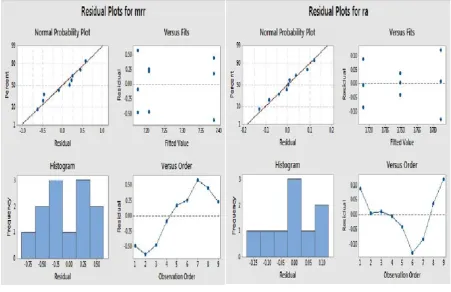
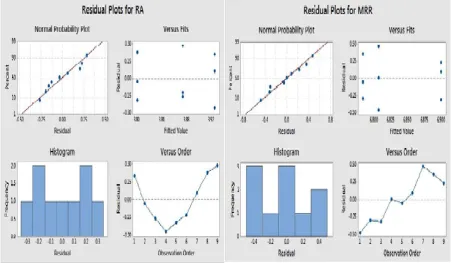
Fig.4. Residual plot for output parameters of Mg SicP 5%
357 | P a g e
Fig. 6. Residual plot for output parameters of Mg SicP 15%
V. DISCUSSION
The confirmation test for the optimal parameter setting with its selected levels was conducted to evaluate the
quality characteristics for Wire EDM of Mg SicP5 %, Mg SicP10 % & Mg SicP 15%
The table.14. shows that the significant machining parameters for performance measures of surface
roughness in the WEDM process. Factors like speed, feed, Time on and Time off have been found to play a
significant role for MRR and surface roughness. Taguchi’s method is used to obtain optimum parameters
combination for maximization of MRR and minimization of surface roughness. The conformation
experiments were conducted to evaluate the result predicted from Taguchi’s Optimization.
TABLE 14 Optimal Process Parameters
MATERIAL FACTOR MRR
(mm³/sec) Ra (µm)
Mg SicP5%
Orthogonal array 7.84 3.7855
Grey theory design 8.72 3.803
Mg SicP10%
Orthogonal array 7.28 3.9875
Grey theory design 7.93 4.234
Mg SicP15%
Orthogonal array 7.14 3.832
358 | P a g e
VI. CONCLUSION
In this project, an application of combined Taguchi Method and Grey Relational Analysis, to improve the
multi-response characteristics of MRR (Material Removal Rate), Surface roughness in the Wire-Cut EDM (Electrical
Discharge Machining) of pure Mg SicP 5%, Mg SicP 10% & Mg SicP15% has been done. As a result, this
method greatly simplifies the optimization of complicated multiple performance characteristics and since it does
not involve complicated mathematical computations, this can be easily utilized by the Manufacturing world.
1. For The pure Mg SicP 5%, the optimal value from the L9 orthogonal array is (EX.NO.8) with (speed – 1500
rpm) , (feed – 1.2 mm/min) , (pulse on – 124µs ) , (pulse off – 42 µs). where as the optimal value obtained
from the Grey theory design is (speed – 1500 rpm) , (feed – 1.0 mm/min) , (pulse on – 120µs) , (pulse off –
46 µs) .
2. For Mg SicP10% the optimal value from the L9 orthogonal array is (EX. NO7) with (speed – 1500 rpm) ,
(feed – 1.1 mm/min) , (pulse on – 124 µs ) , (pulse off – 42 µs) .where as the optimal value obtained from
the Grey theory design is (speed – 1500 rpm) , (feed – 1.2 mm/min) , (pulse on – 124 µs ) , (pulse off– 42
µs) .
3. For Mg SicP 15% the optimal value from the L9orthogonal array is (EX.NO 8) with (speed – 1500 rpm) ,
(feed – 1.2 mm/min) , (pulse on – 124 µs ) , (pulse off – 46 µs), where as the optimal value obtained from
the Grey theory design is (speed – 1500 rpm) , (feed – 1.1 mm/min) , (pulse on – 120 µs ) , (pulse off – 46
µs) .
4. While applying the Grey Taguchi method, the Material Removal Rate shows an increased value.Thus, it
can be concluded that the Grey Taguchi Method is suitable for the parametric optimization of the Wire
Cut EDM process, when using the multiple performance characteristics such as Material Removal Rate
(MRR), Surface Roughness(Ra)for machining the MgSicP5%, MgSicP10% & MgSicP15%.
REFERENCES
[1] Neera Sharma, N., et al.,2013, ‘Modelling and multi response optimization on WEDM for HSLA by RSM’.
International Journal of Scientific and Research Publications, vol. 3, no. 3, pp.1645-1648.
[2] Gao, C., et al.,2012, ‘Research on WEDM process optimization for PCD micro milling tool’. International
Journal of Scientific and Research publications, vol. 2, no. 12, pp.79–90. ISSN 2250-3153.
[3] Kamal jangra, D.,et al .,2013, ‘Optimization of multi machining characteristics in wedm of WC-5.3%Co
composite using integrated approach of taguchi method’. International Journal of Scientific and Research
Publications, vol. 3, no. 3, pp.40–44. ISSN 2250-3153.
[4] Muthu Kumar, V., et al., 2010, ‘Optimization of Wire Electrical Discharge Machining process parameters
of Incoloy800 super alloy’. International Journal of Engineering Science and Technology, vol. 2, ISSN
1538-1547.
[5] Saurav Datta, D., et al.,2010, ‘Modeling, simulation and parametric optimization of wire EDM process
using response surface methodology coupled with grey-Taguchi technique’ International Journal of
359 | P a g e
[6] Kuo-WeiLin & Che-ChungWang., 2010, ‘Optimizing Multiple Quality Characteristics of Wire ElectricalDischarge Machining via Taguchi method-based Gray analysis for Magnesium Alloy’. Journal of C.C.I.T.,
vol.39, no.1,
[7] Kamal Jangra, et al., 2011, ‘Simultaneous optimization of material removal rate and surface roughness for
WEDM of WCCo composite using grey relational analysis along with Taguchi method’. International
Journal of Industrial Engineering Computations.vol. 2, pp.479–490.
[8] Singh, H., & Garg, R., 2009, ‘Effects of process parameters on material removal rate in WEDM’. Journal
of achievements in material and manufacturing engineering, vol. 32, pp.580-587.
[9] Rao, R. V., & Pawar, P. J., 2015-11-16, ‘Modelling and optimization of process parameters of wire
electrical discharge machining’ . Proc I Mech E, Part B: J. Engng Manufact., pp.233, ISSN 1431–1440.
[10] Kumar,K.,& Ravikumar,R.,2014, ‘Modelling and optimization of wire EDM process parameters’
International Journal of Mechanical & Mechatronics Engineering,IJMME-IJENS,vol.14no.05, PP.37-50.