DOI: will be set by the publisher c
Owned by the authors, published by EDP Sciences, 2018
Precision RENORM / MBR Diffraction Predictions Tested by
Re-cent LHC Results
Konstantin Goulianos1,a
1The Rockefeller University, 1230 York Avenue, New York, NY 10065–6399, USA
Abstract. Diffractive, elastic, and precision total pp cross-section predictions, based on the pre-LHC RENORM/MBR model, are compared to recent experimental results. Discrepancies among results by different experiments present a challenge to testing the model. Suggestions for analyses/measurements to understand and resolve the experimen-tal discrepancies are discussed.
1 Introduction
We present an updated comparison between the precision RENORM/MBR model [1] diffraction
predictions and LHC experimantal results, presented at ICNFP-2016, to cover new measurements. Below, we provide a brief historical background of the evolution of the model to a precision tool for data collection and analysis.
In DIS-2015 (Spring 2015) we summarized [2] the pre-LHC predictions of the total, elastic and
total-inelastic, as well as the single diffractive (SD) and double diffractive (DD) components of the
proton-proton cross section at high energies based RENORM/MBR [1]. We compared the
measure-ments of the SD and DD cross sections from the Tevatron and the LHC with the predictions of the model and found excellent agreement. Good agreement was also observed between the model
predic-tions and the total, elastic and total inelastic cross secpredic-tions obtained at the Tevatron at √s=1.8 TeV,
and at the LHC at √s=7 and 8 TeV.
The confirmation of the predictions of all the above cross sections at the Tevatron and the LHC up
to√s=8 TeV prompted a calculation/extrapolation to √s=13 TeV, the nominal foreseen
colliding-beam energy at the LHC for Summer 2015. Forσtot,σelandσinel, we predicted 108 mb, 32 mb, and
77 mb, respectively, with uncertainties of∼ 11% in all cases, mainly due to the uncertainty in the
energy-squared scale parameters0of the model.
In Summer 2015 we updated the energy-squared scale parameter s0 of RENORM/MBR to a
more precise value based on a tensor glueball interpretation of the Axial Field Spectrometer (AFS)
exclusive charged di-pion data [3–5]. This change in RENORM/MBR decreases the uncertainties
in the predictions of the total, elastic, and total-inelastic cross sections to less than 2% from Tevatron
to LHC energies, with little or no effect on the mean values. The predictions were compared with
measurements by ATLAS at √s=7 TeV and by TOTEM at √s=7 and 8 TeV at Moriond QCD in
March 2016 [6] and found to be in good agreement.
At ICNFP-2016 (July 2016) we presented an update of [6] to include the new measurements of
the total inelastic cross section at √s = 13 TeV by ATLAS and CMS reported at DIS-2016 (April
2016) [7]. All measured cross sections were in good agreement within the experimental
uncertain-ties of the data and the theoretical uncertainuncertain-ties of the model, reaching down to the∼1% level
(Ta-ble 1). However, there were some disagreements among the measurements themselves and with the
RENORM/MBR predictions at the∼2σlevel.
We recalled that in RENORM the total inelastic cross section is calculated as the difference
be-tween the total and the elastic cross sections, and thus, a measured lowerσelwould result in a higher
σinel. As can be seen in Table 1, at ICNFP-2016 the MBRσelwas larger than the TOTEM and CMS
measurements by∼2 mb at√s=7 TeV, which would imply a higher MBR prediction forσelat 13 TeV
by∼2 mb as well. We recommended that the interplay betweenσelandσinelbe carefully taken into
consideration as more measurements of bothσel andσtot at √s = 8 TeV and √s = 13 TeV with
reduced luminosity and extrapolation uncertainties became available.
After INNFP-2016, preliminary new results were presented at ICHEP-2016 (August) [8] (cf.
Ta-ble 1). NotaTa-ble among them are the updated measurements at √s = 13 TeV by ATLAS of
σATLASinel =79.3±0.6(exp)±2.5(extr)±1.3(lum) and CMSσCMSinel =71.3±0.5(exp)±2.7(extr)±2.1(lum).
The new results are compatible at the 2σlevel of all the uncertainties combined in quadratute.
A new measurement by TOTEM ofσtot, σelandσinel at √s=2.76 TeV was presented at
DIS-2017 (April DIS-2017) [9] (cf. Table 1). The data are in excellent agreement with the RENORM/MBR
predictions down to the∼1% level.
2 RENORM cross sections
The total, elastic, and total-inelastic cross sections in the RENORM/MBR model depend on the value
of the energy-squared scale parameter,s0. Quoting verbatim from Ref. [2],
“The total cross section (σtot) is expressed as [10]
σtotp±p= 16.79s0.104+60.81s−0.32∓31.68s−0.54 for √s≤1.8 TeV, (1)
σtotp±p= σCDFtot +sπ 0
ln s
sF
2
−lnsCDF sF
2
for √s≥1.8 TeV, (2)
where s0 and sF are the energy and (Pomeron flux) saturation scales, s0 = 3.7 ±1.5 GeV2 and
√s
F =22 GeV, respectively. For √s≤1.8 TeV, where there are Reggeon contributions, we use the
global fit expression [11], while for √s≥1.8 TeV, where Reggeon contributions are negligible, we
employ the Froissart-Martin formula [12–14]. The two expressions are smoothly matched at√s≈1.8
TeV. Theσelfor √s≤1.8 TeV is obtained from the global fit [11], while for 1.8< √s≤50 TeV we
use an extrapolation of the global-fit ratio ofσel/σtot, which is slowly varying with √s,multiplied by
σtot. The total non-diffractive cross section is given byσND=(σtot−σel)−(2σSD+σDD+σCD).”
2.1 Tensor glueball exchange predictions vs. measurements
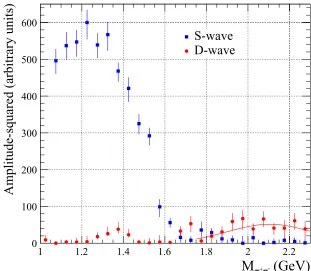
The partial wave analysis of the AFS exclusiveπ±data [5], performed in terms of a fit with a model
with S-wave and D-wave amplitudes as a function of the di-pion mass up to 2.3 GeV, leads to the results presented in Figure 1.
The D-wave dominates at masses above∼ 2 GeV, and according to the presumed interpretation in
Ref. [5] it corresponds to a spin-2 tensor glueball of mass Mtgb. A Gaussian fit to this enhancement
yields Mtgb =2.10±0.68 GeV. Identifying M2tgbwith the saturated glueball-like enhancement of the
At ICNFP-2016 (July 2016) we presented an update of [6] to include the new measurements of
the total inelastic cross section at √s = 13 TeV by ATLAS and CMS reported at DIS-2016 (April
2016) [7]. All measured cross sections were in good agreement within the experimental
uncertain-ties of the data and the theoretical uncertainuncertain-ties of the model, reaching down to the∼1% level
(Ta-ble 1). However, there were some disagreements among the measurements themselves and with the
RENORM/MBR predictions at the∼2σlevel.
We recalled that in RENORM the total inelastic cross section is calculated as the difference
be-tween the total and the elastic cross sections, and thus, a measured lowerσelwould result in a higher
σinel. As can be seen in Table 1, at ICNFP-2016 the MBRσelwas larger than the TOTEM and CMS
measurements by∼2 mb at √s=7 TeV, which would imply a higher MBR prediction forσelat 13 TeV
by∼2 mb as well. We recommended that the interplay betweenσelandσinelbe carefully taken into
consideration as more measurements of bothσelandσtot at √s = 8 TeV and √s = 13 TeV with
reduced luminosity and extrapolation uncertainties became available.
After INNFP-2016, preliminary new results were presented at ICHEP-2016 (August) [8] (cf.
Ta-ble 1). NotaTa-ble among them are the updated measurements at √s = 13 TeV by ATLAS of
σATLASinel =79.3±0.6(exp)±2.5(extr)±1.3(lum) and CMSσCMSinel =71.3±0.5(exp)±2.7(extr)±2.1(lum).
The new results are compatible at the 2σlevel of all the uncertainties combined in quadratute.
A new measurement by TOTEM of σtot,σel andσinelat √s=2.76 TeV was presented at
DIS-2017 (April DIS-2017) [9] (cf. Table 1). The data are in excellent agreement with the RENORM/MBR
predictions down to the∼1% level.
2 RENORM cross sections
The total, elastic, and total-inelastic cross sections in the RENORM/MBR model depend on the value
of the energy-squared scale parameter,s0. Quoting verbatim from Ref. [2],
“The total cross section (σtot) is expressed as [10]
σtotp±p = 16.79s0.104+60.81s−0.32∓31.68s−0.54 for √s≤1.8 TeV, (1)
σtotp±p = σCDFtot +sπ 0
ln s
sF
2
−lnsCDF sF
2
for √s≥1.8 TeV, (2)
where s0 and sF are the energy and (Pomeron flux) saturation scales, s0 = 3.7 ±1.5 GeV2 and
√s
F =22 GeV, respectively. For √s≤1.8 TeV, where there are Reggeon contributions, we use the
global fit expression [11], while for √s≥1.8 TeV, where Reggeon contributions are negligible, we
employ the Froissart-Martin formula [12–14]. The two expressions are smoothly matched at√s≈1.8
TeV. Theσelfor √s≤1.8 TeV is obtained from the global fit [11], while for 1.8< √s≤50 TeV we
use an extrapolation of the global-fit ratio ofσel/σtot, which is slowly varying with √s,multiplied by
σtot. The total non-diffractive cross section is given byσND=(σtot−σel)−(2σSD+σDD+σCD).”
2.1 Tensor glueball exchange predictions vs. measurements
The partial wave analysis of the AFS exclusiveπ±data [5], performed in terms of a fit with a model
with S-wave and D-wave amplitudes as a function of the di-pion mass up to 2.3 GeV, leads to the results presented in Figure 1.
The D-wave dominates at masses above∼ 2 GeV, and according to the presumed interpretation in
Ref. [5] it corresponds to a spin-2 tensor glueball of mass Mtgb. A Gaussian fit to this enhancement
yields Mtgb =2.10±0.68 GeV. Identifying M2tgbwith the saturated glueball-like enhancement of the
MBR parameters0(see Eq. 2) yieldss0 =4.42±0.34 GeV2. Using this value in Eq. 2 we predicted
(GeV)
-π
+
π
M
1 1.2 1.4 1.6 1.8 2 2.2
Amplitude-squared (arbitrary units)
0 100 200 300 400 500 600
S-wave
D-wave
Figure 1.Extraction of tensor-glueball-exchange parameters from a Gaussian fit to the exclusiveπ±Axial Field
Spectrometer data. The fit yields a mean mass valueMπ+π−=2.10 GeV of width∆ =±0.68 GeV.
forσtot,σel, andσinelat 13 TeV cross sections of 103.7±1.9 mb, 30.2±0.8 mb, and 73.5±1.3 mb,
respectively. The ATLAS- and TOTEM-measured cross sections at √s= 7 and 8 TeV [15–17] are
shown in Table 1 along wiith the MBR predictions.
The ICNFP-2016, ATLAS and CMS cross-section are imported from Ref. [7]. Details of the ATLAS results, as presented in [7], are listed below:
1. Elastic cross section:
σALFAel (7 TeV)=24.00±0.19 (stat)±0.57 (syst) mb
2. Nuclear slope:
bALFA(7 TeV)=19.73±0.14 (stat)±0.26 (syst) GeV−2
3. Total cross section
σALFAtot (7 TeV=95.35±0.38 (stat)±1.25 (exp)±0.37 (extr) mb
4. Inelastic cross section:
• σALFAinel (7 TeV)=71.34±0.36 (stat)±0.83 (syst) mb
• σMBTSinel (7 TeV)=69.4±2.4 (exp)±6.9 (extr) mb
Table 1.The total, elastic, and total inelastic MBR predictions (in mb) at√s=7, 8 and 13 TeV presented at ICNFP-2016 vs. measurements at the LHC by TOTEM and ATLAS. Also shown are updated results by ATLAS
for√s=8 and 13 TeV and CMS for√ √s=13 TeV presented at ICHEP-2016, and TOTEM results for
s=2.6 TeV presented at DIS-2017.
√s MBR Experiment σ
tot σel σinel
(TeV) (mb) (mb) (mb)
7 MBR 95.4±1.2 26.4±0.3 69.0±1.0
TOTEM 98.3±2.9 24.8±1.3 73.7±1.7
TOTEM_Lum_ind 98.0±2.5 25.2±1 72.9±1.5
ATLAS 95.35±1.36 24.00±0.60 71.34±0.90
8 MBR 97.1±1.4 27.2±0.4 69.9±1.0
TOTEM 101.7±2.9 27.1±1.4 74.7±1.7
ATLAS-ICHEP16 96.1±0.9 27.1±1.4 74.7±1.7
13 MBR 103.7±1.9 30.2±0.8 73.5±1.3
ATLAS xxx xxx 73.1±0.9(exp)±3.8(extr)±6.6(lum)
ATLAS-ICHEP16 xxx xxx 79.3±0.6(exp)±2.5(extr)±1.3(lum)
CMS-ICHEP16 xxx xxx 71.3±0.5(exp)±2.7(extr)±2.1(lum)
2.6 MBR 85.2±1.2 21.7±0.3 63.5±1.1
TOTEM-DIS17 84.7±3.3 21.8±1.4 62.8±2.9
Shown in Table 1 is also a measurement of the total inelastic cross section by ATLAS at √s =
13 TeV [18],σinel=73.1±0.9 (exp) ±3.8 (extr)±6.6 (lum) mb, which, apart from the extrapolation
and luminosity uncertainties, is in excellent agreement with MBR. All the other measurements are also
in good agreement with the predictions. The tensor-glueball-based prediction ofσinelat √s=13 TeV
agrees with the ATLAS measurement at the 1% level.
Following ICNFP-2016, new results were presented at ICHEP-2016 [8] by ATLAS and CMS, and at DIS-2017 [7] by TOTEM (cf. Table 1). As discussed in the introduction, these results confirm the
predictions of RENORM/MBR.
3 Summary and conclusions
We present the predictions of the total, elastic scattering, and total-inelastic proton-proton cross
sec-tions at√s=7, 8 and 13 TeV of the RENORM/MBR MBR model, based on a Regge-theory inspired
tensor-glueball implementation of the RENORM model for hadronic diffraction, and compare them
with experimental results by the TOTEM, ATLAS, and CMS Collaborations. All measured cross sections are in good agreement within the experimental uncertainties of the data and the theoretical
uncertainties of the model, reaching down to the∼1% level.
Acknowledgments
Table 1.The total, elastic, and total inelastic MBR predictions (in mb) at√s=7, 8 and 13 TeV presented at ICNFP-2016 vs. measurements at the LHC by TOTEM and ATLAS. Also shown are updated results by ATLAS
for√s=8 and 13 TeV and CMS for√ √s=13 TeV presented at ICHEP-2016, and TOTEM results for
s=2.6 TeV presented at DIS-2017.
√s MBR Experiment
σtot σel σinel
(TeV) (mb) (mb) (mb)
7 MBR 95.4±1.2 26.4±0.3 69.0±1.0
TOTEM 98.3±2.9 24.8±1.3 73.7±1.7
TOTEM_Lum_ind 98.0±2.5 25.2±1 72.9±1.5
ATLAS 95.35±1.36 24.00±0.60 71.34±0.90
8 MBR 97.1±1.4 27.2±0.4 69.9±1.0
TOTEM 101.7±2.9 27.1±1.4 74.7±1.7
ATLAS-ICHEP16 96.1±0.9 27.1±1.4 74.7±1.7
13 MBR 103.7±1.9 30.2±0.8 73.5±1.3
ATLAS xxx xxx 73.1±0.9(exp)±3.8(extr)±6.6(lum)
ATLAS-ICHEP16 xxx xxx 79.3±0.6(exp)±2.5(extr)±1.3(lum)
CMS-ICHEP16 xxx xxx 71.3±0.5(exp)±2.7(extr)±2.1(lum)
2.6 MBR 85.2±1.2 21.7±0.3 63.5±1.1
TOTEM-DIS17 84.7±3.3 21.8±1.4 62.8±2.9
Shown in Table 1 is also a measurement of the total inelastic cross section by ATLAS at √s =
13 TeV [18],σinel=73.1±0.9 (exp) ±3.8 (extr)±6.6 (lum) mb, which, apart from the extrapolation
and luminosity uncertainties, is in excellent agreement with MBR. All the other measurements are also
in good agreement with the predictions. The tensor-glueball-based prediction ofσinelat √s=13 TeV
agrees with the ATLAS measurement at the 1% level.
Following ICNFP-2016, new results were presented at ICHEP-2016 [8] by ATLAS and CMS, and at DIS-2017 [7] by TOTEM (cf. Table 1). As discussed in the introduction, these results confirm the
predictions of RENORM/MBR.
3 Summary and conclusions
We present the predictions of the total, elastic scattering, and total-inelastic proton-proton cross
sec-tions at√s=7, 8 and 13 TeV of the RENORM/MBR MBR model, based on a Regge-theory inspired
tensor-glueball implementation of the RENORM model for hadronic diffraction, and compare them
with experimental results by the TOTEM, ATLAS, and CMS Collaborations. All measured cross sections are in good agreement within the experimental uncertainties of the data and the theoretical
uncertainties of the model, reaching down to the∼1% level.
Acknowledgments
Warmly acknowledged are Dr. Michael Albrow for providing a copy of the thesis of Peter C. Cesil, where the tensor-Pomeron data and analysis are discussed, and Dr. Robert Ciesielski for extracting the tensor-Pomeron parameters from the data and for many invaluable discussions.
References
[1] K. Goulianos,Diffraction in QCD[arXiv:hep-ph/0203141]
K. Goulianos,Hadronic diffraction: where do we stand?[arXiv:hep-ph/0407035].
[2] Konstantin Goulianos, Review of RENORM Diffractive Predictions for LHC up to 8 TeV and
Extension to 13 TeV, PoS(DIS 2015)073.
[3] M.G. Albrow, T.D. Coughlin, J.R. Forshaw, Prog. Part. Nucl. Phys. 65, 149 (2010)
[DOI:10.1016/j.ppnp.2010.06.001 [arXiv:1006.1289].
[4] M.G. Albrow, private communication, discussions about the Axial Field Spectrometer results on
exclusiveπ+π−.
[5] Peter Charles Cesil,A Search for Centrally Produced Glueballs in Proton-Proton Interactions,
PhD thesis, University of Cambridge, September 1984.
[6] K. Goulianos,RENORM tensor-Pomeron diffractive predictions, in51st Rencontres de Moriond
on QCD and High Energy Interactions, 19-26 Mar 2016. La Thuile, Italy C16-03-19.1 [arXiv:1606.01302v2 [hep-ph] 3 Jun 2016].
[7] Presented at24th International Workshop on Deep-Inelastic Scattering and Related Subjects (DIS
2016), Hamburg, Germany, April 11-25, 2016 [https://dis2016.desy.de/]:
(a) Maciej Trzebinzki (ATLAS Collaboration), Measurements of Total, Elastic, Inelastic and
Diffractive Cross Sections with the ATLAS Detector;
(b) Hans Van Haevermaet (CMS Collaboration), Measurement of the inelastic cross section at
13 TeV.
[8] Presented at38th International Conference on High Energy Physics (ICHEP 2016), Chicago, IL,
USA August 03-10 2016 [https://www.ichep2016.org/]. T. Sykora (Charles University in Prague,
on behalf of the ATLAS, CMS, LHCb and TOTEM collaborations,Total, elastic and inelastic pp
cross sections at the LHC[https://indico.cern.ch/event/432527/contributions/1072410/].
[9] Presented at XXV International Workshop on Deep-Inelastic Scattering and Related Subjects
(DIS 2017, University of Birmingham, Birmingham, UK, April 3-7 2017 F. J. Nemes (TOTEM
Collaboration), Elastic and Total Cross-Section Measurements by TOTEM: Past and Future,
[PoS(DIS2017)059].
[10] R. Ciesielski and K. Goulianos,MBR Monte Carlo Simulation in PYTHIA-8[arXiv:1205.1446].
[11] R. J. M. Covolan, J. Montanha and K. Goulianos, Phys. Lett. B389, 176 (1996).
[12] M. Froissart, Phys. Rev.3, 123 (1961).
[13] A. Martin, Nuovo Cimento42, 930 (1966).
[14] A. Martin, Phys. Rev. D80, 065013 (2009).
[15] Marek Tasevsky (ATLAS Collaboration), Diffraction and forward physics of the ATLAS
ex-periment from Run I, Diffraction 2014, AIP Conf. Proc. 1654 (2015) 040002, (2015-04-10)
[DOI:10.1063/1.4915967].
[16] G. Antchev et al. (TOTEM Collaboration), Eur. Phys. Lett.101(2013) 21002, Eur. Phys. Lett.
101(2013) 21004, Eur. Phys. Lett.101(2013) 21003.
[17] G. Antchev et al. (TOTEM Collaboration), Phys. Rev. Lett.111, 012001 (2013).
[18] D. Schaefer (CERN),Recent soft QCD results from the LHC, in2016 Aspen Winter Conference