Volume 5, No. 6, July-August 2014
International Journal of Advanced Research in Computer Science
RESEARCH PAPER
Available Online at www.ijarcs.info
Analysis of Position Based Routing Protocols in VANET using NS2 Simulator
Deepak Bindlish, Alka Jindal, Sanjay Batish and Amardeep Singh
Dept. of Comp. Science, PEC University of Technology, Chandigarh, India
Abstract-Vehicular Ad hoc Network can ease our life by making driving safe in near future. To make it successful, efficient routing protocols need to be used for communication among vehicles. This communication can be direct within vehicles and can be through road si de units (RSUs). In this paper we are exploiting the GPSR, ASTAR and BMFR position based routing protocol by comparing their performances with respect to throughput, end to end delay and number of packets drops during communication. We are using IEEE 802.11p as a stan dard protocol for Vehicular Ad hoc Network and simulated the framework through NS2 network simulator.
Keywords-Vehicular Ad Hoc Network (VANET), Road Side Units (RSUs), Dedicated Short Range Communication (DSRC), Wireless Access in Vehicular Environment (WAVE), Intrusion Detection System (IDS).
I. INTRODUCTION
Communication Technologies has become a vital part of our life to induce different quite services. Wireless communication in vehicles has fascinated researchers since the Eighties. Within the previous few years, there has been a large number of analysis during this space. IEEE 802.11 normal has been setting the standard for transport manufacturer to handle the protection and luxury problems of vehicles. Currently a separate wireless spectrum has been allotted for transport wireless communication. With the introduction of world Positioning system (GPS) and wireless transceivers in 1990s, more stirred up the analysis within the field of inter-vehicular communication [1]. Numerous folks across the globe die and even additional battle scarred because of vehicles accident in an exceedingly year. A vehicle collects the protection and alternative info and re-distribute to alternative vehicles with the assistance of V2V and V2X communication, as for instance the warning message is shipped to drivers regarding the danger before they really face it. Most obtainable wireless communication relies aboard station because it helps to synchronization and alternative services. If VANET is with success enforced on the road then it'll kind the biggest unintentional network ever enforced, however still stability, irresponsibleness’ and scalability square measure a significant concern of it. Intelligent.In this variety of network vehicles square measure equipped with instrumentation through with theycommunicate with one another through V2V and V2X communication.
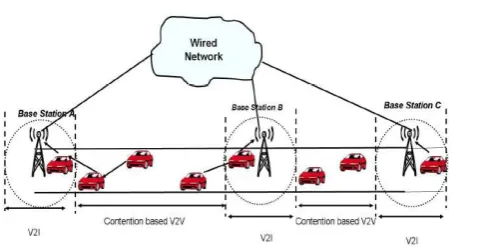
[image:1.595.316.558.272.397.2]Vehicle-to-Infrastructure communication works on infrastructure networks wherever vehicles move with the Road-Side Units (RSUs) that square measure the Access points placed at the margin. RSUs offer info like margin recognition, parking a vehicle, control, lane keeping help etc. Figure 1 shows the situation of V2I communication.
Figure 1 Vehicle-to-Infrastructure communication
II. LITERATURE SURVEY
Vehicular networks are short lived and self-organizing networks established between vehicles. Vehicles are equips with wireless communication devices (OBUs). Vehicles itself are the nodes among the network. They convey and interchange messages with the choice vehicles between the networks to enhance the road safety. Vehicles can communicate either with totally different vehicles’ On-Board Units (OBUs) in associate infrastructure less network or with Road facet Units (RSUs) in associate infrastructure network. Vehicles modification their positions often and exchange information once comes in an exceedingly vary and communicate with the vehicles returning into their varyIt works on Dedicated Short Range Communication (DSRC). Dedicated short range communication is employed as a communication medium and it operates on 4.9GHz band given associate degree metric of seventy four rate DSRC depends on IEEE 802.11a commonplace and Wireless Access in conveyance atmosphere (WAVE) depends on IEEE 1609. Organization is being standardized as IEEE 802.11p for special conveyance communication. [2]
provides non-secure data to the users and increase the chances of collision furthermore death rate [3]. Comfort Applications aim to provide data and amusement to the parents on move. These are information measure exigent and need network capability to provide continuous access to the net with a controlled Quality of Service. It provides internet aquatics, file downloads, email, picture show transfer and vice.
III. ROUTING PROTOCOLS
Various Routing protocols are enforced in vehicular environment to boost its performance and to provide timely and correct data to the drivers [4]. Routing Protocols to be employed in the VANET ought not to be economical, reliable, and robust but also ought to handle network load, and may have low latency.
A. Position Based Routing Protocols:
Position is one in each of the foremost very important data for vehicles. In VANET each vehicle must grasp its own position well as its neighbor vehicle’s position. A routing protocol victimization position data in called the position based mostly routing protocol. Position based mostly routing protocols [5] want the knowledge concerning the physical location of collaborating vehicles be obtainable. This place is obtained by periodically transmitted management messages or beacons to the direct neighbors. A sender will request the position of a receiver by suggests that of an edge service. Position based routing protocols unit of measurement plenty of acceptable for VANETs since the transport nodes unit of measurement famed to maneuver on established ways in which.
In VANETs, route consists of many try of vehicles (communication links) connected to every different from the supply vehicle to the destination vehicle [6]. If we all know this info of vehicles concerned within the routes, we are able to predict their positions within the close to future to predict the link between every try of vehicles within the path. VANET could be a self-organizing mobile impromptu network during which to accumulate the position info of neighboring nodes, every node sporadically exchanges a listing of all neighbors it will reach in one hop, employing a greeting management message or a beacon that contains its ID, location, speed, and a timestamp. One amongst the most blessings of exploitation position primarily based routing protocol is that it's characteristic of not requiring maintenance of routes, that is extremely applicable for extremely dynamic networks like VANETs.
B. Greedy Perimeter Stateless Routing Protocol (GPSRP):
Position-based routing protocols for VANETs extremely depend upon the data of the neighbor’s positions. This info is updated sporadically via hi or beacon messages. In GPSR [7] a node finds the situation of its neighbors by means that of their HELLO messages and also the position of the destination with the assistance of location service. GPSR desires that each node inside the network is in an exceedingly position to go looking out its current position by practice GPS receiver that has speed, , current time, current location, and direction of the vehicles.With of those
passing realm. This operational mode is thought as Greedy Forwarding (in that during which within which) the neighbor which is highest to the destination is chosen because the next-hop node [8].
In some cases, once salutation messages stray because of temporary transmission errors, some vehicles become unaware of existence of its neighbors [9]. But in some regions of the network, a section most would possibly occur once a forwarding node has no neighbor that's nearer to the destination than itself. Throughout this situation GPSR uses a most advance recovery strategy referred to as perimeter routing that uses associate formula of plane graph traversal to hunt out however out of the native most region. Though this advancement, considering solely position info might lead packets to be forwarded in a very wrong direction and loses thus, smart candidates that guarantee its delivery. Since the topology of a transport network in urban or town setting is probably going to satisfy native most, we've turned recovery strategy of perimeter routing on throughout our experiments [9].
C. Advantage:
a. To forward the packet a node must bear in mind only 1 hop neighbor location.
b. Forwarding packet selections are created dynamically.
D. Disadvantage:
a. For high quality characteristics of node, stale data of neighbors’ position are typically contained within the causing nodes’ neighbor table.
b. Though the destination node is moving its data within the packet header of intermediate node is rarely updated
E. Border-node based most forward within radius routing protocol (B-MFR):
Next-hop forwarding technique like greedy forwarding theme for linear network doesn't support well in extremely mobile accidental network like conveyance accidental network. Therefore, alternative position primarily based protocols like MFR, GEDIR, Compass routing, etc. are used for VANET to boost its performance for non-linear network in an exceedingly high conveyance density setting. These protocols are often additional improvement by utilizing farthest one-hop node in an exceedingly dense and extremely mobile network. Border-node (based mostly primarily based). Most Forward among Radius (B-MFR) [10] could be a position based routing protocol that uses Border Nodes with most projection.
The B-MFR utilizes the border-node to avoid mistreatment interior nodes among the transmission vary for additional sending the packet. This technique selects the border-node as a next-hop node for forwarding packet from supply to destination. During this technique, a packet is shipped to the border-node with the best progress because the distance between supply and destination projected onto the road drawn from supply to destination [11].
forwarding theme for linear network doesn't support well in extremely mobile unexpected network like conveyance unexpected network. [12]
F. Advantage:
a. It utilizes the border-node to avoid the utilization of interior nodes among the transmission for any transmission the packet.
b. It uses border-nodes with most progress towards destination node.
G. Disadvantage:
a. The decision for the next forwarding node becomes very difficult. If both nodes are at same point from source.
H. Anchor-Based Street and Traffic Aware Routing (A-STAR):
Anchor-Based Street and Traffic Aware Routing [13] (A-STAR) is a position primarily based routing protocol that is specially style for city situations for bury vehicle communication system. It ensures high property in packet delivery by exploitation vehicle traffic city bus data for associate degree end-to-end association
A-STAR is traffic aware: the traffic on the road determines whether or not the anchor points of the road are going to be thought of within the shortest path. A-STAR routes supported 2 sorts of overlaid maps: a statically rated map and a dynamically rated map. A statistically rated map could be a graph that displays bus routes that usually imply stable quantity of traffic. The development of A-STAR was thoughtlessness with town surroundings. A-STAR conjointly use traffic data and street awareness in path finding.
a. Advantage:
a) In low traffic density, A-STAR ensures for locating AN end-toned connection.
b) By scrutiny with the greedy approach of electrical skin response & the perimeter mode of GPSR. A-STAR uses a brand new native recovery strategy that is additional appropriate for town surroundings. c) Path choice of A-STAR ensures high property
although its packet delivery quantitative relation is less than electrical skin response & GPSR
b. Disadvantage:
a) Packet delivery quantitative relation of A-STAR is less than psych galvanic response & GPSR.
b) To seek out a path from supply to destination it uses static information supported town bus routes that causes property problem on some portion of streets.
c. Simulation and Implementation Result:
[image:3.595.319.550.56.264.2]Simulations were carried for position based routing protocols the well-known GPSR, BMFR and A-STAR. The simulation carried out for 10, 20, 40 and 60 vehicles. This chapter discusses the parameters considered for comparison and the actual simulation results.We consider an open traffic scenario where vehicles are moving that are shown below in snapshot of NAM file in figure 2.
Figure 2 Snapshot of NAM file.
Based on the simulation parameters given below, we simulate the protocols with a transmission range of 250m. We use a 1000m * 500m square area for simulation. Network size is represented by the number of vehicles. The traffic density is not uniform and it depends on the number of vehicles chosen in the given area. The packet transmission density can be adjusted by setting different CBR rates with a packet size of 1000 bytes. A simulation runs for 150 seconds.
Table 1 Parameter Value
Simulation Scene Open
Topology Dimensions 1000 m * 500 m Number of vehicles 10,20,40 & 60 Vehicles speeds 6-15 m/s
Protocols simulated B-MFR, GPSR, A-STAR Simulation time 150 seconds
Communication type Position Based Transmission range 250m
Traffic type CBR(Constant bit rate) Simulator NS_2.35
I. Parameters for simulation:
The three protocols were compared in terms of following parameters.
J. Packet delivery ratio:
Packet delivery ratio is the ratio of numbers of packets delivered to a destination to the number of packet sent by a source(s). It stands for the level of data delivered to the destination.
Mathematically packet delivery ratio is given by: (Sum of packet received by the destination(s) / sum of packet sent by a source (s)) *100
This parameter can alternatively be studied as packet drop ratio, which basically the ratio of packet dropped to the number of packet sent.
Figure: 3 Average Packet delivery ratio of GPSR, BMFRand ASTAR.
K. End to End Delay:
End to end delay refers to the time taken by a packet to reach the destination from the source. That is, the time difference between the time when the packet was received by the receiver and the time packet was sent by the source. This includes any delays that occur during transmission: a) Transmission delay
b) Propagation delay c) Processing delay d) Queuing delay
All these delays occur at each router. So mathematically end to end delay can be written as:
E= N (T+P+PR+Q), where E= End to end delay N= Numbers of links T= Transmission delay P=Propagation delay Pr =Processing delay Q= Queuing delay
Lower the value of end to end delay better is protocol.
Figure: 4 Average End to End delay of GPSR, BMFR andASTAR
L. Throughput:
Throughput is the ratio of packets (bits) received to the time period over which the transmission takes place. Or in the other words throughput is the rate of successful message delivery.
Mathematically:
Throughput= number of bits (or data packets) successfully
Throughput is generally measured in bits per second or kilobits per second (kbps). Other than bps, throughput might sometime be measured in data packets received per second or per time unit. Higher the throughput better is the performance of the protocol.
Throughput is sometimes used to measure bandwidth utilization of channel.
Figure: 5 Average Throughput of GPSR, BMFR andASTAR
IV. CONCLUSION
V. REFERENCES
[1]. Ghassan Samara, Wafaa A.H. A1-Salihy, R. Sures, National Advanced IPv6 Center, Univeristi Sains, Penang, Malaysia, ”Security Issues and Challenges of Vehicular Ad Hoc Networks (VANET)”, IEEE 2009.
[2]. Li . F., Wang.Y. ( 2007): Routing in Vehicular Ad Hoc Networks: A Survey. IEEE Vehicular Magazine.
[3]. Karp B., Kung H.T. ( 2002): GPSR: Greedy Perimeter Stateless Routing for Wireless Networks. MobiCom.
[4]. Seet, B.-C., Liu, G., Lee, B.-S., Foh, C. H., Wong, K. J., Lee, K.-K. (2004), “A-STAR: A Mobile Ad Hoc Routing Strategy for Metropolis Vehicular Communications.”
NETWORKING 2004, 989-999.
[5]. Uma Nagaraj, Dr. M. U. Kharat, Poonam Dhamal,”Study of Various Routing Protocols in VANET”, IJCST Vol. 4, ISSue 4, oCT.-DeC. 2011.
[6]. Jerbi, M., Senouci, S.-M., Meraihi, R., and Ghamri-Doudane, Y. (2007), “An improved vehicular ad hoc routing protocol for city environments,” Communications, 2007. ICC ’07. IEEE International Conference, pp. 3972–3979, 24-28 June 2007.
[7]. Uma Nagaraj, 2Dr. M. U. Kharat, 3Poonam Dhamal,”Study of Various Routing Protocols in VANET”, IJCST Vol. 4, ISSue 4, oCT.-DeC. 2011.
[8]. Si-Ho Cha1 , Min-Woo Ryu2 and Kuk-Hyun Cho2,”A Survey of Greedy Routing Protocols for Vehicular Ad Hoc Networks”, Smart Computing Review, Vol. 2, no. 2, April 2012|25.
[9]. Raw R.S., Lobiyal D.K., “B-MFR Routing Protocol for Vehicular Ad hoc Networks”, IEEE, ICNIT 2010, Manila, Philippines 2010.
[10]. Ram Shringar Raw, Sanjoy Das, “Performance Comparison
of Position-Based Routing Protocols in V2V
Communication”, International Journal of Engineering Science and Technology, 2011.
[11]. Ram Shringar Raw, D K Lobiyal, “B-MFR Routing Protocol for Vehicular Ad hoc Networks”, 2010 International Conference on Networking and Information Technology, 2010.
[12]. Seet, B.-C., Liu, G., Lee, B.-S., Foh, C. H., Wong, K. J.,Lee, K.-K. (2004), “A-STAR: A Mobile Ad Hoc Routing
Strategy for Metropolis Vehicular
Communications.”NETWORKING 2004, 989-999.