Scholarship@Western
Scholarship@Western
Electronic Thesis and Dissertation Repository
1-30-2017 12:00 AM
Expert-in-the-Loop Multilateral Telerobotics for Haptics-Enabled
Expert-in-the-Loop Multilateral Telerobotics for Haptics-Enabled
Motor Function and Skills Development
Motor Function and Skills Development
Mahya Shahbazi
The University of Western Ontario Supervisor
Dr. Rajni V. Patel
The University of Western Ontario
Graduate Program in Electrical and Computer Engineering
A thesis submitted in partial fulfillment of the requirements for the degree in Doctor of Philosophy
© Mahya Shahbazi 2017
Follow this and additional works at: https://ir.lib.uwo.ca/etd
Part of the Biomedical Commons, Controls and Control Theory Commons, and the Robotics Commons
Recommended Citation Recommended Citation
Shahbazi, Mahya, "Expert-in-the-Loop Multilateral Telerobotics for Haptics-Enabled Motor Function and Skills Development" (2017). Electronic Thesis and Dissertation Repository. 4387.
https://ir.lib.uwo.ca/etd/4387
This Dissertation/Thesis is brought to you for free and open access by Scholarship@Western. It has been accepted for inclusion in Electronic Thesis and Dissertation Repository by an authorized administrator of
Among medical robotics applications are Robotics-Assisted Mirror Rehabilitation Therapy
(RAMRT) and Minimally-Invasive Surgical Training (RAMIST) that extensively rely on
mo-tor function development. Haptics-enabled expert-in-the-loop momo-tor function development for
such applications is made possible through multilateral telerobotic frameworks. While
sev-eral studies have validated the benefits of haptic interaction with an expert in motor learning,
contradictory results have also been reported. This emphasizes the need for further in-depth
studies on the nature of human motor learning through haptic guidance and interaction. The
objective of this study was to design and evaluate expert-in-the-loop multilateral telerobotic
frameworks with stable and human-safe control loops that enable adaptive “hand-over-hand”
haptic guidance for RAMRT and RAMIST.
The first prerequisite for such frameworks is active involvement of the patient or trainee,
which requires the closed-loop system to remain stable in the presence of an adaptable
time-varying dominance factor. To this end, a wave-variable controller is proposed in this study
for conventional trilateral teleoperation systems such that system stability is guaranteed in the
presence of a time-varying dominance factor and communication delay. Similar to other
wave-variable approaches, the controller is initially developed for the Velocity-force Domain (VD)
based on the well-known passivity assumption on the human arm in VD. The controller can
be applied straightforwardly to the Position-force Domain (PD), eliminating position-error
ac-cumulation and position drift, provided that passivity of the human arm in PD is addressed.
However, the latter has been ignored in the literature. Therefore, in this study, passivity of the
human arm in PD is investigated using mathematical analysis, experimentation as well as user
studies involving 12 participants and 48 trials. The results, in conjunction with the proposed
wave-variables, can be used to guarantee closed-loop PD stability of the supervised trilateral
teleoperation system in its classical format. The classic dual-user teleoperation architecture
does not, however, fully satisfy the requirements for properly imparting motor function (skills)
in RAMRT (RAMIST). Consequently, the next part of this study focuses on designing novel
loop mirror therapy; b) haptic feedback to the therapist from the patient side; c)
assist-as-needed therapy realized through an adaptive Guidance Virtual Fixture (GVF); and d) real-time
task-independent and patient-specific motor-function assessment. Closed-loop stability of the
proposed framework is investigated using a combination of the Circle Criterion and the
Small-Gain Theorem. The stability analysis addresses the instabilities caused by: a) communication
delays between the therapist and the patient, facilitating haptics-enabled tele- or in-home
reha-bilitation; and b) the integration of the time-varying nonlinear GVF element into the delayed
system. The platform is experimentally evaluated on a trilateral rehabilitation setup consisting
of two Quanser rehabilitation robots and one Quanser HD2robot.
The framework proposed for RAMIST includes the following features: a) haptics-enabled
expert-in-the-loop surgical training; b) adaptive expertise-oriented training, realized through a
Fuzzy Interface System, which actively engages the trainees while providing them with
appro-priate skills-oriented levels of training; and c) task-independent skills assessment. Closed-loop
stability of the architecture is analyzed using the Circle Criterion in the presence and absence
of haptic feedback of tool-tissue interactions. In addition to the time-varying elements of the
system, the stability analysis approach also addresses communication delays, facilitating
tele-surgical training. The platform is implemented on a dual-console tele-surgical setup consisting
of the classic da Vinci surgical system (Intuitive Surgical, Inc., Sunnyvale, CA), integrated
with the da Vinci Research Kit (dVRK) motor controllers, and the dV-Trainer master console
(Mimic Technology Inc., Seattle, WA).
In order to save on the expert’s (therapist’s) time, dual-console architectures can also be
ex-panded to accommodate simultaneous training (rehabilitation) for multiple trainees (patients).
As the first step in doing this, the last part of this thesis focuses on the development of a
multi-master/single-slave telerobotic framework, along with controller design and closed-loop
stability analysis in the presence of communication delays. Various parts of this study are
sup-ported with a number of experimental implementations and evaluations.
The outcomes of this research include multilateral telerobotic testbeds for further studies
on the nature of human motor learning and retention through haptic guidance and
Keywords:Expert-in-the-loop motor skills development; haptics-enabled motor learning; mul-tilateral teleoperation; robotics-assisted surgical training; robotics-assisted mirror
rehabilita-tion therapy; supervised telerobotics.
The thesis presented here has been written by Mahya Shahbazi under the supervision of Dr.
Rajni V. Patel. Parts of the material in this thesis were published in peer-reviewed journal and
conference papers, or are under review. The research published in each paper has been mainly
conducted and written by the principal author. For the research reported in all of the papers,
Dr. Patel was the project leader and supervisor, guiding and directing the study in every aspect,
including idea development, theoretical and experimental evaluations, writing and revising the
papers.
The material presented in Chapter 2 will be submitted for publication:
• Mahya Shahbazi, Rajni V. Patel, “A Systematic Review of Multilateral Teleoperation
Systems”, To be submitted toIEEE Transactions on Haptics, 2016.
The material presented in Chapter 3 has been published as:
• Mahya Shahbazi, Heidar A. Talebi, Rajni V. Patel, “Networked Dual-User Teleoperation
with Time-Varying Authority Adjustment: A Wave Variable Approach”, IEEE/ASME
International Conference on Advanced Intelligent Mechatronics (AIM), pp. 415-420,
2014.
Mahya Shahbazi developed the idea, designed the controller, and experimentally
implemented the framework. She also conducted experiments, evaluated the results
and wrote the manuscript.
Dr. H.A. Talebi was an academic collaborator in this work. He contributed in
development of the theory.
The material presented in Chapter 4 is currently under review for publication:
• Mahya Shahbazi, Seyed Farokh Atashzar, Mahdi Tavakoli and Rajni V. Patel,
“Position-Force Domain Passivity of Human Arm in Telerobotics Systems”, Submitted tothe
In-ternational Journal of Robotics Research: Special Issue on Human-Robot Interaction,
2016.
data analysis and evaluation of results, and writing the manuscript.
Seyed Farokh Atashzar helped in preparing the experimental setup, and user-data
collection.
Dr. Mahdi Tavakoli was an academic collaborator in this work. He helped in the
development of the research hypothesis and in planning the user study. Mahya
Shahbazi was a visiting research scholar in Dr. Tavakoli’s lab for a 6-month period,
during which a part of the work was carried out. This work was supported by joint
grants awarded to Dr. R.V. Patel and Dr. M. Tavakoli.
The material presented in Chapter 5 has been published as:
• Mahya Shahbazi, Seyed Farokh Atashzar, Mahdi Tavakoli and Rajni V. Patel,
“Robotics-Assisted Mirror Rehabilitation Therapy: A Therapist-in-the-Loop Assist-as-Needed
Ar-chitecture”,IEEE/ASME Transactions on Mechatronics, vol. 21, no. 14, pp. 1954-1965,
2016.
• Mahya Shahbazi, Seyed Farokh Atashzar, Mahdi Tavakoli and Rajni V. Patel,
“Therapist-In-The-Loop Robotics-Assisted Mirror Rehabilitation Therapy: An Assist-As-Needed
Framework”, IEEE International Conference on Robotics and Automation (ICRA), pp.
5910-5915, 2015
• Mahya Shahbazi, Seyed Farokh Atashzar, and Rajni V. Patel, “A Framework for
Super-vised Robotics-Assisted Mirror Rehabilitation Therapy”, IEEE/RSJ International
Con-ference on Intelligent Robots and Systems (IROS), pp.3567-3572, 2014.
Mahya Shahbazi was the primary contributor to the development of the idea,
de-sign and experimental implementation of the proposed framework, development of
the theoretical aspects including the stability analysis, conducting experiments and
writing the manuscript.
Seyed Farokh Atashzar helped in preparing the experimental setup, and designing
and conducting the experiments.
Shahbazi was a visiting research scholar in Dr. Tavakoli’s lab for a 6-month period,
during which a part of the work was conducted. This was supported by joint grants
awarded to Dr. R.V. Patel and Dr. M. Tavakoli.
The material presented in Chapter 6 is currently under review for publication:
• Mahya Shahbazi, Seyed Farokh Atashzar, Christopher Ward, Heidar Ali Talebi, Rajni V.
Patel, “Multimodal Sensorimotor Integration for Expert-in-the-Loop Telerobotic
Surgi-cal Training”, Submitted toIEEE Transactions on Robotics, 2016.
A part of the material in this Chapter was published in
• Mahya Shahbazi, Seyed Farokh Atashzar, Heidar Ali Talebi and Rajni V. Patel, “An
Expertise-Oriented Training Framework for Robotics-Assisted Surgery”,IEEE
Interna-tional Conference on Robotics and Automation (ICRA), pp. 5902-5907, 2014.
• Mahya Shahbazi, Seyed Farokh Atashzar, and Rajni V. Patel, ”A dual-user teleoperated
system with Virtual Fixtures for robotic surgical training”, IEEE International
Confer-ence on Robotics and Automation (ICRA), pp. 3639-3644, 2013.
Mahya Shahbazi was the primary contributor to the development of the idea, design
and experimental implementation of the proposed framework, development of the
theory including the stability analysis, conducting the experiments and writing the
manuscript.
Seyed Farokh Atashzar helped in designing and conducting the experiments.
Christopher Ward helped in preparing the experimental setup, and wrote a section
describing the setup.
Dr. Heidar Ali Talebi was an academic collaborator in this work. He contributed in
the development of the theoretical aspect of the work.
The material presented in Chapter 7 has been published in
Cooperative Teleoperation Framework: Multi-Master/Single-Slave System”,IEEE/ASME
Transactions on Mechatronics, vol. 20, no. 4, pp. 1668-1679, 2014.
• Mahya Shahbazi, Seyed Farokh Atashzar, Heidar Ali Talebi and Rajni V. Patel, “A
Multi-Master /Single-Slave Teleoperation System”,ASME Dynamic Systems and Control
Con-ference (DSCC), pp. 107-112, 2012.
Mahya Shahbazi was the primary contributor to the development of the idea,
de-sign and experimental implementation of the proposed framework, development of
the theoretical aspects including the stability analysis, conducting experiments and
writing the manuscript.
Seyed Farokh Atashzar helped to prepare the experimental setup, and conduct the
experiments.
Dr. H.A. Talebi was an academic collaborator in this work. He helped in the
development of the idea and the stability analysis.
and
to my Dearest Grandparents,
whose love has left an indelible impression on my heart.
This thesis would not have been possible without the invaluable support of so many
differ-ent people around the world.
First and foremost, I would like to express my sincere gratitude and appreciation to my
brilliant supervisor, Dr. Rajni Patel, for his continuous support and encouragement, insightful
vision and supervision, as well as constructive advice. It was under his skillful mentorship that
I was able to flexibly pursue my interests and build on my strengths without losing sight of my
goals. He is a living exemplar of a truly humane scientist.
I would like to sincerely thank my former supervisors in Iran, Drs. Hamid D. Taghirad and
Heidar Ali Talebi, who taught me the basics of research in the first place. Special thanks also
go to Dr. Mahdi Tavakoli for his support, guidance and encouragement along the way. I would
also like to thank my examiners, Dr. S.E. Salcudean, Dr. I. Polushin, Dr. A.L. Trejos and Dr.
L. Ferraira, for taking the time to review (and evaluate) my thesis and for providing valuable
comments.
I would also like to acknowledge several Canadian granting agencies and industries,
with-out whose generous financial support my research would not have been possible. This
in-cludes the Canadian Institutes of Health Research (CIHR) and the Natural Sciences and
En-gineering Research Council (NSERC) of Canada through the Collaborative Health Research
Projects (CHRP) Grant #316170, the NSERC Collaborative Research and Development Grant
#CRDPJ411603-10, and the NSERC Discovery Grant #RGPIN1345; the AGE-WELL
Net-work of Centres of Excellence through the project AW-CRP2015-WP5.3; the Canada
Foun-dation for Innovation through Grant LOF 28241, Quanser Inc. (Markham, ON, Canada), as
well as the Ontario Graduate Scholarship (OGS) and the NSERC Collaborative Research and
Training Experience (CREATE) programs.
Special thanks go to Christopher Ward, Abelardo Escoto, Dr. Ali Talasaz and Karen Siroen
for their technical support during this study. I am also grateful to all of my friends at CSTAR
and in London, especially Dr. Iman Khalaji, Dr. Ali Asadian, Dr. Mahta Khoshnam Tehrani,
Behnaz Poursartip, Dr. Peyman Yadmellat, Dr. Nima Najmaei, Saeed Bakhshmand, Sahar
Shahbazi, Vahid Mehrabi, Pouya Soltani Zarrin, Dr. Ran Xu, Linda Andrews, Dr. Nazanin
years.
I am enormously thankful to Ayda Bashiri, Dr. Samaneh Kazemifar, Behnaz Poursartip,
Razieh Karimi, Dr. Laleh Nazari, Dr. Mohammad Ali Tavallaei, Dr. Amir Owrangi, Dr. Iman
Owrangi, and Dr. Sadra Souzanchi for their true friendship, and all the great moments we
have shared. Miles apart from my family, the daily grind would have been harder without their
heartwarming and revitalizing presence as my second family in Canada.
Very special acknowledgments go out to my fiercely devoted mom, Maryam Jafarpour, for
being the angel to lift me to my feet whenever my wings had trouble remembering how to fly. I
would not have been where I am now if it had not been for her and the sacrifices she has made
for me throughout her life.
Endless thanks go to my unbelievably dedicated dad, Rohollah Shahbazi, for continuously
believing in me and my capabilities, no matter the circumstances, and for all the courage and
strength he taught me to have in the face of difficulties. The world would be a better and safer
place to live in if it had more supportive dads like him.
Special thanks go to Jamileh Zerehgar and Dr. Heshmat Atashzar, the world’s most
amaz-ing parents-in-law, for their unconditional love, countless expressions of support and boundless
inspiration. I am truly blessed to be a part of such a caring and loving family. This journey
would have been more difficult if it had not been for them.
I would like to express special thanks to Mohamad Shahbazi for being the perfect brother
one might ask for, someone who makes my world a brighter and more beautiful place to live,
and also to Hasty and Nazly Ataszhzar for being the kind and lovely sisters whom I had always
wished to have. I am so lucky to have them in my life. I also want to thank the rest of my
family in Iran, especially Mehrnoosh and Golrokh Jafarpour, and Haydeh Zerehgar for their
endless love and encouragement.
Finally, I want to express my most sincere gratitude to Dr. Seyed Farokh Atashzar, my
wonderful husband, my best friend, my greatest colleague and, in a single word, my soulmate.
This journey would not have been possible without his ceaseless support and limitless love.
Farokh, you were the source of my strength and inspiration when I was too tired to take another
tears, and, above all, your very enjoyable companionship during the past decade. Thanks for
being a true blessing in my life.
Abstract ii
Co-Authorship Statement v
Acknowledgments x
List of Figures xviii
List of Tables xxiii
List of Acronyms xxiv
1 Introduction 1
1.1 Robotics-Assisted Rehabilitation Therapy . . . 2
1.1.1 Mirror Therapy . . . 2
1.1.2 Robotics-Assisted Mirror Therapy (RAMT) . . . 3
1.2 Robotics-Assisted Minimally Invasive Surgery . . . 4
1.2.1 Robotics-Assisted Minimally Invasive Surgical Training (RAMIST) . . 5
1.3 Research Statement . . . 7
1.3.1 Time-Varying Dominance Distribution . . . 8
1.3.2 Position-Force Domain Passivity . . . 8
1.3.3 Novel Trilateral Teleoperation Frameworks . . . 9
Robotics-Assisted Mirror Therapy . . . 9
Robotics-Assisted Minimally Invasive Surgical Training . . . 10
1.3.4 Novel Multi-Master/Single-Slave Teleoperation Framework . . . 11
1.4 Thesis Structure . . . 11
2.1.1 Teleoperated-Autonomous Shared Control (TASC) . . . 23
Space . . . 23
Haptics-Enabled Training in Virtual Environment . . . 24
Supervised Autonomous Surgical Procedures . . . 25
2.1.2 Dual-User Shared Control (DUSC) . . . 25
Control Strategies for General DUSC Architectures . . . 26
Application-Specific DUSC Architectures: Therapist-In-the-Loop (TIL) Rehabilitation Therapy . . . 28
Application-Specific DUSC Architectures: Expert-in-the-Loop Haptics-Enabled Training . . . 29
2.1.3 Dual-User Redundancy Control (DURC) . . . 33
2.2 MM/SS Architectures . . . 34
2.3 SM/MS Architectures . . . 36
2.4 MM/MS architectures . . . 37
2.5 Topology-Free Stability Analysis of Multilaretal Teleoperation Frameworks . . 40
2.6 Discussion and Future Direction . . . 43
3 Time-Varying Dominance Distribution: A Wave-Variable Approach 57 3.1 INTRODUCTION . . . 57
3.2 System Dynamics and Desired Objectives . . . 60
3.2.1 System Dynamics . . . 60
3.2.2 Desired Objective in Dual-User Systems . . . 61
3.3 The Proposed Wave-Variable-Based Controller . . . 62
3.4 Stability Analysis . . . 64
3.5 Experimental Results . . . 69
3.6 Conclusions . . . 73
4 Position-Force Domain Passivity of Human Arm in Telerobotics Systems 77 4.1 Introduction . . . 77
4.3.1 Experimental Scenario I . . . 84
4.3.2 Experimental Scenario II . . . 84
4.3.3 Experimental Scenario III . . . 85
4.4 User Trials and Statistical Analysis . . . 86
4.4.1 Subjects . . . 87
4.4.2 Setup and Procedure . . . 87
4.4.3 Results . . . 91
Passivity/Non-passivity in Low-Frequency Trials . . . 91
Passivity/Non-passivity in High-Frequency Trials . . . 92
Passivity/Non-passivity Correlation Between Left and Right Arms . . . 93
Correlation Between Passivity/Non-Passivity Levels of the Arm and Physical Features of the Body . . . 97
4.5 Discussion . . . 98
4.6 Conclusions . . . 101
5 Robotics-Assisted Mirror Rehabilitation Therapy: A Therapist-in-the-Loop Assist-as-Needed Architecture 106 5.1 INTRODUCTION . . . 106
5.2 THE PROPOSED FRAMEWORK . . . 111
5.2.1 Architecture for the PIL/Robot Interaction . . . 111
5.2.2 Architecture for the PFL/Robot Interaction . . . 113
5.2.3 Architecture for the Therapist/Robot Interaction . . . 114
5.3 Adaptive Assist-as-Needed Therapy . . . 115
5.3.1 Motor Function Assessment . . . 116
Movement Smoothness (MS) . . . 117
Total Path Length (TPL) . . . 117
5.3.2 Adaptive GVF Design . . . 119
5.4 Closed-loop Stability Analysis . . . 119
5.5 Experiments . . . 125
5.5.3 Scenario III: Adaptive Patient-Targeted ANT . . . 129
5.6 Conclusions . . . 133
6 Multimodal Sensorimotor Integration for Expert-in-the-Loop Telerobotic Sur-gical Training 140 6.1 INTRODUCTION . . . 140
6.2 Sensorimotor Integration for Dual-Console Surgical Robotic Systems . . . 143
6.3 Adaptive Expertise-Oriented Engagement . . . 145
6.3.1 Task-Independent Skills Assessment . . . 146
Total Path Length (TPL) . . . 147
Motion Smoothness (MS) . . . 147
Level Of Guidance (LOG) . . . 148
6.3.2 The Fuzzy Interface System Design . . . 148
6.4 Closed-Loop Stability Analysis . . . 150
6.5 Experimental Evaluations . . . 152
6.5.1 Setup Design and Implementation . . . 152
6.5.2 Experimental Results . . . 155
Scenario I . . . 155
Scenario II . . . 156
Scenario III . . . 159
6.6 Extension: Integration of Haptic Feedback of Tool-Tissue Interaction Forces . . 162
6.6.1 Stability Analysis in the Presence of TTI Force Feedback . . . 164
6.7 Future Work: Sensorimotor Integration for Haptics-Enabled Simulators . . . . 168
6.7.1 Integration of HOH Guidance into RAMIS Simulators . . . 169
6.8 Conclusions . . . 170
7 Multi-Master/Single-Slave Teleoperation Framework 176 7.1 Introduction . . . 176
7.2.2 Slave Console . . . 180
7.3 Desired Objectives for the MM/SS System . . . 181
7.4 Passivity of an Ideal MM/SS System . . . 183
7.5 Control Methodology . . . 186
7.6 Closed-Loop Stability Analysis . . . 187
7.6.1 Constant Communication Delay . . . 190
7.6.2 Time-Varying Communication Delay . . . 194
7.7 Experiments . . . 195
7.7.1 Experimental Setup . . . 195
7.7.2 Experimental Results . . . 196
7.8 Conclusions . . . 203
8 Conclusions and Future Work 209 8.1 Contributions . . . 210
8.2 Future Work . . . 213
Curriculum Vitae 218
1.1 Conventional mirror therapy ( cNorth Coast Medical Inc.) . . . 3
1.2 Robotics-assisted mirror therapy [19]. . . 4
1.3 The overall scheme of the conventional robotics-assisted mirror therapy with
respect to the interconnection between the PFL and the PIL [36] ( c[2016]
IEEE). . . 5
1.4 Theda Vincisurgical robotic system ( c[2006] Intuitive Surgical, Inc.). . . 5
1.5 The dual-consoleda VinciR Si surgical robotic system ( c[2009] Intuitive
Sur-gical, Inc.). . . 6
2.1 Schematic representation of components of an SM/SS teleoperation system. . . 21
2.2 Schematic representation of a unilateral SM/SS teleoperation system. . . 21
2.3 Schematic representation of a bilateral SM/SS teleoperation system. . . 21
2.4 Schematic representation of a TASC framework for surgical procedures [14]
( c[2015] IEEE). . . 25
2.5 Schematic representation of a general trilateral DUSC framework, including
two operator-master sets and one slave-environment set, communicating through
a network [16] ( c[2012] Cambridge University Press). . . 26
2.6 Schematic representation of a trilateral DUSC framework for
therapist-in-the-loop rehabilitation therapy [33] ( c[2016] IEEE). . . 29
2.7 Schematic representation of a trilateral asymmetric DURC framework [46]
( c[2011], SAGE Publications). . . 34
2.8 Schematic representation of an SM/MS teleoperation system with three slave
robots handling a common object [53] ( c[2005] IEEE). . . 35
2.10 Schematic representation of a trilateral teleoperation system modeled by a
3-portnetwork [72] ( c[2010] IEEE). . . 41
2.11 Schematic representation of the reduced 2-port network, by considering the environment as the load termination [72] ( c[2010] IEEE). . . 41
2.12 Schematic representation of a multi-modal telepresence system with visual, auditory and haptic augmentation [80] ( c[2009], SAGE Publications). . . 44
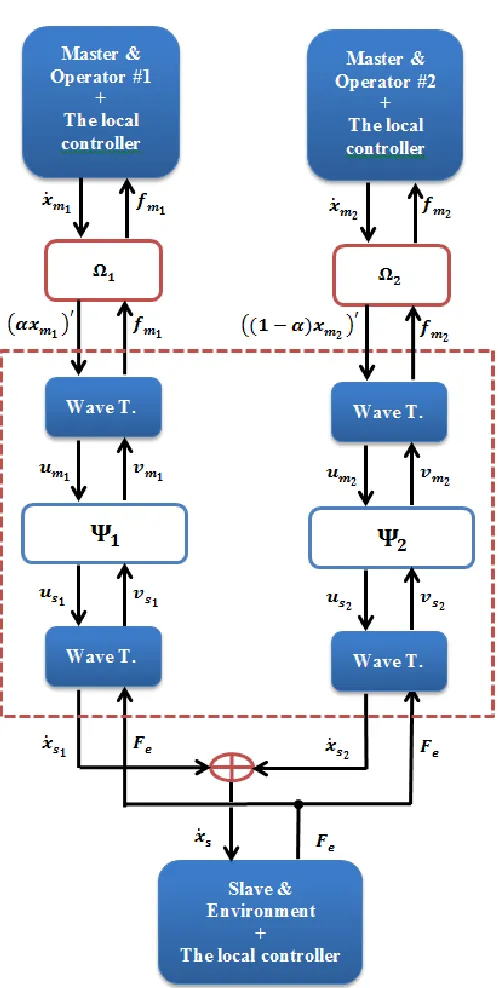
3.1 The overall scheme of the dual-user system focusing on the signals trans-mitted, where Wave T.s refers to the proposed wave transformations;Ψ1 and Ψ2 denote the communication channels between the master robots and the slave robot; vm1(t) = vs1(t−T1), us1(t) = um1(t−T1), us2(t) = um2(t−T2), vm2(t) =vs2(t−T2), where T1 and T2 are the constant time delays inΨ1 and Ψ2 respectively. Ω1 and Ω2 illustrate two sub-systems transforming xΩi to yΩi, i=1,2, as elaborated below in (3.20) and (3.21). . . 67
3.2 Network connection of the simplified wave transformation for communication channel Ωi (i=1,2) given in (3.18) and (3.19), which is in the form of the conventional wave transformation. . . 68
3.3 The experimental setup. . . 69
3.4 Time-varying dominance factorα used in the experiment. . . 70
3.5 Experimental results in the presence of time delays. . . 71
4.1 The overall scheme of a teleoperation system. The teleoperator includes the communication channel as well as the master and the slave robots.U= [u1,u2] andY = [y1,y2]refer to the input and output of the teleoperator, respectively. . . 78
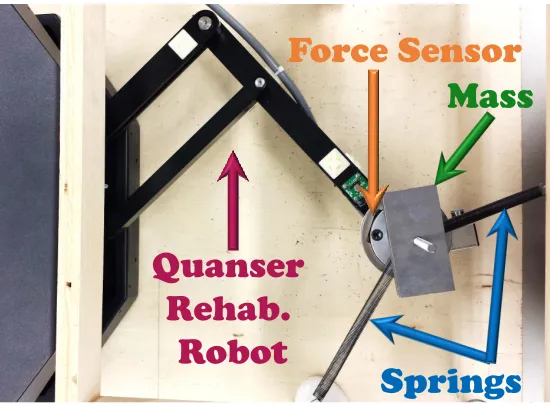
4.2 The mass-spring array system connected to the 2-DOF planar Quanser rehabil-itation robot. . . 84
4.3 Experimental results: effect of inertia onεPD . . . 85
4.4 Experimental results: effect of stiffness onεPD . . . 86
4.5 Experimental results: effect of motion frequency onεPD . . . 87
4.8 High-frequency 2D X-Y position perturbation . . . 90
4.9 εPDfor the left hand of all of the subjects recorded during low-frequency per-turbation . . . 93
4.10 εPD for the right hand of all of the subjects recorded during low-frequency perturbation . . . 94
4.11 εPDfor the left hand of all of the subjects recorded during high-frequency per-turbation . . . 94
4.12 εPD for the right hand of all of the subjects recorded during high-frequency perturbation . . . 95
4.13 εPDcomparison between the left and right hands for subjects #1 and #5 during the low-frequency perturbation. . . 96
4.14 εPDcomparison between the left and right hands for subjects #1 and #5 during the high-frequency perturbation. . . 96
4.15 Passivity/Non-passivity degrees for all the subjects calculated from the least-squared curves fitted to theirεPD. . . 98
4.16 The distribution of the passivity/non-passivity degrees for all the subjects dur-ing the four trials: LH-LF, RH-LF, LH-HF, RH-HF. . . 100
4.17 The distribution of the passivity/non-passivity degrees for the left hand (LH) and right hand (RH) of the subjects. . . 100
5.1 The overall scheme of the conventional robotics-assisted MT. . . 109
5.2 The overall scheme of the supervised trilateral telerobotic framework proposed for Assist-as-Needed Mirror Therapy (ANMT). . . 111
5.3 The overall closed-loop system . . . 120
5.4 The overall closed-loop system . . . 120
5.5 Small-Gain Theorem . . . 121
5.6 Feedback connection used in the Circle Criterion . . . 122
5.7 Feedback connection based on the type II loop transformation [38] . . . 123
5.8 Modified feedback connection used in the Circle Criterion . . . 123
5.11 Experimental scenario #1: 2D plot of trajectories . . . 127
5.12 Experimental scenario #1: 1D plot of trajectories across the mirroring plane . . 127
5.13 Experimental scenario #1: Haptic feedback provided to the therapist . . . 127
5.14 The 2-DOF mass-spring array connected to the PIL robot . . . 129
5.15 Experimental scenario #2: 2D trajectories with respect to time . . . 129
5.16 Experimental scenario #2: 2D plot of trajectories . . . 130
5.17 Experimental scenario #3: PIL’s trajectory compared with the TCT . . . 131
5.18 Experimental scenario #3: Motor-function assessment metrics . . . 132
5.19 Experimental scenario #3: Adaptive GVF’s stiffness adjusted according to the PIL impairment level . . . 132
5.20 Experimental scenario #3: ANT provided to the PIL . . . 133
6.1 The FIS output surfaces with respect to inputs LOP and LOG- Left: ˆαT, Right: ˆ kΓ. . . 149
6.2 The overall scheme of the closed-loop system in the absence of tool-tissue interaction haptic feedback. Image derived from photographs of masters and EndoWristTM-Instruments provided by Intuitive Surgical, Inc. [ c2006]. . . 149
6.3 The closed-loop system at the trainee side. . . 151
6.4 The experimental platform. . . 154
6.5 Experimental results, scenario #1;αT =0,αE =1. . . 157
6.6 Experimental results, scenario #2: position comparison, 2D representation; αT =αE =0.5. . . 158
6.7 Experimental results, scenario #3;ζ =0.5 . . . 161
6.8 Experimental results, scenario #3: position comparison, 2D representation; ζ =0.5. . . 162
6.9 The overall scheme of the closed-loop system in the presence of TTI haptic feedback. . . 164
6.10 The schematic of the closed-loop system transformed based on the Small-Gain Theorem. . . 167
7.1 General scheme of a feedback system with time delays. . . 188
7.2 General scheme of the MM/SS system in the presence of delays. . . 189
7.3 General scheme of the MM/SS system after some manipulations . . . 190
7.4 General scheme of the MM/SS system transformed so as to match with Fig. 7.1. 190
7.5 The experimental setup. . . 195
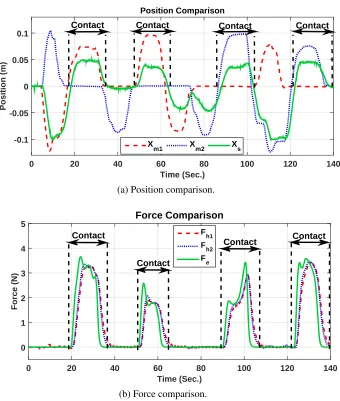
7.6 Experimental results for the first scenario,α1=α2=0.333,α3=0.334,Mi,d= 0.3kgandBi,d=0.6N.s/m. . . 198 7.7 Experimental results for the first scenario,α1=α2=0.5,α3=0,Mi,d=0.3kg
andBi,d=0.6N.s/m. . . 199 7.8 Experimental results for the first scenario,α1=α2=0,α3=1,Mi,d=0.3kg
andBi,d=0.6N.s/m. . . 200 7.9 Experimental results for the second scenario,α1=α2=0.1,α3=0.8,Mi,d=
0.3kgandBi,d=0.6N.s/m. . . 201 7.10 Experimental results for the second scenario,α1=α2=0.1,α3=0.8,Mi,d=
1.2kgandBi,d=2.4N.s/m. . . 202
4.1 Demographics for all participants . . . 88
4.2 Mean-value and standard deviation of the quantified passivity/non-passivity levels 95
2D Two Dimensional
ANMT Assist-as-Needed Mirror Therapy ANT Assist-as-Needed Therapy
BMI Body Mass Index
DM/SS Dual-Master/Single-Slave
DOF Degree Of Freedom DOM Degree Of Mobility
DURC Dual-User Redundancy Control DUSC Dual-User Shared Control dVRK da Vinci Research Kit
EE End-Effector
EIL Expert-In-the-Loop EZW Extended Zeheb–Walach FDA Food and Drug Administration
FDPC Frequency-Domain Passivity Controller FIS Fuzzy Interface System
GUI Graphical User Interface GVF Guidance Virtual Fixture
HF High Frequency
HOH Hand-Over-Hand
IOS Input-Output Stable LAN Local Area Network
LF Low Frequency
LH Left Hand
LOG Level Of Guidance
MIS Minimally Invasive Surgery MM/MS Multi-Master/Multi-Slave MM/SS Multi-Master/Single-Slave
MS Movement Smoothness
MSA Mass-Spring Array
MT Mirror Therapy
MTM Master Tool Manipulator
PCC Pearson product-moment Correlation Coefficient PD Position-force Domain
PDP Position-force Domain Passivity PE Persistently Exciting
PFL Patient’s Functional Limb PIL Patient’s Impaired Limb
PR Positive Real
PS Performance Symmetry PSD Positive Semi-Definite PSM Patient Side Manipulator QLA Quad Linear Amplifier
RAMIS Robotics-Assisted Minimally Invasive Surgery
RAMIST Robotics-Assisted Minimally Invasive Surgical Training RAMT Robotics-Assisted Mirror Therapy
RART Robotics-Assisted Rehabilitation Therapy RAS Robotics-Assisted Surgery
RH Right Hand
RHP Right Half Plane
SAW Surgical Assistant Workstation
SM/SS Single-Master/Single-Slave SPR Strictly Positive Real
TASC Teleoperative-Autonomous Shared Control TCT Therapist-Commanded Trajectory
TDPC Time-Domain Passivity Controller TIL Therapist-in-the-Loop
TPL Total Path Length TTI Tool-Tissue Interaction UDP User Datagram Protocol UMI User Macro Interface VD Velocity-force Domain
VDP Velocity-force Domain Passivity VIM Virtual Internal Model
VR Virtual Reality
ZW Zeheb–Walach
Introduction
A robotics-based teleoperation system (henceforth called a telerobotic or teleoperation system)
extends an operator’s sensing and manipulation capabilities to a remote location. It facilitates
off-site performance of a desired task through a set of robotic consoles, which provides
opera-tors with safety and accessibility. A telerobotic system consists of three main components: 1)
a slave console, performing a desired task on a designated environment; 2) a master console
manipulated by an operator, remotely controlling the slave console [1], [2]; and 3) a
commu-nication channel, to transmit data between the master and slave consoles that may be located
at some distance [3]. Telerobotic systems have been broadly used in a wide range of
appli-cations from mining, space and underwater exploration, to medicine [3], [4], [5], [6]. The
application of telerobotic systems to medicine includes Robotics-Assisted Minimally Invasive
Surgery (RAMIS) [5], [6] and Robotics-Assisted Rehabilitation Therapy (RART) [7], [8], [9],
which have received a great deal of attention during the past couple of decades. Although
teler-obotic systems offer considerable benefits to various aspects of medical interventions, when
it comes to motor function and skills development, their conventional
Single-Master/Single-Slave (SM/SS) structure imposes limitations and there are constraints that need to be addressed.
This research focuses on two main applications of a telerobotic system for motor function
de-velopment in two medical interventions, RART and RAMIS, in terms of the limitations
im-posed by an SM/SS structure, and it proposes solutions for both of these applications. To
discuss each application in further detail, each topic will be elaborated on separately.
1.1
Robotics-Assisted Rehabilitation Therapy
Annually 15 million people worldwide suffer from stroke, a sudden loss of brain function
caused by the rupture of blood vessels in the brain (hemorrhagic stroke) or the interruption
of blood flow to the brain (ischemic stroke). As a result of a stroke, brain cells (neurons) in
the affected area are deprived of oxygen and begin to die [10]. With a survival rate of about
70%– about 10 million people per year– stroke is known to be a major leading cause of
long-term disabilities and severe impairments [11]. The significant number of patients recovering
from stroke, in addition to other neurological disorders, has led to a growing need for
reha-bilitation services in order to induce neuroplasticity in patients. Neuroplasticity is referred
to as the reorganization ability of the brain by developing new neural connections through
sensory inputs, experience, and learning, which allows the brain’s neurons to compensate for
injury and disease [12]. Achieving brain neuroplasticity from rehabilitation therapy is a
labor-intensive process, which necessitates not only a therapist’s expertise and knowledge, but also
reproducible movements and stereotyped exercises. This has led to a paradigm shift towards
Robotics-Assisted Rehabilitation (RAR), offering novel recovery-assessment approaches along
with patient-targeted rehabilitation therapies [13, 14]. MIT-MANUS [13], ARMin [15],
Pneu-WREX [16], RUPERT [16], [17] are some examples of robotics-assisted rehabilitation systems.
As an effective rehabilitation approach, Mirror Therapy (MT) has also found its way into the
robotics-assisted rehabilitation world [18, 19].
1.1.1
Mirror Therapy
Mirror therapy (Fig. 1.1) refers to the use of a mirror to create a reflective illusion of a Patient’s
Impaired Limb (PIL) moving in accordance with the Patient’s Functional Limb (PFL), in order
to trick the brain into thinking the movement has occurred at the impaired/affected side [20].
It has been shown in several studies that observing or imagining an action activates the same
cortical areas of the brain as during execution of the same action [21], [22], [23], [24]. Based
on this mechanism, mirror therapy has been shown to be effective by providing the patient with
a visual illusion of his/her impaired limb moving, thus activating the cortical areas involved in
Figure 1.1: Conventional mirror therapy ( cNorth Coast Medical Inc.; source: https://www.ncmedical.com/item 2444.html).
Moreover, through mirror-symmetric (or any other coordinated bimanual) movement pattern
for the two limbs in mirror therapy, the unimpaired hemisphere of the brain interacts with
the impaired hemisphere, thereby inducing reorganization of the motor cortex networks and
facilitating cortical neuroplasticity through a second mechanism [25, 26].
The effectiveness of mirror-symmetricbimanualtherapy has been shown in comparison with
conventionalunimanual therapy to result in an increase in the functional ability as well as a
decrease in movement completion times for the PIL [27]. Mirror therapy has also been shown
to be effective in terms of improving the accuracy, active range of motion, dexterity and grip
strength of the limb [28–31].
1.1.2
Robotics-Assisted Mirror Therapy (RAMT)
To benefit from the indisputable advantages of RAR, the robotic form of mirror therapy has
evolved during the past decade. During robotics-assisted mirror therapy, motions of the
pa-tient’s functional limb are mirrored through a telerobotic medium to the papa-tient’s impaired
limb, promoting the functional recovery of the impaired limb through the spatial coupling
ef-fect between the two limbs, resulted from the tendency of one limb to adopt the spatial features
of the other limb [26, 32, 33]. Fig. 1.2 illustrates an overall scheme of robotics-assisted mirror
pro-Functional Limb
Impaired Limb
Figure 1.2: Robotics-assisted mirror therapy [19].
vide a bilateral– i.e., single-master/single-slave– telerobotic framework in order for the PIL to
move in accordance with the mirror-image motions of the PFL. This gives patients some level
of control over the therapy through the involvement of their functional limb. However, due to
the inherently restrictive structure of SM/SS systems used in conventional RAMT (Fig. 1.3),
the PIL interacting with the slave robot can only receive commands from the PFL interacting
with the master robot. This means that a therapist cannot be directly involved in the
rehabil-itation loop to apply corrective movements or to monitor/assess the PIL performance through
haptic feedback. Presence of an expert in the loop of the therapy is essential in promoting
the patient’s functional recovery not only because of the therapist’s knowledge and expertise,
but also due to the possible effect of haptic interaction with an expert on the patient’s
learn-ing curve, as discussed in [35]. This haptic interaction between the therapist and the patient
is, however, not achievable through the limiting SM/SS structure of the conventional RAMT
system.
1.2
Robotics-Assisted Minimally Invasive Surgery
In a RAMIS operation, as a particular form of minimally invasive surgery, surgical instruments
are introduced into the patient’s body through tiny incisions, where surgeons perform surgical
intervention by remotely manipulating the instruments through a master/slave telerobotic
Mirror-Symmetric
Trajectory
Pa
ti
en
t’
s
Fu
n
ct
io
n
al
Li
m
b
Pa
tien
t’s
Im
p
air
ed
Li
m
b
Figure 1.3: The overall scheme of the conventional robotics-assisted mirror therapy with re-spect to the interconnection between the PFL and the PIL [36] ( c[2016] IEEE).
Figure 1.4: Theda Vincisurgical robotic system ( c[2006] Intuitive Surgical, Inc.).
less post-operative pain and significantly faster recovery time as result of reduced trauma, and
improved cosmesis [37], RAMIS also offers several advantages to surgeons by 1) improving
dexterity in manipulating surgical instruments, 2) providing HD stereovision capabilities, 3)
filtering out their hand tremor, and 4) scaling down their hand motions resulting in enhanced
precision [38], [37] [39]. The da VinciR surgical system (Fig. 1.4) from Intuitive Surgical
Inc. [40] is an FDA-approved RAMIS system which has been used in more than 200,000
surg-eries to date.
1.2.1
Robotics-Assisted Minimally Invasive Surgical Training (RAMIST)
While this form of surgery has significant advantages for patients, it could be challenging
Figure 1.5: The dual-consoleda VinciR
Si surgical robotic system ( c[2009] Intuitive Surgical, Inc.).
well-planned learning strategy. For successful RAMIS, effective surgical training is necessary
for novice surgeons to acquire appropriate psychomotor skills [41]. There have been several
RAMIS-related adverse events reported to the U.S. Food and Drug Administration (FDA)
dur-ing the past 15 years. One reason cited for this is a lack of proper traindur-ing; affirmdur-ing the
necessity of developing appropriate RAMIST frameworks [42].
In order to provide on-demand training to RAMIS trainees, Intuitive Surgical Inc. has
devel-oped theda VinciR Skills Simulator [40] which is operated from the surgeon’s console of the
da VinciR. The Simulator incorporates a virtual reality (VR)-based simulation platform from
Mimic [43] and provides the trainee with the look and feel of theda VinciR Surgical System.
A more recent development by Intuitive Surgical Inc., the dual-consoleda VinciR Si Surgical
System [44], shown in Fig. 1.5, addresses questions that normally arise regarding fidelity of
the simulation environment by providing a feature that enables a trainee to be involved in an
actual surgical procedure. This system offers two master consoles each manipulated
individ-ually by a surgeon, one of which can be a trainee. However, at each time, the slave console
receives commands only from one master console. Therefore, to involve the trainee in the
pro-cedure, it is required to switch from the expert’s console to the trainee’s. Therefore, when the
which may increase potential risks to the patient. This constraint is mainly imposed due to
the inherent SM/SS structure of the system. Although two master consoles are integrated into
the system, the whole system is a combination of two SM/SS systems independently working
in series/parallel, rather than a cohesive Dual-Master/Single-Slave (DM/SS) framework. In
addition, the system provides the trainee, using a see-and-repeat model [44], with no direct
supervision and control on the trainee through haptic-based interaction between the expert and
the trainee. Such haptic interactions can enhance and speed up the motor learning process
compared to when practicing the task alone for the same duration [35].
1.3
Research Statement
The aforementioned challenges for RAMT and RAMIS necessitate development of appropriate
supervised haptics-enabled multilateral frameworks tailored based on the requirements of each
application in order to cultivate proper motor function (skills). The potency of
expert-in-the-loop dyadic haptic interaction in advancing motor function (skills), as compared to practicing
the learning task alone for the same duration, has been investigated in many studies, although
in the absence of communication delay. While several have validated the benefits of supervised
haptic augmentation in motor learning processes [35], [45], [46], [47], contradictory outcomes
have also been reported possibly due to thefixed-gainnature of the error-reducing haptic
guid-ance provided and/or the forcefulness insufficiency of the haptic guidguid-ance resulting from the
limited stability margin of the dyadic frameworks under investigation [48], [49]. These
contro-versies emphasize the need for further in-depth and conclusive studies on the nature of human
motor learning and retention through haptic guidance and dyadic interactions. An exemplary
testbed for these purposes should enable active involvement of the operator as well as
skills-oriented assignment of the haptic guidance [48], while preserving closed-loop stability in the
presence of sufficiently high level of haptic interaction [49]. Therefore, this thesis aims at
the design and development of appropriate expert-in-the-loop haptics-enabled teleoperation
frameworks that facilitate further informative studies on the nature of human motor learning
1.3.1
Time-Varying Dominance Distribution
To achieve the above-mentioned goal, the first requirement for the trilateral telerobotic system
would be to allow for time-varying dominance/authority distribution between the two
opera-tors (expert/novice or therapist/patient). This allows the patient (novice) to actively engage
in the therapy (training) process depending on their level of impairment (skills). Toward this
end, ensuring closed-loop stability of the dual-user system in the presence of a time-varying
dominance factor is a necessity. Therefore, the first part of this thesis aims at development of
a wave variable control approach for conventional haptics-enabled dual-user teleoperation
sys-tems such that system stability is guaranteed in the presence of a time-varying dominance factor
as well as communication time delay. The proposed controller includes a local
impedance-based controller adopted from the literature for each robot and a wave transformation
mod-ified for the dual-user system with a time-varying dominance-factor. In order to investigate
closed-loop stability, passivity theory has been applied and it has been shown that the proposed
wave-variable-based controller guarantees system stability in the presence of a time-varying
dominance factor, while the communication channels have constant time delays. Validity of
the controller has been demonstrated via experiments.
1.3.2
Position-Force Domain Passivity
Similar to other passivity-based approaches, the above-mentioned wave-variable methodology
is initially developed for velocity-force domain, due to the well-known assumption of passivity
of the human arm in this domain. However, the framework is straightforwardly extendable
to position-force domain, which enhances performance by eliminating position-error
accumu-lation and position drift, provided that the human-arm terminal also remains passive in this
domain. Unlike velocity-force domain passivity of the human arm, position-force domain
pas-sivity of the human-arm terminal has not, however, been studied in the literature. Therefore,
the next part of this thesis focuses on investigating passivity of the human arm in position-force
domain, explored through mathematical analysis, experimentation and statistical user studies
involving 12 subjects and 48 trials. It is shown that, unlike in velocity-force domain, passivity
considera-tion should be given for a framework to be applied in the posiconsidera-tion-force domain. For future
design of suitable controllers, statistical analyses are performed to investigate correlations
be-tween the levels of position-force domain passivity of the left and the right arms of the human
participants, as well as the levels of passivity of the subjects’ arms and their physical
charac-teristics, e.g., weight, height, and body mass index. Possible control strategies through which
the passivity of the operator termination can be guaranteed are also discussed.
1.3.3
Novel Trilateral Teleoperation Frameworks
Integrating the above-mentioned position-force domain passivity analysis with the proposed
wave-variable methodology will facilitate time-varying adjustment of the dominance factor for
the conventional trilateral teleoperation framework in position-force domain. While this will
address instability challenges of a conventional dual-user framework in the presence of a
time-varying dominance factor, the classic dual-user architecture has still some limitations that make
it inadequate for properly inducing motor function/skills in RAMT and RAMIS. Consequently,
the next parts of this thesis focus on design and implementation of novel supervised trilateral
frameworks for inducing motor learning in RAMT and RAMIS, each customized/tailored
ac-cording to the requirements of the application. Rigorous stability analyses have also been
performed to ensure closed-loop stability of the frameworks in the presence of various
desta-bilizing factors, including communication time delays.
The framework proposed for each application provides the following innovations:
Robotics-Assisted Mirror Therapy
1. Therapist-in-the-loop MT, which enhances the PIL motor recovery process through the
cross-cortex coupling effect between limbs, as well as the expertise and direct
supervi-sion of the therapist over the treatment to provide appropriate corrective movements.
2. PFL-mediation, which allows for the supervision/impact of the patient over the treatment
through their PFL medium in order to guarantee the patient’s safety and comfort by
avoiding the application of excessive pressure and pain on the PIL.
decide on the intensity of the therapy administered to the patient.
4. Assist-as-needed therapy, realized through an adaptive Guidance Virtual Fixture (GVF),
which promotes active involvement of the patient in the treatment.
5. Task-independent and patient-specific motor-function assessment, which facilitates
adap-tive adjustment of the therapy based on the patient’s impairment level.
Another contribution of this part of the thesis is an investigation of the closed-loop
stabil-ity of the proposed framework. This was done using a combination of the Circle Criterion
and the Small-Gain Theorem, which leads to a set of sufficient stability conditions. The
pro-posed stability analysis also addresses instabilities caused by communication delays between
the therapist and the patient, which facilitates the case of haptics-enabled tele/in-home
rehabil-itation.The proposed procedure also addresses extra stability challenges raised by the
integra-tion of the time-varying nonlinear GVF element into the delayed closed-loop system. Several
experiments are conducted in order to evaluate the proposed framework.
Robotics-Assisted Minimally Invasive Surgical Training
1. Expert-in-the-loop surgical training with multimodal sensorimotor integration, which
speeds up the learning curve through haptic interaction between the novice and the
ex-pert.
2. Adaptive expertise-oriented training, realized through a Fuzzy Interface System (FIS)–
which actively engages the trainee, while providing them with appropriate level/format
of training, depending on their level of proficiency over the task.
3. Task-independent motor skills assessment, which facilitates adaptive expertise-oriented
training;
4. Haptic feedback from the surgical site to the expert surgeon, which enables the expert to
transparently perceive the surgical environment, disregarding the trainee’s level of skills
5. concurrent conduct of a surgical procedure by an expert providing multimodal training
to a trainee at any stage of motor-skills learning, without jeopardizing patient safety.
Another contribution of this part is an investigation of the closed-loop stability of the proposed
framework using the Circle Criterion, in the presence and absence of tool-tissue interaction
haptic feedback, which leads to sufficient stability conditions. In addition to the time-varying
elements of the system, the stability analysis approach also addresses communication time
delay, facilitating tele-surgical training. Experimental evaluations are presented in support of
the proposed platform through the implementation of a dual-console surgical setup consisting
of the classicda VinciR surgical system (Intuitive Surgical, Inc., Sunnyvale, CA) and the
dV-TrainerR master console (Mimic Technology Inc., Seattle, WA).
1.3.4
Novel Multi-Master/Single-Slave Teleoperation Framework
The above-mentioned dual-console telerobotic architectures provide expert-in-the-loop motor
function development training to one patient/trainee at a time. In order to save on the
thera-pist/surgeon time, the dual-console architectures can be extended to accommodate for multiple
patients/trainees. As the first of step of doing so, the next part of this thesis focuses on
devel-opment of a multi-master/single-slave telerobotics framework. The desired objectives for the
MM/SS system are presented in such a way that both cooperative and training applications,
e.g. surgical teleoperation and surgical training, can benefit. Passivity of the system is
investi-gated and it is shown that an ideal MM/SS system, depending on its structure, may not always
be passive unlike a conventional SM/SS system. An impedance-based control methodology is
developed to satisfy the desired objectives of the MM/SS system in the presence of
commu-nication delays. The Small-Gain theorem is used to analyze closed-loop stability, deriving a
sufficient condition to guarantee system stability in the presence of time delays.
Experimen-tal results conducted on an MM/SS system are presented to evaluate the performance of the
proposed methodology.
1.4
Thesis Structure
Chapter 2 Presents a systematic literature review on multilateral (trilateral and higher) telerobotic systems. It classifies the existing state-of-the-art architecture based
on topologies, applications (including motor function development in robotic
surgical training and rehabilitation), and closed-loop stability analysis approaches.
For each category, the review discusses control strategies used for various
archi-tectures as well as control challenges (e.g., closed-loop instability as a result of
a delay in the communication network, etc.) addressed by each methodology.
Chapter 3 Presents a wave-variable control approach developed for the conventional dual-user teleoperation system, such that closed-loop stability is guaranteed in the
presence of a time-varying dominance factor as well as communication delays.
Chapter 4 Investigates human-arm passivity in position-force domain. It shows through analytical, experimental and user trial studies that unlike in the velocity-force
domain, passivity of the human arm in the position-force domain is
frequency-dependent and thereby, consideration should be given for a framework to be
applied in the position-force domain. The chapter concludes with suggestions
for ensuring passivity of the arm terminal in the aforementioned domain.
Chapter 5 Presents the design and implementation of the proposed supervised trilateral framework for robotics-assisted mirror rehabilitation therapy. Closed-loop
sta-bility analysis of the framework using a combination of the Circle Criterion and
the Small-Gain Theorem, as well as experimental evaluations are also presented.
Chapter 6 Discusses the design and implementation of the supervised dual-console ar-chitecture proposed for robotic minimally invasive surgical training.
Closed-loop stability analysis of the proposed architecture in the presence and absence
of tool-tissue interaction haptic feedback is also discussed and sufficient
sta-bility conditions are derived. The experimental evaluation of the architecture
on a dual-console platform consisting of the classicda VinciR
surgical system
(Intuitive Surgical, Inc., Sunnyvale, CA) and the dV-TrainerR
master console
Chapter 7 Presents the proposed multi-master/single-slave teleoperation framework. An impedance-based control methodology is adopted to satisfy the desired
objec-tives of the MM/SS system in the presence of communication delays.
Closed-loop stability analysis of the framework in the presence of time delays and using
the Small-Gain theorem as well as experimental evaluation of the proposed
plat-form are also given.
[1] Y. Ye and P. X. Liu, “Improving trajectory tracking in wave-variable-based teleoperation,”
IEEE/ASME Transactions on Mechatronics, vol. 15, no. 2, pp. 321–326, 2010.
[2] V. Chawda and M. K. OMalley, “Position synchronization in bilateral teleoperation
un-der time-varying communication delays,” IEEE/ASME Transactions on Mechatronics,
vol. 20, no. 1, pp. 245–253, 2015.
[3] C. Melchiorri, “Robotic telemanipulation systems: An overview on control aspects,” in
Proceedings of the 7th IFAC Symposium on Robot Control, vol. 1, 2003, pp. 707–716.
[4] M. Tavakoli, R. Patel, M. Moallem, and A. Aziminejad,Haptics for Teleoperated Surgical
Robotic Systems. New Frontiers in Robotics, World Scientific, 2008.
[5] A. D. Greer, P. M. Newhook, and G. R. Sutherland, “Human–machine interface for
robotic surgery and stereotaxy,” IEEE/ASME Transactions on Mechatronics, vol. 13,
no. 3, pp. 355–361, 2008.
[6] J. Burgner, D. C. Rucker, H. B. Gilbert, P. J. Swaney, P. T. Russell, K. D. Weaver, and
R. J. Webster, “A telerobotic system for transnasal surgery,”IEEE/ASME Transactions on
Mechatronics, vol. 19, no. 3, pp. 996–1006, 2014.
[7] A. Gupta and M. K. O’Malley, “Design of a haptic arm exoskeleton for training and
rehabilitation,”Mechatronics, IEEE/ASME Transactions on, vol. 11, no. 3, pp. 280–289,
2006.
[8] P. R. Culmer, A. E. Jackson, S. Makower, R. Richardson, J. A. Cozens, M. C. Levesley,
and B. B. Bhakta, “A control strategy for upper limb robotic rehabilitation with a dual
robot system,” IEEE/ASME Transactions on Mechatronics, vol. 15, no. 4, pp. 575–585,
2010.
[9] S. F. Atashzar, I. G. Polushin, and R. V. Patel, “Networked teleoperation with non-passive
environment: Application to tele-rehabilitation,” in2012 IEEE/RSJ International
Confer-ence on Intelligent Robots and Systems (IROS). IEEE, 2012, pp. 5125–5130.
[10] Z. Corbyn, “Stroke: a growing global burden,” Nature, vol. 510, no. 7506, pp. S2–S3,
2014.
[11] http://www.strokecenter.org/patients/about-stroke/stroke-statistics/.
[12] B. B. Johansson, “Brain plasticity and stroke rehabilitation the Willis lecture,” Stroke,
vol. 31, no. 1, pp. 223–230, 2000.
[13] H. I. Krebs, N. Hogan, M. L. Aisen, and B. T. Volpe, “Robot-aided neurorehabilitation,”
IEEE Transactions on Rehabilitation Engineering, vol. 6, no. 1, pp. 75–87, 1998.
[14] R. Colombo, F. Pisano, S. Micera, A. Mazzone, C. Delconte, M. C. Carrozza, P. Dario,
and G. Minuco, “Robotic techniques for upper limb evaluation and rehabilitation of stroke
patients,”IEEE Transactions on Neural Systems and Rehabilitation Engineering, vol. 13,
no. 3, pp. 311–324, 2005.
[15] T. Nef, M. Guidali, V. Klamroth-Marganska, and R. Riener, “Armin-exoskeleton robot
for stroke rehabilitation,” inWorld Congress on Medical Physics and Biomedical
Engi-neering, September 7-12, 2009, Munich, Germany. Springer, 2009, pp. 127–130.
[16] R. Sanchez Jr, E. Wolbrecht, R. Smith, J. Liu, S. Rao, S. Cramer, T. Rahman, J. Bobrow,
and D. Reinkensmeyer, “A pneumatic robot for re-training arm movement after stroke:
Rationale and mechanical design,” in Rehabilitation Robotics, 2005. ICORR 2005. 9th
International Conference on. IEEE, 2005, pp. 500–504.
[17] J. He, E. Koeneman, R. Schultz, D. Herring, J. Wanberg, H. Huang, T. Sugar, R. Herman,
and J. Koeneman, “RUPERT: a device for robotic upper extremity repetitive therapy,” in
27th Annual International Conference of the IEEE Engineering in Medicine and Biology
[18] S. Hesse, G. Schulte-Tigges, M. Konrad, A. Bardeleben, and C. Werner, “Robot-assisted
arm trainer for the passive and active practice of bilateral forearm and wrist movements
in hemiparetic subjects,”Archives of physical medicine and rehabilitation, vol. 84, no. 6,
pp. 915–920, 2003.
[19] C. G. Burgar, P. S. Lum, P. C. Shor, and H. M. Van der Loos, “Development of robots
for rehabilitation therapy: the palo alto va/stanford experience,”Journal of rehabilitation
research and development, vol. 37, no. 6, pp. 663–674, 2000.
[20] H. Thieme, J. Mehrholz, M. Pohl, J. Behrens, and C. Dohle, “Mirror therapy for
improv-ing motor function after stroke,”Stroke, vol. 44, no. 1, pp. e1–e2, 2013.
[21] L. Fadiga, L. Fogassi, G. Pavesi, and G. Rizzolatti, “Motor facilitation during action
observation: a magnetic stimulation study,” Journal of neurophysiology, vol. 73, no. 6,
pp. 2608–2611, 1995.
[22] S. De Vries and T. Mulder, “Motor imagery and stroke rehabilitation: a critical
discus-sion,”Journal of Rehabilitation Medicine, vol. 39, no. 1, pp. 5–13, 2007.
[23] M. Iacoboni, R. P. Woods, M. Brass, H. Bekkering, J. C. Mazziotta, and G. Rizzolatti,
“Cortical mechanisms of human imitation,”Science, vol. 286, no. 5449, pp. 2526–2528,
1999.
[24] C. Keysers, B. Wicker, V. Gazzola, J.-L. Anton, L. Fogassi, and V. Gallese, “A touching
sight: Sii/pv activation during the observation and experience of touch,”Neuron, vol. 42,
no. 2, pp. 335–346, 2004.
[25] J. H. Cauraugh and J. J. Summers, “Neural plasticity and bilateral movements: a
re-habilitation approach for chronic stroke,” Progress in Neurobiology, vol. 75, no. 5, pp.
309–320, 2005.
[26] H. Kim, L. M. Miller, I. Fedulow, M. Simkins, G. M. Abrams, N. Byl, and J. Rosen,
“Kinematic data analysis for post-stroke patients following bilateral versus unilateral
re-habilitation with an upper limb wearable robotic system,”IEEE Transactions on Neural
[27] J. J. Summers, F. A. Kagerer, M. I. Garry, C. Y. Hiraga, A. Loftus, and J. H. Cauraugh,
“Bilateral and unilateral movement training on upper limb function in chronic stroke
pa-tients: a TMS study,”Journal of the Neurological Sciences, vol. 252, no. 1, pp. 76–82,
2007.
[28] E. L. Altschuler, S. B. Wisdom, L. Stone, C. Foster, D. Galasko, D. M. E. Llewellyn,
and V. S. Ramachandran, “Rehabilitation of hemiparesis after stroke with a mirror,”The
Lancet, vol. 353, no. 9169, pp. 2035–2036, 1999.
[29] J. A. Stevens and M. E. P. Stoykov, “Using motor imagery in the rehabilitation of
hemi-paresis,”Archives of Physical Medicine and Rehabilitation, vol. 84, no. 7, pp. 1090–1092,
2003.
[30] J. A. Stevens and M. Ellen Phillips Stoykov, “Simulation of bilateral movement training
through mirror reflection: a case report demonstrating an occupational therapy technique
for hemiparesis,”Topics in stroke rehabilitation, vol. 11, no. 1, pp. 59–66, 2004.
[31] K. Sathian, A. I. Greenspan, and S. L. Wolf, “Doing it with mirrors: a case study of a
novel approach to neurorehabilitation,”Neurorehabilitation and Neural Repair, vol. 14,
no. 1, pp. 73–76, 2000.
[32] A. R. Luft, S. McCombe-Waller, J. Whitall, L. W. Forrester, R. Macko, J. D. Sorkin, J. B.
Schulz, A. P. Goldberg, and D. F. Hanley, “Repetitive bilateral arm training and motor
cortex activation in chronic stroke: a randomized controlled trial,” The Journal of the
American Med. Association, vol. 292, no. 15, pp. 1853–1861, 2004.
[33] M. E. Michielsen, M. Smits, G. M. Ribbers, H. J. Stam, J. N. van der Geest, J. B.
Buss-mann, and R. W. Selles, “The neuronal correlates of mirror therapy: an fMRI study on
mirror induced visual illusions in patients with stroke,” Journal of Neurology,
Neuro-surgery & Psychiatry, vol. 82, no. 4, pp. 393–398, 2011.
[34] P. Lum, C. G. Burgar, M. Van der Loos, P. Shor, M. Majmundar, and R. Yap, “The mime
robotic system for upper-limb neuro-rehabilitation: results from a clinical trial in subacute
[35] G. Ganesh, A. Takagi, R. Osu, T. Yoshioka, M. Kawato, and E. Burdet, “Two is better than
one: Physical interactions improve motor performance in humans,” Scientific reports,
Nature Publishing Group, vol. 4, 2014.
[36] M. Shahbazi, S. Atashzar, M. Tavakoli, and R. Patel, “Robotics-assisted mirror
rehabili-tation therapy: A therapist-in-the-loop assist-as-needed architecture,”IEEE/ASME
Trans-actions on Mechatronics, DOI: 10.1109/TMECH.2016.2551725, 2016.
[37] C. Preusche, T. Ortmaier, and G. Hirzinger, “Teleoperation concepts in minimal invasive
surgery,”Control Engineering Practice, vol. 10, no. 11, pp. 1245–1250, 2002.
[38] J. Rosen, B. Hannaford, M. P. MacFarlane, and M. N. Sinanan, “Force controlled and
tele-operated endoscopic grasper for minimally invasive surgery-experimental performance
evaluation,” IEEE Transactions on Biomedical Engineering, vol. 46, no. 10, pp. 1212–
1221, 1999.
[39] A. Talasaz, “Haptics-enabled teleoperation for robotics-assisted minimally invasive
surgery,” Ph.D. dissertation, Western University, 2012.
[40] http://www.intuitivesurgical.com/products/skills simulator/.
[41] C. Feng, H. Haniffa, J. Rozenblit, J. Peng, A. Hamilton, and M. Salkini, “Surgical training
and performance assessment using a motion tracking system,” inProceedings of the 2nd
European Modeling and Simulation Symposium. EMSS, 2006, pp. 647–652.
[42] H. Alemzadeh, R. K. Iyer, Z. Kalbarczyk, N. Leveson, and J. Raman, “Adverse events
in robotic surgery: A retrospective study of 14 years of FDA data,” ArXiv Preprint
ArXiv:1507.03518, 2015.
[43] http://www.mimicsimulation.com/training/.
[44] http://www.intuitivesurgical.com/products/davinci surgical system/davinci surgical syst
em si/ dualconsole.html.
[45] K. Reed, M. Peshkin, M. J. Hartmann, M. Grabowecky, J. Patton, and P. M. Vishton,
“Haptically linked dyads are two motor-control systems better than one?” Psychological
[46] R. Groten, D. Feth, A. Peer, M. Buss, and R. Klatzky, “Efficiency analysis in a
collab-orative task with reciprocal haptic feedback,” inIEEE/RSJ International Conference on
Intelligent Robots and Systems. IEEE, 2009, pp. 461–466.
[47] D. Feth, B. A. Tran, R. Groten, A. Peer, and M. Buss, “Shared-control paradigms in
multi-operator-single-robot teleoperation,” inHuman Centered Robot Systems. Springer, 2009,
pp. 53–62.
[48] Y. Li, V. Patoglu, and M. K. O’Malley, “Negative efficacy of fixed gain error reducing
shared control for training in virtual environments,”ACM Transactions on Applied
Per-ception, vol. 6, no. 1, p. 3, 2009.
[49] Y. Che, G. M. Haro, and A. M. Okamura, “Two is not always better than one: Effects
of teleoperation and haptic coupling,” in 2016 6th IEEE International Conference on
Literature Review
A teleoperation system consists of at least one master robot locally manipulated by an operator,
and at least one slave robot that remotely mimics the maneuvers of the master robot in order to
perform the operation on an environment. A communication network connects the master and
the slave robots, transferring necessary information between the two sites (Fig. 2.1). A
teler-obotic framework with one master robot and one slave robot is called
Single-Master/Single-Slave (SM/SS) teleoperation system, which establishes unilateral or bilateral information flow
between the two agents. The first SM/SS teleoperator was build in the mid 1940s by Geortz.
Since then, several state-of-the-art studies have been conducted on SM/SS teleoperators and
various control frameworks have been developed for such systems, as discussed in [1, 2]. By
extending the human capability to remote or unaccessible sites, teleoperation has been found
to be effective in a wide range of applications, from underwater and space exploration, mining
and handling toxic materials, to robotics-assisted rehabilitation and telesurgery [1].
As the field of telerobotics grows, multilateral (trilateral and beyond) frameworks have also
received much attention during the past few decades. A multilateral framework not only allows
for one-to-one correspondence between the operator-master and the slave-environment sets,
but also realizes collaborative scenarios between multiple operator-master sets and/or multiple
slave robots. As with human behaviour [3], collaborative performance of a task can enhance
efficacy, precision, dexterity, loading capacity and handling capability [4].
In an SM/SS system, the teleoperator can be modeled as an1-portor2-portnetwork,
de-pending on the type of interactions between the operator and the environment. As shown in
.](https://thumb-us.123doks.com/thumbv2/123dok_us/1977544.1261173/52.612.106.479.75.281/schematic-representation-trilateral-twooperator-environment-communicating-cambridge-university.webp)
.](https://thumb-us.123doks.com/thumbv2/123dok_us/1977544.1261173/60.612.210.385.75.353/figure-schematic-representation-trilateral-asymmetric-durc-framework-publications.webp)
![Figure 2.8: Schematic representation of an SM/MS teleoperation system with three slave robotshandling a common object [53] ( c⃝[2005] IEEE).](https://thumb-us.123doks.com/thumbv2/123dok_us/1977544.1261173/61.612.93.539.66.281/figure-schematic-representation-teleoperation-slave-robotshandling-common-object.webp)
![Figure 2.9: Schematic representation of a multilateral cooperative teleoperation framework1[59].](https://thumb-us.123doks.com/thumbv2/123dok_us/1977544.1261173/64.612.144.449.73.331/figure-schematic-representation-multilateral-cooperative-teleoperation-framework.webp)