The Planning and Control of Multiple Task Work:
a Study of Secretarial Office Administration
Smith, M.W., Hill, B., Long, J.B. and Whitefield, A.D.
Ergonomics Unit, University College London, 26 Bedford Way, London WC1H OAP
1 Introduction
1.1 Design-oriented models and understanding-oriented models
This paper reports an attempt to construct a design-oriented model of the planning and control of
multiple task work (PCMT) based on observations of secretarial office administration (SOA). The model is
design-oriented in that it is intended to assist a designer to reason about the behaviours of an interactive
human-computer worksystem; in this case, the planning and control behaviours of worksystems which carry out multiple task work. Design-oriented models of engineering contrast with the understanding-oriented models of science, which offer an understanding of phenomena in the form of their explanation and prediction.
The approach to constructing a design-oriented model was first to construct a design-oriented conceptual framework of PCMT and then to apply this framework to empirical observations of SOA. The framework was based on a conception of human-computer interaction (HCI) as an engineering discipline (Dowell and Long, 1989) which expresses the HCI general design problem. The conception makes a fundamental distinction between an interactive worksystem (IWS), comprising one or more users and computers, and its
domain of application (DoA), comprising the transformations carried out by the IWS which constitute its
work. The effectiveness with which work is carried out is expressed by the concept of performance. A genuinely design-oriented model must support reasoning about the HCI design problem, and therefore, it is argued, it must address a complete ontology of HCI; that is, it must address the IWS, its DoA and performance.
The paper illustrates the approach to constructing design-oriented models by reporting selected details of an observational study of PCMT in SOA and by summarising the associated design-oriented framework and model. The remainder of Section 1 outlines non-technical views of PCMT and SOA which informed the framework development.
1.2 Planning and control
Planning has long been a major topic of concern in cognitive science, the general aim being to discover how intelligent systems devise schemes for guiding their future actions towards the achievement of goals. From the pioneering work of Newell, Shaw and Simon (1959) on general-purpose problem solving programs, great steps have been made in developing more sophisticated computational architectures (e.g., Sacerdoti, 1974; Wilensky, 1983; Laird, Newell and Rosenbloom, 1987) and in exposing the
commonalities with human planning (e.g., Miller, Galanter and Pribram, 1960; Ericsson and Simon 1980).
Work on planning in cognitive science has also been criticised for assuming that all action is to be
understood as the result of plans and planning. Suchman (1987), for example, argues that actions can only be understood within the context of the particular situation in which they occur. This point is especially pertinent to the complexities of everyday planning where plans might play only a limited role in determining behaviours and should thus be regarded more as (that is one of a number of) 'resources' for behaviour, rather than as specifications of complete and fully-elaborated behaviour sequences.
This paper attempts to address these problems as they relate to everyday planning in complex domains, by distinguishing between planning and control; where planning is the construction of schemes for guiding future behaviour towards the achievement of a goal, and control is deciding which behaviour to carry out next at any particular moment, thus determining the sequencing of behaviours. This notion of control is similar, although not identical, to that used in AI (e.g., Hayes-Roth, 1985). Control is necessary in complex domains, which give rise to incomplete and unelaborated plans, for the selection of suitable behaviours to carry out the task. The selected behaviour might be an execution behaviour which directly, or indirectly, effects the task, or it might be a planning or perception behaviour.
1.3 Multiple task work
This paper is concerned with the planning and control of multiple task work. In multiple task work
situations, a user as part of an interactive worksystem, carries out several tasks which overlap temporally. A task, here, is some desired goal transformation in the DoA of the IWS. In the case of an Air Traffic Control worksystem, for example, a single task might be the safe and expeditious passage of an aircraft through the sector of airspace under control. Thus, the granularity and time-scale of multiple task work is different from those situations where selective and divided attention have been studied by experimental psychology (e.g., Broadbent, 1958) and human factors research (e.g., Damos, 1991). Multiple task work implicates situations where several tasks, which require behaviours of relatively large granularity, are carried out concurrently over relatively long overlapping periods of time.
Multiple task work situations have been studied previously in, for example, the context of industrial process control (Beishon, 1969), and scheduling problems (Sanderson 1989; Moray, Dessouky, Kijowski and Adapathya, 1991). The present work attempts to complement this research.
1.4 Secretarial office administration
Secretarial office administration (SOA) was selected for study as an instance of a domain of application which involves multiple task work and which requires an interactive worksystem to carry out planning and control behaviours.
The design of interactive office worksystems, generally, depends on the development of suitable models of office work (Hammer and Sirbu, 1980; Newman, 1980; Schaffer, 1988). Attempts to conceptualise office work have been carried out within a number of different perspectives, including that of psychological task analysis (e.g., Sebillottee, 1989), and with varying levels of success (Hirschheim, 1985). The present work simplifies the problem of conceptualising office work, by selecting the particular domain of SOA (although Newman (1980) thought that secretarial work was too complex to be modelled).
The domain of SOA is here defined as the support of organizational communication; that is, the support of certain internal communications within the organization of which the secretarial IWS is a part, and certain external communications between the organization and outside bodies, such as clients and other organizations. The domain of SOA can then be characterised as constituting multiple task work, where a single secretarial task is the support of a single Organization Communication (OC) which consists of the transmission of a message (for example, that carried by a letter or a memo) between a set of participants (for example, managers or clients of the organization). Support provision for OCs involves the full range of typical secretarial activities described by Newman (1980), for example: arranging meetings, document production, answering telephone enquiries, etc. Secretarial worksystems are typically engaged in the support of multiple OCs concurrently which instantiates the concept of multiple task work.
2.1 A design-oriented framework of PCMT in SOA
Complex work situations, like SOA, are open to a number of different characterisations, and therefore any investigation of them requires some conceptual framework which directs the identification and
observation of the phenomena of interest. The study of SOA described here used a framework which was intended to support the development of a design-oriented model of PCMT in SOA, which was based on Dowell and Long's (1989) conception for an engineering discipline of human factors.
The interactive worksystem, its domain of application and performance. The framework distinguishes between
an IWS and its DoA and performance, as described in Section 1.1. For SOA, the IWS is the secretary plus various office 'devices', e.g. word processor, photocopier, trays, etc. The SOA-DoA is conceived as the support provision for organizational communication; that is, support provision for certain
communications within the organization of which the SOA-IWS is a part, and between the organization and other organizations. SOA-performance concerns the effectiveness with which support is provided for the OCs.
Multiple task work. The framework concerns domains which involve multiple task work; where tasks are
conceptualised as transformations of objects, both abstract and physical, associated with the DoA. Based on the view of SOA described in Section 1.4, therefore, a single secretarial task is the transformation of a single Organization Communication (OC) object, comprising a message object and a participants object. The message object, in turn, comprises a body object and a header object (details of how the message is to be transmitted), and the participants object comprises a senders object and a receivers object. The
transformation of the OC object, and thus its constituent objects, is the framework's expression of support provision. A single OC task might require the SOA-IWS to carry out diverse behaviours such as typing letters and documents, arranging meetings, passing on messages, etc. The concurrency of the multiple OC tasks requires the temporal interleaving of separate behaviour streams - that is, a behaviour, or
behaviours, associated with individual OC tasks.
Planning and control behaviour. In order to conceptualise the planning and control behaviours of the
SOA-IWS, it was necessary to make explicit the concepts of perception and execution behaviours (see Section 1.2). Planning entails specifying OCs to be supported and/or required behaviours, and control entails deciding which behaviour to carry out next, such as typing a document, consulting with members of the organization, etc. Perception and execution behaviours are, respectively, those whereby the SOA-IWS acquires information about the OCs and those whereby it provides the required support.
2.2 The method of observation
The secretaries studied were employed by a large organization which aims to provide, on a part-time basis, Further Education to students who are unable to attend college during normal working hours. The study was carried out at one of the organization's administrative centres where a large secretarial staff was employed. For each of seven secretaries who participated in the study, the following information was obtained: a 2-3 hour video-recording of normal work; the office and device layout (video and
photographs); demographic details, including expertise level (questionnaire). At a later date, after initial analysis, an interview was carried out with the secretary, supported by playing back the video, to obtain: clarification of selected details concerning the work; an account of the planning and control of the work. Only the analysis of video-recordings is reported here, although this was assisted by the interviews.
2.3 Analysis of video-recordings
For five of the participant secretaries, the following analysis was carried out - the other two participants were eliminated at the first stage, because a suitable sequence of behaviour could not be identified in the video-recording. From the 120-180 minutes of video-recording a sequence of between 30 - 90 minutes was selected for analysis. This selection was based mainly on the criteria that (i) the secretary remained mostly in the observed area, (ii) the observed behaviours were interpretable, and (iii) the analysed period
appeared to be busy (and so was presumed to include behaviours of interest).
Stage1: Raw protocol of behaviours and tasks. The first stage of the analysis was the documentation of
behaviours and tasks to a level of description thought to be at, or below, that necessary for the
TYPE ( ) on letter2 REMOVE letter2 from PUT letter2 on SIGN letter2
Thus, the development of the raw protocol of behaviours and tasks involved the identification of: (i) the physical SOA-DoA objects (e.g, letter2, which was part of a message); (ii) the physical structures of the SOA-IWS (e.g., ); (iii) a low-level description of the tasks, i.e. transformations of the
physical SOA-DoA objects; and, (iv) a low-level description of the behaviours of the secretary and of the physical device structures of the SOA-IWS. Other task-related changes, such as incoming telephone calls or the arrival of people wishing to interact with the secretary, were recorded separately. Figure 1 shows an example of the physical structures of the observed SOA-IWS which included Secretary 5 of the study.
2.4 Modelling the SOA domain of application
Stage 2: Identification of multiple tasks. From the raw protocol of the secretarial behaviours and tasks, the
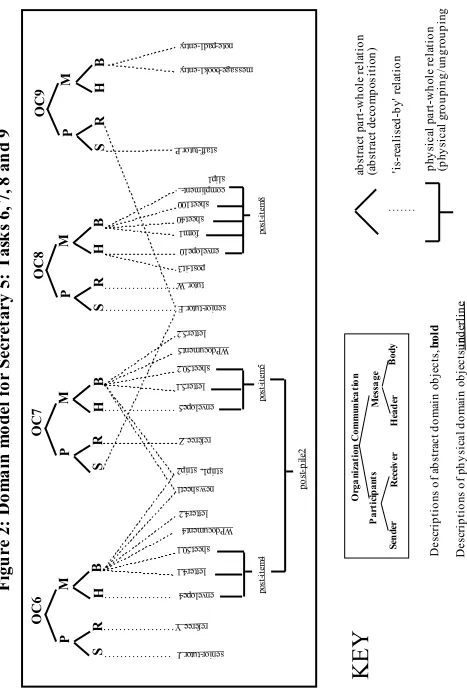
next stage was to identify and separate the multiple tasks being carried out in the analysed sequence; that is, the multiple OCs being supported. This identification required the construction of a domain model of the sort illustrated in Figure 2 for the case of Secretary 5, Tasks 6, 7, 8 and 9.
Figu
re
2:
Do
m
a
in
m
o
del
fo
r
Secre
tary
5:
Tas
k
s
6,
7,
8
an
d
9
O
C
6
P
M
S
R
H
B
O
C
7
P
M
S
R
H
B
O
C
8
P
M
S
R
H
B
O
C
9
P
M
S
R
H
B
ab
st
ra
ct
pa
rt
-w
h
ol
e
re
la
ti
o
n
(a
b
st
ra
ct
de
co
m
p
os
it
ion
)
p
hy
si
ca
l pa
rt
-w
h
ol
e
re
la
ti
o
n
(p
hy
si
ca
l gro
u
pi
n
g
/un
g
rou
p
ing
)
'i
s-re
al
is
ed
-b
y'
re
la
ti
o
n
D
es
cri
p
ti
o
ns
o
f a
b
st
ra
ct
d
o
m
ai
n
ob
je
ct
s,
in
b
ol
d
D
es
cri
p
ti
o
ns
o
f ph
y
si
ca
l d
o
m
ai
n
ob
je
ct
s i
n
u
nd
erl
in
e
O rga ni zat ion C om m un ic a ti o n P ar ti ci p an ts M es sa ge Se n de r R ec ei v er H ead er B od y sen ior -tut or F refer ee Y envelope4 post
support provision for multiple OCs, which are instances of a message (comprising a header and a body) being transmitted between a set of participants (comprising senders and receivers). The lowest level of abstract object description is related to physical object descriptions by an 'is-realised-by' relationship. For example, the sender (of OC6) realised-by senior-tutor-J, and the header (of the message of OC6) is-realised-by the physical object envelope4. The physical object descriptions can be related to each other by (physical) part-whole relationships which produce clusters of hierarchically organized physical objects. For example, the physical object description post-item5 comprises those physical object descriptions envelope5, letter5.1 and sheet50.2. (These physical object hierarchies are inverted in Figure 2).
As an illustration, consider Task 6 in Figure 2 which involved the support of sending a letter from a senior tutor (senior-tutor-J) of the organization to a referee (referee Y) requesting a reference report on a
prospective tutor. This support involved modifying and printing out a word processor document
(WPdocument4) to a letter (letter4.1), of which a copy was kept on file (letter4.2). The letter (letter4.1) was then combined with an information-sheet (sheet50.1) and put into an envelope (envelope4) to make a postable object (post-item4). The information-sheet (sheet50.1) was made by photocopying a newsheet (newsheet1) containing course details for the referee, which involved first photocopying, cutting and re-assembling strips of paper (strip1 and strip2) and then re-photocopying them. The postable object (post-item4) was then put in a pile of postable objects (post-pile2) which was later posted at the internal posting point.
The set of 'is-realised-by' relationships describes both one-to-many and many-to one mappings. For example:
ONE-to-MANY: The body (of OC8) 'is-realised-by' by form1, sheet40, sheet100, and compliment-slip1
MANY-to-ONE: The sender (of OC7), the sender (of OC8) and the receiver (of OC9) all have an 'is-realised-by' relation to senior-tutor-F
2.5 Modelling the SOA interactive worksystem
Stage 3: Identification of behaviour streams. Having identified the multiple tasks of the domain, it was then
possible to categorise the behaviours in the raw protocol into separate behaviour streams; where each behaviour stream is a sequence of behaviours which relate to a single task. It was also possible to
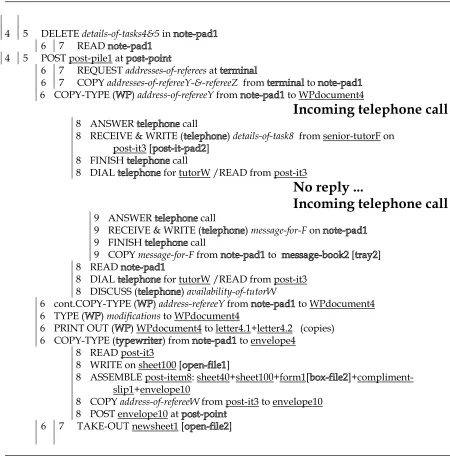
condense the description of behaviours at this stage by raising the level of description without losing any task-relevant information associated with planning and control behaviours. Figure 3 shows an example of a condensed protocol description which relates to the domain model illustration in Figure 2.
The behaviours in Figure 3 are recorded in chronological order and are assigned to Behaviour Streams 4, 5, 6, 7, 8 and 9. Most behaviours are assigned to a single behaviour stream as they were involved in the carrying out of a single task. Certain behaviours, however, are assigned to more than one behaviour stream implying that they were involved in the carrying out of more than one task. The temporal interleaving of behaviour streams in Figure 3 indicates a degree of multiple task concurrency.
Stage 4: Identification of planning and control behaviours. The behaviours of the SOA-IWS were interpreted
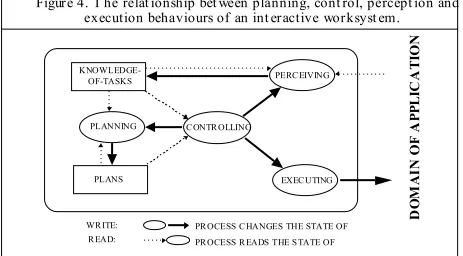
within a model of its abstract information-processing structures (Figure 4). This model describes the structures of the SOA-IWS as a whole, i.e. the secretary plus the interactive devices, rather than the secretary alone, and therefore is similar to the notion of joint-cognition described by Woods and Hollnagel (1987).
The model in Figure 4 makes explicit the interactions between the SOA-IWS processes of planning,
controlling, executing and perceiving, and the representations of knowledge-of-tasks and plans. The
relationships expressed in the model are based partly on theoretical considerations concerning planning and control, discussed in Section 1.2, and partly on a previous case-study of SOA. The model is described elsewhere (Smith et al, 1992), but is included here to provide support for the interpretation of the
Figure 3: Identification of Behaviour Streams
(Illustrative sequence from Secretary 5: Tasks 4, 5, 6, 7, 8 and 9)
4 5 DELETE details-of-tasks4&5 in 6 7 READ
4 5 POST post-pile1 at
6 7 REQUEST addresses-of-referees at
6 7 COPY addresses-of-refereeY-&-refereeZ from to
6 COPY-TYPE ( ) address-of-refereeY from to WPdocument4
Incoming telephone call
8 ANSWER call
8 RECEIVE & WRITE ( ) details-of-task8 from senior-tutorF on
post-it3 [ ]
8 FINISH call
8 DIAL for tutorW /READ from post-it3
No reply ...
Incoming telephone call
9 ANSWER call
9 RECEIVE & WRITE ( ) message-for-F on
9 FINISH call
9 COPY message-for-F from to [ ]
8 READ
8 DIAL for tutorW /READ from post-it3 8 DISCUSS ( ) availability-of-tutorW
6 cont.COPY-TYPE ( ) address-refereeY from to WPdocument4 6 TYPE ( ) modifications to WPdocument4
6 PRINT OUT ( ) WPdocument4 to letter4.1+letter4.2 (copies)
6 COPY-TYPE ( ) from to envelope4
8 READ post-it3
8 WRITE on sheet100 [ ]
8 ASSEMBLE post-item8: sheet40+sheet100+form1[ ]+compliment-slip1+envelope10
8 COPY address-of-refereeW from post-it3 to envelope10 8 POST envelope10 at
6 7 TAKE-OUT newsheet1 [ ]
KEY
BEHAVIOUR
physical domain object information
Figure 4. T he relat ionship bet ween planning, cont rol, percept ion and
execution behaviours of an int eractive worksyst em.
KNOWLEDGE- OF-TASKS
PLANNING
PLANS
CONTROLLING
PERCEIVING
EXECUTING
PROCESS CHANGES THE STATE OF PROCESS READS THE STATE OF WRITE:
READ:
D
O
M
A
IN
O
F
A
P
P
L
IC
A
T
IO
N
Sharing Behaviour
As noted previously, Figure 3 shows some examples of sharing behaviour; that is, where behaviours contribute to the carrying out of more than one task simultaneously. For example: Tasks 4 and 5 are both progressed by the posting of post-pile1; Tasks 6 and 7 are both progressed by the request for the
addresses of referees at the terminal which accesses a central database, and by the photocopying of the newsheet1 to sheet50.1 and sheet50.2 (not shown in Figure 3), and also by the posting of post-pile2 (not shown in Figure 3). Other examples of sharing behaviour occurred where the secretaries contacted OC participants to question them about a number of separate tasks.
These instances of sharing behaviour wererecruited by the SOA-IWS as a more effective way of carrying out multiple tasks. Sharing behaviour may be the result of sophisticated controlling, i.e. through the careful selection of behaviours which will progress more than one task simultaneously. In general, however, sharing behaviour would appear to require some planning. Sharing behaviour was often intentionally made possible by the earlier grouping of physical domain objects, for example the grouping of post-items into post-piles. Furthermore, as partly illustrated for Tasks 6 and 7 in Figure 3, effective sharing behaviour often involved complex patterns of interleaving and sharing between different behaviour streams.
Opportunistic Task Switching Behaviour
Tasks often had to be left 'on wait', pending further relevant task-related changes which were beyond the secretaries' influence. For example, the secretaries had to wait for return telephone calls, for OC
participants to become available, for post-items to arrive, etc. For three of the observed secretaries, there were occasions when they opportunistically switched to a task left on wait because some change occurred which allowed them to do so. In all three cases, this switching behaviour was the result of OC participants suddenly becoming available.
Opportunistic task switching behaviour is evidence of control decisions, informed by the updated knowledge-of-tasks and the plan for the task on wait, which halt the current behaviour stream and select, i.e control, the next behaviour appropriately for the task on wait. The effectiveness of the SOA-IWS was enhanced in this way by exploiting temporary opportunities to progress tasks.
Interruption Management Behaviour
interruptions which are internally generated within the system itself. The protocol in Figure 3 illustrates two external task-related changes, both incoming telephone calls, which generate external interruptions. Figure 3 also shows cases of internal interruption; for example, where the secretary changes from Behaviour Stream 8-to-6, 6-to-8 (second occasion), and 8-to-6&7. Interruptions of behaviour streams, whether external or internal, reflected control decisions. Thus the patterns of interruptions provide an insight into control behaviour.
Internal interruptions generally occurred at 'natural breaks' (Miyata and Norman, 1986) in the tasks, which were formed by the boundaries of sub-tasks and their associated behaviours. External interruptions, on the other hand, could occur at any point during the task. For example, the internal interruption 6-to-8 (second occasion) occurs where the secretary has completed the preparation of letter4.1, letter4.2 and envelope4, but has not yet prepared sheet50.1 (see Figure 2). The external interpretation 6-to-8 (first occasion), in contrast, occurs in the middle of transforming WPdocument4.
It is possible to distinguish, therefore, between the suspension/resumption of behaviour streams, which occur in the middle of sub-tasks, and the stopping/continuing of behaviour streams, which occur at sub-task boundaries. There was a clear preference for the stopping/continuing of behaviour streams over their suspension/resumption. Consider in Figure 3, for example, where Behaviour Stream 6 was
suspended for Behaviour Stream 8, which was in turn suspended for Behaviour Stream 9. As soon as Task 9 was complete, and Behaviour Stream 9 could be stopped, the secretary resumed Behaviour Stream 8 and brought it to its next natural break, and then resumed Behaviour Stream 6 and brought it to its next natural break.
Preference for stopping/continuing was related to the effectiveness with which work was carried out. Suspended, compared to stopped, behaviour streams, were more likely to be adversely affected by the loss of temporarily held task-relevant information, such as the contents of the secretary's working memory, or the current arrangement of documents on the desk.
3 Summary and Conclusions
Empirical observations of secretarial office administration (SOA) were carried out to inform the development of a design-oriented model of the planning and control of multiple task work (PCMT). Complex everyday situations, like SOA, are open to a number of interpretations and so require some conceptual framework for their interpretation. The framework used in the present research led to the identification and expression of the domain of application of SOA as the relationship between abstract and physical objects concerned with multiple organization communications (OCs) for which the SOA worksystem provided support (Figure 2). This expression enabled the identification of separate behaviour streams associated with the separate OC tasks (Figure 3). The framework led finally to the identification of certain planning and control behaviours, of the SOA worksystem, all of which related to the
effectiveness with which the work was carried out: sharing behaviour, opportunistic task switching behaviour and interruption management behaviour.
The development of both the framework and model is currently ongoing, drawing on studies of other domains of application. Even in its current form, however, the model demonstrates its design-oriented nature. Thus, for the case of PCMT in SOA, the model attempts to address a complete ontology of the design problem, by describing the relationship between an interactive worksystem, its domain of application and the performance associated with the work carried out. Such a model would be
appropriate for assisting a designer's reasoning about a to-be-designed interactive worksystem's planning and control behaviours for carrying out multiple task work.
Acknowledgment
References
Ambros-Ingerson, J.A. 1986. Relationships between planning and execution. Quarterly Newsletter of the
Society for the Study of Artificial Intelligence and Simulation of Behaviour, 57, 11-14.
Beishon, R.J. 1969. An analysis and simulation of an operator’s behaviour in controlling continuous baking ovens. In F.Bresson & M. Montmollin (Eds) The simulation of human behaviour. Paris: Duved.
Broadbent, D.E. 1958. Perception and Communication. Oxford: Pergamon. Damos, D. 1991. Multiple task performance. Taylor Francis, London.
Dowell, J. and Long, J. 1989. Towards a conception for an engineering discipline of human factors. Ergonomics,
32, 1513-1536.
Ericsson, K.A. and Simon, H.A. 1980. Verbal reports as data. Psychological Review, 87, 215-251.
Hammer, M. and Sirbu, M. 1980. What is office automation? In I.W.Cotton (Ed) Proceedings of the 1980 Office Automation Conference. Reprinted in Z.W.Pylyshyn and L.Bannon (Eds) Perspectives on the Computer
Revolution, 1989. Ablex Publishing: NJ.
Hayes-Roth, B. 1985. A blackboard architecture for control. Artificial Intelligence, 26, 251-321.
Hirschheim, R.A. 1985. Office Automation: A Social and Organizational Perspective. John Wiley & Sons. Laird, J.E., Newell, A. and Rosenbloom, P.S. 1987. SOAR: An Architecture for General Intelligence. Artificial
Intelligence, 33, 1-64.
Miller, G., Galanter, E. and Pribram, K. 1960. Plans and the structure of behaviour. Holt, Rinehart and Winston: London.
Miyata, Y. and Norman, D.A. 1986. Psychological Issues in Support of Multiple Activities. In Norman & Draper (Eds) User-Centred Systems Design. LEA..
Moray, N., Dessouky, M.I., Kijowski, B.A. and Adapathya, R. 1991. Strategic behaviour, workload, and performance in task scheduling. Human Factors, 33, 607-630.
Newman, W. 1980. Office models and office system design. In N.Naffah (Ed). IntegratedOffice
Systems-Burotics. North Holland.
Newell, A. and Simon, H.A, 1972. Human Problem Solving. Prentice-Hall.
Newell, A. Shaw, J.C. and Simon, H.A. 1959. Report on a general problem-solving program. Proceedings of ICIP, 256-264.
Sacerdoti, E.D. 1974. Planning in a hierarchy of abstraction spaces. Artificial Intelligence, 5, 115-135. Sanderson, P. 1989. The Human Planning and Scheduling Role in Advanced Manufacturing Systems: An
Emerging Human Factors Domain. Human Factors, 31(6), 635-666.
Sebillotte, S. 1989. Action schemata in professional contexts: use and elaboration of new schemata in
administrative tasks. In M.J.Smith & G.Salvendy (Eds) Work with Computers. Elsevier Science Publishers, Amsterdam.
Smith, M.W., Hill, B., Long, J.B. and Whitefield, A.D. 1992. Modelling the relationship between planning, control, perception and execution behaviours. Submitted for publication, 1992.
Suchman, L.A. 1987. Plans and situated actions. Cambridge University Press. Wilensky, R. 1983. Planning and understanding. Reading MA, Addison-Wesley.
Woods, D.D. and Hollnagel, E. 1987. Mapping cognitive demands in complex problem solving worlds.