A Provably Secure And Efficient
Countermeasure
Against Timing Attacks
Boris K¨opf MPI-SWS [email protected]
Markus D¨urmuth Saarland University [email protected]
Abstract
We show that the amount of information about the key that an unknown-message attacker can extract from a deterministic side-channel is bounded from above by|O|log2(n+ 1)bits, where n is the number of side-channel measurements and
Ois the set of possible observations. We use this bound to derive a novel countermeasure against timing attacks, where the strength of the security guarantee can be freely traded for the resulting performance penalty. We give algorithms that efficiently and optimally adjust this trade-off for given con-straints on the side-channel leakage or on the efficiency of the cryptosystem. Finally, we perform a case-study that shows that applying our countermeasure leads to implementations with minor performance overhead and formal security guarantees.
1. Introduction
Side-channel attacks threaten the security of cryptographic algorithms by exploiting informa-tion that is revealed by the algorithm’s physical ex-ecution. Characteristics such as running time [17], cache behavior [27], power consumption [18], and electromagnetic radiation [12], [29] have all been exploited to recover secret keys from imple-mentations of different cryptographic algorithms. In distributed environments such as the internet, timing attacks are maybe the most daunting kind of side-channel attack: Timing can be measured and exploited remotely [4], opening the door for a potentially large number of attackers.
A number of countermeasures against timing attacks have been proposed [17], [4], most notably input blinding and constant-time implementations. To describe input blinding, we use RSA as an example. Input blinding relies on the fact that all known timing attacks against RSA decryption require that the attacker be able to obtain a large
number of pairs of ciphertexts and corresponding execution times. Blinding randomizes each cipher-text before decryption. In this way, the attacker’s timing measurements are decorrelated from the ciphertexts, rendering all known timing attacks ineffective. Blinding has become the state-of-the-art countermeasure against timing attacks and is implemented in a wide range of crypto-libraries. However, it is still unclear whether blinding offers any kind of completeness in the sense that it defeats all possible timing attacks [17]. A recent result even shows that a blinded implementation may leak the entire key information if the number of measurements is sufficiently large [2].
In contrast, constant-time implementations de-feat all timing attacks. However, this security guar-antee comes at the price of a large performance penalty, as the system assumes its worst-case execution time on all inputs. For many resource-critical application domains, such a performance penalty is not acceptable. Moreover, for many platforms, constant-time software is hard to write and maintain. As a consequence, constant-time software is not widely used in practical implemen-tations of cryptosystems.
The key to our solution is the insight that if a system with deterministic timing behavior is run on inputs that have been previously blinded, the amount of information about the key that is leaked by the system’s timing behavior is bounded from above by
|O|log2(n+ 1)
bits, where O is the set of possible execution times, and n is the number of side-channel mea-surements made. We formally establish this bound, and we use it to derive a lower bound on the ex-pected effort for determining the key by exhaustive search after a side-channel attack.
Motivated by this result, we propose the com-bination of blinding and bucketing as a novel countermeasure against timing attacks. Bucketing is the discretization of a system’s execution times such that the results of the computation are only returned at a small number of fixed points in time. More precisely, bucketing partitions a system’s possible execution times into intervals (buckets) of variable length, where, for each execution time, one waits until the enclosing bucket’s upper bound before returning the result of the computation.
Bucketing reduces the number of possible tim-ing observations (and hence improves the bound on the leaked information) at the cost of the system’s performance. The resulting trade-off be-tween security and performance can be adjusted by choosing the number of buckets and their bounds. To this end, we give an algorithm that, for a given number of buckets (i.e., a desired security guarantee), computes a bucketing such that the system’s resulting performance penalty is minimal. Moreover, we give an algorithm that computes the minimal number of buckets (i.e., the best possible security guarantee) under the constraint that the resulting performance penalty does not exceed a given bound.
We have implemented our algorithms and have applied them to evaluate the effect of combining bucketing and blinding on the performance and security of a realistic example. As a case study, we analyze an implementation of an algorithm for 1024 bit RSA decryption. Our results show that meaningful security guarantees can be ob-tained with only a minor performance overhead: If a bucketing of 5 buckets is applied to the
implementation, more than 240 timing measure-ments are necessary for recovering an expected amount of 200 key bits (alternatively, 240 side-channel measurements reduce our lower bound for the expected effort for determining the key by exhaustive search by a factor of 2200). The performance overhead imposed by the bucketing amounts to less than 0.7% with respect to the blinded implementation without bucketing.
In summary, our contributions are both theo-retical and practical. On the theotheo-retical side, we prove a bound on the amount of information that a side-channel attacker can extract from a blinded implementation in a given number of mea-surements. This bound leads to a countermeasure against timing attacks, where the strength of the security guarantee can be freely traded for the re-sulting performance penalty. On the practical side, we give algorithms that efficiently and optimally adjust this trade-off for given constraints on the side-channel leakage or on the efficiency of the cryptosystem. Finally, we perform a case-study that shows that the combination of blinding and bucketing leads to implementations with minor performance overhead and formal security guar-antees.
The remainder of this paper is structured as follows. In Section 2, we present a measure for the amount of information that is leaked by a blinded implementation. In Section 3, we prove a bound on this quantity and give an interpretation of this bound in terms of guessing. In Section 4, we present algorithms for computing optimal bucketings. In Section 5, we present experimental results. We present related work and conclude in Sections 6 and 7, respectively.
2. Preliminaries
In this section, we introduce our model of side-channels and an information-theoretic measure that captures the side-channel leakage of blinded implementations. To begin with, we recall some basic information theory. See [9] for a textbook on the subject.
2.1. Information Theory Basics
X: A → X, we define pX: X → R as
pX(x) =Pa∈X−1(x)p(a), which is often denoted byp(X =x)in the literature.
The (Shannon) entropy of a random variable
X:A→X is defined as
H(X) =−X x∈X
pX(x) log2pX(x).
The entropy is a lower bound on the average number of bits required to represent the results of independent repetitions of the experiment as-sociated with X. Thus, in terms of guessing, the entropy H(X) is a lower bound on the aver-age number of binary questions that need to be asked to determine X’s value [5]. The entropy is nonnegative, and reaches its maximal value of H(X) = log2(|X|) when X is uniformly distributed.
If Y: A → Y is another random variable, H(X |Y =y)denotes the entropy ofX givenY= y, i.e., with respect to the distribution pX |Y=y.
The conditional entropyH(X |Y)is defined as the expected value ofH(X |Y =y) over all y ∈ Y, namely,
H(X |Y) =X
y∈Y
pY(y)H(X |Y =y).
Entropy and conditional entropy are related by the equationH(X Y) =H(Y) +H(X |Y), where
X Y is the random variable defined as X Y(k) = (X(k),Y(k)). The mutual information
I(X;Y) =H(X)−H(X |Y)
captures the expected reduction in uncertainty about X when one learns the value of Y. The mutual information is measured in bits.
2.2. Side-Channels
Let K be a finite set of keys, M be a finite set of messages, and D be an arbitrary set. We consider systems that compute functions of type F: K × M → D, and we assume that the attacker can make physical observations about F’s implementation IF that are associated with
the computation ofF(k, m). We assume that the attacker can make one observation ofIFper call to
Fand that no measurement errors occur. Formally, a side-channel is a functionfIF:K×M → O,
whereO denotes the set of possible observations. We assume that the attacker has full knowledge of the implementation IF; in particular we assume
thatfIF is known to the attacker. We will usually leave IF implicit and abbreviatefIF byf.
Example 1. Suppose that F is implemented in
synchronous (clocked) hardware and that the at-tacker is able to determine IF’s running times up to single clock ticks. Then the timing side-channel of IF can be modeled as a function
f: K×M → N that represents the number of clock ticks consumed by an invocation ofIF. This modeling also applies to software implementations of F on simple microprocessors without caches and pipelines.
Example 2. For implementations on
microproces-sors with performance-enhancing features such as pipelines and caches, the timing behavior of IF is not necessarily a function of the inputs to F. However, if the processor is forced into a fixed initial state before each call to F (e.g., by filling up the pipeline and the cache), and if there are no interferences such as interrupts and preemptions, the execution time becomes a function of the inputs toF.
Our modeling of side-channels also encom-passes simple models of power consumption, e.g. the Hamming weight model [21]. However, these models abstract away certain electrical effects, and formal bounds derived on their basis do not imply security from attackers that exploit the omitted effects. The practical implications of applying our model to power analysis requires further investi-gation. In this paper, we focus on timing side-channels.
2.3. Unknown-Message Attacks
In a side-channel attack, a malicious agent gathers side-channel observations f(k, m1), . . . , f(k, mn) for deducing k or
narrowing down its possible values. Depending on the attack scenario, the attacker might additionally be able to see or choose the messages mi ∈M: An attack is chosen-message
if the attacker can choose mi ∈ M; an attack
attack is unknown-message if the attacker cannot observemi∈M.
As previously mentioned, all known timing attacks against RSA decryption require that the attacker be able to obtain a large number of pairs of ciphertexts and corresponding execution times. Input blinding randomizes each ciphertext be-fore decryption, thus turning chosen- and known-message attacks into unknown-known-message attacks.
Example 3. Consider an RSA decryptionx=mk
modN, where m is a ciphertext chosen by the attacker, x is the plaintext, N = p· q is the modulus, and k with k ·e = 1 modϕ(N) is the secret key. In the blinding phase, one picks a random r that is relatively prime to N and computesm·re modN. The result of the decryp-tion is(m·re)k =x·r modN, which yieldsx after unblinding, i.e., after multiplication withr−1 modN.
Input blinding techniques are available for many common cryptographic algorithms, including El-Gamal and Diffie-Hellman. While the mathemat-ical details of these techniques depend on the al-gebraic properties of the individual cryptosystems, the notion of an unknown-message attack provides a common abstraction for attacks against blinded implementations.
2.4. Side-Channel Leakage in
Unknown-Message Attacks
We review the information measure from [2] that captures the side-channel leakage in unknown-message attacks. For this, let pK: K → R and pM: M → R be probability
distributions and let the random variables
K =idK, M = idM model the choice of keys
and messages, respectively; we assume that pM
andpK are known to the attacker.
For n ∈ N, we define the random variable
On:K×Mn → On by On(k, m1, . . . , m n) =
(f(k, m1), . . . , f(k, mn)), where
pK×Mn(k, m1, . . . , mn) =pK(k)
n
Y
i=1
pM(mi)
is the probability distribution on K×Mn. The
definition of the random variableOncaptures that
kremains fixed over all invocations off, while the messagesm1, . . . , mn are chosen independently.
Example 4. Consider again the blinded RSA
ciphertextm·re modN from Example 3. Ifmis relatively prime to N, the multiplication with m
and the exponentiation with e are permutations on Z×N. Hence, for independent and uniformly distributed values of r, the blinded inputs to the decryption are also independent and uniformly distributed. Note that choosing a ciphertext m
that is not relatively prime to N corresponds to guessing one of the prime factors ofN =p·q. We can hence safely capture the effect of RSA input blinding by assuming a uniform distribution pM.
An unknown-message attacker making n side-channel observations On may learn information about the value of K, i.e., about the secret key. This information can be expressed as the reduc-tion in uncertainty about the value of K, i.e., I(K;On) =H(K)−H(K|On).
Note that I(K;On) captures only the informa-tion leaked by the time required for computing F, but does not capture the timing behavior of the blinding and unblinding steps. We assume that these steps do not introduce additional timing leaks.
3. Bounds on the Side-Channel
Leak-age
In this section, we prove our main result, which is an upper bound on the amount of information that an unknown-message attacker can extract from a side-channel in a given number of mea-surements. We give the proof idea in Section 3.1 and formalize it in Section 3.2. In Section 3.3, we give an interpretation of this bound in terms of the remaining effort for correctly guessing a key.
3.1. Proof Idea
For a fixed key, however, the individual observa-tions are independent and identically distributed. As a consequence, their ordering is irrelevant: only the relative frequency with which each observation occurs carries information about the key. The number of relative frequencies of observations, however, is bounded from above by (n+ 1)|O|,
which leads to our|O|log2(n+ 1)upper bound on the leaked information.
3.2. Formal Proof
Formally, the type to of a sequence o =
(o1, . . . , on) ∈On is the relative frequency with
which each element of O occurs in o. Let Tn = {to | o ∈ On} be the set of types of sequences
of length n of elements of O. The function
Tn: On → T
n defined by o 7→ to is a random
variable wherepTn(t) =pOn({o∈O
n |t o=t}).
We denote by|to|the number of observation vec-tors of typeto, i.e.,|to|=|{o′∈On|to′ =to}|. The following bound on the size of Tn is
fundamental to the (information-theoretic) method of types, see e.g. [10].
Lemma 1. |Tn| ≤(n+ 1)|O|
Proof: Each typeto∈Tn can be represented
by a vector in {0, . . . , n}|O|, where each
com-ponent of the vector corresponds to the number of occurences of a particular observation in o. The assertion then follows from|{0, . . . , n}|O||=
(n+ 1)|O|.
Lemma 2 shows that a vector of observationso contains as much information (i.e., leads to the same reduction in uncertainty) about the key as the typeto.
Lemma 2. H(K|On =o) =H(K|Tn=to)
Proof: H(K|On = o) is defined by
−P
k∈KpK|On=o(k) log2pK|On=o(k), hence it
suffices to show that pK|On=o = pK|Tn=to. For a fixed k, the individual observations in o = (o1, . . . , on)are independent, hence
pOn|K=k(o) =
n
Y
i=1
pO1|K=k(oi).
In particular, this implies that pOn|K=k(o) =
pOn|K=k(o
′)whenevert
o=to′. Hence
pTn|K=k(to) =
X
o′:t o=to′
pOn|K=k(o
′)
=|to|pOn|K=k(o). We further have
pK|T=to(k) =
pT |K=k(to)pK(k)
pT(to)
= P pT |K=k(to)pK(k)
k′
∈KpT |K=k′(to)pK(k′) = |to|pOn|K=k(o)pK(k)
P
k′∈K|to|pO
n|K=k′(o)pK(k
′)
= pOn|K=k(o)pK(k) pOn(o) =pK|On=o(k),
from which the statement follows.
Lemma 3 shows that the random variable On
contains as much information about the key as the random variableTn.
Lemma 3. H(K|On) =H(K|Tn)
Proof:
H(K|On) = X
o∈On
pOn(o)H(K|On=o)
= X
t∈Tn
X
o:to=t
pOn(o)H(K|On =o) (∗)
= X
t∈Tn
pT(t)H(K|Tn =t)
=H(K|Tn)
where step (∗)follows from Lemma 2.
We are now ready to give the proof of our main result, which is an upper bound on the amount of information that an unknown-message side-channel attacker can extract in a given number of measurements.
Theorem 1. Let f: K ×M → O be a
side-channel and let K and On be defined as above. Then we have
I(K;On)≤ |O|log2(n+ 1).
I(K;On) =H(K)−H(K|On) (1) =H(K)−H(K|Tn) (2) =H(Tn)−H(Tn|K) (3)
≤H(Tn) (4)
≤log2|Tn| (5) ≤ |O|log2(n+ 1), (6)
where (1) follows from the definition of the mu-tual information, (2) follows from Lemma 3, (3) follows from the chain rule for the conditional entropy, (4) follows from the non-negativity of the entropy, (5) is basic information theory, and (6) follows from Lemma 1.
Theorem 1 characterizes the available side-channel information in terms of a bound on the expected number of leaked bits. Below, we give a characterization of this information in terms of the remaining effort for correctly guessing a key.
3.3. The Effort for Guessing Keys after a
Side-channel Attack
In this section, we give a lower bound on the attacker’s expected effort for guessing the correct key afternside-channel measurements.
The basis for our proof is a result by Massey [22] that shows that the average number of questions of the form “DoesX =xhold” that must be asked to guess the value of a random variableXwithH(X)≥2is bounded from below by2H(X)−2+ 1. We extend this bound to a bound in terms of the conditional Shannon entropy and apply the result to Theorem 1.
To this end, observe that the optimal guessing strategy is to try each of the possible values of
X:A→X in order of their decreasing probabil-ities. Without loss of generality, letX be indexed such that pX(xi) ≥ pX(xj), whenever i ≤ j.
Then the guessing entropyG(X) ofX is defined as G(X) = P
1≤i≤|X|i pX(xi). One defines the conditional guessing entropyG(X |Y)as
G(X |Y) =X
y∈Y
pY(y)G(X |Y =y).
The conditional guessing entropy captures the expected number of guesses needed to determine
X when the value ofY is already known [5].
The following lemma generalizes Massey’s en-tropic lower bound on the guessing entropy to a lower bound on the conditional guessing entropy.
Lemma 4. Let X,Y be random variables. Then
G(X |Y) = 2H(X |Y)−2.
Proof: We haveG(X)≥2H(X)−2+ 1 when-ever H(X) ≥ 2. Note that G(X) ≥ 1 always holds, hence we have G(X) ≥2H(X)−2 without any restrictions on H(X). We conclude
G(X |Y) =E(G(X |Y =y)
≥E(2H(X |Y=y)−2) (∗)
≥2E(H(X |Y=y))−2 = 2H(X |Y)−2 ,
where E denotes the expected value over y ∈Y and where (∗) follows from Jensen’s inequality.
The following corollary of Theorem 1 shows that the information contained in n side-channel measurements lowers the bound for the effort for guessing the correct key by a factor of(n+ 1)|O|.
Corollary 1. LetK andOn be defined as above.
Then
G(K|On)≥ 2 H(K) 4 (n+ 1)|O| .
Proof: We have
G(K|On)(≥∗)2H(K|On)−2 (∗∗)
≥ 2H(K)−|O|log2(n+1)−2 , where(∗)follows from Lemma 4 and(∗∗)follows from Theorem 1.
4. An
Adjustable
Countermeasure
Against Timing Attacks
4.1. Bucketing
Reducing the size ofO improves the bound on the leaked information given by Theorem 1. In the case of timing, such a reduction can be achieved by a discretization of the possible execution times, which we call bucketing. Bucketing partitions a system’s possible execution times into intervals (which we call buckets) of variable length, where, for each execution time, one waits until the en-closing bucket’s upper bound before returning the result of the computation.
Clearly, bucketing leads to a performance penalty. In this section we show how, for a given r∈N, one can compute a bucketing intorbuckets such that the resulting performance penalty is minimal. Moreover, we show how, for a given ǫ >0, one can compute a bucketing with a mini-mal number of buckets, such that the performance penalty when applying this bucketing is belowǫ.
Our algorithms take as input a sample S of execution times of IF and do not require
pre-cise knowledge about fIF. The accuracy of the estimated performance penalty, however, depends on the accuracy with which S approximates the average execution time ofIF (In Section 5.3, we
show how to estimate this accuracy). By contrast, the validity of the obtained security guarantee depends only on the correct number of buckets and does not rely on the accuracy ofS. For the number of buckets to be correct, it suffices thatS contains an upper bound for the worst-case execution time ofIF. For many embedded processors, such upper
bounds can be obtained by automated worst-case execution time analysis [32].
4.2. Trading Security for Performance
In the remainder of this section, we assume that O={o1, . . . , om}is a set of positive reals that is indexed in ascending order, i.e.oi≤oj whenever
i < j. We denote the set{o1, . . . , ot} byOt.
A sampleS is a multiset of observations. For-mally, S is a function S: O → N, where S(o) represents the number of occurrences of o in
S. We denote the relative frequency with which o∈O occurs inS by pS(o), i.e.,
pS(o) =
S(o) P
o∈OS(o)
.
We extendpS to sets of observations in the natural
way.
An (r-)bucketing B of Ot is a vector B =
(ˆo1, . . . ,oˆr) of observations, with ˆor = ot and
ˆ
oi≤ˆojwheneveri < j. Note that it would suffice
to require thatˆor≥otand later prove that equality
holds for optimal bucketings. We avoid this detour by definition.
Fori∈ {1, . . . , r}, we define the bucket bi by
bi ={o∈O|ˆoi−1< o≤oˆi},
where we set o0ˆ =−1. For a bucketingB ofOt
and a sample S, we define the average ofS with respect to B by
avg(S, B) =
r
X
i=1 ˆ
oi pS(bi). (7)
An r-bucketing B of Ot is S-optimal if
avg(S, B)≤avg(S, B′)for everyr-bucketingB′
ofOt.
In our application, S models a sample of exe-cution times of the target system andBrepresents a sequence of time boundaries. If a computation takes timeo, we wait for the minimal time bound-ary ˆoi with oˆi ≥ o until we return the result
of the computation. This modified system has an average running time of avg(S, B). The
perfor-mance penaltypen(S, B)resulting from applying a bucketingB ofO toS is given by
pen(S, B) =avg(S, B)−X o∈S
o pS(o).
Example 5. The sequence(o1, . . . , om)is a
buck-eting ofO with
avg(S,(o1, . . . , om)) =
X
o∈O
o pS(o).
This value is the average value of the sample
S, which leads to a performance penalty of 0
Example 6. The singleton sequence(om)is a1 -bucketing ofO with
avg(S,(om)) =om.
This reflects that a system with bucketing (om) requires timeomfor all inputs, and hence the av-erage and the worst-case execution times coincide.
We consider the following two optimization problems related to bucketings.
Definition 1 (Minimal Performance Penalty Prob-lem). Given a sample S of observations and
r ∈ N, the Minimal Performance Penalty
Prob-lem is to find an r-bucketing of O with minimal performance penalty with respect toS. Formally, the goal is to find an r-bucketing B of O, such that
avg(S, B)≤avg(S, B′)
for allr-bucketingsB′ ofO.
Definition 2 (Minimal Information Loss Problem).
Given a sampleS of observations andǫ >0, the
Minimal Information Loss Problem is to find a
bucketing that minimizes the system’s information loss through timing behavior under the constraint that the resulting performance penalty does not exceed ǫ . Formally, the goal is to find an r -bucketingB ofO with minimalrand
pen(S, B)≤ǫ . (8)
Below, we present efficient algorithms for both problems.
4.3. Computing Optimal Bucketings
In this section, we propose efficient algorithms for the Minimal Performance Penalty Problem and for the Minimal Information Loss Problem stated above. For this, we leverage ideas from computing optimal histograms [16].
4.3.1. An Algorithm for the Minimal Perfor-mance Penalty Problem. The following obser-vation is fundamental for our algorithm: Every S-optimal bucketing of Oi contains a S-optimal
bucketing for some Oj with j < i. Formally, if
the bucketingB = (ˆo1, . . . ,oˆr)is optimal forOi,
then the bucketing (ˆo1, . . . ,oˆr−1) is optimal for Oj, where oj = ˆor−1. Assume to the contrary
that (ˆo1, . . . ,oˆr−1) is not optimal for Oj. Then
one can pick the S-optimal (r −1)-bucketing of Oj and add one bucket for the observations
oj+1, . . . , oi. The result is an r-bucketing B′ of
Oi, with avg(S, B′)< avg(S, B), which
contra-dicts the optimality ofBforS. A consequence of this so-called optimal substructure property is that we can use dynamic programming (see, e.g., [9]) to construct optimal bucketings of a set Oi from
optimal bucketings of subsets Oj ⊆Oi.
To this end, we define the function a, where the intuition is that a(i, r) captures the value avg(S, B)for anS-optimalr-bucketingB ofOi.
a(i,1) =oi
X
o≤oi pS(o)
a(i, r) = min
1≤j≤ia(j, r−1) +oi
X
oj<o≤oi pS(o)
The following lemma formalizes our intuition about a.
Lemma 5. Let S be a sample and B =
(ˆo1, . . . ,oˆr)be a bucketing of Oi. Then
a(i, r)≤avg(S, B). (9)
Moreover, there exists an r-bucketing of Oi for which equality holds in (9).
Proof: We prove the assertion by
induc-tion on r. For r = 1, there is only one r -bucketing ofOi, namely(oi). We have a(i,1) =
oiPo≤oi pS(o), which proves the assertion. For
r >1, it follows by induction thata(j, r−1) = avg(S, B), where B is an S-optimal (r −1) -bucketing of Oj. By adding one bucket with
boundaryoi and weightPoj<o≤oipS(o), one can extendB to anr-bucketingB′ ofO
i with
avg(S, B′) =avg(S, B) +oi
X
oj<o≤oi pS(o).
Note that B′ is not necessarilyS-optimal forO
i.
However, as previously observed, anS-optimalr -bucketingB∗ ofO
i contains an optimal(r−1)
-bucketing of someOj∗ withj∗< i. By definition of a(i, r), this j∗ is found and, hence, a(i, r) =
avg(S, B∗).
For computing each entry, at most |O| lookups are necessary (The values P
o≤oipS(o) can be precomputed for i ∈ {1, . . . ,|O|}). A concrete bucketing can then be obtained from this table by backtracking, which yields the following proposi-tion.
Proposition 1. For a sample S and a number
of buckets r, the Minimal Performance Penalty Problem can be solved in timeO(r|O|2).
As we show next, a similar approach can be taken for solving the Minimal Information Loss Problem.
4.3.2. An Algorithm for the Minimal Infor-mation Loss Problem. We present an algorithm for the Minimal Information Loss Problem. For this, we re-use the functiona defined in Section 4.3.1. As before, we use dynamic programming to build a value-table representation of a, where the difference to the algorithm for the Minimal Performance Penalty Problem is that the minimal length r of a bucketing B with pen(S, B) ≤ ǫ is not known a priori. However, as Example 5 shows, there is a bucketing of length |O| with a performance penalty of 0. Hencer is bounded from above by |O|, which leads to an O(|O|3) -algorithm.
Proposition 2. For a sample S and ǫ > 0, the
Minimal Information Loss Problem can be solved in timeO(|O|3).
This direct approach to the Minimal Informa-tion Loss Problem is efficient enough for our ex-periments, however, it is likely that the complexity bounds can be further improved, e.g., along the lines of [16].
5. Experimental Results
In this section, we perform a case study where we evaluate the influence of bucketing on the per-formance and the security of a realistic example. To this end, we apply the algorithms presented in Section 4 to compute optimal bucketings for an implementation of 1024 bit RSA decryption.
1 procedureExp(x, k, N)
2 inputx, k, N ∈N
3 outputxk modN
4 begin
5 p←MontMul(1,1)
6 x←MontMul(x,1)
7 fori=n−1 downto0 do
8 p←MontMul(p, p)
9 ifk[i] = 1 then
10 p←MontMul(p, x)
11 od
12 p←MontMul(p, R2)
13 returnp
14 end.
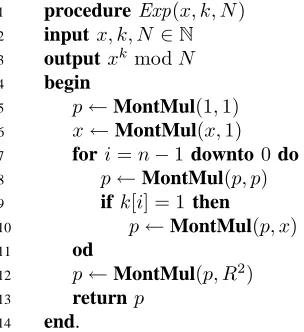
Fig. 1. Pseudo-code of the exponentiation algorithm, where MontMul stands for Mont-gomery Multiplication. The operations in lines 5, 6, and 12 transform the operands to Mont-gomery form and back, respectively, and the loop in lines 7–11 performs the actual expo-nentiation.
5.1. RSA
Implementation
and
Timing
Model
We consider the RSA implementation in Figure 1, in which the modular exponentiation is per-formed by square-and-multiply, and where each modular multiplication is carried out using Mont-gomery’s algorithm [26], which is a common choice in practice. It is important to note that Montgomery multiplication is not constant-time, because of so-called extra reductions that must be performed for some operands.
0 200 400 600 800 1000
... 2150000 2200000 1500000 1550000 1600000 1650000 0
40000 80000 120000 160000 200000
# samples
# samples per bucket
execution time in ticks
buckets worst-case execution time measurement
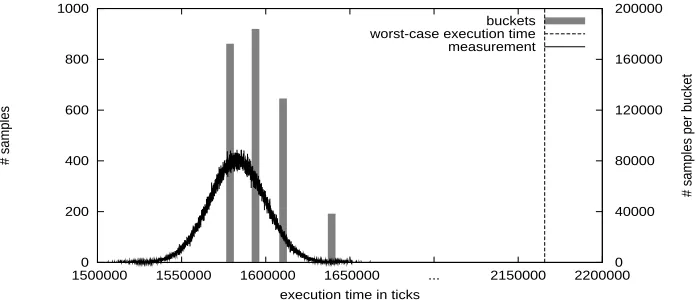
Fig. 2. Execution time in clock cycles of1024-bit RSA exponentiation for219samples. The mean
for the original distribution is1 586 211, the mean for the bucketized distribution is1 596 726.
reduction step, respectively.
An upper boundtmax on the worst-case execu-tion time of our implementaexecu-tion is given by
tmax = (2·1024 + 3)(tmul+tred) = 2 165 856,
which corresponds to an execution in which all possible multiplications and extra reductions are carried out.
5.2. The Effect of Bucketing on Security
and Performance
The black curve in Figure 2 shows the distribu-tion of the execudistribu-tion times of our RSA implemen-tation, based on219randomly sampled inputs. The average execution time of this implementation is 1 586 211clock ticks.
The (centers of the) gray bars and the dashed vertical line depict the boundaries of an optimal5 -bucketing computed with our algorithm, i.e, a so-lution to the Minimal Performance Penalty Prob-lem. The average execution time for the system with this bucketing is1 596 726clock ticks, which corresponds to an overhead of only 0.67% with respect to the implementation without bucketing.
Theorem 1 shows that a5-bucketing is coarse enough for obtaining meaningful security guar-antees: At least 2200/5 timing measurements are necessary for learning an expected amount of 200 key bits. Alternatively, Corollary 1 shows that2200/5timing measurements reduce the lower
bound for the attacker’s expected effort for cor-rectly guessing the key by a factor of at most 2200. A modern Smartcard such as Infineon’s SLE 66CX366PE can perform an RSA decryption in 26ms [15] (see also [13]). For such a system, the time for performing these 240 measurements amounts to more than900years.
We conclude that adding bucketing to a blinded implementation implies only a minor performance overhead and yields meaningful formal security guarantees.
Figure 3 depicts how the average execution time decreases as the number of buckets grows. This decrease is most notable between bucketings of1 and 2 buckets, which illustrates the performance gain of a 2-bucketing with respect to a constant-time implementation. Observe that this strong per-formance gain does not give the whole picture, be-cause our analysis does not consider the overhead introduced by the blinding and unblinding steps. If the mask recan be precomputed, however, this
overhead will be small.
5.3. Error Estimations
1400000 1600000 1800000 2000000 2200000
1 2 3 4 5 6 7 8
avg. execution time
n
without buckets with n buckets
Fig. 3. Expected execution time vs. number of buckets for1024-bit RSA exponentiation for219
samples.
penalty. We next show how this precision can be determined.
Formally, we derive a bound on
|pen(S, B)−pen(SO, B)|,
where SO denotes an “idealized sample” ofO1, i.e. a sample with pSO = pO1. To this end, let B= (ˆo1, . . . ,oˆr), let
∆(pO1, pS) = 1 2
X
x∈O
|pO1(x)−pS(x)|
denote the statistical distance of pO1 andpS, and
letE denote the expected value. We have
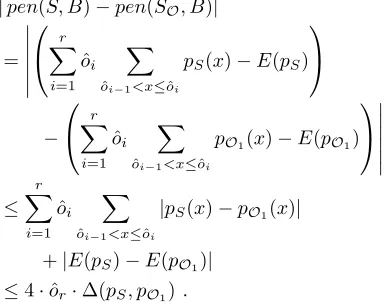
|pen(S, B)−pen(SO, B)|
=
r
X
i=1 ˆ oi
X
ˆ
oi−1<x≤ˆoi
pS(x)−E(pS)
−
r
X
i=1 ˆ oi
X
ˆ
oi−1<x≤oˆi
pO1(x)−E(pO1)
≤ r
X
i=1 ˆ oi
X
ˆ
oi−1<x≤ˆoi
|pS(x)−pO1(x)|
+|E(pS)−E(pO1)|
≤4·oˆr·∆(pS, pO1).
For our example, we instantiate ˆor with the
worst-case execution time of 2 165 856 clock cycles. We have computed upper bounds on ∆(pS, pO1)in terms of the size of O, which we estimate as follows: All variations in the execution time are multiples of32clock cycles, hence it suf-fices to count the number of variations. Only the
multiplication in line 10 and the extra reductions in lines 5, 6, 8, 10, and 12 account for potential variations. Summing up, we see that
|O| ≤1024·(32 + 1 + 1) + 3 = 34 819.
Our computation of bounds on the statistical distance of pO1 and pS in terms of |O| uses Chernoff bounds and the McDiarmid Inequality. The actual computation is tedious and we omit it for better readability. The result is that a sample of 219 execution times is sufficient to guarantee an approximation error of less than 0.01 with a confidence of more than0.99. With this, we obtain
|pen(S, B)−pen(SO, B)|<64 976
clock cycles, which amounts to less than 4.1% of the expected execution time. Note that these error bounds depend only on|O|andoˆrand hold
for arbitrary systems with these parameters. The timing behavior of our case-study shows strong regularity, and we expect that this can be exploited for deriving much tighter error bounds.
6. Related Work
Our results are based on the model of side-channels from [19] and the measure for information-flow in unknown-message attacks from [2]. The exact computation of this measure for a given system requires the enumeration of all possible inputs and does not scale. Our new result implies that, by combining bucketing and blinding, such a costly analysis can be entirely avoided.
which also leads to a trade-off between security and performance. Applying these language-based approaches requires restrictive programming and precise knowledge about the time consumption of the individual instructions on the underlying machine. By contrast, our approach only requires that the system’s execution time be a function of the inputs to the system.
Code transformations to eliminate the influence of secrets on the control flow of a program have been proposed in [25], [8], and they have been applied to eliminate timing leaks in code for modern multi-purpose processors. As shown in [25], the resulting performance overhead can be large compared to that introduced by blinding (and hence to that introduced by our countermeasure). Standaert et al. propose a framework for the evaluation of side-channel attacks [31], where they use two largely independent metrics for the evalu-ation of systems. The informevalu-ation-theoretic metric captures non-adaptive chosen-message adversaries and is not given a direct interpretation in terms of security. The security metric characterizes the security of a system in terms of the success rate of applying a given key recovery strategy to the measurement data. In this way, an analysis with the model of [31] yields assertions about the effectiveness of a particular kind of attack, but not necessarily universal bounds.
Micali and Reyzin [24] propose physically
ob-servable cryptography, a mathematical model that
aims at providing provably secure cryptography on hardware that is only partially shielded. Using a similar approach, Dziembowski and Pietrzak [11] recently obtained the first positive results, where they construct a stream cipher that is provably secure in the presence of arbitrary leakage func-tions with output of logarithmic length (assuming ordinary PRFs) or of a constant fraction of state-bits (assuming the existence of exponentially hard PRFs). It will be interesting to see how efficient their constructions work in practice, and whether they extend to public-key cryptography. Our ap-proach is more concrete than that of [11] in that we prove the security of a specific countermea-sure against timing attacks. This countermeacountermea-sure, however, can readily be applied to existing cryp-tosystems.
The term bucketing and the idea of
comput-ing optimal bucketcomput-ings by dynamic programmcomput-ing is inspired by work on computing optimal his-tograms of probability distributions [16]. In [16], the buckets partition a set of values (which corre-sponds to the observations in our model), where each value has a given frequency (which corre-sponds to the number of occurences in a sam-ple). However, there is no direct correspondence between the notions of optimality of bucketings in [16] and in our approach, which requires our development in Section 4.3.
The discretization of the execution time into multiples of a fixed time quantum has been pro-posed in [4]. However, it was observed that, for obtaining security guarantees, the execution time for all all decryption operations must lie within a single time quantum. This use of discretization corresponds to the requirement that the decryption operation is constant-time. Bucketing weakens this requirement and hence improves the performance of the system. Our results show that this im-provement can be achieved while retaining formal security guarantees.
7. Conclusions
We have presented a provably secure and efficient countermeasure against timing attacks, where the strength of the obtained security guar-antee can be freely traded for the resulting perfor-mance overhead. We have given algorithms that efficiently and optimally adjust this trade-off for given constraints on the side-channel leakage or on the efficiency of the cryptosystem. Finally, we have performed a case-study that shows that our countermeasure leads to implementations with minor performance overhead and meaningful se-curity guarantees.
blinded implementations. Finally, any improve-ment on the information-theoretic bounds will have a direct impact on the security guarantees delivered by our countermeasure.
References
[1] Johan Agat. Transforming out timing leaks. In Proc.
POPL ’00, pages 40–53. ACM, 2000.
[2] Michael Backes and Boris K ¨opf. Formally bounding the side-channel leakage in unknown-message attacks. In
Proc. ESORICS ’08, volume 5283 of LNCS, pages 517–
532. Springer, 2008.
[3] Gilles Barthe, Tamara Rezk, and Martijn Warnier. Pre-venting timing leaks through transactional branching in-structions. In Proc. QAPL ’05, ENTCS, pages 33–55. Elsevier, 2005.
[4] Dan Boneh and David Brumley. Remote timing attacks are practical. In Proc. USENIX Security ’03, 2003. [5] Christian Cachin. Entropy measures and unconditional
security in cryptography. PhD thesis, ETH Z ¨urich, 1997. [6] David Clark, Sebastian Hunt, and Pasquale Malacaria. Quantitative information flow, relations and polymorphic types. J. Log. Comput., 18(2):181–199, 2005.
[7] M.R. Clarkson, A.C. Myers, and F.B. Schneider. Belief in information flow. In Proc. CSFW ’05, pages 31– 45. IEEE, 2005.
[8] Bart Coppens, Ingrid Verbauwhede, Koen De Bosschere, and Bjord De Sutter. Practical mitigation for timing-based side-channel attacks on modern x86 processors. In
Proc. IEEE SSP ’09 (to appear). IEEE, 2009.
[9] Thomas H. Cormen, Clifford Stein, Ronald L. Rivest, and Charles E. Leiserson. Introduction to Algorithms. McGraw-Hill Higher Education, second edition, 2001. [10] Thomas M. Cover and Joy A. Thomas. Elements of
Information Theory. Wiley, second edition, 2006.
[11] Stefan Dziembowski and Krzysztof Pietrzak. Leakage-resilient cryptography. In Proc. FOCS ’08, 2008. [12] Karine Gandolfi, Christophe Mourtel, and Francis
Olivier. Electromagnetic analysis: Concrete results. In
Proc. CHES ’01, volume 2162 of LNCS, pages 251–261.
Springer, 2001.
[13] Helena Handschuh and Pascal Paillier. Smart card crypto-coprocessors for public-key cryptography. In Proc.
CARDIS 2000, volume 1820 of LNCS, pages 386–394.
Springer, 2000.
[14] Daniel Hedin and David Sands. Timing aware infor-mation flow security for a JavaCard-like Bytecode. In
BYTECODE ’05, ENTCS. Elsevier, 2005.
[15] Infineon. Datasheet for the SLE 66CX366PE Chip Card & Security ICs. Online at http://www.infineon.com. [16] H. V. Jagadish, Viswanath Poosala, Nick Koudas, Ken
Sevcik, S. Muthukrishnan, and Torsten Suel. Optimal histograms with quality guarantees. In Proc. VLDB, pages 275–286, 1998.
[17] Paul Kocher. Timing attacks on implementations of Diffie-Hellman, RSA, DSS, and other systems. In Proc.
CRYPTO ’96, volume 1109 of LNCS, pages 104–113.
Springer, 1996.
[18] Paul Kocher, Joshua Jaffe, and Benjamin Jun. Differential power analysis. In Proc. CRYPTO ’99, volume 1666 of
LNCS, pages 388–397. Springer, 1999.
[19] Boris K ¨opf and David Basin. An information-theoretic model for adaptive side-channel attacks. In Proc. CCS
’07, pages 286–296. ACM, 2007.
[20] Gavin Lowe. Quantifying information flow. In Proc.
CSFW ’02, pages 18–31. IEEE, 2002.
[21] Stefan Mangard, Elisabeth Oswald, and Thomas Popp.
Power Analysis Attacks: Revealing the Secrets of Smart Cards. Springer, 2007.
[22] James L. Massey. Guessing and Entropy. In Proc. IEEE
Int. Symp. on Info. Th. ’94, page 204. IEEE, 1994.
[23] Alfred J. Menezes, Paul C. Van Oorschot, and Scott A. Vanstone. Handbook of Applied Cryptography. CRC Press, 1997.
[24] Silvio Micali and Leonid Reyzin. Physically observable cryptography (Extended Abstract). In Proc. TCC ’04, volume 2951 of LNCS, pages 278–296. Springer, 2004. [25] David Molnar, Matt Piotrowski, David Schultz, and
David Wagner. The program counter security model: Automatic detection and removal of control-flow side channel attacks. In Proc. ICISC ’05, volume 3935 of
LNCS, pages 156–168. Springer, 2006.
[26] Peter Montgomery. Multiplication without trial division.
Math. Computation, 44:519–521, 1985.
[27] Dag Arne Osvik, Adi Shamir, and Eran Tromer. Cache attacks and countermeasures: the case of AES. In
Proc. CT-RSA ’06, volume 3860 of LNCS, pages 1–20.
Springer, 2006.
[28] Alessandra Di Pierro, Chris Hankin, and Herbert Wik-licky. Quantifying timing leaks and cost optimisation. In
Proc. ICICS ’08, volume 5308 of LNCS, pages 81–96.
Springer, 2008.
[29] Jean-Jacques Quisquater and David Samyde. Electro-magnetic analysis (EMA): Measures and couter-measures for smard cards. In Proc. E-smart ’01, volume 2140 of
LNCS, pages 200–210. Springer, 2001.
[30] Geoffrey Smith. On the foundations of quantitative information flow. In Proc. FoSSaCS ’09, volume 3935 of LNCS 5504, pages 288–302. Springer, 2009. [31] Francois-Xavier Standaert, Tal G. Malkin, and Moti
Yung. A Unified Framework for the Analysis of Side-Channel Key Recovery Attacks. Cryptology ePrint Archive, Report 2006/139, 2006.
[32] Reinhard Wilhelm, Jakob Engblom, Andreas Ermedahl, Niklas Holsti, Stephan Thesing, David Whalley, Guillem Bernat, Christian Ferdinand, Reinhold Heckmann, Tulika Mitra, Frank Mueller, Isabelle Puaut, Peter Puschner, Jan Staschulat, and Per Stenstr¨om. The worst-case execution-time problem—overview of methods and survey of tools.