Multi-Resolution Spin-Images
H. Quynh Dinh
Department of Computer Science
Stevens Institute of Technology
Steven Kropac
Department of Computer Science
Stevens Institute of Technology
Abstract
Johnson and Hebert’s spin-images have been applied to the registration of range images and object recognition with much success because they are rotation, scale, and pose in-variant. In this paper we address two issues concerning images, namely: (1) comparing uncompressed spin-images across large datasets is costly, and (2) a method to select the appropriate bin size and image width for spin-images is not clearly defined.
Our solution to these issues is a multi-resolution method that generates a pyramid of spin-images by successively decreasing the spin-image size by powers of two. To ef-ficiently correlate surface points, we compare spin-images in a low-to-high resolution manner. Once multi-resolution spin-images are generated for a given object, we have found that the different resolutions can also be used to compare objects that have differing or non-uniform point densities. To select the appropriate bin sizes for comparing such jects, we use the ratio of the average edge lengths of the ob-jects. We also show preliminary results of using the pyramid to converge on the appropriate image width by traversing the pyramid in a low-to-high resolution manner looking for the highest resolution at which the fewest number of highly correlated points are found to match a given feature point.
1. Introduction
Two applications of spin-images and other local shape descriptors are registering range scans of a single object from multiple viewpoints and matching or recognizing ob-jects. In both these applications, pairs of matching points are used to recover the rigid transformation between scans taken of the object from different viewpoints, as done in [8, 12, 18, 20, 19, 21, 17, 28, 30, 33, 34, 36, 35] among many others examples. Two other important applications of corresponding surface points are shape metamorpho-sis [11, 23, 31, 26] and recognizing objects undergoing non-rigid transformations [3, 24, 4]. In shape metamorpho-sis, corresponding points between two objects are used to
solve for a rigid transformation and a thin-plate deforma-tion that aligns the objects. Belongie et al. also use the thin-plate spline to compute a measure of shape difference between objects that are similar through a non-rigid defor-mation [3, 4].
Spin-images have been particularly successful in shape matching because they are rotation, scale, and pose invari-ant [8, 18, 20, 19, 21, 17, 10, 5]. There are several unre-solved issues concerning spin-images, however. One is that finding the point that corresponds to a given spin-image on an object ofnpoints requires a costly search over alln spin-images of the object. In [21], Johnson and Hebert reduce the dimensionality of spin-images and use closest point search to reduce the time required for matching. In this paper, we describe a multi-resolution method to efficiently match points that, unlike dimensionality reduction, is not lossy. We construct a pyramid of spin-images by successively de-creasing the spin-image size by powers of 2, and perform point matching in a low-to-high resolution manner that suc-cessively prunes the list of potential matches. A second dis-advantage of the original spin-images algorithm is that the density of the data points must be uniform across the sur-faces being compared. This issue was resolved in [8, 17], but we have found that multi-resolution matching can also effectively compare models with differing or non-uniform sampling densities. A final issue we address is the selection of appropriate values for spin-image parameters – namely the bin size and image width of spin-images. We use the ratio of the average edge lengths of the objects being com-pared as the bin size ratio, and we show preliminary results for converging to the appropriate image width by traversing the pyramid in a low-to-high resolution manner looking for the highest resolution at which the fewest number of highly correlated points are found to match a given feature point.
In Section 2, we review spin-images and briefly cover other shape descriptors. In Section 3, we describe our multi-resolution spin-image implementation and its use in corre-lating surface points. In Section 4, we show timing and correlation results of multi-resolution matching.
2. Related Work
Because our work is an extension of the spin-image rep-resentation of Johnson and Hebert, we review how spin-images are generated and briefly compare the representation to other shape descriptors.
2.1. Spin-Images
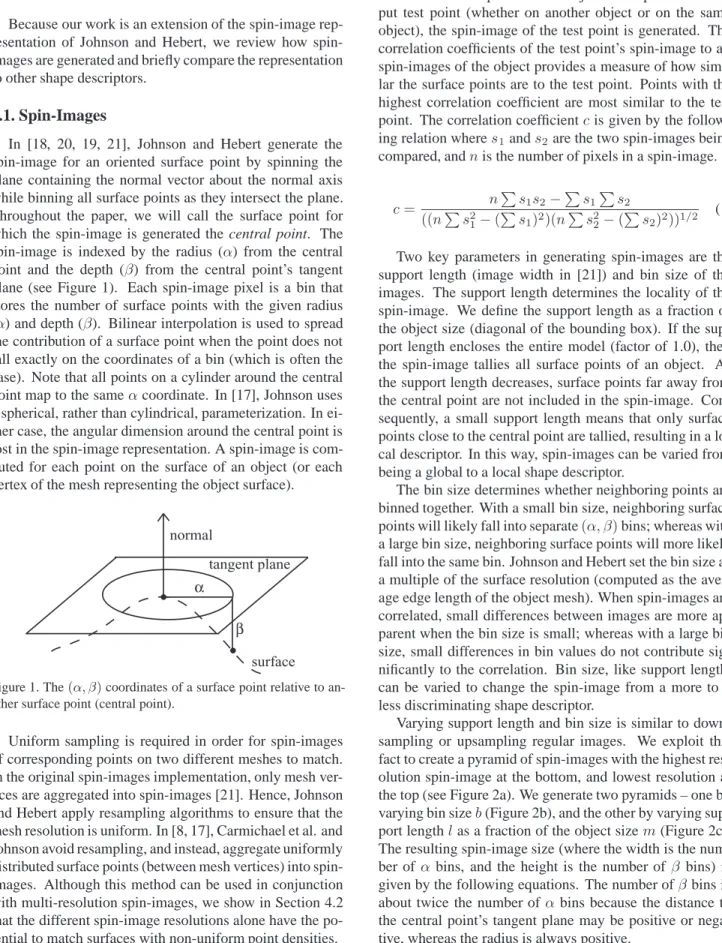
In [18, 20, 19, 21], Johnson and Hebert generate the spin-image for an oriented surface point by spinning the plane containing the normal vector about the normal axis while binning all surface points as they intersect the plane. Throughout the paper, we will call the surface point for which the spin-image is generated the central point. The spin-image is indexed by the radius (α) from the central point and the depth (β) from the central point’s tangent plane (see Figure 1). Each spin-image pixel is a bin that stores the number of surface points with the given radius (α) and depth (β). Bilinear interpolation is used to spread the contribution of a surface point when the point does not fall exactly on the coordinates of a bin (which is often the case). Note that all points on a cylinder around the central point map to the sameαcoordinate. In [17], Johnson uses a spherical, rather than cylindrical, parameterization. In ei-ther case, the angular dimension around the central point is lost in the spin-image representation. A spin-image is com-puted for each point on the surface of an object (or each vertex of the mesh representing the object surface).
normal
β α
tangent plane
surface
Figure 1. The(α, β)coordinates of a surface point relative to an-other surface point (central point).
Uniform sampling is required in order for spin-images of corresponding points on two different meshes to match. In the original spin-images implementation, only mesh ver-tices are aggregated into spin-images [21]. Hence, Johnson and Hebert apply resampling algorithms to ensure that the mesh resolution is uniform. In [8, 17], Carmichael et al. and Johnson avoid resampling, and instead, aggregate uniformly distributed surface points (between mesh vertices) into spin-images. Although this method can be used in conjunction with multi-resolution spin-images, we show in Section 4.2 that the different spin-image resolutions alone have the po-tential to match surfaces with non-uniform point densities.
To find which points of an object correspond to an in-put test point (whether on another object or on the same object), the spin-image of the test point is generated. The correlation coefficients of the test point’s spin-image to all spin-images of the object provides a measure of how simi-lar the surface points are to the test point. Points with the highest correlation coefficient are most similar to the test point. The correlation coefficientcis given by the follow-ing relation wheres1ands2are the two spin-images being compared, andnis the number of pixels in a spin-image.
c= n
s1s2−s1s2
((ns21−(s1)2)(ns22−(s2)2))1/2 (1) Two key parameters in generating spin-images are the support length (image width in [21]) and bin size of the images. The support length determines the locality of the spin-image. We define the support length as a fraction of the object size (diagonal of the bounding box). If the sup-port length encloses the entire model (factor of 1.0), then the spin-image tallies all surface points of an object. As the support length decreases, surface points far away from the central point are not included in the spin-image. Con-sequently, a small support length means that only surface points close to the central point are tallied, resulting in a lo-cal descriptor. In this way, spin-images can be varied from being a global to a local shape descriptor.
The bin size determines whether neighboring points are binned together. With a small bin size, neighboring surface points will likely fall into separate(α, β)bins; whereas with a large bin size, neighboring surface points will more likely fall into the same bin. Johnson and Hebert set the bin size as a multiple of the surface resolution (computed as the aver-age edge length of the object mesh). When spin-imaver-ages are correlated, small differences between images are more ap-parent when the bin size is small; whereas with a large bin size, small differences in bin values do not contribute sig-nificantly to the correlation. Bin size, like support length, can be varied to change the spin-image from a more to a less discriminating shape descriptor.
Varying support length and bin size is similar to down-sampling or updown-sampling regular images. We exploit this fact to create a pyramid of spin-images with the highest res-olution spin-image at the bottom, and lowest resres-olution at the top (see Figure 2a). We generate two pyramids – one by varying bin sizeb(Figure 2b), and the other by varying sup-port lengthlas a fraction of the object sizem(Figure 2c). The resulting spin-image size (where the width is the num-ber ofα bins, and the height is the number ofβ bins) is given by the following equations. The number ofβbins is
about twice the number ofαbins because the distance to
the central point’s tangent plane may be positive or nega-tive, whereas the radius is always positive.
decreasing resolution w x h w/2 x h/2 w/4 x h/4 w/8 x h/8 w/16 x h/16 β normal α w x h β α w/2 x h/2 normal β α w/4 x h/4 normal β α w x h w/2 x h/2 w/4 x h/4 normal
(a) image pyramid (b) varying bin size (c) varying support length
Figure 2. (a) Image pyramid. Multi-resolution spin-images constructed by increasing bin size (b) and reducing support length (c). Note that changing bin size does not eliminate surface points from the resulting spin-image, but reducing support length does.
width= ml
b + 1 height=
2ml
b + 1 (2)
In [21], Johnson and Hebert use principle component analysis (PCA) to compress the spin image, thereby re-ducing the spin-image dimensions. Once compressed, they compute theL2norm of the Eigenvector coefficients (val-ues obtained by projecting the spin-images onto the Eigen-vectors) rather than the correlation coefficient between the original spin-images. They also use a closest point search to find the best matching spin-image in the lower dimensional space. Instead of compressing spin-images which is lossy, we retain all the information in a multi-resolution spin-image representation, and we efficiently correlate points in a low-to-high resolution manner.
2.2. Shape Matching
Many shape descriptors have been developed for ob-ject matching or recognition. They can be categorized as point-based, patch-based, and global descriptors. Global methods generate a shape signature to compare objects but cannot be used to locally compare surface points for
the purpose of point matching. Examples are invariant
histograms [16], shape distributions [25], and spherical
harmonics [22]. Patch-based methods segment the
ob-ject surface into patches, and then match patches to tem-plate patches either by patch type [7] and/or pose estima-tion [7, 27, 13]. Objects are often segmented into patches by aggregating similiar points using local shape descrip-tors [7, 27]. Although point correspondences can be found after patches are matched, segmenting models into patches is an additional computation.
Extended Gaussian images and spherical attribute im-ages (SAI) store the shape signature in a spherical
do-main [14, 15]. Two objects match if a rotation can be
found that matches node or point mass values stored on the spheres. The matching nodes provide the point-wise correspondences between two objects. Unfortunately, both SAI and extended Gaussian images are only applicable to objects that are homeomorphic to a sphere. In geometric
hashing [32], a hash table is generated by selecting a pair of surface feature points as the basis and redefining every other feature point with respect to the basis. To perform recognition, two feature points in the input scene are used as the basis to which all other input feature points are de-fined. These transformed feature points vote for a matching model and basis pair in the database. As noted in [21], spin-images are more discriminating than geometric hash-ing because all surface points (not just feature points) are incorporated into the spin-image and is not dependent on effective feature extraction.
Algorithms most related to spin-images are local shape descriptors that encode all surface information relative to a surface point in the same manner as spin-images. These include splash, surface signatures, point signatures, point fingerprints, harmonic maps and shape contexts. Splash en-codes normal variation along a geodesic circle around a cen-tral point [28]. Surface signatures encode the distance and normal variation between a central point and every other feature point in an image [33, 34]. They differ from spin-images in that the image pixels are not bins accumulating surface points, but rather, store the actual distance and av-erage normal variation from the central point. Point signa-tures record the variation around a central point by comput-ing the distance of a patch boundary around the central point to a plane fitted to the boundary [9]. Point fingerprints are generated by projecting geodesic contours around a central point onto the central point’s tangent plane [29, 30]. Point fingerprints do not scale effectively into a global descriptor. In [36], harmonic maps are computed for patches and stored in images to reduce the surface matching problem to one of image matching (like spin-images). Point signatures, point fingerprints, and harmonic maps are not rotationally invari-ant. Shape contexts can be described as a 2D variant of spin-images. For each point on the silhouette of a shape, the shape context is a log-polar histogram in which each bin stores the number of other points that are some distance and angle from the point of interest [2, 1]. An extension to 3D shape contexts is presented in [12] along with harmonic shape contexts. Although, Frome et al. show that 3D shape contexts have a higher recognition rate than spin-images in
noisy and cluttered scenes, the methods are comparable, and a multi-resolution framework may be applied to either. We believe that a multi-resolution representation can augment many local shape descriptors to speed-up point matching. In this paper, we use spin-images as an effective example.
3. Multi-resolution Spin-Images
To create multi-resolution spin-images, we decrease im-age size by increasing bin size and reducing support length.
3.1. Increasing Bin Size
We can decrease the image size by increasing the range of radii and depths that a bin covers (increasing bin size). By doing so, we are essentially reducing the radius and depth resolutions (see Figure 2b). Decreasing the resolution in this way does not change the locality of the spin-image which is controlled by the support length. If the high reso-lution spin-image tallies points of all radii and depth ranges, the low resolution version also does.
Image pyramids are constructed by downsampling a high resolution image. Going up the pyramid, the image dimen-sions are reduced by half from one level to the next. In typical image pyramids, such as [6], the low resolution im-ages are created by averaging neighboring samples of the high resolution image. For spin-images, we cannot aver-age bin values to create a lower resolution spin-imaver-age be-cause the bin values reflect the number of surface points collected at(α, β)coordinates away from the central point. Instead, we must accumulate neighboring values to create a lower-resolution spin-image from a high resolution
im-age. To accurately spread the contribution of a surface
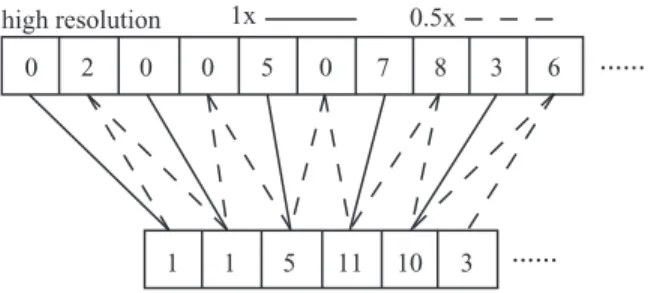
point to neighboring bins, Johnson and Hebert bilinearly interpolated a surface point’s (α, β) coordinates. As we accumulate the values of neighboring bins in a high reso-lution spin-image to generate a low resoreso-lution image, we must also spread each bin’s contribution to neighboring low resolution bins. In 1D, we do so by dividing the value of every other bin equally among the two neighboring bins in the lower-resolution spin-image as shown in Figure 3. This method scales to 2D spin-images where bin values are di-vided equally among two or four neighboring bins.
3.2. Decreasing Support Length (Radius and Depth)
A second way we can reduce image size is by decreasing support length along both the radius and depth dimensions (see Figure 2c). To create a pyramid of spin-images based on decreasing support length, we iteratively halve the spin-image along both dimensions in going from high to lower resolutions and throw away three-quarters of the higher res-olution spin-image at each iteration. In other words, we clamp the lower resolution spin-image at half the high res-olution radius and half the high resres-olution depth in going
... ... high resolution low resolution 1x 0.5x 0 2 0 1 1 0 5 0 5 7 8 3 6 11 10 3
Figure 3. 1D example of creating a lower resolution spin-image from a high resolution spin-image. Solid and dashed lines indicate how bin values in boxes are distributed.
down one resolution. In practice, we do not store separate images for each level of the pyramid to save on memory and database space. Instead, we compute the correlation coeffi-cient on a subset of the image when correlating at smaller support length.
3.3. Multi-resolution Matching
In a spin-image pyramid, there are now more images to correlate when comparing two points. However, we actually reduce the time required to find the best matching surface points to a given test point by computing the correlation coefficient for most points on low resolution spin-images and fewer points at higher resolutions. Comparing low res-olution spin-images is faster because the time to compute the correlation coefficient between two spin-images grows linearly with size. In general, two points’ spin-images are similar at low resolution and become increasingly discrim-inative at higher resolutions. Hence, points that are un-correlated at low resolution will not be highly un-correlated at higher resolutions. For spin-image pyramids based on support length, this invariance is true because lower resolu-tion images are a subset of the high resoluresolu-tion spin-image. The image difference measured by the correlation coeffi-cient will only increase as more bins are included in the calculation as we go down the pyramid.
For pyramids based on increasing bin size, this invari-ance is less obvious. We speculate that the correlation co-efficient is greater for two low resolution spin-images than for their higher resolution counterparts despite the n
fac-tor. Thes1ands2values in Equation 2.1 remain the
same since the total value of all the bins remains the same from one resolution to the next, whereas all sum of squared values and the s1s2 term is greater for low resolution images since they aggregate bins of high resolution images. Hence, points that are not highly correlated at low resolu-tion (where the correlaresolu-tion coefficient is higher) will not be highly correlated at high resolutions. We exploit this in-variant to iteratively cull potential matches as we correlate points in a low-to-high resolution manner for both types of spin-image pyramids.
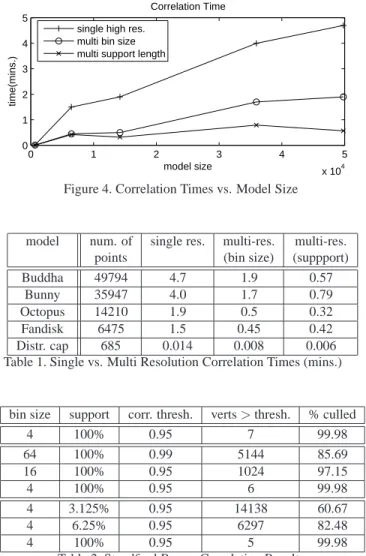
The pruning of potential matching candidates from one resolution to the next is based on a threshold correlation coefficient below which the surface point is no longer con-sidered a potential match. At each level in the pyramid, we pass only points with correlation coefficients of 0.95 or above (out of a max of 1.0) to the next higher resolution. At the highest resolution, there are only a few number of candi-date points remaining for which the correlation coefficient must be computed. An example of how quickly points are culled in this process are shown in Table 2. In practice, we do not traverse all resolutions in the pyramid. Instead, we have found that computing the correlation coefficient and pruning candidate matches at every other pyramid level is a good balance between the increased number of spin im-ages for correlation per surface point and the reduction in the number of candidate points. The speed-up we obtain is 2x or more to find the best matching surface points using multi-resolution spin-images compared to single resolution matching at the highest resolution. Table 1 summarizes the results of self-correlation (where the test point is a surface point on the object) on several models.
4. Results
In the following sections, we show the speed-ups we achieve using multi-resolution spin-images. Because we want to focus on the efficiency and accuracy of spin-image pyramids in matching points, we demonstrate examples of correlating a selected surface point on an object with all other surface points of the same object (self-correlation). We show that the appropriate bin size is imperative to cor-relating surface points of models that do not have the same point density or do not have uniform sampling. Finally, we describe the potential for using spin-image pyramids to de-termine an appropriate support length for matching.
4.1. Multi-resolution Matching
Table 1 (plotted in Figure 4) shows that performing low-to-high resolution matching of a test point to all surface points on an object is more efficient than matching based only on the highest resolution spin-image in each pyramid. Table 2 shows the number and percentage of surface points that are culled away after each iteration in performing low-to-high resolution matching on the Stanford Bunny model with both types of pyramids. The first row in Table 2 shows the number of surface points above 0.95 correlation when using only the highest resolution spin-image for matching (single resolution matching). Nearly the same number of matching points are identified when using bin size pyra-mids and support length pyrapyra-mids. Note that we do not get the exact same matches because the correlation threshold used at lower resolutions is not strictly equivalent to that used at higher resolutions even if the threshold value is the same. This is due to the non-linearity of Equation 2.1.
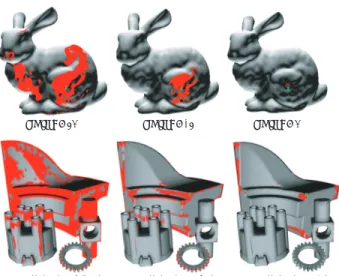
Fig-ure 5 shows the surface points (in red) at each iteration in low-to-high resolution matching that pass the threshold for the Stanford Bunny and for a cluttered scene. As expected, the number of remaining potential matches decreases as we go to higher resolutions. At each iteration, the correlation coefficient is computed only for those points that pass the threshold in the previous iteration. In all tables and figures, the bin size is a multiple of the average edge length, the support length is given as a percentage of the model size (diagonal of bounding box), and the max correlation is 1.0.
0 1 2 3 4 5 x 10⁴ 0 1 2 3 4 5 model size time(mins.) Correlation Time single high res.
multi bin size multi support length
Figure 4. Correlation Times vs. Model Size
model num. of single res. multi-res. multi-res. points (bin size) (suppport)
Buddha 49794 4.7 1.9 0.57
Bunny 35947 4.0 1.7 0.79
Octopus 14210 1.9 0.5 0.32 Fandisk 6475 1.5 0.45 0.42 Distr. cap 685 0.014 0.008 0.006 Table 1. Single vs. Multi Resolution Correlation Times (mins.)
bin size support corr. thresh. verts>thresh. % culled
4 100% 0.95 7 99.98 64 100% 0.99 5144 85.69 16 100% 0.95 1024 97.15 4 100% 0.95 6 99.98 4 3.125% 0.95 14138 60.67 4 6.25% 0.95 6297 82.48 4 100% 0.95 5 99.98
Table 2. Standford Bunny Correlation Results
We have also simultaneously varied bin size and support length such that the resulting spin-image resolution is kept fixed. The purpose of doing so is to keep the correlation time constant while optimizing on the bin size and support length. Figure 6 shows the percentage of vertices of the Stanford Bunny with correlation above 0.95 plotted against the various combinations of support lengths and bin sizes used to compute correlation. For each line plot, the com-binations result in a fixed image size (4x7 or 7x12). As expected, a large bin size is not discriminating, and many
x bin size = 64 x bin size = 16 x bin size = 4
support length = 1.5625% support length = 3.125% support length = 6.25%
x x
x
Figure 5. Top: low-to-high resolution correlation of Stanford Bunny to a selected point (x) on the model. Bottom: low-to-high resolution correlation of a cluttered scene to a selected point (x) on the Fandisk model. Only points with correlation coefficients higher than the threshold (light regions) are used in the correlation calculation at the next higher resolution.
vertices are highly correlated even though support length is at 100%. At the other extreme, a very small support length is also not discriminating. The optimal support length and bin size for a fixed resolution spin-image falls in the middle, though there is a slight bias towards smaller bin sizes. The higher resolution spin-images (7x12) are more discriminat-ing than the lower resolution spin-images (4x7).
100%:64 50%:32 25%:16 12.5%:8 6.25%:4 3.125%:2 1.5625%:1 1%
10% 100%
% of vertices above 0.95 corr.
support(%) : bin size
Correlation using Single Resolution Spin Images of Various Support and Bin Size 4x7 spin image res.
7x12 spin image res.
Figure 6. Correlation vs. Support Length and Bin Size
In [21], Johnson and Hebert show that compressing spin-images using PCA and closest point search significantly re-duces the time to find best matching points. In order to compute the most respresentative subspace (set of Eigen-vectors), all the objects in the database must be included in the computation. Matching is then assumed to be on sam-ple points from an object that is in the database. This as-sumption is valid for recognition applications in which we are trying to identify objects in a scene given a database of possible objects. Even if the surface point is from an object that is not in the database, matching using the
com-pressed spin-images will likely identify good matches, but the match is not guaranteed to be as accurate as an exhaus-tive search on the original, uncompressed spin-images, and the space spanned by the compressed images may not be representative of new spin-images (that were not included in the computation of the Eigenvectors).
Although multi-resolution spin-images may not be as ef-ficient as compressed spin-images for matching large num-bers of objects, multi-resolution spin-images can be gen-erated for any new object that enters the database. Low-to-high resolution matching will identify the same set of matching points as exhaustive single resolution matching and does not depend on selecting an appropriate level of compression to retain the ability to discriminate between similar points. Additionally, multi-resolution and compres-sion are not mutually exclusive. Comprescompres-sion can be ap-plied to spin-image pyramids for more efficient matching.
x
x
0.0 1.0
Figure 7. Left: high (top) and low (bottom) resolution models of the Stanford Bunny. Top: selected point (x) on low resolution model is correlated with the high resolution model. Bottom: se-lected point (x) on high resolution model is correlated with the low resolution model. Center: correlation using highest resolution spin-images. Right: correlation using spin-images with corrected bin sizes of 9.1 to 1. Correlation color coding is shown at the right.
4.2. Matching Surfaces of Differing or Non-uniform
Densities
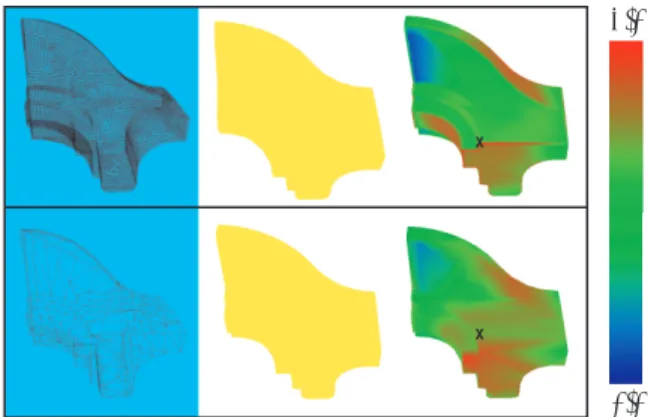
Once multi-resolution spin-images are generated and stored for a given object, the different resolutions can be used to compare objects that have differing point densities. For example, the simplified version of an object will have a much lower point density than the high resolution ver-sion of the object. If spin-images of the same bin size are used to compare points of the two objects, the match will fail as seen in Figures 7 and 8 even when normalized by the total number of surface points. We can, however, com-pute appropriate bin sizes at which the point densities will be equalized based on the average edge length of the ob-ject (if the obob-ject is not represented as a mesh, it is possible to use the average distance to neighboring points within a given radius). The ratio of the larger average edge length
x
x
0.0 1.0
Figure 8. Left: high (top) and low (bottom) resolution models of the fandisk. The low resolution model has non-uniform point den-sity. Top: selected point (x) on low resolution model is correlated with the high resolution model. Bottom: selected point (x) on high resolution model is correlated with the low resolution model. Center: correlation using highest resolution spin-images. Right: correlation using spin-images with corrected bin sizes of 6.8 to 1.
over the smaller average edge length is used as the bin size for the higher resolution mesh, while a bin size of 1 is used for the lower resolution mesh (recall that bin size is mul-tiplied with the average edge length). For example, the average edge length of the low resolution Stanford Bunny model is 0.052, while the high resolution model has an av-erage edge length of 0.0057 giving a ratio of 9.1 to 1. We have found that even though a simplified mesh tends to have non-uniform sampling (fewer surface points at planar re-gions than in rere-gions of high curvature), bin sizes based on edge length remains effective as shown in Figure 8 where the simplified fandisk has non-uniform sampling. To more robustly handle non-uniform sampling, interpolative sam-pling methods such as [8, 17] should be used in generating the multi-resolution spin-images.
4.3. Selecting the Appropriate Support Length
One ambiguity of spin images as described in [18, 20, 19, 21] is that the appropriate bin size and image width for comparing objects is not apparent. Johnson and Hebert sug-gest values that they found effective. As we have shown in the previous section, we can use the ratio of average edge lengths to select appropriate bin sizes for comparing mod-els. In this section we show that the spin-image pyramid based on support length has the potential to automatically identify a suitable support length. We stress that this ap-proach has not been thoroughly verified.
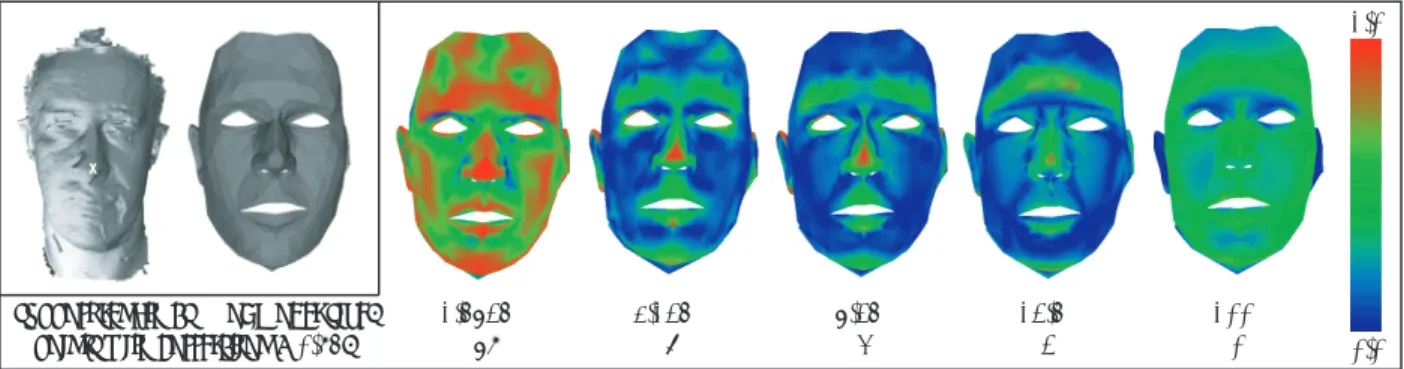
In preliminary experiments, we have found that the spin-image pyramid can be used to converge to an appropriate support length by tallying the number of surface points that are highly correlated to an input test point. As we go from the top of the pyramid to the bottom, the number of surface points that are highly correlated to the test point decreases.
We speculate that the level at which there are highly corre-lated points but at which the number of such points is small is the appropriate level for matching. The heuristic we use is to find the the lowest pyramid level (largest support length) at which there remain highly correlated points (below this level there are none). With this heuristic, it is necessary to define a threshold describing high correlation. Throughout this paper, we consistently use thresholds of 0.95 and 0.99.
An example of using spin-image pyramids to converge to an appropriate support length is shown in Figure 9 where the tip of the nose of one face (face on the left) is correlated with the surface points of another face. In this example, we have already selected the bin size according to edge lengths. At the maximum support length (100%), none of the surface points are highly correlated to the test point. As we go from left to right – low resolution (small support length) to high resolution – the number of points with a high correlation coefficient decreases, but the points around the tip of the nose remain highly correlated throughout. From this pro-gression, we automatically identify 12.5% as the appropri-ate support length and simultaneously identify the surface point that best matches the test point.
5. Conclusions
We have described a multi-resolution representation for images to efficiently compare uncompressed spin-images in a low-to-high resolution manner. We have also described ways for selecting bin size and support length. In future work, we intend to conduct a more thorough analysis on determining appropriate support length, as well as ex-plore ways of extending spin-images so that they can handle matching of points between deformed objects.
References
[1] S. Belongie and J. Malik. Matching with shape contexts.
Proc. of Int. Conf. Computer Vision (ICCV), 2001.
[2] S. Belongie and J. Malik. Shape contexts enable efficient retrieval of similar shapes. Proc. of Conf. Computer Vision
and Pattern Recognition (CVPR), 2001.
[3] S. Belongie, J. Malik, and J. Puzicha. Matching shapes.
Proc. of Int. Conf. Computer Vision (ICCV), 2001.
[4] S. Belongie, J. Malik, and J. Puzicha. Shape matching and object recognition using shape contexts. IEEE TPAMI, 24(24):509–522, 2002.
[5] N. Brusco, M. Andreetto, A. Giorgi, and G. Cortelazzo. 3d registration by textured spin-images. Proc. of Int. Conf. on
3D Digital Imaging and Modeling, pages 262–269, 2005.
[6] P. Burt and E. Adelson. The laplacian pyramid as a compact image code. IEEE Tr. on Comm., 31(4):532–540, 1983. [7] R. Campbell and P. Flynn. Recognition of free-form objects
in dense range data using local features. Proc. of Int. Conf.
100%
1.5625% 3.125% 6.25% 12.5%
x
support length as % of model size:
# points with correlation > 0.95: 69 7 4 2 0 0.0
1.0
Figure 9. Correlating the selected point (x) on one face model (left) to the surface points of the other face model. Left to right: the number of points that are highly correlated to the selected point decreases as the support length increases. Right: at the maximum support length none of the points are found to be highly correlated to the selected point. Correlation color coding shown at the right.
[8] O. Carmichael, D. Huber, and M. Hebert. Large data sets and confusing scenes in 3-d surface matching and recognition.
Proc. of Int. Conf. on 3-D Digital Imaging and Modeling (3-DIM), pages 358–367, 1999.
[9] C. Chua and R. Jarvis. Point signatures: A new representa-tion for 3-d object recognirepresenta-tion. Int. Journal Computer Vision, 25(1):63–85, 1997.
[10] P. Claes, D. Vandermeulen, L. Gool, and P. Suetens. Auto-matic, robust and accurate 3d modelling based on variational implicit surfaces. Katholieke Universiteit Leuven, Center for
Processing Speech and Images Technical Report, 2004.
[11] D. Cohen-Or, D. Levin, and A. Solomovici. Three dimen-sional distance field metamorphosis. ACM Trans. on
Graph-ics, 17(2):116–141, 1998.
[12] A. Frome, D. Huber, R. Kolluri, T. B¨ulow, and J. Malik. Recognizing objects in range data using regional point de-scriptors. Proc. of European Conf. on Computer Vision (ECCV), 3:224–237, 2004.
[13] A. Gruen and D. Akca. Least squares 3d surface and curve matching. PandRS, 59(3):151–174, May 2005.
[14] M. Hebert, K. Ikeuchi, and H. Delingette. A spherical representation for recognition of free-form surfaces. IEEE
TPAMI, 17(7):681–690, 1995.
[15] B. Horn. Extended gaussian images. Proc. of the IEEE, 72(12):1671–1686, 1984.
[16] K. Ikeuchi, T. Shakunaga, M. Wheeler, and T. Yamazaki. In-variant histograms and deformable template matching for sar target recognition. Proc. of Conf. Computer Vision and
Pat-tern Recognition (CVPR), pages 100–105, 1996.
[17] A. Johnson. Surface landmark selection and matching in natural terrain. Proc. of Conf. Computer Vision and Pattern
Recognition (CVPR), 2:413–420, 2000.
[18] A. Johnson and M. Hebert. Surface registration by matching oriented points. Proc. of Int. Conf. Recent Advances in 3-D
Digital Imaging Modeling, pages 12–15, 1997.
[19] A. Johnson and M. Hebert. Efficient multiple model recogni-tion in cluttered 3-d scenes. Proc. of Conf. Computer Vision
and Pattern Recognition (CVPR), pages 671–677, 1998.
[20] A. Johnson and M. Hebert. Recognizing objects by matching oriented points. Proc. of Conf. Computer Vision and Pattern
Recognition (CVPR), pages 684–689, 1998.
[21] A. Johnson and M. Hebert. Using spin images for efficient object recognition in cluttered 3d scenes. IEEE TPAMI,
21(5):433–449, 1999.
[22] M. Kazhdan, T. Funkhouser, and S. Rusinkiewicz. Rotation invariant spherical harmonic representation of 3d shape de-scriptors. Eurogr. Sym. Geometry Processing, 2003. [23] A. Lee, D. Dobkin, W. Sweldens, and P. Schr¨oder.
Multires-olution mesh morphing. SIGGRAPH, pages 343–350, 1999. [24] G. Mori, S. Belongie, and J. Malik. Shape contexts enable efficient retrieval of similar shapes. Proc. of Conf. Computer
Vision and Pattern Recognition, pages 723–730, 2001.
[25] R. Osada, T. Funkhouser, B. Chazelle, and D. Dobkin. Shape distributions. ACM Tr. Graphics, 21(4):807–832, 2002. [26] E. Praun, W. Sweldons, and P. Schr¨oder. Consistent mesh
parameterizations. SIGGRAPH, pages 179–184, 2001. [27] I. Stamos and M. Leordeanu. Automated feature-based range
registration of urban scenes of large scale. Proc. of Conf.
Computer Vision and Pattern Recognition, 2:555–561, 2003.
[28] F. Stein and G. Medioni. Structural indexing: efficient 3-d object recognition. IEEE TPAMI, 14(2):125–145, 1992. [29] Y. Sun and M. Abidi. Surface matching by 3d point’s
finger-print. Proc. of 8th Int. Conf. Computer Vision (ICCV), pages 263–269, 2001.
[30] Y. Sun, J. Paik, A. Koschan, D. Page, and M. Abidi. Point fingerprint: a new 3-d object representation scheme. IEEE
Tr. Sys., Man, and Cybernetics, 33(4):712–717, 2003.
[31] G. Turk and J. O’Brien. Shape transformation using varia-tional implicit functions. SIGGRAPH, pages 335–342, 1999. [32] H. Wolfson. Geometric hashing: an overview. IEEE
Com-putational Science and Engineering, pages 10–21, 1997.
[33] S. Yamany and A. Farag. Free-form surface registration us-ing surface signatures. Proc. of 7th Int. Conf. Computer
Vi-sion (ICCV), pages 1098–1104, 1999.
[34] S. Yamany, A. Farag, and A. El-Bialy. Free-form object recognition and registration using surface signatures. Proc.
of Int. Conf. on Image Processing, 2:457–461, 1999.
[35] S. Yiyong, J. Paik, A. Koschan, D. Page, and M. Abidi. Point fingerprint: A new 3-d object representation scheme. IEEE
Trans. Sys., Man, and Cybernetics, 33(4):712–717, 2003.
[36] D. Zhang and M. Hebert. Harmonic maps and their applica-tions in surface matching. Proc. of Conf. Computer Vision