www.ijres.org Volume 7 Issue 4 Ser. I ǁ 2019 ǁ PP. 06-11
Catalytic Wet Oxidation of Phenol on Supported Platinum
Catalysts
Dul-Sun Kim, Dong-Keun Lee
*Department of Chemical Engineering, Gyeongsang National University, 501 Jinju-daero, Jinju-si, Gyeongsangnam-do 52828, Korea
Corresponding Author: Dong-Keun Lee
Abstract:
Catalytic wet oxidation of phenol was performed at 2.3MPa on the platinum catalysts supported on alumina, activated carbon and titania. When compared with the uncatalyzed reaction, the use of catalysts could increase the rate of phenol oxidation greatly. The Pt/TiO2 catalyst was preferable to the other catalysts for the destructive oxidation of phenol. Reaction pathways of catalytic wet oxidation was proposed on the basis of the results from the temperature-programmed oxidation. Phenol was shown to be oxidized via the following species: hydroquinone, catechol, benzoquinone, maleic acid, furmalic acid, glycolic acid, acetic acid, formic acid and oxalic acidKeywords:
Catalytic Wet Oxidation, Phenol, Platinum Catalysts, Leaching, Reaction Pathways--- --- Date of Submission: 27-11-2019 Date of Acceptance: 12-12-2019 --- ---
I.
INTRODUCTION
The industrial wastewater generated from various industries contains huge amounts of toxic and refractory organic compounds. However, conventional treatment technologies like biological treatment are used for domestic as well as non-toxic industrial wastewater. The wastewater containing toxic and refractory compounds requires advanced oxidation processes(AOPs) like Fenton, wet air oxidation (WAO), ozonation (O3), hydrogen peroxide oxidation, photocatalysis, etc. The hydroxyl radicals generated by AOPs are highly reactive and capable to oxidize various organic compounds.
Wet air oxidation is a very attractive and useful technique for treatment of effluent streams exhibiting high organic loading (10–100 g/L of COD) which is too dilute for incineration and toxic for biological treatment (Kim and Ihm, 2011), but it has a detrimental shortcoming that it should be operated under severe conditions of high temperature(150∼350℃) and high pressure(6-17MPa). The severity of the process can be lowered by using catalysts. Catalytic wet air oxidation (CWAO) is a catalytic oxidation of oxidizable compounds with air or pure oxygen in an aqueous phase.
Homogeneous catalysts are in general more effective than heterogeneous oxidation catalysts(Fu et al., 2015; Yadav and Garg, 2014; Arena et al., 2010; Velegraki et al., 2011), but their use necessitates a separation step such as precipitation or membrane separation to remove toxic catalyst ions from the final effluent. Heterogeneous catalysts have also been used. The noble metal catalysts have been used for the treatment of various pollutants such as phenol, substituted phenols, carboxylic acids by CWAO process (Espinosa de los Monteros et al., 2015;Yang et al., 2015; Cau et al., 2014; Suarez-Ojeda et al., 2005;Gaálová et al., 2010).
As an early researcher on CWAO, Imamura et al.(1982a, 1982b) developed several heterogeneous catalysts to improve the liquid phase oxidation and found that Co/Bi composite oxides were remarkably active for the oxidation of many low molecular weight carboxylic acids. Ru, Pt and Rh were also proved to be active than a homogeneous copper catalyst toward the wet oxidation of phenols and other model compounds(Imamura et al.,1988). Mixed copper, zinc and cobalt oxide catalysts were used for the catalytic oxidation of phenol and substituted phenols, and the CuO/ZnO/Al2O3 catalyst was proved to be effective for oxidation(Pintar and Levec, 1992).Perkas et al. (2005) studied CWAO of succinic, acetic and p-coumaric acids to demonstrate the activity of platinum and ruthenium metals supported on TiO2 and ZrO2 supports and reported that the Pt/TiO2 catalyst showed higher activity. Espinosa de los Monteros et al. (2015) studied the oxidation of phenol using platinum and ruthenium metals supported on TiO2-CeO2. They reported that platinum was more efficient than rhodium catalyst and suggested that the activity of noble metals varies with the nature of support as well as metal dispersion on the support. The selectivity of support toward phenols and byproducts formed during CWAO reaction also varies with varying operating conditions of temperature and pressure.
This research was undertaken to gain further understanding of catalytic wet oxidation of phenol, the model pollutant compound, and the identification of reaction intermediates together with the elucidation of reaction pathways was carried out.
II.
METHODS
A stainless steel high pressure batch reactor was used for the catalytic wet oxidation of phenol. The operating pressure was kept at 2.3MPa. The concentration of phenol aqueous solution was 1,000mg/L. After heating up the aqueous solution to the desired temperature under nitrogen atmosphere at 1.7MPa, oxygen was fed continuously to the reactor at a partial pressure of 0.6MPa. The catalyst was introduced into the aqueous solution before the heating-up schedule.
Liquid samples were immediately filtered and then analyzed. Total organic carbon(TOC) was measured with a Shimazu 5000A TOC analyzer whose operation is based on the combustion/non-dispersive infrared(NDIR) gas analysis. The TOC was determined by subtracting IC(Inorganic Carbon) from TC(Total Carbon). Reaction intermediates were identified by HPLC(Waters Associate) and Ion Chromatograph (Dionex 300). The detection was achieved with the UV detector and the products were analyzed with the Econosil C18 column using methanol/H2O/H3PO4 (40/60/0.5) as a mobile phase.
Three different heterogeneous catalysts were used: Pt/A.C, Pt/Al2O3 and Pt/TiO2. The catalysts were prepared by impregnating H2PtCl6 aqueous solutions onto the supports of activated carbon(Darco), γ-Al2O3(Strem Chemicals) and TiO2(Degussa P25), followed by calcination at 500℃ for 24hrs.
III.
RESULTS AND DISCUSSION
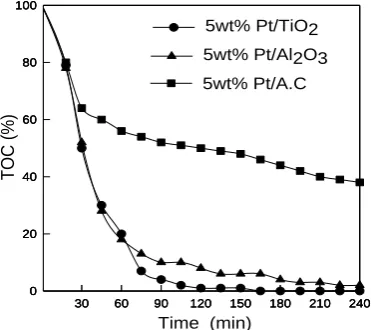
Experiments were conducted with three different catalysts of Pt/A.C, Pt/γ-Al2O3, Pt/TiO2. Figure 1 shows the time dependence of TOC removal on the three different catalysts at 150℃. The Pt/TiO2 catalyst seems to be the most effective for the oxidation of phenol, and the complete removal of phenol could be achieved after 150min of oxidation. The uncatalyzed oxidation of phenol was also carried out, but in all cases the TOC removal was negligible when compared with the catalytic reaction.
Time (min)
30 60 90 120 150 180 210 240 0
20 40 60 80 100
5wt% Pt/Al2O3
30 60 90 120 150 180 210 240 0
20 40 60 80 100
5wt% Pt/TiO2
30 60 90 120 150 180 210 240
TOC (
%)
0 20 40 60 80 100
5wt% Pt/A.C
Figure 1: Time dependence of TOC removal on 5wt%Pt/TiO2, 5wt%Pt/Al2O3 and 5wt%Pt/A.C at 150℃ and 2.3MPa (1.5g catalyst)
Figure 2 shows the effects of the amount of the 5wt% Pt/TiO2 catalyst introduced into the reactor on the removal of TOC. As the amount of the 5wt% Pt/TiO2 catalysts is increased from 0.2 to 5.0g, the time needed for complete oxidation of phenol becomes shorter, and eventually most of the TOC is removed within 60min reaction with 5.0g catalyst.
0 30 60 90 120 150 180 210 240 0 20 40 60 80 100 1.5g
0 30 60 90 120 150 180 210 240 0 20 40 60 80 100 0.5g
0 30 60 90 120 150 180 210 240 0 20 40 60 80 100 1.0g
0 30 60 90 120 150 180 210 240 0 20 40 60 80 100 0.2g
0 30 60 90 120 150 180 210 240 0 20 40 60 80 100 3.0g Time (min)
0 30 60 90 120 150 180 210 240
TOC ( %) 0 20 40 60 80 100 5.0g
Figure 2: Effects of the amount of the 5wt%Pt/TiO2 catalyst on TOC removal at 150℃ and 2.3MPa
Time (min)
30 60 90 120 150 180 210 240
0 20 40 60 80 100
150 o
C
30 60 90 120 150 180 210 240
TOC (
%) 0 20 40 60 80 100
200 o
C
30 60 90 120 150 180 210 240
0 20 40 60 80 100
250 oC
30 60 90 120 150 180 210 240
0 20 40 60 80 100
120 o
C
Figure 3: Effects of oxidation temperature on TOC removal with 0.5g 5wt%Pt/TiO2 catalyst at 2.3MPa
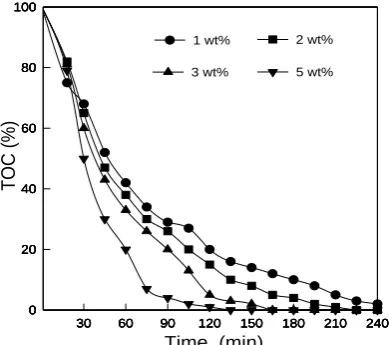
As expected the reactivity changed greatly with the Pt loading in the Pt/TiO2 catalyst. As shown in Figure 4 the TOC removal increases greatly with Pt loading.
Time (min)
30 60 90 120 150 180 210 240
0 20 40 60 80 100 1 wt%
30 60 90 120 150 180 210 240
TOC ( %) 0 20 40 60 80 100 2 wt%
30 60 90 120 150 180 210 240
0 20 40 60 80 100 3 wt%
30 60 90 120 150 180 210 240
0 20 40 60 80 100 5 wt%
Temperature (oC)
100 120 140 160 180 200 220
Relati ve peak area 0.0 .1 .2 .3 .4 .5 .6 .7 .8 .9 1.0 Phenol
100 110 120 130 140 150 160 170 180 190 200 210 220 0.0 .1 .2 .3 .4 .5 .6 .7 .8 .9 1.0 catechol
100 110 120 130 140 150 160 170 180 190 200 210 220 0.0 .1 .2 .3 .4 .5 .6 .7 .8 .9 1.0 hydroquinone
100 110 120 130 140 150 160 170 180 190 200 210 220 0.0 .1 .2 .3 .4 .5 .6 .7 .8 .9 1.0 benzoquinone
100 110 120 130 140 150 160 170 180 190 200 210 220 0.0 .1 .2 .3 .4 .5 .6 .7 .8 .9 1.0 furmalic acid
100 110 120 130 140 150 160 170 180 190 200 210 220 0.0 .1 .2 .3 .4 .5 .6 .7 .8 .9 1.0 maleic acid
100 110 120 130 140 150 160 170 180 190 200 210 220 0.0 .1 .2 .3 .4 .5 .6 .7 .8 .9 1.0 oxalic acid
Figure 5: Changes in product concentrations during temperature-programmed oxidation with0.5g 5wt%Pt/TiO2 catalyst (temperature increase rate: 1K/min)
Another point to be emphasized from the aforementioned results is the changes in pH with reaction time. The pH rapidly dropped to around 2 probably due to the production of organic acids. Under these low values of pH, catalyst leaching may occur. The concept of catalyst leaching is important in wastewater treatment. Dissolved metal ions must be responsible for homogeneous catalytic reaction, and a homogeneous-heterogeneous reaction system should be considered rather than a pure homogeneous-heterogeneous reaction. Besides an additional processes such as membrane separation and precipitation may be needed to remove any leached catalyst compound from the effluent. Continuous leaching would lead to the progressive deactivation of the heterogeneous catalyst.
To investigate the stability of the Pt/TiO2 catalyst with respect to metal leaching, samples were taken after the reaction at various temperatures. The catalyst loading and the concentration of dissolved Pt and Ti metals were analyzed using atomic absorption. No detectable amounts of the dissolved Pt and Ti metals were measured. Accordingly at the reaction conditions employed in this research it can be said that no leaching occurred.
Analysis of the reaction products was performed under temperature-programmed oxidation conditions to determine the sequence in which the reaction intermediates are formed. The rate of temperature increase during the temperature-programmed was controlled to be 1K/min, and the sample was taken at 10min intervals.
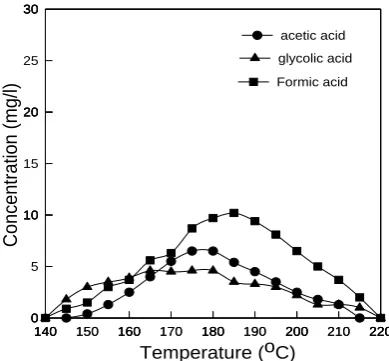
Figure 5 shows the changes in product concentrations taken during the temperature -programmed oxidation with 0.5g 5wt%Pt/TiO2 catalyst. Since the separation of glycolic and formic acid was not successful in the HPLC, the concentration of both acids was analyzed with the Ion Chromatograph. The change in the concentration of glycolic acid and formic acid are plotted separately in Figure 6.
140 150 160 170 180 190 200 210 220
0 5 10 15 20 25 30 Formic acid Temperature (oC)
140 160 180 200 220
Concentration (mg/l ) 0 10 20 30 glycolic acid
140 150 160 170 180 190 200 210 220
0 10 20 30
acetic acid
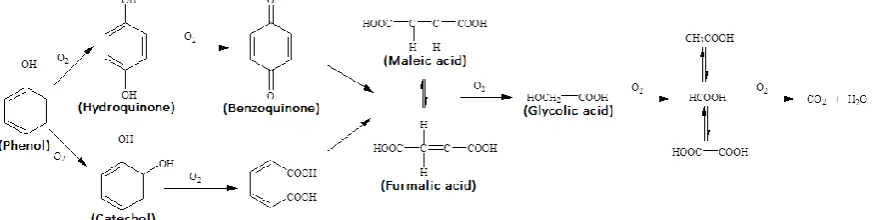
As the concentration of phenol graduallyfalls, many kinds of reaction intermediates appear depending on the temperature. A small amount of catechol and hydroquinone is observed in the temperature interval of roughly 110∼150℃. At the temperature of the maximum catechol, hydroquinone and benzoquinone begin to appear and go through a maximum as the temperature is increased. Since the chemical structure of benzoquinone is somewhat similar to that of hydroquinone but not to that of catechol, benzoquinone is believed to be formed through the oxidation of hydroquinone.
The disappearance of benzoquinone is then followed by the formation of both the maleic acid and furmalic acid. Acetic acid and formic acid are found in somewhat wide temperature region, and oxalic acid concentration continues to grow up to 210℃ and then decreases.
On the basis of the results in the plot of relative concentration as a function of temperature for each intermediate, the reaction pathways of the catalytic wet oxidation of phenol on the Pt/TiO2 catalyst can be proposed as the sequential step in Figure 7.
Figure 7: Proposed pathways for the catalytic wet oxidation of phenol on Pt/TiO2 catalyst
IV.
CONCLUSIONS
The catalytic wet oxidation of phenol as the model pollutant compound was studied. The platinum catalysts supported on alumina, activated carbon and titania had been investigated with respect to their efficiency for oxidizing phenol.
The Pt/TiO2 catalyst was preferable to the other catalysts for the destructive oxidation of phenol. The stability of the catalyst was monitored in terms of metal leaching, and it was found that the metal leaching was almost negligible under the operation conditions employed in this study. Reaction intermediates had been identified, and possible reaction pathways were proposed on the basis of the results from the temperature-programmed oxidation of phenol. Phenol was partially oxidized into both catechol and hydroquinone, the latter being converted further into benzoquinone. Ring cleavage was then followed to produce such low molecular weight organic acids as maleic acid and furmalic acid. Both acids were believed to be oxidized into CO2 and H2O via glycolic acid, acetic acid, oxalic acid and formic acid.
REFERENCES
[1]. Arena, F., Italiano, C., Ferrante, G.D., Trunfio, G., Spadaro, L., 2014. A mechanistic assessment of the wet air oxidation activity of nCeOx catalyst toward toxic and refractory organic pollutants. Appl. Catal. B Environ. 144, 292–299.
[2]. Cau, C., Guari, Y., Chave, T., Larionov, J., Nikitenko, S.I., 2014. Thermal and sonochemical synthesis of porous (Ce, Zr)O2 mixed
oxides from metal b-diketonate precursors and their catalytic activity in wet air oxidation process of formic acid. Ultrason. Sonochem. 21, 1366–1373.
[3]. Espinosa de los Monteros, A., Lafaye, G., Cervantes, A., Del Angel, G., Barbier, J.J., Torres, G., 2015. Catalytic wet air oxidation of phenol over metal catalyst (Ru, Pt) supported on TiO2–CeO2 oxides. Catal. Today 258, 564–569.
[4]. Fu, D., Zhang, F., Wang, L., Yang, F., Liang, X., 2015. Simultaneous removal of nitrobenzene and phenol by homogenous catalytic wet air oxidation. Chin. J. Catal. 36, 952–956.
[5]. Gaálová Jr., J., Barbier, J., Rossignol, S., 2010. Ruthenium versus platinum on cerium materials in wet air oxidation of acetic acid. J. Hazard Mater. 181, 633–639.
[6]. Imamura, S., Hirano, A., Kawabata, N., 1982a. Wet oxidation of acetic acid catalyzed by Co-Bi complex oxides. Ind. Eng. Chem., Prod. Res. Dev., 21, 570-575.
[7]. Imamura, S., Kinunaka, H., Kawabata, N., 1982b. The wet oxidation of organic compounds catalyzed by Co-Bi complex oxides. Bull. Chem. Soc. Jpn., 55, 3679-3680.
[8]. Imamura, S., Fukuda, I., Ishida, S., 1988. Wet oxidation catalyzed by ruthenium supported on cerium(Ⅳ)oxides. Ind. Eng. Chem. Res., 27, 718-721.
[9]. Kim, V.K., Ihm, S., 2011. Heterogeneous catalytic wet air oxidation of refractory organic pollutants in industrial wastewaters: a review. J. Hazard Mater. 186, 16–34.
[10]. Perkas, N., Minh, D.P., Gallezot, P., Gedanken, A., Besson, M., 2005. Platinum and ruthenium catalysts on mesoporous titanium and zirconium oxides for the catalytic wet air oxidation of model compounds. Appl. Catal. B Environ. 59, 121–130.
www.ijres.org 11 | Page
]
2400.[12]. Suarez-Ojeda, M.E., Stuber, F., Fortuny, A., Fabregat, A., Carrera, J., Font, J., 2005. Catalytic wet air oxidation of substituted phenols using activated carbon as catalyst. Appl. Catal. B Environ. 58, 105–114.
[13]. Velegraki, T., Noulia, E., Katsoni, A., Yentekakis, I.V., Mantzavinos, D., 2011. Wet oxidation of benzoic acid catalyzed by cupric ions: key parameters affecting induction period and conversion. Appl. Catal. B Environ. 101, 479–485.
[14]. Yadav, B.R., Garg, A., 2014. Catalytic wet oxidation of ferulic acid (a lignin model compound) in the presence of non-noble metal based catalysts at mild conditions.Chem. Eng. J. 252, 185–193.
[15]. Yang, S., Besson, M., Descorme, C., 2015. Catalytic wet air oxidation of succinic acid over Ru and Pt catalysts supported on CexZr1−xO2 mixed oxides. Appl. Catal. B Environ. 165, 1–9.