ISSN (Online): 2320-9364, ISSN (Print): 2320-9356
www.ijres.org Volume 7 Issue 4 Ser. I ǁ 2019 ǁ PP. 60-70
Empirical analysis of the effect of recommended advertisements
on social media platform
1
Wang Yibo,
1Cui Xin,
1Li He,
1Li Ran,
2Zhang Yuzhuo,
1Chang Xiaolin
*1 School of Management, Tianjin University of Technology, Tianjin, P.R. China 2
School of Computer Science, WuHan University, Wuhan, P.R. China Corresponding Author:He Li
ABSTRACT: With the rapid development of Internet technology, the contents and forms of social media platform recommended advertisements gradually present the characteristics of personalization, diversification and interaction. Based on users’ evaluation data on recommended advertisements, descriptive statistical and multivariate statistical analyses are carried out to study the factors of the publicity and promotion effect of recommended advertisements on the social media platforms. The results show that the main factors affecting users' acceptance of recommended advertisements are the degree of users’ demands and the price of products. Female users have a higher acceptance of recommended advertisements, and personalized recommended advertisements have a limited impact on users’ acceptance of advertisement. However, interactive advertisements have a potential positive impact on users’ acceptance. To make the recommended advertisement more personalized and accurate, the price of the product should play an important role in designing the recommended advertisement issued by social media platform.
KEYWORDS: recommended advertisement, social media platform, advertising effect, relevance, regression analysis, empirical analysis, personalization, interaction.
--- --- Date of Submission: 30-12-2019 Date of acceptance: 12-01-2020
--- ---
I.
INTRODUCTION
The scale of Internet and mobile users in China is still expanding. According to the 43rd China Internet Development Statistics Report issued by China Internet Information Centre, the scale of Chinese Internet users has reached 829 million by December 2018, the scale of mobile users has reached 817 million, and the proportion of mobile users accessing the Internet has reached 817 million. Internet users have generated the huge amounts of users‟ data on the network and social media, and the scale of data is still growing rapidly. More and more social media platforms use these data to analyze the behavior of network users and the purpose of collecting the data is to provide accurate advertisements with different users, and to improve the promotion and publicity effect of media platform recommended advertisement.
In recent years, some research of recommended advertisements focuses on the technology of posting the advertisements, and the other research studies the reasonable form of recommended advertisements. Most of the existing studies examine the advertising changes and trends of overall social media platform from a macro perspective. However, few literatures concentrate on the development of social media platform‟s recommended advertisements from the perspective of ordinary users, and studied the views of different users towards the current rapid development of recommended advertisements, as well as the specific reasons affecting user evaluation.
In order to explore the factors influencing recommended advertisement, this paper studies the evaluation on social media platform from the angle of users. We collect the users‟ evaluation data by questionnaire survey. Firstly, the descriptive statistical analysis is carried out to study the overall evaluation trend. We use the main influencing factor, gender, to analyze the differences of evaluation results. Then the questionnaire data are analyzed by the multivariate statistical analysis. Correlation analysis and regression analysis are used to explore the main factors that affect the user's acceptance of advertising. Finally, we summarize the user evaluation on recommended advertisements, and provide specific suggestions for the effectiveness of the recommended advertisements.
According to the evaluation data of ordinary users on the recommended advertisements, we obtain the attitudes and expectations of users on the number of advertisements on the current social media platform, finding that users are negatively inclined to recommend advertisements most of the time.
II.
LITERATURE REVIEW
We look through the results about personalized and interactive features of social media platforms recommended advertisements researches in recent years.Regarding the personalized characteristics of recommended advertisements on social media platforms, Petty [1] suggests that recommended advertisements which provide information that can matches the user are more convincing to the users. Zhou et al. [2] state that Consumers' purchases thresholds decline as search costs decrease, and the characteristics of recommended advertisements can lead to lower users search costs, so that can increase the merchant's expected revenue. Content-driven personalized technology has a strong influence on the persuasion effects of advertising [3]. Zhou et al. [4] and Zhou et al. [5] have proved that recommended advertisements can expand the size of the potential consumer group. Advertisers can effectively obtain the network activity data generated by users for analysis, accurately identify target users, push personalized advertising information to match users and products, improve the efficiency of attracting users' attention and improve persuasion [6]. Also, personalized features can effectively reduce the occurrence of users‟ advertisements‟ avoidance behavior [7]. Personalization can promote users‟ response to social media recommended advertisements through user-perceived recommendations and their relevance [8,9]. Users in the same social circle have the same consumer characteristics and merchandise preferences frequently. Therefore, the personalized social media platform recommended advertisements are targeted to the potential user group, and these brand new advertisements are improving the efficiency and precision of the advertisements.
Interaction features of social media platform recommended advertisements have three main forms. The first type of interaction is that the brand appears in the form of anthropomorphism. Currently, many companies have opened accounts on Facebook, Twitter and Microblog. These social media brand homepages have become an important promotional tool for connecting businesses with users [10]. Studies have shown that the degree of interaction is positively related to users‟ attitudes toward advertisements and products. And the degree of interaction has an impact on the persuasion process [11]. The second type of interactions is through social interaction between celebrities and regular users on social media. About using the celebrity effects to indirectly promote celebrity ads or endorsement products, Studies [12] have shown that this kind of quasi-social interaction can bring positive feedback to the audience and improve the advertising effect of social media. Users are encouraged to purchase products endorsed by celebrities [13]. The third type of interactions is to indirectly promote user and brand interaction through social behavior between users. Strong connections in social networks can trigger behavior, and users‟ participation in mobile social media has a positive impact on perceived advertisement value, thereby affecting their willingness to accept advertisements on social media [14]. On Facebook's brand home page, the total “likes” and friends' “likes” have a significant impact on the user's brand attitude, brand trust, brand involvement and purchase intention. In addition, there is an interaction between the total “likes” and the “likes” of friends [15]. Some scholars have also proved that the interaction between users on social media will have a positive impact on the willingness to purchase [16]. The interactivity of recommended advertisements on social media platforms can increase users' awareness and affection of products and brands, and turn them into dependence on products and brands. In the interaction between the user and the user through social media, the merchant will require the user to interact with the friends on the social media, such as collecting and forwarding, and transmitting the advertising information to the user through the interactive means. Some scholars have proved that the interaction between users and users in social media have a positive impact on users‟ willingness to pay.
III.
THE RESULTS ANALYSIS BASEDON DESCRIPTIVE STATISTICS
This section studies the effect of recommended advertisement on the social media platform based on the descriptive statistics. We post the questionnaires about recommended advertisement on social media platforms. A total of 425 questionnaires were collected, among which 408 were valid, with an effective rate of 96%. The questionnaire can be found in Appendix.
A total of 22 questions in the questionnaire were designed, and can be divided into 5 parts. The first two questions in the part one are about the respondents‟ age and gender. In the part two to five, page view, platforms, category of products, and activity type were selected separately in studying their efforts on users‟ estimate about recommendation on social media platform. The users‟ attitude to recommended advertisements on social media platforms was obtained based on the descriptive statistics as follows.
3.1 Recommended advertisements’ page view and acceptance
Figure 1 shows the users‟ evaluation of the number of recommended advertisements with different expectation ratio. From Figure 1, it shows that the recommended advertisements are more than users‟ expectation, and even more than the users‟ maximum acceptance ratio. Meanwhile, for the view of users, the businesses‟ recommended advertisement has only mild efforts on users‟ purchase behaviour from Figure 2. These superfluous recommended advertisements can‟t raise the advertisements‟ effects, but may contribute to users‟ dislike, and even lead to the resistance to the recommendation on social media platforms.
In comparing to the two kinds of recommended advertisements from friends and from businesses, we can find the users‟ different attitude towards the two of them. For the recommended advertisements from businesses, about 25.8% of the users would like to check it on average. About 85% of the users would like to check half of the advertisements, and 60% of the users would only check 20% of the advertisements. If the users receive the recommended advertisements form their friends, things would be different. 34.5% of the users on average would like to see the advertisements that their friends shared to them. The number is about 10% higher than the advertisements from businesses. This trend can be shown in Figure 3. The data also shows that the recommended advertisement with interaction attributes could increase users‟ attention on recommended advertisements.
Table 1 analyze the effects of social media recommended advertisement with different user‟ genders. Female users take more attention on advertisements than male ones. About the acceptance ratio to the advertisement, female users gave 32% while male users only 27.4%.
Figure 1. User’s evaluation of the number of recommended ads with different expectation ratio
Figure 3. Users’ attention to recommended ads from two sources
Table 1. Comparison of attitudes towards advertising about gender
Gender Male Female
Average browsing time (h) 3.53 3.91 Expected ratio 23.7% 28.7% Acceptance ratio 27.4% 32.0% Percentage of ads viewed(from merchants) 23.7% 28.2% Percentage of ads viewed(from friends) 31.4% 38% Effect degree of the number of ads 3.2 3.4
3.2 Users’ recommended advertisement preference with different platform selection
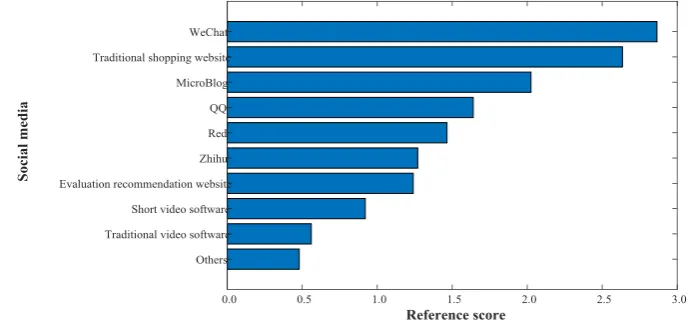
In studying users‟ recommended advertisement preference to different platform selection, we find that most people don‟t feel huge difference when faced with advertisement‟s reform. Figure 4 shows that users don‟t give additional attention to the emergence of personalization recommendation and interactive feature. It is still the users‟ familiar social media platform that they view the recommended advertisement. Traditional E-commerce platforms and popular social software are still the first choice for users. At the same time, as the new generation of young people gradually enter the field of online consumption, these newly emerging social media platforms gradually get young users‟ attention.
According to the data analysis, we find that users‟ choice of advertising still depends on the frequency of use of the platform. In addition, personalization recommendation and interactive feature do not significantly affect users‟ choice of social media platforms. For further exploration, more targeted exploration needs to be carried out.
In order to increase users‟ attention, businesses should analyze and design the current platform environment to understand users‟ usage and browsing habits on the current platform. By taking advantage of the inertia on this platform, the recommended advertisements could be specificly designed by the social media platform.
Figure 5. Statistics of users' selection criteria
3.3 Users’ recommended advertisement preference with different categories of goods
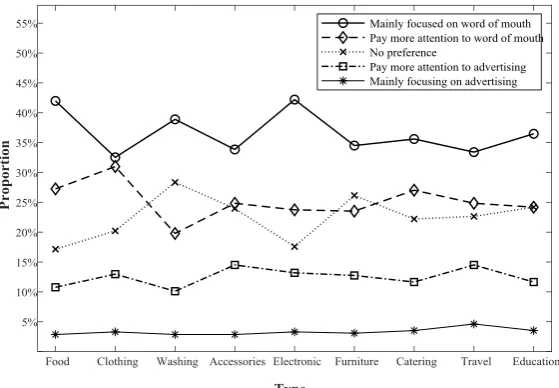
Analyze user‟s word of mouth and advertising preferences for different categories of products From Figure 6, we can obtain that users are significantly more concerned about the word-of-mouth information of products, but with the analyses of gender, there are some differences between different products categories. For most categories of products, male users are more concerned with the word-of-mouth information of products, while the female users are more concerned with recommended advertisements‟ form, publicity pictures and the contents.
Users pay attention to different features of products when facing different categories of products. Figure 7 is given to show users‟ selection criteria of different categories of products. In the face of different categories of products, users have different concerns. The quality of goods is still the most important indicator for users. Secondly, users are concerned about the environmental protection of products. For these three less obvious indicators: brand, quality and the product‟s characteristic, the problem is divided into two types of analysis – male and female. For male users, the three indicators do not show obvious differences. For female users, three indicators change dramatically with different categories of products.
Figure 7. Users’ selection criteria of different categories of products
3.4 Users’ recommended advertisement preference with different preferential policies
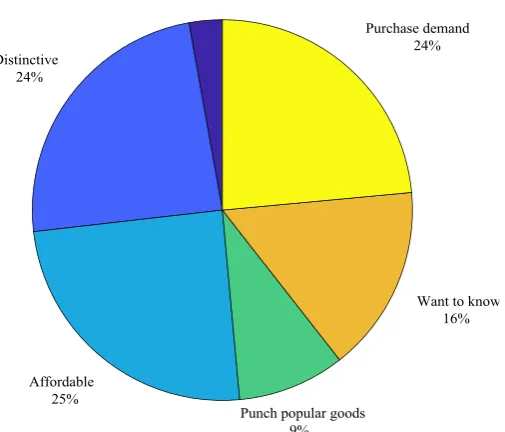
Users are more likely to check the recommended advertisement only if the products are affordable, distinctive and users have just the right demand. Users don't care if the product is web celebrity. Figure 8 shows the statistical results of the reasons for accepting advertising.
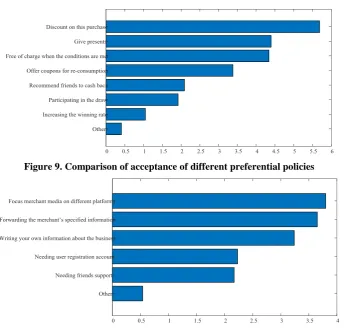
When facing different types of preferential advertisements, users are more willing to choose activities without threshold. This trend can be shown in Figure 9. Users' prefer these activities such as discounts and gifts. At the same time, high-risk activities are not taken seriously by users. Users are more likely to participate in activities that are sure to pay off.
Activities that are easy to accomplish are more popular with users. For example, when businesses offer a variety of promotions, users prefer those preferential policies that don't require too much effort, such as direct discounts or small gifts. Given the cost of participation, users will not participate in activities that require more complex requirements, even if these activities are more profitable Figure 10 shows the differences.
Figure 9. Comparison of acceptance of different preferential policies
Figure 10. Comparison of the acceptance of different forms of preferential participation
We find that, at the stage now, users still tend to see as few recommended advertisements as possible, just like the users‟ attitude towards traditional advertisements. The purpose of recommended advertisement on social media platforms is to make users feel more intimate and reduce their resistance to businesses‟ recommendation. This new form of advertisements attempts to improve the reputation for product in user groups and stimulate users‟ desire. However, it seems that this kind of recommended advertisement has not achieved the expected effect now.
Users have shown interests particularly in some features of recommended. Users‟ spontaneous publicity activities, compared with advertisements released by businesses, have achieved better publicity effect. On the one hand, the advertisements users posted spontaneously are more realistic, On the other hand, with the use of social media platforms, users are getting closer to each other. Advertisements released by businesses, however, are more like an intruder, destroy the intimacy between users on the social media platforms, naturally lead to users‟ resistance. Businesses put forward the new idea cleverly that let users spontaneously disseminateadvertisements. This new type of advertising has greatly reduced the resistances of users, and brought higher attention to businesses. As a result, businesses are combining advertising with social media, taking advantage of social platforms, and have improved the effectiveness of advertising.
IV.
THE RESULTS ANALYSIS BASEDON MULTIVARIATE STATISTICS
4.1 Correlation analysis
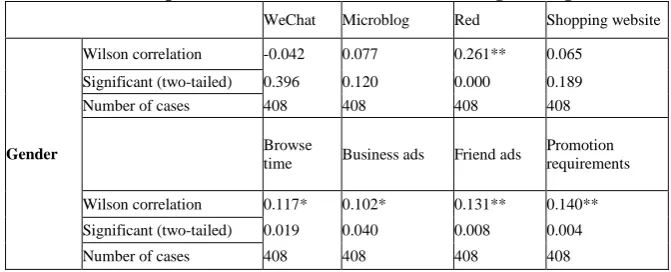
We first analyze the correlation between user gender and user-selected social media platforms. The results of the analysis are shown in Table 2. It shows that most of the selecting platform results do not have a significant correlation with gender. However, when male and female users choose a social media platform with a specific target audience, the result has a big difference. For example, in the questionnaire, there is a significant correlation between the results of the “Little Red Book” platform reference degree evaluation and gender. The reason for this difference is that the platform sets female users as its primary audience when it is established. Therefore, the content and the design of the software are based on female preference. It can be concluded that the social media platform adopts personalized advertisements for the target user groups to cater to the needs of users and the strategy for improving platform popularity and page views are effective.
products on social platforms and promote their products. For such activities, compared to male users, female users have a higher enthusing. Using gender as the influencing factor, study the correlation between gender and the time of browsing recommended advertisements and the acceptance of recommended advertisements by businesses. The results of the above two items are related to gender. Female users‟ browsing time and acceptance of businesses advertisements are higher than male users. In another preferred analysis of businesses promotion information and user word-of-mouth information, male users pay more attention to the user‟s words of mouth and female users are more likely to accept the businesses' propaganda messages. Based on the results above, the female user group has a higher sense of identity and goodwill than the male when facing the businesses. Female users also prefer to believe and accept the promotional content of the businesses.
Table 2. Comparison of attitudes towards advertising about gender
WeChat Microblog Red Shopping website
Gender
Wilson correlation -0.042 0.077 0.261** 0.065
Significant (two-tailed) 0.396 0.120 0.000 0.189 Number of cases 408 408 408 408
Browse
time Business ads Friend ads
Promotion requirements
Wilson correlation 0.117* 0.102* 0.131** 0.140**
Significant (two-tailed) 0.019 0.040 0.008 0.004
Number of cases 408 408 408 408 * At the 0.05 level, the correlation is significant
** At the 0.01 level, the correlation is significant “-” Negative correlation
In conducting a correlation analysis to study the relationship between the product characteristic preferences of different users, the businesses‟ preferential policies, preferential conditions, and acceptance of the businesses' promotional rebate policy, we get some conclusions. There is a correlation between the user's preference for low-priced goods and the acceptance of the businesses' promotional rebate policy. Price-sensitive users pay more attention to the actual payment price of goods, and have a higher acceptance level for activities that can reduce the payment price. Thus, it is easier to accept various preferential policies proposed by businesses. In addition, there is a correlation between the actual demand as a consumer motivation and the sensitivity to discounts. Users who have a clear demand for goods pay more attention to the price of the goods they need, though the price change of the products is the most concerned part for users. Also, there is a correlation between the degree of user attention to product features and the acceptance of continuous attention to the businesses‟ information. Unique products can increase users‟ interest and attention to businesses. Therefore, acceptance in the face of the businesses' request to pay attention to official information will be better than other businesses.
4.2 Regression analysis
The log-linear model is used, the user's acceptance of the advertising content is the dependent variable (y), and the gender, product characteristics, advertising characteristics, participation in the preferential policies and interaction conditions are independent variables (x). Regression analysis was performed using the R language and the variables were selected by using the stepwise screening method. The results are shown in Table 3.
Table 3. Regression analysis table
Project Estimate Std. Error z value Pr(>|z|) (Intercept) 1.50826 0.05023 30.030 < 2e-16 *** Gender(x1) 0.10569 0.04169 2.535 0.01123 * Features(x2) 0.06650 0.04272 1.557 0.11958 Price(x3) 0.12372 0.04323 2.862 0.00422 ** Demand(x4) 0.11010 0.04211 2.615 0.00892 **
The determined log-linear regression equation is
E y = e(1.50826 +0.10569 x1+0.06650 x2+0.12372 x3+0.11010 x4)
level of the product and the degree of user demand for the product have a greater impact on the acceptance of the promotional rebate. From the estimated value of the coefficient, the user's selection order of the social media platform recommended advertisement is determined as price-demand-content. Variables related to the recommended form of advertising on the social media platform were removed during the screening process. It indicates that when the user accepts the advertisement, the degree of concentration on the feature of the product is greater than the degree of attention to the form of the advertisement. Demand and price levels are the main consumers‟ motives. Therefore, the approximate judgment order when the user selects the advertisement is: price-demand-content-form. The personalized and interactive features of the social media platform recommendation advertisements cannot significantly affect the user's acceptance of the advertisement recommendation. The degree of influence on the actual purchase behaviour of the user is insufficient.
Ordinary users are not sensitive to the form of social media platform recommended ads. The majority of social media platforms currently recommend advertisements, and their personalized and interactive features are only reflected in the form of advertising. This form of change does not significantly affect the display of relevant product content, so it cannot have a sufficient influence on the user's purchase demand and desire. Therefore, such seemingly advantageous social media platform recommendation advertisements do not bring more benefits to businesses at the stage. However, compared with the traditional forms of advertising, the recommended ads of new social media platform rely on its characteristics of precision, personalization and interactivity, it still have better advertising efficiency, under the premise of meeting user privacy requirements. The reason for not achieving good results is personalized or precise advertising at this stage do not achieve sufficient personality and precision. Personalized advertising is not enough "personality", accurate advertising is not enough "precise". Interactive advertising also stays in the form without giving the user a sense of participation. Naturally it can't achieve significant results. Businesses should adjust the content and the form of recommended ads on social media platforms. While analyzing the user's product preferences, businesses also need toanalyze the reasons for the user's preferences, and analyze the user's attention to the different characteristics of such products,so that the social media platform can achieve a truly personalized designin recommended advertising. The businesses can split the current advertisement into different modules and preset various alternatives for different module parts. The form and content of the advertisement are classified according to different preference characteristics of the target user group, and then combined according to the advertisement form with the highest user acceptance degree and the product feature most concerned by the user. Improve the personalization and accuracy of your ads. Achieve the effect of meeting different users' different concerns for different products.
However, the degree of personalization of social media platform recommended advertisements are also restricted by factors such as the privacy protection and trust in the businesses. Excessive collecting users' data can cause users worrying about the disclosure of personal information, and appearing distrust and evasive attitude. But insufficient users‟ data collection cannot achieve a high level of accuracy. Therefore, businesses should balance the collection and utilization of users‟ personal information. Businesses should give users the right to freely choose the recommended ads for the social media platform, retain users‟ right to know clearly about the collection of personal information, let users know the flowing of the information and the place of use and reduce the user's alertness to the outflow of personal information. These methods not only avoid the negative emotions to the businesses in certain, but also enhance the user's understanding and trust to the businesses.
V.
CONCLUSION
Users‟ choice of recommended advertisements on social media platforms has no significant correlation with the form of recommended advertisements on new social media platforms. Personalized advertisements have limited impact on users‟ actual consumption. Users are more likely to accept referrals from friends than posted by business. Recommended advertisements spread on social media in an interactive format get more page views. However, from the feedback results of users, we can know that this kind of higher page views can neither significantly improve the actual acceptance of social media platform recommended advertisements, nor does it directly translate into actual consumption. The previous analysis shows that users pay more attention to the reputation of the product than to the advertising content. Combining this conclusion, it is considered that the current price level and the degree of user demand restrict the users to convert this concentration into consumption. When the users have enough demand for the product, the advantage of interactive advertisement might be appeared. Users could prioritize the purchase of recognized products through recommended advertisements on social media platforms, also increased the demand for these products. Therefore, the interactivity of recommended advertisements on social media platforms has a potential positive impact on users‟ consumption, but a limited impact on instant purchase behaviour.
consumption. The effect of social media platform recommended advertisements have certain correlation with platform. In order to improve the promotion effect of recommended advertisements on social media platforms, the design of the advertisements should not only focus on the analysis of users‟ characteristics, but also combine the characteristics of different social media platforms.
Users of different genders have different attitudes towards advertising recommendation on social media platforms. Personalized social media platform recommendation advertisement‟s precise push has a more obvious impact on female users' consumption behavior. Female users have a higher degree of acceptance and enthusiasm to participate in the recommended advertisements on social media platforms. For the attitude of the business, female users are more affectionate than male users. Female users are more interested in emerging forms of advertising. Male users are more rational. They have basically the same attitude towards recommended advertisements on new social media platforms and traditional advertisements, and are not highly receptive and sensitive to personalized interactive advertisements. Besides, female users pay more attention to different categories of products. Compared with male users who pay more equal attention to the characteristics of goods, female users have a more obvious tendency. Therefore, when merchants grasp the characteristics of users, they are more likely to be affected by targeted and personalized publicity of merchants.
The order for users to choose advertisements can be roughly determined as follows: price, demand, content and form. Currently, social media platforms recommend advertisements by analyzing big data, carrying out personalized push and combining with interactive features to try to improve the promotion effect of advertisements. But the data analysis based on questionnaire showed that its effect is limited. Recommended advertisements on social media platforms should be adjusted according to users‟ choice, and excessive pursuit of publicity should be changed. The evolution direction of social media platform recommendation advertising is adjusted stimulating potential needs and changing the way that perceive commodity prices. It can improve users' desire to accept actively, control the amount of advertisements recommended by social media platforms, reduce users' negative emotions towards advertisements, and make more effective use of advertisers' resources. Thus, new social media platforms have better effects in recommending advertisements.
Efficient social media platform recommendation advertising is the common expectation of merchants and users. In the future, the improvement of technology will greatly improve the efficiency of recommendation advertising on social media platforms. For social media platforms to recommend advertisements, the improvement of information flow can essentially change the display form of advertisements, spread the traditional offline experience to users through digital media, create the use situation of products for users, and make users truly experience the actual use effect after purchase. The expansion of user data scale and the improvement of data utilization rate enable advertisers to more accurately understand users‟ consumption habits and commodity preferences, which greatly improves the accuracy and personalization of recommended advertisements on social media platforms, and makes the communication and interaction between merchants and users closer. However, in the process of constantly improving social media platform recommendation advertising, the protection of users‟ personal information and privacy cannot be ignored. Only by grasping the acceptability of different users to social media platforms can the advantages of personalized diversification and interactivity of social media platforms be brought into play.
Appendix A. Questionnaire 1 Your gender
2 Your age
3 How long do you view the information on social media platform every day?
4 What is the proportion of advertising information you browse on the social media platform?
5 What percentage of advertising information would you like to see on the social media platform? 6 What is the maximum proportion of advertising messages you can accept?
7 What percentage of all advertisements do you choose to understand?
8 What percentage of all friend recommendations do you choose to know about the content?
9 The extent to which the amount of advertising a business has on your buying behavior? 10 Which platforms do you prefer as a source of shopping information?
11 What is your preference for this platform?
12 For different categories of products, you pay more attention to the word of mouth or business advertising information?
13 For different kinds of products of the business advertising, you will choose how much proportion to understand
14 For different kinds of products, which content will be the most important basis for your choice of consumption?
www.ijres.org 70 | Page]
16 What kind of discount do you expect the merchant to offer?
REFERENCES
[1]. Petty, R.E., Wheeler, S.C. and Bizer, G.Y. (2000) „Attitude functions and persuasion: An elaboration likelihood approach to matched versus mismatched messages‟, inMaio, G. R. et al(Eds.), Why we evaluate: Functions of attitudes, Psychology Press, London, pp. 133–162.
[2]. Zhou, C., Tang, W. and Zhao, R. (2015) „Optimal consumer search with prospect utility in hybrid uncertain environment‟, Journal of Uncertainty Analysis and Applications, Vol. 3 No. 1, pp.1-10.
[3]. Chutijirawong, N. and Kanawattanachai, P. (2014) „The role and impact of context-driven personalization technology on customer acceptance of advertising via short message service (SMS)‟, International Journal of Mobile Communications, Vol. 12 No. 6, PP.578-602.
[4]. Zhou, C., Ma, N., Cui, X., and Liu, Z. (2018) „The impact of online referral on brand market strategies with consumer search and spillover effect‟ Soft Computing,[online] https://doi.org/10.1007/s00500-018-3661-4(Accessed 22 November 2018).
[5]. Zhou, C., Xu, G., Liu, Z. (2019) Incentive contract design for internet referral services: Cost per click vs cost per sale. Kybernetes, DOI: 10.1108/K-07-2018-0371
[6]. Petty, R.E, Priester, J R and Briñol, P. (2009) Mass Media Attitude Change: Implications on the Elaboration Likelihood Model of Persuasion, Routledge, New York, NJ, US.
[7]. Baek, T.H., and Morimoto, M. (2012) „Stay away from me: examining the determinants of consumer avoidance of personalized advertising‟, Journal of Advertising, Vol. 41 No. 1, PP.59-76.
[8]. De Keyzer, F., Dens, N. and De Pelsmacker, P. (2015) „Is this for me? how consumers respond to personalized advertising on social network sites‟, Journal of Interactive Advertising, Vol. 15 No. 2, PP.1-11.
[9]. Tucker, C.E. (2011) „Social networks, personalized advertising, and privacy controls‟, Journal of Marketing Research, Vol. 51 No. 5, PP.546-562.
[10]. Muk, A., Chung, C. and Kim, J. (2014) „Korean consumer perspectives on social media advertising and intention to join brand pages‟, Journal of Global Scholars of Marketing Science, Vol. 24 No. 4, PP.384-394.
[11]. Sundar, S.S. and Kim, J. (2005) „Interactivity and persuasion‟, Journal of Interactive Advertising, Vol. 5 No. 2, PP.5-18.
[12]. Lueck, J.A. (2015) „Friend-zone with benefits: the parasocial advertising of kimkardashian‟, Journal of Marketing Communications, Vol. 21 No. 2, PP.91-109.
[13]. Kim, H., Ko, E., and Kim, J. (2015) „SNS users' para-social relationships with celebrities: social media effects on purchase intentions‟. Journal of Global Scholars of Marketing Science, Vol. 25 No.3, pp.279-294.
[14]. Wu, L. (2016) „Understanding the impact of media engagement on the perceived value and acceptance of advertising within mobile social networks‟, Journal of Interactive Advertising, Vol.16 No. 1, PP.59-73.
[15]. Phua, J., and Ahn, S. J. (2016) „Explicating the 'like' on Facebook brand pages: The effect of intensity of Facebook use, number of overall 'likes', and number of friends' 'likes' on consumers' brand outcomes‟ Journal of Marketing Communications, Vol.22 No. 1, PP.544-559.
[16]. Chang, Y., and Dong, X. (2016) „Research on the impact of consumer interaction behaviour on purchase intention in an SNS environment: evidence from China‟ Information Development, Vol.32 No. 3, pp.496-508.
[17]. Bang, H.J. and Lee, W.N. (2016) „Consumer response to ads in social network sites: an exploration into the role of ad location and path‟, Journal of Current Issues and Research in Advertising, Vol.37 No. 1, PP.1-14.
[18]. Li, Y.M., Lin, L. and Chiu, S.W. (2014) „Enhancing targeted advertising with social context endorsement‟, International Journal of Electronic Commerce, Vol. 19 No. 1, PP.99-128.
[19]. Okazaki, S., Li, H., & Hirose, M. (2009) „Consumer privacy concerns and preference for degree of regulatory control‟, Journal of Advertising, Vol. 38 No. 4, PP.63-77.
[20]. Hurwitz, J.B. (2012), „Acceptance of Advertising and Collection of Personal Information‟ In Proceedings of the Human Factors and Ergonomics Society Annual Meeting, SAGE Publications, Los Angeles, Vol. 56, No. 1, pp. 1238-1242.
[21]. Yu, J.H. and Cude, B.J. (2009) „Possible Disparities in Consumers' Perceptions toward Personalized Advertising Caused by Cultural Differences: U.S. and Korea‟, Journal of International Consumer Marketing, Vol. 21 No. 4, PP.251-269.
[22]. Zhang, H., Guerrero, C., Wheatley, D. and Lee, Y.S. (2010) „Privacy issues and user attitudes towards targeted advertising: a focus group study‟, Human Factors and Ergonomics Society Annual Meeting Proceedings, Vol. 54 No. 19, PP.1416-1420.