National Conference on Advances in Engineering and Applied Science (NCAEAS) 29th January 2018
Organized by : Anjuman College of Engineering and Technology (ACET) Nagpur, Maharashtra, India, In association with
International Journal of Scientific Research in Science and Technology
Imagae Feature Based Annotation for Data Verification
System
Priyanka Mankar, Shweta Meshram, Prof. Imteyaz Shahzad
Department of Computer Sci. & Engineering, Engineering, Anjuman College of Engineering & Technology Technology Nagpur, Maharashtra, India
ABSTRACT
A face annotation has many applications the main part of based face annotation is to management of most same facial images and their weak data labels. This problem, different method are adopted. The efficiency of annotating systems are improved by using these methods. This paper proposes a review on various techniques used for detection and analysis of each technique. Combine techniques are used in retrieving facial images based on query. So it is effective to label the images with their exact names. The detected face recognition techniques can annotate the faces with exact data labels which will help to improve the detection more efficiently. For a set of semantically similar images Annotations from them. Then content-based search is performed on this set to retrieve visually similar images, annotations are mined from the data descriptions. The method is to find the face data association in images with data label. Specifically, the task of face-name association should obey the constraint face can be a data appearing in its associated a name can be given to at most one face and a face can be assigned to one name.
Keyword: Face Annotation, Content Based, face data, association.
I.
INTRODUCTION
The face annotation is an important technique that to annotate facial feature images automatically. The face annotation can be useful to many Applications. The face annotation approaches are often treated as an extended face recognition issue, where different classification models are trained model-based face annotation time consuming and cost of to collect a large amount of human labelled facial images.
some studies have attempted to get a search based annotation for facial image annotation by mining to tackle the automated face annotation by
exploiting content-based image retrieval method The objective of is to assign correct data labels given query facial image[1]. It is usually time consuming and cost to collect a large amount of human data labeled training facial images. It is usually difficult to the models when new data or new persons are added, in which an retraining process is usually required. The annotation or recognition performance often poorly when the number of persons or classes is very large.
II.
LITERATURE REVIEW
images that are freely available on the World Wide Web (WWW). One challenging problem for search-based face annotation scheme is how to effectively perform annotation by exploiting the list of most similar facial images and their weak labels that are often noisy and incomplete[1]. To tackle this problem, we propose an effective unsupervised label refinement (ULR) approach for refining the labels of web facial images using machine learning techniques. We formulate the learning problem as a convex optimization and develop effective optimization algorithms to solve the large-scale learning task efficiently. To further speed up the proposed scheme, we also propose a clustering-based approximation algorithm which can improve the scalability considerably. We have conducted an extensive set of empirical studies on a large-scale web facial image tested, in which encouraging results showed that the proposed ULR algorithms can significantly boost the performance of the promising SBFA scheme.
The face annotation has many real world applications. The challenging part of search based face annotation task is management of most familiar facial images and their weak labels. To tackle this problem, different techniques are adopted. The efficiency and performance of annotating systems are improved tremendously by using these methods. Here this paper proposes a review on different techniques used for this purpose and check the pros and cons of each technique[5].
Face images that are captured by surveillance cameras usually have a very low resolution, which significantly limits the performance of face recognition systems[6]. In the past, super-resolution techniques have been proposed to increase the resolution by combining information from multiple images. These techniques use super-resolution as a
preprocessing step to obtain a high-resolution image that is later passed to a face recognition system[7]. Considering that most state-of-the-art face recognition systems use an initial dimensionality reduction method, we propose to transfer the super-resolution reconstruction from pixel domain to a lower dimensional face space. Such an approach has the advantage of a significant decrease in the computational complexity of the super-resolution reconstruction. The reconstruction algorithm no longer tries to obtain a visually improved high-quality image, but instead constructs the information required by the recognition system directly in the low dimensional domain without any unnecessary overhead. In addition, we show that face-space super-resolution is more robust to registration errors and noise than pixel-domain super-resolution because of the addition of model-based constraints.
Modulus
Database creation with image in binary bit format array
Scanning BMP Format Reading per pixel value in RGB value
Facial feature indexing with data label
Similar face retrieval with value
Detected Final output
Refined data
III.
METHODOLOGY
1. The system fed with a image. 2. Extracting facial Features
3. The important data is extracted from the sample. Using software where many algorithms are available The outcome which is a reduced set of data that represents the important features of the enrolled user's face.
5. This depends on the application at hand. That identification purposes, It will be a comparison between the stored on a database.
6. Declaring a Match with data
7. The face recognition system will return a match The intervention of a human operator will be required in order to select the best fit from the candidate data.
Data labeling procedure. The procedure are compared with data labeling on spectral clustering. After initial labeling with partial clustering, The proposed labeling algorithm and spectral clustering to label the rest of the faces. We recluster label faces, then data label the cluster, which similarity variation is the lowest. proposed data labeling algorithm get higher efficiency at the beginning of data labeling,
The selection of neural network is done as it has got the unique feature of flexibility with accuracy. We can consider neural network as that student who once taught a thing never forgets to reproduce it as and when required. Face Feature Recognition has adopted the adaptive behavior of neural network, which makes the project consider Time Complexity and Space Complexity.
Human beings are gifted with a unique power of visualizing and interpreting the things. But this power is being misused sometimes or it may lead you in a state of ambiguity. It happens sometimes that criminals do change their get up to escape .we familiar with sort of event in some hijacking case or bank robbery case.
But if the power of visualizing is adopted in system, the system will not allow this to happen comes for help here. Face Feature Recognition has neural net has learning element. A face is given as input to the
neural net, it matches it with faces in its databases and give output in the form as it has recognize the face and will display the personality description. This is the core of the thesis. While giving the face as input few initial arrangements has to be carried out. These arrangements are listed below.
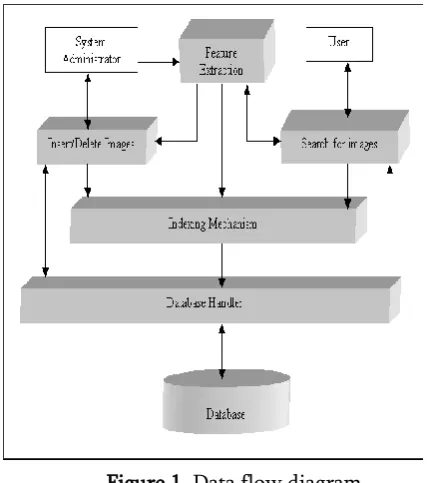
Figure 1. Data flow diagram
IV.
FACIAL FEATURES
This phase is one of the most vital phase of the project. The outline profile of the end view of human face pattern yields the best descriminant features for identification of human face. This involves the following steps: -
1) Binarizing the digitized photograph.
2) Reduction of the binarized photograph to line profile.The ultimate output of this phase is ten facial features, which is necessary and enough to make neural network recognize the human face.
If we look at the side profile of the human face, we find that certain points can be readily defined on the face profile. If these points can be correctly identified they can help in extracting certain characteristics features for that particular face. Ten such points are shown in figure .Out of these ten points, eight points are independent of each other but point 3 and 2 are interrelated with each other. All these points are calculated by using some
mathematical relationship logic along with some statistical knowledge Now, this image can be used to extract the ten points. The ten points and the methods to extract them is as follows:
A) Nose Point (Point1): This point is the most important of all the points. Nose point forms the basis for the computation of all the other fiducial points. The other can be calculated using certain mathematical logic and available formulas only after finding nose points. To find the nose point the logic to be applied is that, the first point obtained as we scan left to right, the input photograph in side profile is considered as the nose point.
B) Chin Point (Point2): This is the second fiducial point, which is to be calculated after the calculation of nose point. To find the chin point, all the pixels below the nose point, in the side profile of the input human face are joined with the nose point and whichever pixel is making the largest angle is being considered as the chin point.
Figure 2. Process Flow
IMMFace
database
Image
selection
Im
age
s
Edge
detection
Feature
extractio
n
Pattern –
matchin
g
Seman
tic
ANNO
TATI
ONS
Label
Filtratio
n
V.
CONCLUSION
The face annotation on labeled images. So research works and new methods are being proposed. The research in this field importance as it is very useful in searching and social Media. The future work will work on multi person data task and thereby efficiency and accuracy of result. If the techniques are implemented properly, then the data label problem will be solved.
VI.
REFERENCES
[1].X.-J. Wang, L. Zhang, F. Jing, and W.-Y. Ma, "AnnoSearch: ImageAuto-Annotation by Search," Proc. IEEE CS Conf, 2006.
[2].D. Wang, S.C.H. Hoi, Y. He, and J. Zhu, "Retrieval-Based Face Annotation by Weak Label Regularized Local Coordinate Coding," 2011.
[3].A.W.M. Smeulders, M. Worring, S. Santini, A. Gupta, and R. Jain,"Content-Based Image Retrieval at the End of the Early Years," IEEE Trans. Pattern Analysis and Machine
[4].Dayong Wang, Steven C.H. Hoi, Ying He, and Jianke Zhu," Mining Weakly Labeled Web Facial Images for Search-Based Face Annotation" IEEE Transactions on Knowledge and Data Engineering, vol. 26, no. 1, January 2014
[5].W. Dong, Z. Wang, W. Josephson, M. Charikar, and K. Li, "Modeling LSH for Performance Tuning," Proc. 17th ACM Conf.2008.
[6].C. Siagian and L. Itti, "Rapid Biologically-Inspired Scene Classification Using Features Shared with Visual Attention,"IEEE