Journal of Chemical and Pharmaceutical Research, 2014, 6(6):1481-1487
Research Article
CODEN(USA) : JCPRC5
ISSN : 0975-7384
Method of detection and removal rain from image based on the HSV
color space
Dong Huiying*, Lu Xue and Zhao Xuejing
School of Information Science and Engineering, Shenyang Ligong University, Shenyang, China
_____________________________________________________________________________________________
ABSTRACT
This paper proposed a method which combines color space with an improved frame differential method to remove the raindrops in color images, based on the study of the existing rain removal image restoration method of using Color space and frame difference method. First analyzes the characteristics of HSV color space, comparing with the RGB space only V channel is affected by rain on a rainy day shooting video in HSV space, thus translate color image from RGB space into HSV space. Then deal the rain with the improved five frame difference method on the V channel. Because of the same pixel on the two consecutive frames may not be covered by the same rain .Then introduce the difference between average and median in five frame pixel as constraint condition to detect the rain. Experiments show that this algorithm can well remove the raindrops on the image. And the processing speed is greatly improved compared with the frame differential method in RGB space and k-means in YCbCr.
Key words: color space transformation, frame difference method, Rain removal, image restoration
_____________________________________________________________________________________________
INTRODUCTION
During the rapid development of science and technology in recent years, all kinds of monitoring and control system is also emerge in endlessly.Along with the development of science and technology,higher requirements are needed for the performance of the monitoring system and the processing algorithms to bad weather. Rainy day is among the more common bad weather and also serious influence on surveillance video.Therefore,how to remove the rain of videos is a problem that cannot be ignored, also, it is a research hotspot nowadays.
Garg and Nayar[1] first proposed the method to remove rain based on hardware by adjusting the camera’s exposure time and aperture series,laterputforwardthe photometric model and dynamic model.Whereas their algorithm takes longer time in rain detects and it cannotprocess the heavy rain well.FenglongShen[2] et almade a more detailed review for the related literature about removing rain. Chunyu Chen[3] et al put forwardan improved frame differential method which needs five frames,then using criterion to judge whether there has rain. Thecriterion is that whether the difference of maximum and minimum value inthe same pixel is greater than zero. Then using the current pixel to subtract the maximumvalues and the minimum values independently, if the formeris greater than thelatter, they use the minimum values to replace pixel values. Yingxiang Zhang et al [4] put forwardImproved frame differential method as well, they use the nth frame to compare with the n – 2 frame and the n + 2 frame of 5 frames respectively, if the pixel satisfy the constraints I=In-In+2=In-In-2≥c, they believe that it is covered with raindrops, Comparing the pixels with front and rear frame’s same pixels to remove raindrops:α is the radio of (In-1+In+1)/2 and (In-2+In+2)/2.if α<1, the former is used to replace the original pixels, or with the latter.
Dong Huiying et al
J. Chem. Pharm. Res., 2014, 6(6):1481-1487
______________________________________________________________________________
clustering algorithm to remove the raindrops on the Y component .Which improves the real-time performance of the algorithm. However clustering algorithms need to scan each pixel of the image of the video,it has a great influence on real-time of the algorithm.
Generally,the existing algorithmsin raindrops removal based on software can be roughly divided into clustering algorithms, such as k-means[4,7,8], fuzzy c-means[9,10], the frame difference methods including improved three-frame difference method、the five-frame difference method, optical flow method[11], Kalman filter, the
Gaussian model[12], active contour model[13],shadow pursuit model[14] and the algorithms combining the algorithms mentioned in the color space conversion.
In this paper, put forward an improved frame difference algorithm to remove the raindrops which is based on the basis of further analysis of HSV color space. Study finds that both the constraint I = In − In + 1 = In − In − 1 ≥ c,in the three-frame difference or the I = In − In + 2 = In − In − 2 ≥ c in the five-frame difference have rain omission inspection situations. Therefore, compared the mean value of the same pixel with the median value in 5 frames, if that is bigger than a, then regarded as rain. The improved algorithm can remove raindrops better and more rapidly
1 Raindrops color attributes and the HSV color space
1.1 Raindrops color attributes
Raindrops approximation can be seen as an ellipsoid, similar to be a convex lens which is 165 degrees reflecting and refracting light atmosphere, causing the enhance of light intensity. Raindrops its own brightness is greater than the original background which it covers.Figure1, Figure2 are taken at the same camera parameters.Figure1 is taken in the rain meanwhile Figure2 is in the sunny day. Both have same scenes and light. Figure 1, Figure 2 shows that the pixels covered by raindrops intensity are larger.
Studies show the refractive index of raindrops has little difference among red green and blue light. The refractive index can be seen as largely the same, then the angle of incidence of refraction light is approximately equal
θB≈θG≈θR. Changes in light intensity directly determine the changes in the brightness of pixels, so the R, G, B three components caused by the refraction should also be approximately equal intensity.
Figure1 Rainy day image, the R, G, B Figure2 Sunny day image at the same conditions value of (79,270) pixels is 90,69,73of figure1,the R, G, B value of (79,270) pixels is 58,32,37
Figure1,Figure2 shows variation of raindrops is approximately equal in the RGB three-component, that is
∆R≈∆G≈∆B.
1.2 Analysis of HSV Color Space
HSV represents the hue, saturation and brightness. As the human visual sensitivity to brightness is far stronger than the sensitivity of the color shade, in order to process and identify color, the human visual system often use the HSV color space, because it is better than the RGB color space consistent with human visual characteristics. The easiest conversion formula translating image from RGB space to HSV space is:
= −3 −+ − 1
= 1 − , , 2
= + +3 3
!"# $, % = & '#) $, % ( +
* & '" $, % (
+
)
Wherein, Ibr (x, y) represents the pixel brightness, that the position of the projection plane affected by rain (x, y), τ
represents the time that the process of falling through the raindrops on the pixel position (x, y), Eb (x, y) is the average background pixel irradiance, Er (x, y) is the irradiance which raindrops pass pixel position (x, y), time T is the exposure time of the camera. Simplified imaging model for the rain is:
!# $, % = ,!- $, % + 1 − , !" $, %
In RGB color image
!# $, % = .!#_0 $, % , !#_1 $, % , !#_2 $, % 3+ !" $, % = .!"_0 $, % , !"_1 $, % , !"_2 $, % 3+
!- $, % = .!-4 $, % , !-5 $, % , !-6 $, % 3+ = 7!- $, % , !- $, % , !- $, % 8+
From the above:
!#4 $, % = ,!- $, % + 1 − , !"4 $, % = (4)
!#5 $, % = ,!- $, % + 1 − , !"5 $, % = (5)
!#6 $, % = ,!- $, % + 1 − , !"6 $, % = (6)
We can get as below by Calculating formula (4), (5), (6) with (1),(2),(3),
= 3.!"5 $, % − !"6 $, % 3
.2!"4 $, % − !"5 $, % − !"6 $, % 3
= 1 − ,!- $, % + 1 − , !"6 $, %
,!- $, % + 9:; <=>4?,@ A=C>5?,@ A=>6?,@ B
For , → 0,,!- $, % → 0
= 1 − 3!"6 $, %
!"4 $, % + !"5 $, % + !"6 $, %
= ,!- $, % + 1 − , .!"4 $, % + !"5 $, % + !"6 $, % 3 3
It can be seen only V components affected by the raindrops in the HSV space .Therefore, only need to process the
raindrops in V components. After processing, combining V 、H and S components . At last we can achieve consistent results with whole process.
2 raindrops detection with improved five frame difference method
Based on the optical model of raindrops, Garg and Nayar first put forward frame differential method to detect the raindrops.
∆! = ! − ! − 1 = ! + 1 − ! ≥ F
The idea is that when the background pixels covered by raindrops brightness will up rush, as the rain has the faster falling speed, the same pixel point of adjacent frames are not covered by the same raindrops. Therefore consider n - 1, n, n + 1 frame pixel brightness I. Assume that the background is static, then the nth frame pixel brightness changes affected by rain, ∆I meet the conditions:
∆I= In-In-1 =In+1-In≥c
c is a threshold for determine whether there is rain, there. c = 1 ~ 3, denote the minimum intensity change caused by rain.
Zhang Yingxiang and other people enlarged detection range from 3 frames to 5 frames. The constraint conditions is:
∆I = In − In + 2 = In − In − 2 ≥ c. If they meet such conditions are judged for rains.
Dong Huiying et al
J. Chem. Pharm. Res., 2014, 6(6):1481-1487
______________________________________________________________________________
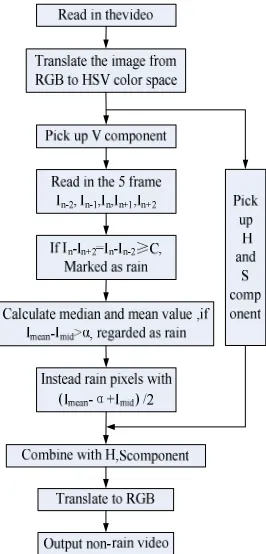
Then calculate the median and the mean values of 5 frame pixel intensity in the same position. Because the pixels of two consecutive frames in the same position will not be covered by the same raindrops, then the median value of 5 frame pixels’ intensity is not changed. But brightness values of the mean will enlarged affected by the rain. However, if it is not affected by rain in the static background, the mean value Imean and median value Imid is almost the same.
Then the constraint is introduced: if Imean-Imid≥a, (a is an experience value according to the size of the rainfall), regarded as rain.
3 raindrops remove
On the raindrops removal, replace the detect raindrops on V channel with corresponding background color can be restore the image affected by the rain.
Zhang use the ratio of the pixel mean for the two frames before and after to replace the rain,that is,α is the ratio of
(In-1+In+1)/2 and(In-2+In+2)/2. If α<1, to replace the rain using(In-1+In+1)/2,otherwise using(In-2+In+2) /2.
[image:4.595.242.375.313.590.2]This paper use the average of Imean - a andImid instead of pixels by rain interference, which is better suitable for almost all condition of rain-image restoration.
Figure 3 Flow chart of color space method for raindrops removal algorithm
RESULTS AND DISCUSSION
(1) Processing result Comparison Under the standard video
(a) The original video image
(d) Raindrops Detection of
YCbCr method
(e) the result of YCbCr
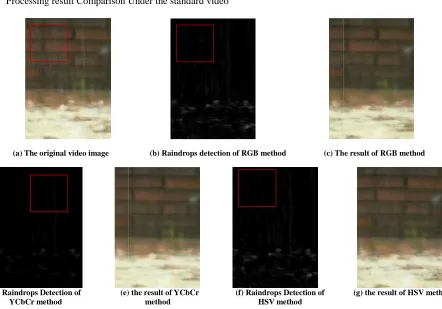
Figure 4 Algorithms comparison of this paper and the RGB space and YCbCr algorithm in Standard video
Standard video in this paper is the same with Garg and Nayars’ videos in rain study which is 192 * 272 pixels, length of time is 6 seconds, and frame rate is 30 frames per second. By figure 4 (b), 4 (d), 4 (f) marked in the upper-left area’s comparison can see that only the algorithm in this paper get a good detection of the rain. In other parts of the images YCbCr method is stil
incomplete. And the algorithm of this paper is better to remove raindrops and keep the details.
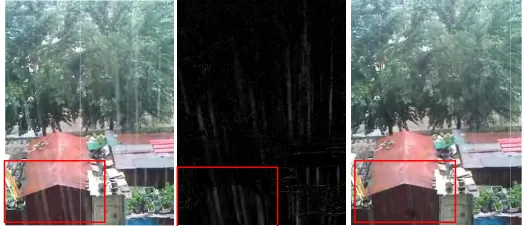
[image:5.595.87.529.77.386.2](2) Processing result Comparison under the Amateur video Figure 5 is the five consecutive frames of 131
the restored image respectively.
(a) five consecutive frames of the original video image
Processing result Comparison Under the standard video
(b) Raindrops detection of RGB method (c) The result of RGB method
(e) the result of YCbCr
method
(f) Raindrops Detection of HSV method
lgorithms comparison of this paper and the RGB space and YCbCr algorithm in Standard video
Standard video in this paper is the same with Garg and Nayars’ videos in rain study which is 192 * 272 pixels, is 6 seconds, and frame rate is 30 frames per second. By figure 4 (b), 4 (d), 4 (f) marked in the left area’s comparison can see that only the algorithm in this paper get a good detection of the rain. In other parts of the images YCbCr method is still missing some raindrops in detecting which cause the rain removal incomplete. And the algorithm of this paper is better to remove raindrops and keep the details.
(2) Processing result Comparison under the Amateur video
ames of 131-135 in amateur video of the original images; rain detects image and
(a) five consecutive frames of the original video image
(b)five consecutive frames of the rain
(c) The result of RGB method
(g) the result of HSV method
lgorithms comparison of this paper and the RGB space and YCbCr algorithm in Standard video
Standard video in this paper is the same with Garg and Nayars’ videos in rain study which is 192 * 272 pixels, is 6 seconds, and frame rate is 30 frames per second. By figure 4 (b), 4 (d), 4 (f) marked in the left area’s comparison can see that only the algorithm in this paper get a good detection of the rain. In other l missing some raindrops in detecting which cause the rain removal incomplete. And the algorithm of this paper is better to remove raindrops and keep the details.
Dong Huiying et al
______________________________________________________________________________
Amateur video is 240 * 320 pixels, length of time is 6 seconds, and video frame rate is 30 frames per second. Using the 133th frame to compare our methods with frame differential in RGB space
color space Amateur video has more complex background and greater rainfall compare with the standard video.
By figure 6 (a) 6(b) 6 (d) 6(f) in the lower
algorithm in this paper is better detected the raindrops. And rain residual amount is larger in the upper marker in 6 (d). In the restored image 6 (a) 6(c) 6 (e) 6(g) marker can seen that this algorithm is better removal the rain, rehabilitation effect basically guarantee the image quality and details.
On the processing speed, the algorithm of this paper is done in HSV space. Due to the rain j
thus greatly improves the speed of the algorithm. And Dong Shuli’sYCbCr space algorithm has just deal with rain on the Y component, but the k-means clustering algorithm need to scan each pixel which greatly increased the whole time of the algorithm. Table 1 is the running time comparison for this article and Dong Shuli’sYCbCr space algorithm and Zhang Yingxiang’s frame differential method in RGB space, from table 1 we can see that RGB method‘s running speed is three times of HSV spac
algorithm in this paper, so this algorithm has good real
(a) The original video image (b) Raindrops Detection of RGB method (c) The result of RGB method
(d) Raindrops Detection of YCbCr method
[image:6.595.175.437.369.482.2](e) the result of YCbCr
Figure 6 Algorithms comparison of this paper and the RGB space and FCM algorithm in
Video type Standard video running time Amateur video running time
J. Chem. Pharm. Res., 2014, 6(6):
______________________________________________________________________________
(c)five consecutive frames of the rain removal image
Amateur video is 240 * 320 pixels, length of time is 6 seconds, and video frame rate is 30 frames per second. Using the 133th frame to compare our methods with frame differential in RGB space and Dong Shuli’s method in YCbCr color space Amateur video has more complex background and greater rainfall compare with the standard video.
By figure 6 (a) 6(b) 6 (d) 6(f) in the lower-left corner marked areas can be seen that on the raindrops detection algorithm in this paper is better detected the raindrops. And rain residual amount is larger in the upper marker in 6 ge 6 (a) 6(c) 6 (e) 6(g) marker can seen that this algorithm is better removal the rain, rehabilitation effect basically guarantee the image quality and details.
On the processing speed, the algorithm of this paper is done in HSV space. Due to the rain j
thus greatly improves the speed of the algorithm. And Dong Shuli’sYCbCr space algorithm has just deal with rain means clustering algorithm need to scan each pixel which greatly increased the whole of the algorithm. Table 1 is the running time comparison for this article and Dong Shuli’sYCbCr space algorithm and Zhang Yingxiang’s frame differential method in RGB space, from table 1 we can see that RGB method‘s running speed is three times of HSV space algorithm in this paper, YCbCr algorithm is four times of the algorithm in this paper, so this algorithm has good real-time performance.
(a) The original video image (b) Raindrops Detection of RGB method (c) The result of RGB method
(e) the result of YCbCr method
(f) Raindrops Detection of HSV method
Figure 6 Algorithms comparison of this paper and the RGB space and FCM algorithm in
Tab1. Running speed comparison
Video type \ using method HSV YCbCr RGB Standard video running time (unit: second) 93.504 353.477 286.513 Amateur video running time (unit: second) 145.104 654.753 430.230
J. Chem. Pharm. Res., 2014, 6(6):1481-1487
______________________________________________________________________________
Amateur video is 240 * 320 pixels, length of time is 6 seconds, and video frame rate is 30 frames per second. Using and Dong Shuli’s method in YCbCr color space Amateur video has more complex background and greater rainfall compare with the standard video.
left corner marked areas can be seen that on the raindrops detection algorithm in this paper is better detected the raindrops. And rain residual amount is larger in the upper marker in 6 ge 6 (a) 6(c) 6 (e) 6(g) marker can seen that this algorithm is better removal the rain,
On the processing speed, the algorithm of this paper is done in HSV space. Due to the rain just infect V component, thus greatly improves the speed of the algorithm. And Dong Shuli’sYCbCr space algorithm has just deal with rain means clustering algorithm need to scan each pixel which greatly increased the whole of the algorithm. Table 1 is the running time comparison for this article and Dong Shuli’sYCbCr space algorithm and Zhang Yingxiang’s frame differential method in RGB space, from table 1 we can see that RGB e algorithm in this paper, YCbCr algorithm is four times of the
(a) The original video image (b) Raindrops Detection of RGB method (c) The result of RGB method
g) the result of HSV method
Figure 6 Algorithms comparison of this paper and the RGB space and FCM algorithm in amateur video
Acknowledgements
This paper is supported by the pre-research fund.
REFERENCES
[1]K GARG,S K NAYAR. International Journal of Computer Vision,200775( 1): 3-27. [2]ShenFenglong, Dong Huiying. [J].Science and Technology Innovation Herald.2008,32:119. [3]Chen Chunyu, XieKeyu, Liu Shihui. Applied Science and Technology, 2011,11:54-57. [4]ZHANG Y X, CHEN Q, LIU Y C..Microcomputer Applications, 2007, 23(12): 16-20.
[5]LIU Peng, XU Jing, LIU Jia-Feng, TANG Xiang-Long. Acta Automatica Sinica, 2010,10:1371-1378.. [6]DONG SH L, XU G L, CAO CH D, et al. Computer Simulation, 2011, 28(9): 283-286.
[7]ZHU Zhi-chao, LI Bin, FANG Shuai, Journal of Hefei University of Technology(NaturalScience),
2011,34(07):1011-1014.
[8]Ming Zhou, Zhichao Zhu. 2011 Chinese Control and Decision Conference(CCDC)2011 4:615-618
[9]CaiZhixiang, Geng Biao. Journal of Electronic Measurement and Instrument, 2012,6,26(6):553-557 [10] HU Wei, HE Xiaohai, CUI Yu. Communications Technology, 2012,03:75-78..
[11] MinminShen, Ping Xue, A fast algorithm for rain detection and removal from videos.[C] Proceedings of the 2011
IEEE International Conference on Multimedia and Expo, ICME 2011,7: 11-15
[12] AI Kai- wen, HU Gui- ming, LI Wei- wei. Equipment Manufacturing Technology, 2012,05:41-43..
[13] Sun Yigang, DuanXiaoye,ZhangHongying, Yu Zhijing. Application Research of Computers,
2011,05:1991-1993..