ISSN: 1992-8645 www.jatit.org E-ISSN: 1817-3195
883
3D COMPLEX CURVED SURFACE RECONSTRUCTION OF
DISCRETE POINT CLOUD BASED ON SURFELS
FENGJUN HU, ZHANGQUAN WANG
Institute of Information Technology, Zhejiang ShuRen University, Hangzhou 310015, Zhejiang, China
ABSTRACT
A Surfels 3D reconstruction method based on improved KD-Tree is put forward, firstly collecting the discrete point cloud data through RGB-D camera, replacing the circular or oval surfel model with hexagonal model for modeling and determining the surfel radius in light of neighborhood distribution of sample points; Moreover, doing inside and outside relations test between one point model and another discrete point model, building KD-Tree for each model, setting the axis with the longest projection length as the separating axis, improving segmentation rules, accelerating the detection of inside and outside and intersecting relations. Experiments show this algorithm has great reconstruction effects on the 3D reconstruction both of heterogeneous sample points and discrete point cloud with different resolution with steady and efficient calculation.
Keywords: Surfels, Discrete Cloud, 3D Reconstruction, KD-Tree
1. INTRODUCTION
Surface reconstruction technologies on the object or scene are mainly divided into the following categories: traditional geometric modeling, 3D scanning devices and 3D reconstruction based on stereoscopic vision. The traditional modeling method requires the size of objects which is difficult for irregular curved surface object to be measured, the complex creative process, the modeling staff with high professional knowledge, especially in modeling software including AutoCAD, 3D-Max, Maya, OpenGL etc.. The 3D scanning devices can be divided into contact and non-contact. Although this method is simple to reconstruct object and get accurate 3D model, its devices cost hugely. 3D reconstruction method based on stereoscopic vision uses binocular camera or depth camera to obtain three-dimensional coordinates of the object or scene through triangulation principle and finally have a high-precision reconstruction effect. It is economical and convenient and now widely used around the world.
Surface reconstruction is mainly divided into traditional surface modeling methods and the modeling method based on point model. Traditional surface modeling methods mainly include the following three types: Mesh surface [1-3] uses point, line and plane surface patch to represent geometric model, which can express three-dimensional objects with arbitrary topology and arbitrary shape; Parametric surface reconstruction [4-5], namely explicit surface reconstruction, is
always the main method to describe geometric model with simplicity and convenience and ability to determine point location on the curve or curved surface; Implicit surface reconstruction [6-7] is a kind of curve fitting, which is easy to express the geometric model with complex topological structure and has no need to parameterize discrete point cloud. Surface modeling method is not suitable for point cloud modeling, for a polygon mesh contains topology among the sampling points requiring a lot of resource to store the information, and for geometric means of expression based on the point model don’t need maintaining a uniform topology.
884 on surface element and resampled the surface to remove the surfels redundancy by the particle mutex method. Schaufler [12] et al. proposed to store surfels in the octree node and graph data by ray tracing algorithm. Botsh[13] et al. expressed point model by mixed data structure which can accelerate rendering and save space. Coconu [14] et al. used hardware acceleration algorithm EWA Splatting, all the sampling points stored in the octree. Adams [15] et al presented a surface element model for Boolean operations, accelerating surface element detection with three-color octree. Zhang long [16] et al. drew multi-resolution LOD for large scale point model using EWA rendering algorithm. Bentley [17] et al. expanded the application of bintree to multidimensional space. Arya [18] et al. proposed to move the divide planar located in the center of the cube box to the nearest point. Stückler [19] et al. proposed to do 3D scene reconstruction using multi-resolution surface element to present depth camera information.
On the foundation of surfels-based 3D point cloud rendering, this paper put forward a kind of improved KD-Tree point cloud data index structure which improved KD-Tree segmentation rules, took bounding box test for surfels, resampled the boundary and finally improved the precision of curved surface modeling.
2. MODELS AND ALGORITHMS
2.1 Surfels-based Point Model 2.1.1 Point model radius
The definition of point model proposed by Levoy is ( , , , , , , )x y z r g b a of which each value is a property exclusive of normal vector and radius. Point cloud is a sampling collection on unknown surfaces, namelyQ={qi∈R3}, and the definition of normal vector is:
{ 3,|| || 1}
i i
N= n ∈R n = , wherei∈ ⋅{1, , }m ⑴
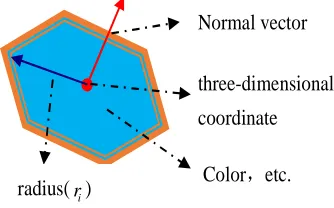
Due to the large cavity on the boundary in 3D reconstruction based on circular or oval surfels, we utilize hexagon surfel point model to smoother surface, as shown in figure 1.
Estimation formula of the radius of surfel point model is :
* max( ( )), {1, , }, {1, , }
i i j
r =ε d q q i∈ ⋅ m j∈ ⋅ m ⑵
Where εis initial radius coefficient, (d q qi j)is
the distance between q andi q .This sampling j method is suitable for heterogeneous sample points which can make surfels cover the entire model surface by increasing the radius of surfels on the
surface with sparse sample points and decreasing that with intensive sample points, and at the same time reduce overlapping phenomenon.
three-dimensional
coordinate
Normal vector
[image:2.612.330.497.143.247.2]Color
,
etc.
radius(
ri)
Figure 1: Surface Element
2.1.2 Normal vector of point model
The surface profile around the discrete point q is determined by the neighborhood points of the point. Normal vector to a tangent plane of the surface on point q is the normal vector of point q . Through least square method, we calculated the tangent plane to point q , V x( ) : T T
i
n q=n s , ||n|| 1=
when ( T( ))2 i
n q−s is the minimum, s is the i
k-order least proximal point of point q or the point weighted by local compactly support function δ :
2 || || 1
min ( T( i)) (|| i ||)
n i
n q s δ s q
=
∑
− − ⑶Because of the constraint ||n|| 1= , above expression can be simplified to:
0 1
( )( )T ( , ,..., ) T
i i m
i
q−s s −q =Ediag σ σ σ E
∑
⑷0 1
min( )n =n EdiagT (σ σ, ,...,σm)E nT ⑸
where E is orthogonal matrix composed of the eigenvectors corresponding toσ σ0, 1,...,σm.
Whenn ET =(1, 0, 0,..., 0)T,
min( )n reaches to the
least so as to get the normal of the tangent plane to point q.
2.2 Improved KD-Tree
Point model doesn’t record the topological relations between points determined by spatial position. Before the complicated surface 3D reconstruction, discrete point cloud data is organized according to spatial data structure, such as octree, KD-Tree etc.
KD-ISSN: 1992-8645 www.jatit.org E-ISSN: 1817-3195
885 Tree, middle-point segmented Tree and KD-Tree with sliding midpoint. Segmentation plane of balanced KD-Tree gets through one point of the node-containing points, the points on both sides of plane substantially equal. Segmentation plane of midpoint segmented KD-Tree locates in the center of subspace, of which adjacent layers have characteristic of shared location between nodes. Sliding midpoint KD-Tree moves segmentation plane in the center of the subspace to the nearest point, and then goes segmentation on KD-Tree.
Firstly, we determine the local coordinate system and the bounding box size of discrete point cloud
3 { i }
Q= q ∈R during spatial segmentation, to make
o
q the average position of Q :
1 1 m o i i q q m =
=
∑
⑹Then the third order covariance matrix is:
1 1 ( )( ) m T i o i o i
L q q q q n =
=
∑
− − ⑺L is symmetric positive semi-definite matrix with eigenvectors orthogonal to each other, then its eigenvalues are:
L−λ βi i =0,i∈{1, 2, 3} ⑻
whereλi as the eigenvalue, βi as the eigenvector.
We supposeφ1, φ2and φ3 are three eigenvectors for discrete cloud points along three coordinate axes, then:
1 1 1
1 1
1
(min{ . } max{ . }}
2 i mi i mi
q q
φ β β
≤ ≤ ≤ ≤
= +
2 2 2
1 1
1
(min{ . } max{ . }}
2 i mi i mi
q q
φ β β
≤ ≤ ≤ ≤
= +
3 3 3
1 1
1
(min{ . } max{ . }}
2 i mi i mi
q q
φ β β
≤ ≤ ≤ ≤
= + ⑼
The bounding box center is:
ψo=φ β φ β φ β1 1+ 2 2+ 3 3 ⑽ It is determined the segmentation plane is to divide current point cloud space along one axis. This paper projects coordinate of the node into each coordinate axis in KD-Tree segmentation, setting the axis with the longest projection length as the separating axis, also the direction of normal vector of segmentation plane. Suppose node subspace q x y zi( ,i i, )i , where xi is the projected
length on the x-axis of knot subspace. yi is the
projected length on the y-axis of knot subspace.zi
is the projected length on the z-axis of knot subspace.
If Max x y z( ,i i, )i =zi , then select the plane parallel to z-axis for segmentation. According to these segmentation rules KD-Tree has the same space size and the same segmentation direction, and can produce the same segmentation sequence without saving segmentation information. After the production of KD-Tree, same segmentation rules can be followed to access knot subspace.
3. BOOLEAN OPERATIONS ON
SURFELS-BASED POINT MODEL
There are three relations between a surfel model and another model: internal relation, external relation and intersecting relation.
Framework of the algorithm is as follows: 1) Establishing the surfel model of each point, and improved KD-Tree data index based on point cloud quantity accelerating the neighborhood search.
2) Calculating surfel radius of sample point which is required to cover just the sample point surface according to the neighborhood of each sample point.
3) Doing "internal, external, intersecting" relationship test on the surface between each of the surfel model and another point model.
Suppose α and β are surfels sets of curved
surface model, Sα and Sβ are the point model
surfaces covered by α and β ,Vα ,Vβ are 3D spatial entities surrounded by Sαand Sβ ,and ψ is surfel for a discrete point. Boolean operations on the complex curved surface model are performed as:
out out
& & &
= & & &
α β ψ ψ α∪ ∈ β ψ β∈ α
& & &
= & in& & in
α β ψ ψ α∩ ∈ β ψ β∈ α
out
&
= & & & & & in
β α ψ ψ β− ∈ α ψ α∈ β
out
&
= & & & & & in
α β ψ ψ α− ∈ β ψ β∈ α ⑾ Among them,αin,αout,βin,βoutpoint ψ is inside
886
No Yes
No
Yes
Initial point cloud
Output
Resampling
Inter- secting or
not?
Enough Precision or not ?
subdivision Improved
KD-Tree
ordering Local
[image:4.612.125.512.70.357.2]KD-Tree
Figure 2: Boolean Operation Flowchart Of Point Model
4. EXPERIMENT RESULTS
[image:4.612.84.303.376.436.2]In order to verify the validity of the algorithm, we used the Kinect to collect 3D point cloud data: test data is from indoor complex scenes with the data size up to 149821 points. The server we used for operation is the CPU I73610QM, 4G RAM, graphics card GeForce GTX 675M, and operation rate is 30 frame / sec.
Table 1 : Surface Reconstruction Complexity Of Three Complex Scenes
Scene Reconstruction points number reconstruction Surfel Reconstruction time 1 75564 52340 0. 021 2 149821 117780 0.031 3 84730 70919 0. 025
4 69857 58818 0.022
As show in table 1, we test the algorithm in 4 indoor scene using Nvidia Geforce GTX 675m. The discrete points was sent to GPU accelerated, has to meet the real time requirements.
The discrete point’s data is quite big in the 4 indoor scene. By the Surfels and KD-Tree algorithm for 3D reconstruction can effectively remove the useless point cloud data, and effectively carry out the data compression.
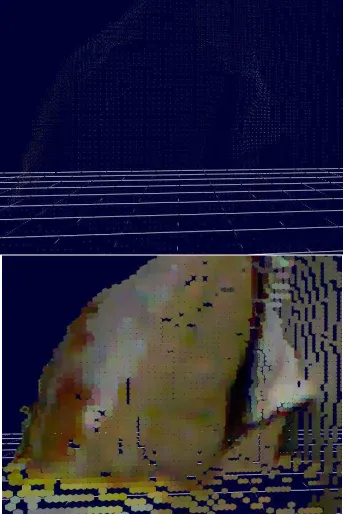
As shown in the below figure is robot plane surface reconstruction. Through two different resolution three-dimensional reconstruction based on this algorithm, it takes the good experimental effect.
Figure 3: The 3D Reconstruction Of A Large-Scale Landscape
[image:4.612.332.505.464.721.2]Up of Figure 3 used the pure point cloud for 3D reconstruction, and the below was the surfels model of reconstruction. In the 3D reconstruction of pure point cloud, apparent voids or continuous cavity appeared, and 3D reconstruction effect was not good. 3D reconstruction based on the surfels model has no cavity with continuous surface and good 3D reconstruction effect.
ISSN: 1992-8645 www.jatit.org E-ISSN: 1817-3195
887 As shown up in Figure 4, when modeling target is far away from us, under the condition of lower resolution, we can only get the less details of the scene after amplifying many multiples. As shown below in Figure 4, after processing by our algorithm, 3D modeling based on the surfels model can get the high resolution details and obtained more continuous curved surface model.
5. CONCLUSION
This paper made adjustment of the shape of surfels point model, determined the surfels radius according to the neighborhood distribution of sample points, and put forward a segmentation rule of KD-Tree. The detection of inside and outside and intersection relations could be accelerated by testing the surfels point model inside and outside. Great reconstruction effects were demonstrated for the 3D reconstruction both of heterogeneous sample points and discrete point cloud with different resolution. However, improved KD-Tree segmentation rules are helpless to the segmentation of two-dimension points. Therefore, further research will be conducted on processing technology of point cloud data.
ACKNOWLEDGEMENTS
This work was supported by Zhejiang Province excellent Youths Research Plan of Colleges and Universities.
REFERENCES:
[1] M. Loffler, J. Snoeyink, “Delaunay triangulation of imprecise points in linear time after preprocessing”, Computational Geometry, Vol. 43, No. 3, 2010, pp. 234-242.
[2] J. Klenin, J. Zachmann, “Point Cloud Surfaces Using Geometric Proximity Graphs”, Computers and Graphics, Vol. 28, No. 6, 2004, pp. 839-850.
[3] Z.W. Yang, Y.H. Seo, T.W. Kim, “Adaptive triangular-mesh reconstruction by mean-curvature-based refinement from point clouds using a moving parabolic approximation”, Computer-Aided Design, Vol. 42, No. 1, 2010, pp. 2-17.
[4] Y.H. Chen, C. Liu, “Robust segmentation of CMM data based on NURBS”, The International Journal of Advanced
Manufacturing Technology, Vol. 13, No. 8, 1997, pp. 530-534.
[5] Y. Hitoshi, G. Stefan, Z. Rhaleb, et al., “Mesh Segmentation Driven by Gaussian Curvature”, The Visual Computer , Vol. 21, No. 10, 2005, pp. 659-668.
[6] M. Kazhdan, M.Bolitho, H. Hoppe, “Poisson surface reconstruction”, Proceedings of the 4th Eurogaphics Symposium on Geometry Processing, IEEE Press, Jun 26-28, 2006, pp. 101-102.
[7] L. Yuxu, C. Chun, S. Mingli, B. Jiajun, “Polar Field Based Implicit Surface Reconstruction”, Journal of Computer-Aided Design & Computer Graphics, Vol. 21, No. 2, 2009, pp. 1035-1041.
[8] H. Pfister, M. Zwicker, B. Van,et al., “Surfels: Surface Elements as Rendering Primitives”. In Proceedings of Siggraph, ACM Press, July 23-28, 2000, pp. 335-342.
[9] S. Rusinkiewicz, M. Levoy, “Streaming QSplat:A Viewer for Networked Visualization of Large,Dense Models”, In Proc of the 2001 ACM Symp on Interactive 3D Graphics, ACM Press, March 19-21, 2001, pp. 63-68.
[10] M. Botsch, L. Kobbelt, “High-Quality Point-Based Rendering on Modem GPUs”, In Pacific graphics 2003 Conference Proceedings, IEEE Computer Society Press, October 8-10, 2003, pp. 335-343.
[11] J.H. Wu, K. Leif, “Optimized Sub-Sampling of Point Sets for Surface Splatting”, Computer Graphics Forum, Vol. 23, No. 3, 2004, pp. 643-652.
[12]G. Schaufler, H.W. Jensen, “Ray Tracing Point Sampled Geometry”, In Proceedings of the 11th Eurographics Workshop on Rendering, Springer-Verlag, June 26-28, 2000, pp. 319-328.
[13] B. Mario, W. Andreas, K. Leif, “Efficient High Quality Rendering of Point Sampled Geometry”, In Proceedings of the 13th Eurographics Workshop on Rendering, ACM Press, June 26-28, 2002, pp. 53-64.
888 Workshop on Rendering, ACM Press, June 26-28, 2002, pp. 43-52.
[15] B. Adams, P. Dutre, “Interactive Boolean operations on surfel-bounded solids”, ACM Transactions on Graphics, Vol. 22, No. 3, 2003, pp. 651-656.
[16] Z. Long, D. Zhao, C. Wei, P. Qunsheng, “High Quality Real-Time Rendering of Large Scale Point Model” , Chinese Journal of Computers, Vol. 28, No. 2, 2005, pp. 241-249. [17] J.L. Bentley, “Multidimensional binary search
trees used for associative searching”, Communications of the ACM, Vol. 18, No. 9, 1975, pp. 509-517.
[18] S. Arya, F. Addy, “Expected-case complexity of approximate nearest neighbor searching”,
In Proceedings of the eleventh annual ACM-SIAM symposium on discrete algorithms, ACM Press, January 23-25, 2000, pp. 379-388. [19]J. Stückler, S. Behnke, “Robust Real-Time
Registration of RGB-D Images using Multi-Resolution Surfel Representations”, Proceedings of ROBOTIK, Springer-Verlag, May 21-11, 2012, pp. 1-4.