CHEMICAL PROBES FOR THE LYSINE METHYLTRANSFERASES EZH2 AND G9A: DESIGN, DEVELOPMENT, AND APPLICATION
Kyle David Konze
A dissertation submitted to the faculty at the University of North Carolina at Chapel Hill in partial fulfillment of the requirements for the degree of Doctor of Philosophy in the Pharmaceutical Sciences (Chemical Biology & Medicinal Chemistry) program in the Eshelman School of Pharmacy.
Chapel Hill 2015
Approved by: Stephen Frye Michael Jarstfer Jian Jin
ABSTRACT
KYLE DAVID KONZE: Chemical Probes for the Lysine Methyltransferases EZH2 and G9a: Design, Development, and Application
(Under the direction of Jian Jin)
In eukaryotic genomes, DNA is wrapped around histone proteins to form repeating units known as nucleosomes, which are further condensed into chromosomes. This high level of structure creates a barrier to transcription, which is maintained or reversed via modifications to the N-terminal tails of histone proteins. Histone lysine methyltransferases catalyze the mono-, di-, and/or trimethylation of lysine residues within histone tails; the methylation state of histone tails has profound effects on transcription. For example, polycomb repressive complex 2 (PRC2) is responsible for regulating the methylation status of histone 3 lysine 27 (H3K27) via the catalytic subunit EZH1 or EZH2, and the lysine methyltransferase G9a catalyzes mono- and dimethylation of histone 3 lysine 9 (H3K9). These methyltransferases are of great interest, because trimethylation of H3K27 and dimethylation of H3K9 are transcriptionally repressive marks that play a key role in the progression of many diseases.
Chemical probes that selectively inhibit the methyltransferase of interest are valuable tools to drive further understanding of the biological function of these proteins and assess their potential as therapeutic targets. Here we
for both EZH1 and EZH2 (UNC1999), and G9a (UNC0965). UNC1999 was the first orally bioavailable chemical probe of EZH1 and EZH2. This discovery led to the design of a biotinylated tool (UNC2399), which allows for selective
chemiprecipitation of EZH1 and EZH2 from cellular lysates. UNC1999 is also the most panactive EZH1 and EZH2 chemical probe to date. We exploited this feature to demonstrate the potential therapeutic application of small molecule inhibition of both EZH1 and EZH2 in MLL-rearranged leukemia. Lastly, we detail the in vitro and ex vivo use of a biotinylated G9a inhibitor (UNC0965) in a
DEDICATION
For Mrs. Parul Kirit Bazaz. To this day I still think of your impact on my life, and how fortunate I am that you were part of it. Thank you for being the spark of
ACKNOWLEDGEMENTS
I first and foremost want to thank my family. My father, Lance Edward Konze, for the influence he has had in my life. He taught me so many things that are part of the reason I am here today: never give up, don’t let anger or emotions get the best of you, and above all, “heart isn’t measured on the scoreboard.” Thank you to my mother, Jodie Kay Kulla, for her endless love and support, and continued encouragement to chase my dreams. Thanks to my step-father, Tim Kulla, and my wonderful half-but-whole, brothers and sisters, Austin Kulla, Jenna Kulla, Aaron Kulla, and Logan Konze for keeping things interesting. Thank you to my Grandfather, Loren Schulenberg, for teaching me how to grip a golf club, and to my Grandmother, Lee Schulenberg, for being the sweetest person on the face of the earth. I also want to thank my Grandmother and Grandfather Foley for always having their door open. Last, but not least, I want to thank my beautiful fiancée, Jordan Smith, for not getting too angry with me for staying up late
working on this dissertation, and always being there for me after a bad day at lab. And how can I forget Tubby, the greatest dog, and best friend, a person could ask for; watching him chase down a tennis ball always helps to keep things in perspective.
In addition to my family, there were numerous teachers that had an
Centerville Elementary, Mr. George Burr, he played an integral part in molding me into what I am today. My sixth grade teacher at Edinbrook Elementary, Mr. Dan Rice, had the largest impact on teaching me how to control and focus my anger into positive actions. I want to thank my Math teachers in both my seventh and eighth grade classes at Brooklyn Junior High for telling me that I didn’t have what it takes to move up to the higher level math classes. They were wrong, and the chip they carved into my shoulder has helped fuel me all the way to a Ph.D. I want to thank my 12th grade Pre-Calculus teacher, Mr. Marshall Thompson, and my 12th grade Statistics teacher Mr. Ed Dillon for keeping things fun, and
tolerating my misbehavior from time-to-time.
I also want to thank all of my previous employers that have helped me get to where I am today. Raymond Hawk gave a 15-year old version of myself a chance to make some money washing dishes on the weekends. In the process, he taught me the value of hard work, and became one of my very best friends. Dr. Samuel Yang gave me my first science job in my second year of undergrad, and helped me get my foot in the science door. Dr. Yuk Yin Sham holds a very special place in my heart. I truly believe that I would not have applied to the Chemical Biology and Medicinal Chemistry (CBMC) program at UNC had he not offered me a chance to work on computer-aided drug design. He opened my eyes, and introduced me to a branch of science that I did not even know existed, and for that, I am forever grateful.
Shafer, Anil Harbaran, Mark Vonderharr, Pat Hilden, and Nate Hakel. My biomedical engineering study group: Hrishikesh Rao, Craig Huang, Franklin Li, and Saalini Velamakanni, for keeping Transport homework fun at 2 am. My great group of North Carolina friends: Jake Stuckey, Jarod Waybright, Josh Brattlie, Zach Rodgers, Daniel Price, and Colin O’banion. Thanks to their friendship, my transition from Minnesota to North Carolina didn’t feel like a transition at all.
I next want to thank my dissertation committee for their guidance, and continued support. My advisor Dr. Jian Jin has a door that doesn’t close, and his constant feedback has taught me how to go about solving problems the correct way. I am truly grateful that Jian allowed me to join his lab three-and-a-half short years ago; the time absolutely flew by. My committee chair, Dr. Michael Jarstfer, has always provided wonderful insight into problems that have occurred
throughout my research; he is a constant supply of terrific, thought-provoking questions at my committee meetings. I also owe him even more, as he was the Director of Graduate Admissions when I was applying to graduate school, and he most certainly played a large role in offering me a position at UNC, and was also a large part of the reason why I decided to attend. I want to thank Dr. Stephen Frye for setting up such a high-class environment for graduate students to work in, and allowing me to be one of those graduate students. The Center for
multiple opportunities to publish papers, for that, I am very fortunate and grateful. And last, but not least, I want to thank Dr. Brian Strahl for being an approachable face in the Genomic Medicine Building, and providing wonderful insight and questions at my meetings, which really helps one figure out what they don’t know, and need to improve upon.
I want to thank all of the current and past members of the Jin lab, especially Dr. Feng Liu and Dr. Anqi Ma. Prior to joining the Jin lab, the only organic synthesis that I had performed was in organic chemistry lab. If Anqi and Feng hadn’t taken me under their wing and taught me the right way to do things, who knows what would have happened. I would also like to articulate my
appreciation for all the people that I have worked with at CICBDD. This highly collaborative environment served as a catalyst for my learning. Above all, I want to thank Dr. Samantha Pattenden for her guidance in all things biology, without her I would have been banging my head on the wall far more often, and much harder. She taught me many different techniques, and underscored the
importance of good notebook keeping, and honest data analysis, which are skills that I will carry with me far beyond graduate school. I also want to thank Dr. Jacqueline Norris-Drouin, Dr. Brandi Baughman, and Stephanie Cholensky for allowing me to constantly be in their space while I was working on my biological experiments.
our students to see all possibilities in the world of drug discovery, and prepares us very well for the future. As such, I would like to thank the entire CBMC faculty for the work that they put into the curriculum, and the time they invest in their students. And finally, I would like to thank Dr. Fred Eshelman, the UNC
TABLE OF CONTENTS
LIST OF TABLES ... xiv
LIST OF FIGURES ... xv
LIST OF ABBREVIATIONS ... xvii
CHAPTER I: INTRODUCTION ... 1
Histone Lysine Methyltransferases ... 1
Polycomb Repressive Complex 2 ... 3
Role of EZH2 and EZH1 in Disease Progression ... 5
Current Chemical Probes for EZH2 ... 7
Summary and Significance ... 8
Tables ... 11
Figures ... 12
CHAPTER II: UNC1999 IS AN ORALLY BIOAVAILABLE INHIBITOR OF THE LYSINE METHYLTRANSFERASE EZH2 ... 14
Introduction ... 14
Methods ... 15
Tables ... 48
Figures ... 52
CHAPTER III: DUAL INHIBITION OF EZH2 AND EZH1 IS A VIABLE THERAPEUTIC OPTION FOR MLL-REARRANGED LEUKEMIA ... 63
Introduction ... 63
Methods ... 65
Results ... 108
Discussion ... 116
Tables ... 119
Figures ... 125
CHAPTER IV: IRREVERSIBLE INHIBITORS AS PUTATIVE EZH2 SPECIFIC CHEMICAL PROBES ... 134
Introduction ... 134
Methods ... 135
Results ... 157
Discussion ... 160
Tables ... 162
Figures ... 164
CHAPTER V: CHEMICAL PROBE FUNCTIONALIZATION PROVIDES A NOVEL METHOD FOR DETECTION OF GENETIC OCCUPANCY ... 166
Results ... 174
Discussion ... 179
Tables ... 181
Figures ... 183
Chapter VI: CONCLUSION ... 190
Key Findings... 190
Future Directions ... 193
Potential Adverse Effects of PRC2 Inhibition ... 194
APPENDIX: PERSONAL CONTRIBUTIONS TO DISSERTATION CHAPTERS ... 196
LIST OF TABLES
Table 1.1. Summary of current EZH2 inhibitors. ... 11
Table 2.1: in vitro activity of EZH2 inhibitors. ... 48
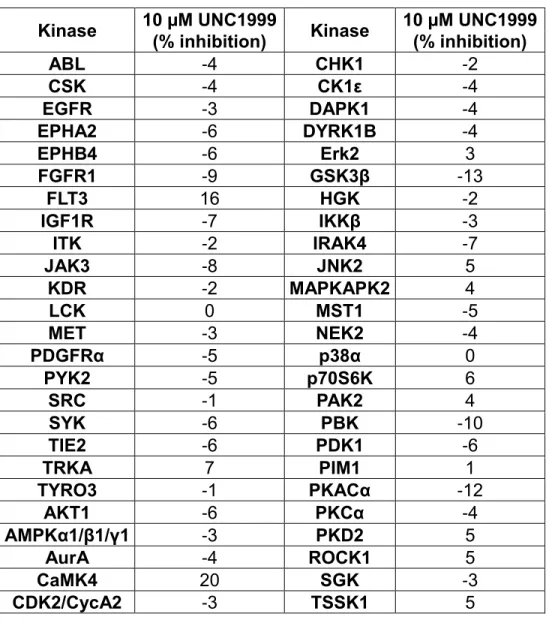
Table 2.2: Selectivity of UNC1999 versus representative kinase panel. ... 49
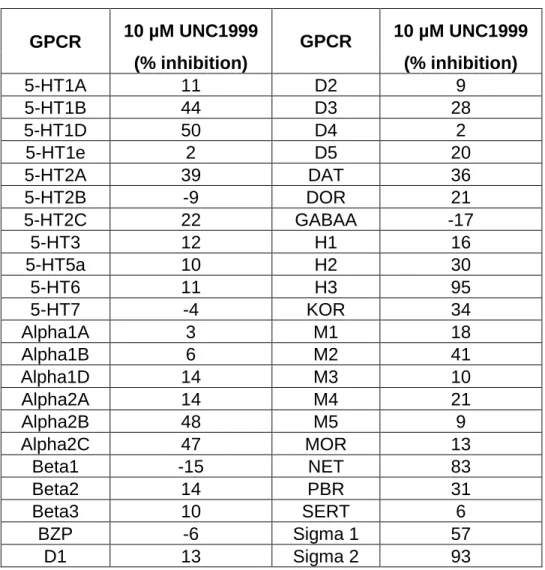
Table 2.3: Selectivity of UNC1999 versus NIMH PDSP panel. ... 50
Table 2.4: UNC1999 binding affinity and potency. ... 51
Table 3.1: N-methylated derivatives of UNC1999. ... 119
Table 3.2: UNC1999 activity in leukemic cell lines of differing genetic backgrounds. ... 120
Table 3.3: EZH2/EZH1 selectivity of GSK reported compounds and UNC1999. ... 121
Table 3.4: EZH2/EZH1 selectivity of UNC1999 analogs: exploration of C4 (R1) and C6 (R2) of pyridone. ... 122
Table 3.5: EZH2/EZH1 selectivity of UNC1999 analogs: exploration of C5 (R2) of pyridone. ... 123
Table 3.6: EZH2/EZH1 selectivity of UNC1999 analogs: exploration of C6 (R2) of pyridone. ... 124
Table 4.1: First generation of EZH2 irreversible inhibitors. ... 162
Table 4.2: Second generation of EZH2 irreversible inhibitors. ... 163
Table 5.1: Primer sequences for qPCR of G9a ChIP and chem-ChIP. ... 181
LIST OF FIGURES
Figure 1.1: Graphical representation of histones. ... 12
Figure 1.2: Phylogenetic tree of lysine methyltransferases. ... 13
Figure 2.1: EZH2 homology model: UNC1999 and EPZ005687 have similar modes of binding. ... 52
Figure 2.2: Characterization of UNC1999 and UNC2400 in biochemical assays. ... 54
Figure 2.3: Characterization of UNC1999 versus EZH2 mutants, EZH1, and other methyltransferases. ... 56
Figure 2.4: UNC1999 potently reduces H3K27me3 levels in cells and shows low cell toxicity. ... 57
Figure 2.5: UNC1999 selectively kills DB cells, a DLBCL cell line with the EZH2 Y641N mutation. ... 58
Figure 2.6: Biotinylated UNC1999 (UNC2399) enriches EZH2 from HEK293T cell lysates. ... 59
Figure 2.7: Live cell imaging with UNC1999-dye conjugate (UNC2239). ... 61
Figure 2.8: Pharmacokinetic profiles of UNC1999 in male swiss albino mice. ... 62
Figure 3.1: Activity of UNC1999 and UNC2400 in MLL-rearranged cells. ... 125
Figure 3.2: UNC1999 is more effective than GSK126 at suppressing H3K27me3 and inhibiting MLL-rearranged leukemic cell growth. ... 127
Figure 3.3: UNC1999 activity in leukemic cell lines... 128
Figure 3.4: UNC1999 derepresses PRC2 gene targets. ... 129
Figure 3.5: UNC1999 treatment prolongs survival of mice with MLL-AF9. ... 131
Figure 3.6: Location of pyridone substitutions of EZH1/EZH2 selectivity. ... 133
Figure 4.1: Rationale for EZH2 irreversible inhibitor design. ... 164
LIST OF ABBREVIATIONS
Ac acetylation
AEBP2 AE Binding Protein 2 AML acute myeloid leukemia
BM bone marrow
bp base pair
CDKN2a cyclin dependent kinase inhibitor 2a
chem-ChIP chemical inhibitor-based chromatin immunoprecipitation ChIP chromatin immunoprecipitation
Cmax maximum plasma concentration CML chronic myelogenous leukemia Co-IP co-immunoprecipitation
DLBCL diffuse large B-cell lymphoma DNA deoxyriboneucleic acid
EA ethyl acetate
EC50 concentration to achieve 50% of desired effect EED embryonic ectoderm development
EZH1 enhancer of zeste homolog 1 EZH2 enhancer of zeste homolog 2
GAPDH glyceraldehyde 3-phosphate dehydrogenase GFP green fluorescent protein
GLP G9a-like protein
GSK GlaxoSmithKline
h hours
H2A Histone 2A
H2B Histone 2B
H3 Histone 3
H3K27me3 trimethlyated histone 3 lysine 27 H3K4me3 trimethlyated histone 3 lysine 4 H3K9me2 dimethlyated histone 3 lysine 9
H4 Histone 4
HPLC high-performance liquid chromatography HSC hematopoietic stem cell
IC50 concentration to achieve 50% inhibition ICW in-cell western assay
IF immunofluorescence
IgG immunoglobulin G IP intraperitoneal IP immunoprecipitate
JARID2A Jumonji AT-rich interactive domain 2A
KO knockout
MD molecular dynamics
MDS myelodysplastic syndrome MEF mouse embryonic fibroblast
MLL Mixed Lineage Leukemia MPN myeloproliferative neoplasms
MS mass spectrometry
NET Norepinephrine transporter
NIMH National Institute of Mental Health PCL Polycomb-like
PDSP Psychoactive Drug Screening Panel PMF primary myelofibrosis
PO per os
PRC2 Polycomb Repressive Complex 2 PTM post-translational modification
qPCR quantitative polymerase chain reaction
RbAp48/46 retinoblastoma protein-associated protein 48 and 46 RBC red blood cell
RNA ribonucleic acid RNAi RNA interference
SAH S-Adenosyl homocysteine SAM S-Adenosyl methionine
SET Su(var)3-9 and enhancer of zeste
SP spleen
Suz12 suppressor of zeste 12
WBC white blood cell
WT wild-type
CHAPTER I: INTRODUCTION
Histone Lysine Methyltransferases
The eukaryotic genome is organized into 23 pairs of chromosomes, which are dense structures consisting of DNA and proteins. In order to package the entirety of the eukaryotic genome into an average 10 µm diameter cell, DNA and proteins are wrapped around histones for compaction. This DNA-protein
events [1]. Regions of high density, termed heterochromatin, are less accessible to transcriptional machinery, whereas regions that are not as compact, termed euchromatin, are more accessible, and correlate with more actively transcribed regions. Alterations in gene activity, which are not due to changes in the DNA sequence, are referred to as epigenetics (“above genetics”).
Modifications to histones are maintained via three main families of epigenetic proteins: “writers” (the enzymes responsible for producing post-translational modifications (PTMs)), “readers” (the proteins responsible for binding PTMs), and “erasers” (the enzymes responsible for removing PTMs). These proteins work in concert to dynamically regulate the chromatin landscape, controlling the temporal expression of genes in the process. One class of
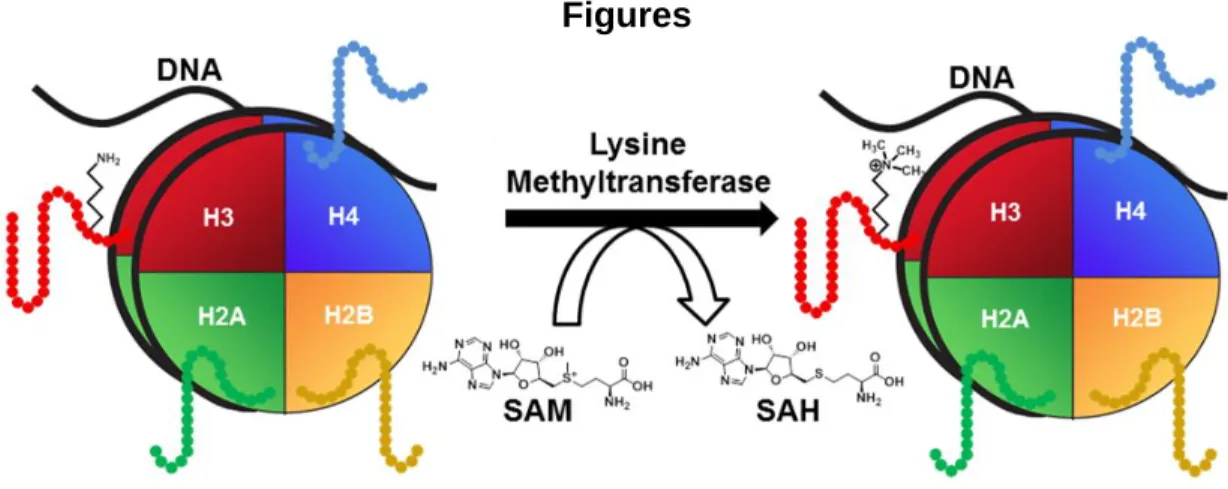
“writers” is protein lysine methyltransferases, which are capable of catalyzing mono-, di-, and/or trimethylation of lysine residues on histone and non-histone substrates. Most lysine methyltransferases (excluding DOT1L) catalyze the methylation of a given lysine residue by utilizing their Su(var)3-9 and enhancer of zeste (SET) domain, and the endogenous methyl donor S-Adenosyl methionine (SAM). The products of a methyl transfer from the sulfonium ion of SAM are S-Adenosyl homocysteine (SAH) and methylated lysine (Figure 1.1). Even a small chemical modification like the methylation of a lysine residue has a profound effect on transcriptional activity. For example, trimethylation of lysine 4 on histone H3 (H3K4me3) corresponds to regions of active transcription, whereas
active chromatin. Dysregulation of these processes often occurs in many
developmental diseases and maladies. Hypertrimethylation of H3K27 is present in many cancers, and usually correlates with a late-stage metastatic disease with poor prognosis. Although, lysine residues within each histone are structurally similar, specific enzymes are responsible for their maintenance.
Polycomb Repressive Complex 2
The methylation state of lysine residues on histone proteins is modulated by two classes of proteins: trithorax and polycomb proteins. Trithorax group proteins serve to maintain expression via methylation of specific lysines. For example, the Mixed Lineage Leukemia (MLL) (Figure 1.2, MLL-MLL4) proteins catalyze the mono-, di-, and/or trimethylation of H3K4. And H3K4me3 is
associated with the 5’ regions of nearly all actively transcribed genes. Further, H3K4me3 is highly correlated with histone acetylation, high rates of transcription, and polymerase II occupancy [2, 3]. In contrast to trithorax group proteins, polycomb group proteins function to repress gene expression. For example, Polycomb Repressive Complex 2 (PRC2) catalyzes the di- and trimethylation of H3K27, which leads to a repressive chromatin state, shutting down expression of genes upstream of H3K27me3 containing promoters.
48 and 46 (RbAp48/46). EZH1 or EZH2 are the catalytically active subunits, which utilize their evolutionarily conserved SET domain to methylate H3K27me1 or H3K27me2 to produce H3K27me2 or H3K27me3, respectively [4]. EED and RbAP46/48 contain repeats of the WD40 domain, which facilitates binding to H3K27me3 via the tryptophan (W) and aspartic acid (D) rich domains [5, 6]. Suz12 contains a zinc-finger domain necessary for DNA binding, and a VEFS domain necessary for interaction with EZH1 or EZH2; Suz12 is believed to function as a facilitator of DNA-binding for PRC2 [7, 8].
myeloma [17]. To further complicate matters, EZH2 has been described as both a tumor suppressor [18] and tumor promoter [16]. This paradox highlights the need for the development of chemical probes to study the mechanisms of EZH1 and EZH2 (EZH1/EZH2) catalytic activity.
Role of EZH2 and EZH1 in Disease Progression
Overexpression of EZH2 was first linked to the progression of prostate cancer merely twelve years ago [14]. Since that time, aberrations in both EZH2 expression and catalytic activity have been attributed to highly invasive cancers with poor prognosis. In solid tumors, overexpression of EZH2 leads to
hypertrimethylation of H3K27 and subsequent repression of genes encoding proteins important for cell cycle regulation, cell-cell contacts, and cell-matrix adhesions [23, 24]. In blood tumors, like MLL-rearranged leukemia, both EZH1 and EZH2 have been shown to contribute to disease progression.
MLL-rearranged leukemia result in aberrantly active proteins produced from
chromosomal translocations of MLL and a host of transcription factors (e.g., AF4, AF9, ENL, PTD) [25]. These translocations lead to unnecessary recruitment of machinery responsible for transcriptional elongation and increased expression of key leukemic genes Hoxa and Meis1 [26]. The MLL-AF9 fusion complex
Current Chemical Probes for EZH2
The identification of EZH2 overexpression in various human cancers has led the community to propose EZH2 as an attractive drug target for therapeutic intervention [25], and has inspired several pharmaceutical companies to
endeavor on high-throughput screening campaigns for inhibitors of EZH2.
Independent efforts by Epizyme, GlaxoSmithKline (GSK), and Novartis revealed a structurally similar, cofactor-competitive, small molecule, which potently
suppresses EZH2-catalyzed H3K27me3 [32-38]. These independent hits were then optimized via traditional medicinal chemistry to enhance the drug-likeness of these compounds.
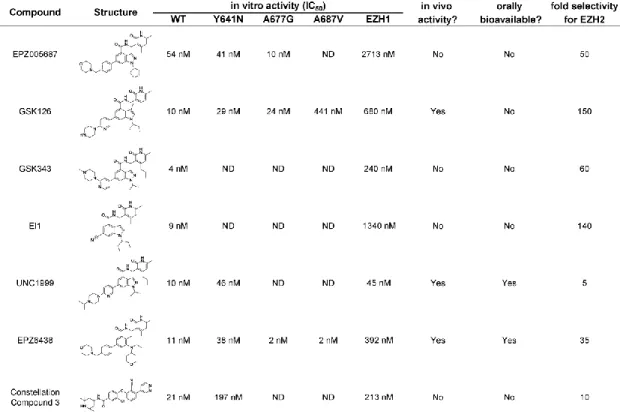
The first two published EZH2 inhibitors are EPZ005687 [33] and GSK126 [32] (Table 1.1), which potently inhibit wild type and lymphoma-associated gain-of-function EZH2 mutants. Additionally, both of these compounds are highly selective for EZH2 over a range of methyltransferases, kinases, and GPCRs. EPZ005687, from Epizyme, was not suitable for in vivo studies, but it was an essential tool compound for target validation and overall study of EZH2 biology. GSK126, from GSK, demonstrated in vivo potency via IP administration [32]. These compounds share very similar pharmacophoric features, and are fairly selective for EZH2 versus EZH1 (50-150 fold selectivity, Table 1.1),
1.1) is a compound that was optimized from a high-throughput screening
campaign hit at Novartis [34]. El1 has similar structural features and selectivity as EPZ005687 and GSK126, but did not display any in vivo activity. UNC1999 (Table 1.1) represents the first orally bioavailable inhibitor of EZH2, and is the most panactive EZH1/EZH2 inhibitor to date [35]. UNC1999 shares similarity in structure to GSK343, differing only in the substitution of the pyridine, and the capping group of the piperazine. However, this small modification has a large effect on the pharmacokinetic properties of the compound, and the EZH1/EZH2 selectivity. This EZH1/EZH2 panactivity poses a potential advantage for
UNC1999 in cancer cells that rely on both EZH isoforms, such as
MLL-rearranged leukemia [16, 39]. Shortly after the disclosure of UNC1999, Epizyme released an orally bioavailable derivative of EPZ005687: EPZ-6438 [36] (Table 1.1). Unlike previously published compounds that contain a bicyclic core, EPZ-6438 has a monocyclic phenyl core. The only non-pyridone containing inhibitor of EZH2 is Constellation Pharmaceuticals compound 3 (Table 1) [37]. This
compound is not suitable for in vivo studies, and shows about 10-fold selectivity for EZH2 versus EZH1. All of these inhibitors demonstrate high potency and high selectivity towards wild-type EZH2 and its lymphoma-associated mutant forms [32-38] (Table 1.1).
Summary and Significance
and leukemia. However, as a relatively nascent target in the field of drug
discovery, there is a lack of complete knowledge of PRC2 function, and this may present a barrier to success in the clinic. For example, it is well-received that EZH2 plays a role in the progression of prostate cancer, and that overexpression of EZH2 in this context correlates with late-stage, metastatic disease [14, 40]. Contrarily, EZH2 also appears to have a tumor suppressor role, because EZH2 deletion has been observed in the development of myelodysplastic syndrome (MDS) [18, 41]. This observation is compounded by the fact that both EZH2 and EZH1 are regulators of hematopoietic stem cell function [20, 42]. Even within the realm of what is known about PRC2, the effects of complexes containing either EZH2 or EZH1 are still confounding. Suffice to say; much more research is to be conducted on PRC2 biology before it can be certain that it is a viable therapeutic target.
Until recently, the main methods used to study the role of PRC2 were genetic knockouts (KOs) or RNA interference (RNAi) of PRC2 components. These methods have many disadvantages: embryonic lethality, loss of complex integrity, residual expression, and lack of translation to animal studies. Complete removal of a protein from a biological system often results in a different
levels. However, early chemical probes of EZH2 were not orally bioavailable [32, 44], complicating clinical translation, and current probes do not display as potent EZH1 inhibition, which can be beneficial in certain diseases [39]. The lack of a panactive EZH1/EZH2 inhibitor further highlights the need for the development of more advanced chemical probes.
Tables
Figures
Figure 1.1: Graphical representation of histones.
Figure 1.2: Phylogenetic tree of lysine methyltransferases.
CHAPTER II: UNC1999 IS AN ORALLY BIOAVAILABLE INHIBITOR OF THE LYSINE METHYLTRANSFERASE EZH2
Introduction
Due to the impact of chromatin modifications on genetic expression, epigenetic “writers” (the enzymes responsible for producing post-translational modifications (PTMs)), “readers” (the proteins responsible for binding PTMs), and “erasers” (the enzymes responsible for removing PTMs) have gained increasing interest as an important class of drug targets [45, 46]. One “writer” of specific interest is the lysine methlytransferase EZH2, which is the catalytic component of PRC2. PRC2 is responsible for the methylation status of H3K27; H3K27me3 correlates with regions of repressed expression, and the process of monitoring this methylation state often goes awry in many cancers. As such, EZH2 is an attractive target for potential therapeutic intervention.
Recent advances in EZH2 inhibitor development have been spearheaded by Epizyme, GSK and Novartis. Specifically, independent high-throughput
(Table 1.1). These inhibitors were very potent in in vitro and cellular assays, but only GSK126 displayed any in vivo activity, and none were orally bioavailable.
Herein, we report the design and development of UNC1999, the first orally bioavailable inhibitor of EZH2. In addition to optimizing the physicochemical properties of this class of EZH2 inhibitors, we also designed several compounds that serve as additional tools for studying EZH2 biology. UNC2400 is a
structurally similar, yet inactive, analog of UNC1999 that serves as a negative control. UNC2399 is a biotinylated derivative of UNC1999 that is capable of chemiprecipitating EZH2 from cell lysates. UNC2239 is a UNC1999 derivative that contains a cell penetrant dye capable of engaging EZH2 in cells. These four compounds together, help to validate our proposed binding hypothesis for
UNC1999, and also provide a useful chemical toolbox for the research community to accelerate further study of EZH2 biology.
Methods
Chemistry General Procedures
HPLC spectra for all compounds were acquired using an Agilent 6110 Series system with UV detector set to 254 nm. Samples were injected (5 µL) onto an Agilent Eclipse Plus 4.6 x 50 mm, 1.8 µM, C18 column at room temperature.
minutes with A being H2O + 0.1% acetic acid. The flow rate was 1.0 mL/min.
Mass spectra (MS) data were acquired in positive ion mode using an Agilent 6110 single quadrupole mass spectrometer with an electrospray ionization (ESI) source. Nuclear Magnetic Resonance (NMR) spectra were recorded using a Varian Mercury spectrometer with 400 MHz for proton (1H NMR) and 100 MHz for carbon (13C NMR); chemical shifts are reported in ppm (δ). Preparative HPLC was performed on Agilent Prep 1200 series with UV detector set to 254 nm. Samples were injected onto a Phenomenex Luna 75 x 30 mm, 5 µM, C18 column
at room temperature. The flow rate was 30 mL/min. A linear gradient was used with 10% (or 50%) of MeOH (A) and 0.1 % TFA in H2O (B) to 100% of MeOH (A).
Compound Synthesis
Scheme 2.1. Reagents and conditions: (a) K2CO3, NMP
(1-methyl-2-pyrrolidinone), 120°C, 50%; (b)
4,4,4',4',5,5,5',5'-octamethyl-2,2'-bi(1,3,2-dioxaborolane), KOAc, 1,4-dioxane, Pd(dppf)Cl2 · CH2Cl2, 80°C, 55%; (c) KOAc,
1,4-dioxane, H2O, Pd(dppf)Cl2 · CH2Cl2, reflux, 78%; (d) HCl (aq), rt, 95%; (e)
formaldehyde solution (37 wt.% in H2O) / acetaldehyde / acetone, NaBH3CN,
AcOH, MeOH, 0°C - rt, 48-86%; (f) bis(pinacolato)diboron, KOAc, Pd(dppf)Cl2 ·
CH2Cl2, 1,4-dioxane, 80°C, Ar; (g) 2-bromo-5-fluoropyridine, Pd(PPh3)4, K2CO3,
1,4-dioxane, H2O, 90°C, 61% (two steps); (h) K2CO3, (4-fluorophenyl)boronic
acid, Pd(PPh3)4, 1,4-dioxane, H2O, microwave, 150°C, 73%.
tert-Butyl
tert-butyl piperazine-1-carboxylate (29 g, 156 mmol), and potassium carbonate (22 g, 156 mmol) were mixed in NMP (50 mL) and heated to 120°C overnight. The mixture was then cooled to room temperature and diluted with water until precipitate was observed. The solid was collected by filtration, washed with water and dried under vacuum to give tert-butyl
bromopyridin-2-yl)piperazine-1-carboxylate as a white solid (9 g, 50% yield). tert-Butyl 4-(5-bromopyridin-2-yl)piperazine-1-carboxylate (5 g, 14.6 mmol), 4,4,4',4',5,5,5',5'-octamethyl-2,2'-bi(1,3,2-dioxaborolane) (4.46 g, 17.6 mmol), and potassium acetate (2.15 g, 22.0 mmol) were mixed with 1,4-dioxane (120 mL) in a flask. To this mixture, 1,1'-bis(diphenylphosphino)ferrocene-palladium(II)dichloride
dichloromethane complex (600 mg, 0.73 mmol) was added under argon
atmosphere at room temperature. The mixture was heated to 80°C for 5 h and cooled to room temperature. The resulting mixture was then diluted with EA and washed with water. The combined organic layers were dried over sodium sulfate. After concentration in vacuo, the crude product was purified by silica
chromatography (Hex/EA = 5/1) to afford the title compound as a white solid (3.2 g, 55% yield). 1H NMR (300 MHz, CDCl3), δ: 8.56 – 8.51 (m, 1H), 7.83 (dd, J =
8.6, 1.9 Hz, 1H), 6.59 (d, J = 8.5 Hz, 1H), 3.60 (dd, J = 6.6, 3.2 Hz, 4H), 3.52 (dd, J = 6.7, 3.2 Hz, 4H), 1.48 (s, 9H), 1.31 (s, 12H).
1-Isopropyl-N-((6-methyl-2-oxo-4-propyl-1,2-dihydropyridin-3-yl)methyl)-6-(6-(piperazin-1-yl)pyridin-3-yl)-1H-indazole-4-carboxamide (2.1). 6-Bromo-1-
isopropyl-N-((6-methyl-2-oxo-4-propyl-1,2-dihydropyridin-3-yl)methyl)-1H-indazole-4-carboxamide (1 g, 2.3 mmol), tert-butyl 4-(5-(4,4,5,5-tetramethyl-1,3,2- dioxaborolan-2-yl)pyridin-2-yl)piperazine-1-carboxylate (965 mg, 2.48 mmol), and potassium acetate (680 mg, 6.90 mmol) were mixed with 1,4-dioxane (20 mL) and water (5 mL). 1,1'-bis(diphenylphosphino)
ferrocene-palladium(II)dichloride dichloromethane complex (190 mg, 0.23 mmol) was added to the mixture under argon atmosphere at room temperature. The resulting mixture was heated to reflux for 5 h, then cooled and diluted with EA. The mixture was washed with water, dried over sodium sulfate and concentrated in vacuo. The crude product was purified by silica chromatography (DCM/MeOH = 40/1) to give tert-butyl
4-(5-(1-isopropyl-4-(((6-methyl-2-oxo-4-propyl-1,2- dihydropyridin-3-yl)methyl)carbamoyl)-1H-indazol-6-yl)pyridin-2-yl)piperazine-1-carboxylate as a white solid (1.1 g, 78% yield). This product was then dissolved in a saturated solution of HCl in EA. The mixture was stirred at room temperature overnight. The solvent was removed in vacuo to give the title compound 2.1 as a yellow solid (1 g, 95% yield). 1H NMR (400 MHz, d4-MeOH), δ: 8.49 (d, J = 2.3
1-Isopropyl-N-((6-methyl-2-oxo-4-propyl-1,2-dihydropyridin-3-yl)methyl)-6-(6-(4-methylpiperazin-1-yl)pyridin-3-yl)-1H-indazole-4-carboxamide (2.2). Compound 2.2 was prepared according to previously published procedures. [47]
6-(6-(4-Ethylpiperazin-1-yl)pyridin-3-yl)-1-isopropyl-N-((6-methyl-2-oxo-4-propyl-1,2-dihydropyridin-3-yl)methyl)-1H-indazole-4-carboxamide (2.3). Compound 2.1 (50 mg, 0.089 mmol), acetaldehyde (50 µL, 0.89 mmol) and acetic acid (~0.5 µL, 0.009 mmol) were mixed with MeOH (1 mL) at 0°C and then sodium cyanoborohydride (17 mg, 0.267 mmol) was added. The reaction was stirred at room temperature overnight and then purified by preparative HPLC (10% – 100% methanol / 0.1% TFA in H2O) to afford compound 2.3 as a white
solid (24 mg, 48% yield). 1H NMR (400 MHz, CDCl3), δ: 12.66 (s, 1H), 8.48 (d, J
= 2.5 Hz, 1H), 8.39 (s, 1H), 8.00 (t, J = 5.7 Hz, 1H), 7.76 (dd, J = 8.8, 2.6 Hz, 1H), 7.71 (d, J = 1.2 Hz, 1H), 7.58 (s, 1H), 6.67 (d, J = 8.8 Hz, 1H), 5.93 (s, 1H), 4.87 (dp, J = 13.1, 6.6 Hz, 1H), 4.67 (d, J = 5.8 Hz, 2H), 3.75 – 3.58 (m, 4H), 2.75 – 2.67 (m, 2H), 2.65 (s, 4H), 2.56 (dd, J = 14.2, 7.1 Hz, 2H), 2.16 (s, 3H), 1.65 (dd, J = 15.2, 7.5 Hz, 2H), 1.58 (d, J = 6.7 Hz, 6H), 1.18 (t, J = 7.2 Hz, 3H), 1.01 (t, J = 7.3 Hz, 3H).
1-Isopropyl-6-(6-(4-isopropylpiperazin-1-yl)pyridin-3-yl)-N-((6-methyl-2-oxo-4-propyl-1,2-dihydropyridin-3-yl)methyl)-1H-indazole-4-carboxamide
instead of acetaldehyde. This compound was obtained as a white solid (21 mg, 78%). 1H NMR (400 MHz, d4-MeOH), δ: 8.48 (d, J = 2.4 Hz, 1H), 8.36 (s, 1H),
7.91 (dd, J = 8.9, 2.6 Hz, 1H), 7.87 (s, 1H), 7.75 (d, J = 1.2 Hz, 1H), 6.81 (d, J = 8.9 Hz, 1H), 6.09 (s, 1H), 5.06 (dt, J = 13.3, 6.6 Hz, 1H), 4.58 (s, 2H), 3.61 – 3.46 (m, 4H), 2.70 (ddd, J = 13.1, 8.6, 6.3 Hz, 3H), 2.63 (dd, J = 11.2, 6.0 Hz, 4H), 2.23 (s, 3H), 1.63 (dt, J = 15.3, 7.5 Hz, 2H), 1.55 (d, J = 6.6 Hz, 6H), 1.09 (d, J = 6.5 Hz, 6H), 1.00 (t, J = 7.3 Hz, 3H).
6-(5-Fluoropyridin-2-yl)-1-isopropyl-N-((6-methyl-2-oxo-4-propyl-1,2-dihydropyridin-3-yl)methyl)-1H-indazole-4-carboxamide (2.5). 6-Bromo-1- isopropyl-N-((6-methyl-2-oxo-4-propyl-1,2-dihydropyridin-3-yl)methyl)-1H-indazole-4-carboxamide (50 mg, 0.112 mmol), bis(pinacolato)diboron (34 mg, 0.135 mmol), and potassium acetate (16.5 mg, 0.168 mmol) were mixed with 1,4-dioxane (1.25 mL) under argon atmosphere at room temperature. The mixture was added a catalytic amount of [1,1-bis(diphenylphosphino)
ferrocene]dichloropalladium(II) complex with dichloromethane (9.1 mg, 0.011 mmol), and heated to 80°C. After being stirred overnight, the resulting mixture was concentrated in vacuo, and used for the next step without further purification. To the solution of crude
1-isopropyl-N-((6-methyl-2-oxo-4-propyl-1,2- dihydropyridin-3-yl)methyl)-6-(4,4,5,5-tetramethyl-1,3,2-dioxaborolan-2-yl)-1H-indazole-4-carboxamide and 2-bromo-5-fluoropyridine (158 mg, 0.896 mmol) in 1,4-dioxane and water (1.25 mL/0.25 mL) was added
carbonate (46 mg, 0.336 mmol). After being stirred overnight at 90°C, the resulting mixture was purified by preparative HPLC (10% – 100% methanol / 0.1% TFA in H2O) to afford the title compound 2.5 as a white solid (32 mg, 61%
yield). 1H NMR (400 MHz, CDCl3), δ: 12.69 (s, 1H), 8.52 (d, J = 2.2 Hz, 1H), 8.44
(s, 1H), 8.22 (s, 1H), 8.07 (s, 1H), 7.94 (s, 1H), 7.85 (dd, J = 8.6, 4.1 Hz, 1H), 7.47 (td, J = 8.4, 2.3 Hz, 1H), 6.02 (s, 1H), 4.97 (dt, J = 13.2, 6.6 Hz, 1H), 4.69 (d, J = 3.8 Hz, 2H), 2.82 – 2.68 (m, 2H), 2.21 (s, 3H), 1.70 – 1.62 (m, 2H), 1.60 (d, J = 6.6 Hz, 6H), 1.02 (t, J = 7.3 Hz, 3H).
6-(4-Fluorophenyl)-1-isopropyl-N-((6-methyl-2-oxo-4-propyl-1,2-dihydropyridin-3-yl)methyl)-1H-indazole-4-carboxamide (2.6). To a
microwave vessel containing 6-bromo-1-isopropyl-N-((6-methyl-2-oxo-4-propyl-1,2-dihydropyridin-3-yl)methyl)-1H-indazole-4-carboxamide (50.6 mg, 0.112 mmol) was added potassium carbonate(46.4 mg, 0.336 mmol), (4-fluorophenyl) boronic acid (23.5 mg, 0.168 mmol), and tetrakis(triphenylphosphine)palladium (1.16 mg, 0.001 mmol). After adding 1 mL of dioxane:H2O (5:1), the vessel was
placed in a microwave reactor for 20 minutes at 150°C. The contents were separated using EA and brine, extracting 3 times with EA then dried using Na2SO4. The crude product was purified using HPLC and then concentrated in
vacuo to yield compound 2.6 (37.7 mg, 73%). 1H NMR (400 MHz, CDCl3), δ: 8.41
Scheme 2.2. Reagents and conditions: (a) DMF, K2CO3, CH3I, rt, 68%; (b)
DMF, NaH, CH3I, rt, 92%; (c) K2CO3, Pd(PPh3)4,
1-(5-(4,4,5,5-tetramethyl-1,3,2-dioxaborolan-2-yl)pyridin-2-yl)piperazine, 1,4-dioxane, H2O, microwave, 150°C;
(d) TFA, DCM, 88%; (e) acetone, MeOH, AcOH, NaBH3CN, 0°C - rt, 83%.
6-Bromo-N-((1,6-dimethyl-2-oxo-4-propyl-1,2-dihydropyridin-3-yl)methyl)-1-isopropyl-N-methyl-1H-indazole-4-carboxamide (2.7). 6-Bromo-1-isopropyl-N-
((6-methyl-2-oxo-4-propyl-1,2-dihydropyridin-3-yl)methyl)-1H-indazole-4-carboxamide (50.8 mg, 0.112 mmol), and potassium carbonate (102.4 mg, 0.741 mmol) were added to a 4 mL scintillation vial, and dissolved in DMF (0.5 mL). The resulting mixture was stirred at room temperature for 5 minutes before
room temperature for 5 minutes before adding iodomethane (10 µL). The resulting mixture was stirred at rt for 24 hours and purified by HPLC to yield the title compound (14.4 mg, 0.030 mmol, 92%). 1H NMR (the major rotamer is reported here) (400 MHz, CDCl3), δ: 7.93 (s, 1H), 7.64 (s, 1H), 7.25 (s, 1H), 6.12
(s, 1H), 4.85 (s, 2H), 4.81 – 4.66 (m, 1H), 3.59 (s, 3H), 2.93 (s, 3H), 2.70 (t, J = Hz, 2H), 2.38 (s, 3H), 1.76 – 1.46 (m, 8H), 1.01 (t, J = 7.3 Hz, 3H).
N-((1,6-Dimethyl-2-oxo-4-propyl-1,2-dihydropyridin-3-yl)methyl)-1-
isopropyl-6-(6-(4-isopropylpiperazin-1-yl)pyridin-3-yl)-N-methyl-1H-indazole-4-carboxamide (UNC2400 (2.8)). 6-Bromo-N-((1,6-dimethyl-2-oxo-4- propyl-1,2-dihydropyridin-3-yl)methyl)-1-isopropyl-N-methyl-1H-indazole-4-carboxamide (22.6 mg, 0.034 mmol) was added to a microwave vessel with tert-butyl 4-(5-(4,4,5,5-tetramethyl-1,3,2-dioxaborolan-2-yl)pyridin-2-yl)piperazine-1-carboxylate (27.9 mg, 0.112 mmol), potassium carbonate (23.2 mg, 0.168 mmol), and a catalytic amount of tetrakis(triphenylphosphine)palladium (1 mg, 0.001 mmol). The resulting mixture was dissolved in 1 mL of dioxane:H2O (5:1) and
placed in a microwave reactor at 150°C for 20 minutes. The resulting mixture was separated with EA and brine, extracted 3 times with EA, and purified by HPLC. The dried product was then dissolved in 1 mL TFA:EA (1:1), basified using NH3 (1 mL), and then concentrated in vacuo to yield
N-((1,6-dimethyl-2-
N-((1,6-Dimethyl-2-oxo-4-propyl-1,2-dihydropyridin-3-yl)methyl)-1-isopropyl-N-methyl-6-(6-(piperazin-1-yl)pyridin-3-yl)-1H-indazole-4-carboxamide (19.9 mg, 0.030 mmol) was added to a vial containing sodium cyanoborohydride (15 mg, 0.239 mmol) on ice, and dissolved in methanol (0.2 mL). Acetone (30 µL) and acetic acid (25 µL) were then added to the mixture, the vial was removed from ice and the reaction was run at room temperature overnight. The mixture was then purified using HPLC to yield the title compound (UNC2400 (2.8)) (14.9 mg, 0.025 mmol, 83%). 1H NMR (the major rotamer is reported here) (400 MHz, CDCl3), δ: 8.47 (s, 1H), 7.93 (s, 1H), 7.76 (d, J = 8.7 Hz, 1H), 7.50 (s, 1H), 7.32
(s, 1H), 6.73 (d, J = 8.8 Hz, 1H), 6.00 (s, 1H), 4.98 – 4.79 (m, 3H), 3.63 (s, 3H), 3.55 (s, 3H), 2.94 (s, 3H), 2.83 – 2.60 (m, 7H), 2.35 (s, 3H), 1.83 – 1.52 (m, 9H), 1.10 (d, J = 6.5 Hz, 6H), 1.02 (t, J = 7.2 Hz, 3H).
Scheme 2.3. Reagents and conditions: (a) hex-5-yn-1-yl 4-bromobenzenesulfonate, K2CO3, DMF, rt, 74%; (b) azide-dye, Cat.
Cu(CH3CN)4PF6, DCM, rt, 90%.
added 4-bromobenzenesulfonyl chloride (5.93g, 23.20 mmol) and DABCO (2.84 g, 25.30 mmol) at 0ºC. The resulting mixture was stirred for 2 hours at 0ºC. 15 mL of distilled water was added. The organic phase was collected, dried with sodium sulfate, filtered, concentrated and purified by silica gel chromatography (hexanes to 15% EA in hexanes) to afford hex-5-yn-1-yl
4-bromobenzenesulfonate (6.15 g, 92%). To a solution of compound 2.1 (56 mg, 0.10 mmol) and hex-5-yn-1-yl 4-bromobenzenesulfonate (44 mg, 0.14 mmol) in 1.0 mL of DMF was added potassium carbonate(41 mg, 0.30 mmol) at room temperature, and stirred overnight. After water (2 mL) was added, the mixture was extracted with EA (10 mL × 3). The combined organic phases were dried with sodium sulfate, filtered, concentrated and purified by preparative HPLC to give the title compound as a yellow solid (44 mg, 72%). 1H NMR (400 MHz, CDCl3), δ: 12.93 (s, 1H), 8.47 (dd, J = 2.5, 0.4 Hz, 1H), 8.39 (s, 1H), 8.01 (t, J =
5.7 Hz, 1H), 7.75 (dd, J = 8.8, 2.6 Hz, 1H), 7.71 (d, J = 1.3 Hz, 1H), 7.57 (s, 1H), 6.66 (d, J = 8.8 Hz, 1H), 5.92 (d, J = 0.6 Hz, 1H), 4.85 (dd, J = 13.3, 6.7 Hz, 1H), 4.66 (d, J = 5.7 Hz, 2H), 3.65 – 3.56 (m, 4H), 2.70 (dd, J = 8.5, 7.0 Hz, 2H), 2.63 – 2.51 (m, 4H), 2.48 – 2.38 (m, 2H), 2.23 (td, J = 6.9, 2.6 Hz, 2H), 2.15 (s, 3H), 1.96 (t, J = 2.6 Hz, 1H), 1.73 – 1.52 (m, 12H), 1.00 (t, J = 7.3 Hz, 3H).
yl)piperazin-1-yl)butyl)-1H-1,2,3-triazol-1-yl)ethyl)-2,4,6-
trioxotetrahydropyrimidin-5(2H)-ylidene)but-2-en-1-ylidene)-3,3-dimethylindoline-5-carboxylate (UNC2239 (2.10)). Cu(CH3CN)4PF6 (0.7 mg,
0.0018 mmol) was added to a solution of 6-(6-(4-(hex-5-yn-1-yl)piperazin-1- yl)pyridin-3-yl)-1-isopropyl-N-((6-methyl-2-oxo-4-propyl-1,2-dihydropyridin-3-yl)methyl)-1H-indazole-4-carboxamide (6.3 mg, 0.0104 mmol) and the azide-dye compound (5.9 mg, 0.0087 mmol) in DCM (1.0 mL); the mixture was stirred overnight at room temperature [48]. The resulting product was concentrated and purified by preparative HPLC to give the title compound (UNC2239 (2.10)) as a dark red solid (10.1 mg, 90%). 1H NMR (400 MHz, d4-MeOH), δ: 8.55 (s, 1H),
Scheme 2.4. Reagents and conditions: (a) O-[2-(biotinylamino)ethyl]-O’-(2-carboxyethyl)undecaethylene glycol, DMF, DIPEA, HATU, rt, 41%. (b) Biotin, DMF, DIPEA, HATU, rt, 78%.
1-isopropyl-N-((6-methyl-2-oxo-4-propyl-1,2-dihydropyridin-3-yl)methyl)-6-
(6-(4-(41-oxo-45-(2-oxohexahydro-1H-thieno[3,4-d]imidazol-4-yl)-
4,7,10,13,16,19,22,25,28,31,34,37-dodecaoxa-40-
azapentatetracontanoyl)piperazin-1-yl)pyridin-3-yl)-1H-indazole-4-carboxamide (UNC2399 (2.11)). Compound 2.1 (21.4 mg, 0.041 mmol) was added to a vial containing HATU (1-[bis(dimethylamino)methylene]-1H-1,2,3-triazolo[4,5-b]pyridinium 3-oxid hexafluorophosphate) (18.5 mg, 0.049 mmol) and O-[2-(biotinylamino)ethyl]-O’-(2-carboxyethyl)undecaethylene glycol. The two
8.40 (s, 1H), 8.10 (s, 1H), 7.80 (d, J = 1.3 Hz, 1H), 7.50 (d, J = 9.5 Hz, 1H), 6.18 (d, J = 0.7 Hz, 1H), 5.13 (tt, J = 13.4, 6.6 Hz, 2H), 4.61 (s, 2H), 4.49 (dd, J = 7.9, 4.2 Hz, 1H), 4.30 (dd, J = 7.9, 4.5 Hz, 1H), 3.97 – 3.78 (m, 9H), 3.67 – 3.55 (m, 33H), 3.52 (t, J = 5.5 Hz, 2H), 3.34 (t, J = 5.5 Hz, 2H), 3.19 (ddd, J = 8.9, 5.8, 4.6 Hz, 1H), 2.92 (dd, J = 12.8, 5.0 Hz, 1H), 2.79 – 2.67 (m, 5H), 2.28 (s, 3H), 2.20 (t, J = 7.4 Hz, 2H), 1.78 – 1.52 (m, 11H), 1.48 – 1.37 (m, 2H), 1.03 (t, J = 7.3 Hz,
3H).
1-isopropyl-N-((6-methyl-2-oxo-4-propyl-1,2-dihydropyridin-3-yl)methyl)-6- (6-(4-(5-(2-oxohexahydro-1H-thieno[3,4-d]imidazol-4-yl)pentanoyl)piperazin-1-yl)pyridin-3-yl)-1H-indazole-4-carboxamide (UNC2398 (2.12)). The
procedure for UNC2398 is the same as UNC2399 except that biotin was used instead of O-[2-(biotinylamino)ethyl]-O’-(2-carboxyethyl)undecaethylene glycol to give UNC2398 in 78% yield.
EZH2 Homology Modeling
An EZH2 homology model was built using the X-ray crystal structure of the lysine methyltransferase GLP (PDB: 2RFI) as a template. 3D conformation of EPZ005687 or UNC1999 was constructed and docked into the EZH2 homology model. A subsequent induced-fit minimization was conducted to further optimize the complex. The ligand interaction diagram was drawn with Maestro 9.3
Scintillation Proximity Assay
Methyltransferase activity assays were performed by monitoring the incorporation of a tritium-labeled methyl group from S-adenosylmethionine (3 H-SAM) to biotinylated peptide substrates using Scintillation Proximity Assay (SPA) for PRC2 trimeric complex (EZH2:EED:SUZ12), SETD7, G9a, GLP, SETDB1, SETD8, SUV420H1, SUV420H2, SUV39H2, MLL1 tetrameric complex
(MLL:WDR5:RbBP5:ASH2L), PRMT1, PRMT3, PRMT5-MEP50 complex and SMYD2. The reaction buffer for SMYD2 and SMYD3 was 50 mM Tris pH 9.0, 5 mM DTT, 0.01% Triton X-100; for G9a, GLP and SUV39H2 was 25 mM
potassium phosphate pH 8.0, 1 mM EDTA, 2 mM MgCl2 and 0.01% Triton X-100; and for other HMTs 20 mM Tris pH 8.0, 5 mM DTT, 0.01% Triton X-100. To stop the enzymatic reactions, 10 µL of 7.5 M guanidine hydrochloride was added, followed by 180 µL of buffer, mixed and transferred to a 96-well FlashPlate (Cat. # SMP103; Perkin Elmer; www.perkinelmer.com). After mixing, the reaction mixtures were incubated and the CPM counts were measured using a Topcount plate reader (Perkin Elmer, www.perkinelmer.com). The CPM counts in the absence of compound for each data set were defined as 100% activity. In the absence of the enzyme, the CPM counts in each data set were defined as background (0%). IC50 values were determined using compound concentrations
ranging from 100 nM to 100 µM. The IC50 values were determined using
SigmaPlot software. For DNMT1, the assay was performed as described above using hemi-methylated dsDNA as a substrate. The dsDNA substrate was
strand: B-GAGCCCGTAAGCCCGTTCAGGTCG and reverse strand:
CGACCTGAACGGGCTTACGGGCTC), synthesized by Eurofins MWG Operon. Reaction buffer was 20 mM Tris-HCl, pH 8.0, 5 mM DTT, 0.01% Triton X-100. Methyltransferase activity assays for DOT1L were performed using filter-plates (Millipore; cat.# MSFBN6B10; www.millipore.com). Reaction mixtures in 20 mM Tris-HCl, pH 8.0, 5 mM DTT, 2 mM MgCl2, and 0.01% Triton X-100 were
incubated at room temperature for 1h, 100 µL 10% TCA was added, mixed and transferred to filter-plate. Plates were centrifuged at 2000 rpm for 2 min followed by 2 additional 10% TCA wash and one ethanol wash (180 µL) followed by centrifugation. Plates were dried and 100 µL MicroO was added and centrifuged. 70 µL MicroO was added and CPM were measured using Topcount plate reader.
UNC1999 Mechanism of Action Studies
To determine the mechanism of action of UNC1999, methyltransferase activity of PRC2-EZH2 was assessed in the presence of different concentrations of the compound (0, 1, 3 and 5 nM) at (1) fixed concentration of peptide (5 µM) and SAM concentrations from 0.625 to 10 µM and (2) fixed concentration of SAM (10 µM) and peptide concentrations from 0.3 to 5 µM. Assays were performed in triplicate, and kinetic values were obtained using Lineweaver-Burk plots
In-cell Western Assay
MCF10A cells were grown in DMEM/F12 media 5% horse serum, EGF (20 ng/mL), hydrocortisone (0.5 µg/mL), cholera toxin (100 ng/mL), and insulin (10 µg/ml) in the presence of inhibitors as stated in the figures. MCF7 cells were cultured in DMEM supplemented with 10% FBS. Fixation in 96 well black wall clear bottom plates was performed by 2% formaldehyde in PBS for 10 min. After five washes with 0.1% Triton X-100 in PBS, cells were blocked for 1 h RT, or overnight at 4°C with 3% BSA, 5% goat serum in PBS. Three replicate wells from each experimental group were incubated in primary H3K27me3 antibody,
Diagenode MAb-181-050 at 1/4000 dilution in 3% BSA, 5% goat serum PBS for 18 h at 4°C. The wells were washed five times with 0.1% Tween-20 in PBS, then secondary IR800 conjugated antibody (Li-Cor) in Li-Cor blocking buffer (1:1000) and nucleic acid-intercalating dye, DRAQ5 (Cell Signaling Technologies) added for 1 h RT. After 5 washes with 0.1% Tween-20 PBS, the plates were read on an Odyssey (LiCor) scanner at 800 nm (H3K27me3 signal) and 700 nm (DRAQ5 signal). Fluorescence intensity was quantified, normalized to the background, then to the DRAQ5 signal, and expressed as a percentage of control.
Cell Viability Assay
Cell viability assays were performed using 0.1 mg/mL of resazurin (Sigma) in the media. Resazurin reduction was monitored with 544 nm excitation,
Kinase and GPCR studies
Selectivity against a panel of 50 representative kinases and 46
representative GPCRs was carried out by PDSP according to their standard protocols.
Pharmacokinetic Studies
These studies were conducted at Sai Life Sciences according to their standard protocols. 15, 50, and 150 mg/kg IP as well as 50 mg/kg PO PK studies were performed in male Swiss albino mice (9 per dosing regimen). Each study lasted 24 hours, plasma concentrations of UNC1999 were obtained at .08, .25, .5, 1, 2, 4, 8, and 24 hr post-dosing.
EZH2 Y641N Biochemical Assay
EZH2 Y641N mutants were generated and assayed by BPS Bioscience. A series of dilutions of UNC1999 were prepared with 10% DMSO in HMT assay buffer (BPS #52170) and 5 µL of the dilution was added to a 50 µL reaction so that the final concentration of DMSO is 1% in all of reactions. All of the enzymatic reactions were conducted in duplicate at room temperature for 60 minutes
and slowly shaken with Blocking Buffer (BPS #52100) for 10 minutes. Wells were emptied, and 100 µL of diluted 1° antibody (BPS #52140F) was added. The plate was then slowly shaken for 60 minutes at room temperature. As before, the plate was emptied and washed three times, and shaken with Blocking Buffer for 10 minutes at room temperature. After discarding the Blocking Buffer, 100 µL of diluted 2° antibody (BPS #52131H) was added. The plate was then slowly shaken for 30 minutes at room temperature. As before, the plate was emptied and washed three times, and shaken with Blocking Buffer for 10 minutes at room temperature. Blocking Buffer was discarded and a mixture of the HRP
chemiluminescent substrate was freshly prepared. 100 µL of this mixture was added to each empty well. Immediately, the luminescence of the samples was measured in a BioTek SynergyTM 2 microplate reader.
DB Cell Proliferation Assay
DB cells, a diffuse-large B-cell lymphoma cell line harboring the EZH2 Y641N mutation [49, 50] were obtained from ATCC and cultured in RPMI 1640 supplemented with 10% fetal bovine serum, antibiotics, and various
antibodies. Antibodies used in this study are those against EZH2 (BD bioscience 612666), general H3 (Abcam ab1791), and H3K27me3 (Abcam ab6002).
Results
Discovery of UNC1999
Homology modeling of EZH2 based on the X-ray crystal structure of GLP (PDB: 2RFI), an H3K9 methyltransferase, was performed in order to establish a binding hypothesis for pyridone-containing EZH2 inhibitors. Docking of
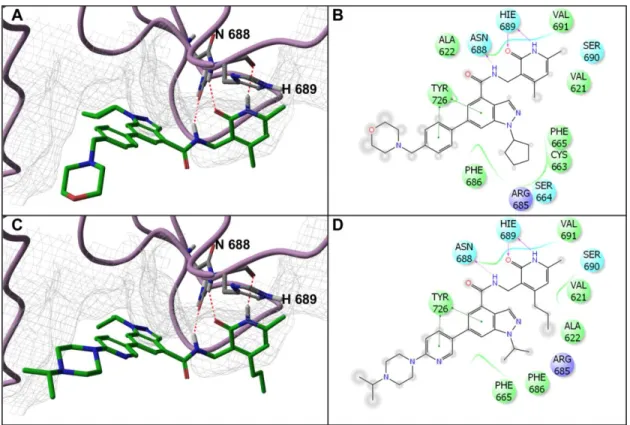
EPZ005687 into the homology model identified a low energy conformation demonstrating that the terminal morpholine group was solvent exposed, and did not appear to make contacts with the EZH2 protein surface (figure 2.1 A & B). Other interesting interactions were observed; a hydrogen bonding network present between the central amide and pyridone of EPZ005687, and asparagine 688 and histidine 689 of EZH2 (figure 2.1 A & B). On the basis of our binding hypothesis, and knowledge of key structural features of GSK126 and EPZ005687 that lead to EZH2 inhibition, we designed several compounds with the aim of endowing oral bioavailability.
We focused on modifying the morpholinomethyl region of EPZ005687 to modulate the physicochemical properties of this series, which resulted in the design and synthesis of the compounds in Table 2.1. These changes were
with the protein. Among the compounds from Table 2.1, UNC1999 was docked into the homology model, and like EPZ005687, the docking model of UNC1999 suggests that: (1) the secondary amide, and pyridone, maintain the respective key hydrogen bonds with N688 and H689, (2) the indazole core is buried in a hydrophobic pocket, and (3) the N-isopropyl piperazine does not interact with the protein (Figure 2.1 C & D).
The compounds in Table 2.1 were evaluated in an EZH2 radioactive biochemical assay which measures the direct transfer of the tritiated methyl group from the cofactor 3H – SAM to a peptide substrate. IC50 values of these compounds in this assay, and their calculated partition coefficient (clogP) values, are summarized in Table 2.1. As expected, the unsubstituted and N-alkyl
piperazines had high in vitro potency for EZH2 (IC50 < 10 nM), which indicated
that modifications to the N-capping group are well tolerated. These in vitro results support our binding hypothesis: the N-alkyl piperazine does not interact with the protein. Among these four inhibitors, UNC1999 has the most desirable clogP (3.1), suggesting that this inhibitor may be well absorbed orally. In addition, UNC1999 has a more desirable clogP than either EPZ005687 (2.2) or GSK126 (2.6). Interestingly, replacing the 2-piperazinyl pyridin-5-yl moiety with the 3-fluoro pyridin-6-yl group retained high in vitro potency (IC50 = 10 ± 1 nM (n = 3)), but replacing the 3-fluoro pyridin-6-yl group with the 4-fluorophenyl group led to a 6-fold loss in potency. Based on these results, we selected UNC1999 for
Discovery of UNC2400
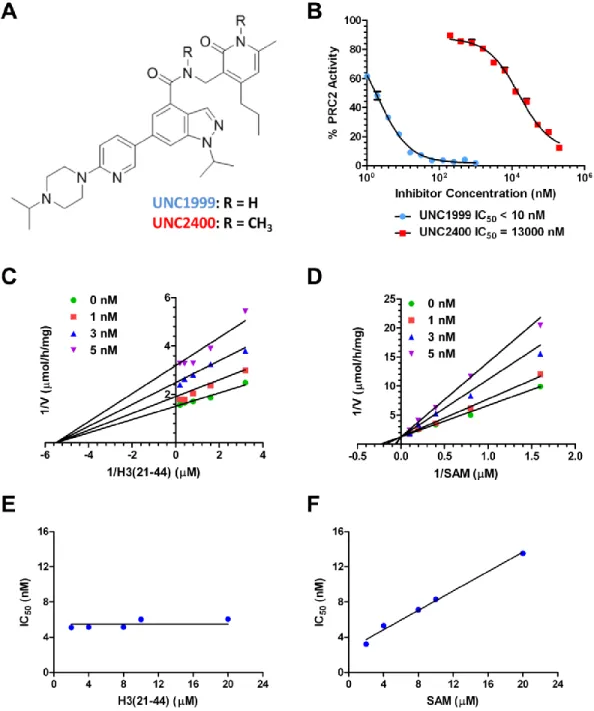
To provide the research community with a set of useful tools, we aimed to create a structurally similar, but significantly less potent, EZH2 inhibitor as a negative control for in vitro and cell-based studies. The UNC1999 docking model suggests that the secondary amide and pyridone form key hydrogen bonds with N688 and H689 (Figure 2.1 C & D). So, we designed and synthesized UNC2400 (Figure 2.2 A), which contains an N-methyl group at both the secondary amide and pyridone moieties of UNC1999. We hypothesized that the addition of these two N-methyl groups would abolish the hydrogen bonds between the secondary amide and pyridone of UNC1999 with N688 and H689 of EZH2, respectively. Indeed, UNC2400 displayed an IC50 = 13,000 ± 3,000 nM (n = 3) in the EZH2 radioactive biochemical assay (Figure 2.2 B), which is more than 1000-fold less potent than UNC1999, thus supporting our in silico binding hypothesis for UNC1999. Importantly, UNC2400 was also inactive in a number of cell-based studies (see below). The high structural similarity and drastic potency difference between UNC1999 and UNC2400 suggest they will be excellent positive and negative control tool compounds.
UNC1999 Is a SAM-competitive, Potent, and Selective Inhibitor of EZH2 and EZH1
non-competitive with the H3 peptide substrate. We also determined that increasing the H3 peptide concentration had no effect on the IC50 values of UNC1999 (Figure 2.2 E) while increasing SAM concentration dramatically affected the IC50 values of UNC1999 (Figure 2.2 F), which further supports that UNC1999 is a SAM-competitive EZH2 inhibitor.
We next determined the potency of UNC1999 against EZH2 Y641
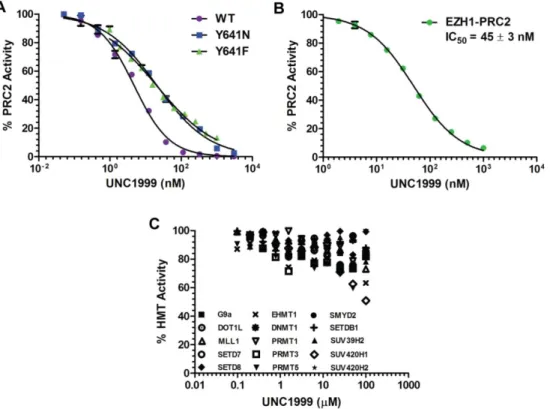
mutants. UNC1999 was highly potent for Y641N and Y641F mutants (Figure 2.3 A, blue and green, respectively), displaying less than 5-fold more potent inhibition for the WT over the Y641N (IC50 = 24 nM) and Y641F (IC50 = 23 nM) mutant enzymes. This data is consistent with other pyridone containing EZH2 inhibitors to date [32, 34, 44]. To further determine the selectivity profile of UNC1999, we first tested UNC1999 against EZH1. Compared with EPZ005687, GSK126 and El1, which are at least 50-fold selective for EZH2 over EZH1, [32, 34, 44] UNC1999 had a higher in vitro potency for EZH1 (IC50 = 45 ± 3 nM; n = 3) (Figure 2.3 B); about 10-fold less potent for EZH1 than EZH2. UNC1999 is also very selective for EZH2 versus 15 other lysine, arginine or DNA
methyltransferases (Figure 2.3 C) assayed; 10,000-fold selective for EZH2 (IC50 < 10 nM) over these methyltransferases (IC50 > 100,000 nM).
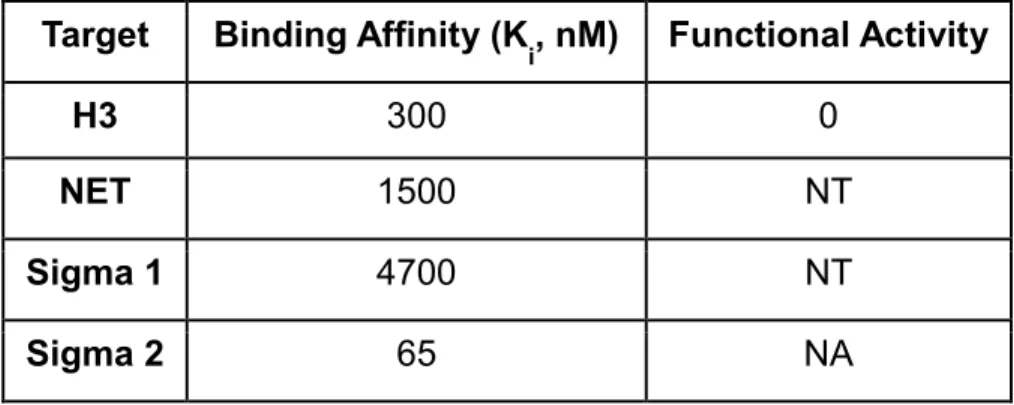
moiety, which is a potential pharmacophore for aminergic G protein-coupled receptor (GPCR) binding, so we tested it in the National Institute of Mental Health (NIMH) Psychoactive Drug Screen Program (PDSP) Selectivity Panel. This panel consists of 44 representative GPCRs, transporters, and ion channels (Table 2.3); UNC1999 was found to show no more than 50% inhibition at concentrations as high as 10,000 nM against 40 targets, and > 50% inhibition at 10,000 nM against 4 targets in the panel. Ki determinations in the radioligand binding assay for each of the 4 interacting targets was subsequently performed (Table 2.4). UNC1999 had Ki values of 4,700 nM, 65 nM, 300 nM, and 1,500 nM for sigma1, sigma2, histamine H3, and NET (norepinephrine transporter), respectively. Although we could not evaluate UNC1999 in sigma2 functional assays, because they do not exist, we tested UNC1999 in histamine H3 functional assays and found that it did not display any agonist or antagonist activities at concentrations up to 1,000 nM. Therefore, with the exception of sigma2, UNC1999 was more than 200-fold selective for EZH2 over a broad range of kinases, GPCRs, transporters, and ion channels.
UNC1999 Potently Reduces H3K27me3 in Cells and Selectively Kills EZH2-mutant DLBCL Cells
To assess the cellular potency of UNC1999, we employed an H3K27me3 antibody cell immunofluorescence In-Cell Western (ICW) assay. This assay allows for rapid processing of multiple samples for H3K27me3
nucleic acid dye, DRAQ5. We characterized UNC1999 and UNC2400 in MCF10A cells, which bear the WT EZH2 enzyme. UNC1999 (72 h exposure) exhibited concentration-dependent reductions in H3K27me3 with an IC50 of 124 ± 11 nM (n = 3) (Figure 2.4 A, blue dots). On the other hand, UNC2400 (negative control) showed little or no activity in this ICW assay (Figure 2.4 B, red dots), which is consistent with its poor in vitro potency. In addition, the treatment of MCF7 cells with UNC1999 at 5,000 nM for 72 h almost completely removed the H3K27me3 mark but did not have significant effects on cellular levels of EZH2 (Figure 2.4 C).
One of the most desirable characteristics of a high quality chemical probe is low toxicity due to off-target effects. Both UNC1999 (EC50 = 19,200 ± 1,200 nM; n = 3) and UNC2400 (EC50 = 27,500 ± 1,300; n = 3) had low cellular toxicity in a standard resazurin (Alamar Blue) reduction assay (Figure 2.4 A & B). Taken together, UNC1999 had an excellent separation of cellular potency and toxicity with a function/toxicity ratio of more than 150 (Figure 2.4 A, blue vs grey dots). We next investigated whether DB cells, a DLBCL cell line harboring the EZH2 Y641N mutant [49, 50], are more sensitive to UNC1999 treatment.
UNC1999 (8 day exposure) displayed robust, concentration-dependent inhibition of cell proliferation (EC50 = 633 ± 101 nM; n = 3) (Figure 2.5 A), which is slightly more potent than GSK126 [32]. At 5,000 nM, UNC1999 (8 day exposure)
(Figure 2.5 A) as was also seen with EPZ005687 and GSK126 [32, 44]. We also compared the effects of the negative control UNC2400 on cell proliferation to UNC1999. UNC1999 (3,000 nM, 8 day treatment) significantly inhibited DB cell proliferation, while UNC2400 (3,000 nM, 8 day treatment) had negligible effects (Figure 2.5 B, blue bar vs red bar). Furthermore, UNC1999 (3,000 nM, 3 day treatment) significantly reduced the H3K27me3 mark but did not significantly change EZH2 levels in DB cells (Figure 2.5 C, well 2). On the other hand, treatment with UNC2400 at 3,000 nM for 3 days did not result in a significant reduction in the H3K27me3 mark, nor EZH2 levels in DB cells (Figure 2.5 C, well 3). Combining the observed low toxicity in MCF10A cells and high sensitivity in DB cells, we provide evidence that UNC1999 selectively kills DLBCL cells heterozygous for Y641 point mutations. In addition, we showed that UNC1999 has robust on-target activities in cells and UNC2400 is an excellent negative control for cell-based studies.
Discovery of UNC2399 and UNC2239
Our UNC1999 binding hypothesis predicts that the N-terminal nitrogen of the piperazine of UNC1999 is solvent exposed. To test this possibility, and create functionalized chemical tools, we appended both a PEG-biotin group (UNC2399) and a cell permeable dye (UNC2239) to the terminal piperazine nitrogen of UNC1999.
O-[2-(biotinylamino)ethyl]-O’-(2-carboxyethyl)undecaethylene glycol (Scheme 2.4), which yielded a 12 PEG linker between the UNC1999 moiety, and biotin handle (Figure 2.6 A). We implemented a lengthy linker to ensure that the biotin handle would be sufficiently solvent exposed for capture by streptavidin-coated beads. Indeed, UNC2399 displayed high in vitro potency (IC50 = 17 ± 2 nM; n = 3) in the EZH2 radioactive
biochemical assay (Figure 2.6 B), which provides further evidence for our in silico binding hypothesis of UNC1999.
To perform EZH2 chemiprecipitation, we first conjugated UNC2399 to streptavidin-coated beads. The compound-conjugated beads were used to capture EZH2 protein from HEK293T (human embryonic kidney 293T) cell lysates. We were pleased to find that UNC2399 – streptavidin conjugated beads (Figure 2.6 C, well 3) enriched EZH2 from cell lysates as compared to
unconjugated streptavidin beads (DMSO control, Figure 2.6 C, well 2). To control for non-specific interactions, we pretreated the cell lysates with a soluble
competitor, UNC1999 or UNC2400, before pull-down. As expected, pretreatment of lysate with UNC1999 (100 µM) antagonized the enrichment of EZH2 by
UNC2399 – streptavidin beads (Figure 2.6 C, well 4 versus well 3). On the other hand, pretreatment with UNC2400 (100 µM) resulted in EZH2 levels nearly identical to the untreated lysates (Figure 2.6 C, well 5 versus well 3). It is important to note that a direct conjugation of biotin to the free piperazine of
chemiprecipitate EZH2 (Figure 2.6 F), so a linker is imperative for efficient chemiprecipitation of EZH2.
Next, we synthesized UNC2239 (Figure 2.7 A) by utilizing click chemistry between a UNC1999 analog containing a terminal alkyne (compound 2.9) and a membrane permeable merocyanine dye with an azide side chain (Scheme 2.3). As expected, UNC2239 displayed high in vitro potency (IC50 = 21 ± 1 nM; n = 3) in the EZH2 radioactive biochemical assay, despite the addition of the
fluorophore (Figure 2.7 B). Mouse embryonic fibroblast (MEF) cells stably expressing yellow fluorescent protein (YFP) were treated with the fluorescent EZH2 probe UNC2239 or with only the dye component of the probe as a control (Figure 2.7 C). The dye is known to distribute uniformly in MEF cells without evidence of any compartmental or organelle specific interactions. YFP serves as a uniformly distributed volume control fluorophore. When examining the
localization of the probe, the ratio of dye intensity to YFP intensity was
normalized for effects arising from varying cell thickness and uneven illumination intensity. Because the concentration of the probe and YFP varied from cell-to-cell, ratio images were normalized by setting the lowest 5% of pixels within each cell equal to 1. Cells treated with UNC2239 showed significantly higher
of GFP – tagged EZH2 as seen in transfected HEK 293 cells (Figure 2.7 D), suggesting that UNC2239 co-localizes with EZH2.
UNC1999 Is Orally Bioavailable in Mice
We next evaluated the in vivo PK properties of UNC1999. A single intraperitoneal (IP) injection of UNC1999 at 15, 50, or 150 mg/kg achieved high Cmax (9,700 – 11,800 nM) and exhibited dose linearity in male Swiss albino mice (Figure 2.8 A). Both the 150 and 50 mg/kg IP doses resulted in plasma concentrations of UNC1999 above its cellular IC50 over the entire 24 h period, and the 15 mg/kg IP dose led to the plasma concentrations of UNC1999 above its cellular IC50 for approximately 12 h. We next examined whether UNC1999 is orally bioavailable and were pleased to find that a single 50 mg/kg oral dose of UNC1999 achieved high Cmax (4,700 nM) and good exposure levels in male Swiss albino mice (Figure 2.8 B). The plasma concentrations of UNC1999 were maintained above its cellular IC50 for approximately 20 h following this single oral dose. It is worth noting that all doses including the 150 mg/kg IP dose were well tolerated by all test mice, and no adverse effects were observed.
Discussion
community as a set of chemical tools that will help accelerate our understanding of PRC2 function, and how this function becomes dysregulated in cancers and developmental diseases.
In addition to our chemical probe UNC1999, we discovered UNC2400, a structurally similar analog that is almost completely inactive in both in vitro and cellular assays. The use of this compound provided evidence for the presence of our hypothesized hydrogen bonding network between the pyridone and acyclic amides of UNC1999, and N688 and H689 of EZH2. Further, the fact that
UNC2400 and UNC1999 display low, yet nearly equal, cytotoxicity in cell viability assays, demonstrates that potential toxicity of pyridone containing compounds is most likely not due to inhibition of EZH2. This data is exciting, as it provides a positive prognosis for the development of EZH2 inhibitors as therapeutics going forward.
Our UNC1999 binding hypothesis also predicted the N-terminal piperazine to be solvent exposed, which provided a useful handle to functionalize this site. First, PEG-biotinylation led to the discovery of UNC2399. UNC2399 selectively chemiprecipitates EZH2 from cell lysates, which is especially useful for
complexes like PRC2. While the core components of PRC2 (EZH2 or EZH1, SUZ12 and EED) are always present, many other proteins (DNMT1, JARID2A, etc) which possess strictly different functions are present in a cell- and
developmental-specific context. So, a small molecule capable of
The chemoproteomics applications of UNC2399 are very promising, and will surely play a role in the understanding of PRC2 function in malignant
transformation. We also developed UNC2239, which contains a cell penetrant dye conjugated to the piperazine of UNC1999. This compound will have many applications going forward, one of which is to provide an alternative to traditional immunofluorescence (IF). A cell permeable compound which engages and identifies the target is more advantageous than traditional antibody-based immunofluorescence for intracellular targets, which involves permeation of the membrane.
UNC1999 is also the most active inhibitor of EZH1 to date, which may have potential benefit in treating specific cancers [16]. The exact reasoning for this selectivity switch between the scaffolds is unfounded, as the key interactions between UNC1999 and EPZ005687 and EZH1/EZH2 appear identical in
homology models that were constructed. It is possible that this change in selectivity may be due to issues beyond direct ligand – protein interactions; UNC1999 may affect how EZH1/EZH2 interacts with other PRC2 components, but this is purely speculation. The dual inhibition of EZH2 and EZH1 by UNC1999 might result in higher efficacy in cell-based and animal models where the
methylation of H3K27 by PRC2-EZH2 is compensated by PRC2-EZH1, but in the very least provides another avenue for exploration in the nascent field of PRC2 small molecule drug discovery.
Tables
Table 2.1: in vitro activity of EZH2 inhibitors.
a
IC50 determination experiments were performed in triplicate. b The IC50 limit of
Kinase 10 µM UNC1999 Kinase 10 µM UNC1999 (% inhibition) (% inhibition)
ABL -4 CHK1 -2
CSK -4 CK1ε -4
EGFR -3 DAPK1 -4
EPHA2 -6 DYRK1B -4
EPHB4 -6 Erk2 3
FGFR1 -9 GSK3β -13
FLT3 16 HGK -2
IGF1R -7 IKKβ -3
ITK -2 IRAK4 -7
JAK3 -8 JNK2 5
KDR -2 MAPKAPK2 4
LCK 0 MST1 -5
MET -3 NEK2 -4
PDGFRα -5 p38α 0
PYK2 -5 p70S6K 6
SRC -1 PAK2 4
SYK -6 PBK -10
TIE2 -6 PDK1 -6
TRKA 7 PIM1 1
TYRO3 -1 PKACα -12
AKT1 -6 PKCα -4
AMPKα1/β1/γ1 -3 PKD2 5
AurA -4 ROCK1 5
CaMK4 20 SGK -3
CDK2/CycA2 -3 TSSK1 5
GPCR 10 µM UNC1999 GPCR 10 µM UNC1999 (% inhibition) (% inhibition)
5-HT1A 11 D2 9
5-HT1B 44 D3 28
5-HT1D 50 D4 2
5-HT1e 2 D5 20
5-HT2A 39 DAT 36
5-HT2B -9 DOR 21
5-HT2C 22 GABAA -17
5-HT3 12 H1 16
5-HT5a 10 H2 30
5-HT6 11 H3 95
5-HT7 -4 KOR 34
Alpha1A 3 M1 18
Alpha1B 6 M2 41
Alpha1D 14 M3 10
Alpha2A 14 M4 21
Alpha2B 48 M5 9
Alpha2C 47 MOR 13
Beta1 -15 NET 83
Beta2 14 PBR 31
Beta3 10 SERT 6
BZP -6 Sigma 1 57
D1 13 Sigma 2 93
Target Binding Affinity (K
i, nM) Functional Activity
H3 300 0
NET 1500 NT
Sigma 1 4700 NT
Sigma 2 65 NA
Table 2.4: UNC1999 binding affinity and potency.
Figures
Figure 2.1: EZH2 homology model: UNC1999 and EPZ005687 have similar modes of binding.
Figure 2.2: Characterization of UNC1999 and UNC2400 in biochemical assays.