Optimized Clustering Protocol for Balancing
Energy in Wireless Sensor Networks
Dina M. Omar
1, Ahmed M. Khedr
2and Dharma P. Agrawal
31
Department of Mathematics, University of Zagazig, Egypt
2
Department of Computer Science, University of Sharjah, Sharjah 27272, UAE
3
Department of Electrical Engineering and Computing Systems, University of Cincinnati, Cincinnati, OH, 45221-0030, USA
Abstract: While wireless sensor networks (WSNs) are increasingly equipped to handle more complex functions and in-network processing may require these battery powered sensors to judiciously use their constrained energy to prolong the effective network lifetime. Cluster-based Hierarchical Routing Protocol using compressive sensing (CS) theory (CBHRP-CS) divides the network into several clusters, each managed by a set of CHs called a header. Each member of the header compresses the collected data using CS. This paper proposes an optimized clustering protocol using CS (OCP-CS) to improve the performance of WSNs by exploiting compressibility. In OCP-CS, each cluster is managed by a cluster head (CH). CHs are selected based on node concentration and sensor residual energy, and performs data aggregation using CS to reduce the energy consumed in the process of data sampling and transmission. Simulations show that our proposed protocol is effective in prolonging the network lifetime and supporting scalable data aggregation than existing protocols.
Keywords: Clustering algorithms, Compressive sensing, Energy efficiency, Node concentration, Wireless sensor networks.
1.
Introduction
Advances in sensor and communication technology have focused interest on using WSNs, which are formed by a set of small untethered sensor devices that are deployed in an ad hoc fashion to cooperate on sensing a physical phenomenon, causing inferences, and transmitting the data. WSNs can be used for a wide variety of applications [8] dealing with monitoring (health environments, seismic, etc.), control (object detection and tracking), and surveillance (battlefield surveillance), connected cover, perimeter, and topology discovery [15, 16, 17, 18].
Energy consumption and energy-balancing are one of the primary research issues for WSNs. Since node's energy is limited and non-rechargeable, how to improve energy efficiency and balance the energy have become more and more important. As the sensors in the network have limited battery power, enhancing the lifetime of a network is the basic aim of designing an energy efficient routing protocol. Routing in WSNs is very challenging due to the essential characteristics that distinguish WSNs from other wireless networks. It is highly desirable to find the method for energy efficient route discovery and relaying of data from each sensor node to base station (BS) so that lifetime of the network is maximized. In WSNs, the sensor nodes are often grouped into individual disjoint sets called a cluster, as clustering is used in WSN to provide network scalability, resource sharing and efficient use of constrained resources that gives network topology stability and energy saving attributes [24].
Clustering schemes offer reduced communication overheads, and efficient resource allocation, thus decreasing overall
energy consumption and reducing the interferences among sensor nodes. The basic idea of clustered routing [28] is to use the information aggregation mechanism in the cluster head (CH) that reduces the amount of data transmission, thereby, reduces the energy dissipation in communication and in turn achieves the purpose of saving energy of the sensor nodes. In addition clustering facilitates load balancing and extends network lifetime. For example, if a CH's energy becomes depleted due to its tasks of intra-cluster communications, performing the aggregation function and inter-cluster communications, the CH may choose to resign its position; new clusters may be formed; and, other nodes may become CH to relieve the current CH of its duties. In this way, nodes in the network share the duties of being CH based on some parameter. Accordingly, clustering strives to maximize the lifetime of the network by balancing the duties of being CH.
CS is a new sampling theory which exploits compressibility of signals to reduce the samples required to reconstruct the original signal. Recently, CS [6, 7] provides a very different approach for data sampling and compression in WSNs [3, 11, 13, 20], remote sensing and medical imaging. The main idea of CS is that any unknown signal X having a sparse representation in one basis (sparsifying transform) can be recovered from a small number of projections onto a second basis (sampling matrix) which is incoherent with the first one. The combination of CS theory with WSNs shows a great potential to reduce energy consumption for sensors which is an important factor in WSNs [7, 27, 29]. It reduces global scale communication cost without introducing intensive computation or complicated transmission control. This results in extending the lifetime of the WSN.
In this paper, we propose an optimized clustering protocol using CS (OCP-CS) where, we assume that the network is randomly divided into several clusters; each managed by a CH called a group leader with the selection of a group leader member is based on residual energy and concentration degree of sensor nodes. Each member of the group leader compresses collected data using CS. Simulation results show that our proposed protocol can compress data efficiently, greatly reduce energy consumption and prolong the lifetime of the whole WSN to a great extent and balance load among CHs as compared to other protocols.
International Journal of Communication Networks and Information Security (IJCNIS) Vol. 9, No. 3, December 2017
2.
Related works
Recently, there has been a growing interest in WSNs. One of the major issues in WSN is developing an energy-efficient routing protocol. Routing in WSNs is a challenging task firstly because of the absence of global addressing schemes; secondly data source from multiple paths to single destination of BS, thirdly because of data redundancy and also because of energy and computation constraints of the network [5]. The conventional routing algorithms are not efficient when applied to WSNs. The performance of the existing routing algorithms for WSNs varies from application to application because of diverse demands of different applications. There is a strong need for development of routing techniques which work well across wide range of applications.
In [13], authors proposed (Low Energy Adaptive Clustering Hierarchy (LEACH) protocol, which is considered as the basic energy efficient hierarchical routing protocol. In the setup phase of LEACH, each node decides whether to become a CH for the current round, this decision is based on a predetermined fraction of nodes and the threshold T(s) as follows:
(1) where is the predetermined percentage of CHs, is the
count of current round, and is the set of sensor nodes that have not been CHs in the last rounds. Using this
threshold, each node will become a CH at some round within rounds. After rounds, all nodes are once again
eligible to become CHs. LEACH does not consider the residual energy of each node, so the nodes that have relatively smaller energy remaining can be selected as CHs. This shortens the network lifetime. Many protocols have been derived from LEACH with some modifications and applying advance routing techniques.
Figure1. General view of LEACH protocol.
A Weighted Energy Efficient Clustering algorithm for WSNs (WEEC) is proposed in [2], it is an improvement of LEACH. It takes into consideration the distance of the nodes to the BS as an important factor in CH selection phase and assigns a probability to each node which is analytically derived from
the distance of the nodes to the BS. In [21], authors proposed Cluster-based Hierarchical Routing Protocol (CBHRP). CBHRP is an extension of LEACH [13]. It introduces a header for the control and management of clusters. It divides the network into a few real clusters that are managed by a virtual CH. In [23], authors proposed a technique named as Honey Bee Optimization (HBO) that aims to reduce the energy consumption by finding an optimal route with low cost. However, our proposed protocol (OCP-CS) uses group leader concept and CHs are selected on the basis of their residual energy and their concentration.
CS is a sampling theory, which gives a new solution for balancing the load of WSN. Based on the theory, as long as the sampled data is sparse under some basis, such as frequency domain, DFT domain, wavelet domain, it can be reconstructed through a small number of measurements with high precision [7, 11]. Using CS as the data acquisition approach in WSNs, it can significantly reduce the energy consumed in the process of sampling and transmission, and also lower the wireless bandwidth required for communication [29]. Under CS framework, any compressible signal
can be represented in the form of:
(2)
where
is the transform matrix and is the sparse representation of X. The signal can be shown as a linear combination of vectors with K N, and nonzero coefficients and zero coefficients in Equation (2). In many applications, signals have only a few large coefficients. These few large coefficients can be approximated by . One would then select the largest coefficients and discard smallest coefficients. Traditionally, one is required to acquire the full -sample of signal X to compute the complete group of transform coefficients. Traditional compression techniques suffer from an important inherent inefficiency since they compute all N coefficients and records all zero coefficients, although K N [4]. CS can replace traditional sampling with new sampling scheme and reduce the number of measurements. CS combines the acquisition step and the compression step into one and can directly acquire signals without going through the intermediate steps. As a result, a small number of coefficients can be transmitted or stored rather than the full set of signal coefficients. Consequently, CS provides a scheme that reduces power consumption, data size and cost of the system.
Measurement of is Y= X, where
is a sampling matrix with far fewer rows than columns (M N). Measurement
is much easier than the original networked data
to be stored, transmitted, and retrieved since M N. Therefore, measurement can be expressed as,
(3)
If
satisfies restricted isometry property (RIP) [7]
constant with , the vector can be accurately recovered from as the unique solution of:
(4)
The original networked data may be sparse itself or can be sparsified with a suitable transform such as Discrete Cosine Transform or Discrete Wavelet Transform [20]. One example of the self-sparse is a linear combination of just basis vectors, with K N, that is; only are nonzero and are zeros [14].
Usually, the networked data vector is sparse with a proper transform in Equation (2). In WSNs, sampling matrix is usually pre-designed, i.e., each sensor locally draws elements of the random projection vectors by using its network address as the seed of a pseudorandom number generator. Based on CS theory [14] consider a sparse event detection scenario where the channel impulse response (CIR) matrix is used as a natural sampling matrix. In [10], authors proposed a basic global superposition model to obtain the measurements of sensor data, where sampling matrix is modelled as the channel impulse response (CIR) matrix while the sparsifying matrix is expressed as the distributed wavelet transform. In [26], authors proposed a JSM-2 model and a quantization configuration for data compressed collection for sensor network based on distribution compressive sensing theory. Then, they constructed energy consumption configuration model joint distribution compressive sensing and quantization compressive sensing. In this paper, we use CS to compress data efficiently and consider residual energy and nodes concentration in CH election to achieve a robust self-configured WSN that maximizes lifetime.
In [25], authors proposed an Energy-Efficient Cluster-based Dynamic Routes Adjustment approach (EECDRA) which aims to minimize the routes reconstruction cost of the sensor nodes while maintaining nearly optimal routes to the latest location of the mobile sinks. The network is divided into several equal clusters and CHs are selected within each cluster. However, in the proposed protocol, we discuss effective aggregation by using the CS and energy load is well distributed by dynamically created clusters and using dynamically elected CHs according to the residual energy and the nodes concentration.
In [19], authors proposed Energy Efficient Clustering and Data Aggregation Protocol for Heterogeneous WSNs (EECDA). It combines energy efficient cluster based routing and data aggregation for improving the performance in terms of lifetime and stability. In [22], authors proposed Improved and Balanced LEACH (IB-LEACH), a heterogeneous-energy protocol and examined the impact of heterogeneity of nodes, in terms of their energy in hierarchically clustered WSNs. In these WSNs, some high-energy nodes called NCG (Normal node/Cluster Head/ Gateway) become CHs to aggregate the data of their cluster members and transmit it to the chosen "Gateways" that requires the minimum communication energy to reduce the energy consumption of CH and decrease the probability of nodes failure. However, in the
proposed protocol we discuss effectiveness of aggregation using CS and assume that CHs are randomly selected based on their residual energy and concentration degree.
In addition to the differences we mentioned before, all the above protocols do not consider efficient data compression with efficient selection of CHs. In this paper, we consider compression of data using CS and the selection of CHs is based on weights taking residual energy into account and concentration degree of sensor nodes. Simulation shows that the proposed protocol achieves much better performance as compared to CBHRP, IB-LEACH and EECDA protocols.
3.
The Proposed optimized clustering protocol
using CS (OCP-CS)
In this paper, we propose an optimized clustering protocol using CS (OCP-CS) where each sensor node independently elects itself as a CH based on its residual energy and concentration degree. Each CH compresses the data received from member nodes using CS and transfers it to the BS so that the energy dissipation of the whole network can be balanced. The proposed protocol efficiently improves data aggregation and therefore significantly reduces the energy consumed in the process of sampling and transmission and lower the wireless bandwidth required for communication. It improves load balancing among CHs which leads to increased system stability and improved communication between different nodes in the system.
4.
System model
In clustering, CH selection criteria strongly influence the network behavior in terms of communication overhead, latency, and inter- and intra-cluster communication. In this paper, we propose an optimized clustering protocol (OCP-CS). We assume that the CH election is based on residual energy and node concentration and use CS for aggregating data.
Our model relies on the following key assumptions regarding to the field and the sensor nodes:
N sensor nodes are uniformly dispersed within a square field of area ,
All sensor nodes and the BS are stationary after deployment,
Communication is based on single-hop approach, Networked data vector is sparse or highly
compressible in Distributed Wavelet Transform (DWT) domain, i.e., it contains largest coefficients. Setting the rest coefficients zero will not cause much information loss.
4.1 Architecture of OCS-CS
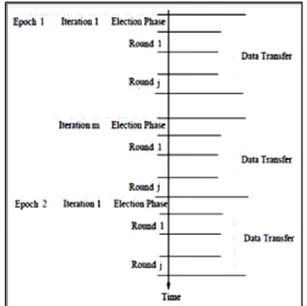
OCP-CS divides the network into a few real clusters. Each cluster has a group leader that consists of several virtual CHs; however, only one CH is active at one time. Iteration consists of two stages: an election phase and a data transfer phase.
International Journal of Communication Networks and Information Security (IJCNIS) Vol. 9, No. 3, December 2017
of sensor nodes. These CHs send a short range advertisement broadcast message. The sensor nodes receive the advertisements and choose their CHs based on the signal strength of the advertisement messages. Each sensor node sends an acknowledgment message to its CH. Moreover, in each iteration, the CHs choose a group of associate leaders based on election weights taking account of the residual energy and the concentration degree of sensor nodes and the signal strength of the acknowledgments.
A group leader consists of a CH and the associates. In the data transfer phase, the group leader member (CH) receives data from the neighboring nodes, aggregates the collected data using CS, aiming at improving the network lifetime and reducing the network energy consumption, and then CH transmits the aggregated results to the distant BS.
Finally, the BS decodes the networked data. Each data transfer phase consists of several rounds. Each member of the group leader becomes a CH once during a round. An epoch consists of several iterations. In one epoch, each sensor node becomes a member of the group leader for one time. All the group leader members share the same time slot to transmit their frames. The above communication stages are illustrated in Figure 2.
Figure 2. Communication stages in OCP-CS.
4.2 Radio communication model
We use the radio energy model proposed by [13]. According to the radio energy dissipation model illustrated in Figure 3, to achieve an acceptable Signal-to-Noise Ratio (SNR) in transmitting L-bit message over a distance , the energy expended by the radio is given by:
(5) where is the energy dissipated per bit to run the
transmitter or the receiver circuit, and depend on the
transmitter amplifier model used and is the distance between the sender and the receiver. By equating the two
expressions at , we have
. To receive an L-bit message the radio expends
Figure 3. Radio energy dissipation model.
4.3 Optimal number of clusters
We assume that we have an area square meters over which nodes are uniformly distributed. For simplicity, we assume that the BS is located in the centre of the field, and the distance between any node to the BS or its CH is less than or equal to . Thus, energy consumed by a CH is estimated as follows:
(6)
where is the number of clusters, is the aggregated data and is the average distance between CH and BS. The
energy consumed by a non-CH node is given by:
(7)
where is the average distance between a cluster member
and its CH. Using Euclidian metric, the area occupied by each cluster will be
with node distribution :
(8)
Assuming the area is a circle with , is constant, and the density is uniform and where , can be simplified as follows:
(9)
The energy dissipated in a cluster per round is given by:
(10)
The total energy dissipation in the network per round is the sum of the energy dissipation by all clusters, i.e.
(11)
By differentiating with respect to and equating to
zero, the optimal number of constructed clusters can be found:
where, the average distance from a CH to the BS is
given by [1] as follows:
(13)
If the distance of a significant percentage of nodes to the BS is greater than , then following the same analysis as in [12] we obtain:
(14) The optimal probability of a node to become a CH, , can
be computed as follows:
(15)
The optimal construction of clusters is very important. [13] showed that if the clusters are not constructed in an optimal way, the total consumed energy of the sensor network per round is increased exponentially either when the number of constructed clusters is greater than the optimal number of clusters or especially when the number of constructed clusters is less than the optimal number of clusters. If the number of the constructed clusters is less than the optimal number of clusters, some nodes in the network have to transmit their data very far to reach the CH, causing the global energy in the system to increase. If the number of the constructed clusters is greater than the optimal number of clusters, the total routing traffics within each cluster will be reduced because of fewer members, however, more clusters will result in more one-hop transmissions from the CHs to the BS. The CHs will receive data from fewer members, reducing the local data aggregation being performed and increasing the communications among the CHs.
4.4 Cluster head election phase
An optimal probability of a node to become a CH is equivalent to the optimal construction of clusters. This clustering is optimal in the sense that energy consumption is well distributed over all sensors and the total energy consumption is minimal. Such optimal clustering highly depends on the energy model that we use.
Energy consumption of the CHs is relatively expensive, so the residual energy of sensor node is the main criteria for the election of CH. Moreover, data aggregation can save considerable energy when the source nodes forming one cluster are distributed in a relatively small region while the BS is far away from the source nodes, because sensor nodes only need much smaller energy for sending data to the CH than sending data directly to the BS when the BS is located at a remote distance. It is reasonable to infer that the closer source nodes within a cluster, lower are the energy to consume to send data.
Based on this deduction, an election weight taking account of the residual energy and the concentration degree of sensor nodes is introduced as OCP-CS for CH election.
Definition 1: Given a WSN of N sensor nodes is defined to be the concentration degree of node namely the number of sensor nodes that can sense during the round. is defined as the election weight of node in round,
(16)
where
is an adaptive factor to adjust the impact of
residual energy and concentration degree on the election weight,
denotes the residual energy of node in round
is the initial energy of node and is the average residual energy of network in round. With the reduction
of residual energy, gradually increases to adapt to a decrease in the number of effective sensor nodes in WSN.
4.5 Setupphase
Step 1 During initialization, sensor nodes calculate their own concentration degree according to the Definition 1, and mark their own level as level 1. Step 2 In the initialization phase of the network, the
BS broadcasts in “CH election” messages. When a node receives the broadcast message, it compares its own residual energy with . If , a node calculates the election weight using its own and , and then send the weight and its ID to the BS for CH election in the “CH election” messages. Otherwise, a node gives up as CH election, and chooses to join a cluster later.
Step 3 The BS marks its own level as level 1, chooses
sensor nodes with maximum election weight as
CHs. Sensor nodes that have been chosen to be the CHs by the BS, are marked themselves as CHs. After that, CHs broadcast to neighbor nodes to notify them that they have been elected as new CHs.
Step 4 When a node is elected as a CH, it broadcasts “re-join the cluster” messages to each regular node. After receiving the broadcast message, each regular node chooses its closest CH with the largest received signal strength and then informs the CH by sending a join cluster message. Furthermore, in each iteration, the CHs choose a set of associate leaders based on their election weight and the signal strength of the acknowledgments. A group leader consists of a CH and the associates. The group leader member is responsible for sending messages to the BS.
Step 5 The CH sets up a time-division multiple access (TDMA) schedule and transmits it to the nodes in the cluster. After the TDMA schedule is known by all nodes in the cluster, the set up phase is completed and the next phase begins.
4.6 Data transmission phase
Once the clusters are formed and the TDMA schedule is fixed, the data transmission phase can begin. We consider sensors randomly located in a field, each generating a data sample to be measured. The vector of data samples is called networked data [11], which is transmitted to the BS. We use DWT matrix as the sparsifying transform matrix and channel impulse response (CIR) matrix as the sampling matrix.
4.7 DWT basis
International Journal of Communication Networks and Information Security (IJCNIS) Vol. 9, No. 3, December 2017
computed. DWT replaces the 2-D set of measurements with a set of transform coefficients that, for piecewise smooth fields, are sparser than the original data,
(17) where is the transform coefficient vector which contains nonzeros, and is the DWT basis.
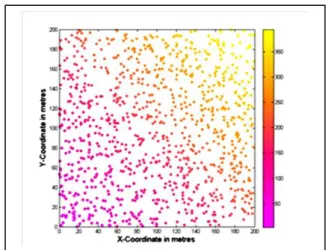
Figure 4. Network topology comprised of 1000 nodes.
Note: The locations of nodes are generated as random values drawn from the standard uniform distribution on the open interval (0, 200).
Figure 5. Sparsity of networked data in a DWT basis. The
networked data can be presented with nonzero coefficients after DWT transform.
4.8 CIRbasis
At each cluster, a group leader member CH receives data from the neighboring nodes, aggregates the collected data using CS and transmits the aggregated results to the distant BS. The received signal vector at CH can be written as,
(18) where is the CIR matrix whose component can be written as,
(19)
where is the distance between the CH and the
sensor node. is the propagation loss factor which is 2 for free space [9] and takes on other values for different media [14]. is the Rayleigh fading coefficient modeled as complex Gaussian noise with zero mean and unit variance.
Figure 6. Transmission in clusters.
As shown in Figure 7 sensor nodes transmit their samples to CHs. Subsequently CHs transmit measurements to the BS independently. Finally, the BS decodes the networked data from using the basis pursuit solver in Sparselab toolbox of Matlab [6].
Figure 7. The basic CIR model.
5.
Simulation results
In this section, analysis of the proposed OCP-CS protocol is carried out using MATLAB to evaluate the energy consumption and maximize the lifetime of the sensor network.
Table 1. Simulation parameters.
Description Parameter Value
No. of nodes N 1000
Initial energy 0.5
Location of the BS BS (50,50)
Data packet size L 4000 bits
Network area
Transmit amplifier if
Transmit amplifier if
Threshold distance 87.7058
No. of nonzero Coefficients 10
No. of measurements 50
We describe our simulation environment and experimental results. The simulation parameters are summarized in Table 1.
5.1 Energy consumption
Since energy consumption is the most important issue in WSNs, we discuss the impact of using CS on energy consumption by comparing the performance of the proposed protocol with other existing protocols. Energy consumption for specific number of frames with respect to the variation of cluster number and network diameter size is also examined. Figure 8 illustrates the difference of energy consumed per round for proposed, EECDA, IB-LEACH and CBHRP protocols. It shows that IB-LEACH achieves better performance compared with CBHRP, whereas the gateways take up the role to reduce the energy consumption of CH and decrease the probability of failed WSN. Also, EECDA performs better than IB-LEACH. The reason is EECDA selects path with a maximum sum of energy residual for data transmission in spite of paths with minimum energy. It is obvious that the energy consumption of the proposed protocol is much lower than that of CBHRP, IB-LEACH and EECDA. This is because OCP-CS uses an election weights residual energy and concentration degree of sensor nodes in electing CHs. Node having higher election weight has better chance to be a CH, therefore, the energy efficiency is enhanced. Besides, OCP-CS efficiently compresses the data and at the same time guarantees fast data compression which are important issues in WSNs due to the scare resources of sensor node. Consequent to this compression, the total network energy consumption is minimized as compared with CBHRP, IB-LEACH and EECDA.
Figure 8 shows that energy consumption is reduced when the number of clusters is increased and the network diameter decreases. For the simulated network of 1000 nodes, it is shown that the optimum range of clusters lies between 20 and 60. As the number of clusters increases and the network diameter decreases, the energy consumption also decreases. When the number of clusters is below the optimum range, for example 10, the sensor nodes have to send data to the distant CHs. On the other hand, when the number of clusters is greater than optimum range, there will be more transmissions to the distant BS. Moreover, when the network diameter increases, the CHs have to send data to the distant BS. Furthermore, when the network diameter decreases, the energy consumption also decreases and there will be more transmissions to the BS.
Figure 8. Energy consumption.
Figure 9 show that OCP-CS consumes lower energy as compared to CBHRP, IB-LEACH and EECDA. The reason is that all the sensor nodes in OCP-CS organize themselves into clusters with one node elected as a CH according to the residual energy and the concentration degree of sensor nodes leading to reducing the energy consumption of sensor nodes.
Figure 9. Energy consumption for every sensor node.
5.2 Iteration time
In WSNs, the most important metric is the total survival lifetime of the WSN. In this section, the average time to complete one iteration such that every node becomes a member of group leader is analyzed using OCP-CS and compared with existing protocols.
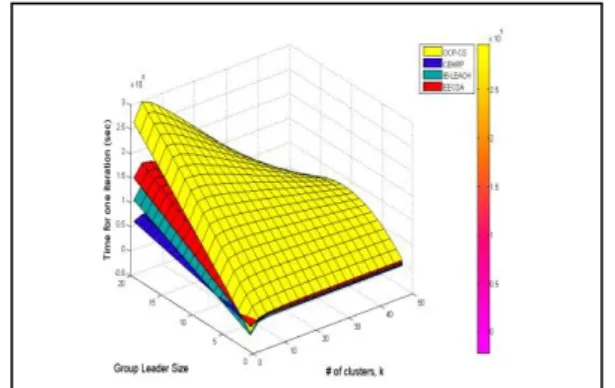
The estimated time for one iteration with respect to the network diameter considering the percentage of group leader size is shown in Figure 10. It is obvious that the estimated time for one iteration of the proposed protocol is more than that of EECDA, IB-LEACH and CBHRP. Whereas, in the proposed protocol the extension of the network service duration is because OCP-CS efficiently compresses data using CS and every sensor node independently elects itself as a CH based on its election weight. Therefore, OCP-CS would extend the estimated time for one iteration, and consequently the battery lifetime would be extended more than lifetime of other schemes. The iteration time is proportional to the initial energy and the network diameter obtained in this figure. The network will be alive for a longest period of time with initial energy when the group leader size is 50% of the cluster size. However, it is more or less with respect to the group leader size.
Figure 10. Time for iteration with respect to network
diameter and group leader size.
International Journal of Communication Networks and Information Security (IJCNIS) Vol. 9, No. 3, December 2017
of clusters, the time for iteration increases as the group leader size increases and one iteration can last longer for larger group leader sizes. However, for larger number of clusters, the time for iteration is reduced. This graph shows that the group leader size and the number of clusters should be carefully chosen to extend the network lifetime. The figure shows that OCP-CS outperforms EECDA, IB-LEACH and CBHRP protocols, the reason is using CS would optimize energy usage and this leads to prolonging the network lifetime.
Figure 11. Time for iteration with respect to number of
clusters and group leader size. 5.3 Number of frames
The number of frames transmitted in each iteration is evaluated using OCP-CS and compared with EECDA, IB-LEACH and CBHRP. Figure 12 shows the number of frames transmitted per iteration in the proposed, EECDA, IB-LEACH and CBHRP protocols. It is clear that the proposed protocol outperforms other existing protocols. It is also shown that when the group leader size increases, there are more control and management sensor nodes. As a result, the iteration can last for a longer time, which is also consistent with the results shown in Figure 10 and Figure 11. Consequently, the data collecting nodes can be used for a longer period of time. Our results show that the proposed protocol provides a more systematic approach of transmitting a larger number of data frames in contrast to EECDA, IB-LEACH and CBHRP.
Figure 12. Number of frames transmitted per iteration.
5.4 Standard deviation of load
Standard deviation of the load is the variance in load which signifies that load is not uniformly distributed among the clusters. It gives a good evaluation of distribution on load per cluster. To test our system for different sensors densities, we measured standard deviation of load by increasing the
number of sensors in the system from 500 to 5000 with uniform increments.
We measured standard deviations of load in the proposed, EECDA, IB-LEACH and CBHRP as shown in Figure 13. On average, the standard deviation of OCP-CS is 53.4% less than that of CBHRP, 35.8% less than that of IB-LEACH and 17.8% less than that of EECDA, indicating that OCP-CS shows more uniform performance than EECDA, IB-LEACH and CBHRP. Whereas, the rising values of EECDA, IB-LEACH and CBHRP protocols clearly indicate that the variance of load among different clusters increases, as more sensors are included in the system.
Figure 13. Standard deviations of load.
6.
Conclusions
In this paper, we propose an optimized clustering protocol using compressive sensing to enhance the energy consumption, lifetime and throughput of the wireless networks. Compressive sensing measurements are obtained via cluster heads. Discrete Wavelet Transform (DWT) is used as the sparsifying matrix and channel impulse response (CIR) matrix is used as the sampling matrix. Using group leader concepts in a clustering algorithmic approach, nodes elect themselves as cluster heads based on their energy levels and concentration degree, retaining more uniformly distributed energy among sensor nodes. The simulation results show that our protocol decreases the energy consumption and therefore, prolongs the network lifetime and increases the number of frames transmitted per iteration as compared with EECDA, IB-LEACH and CBHRP protocols.
References
[1] S. Bandyopadhyay and E. J. Coyle, “Minimizing communication costs in hierarchically-clustered networks of wireless sensors,” Computer Networks. Vol. 44, No. 1, pp. 1-16, 2004.
[2] N. Behboudi and A. Abhari, “A Weighted Energy Efficient Clustering (WEEC) for Wireless Sensor Networks,” Seventh International Conference on Mobile Ad-hoc and Sensor Networks (MSN), pp. 146-151, 2011.
[3] M. Behzad and Y. Ge, “Performance Optimization in Wireless Sensor Networks: A Novel Collaborative Compressed Sensing Approach,” IEEE 31st International Conference on Advanced Information Networking and Applications (AINA), Taipei, pp. 749-756, 2017.
[5] P. M. Dave and P. D. Dalal, “Simulation & Performance Evaluation of Routing Protocols in Wireless Sensor Network,” International Journal of Advanced Research in Computer and Communication Engineering, Vol. 2, No. 3, 2013.
[6] D. L. Donoho, “Compressed sensing,” IEEE Trans. Inf. Theory, Vol. 52, No. 4, pp. 1289-1306, 2006.
[7] E. J. Candes and M. B. Wakin, “An introduction to compressive sampling,” IEEE Signal Process. Mag, Vol. 25, No .2, pp. 21-30, 2008.
[8] D. P. Agrawal, “Embedded Sensor Systems,” (book), Springer, 2017.
[9] J. A. Gay-Fernandez, M. G. Sanchez, I. Cuinas, A. V. Alejos, J. G. Sanchez, and J. L. Miranda-Sierr, “Propagation analysis and deployment of a wireless sensor network in a forest,” Progress in electromagnetics research, Vol. 106, pp. 121- 145, 2010.
[10]D. Guo, X. Qu, L. Huang and Y. Yao, “Optimized local superposition in wireless sensor networks with T-average-mutual-coherence,” Progress in electromagnetics research,” Vol. 122, pp. 389- 411, 2012.
[11]J. Haupt, W. U. Bajwa, M. Rabbat and R. Nowak, “Compressed sensing for networked data,” IEEE signal process Mag, Vol. 25, No. 2, pp. 92-101, 2008.
[12]W. B. Heinzelman, A. P. Chandrakasan and H. Balakrishnan, “An Application-Specific Protocol Architecture for Wireless Microsensor Networks,” IEEE Transactions on Wireless Communications, Vol. 1, No. 4, pp. 660-669, 2002.
[13]W. Heinzelman, A. Chandrakasan and H. Balakrishnan, “Energy-efficient communication protocol for wireless microsensor networks,” Proceedings of 3rd Hawaii international conference on system sciences, 2000.
[14]M. Jia, L. Husheng and H. Zhu, “Sparse event detection in wireless sensor networks using compressive sensing,” 3rd Annu. Conf. information sciences and systems, pp. 181-185, 2009.
[15]A. M. Khedr, W. Osamy and D. P. Agrawal D. P, “Perimeter Discovery in Wireless Sensor Networks,” J. Parallel Distrib. Comput, Vol. 69, pp. 922–929, 2009.
[16]A. M. Khedr and W. Osamy, “Effective Target Tracking Mechanism in a Self-Organizing Wireless Sensor Network,” Journal of Parallel a Distributed Computing, Vol. 71, pp. 1318–1326, 2011.
[17]A. M. Khedr and W. Osamy, “Mobility- assisted minimum connected cover in a wireless sensor network,” J. Parallel Distrib. Comput, Vol. 72, pp. 827-837, 2012.
[18]A. M. Khedr and W. Osamy, “Target tracking Mechanism for Cluster Based Sensor Networks,” Applied Mathematics and Information Science Journal, Vol. 1, No. 3, pp. 287–303, 2007.
[19]D. Kumar, T. C. Aseri and R. B. Patel, “EECDA: Energy Efficient Clustering and Data Aggregation Protocol for Heterogeneous Wireless Sensor Networks,” Int. J. of Computers, Communi cations & Control, Vol. 6, No. 1, pp. 113-124, 2011.
[20]S. Lee, S. Pattem, M. Sathiamoorthy, B. Krishnamachari and A. Ortega, “Spatially localized compressed sensing and routing in multi-hop sensor networks,” 3rd Int. conf. on Geo. Sensor networks, pp. 11-20, 2009.
[21]M. G. Rashed, M. H. Kabir, M. S. Rahim and S. E. Ullah, “Cluster Based hierarchical routing protocol for wireless sensor network,” International Journal of computer and network security, Vol. 5, No. 2, 2010.
[22]B. A. Said, E. Abdellah, A. Beni-Hssane and M. L. Hasnaoui, “Improved and Balanced LEACH for heterogeneous wireless sensor networks,” International Journal on Computer Science and Engineering, Vol. 2, No. 8, pp. 2633-2640, 2010. [23]M. Selvi, C. Nandhini, K. Thangaramya, K. Kulothungan and
A. Kannan, “HBO based clustering and energy optimized routing algorithm for WSN,” 2016 Eighth International
Conference on Advanced Computing (ICoAC), Chennai, India, pp. 89-92, 2017.
[24]P. Singh and M. Bhatia, “Performance Enhancement in Routing using Leach and SAR Protocol,” International Journal of Computer Applications, Vol. 97, No. 4, pp. 0975 – 8887, 2014.
[25]J. Wang, J. Cao, S. Ji and J. H. Park, “Energy-efficient cluster-based dynamic routes adjustment approach for wireless sensor networks with mobile sinks,” The Journal of Supercomputing, 2017.
[26]W. Wang, D. Wang and Y. Jiang, “Energy efficient distributed compressed data gathering for sensor networks,” Ad Hoc Networks, Vol. 58, pp. 112-117, 2016.
[27]H. Yang, K. Tang and H. Xu, “Energy-Efficient Transmission Based on Compressive Sensing in WSN,” IEEE Wireless Communications and Networking Conference (WCNC), San Francisco, CA, pp. 1-6, 2017.
[28]Z. Zhang and X. Zhang, “Research of Improved Clustering Routing Algorithm Based on Load Balance in Wireless Sensor Networks,” IET International Communication Conference on Wireless Mobile and Computing, pp. 661-664, 2009.