Biolinguistics 5.1–2: 036–042, 2011 ISSN 1450–3417 http://www.biolinguistics.eu
Learn? A Statistical Account of the Staged Input
Effect on Learning a Center-Embedded
Structure in Artificial Grammar Learning (AGL)
Fenna H. Poletiek
In an artificial grammar learning study, Lai & Poletiek (2011) found that human participants could learn a center-embedded recursive grammar only if the input during training was presented in a staged fashion. Previous studies on artificial grammar learning, with randomly ordered input, failed to demonstrate learning of such a center-embedded structure. In the account proposed here, the staged input effect is explained by a fine-tuned match between the statistical characteristics of the incrementally organized input and the development of human cognitive learning over time, from low level, linear associative, to hierarchical processing of long distance dependencies. Interestingly, staged input seems to be effective only for learning hierarchi-cal structures, and unhelpful for learning linear grammars.
Keywords: artificial grammar learning; linguistic environment; recursion; staged input; statistical learning
1. Recursion Learning in the Artificial Grammar Learning Paradigm
Language acquisition is one of the most complex tasks imaginable. Young learners, from infancy on, are faced with a noisy, degraded, and small set of streams of sounds — linguistic stimuli — from which grammatical principles have to be induced. Though generalization from the stimuli is needed to learn the grammar, it is bound to complex constraints: It should not go too far, and not be simple and linear. It is one of the most persistent mysteries in cognitive science how humans achieve this goal. How does this learning proceed?
the dog bites shouts’, the first encountered noun (subject) is associated with the last verb rather than with the first encountered next verb, revealing the appli-cation of a hierarchical principle.
The non-linear process required for natural language seems hard to explain with statistical learning mechanisms. Recently (and less recently; see Gold 1967), it has been proposed that this type of hierarchical structures is unique for human language and therefore is a crucial characteristic of the human language faculty (Hauser et al. 2002, Fitch & Hauser 2004; see also Corballis 2007). Very little is known, however, about how these structures are actually learned and used, and to what extent general statistical learning mechanisms and the learner’s environ-ment factor into acquiring hierarchical structures like center embedding.
The purpose of the present paper is to propose an explanation for a recently found facilitation effect of the organization of the linguistic input on learning a center-embedded structure (Lai & Poletiek 2011). The effect is accounted for in terms of the match between the statistical characteristics of the input and the developmental pattern of the learning process. I propose that the changing organization of the linguistic environment over time narrowly matches the synchronic development of cognitive learning mechanisms, binding formal language complexity to learnability.
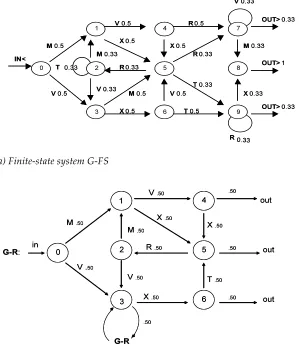
Because of the extremely high complexity of natural grammars, little infor-mation about fundamental mechanisms involved in natural grammar learning can be derived directly from the features of language. Therefore, a growing body of research on grammar learning uses artificial grammars for both simulation studies and empirical experimentation. A now classical paradigm is the Artificial Grammar Learning (AGL) procedure (Reber 1969, 1993). Reber (1969) exposed human participants to exemplars of a simple finite state grammar (see Figure 1a below) with a few ‘words’ (mostly letters). Next, participants are given a test task in which new strings are presented, half of which are grammatical and half are not. Participants give grammaticality judgments for each test string. Typically, participants perform significantly above chance level, indicating that the structure was induced during training and applied during the test phase, at least to some extent.
The artificial grammar learning paradigm can be used to perform a labora-tory test of possible effects of environmental characteristics on the learnability of sequential structures, by simulating these characteristics in the experimental task and comparing learning behavior under experimental conditions with a matched control condition in which the investigated characteristics are not implemented.
2. Staged Input Facilitates Hierarchical Processing
training strings followed by twelve test strings. This procedure allowed us to measure the development over time of grammaticality judgments performance as exposure increases.
In contrast to what de Vries et al. (2008) found, our participants performed well — but only if the input exemplars with which they were trained were presented in an incremental fashion, starting with the shortest and least complex exemplars without embeddings and ending with exemplars with multiple levels of embedding. This result suggests that the time course of exposure to hierar-chical increasingly complex stimuli, allows cognitive learning of the hierarhierar-chical system. A statistical analysis of the input presented incrementally may provide an account of this staged input effect. Moreover, as I will argue below, this analy-sis also provides an explanation of why hierarchical structures rather than simple linear finite-state structures benefit from an incrementally organized input.
Consider a finite-state structure (G-FS) with five elements (letters M, V, R, X, T) and a hierarchical recursive center-embedded structure (G-R), with the same five elements:
a) Finite-state system G-FS
b) Center-embedded system G-R
Both systems generate strings of elements (e.g. MXTRR for G-FS and VMXRMVX for G-R). For both systems, the probability of each unique element the system generates (p(exemplar|G)) can be calculated (van der Mude & Walker 1978, Charniak 1994, Poletiek & Wolters 2009). The sum of the probabilities of all unique strings generated by a system (i.e. the ‘full output’) is, or approximates, one (Poletiek & van Schijndel 2009). The probability distributions of the unique strings generated by both grammars differ. Indeed, it can be shown that the probability distribution of the exemplars generated by G-FS is more ‘even’ than the probability distribution of the strings generated by the recursive structure G-R. In the recursive system, the strings without any center-embedded clause are much more probable than strings with embeddings. Moreover, as the number of levels of embedding increases, the probability of production by the system drops quickly to approximate zero.
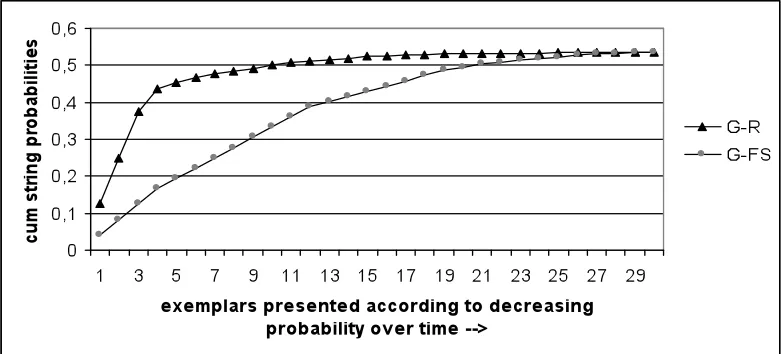
If the exemplars of both grammars are ordered in a staged fashion, according to their decreasing probabilities to be produced by G-R and G-FS, then let us assume that learning of the grammars at any point in time may be repre-sented by the sum of the probabilities of the exemplars a learner has been ex-posed to up to that point in time (Lai & Poletiek 2011). For example, if this sum
(Σ(p(exemplar|G))) is .50 after exposure to n exemplars presented in a growing
fashion (staged input), the learner has been exposed and allowed to learn ‘half’ of the system. In Figure 2, the evolution over time of Σ (p(G|string) is displayed for both G-FS and G-R, for an input presented over time according to decreasing probabilities of the exemplars. Assuming that the cumulative probabilities of the gradually increasing set of input stimuli reflect the proportion of the full language (i.e. 100% of the stimuli it generates) at each stage of exposure, Figure 2 displays the evolution of this cumulative value over time for a Finite State Grammar and for a Recursive Grammar.
Consider two learners. After exposure to the 30 most probable exemplars of G-FS learner A has learned 50% of that grammar (Figure 2). Likewise, learner B, after having been exposed to the 30 most probable exemplars of G-R would also have learned 50% of G-R. Thus, the two learners have seen an equal number of exemplars of their ‘own’ grammar, covering an equal part of the grammar gener-ating them. The difference between the two learning situations, however, is in the shapes of the curves.
As Figure 2 shows, in the earliest stage of exposure (e.g., after having seen five exemplars), the proportion (Poletiek & van Schijndel 2009) of the recursive system G-R, covered by the exemplars, exceeds by far the proportion of G-FS after exposure to five exemplars of G-FS. Assuming that the cumulative probabi-lities curve (y-values) reflects how much of the underlying system has been learned at each point of exposure (x-values), the lines might be considered to mo-del learning curves of the two learners after a given amount of exposure. Figure 2 then reveals that presenting the input in an incremental fashion strongly boosts the learning curve of the recursive language in the early stage of learning (see also Elman 1993), according to this simulation.
This facilitation effect of staged input for recursive grammars was verified by Lai & Poletiek (2011) in their AGL study. Interestingly, the incremental presentation of the input does not help much for learning a linear finite-state grammar. As can be seen in Figure 2, the non-recursive grammar produces a more linear learning curve, implying a weaker effect of the organization of the input over time for non-recursive linear systems.
3. Artificial and Natural Grammar Learning
in-duced by the natural learner hierarchical and recursive — not linear.
In sum, the present theoretical explanation of the beneficial effect of a staged linguistic input on grammar induction, derived from artificial grammar study, suggests a well-tuned fit between the organization of the linguistic environment and the development of learning abilities. In addition, the model can explain why this facilitation occurs specifically for recursive grammars, and not for linear ones. Generally, as shown in this analysis, artificial grammar studies and statistical models of the effects they reveal are useful tools to our under-standing of fundamental processes underlying natural grammar learning.
References
Charniak, Eugene. 1994. Statistical Language Learning. Cambridge, MA: MIT Press.
Corballis, Michael C. 2007. Recursion, language, and starlings. Cognitive Science
31, 697–704.
Elman, Jeffrey L. 1993. Learning and development in neural networks: The importance of starting small. Cognition 48, 71–99.
Fitch, W. Tecumseh & Marc D. Hauser. 2004. Computational constraints on syntactic processing in a non-human primate. Science 303, 377–380.
Gold, E. Mark. 1967. Language identification in the limit. Information and Control
10, 447–474.
Gómez, Rebecca L. & LouAnn Gerken. 2000. Infant artificial language learning and language acquisition. Trends in Cognitive Sciences 4, 178–186.
Hauser, Marc D., Noam Chomsky & W. Tecumseh Fitch. 2002. The faculty of language: What is it, who has it, and how did it evolve? Science 298, 1569– 1579.
Lai, Jun & Fenna H. Poletiek. 2011. The Impact of Adjacent-Dependencies and Staged-Input on the Learnability of Center-Embedded Hierarchical Structures. Cognition, 118(2), 265-273
Pine, Julian M. 1994. The language of primary caregivers. In Clare Gallaway & Brian J. Richards (eds.), Input and Interaction in Language Acquisition, 15–37. Cambridge: Cambridge University Press.
Poletiek, Fenna H. & Tessa J. P. van Schijndel. 2009. Stimulus set size and gram-mar coverage in artificial gramgram-mar learning. Psychonomic Bulletin & Review
16, 1058–1064.
Poletiek, Fenna H. & Gezinus Wolters. 2009. What is learned about fragments in artificial grammar learning: A transitional probabilities approach. Quarterly Journal of Experimental Psychology 62, 868–876.
Reber, Arthur S. 1969. Transfer of syntactic structures in synthetic languages.
Journal of Experimental Psychology 81, 115–119.
Reber, Arthur S. 1993. Implicit Learning and Tacit Knowledge: An Essay on the Cognitive Unconscious. Oxford: Oxford University Press.
Saffran, Jenny R. 2003. Statistical language learning: Mechanisms and constrains.
van der Mude, Antony & Adrian Walker. 1978. On the inference of stochastic regular grammars. Information and Control 38, 310–329.
de Vries, Meinou H., Padraic Monaghan, Stefan Knecht & Pienie Zwitserlood. 2008. Syntactic structure and artificial grammar learning: The learnability of embedded hierarchical structures. Cognition 107, 763–774.
Fenna H. Poletiek Leiden University
Cognitive Psychology Department P.O. Box 9555
2300 RB Leiden The Netherlands