A N E F F I C I E N T P A R S I N G A L G O R I T H M F O R T R E E A D J O I N I N G
G R A M M A R S
K a r i n H a r b u s c h
DFKI
- D e u t s c h e s F o r s c h u n g s z e n t r u m fiir K f i n s t l i c h e I n t e l l i g e n z S t u h l s a t z e n h a u s w e g 3, D - 6 6 0 0 S a a r b r i i c k e n 11, F . R . G .h a r b u s c h ~ d f k i . u n i - s b . d e
A B S T R A C T
In the literature, Tree Adjoining G r a m m a r s (TAGs) are propagated to be adequate for nat- ural language description - - analysis as well as generation. In this paper we concentrate on the direction of analysis. Especially i m p o r t a n t for an implementation of that task is how efficiently this can be done, i.e., how readily the word problem can be solved for TAGs. Up to now, a parser with O(n 6) steps in the worst case was known where n is the length of the input string. In this paper, the result is improved to O(n 4 log n) as a new lowest upper bound. T h e paper demonstrates how local interpretion of TAG trees allows this reduction. 1 I N T R O D U C T I O N
Compared with the formalism of context-free
grammars ( CFC, s), the rules of Tree Adjoining
Grammars (TAGs) can be imagined intuitively
as parts of context-free derivation trees. W i t h o u t paying attention to the fact that there are some more restrictions for these rules, the recursion op- eration (adjoining) is represented as replacing a node in a TAG rule by another TAG rule so that larger derivation trees are built.
This close relation between CFGs and TAGs can imply that they are equivalent. But TAGs are more powerful than context-free grammars. This additional power - - characterized as mildly
context-sensitive - - leads to the question of
whether there are efficient algorithms to solve the word problem for TAGs.
Up to now, the algorithm of Vijay-Shanker and
Joshi with a time complexity of O(n 6) for the worst case was known, in addition to several un- successful a t t e m p t s to improve this result. This paper's main emphasis is on the improvement of this result. An efficient parser for Tree Adjoining G r a m m a r s with a worst case time complexity of O(n 4 log n) is discussed.
All known parsing algorithms for TAGs use the close structural similarity between TAGs and CFGs, which can be expressed by writing all inner nodes and all their sons in a TAG as the rule set of a context-free g r a m m a r (the context-free ker- nelof a TAG). Additionally, the constraint has to be tested t h a t all further context-free rules corre- sponding to the same TAG tree must appear in the derivation tree, iff one rule of that TAG tree is in use. Therefore, it is clear that a context-free parser can be the basis for extensions representing the test of the additional constraint.
On the basis of the two fundamental context- free analysers, the different approaches for TAGs
284
can be divided into two classes. One class extends an Earley parser and the second class extends a
Cocke-Kasami- Younger ( CKY) parser for CFGs.
Here, we focus on the approaches with a CKY basis, because the relation between the resulting
triangle matrix and the encoded derivation trees
is closer than for the item lists of an Earley parser. In particular, the paper is divided into the fol- lowing sections. First, a short overview of the TAG formalism is given in order to have a com- mon terminological basis with the reader.
In the second section, the approach of Vijay- Shanker and Joshi is presented as the natural way of extending the CKY algorithm for context-free grammars to TAGs. As a precondition for that analysis, it has to be proven that each TAG can be transformed into two form, a normal form re- stricting the outdegree of a node to be less three. In section 4, the main section of this paper,
a normal-form is defined as a precondition for a new and more efficient parsing algorithm. This form is more restricted than the two form, and is closely related to the Chomsky normal form for CFGs. The main emphasis lies on the description of the new parsing approach. The general idea is to separate the context-free parsing and the addi- tional testing so that the test can run locally. On the triangle m a t r i x which is the result of the CKY analysis with the context-free kernel, all complete TAG trees encoded in the triangle m a t r i x are computed recursively. It is intuitively motivated that this approach needs fewer steps than the strategy of Vijay-Shanker and Joshi, which stores all intermediate states of TAG derivations, be- cause the locally represented elementary trees can be interpreted as TAG derivations where equal parts are computed exactly once instead of indi- vidual representations in each derivation.
In the summary, our experience with an imple- mentation in C o m m o n L I S P on a Hewlett Packard machine is mentioned to illustrate the response time in an average case. Finally, different ap- proaches for TAG parsing are characterized and compared with the approaches presented here. 2 T A G S B R I E F L Y R E V I S I T E D First of all, the basic definitions for TAGs are re- visited in order to have a common terminology with the reader (even though not defined explic- itly here, CFGs are used as described, e.g., in [Hopcroft, Ullman 79]).
et al. 75]). Since then, a wide variety of prop- erties - - formal properties as well as linguisti- cally relevant ones - - have been studied (see, e.g., [Joshi 85] for a good overview).
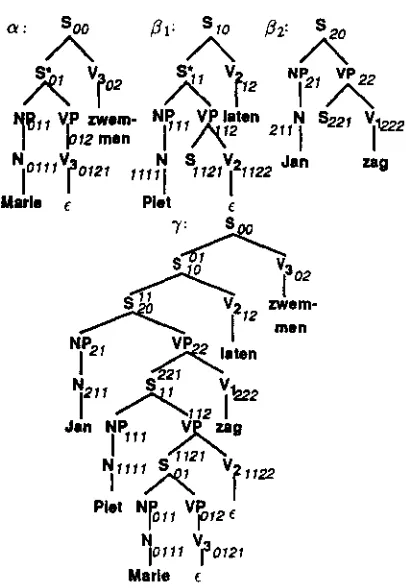
The following example describing the crossed dependencies in Dutch should illustrate the for- malism (see Figure 1, where the node numbers written in slanted font should be ignored here; they make sense in combination with the descrip- tion of the new algorithm, especially step (tag2)). A TAG is a tree generation system. It consists, in addition to the set of nonterminals N, the set of terminals T and the start symbol S, an extraor- dinary symbol in N, of two different sets of trees, which specify the rules of a TAG. Intuitively, the set I of initial trees can be seen as context-free derivation trees. This means the start symbol is the root node, all inner nodes are nontermi- nals and all leaves are terminals (e.g., in Figure 1 tree a). The second set A, the auxiliary trees, which can replace a node in an initial tree (which is possibly modified by further adjoinings) dur- ing the recursion process, must have a form, so that again a derivation tree results. The trees/31 and /32 demonstrate that restriction. A special leaf (the foot node) must exist, labelled with the same nonterminal as the root node. Further, it is obligatory that an auxiliary tree derives at least one terminal. The union of the initial and the auxiliary trees, so to speak the rule set of a TAG, is called the set of elementary trees.
Tree 7 in Figure 1 shows a TAG derivation tree, which means an initial tree with an arbi- trary number of adjoinings (here /3x is adjoined at the node S* in a and/32 at the node S* in the adjoined tree /31). During the recursion process (adjoining), a node X in an initial tree a, which can be modified by further adjoinings, is replaced by an auxiliary tree /3 with the same nontermi- nal label at root and foot node, t h a t X is labelled with. The incoming edge in X (if it exists; this is true if X is not the root node of a) now ends in the root node of/3, and all outgoing edges of X in a now start at the foot node of/3.
The set of all initial trees modified by an arbi- trary number of adjoinings (at least zero) is called T(G), the tree set of a TAG G. The elements in this set can also be specified by building a series of triples (ai,/3i, Xi) (0 < i < n) - - the deriva. tion - - where s0 E I, al (1 < i < n) is the result of the adjoining of/31-x in node ~:i-x in ai-x,/3i (0 < i < n-l) is the auxiliary tree, which is ad- joined in node Xl in tree ai and Xi (0 < i < n-l) is a unique node number in ai. This description has the advantage that structurally equal trees in T(G) which result from different adjoinings can be uniquely represented.
L(G), the language of a TAG, is defined as the set containing all leaf strings of trees in T ( G ) , respectively all trees which can be constructec[ by adjoining as described in the corresponding derivation. Here, a leaf string means all labels of leaves in a tree are concatenated in order from left to right. In the tree 3' in Figure 1 'Jan Pier Marie e e zag laten zwemmen' is in L(G).
The relation between TAGs and CFGs can be characterized by defining the context.free kernel
285
a : A S ° ° /3F ~ S I 0 /32: / ~
Marie
ePlet
e7: s ~
l'2 men"
N~P2'
~ a t e n
Jan N.P
111
V~ zag
Marie c
Figure l: A small sample TAG demonstrating the process of ADJOINING
K of a TAG G. K is a CFG and consists of the same sets N, T and S of G, but P(K) is the set of all inner nodes of all elementary trees in G interpreted as the lefthand side of a rule, where all sons in their order from left to right build the righthand side of t h a t rule. E.g., in Figure 1 /32 has the corresponding context-free rules: (S, NP VP), (NP, N), (N, Jan), (VP, S V1), (V1, zag).
It is clear that having a context-free derivation tree (on the basis of the context-free kernel K of a TAG G) is a necessary, but not sufficient prop- erty for an input string, which is tested to be an element in L(G). In the following, this property motivates the extension of context-free parsing al- gorithms to accept TAGs as well.
The following parsing algorithms are able to ac- cept some extensions of the pure TAG definition without changing the upper time bound. Here, only TAGs with Constraints are mentioned (for more information about other extensions, e.g., TAGs with Links, with Unification or Multi Com- ponent TAGs - - some extending the generative capacity - - see, e.g., [Joshi 85]).
The motivation for TAGs with Constraints TAGCs) is to restrict the recursion operation of Gs. Each node X in an elementary tree la- belled with a nonterminal has an associated con- straint set C, which has one 0fthe following forms:
• NA stands for null adjoining and means that at node X no adjoining can take place, • SA(B) stands for selective adjoining and
iary tree (6 B). can take place (where each tree in B h a s the same root and foot node label as X) or
• OA(B) stands for
obligalory adjoining
and means that at X the adjoining of an auxiliary tree (E B) must take place (where each tree in B has the same root and foot node labelas
X).
When TAGs are mentioned in the following, the same result can be shown for TAGs with Con- straints, which it is not explicitly outlined. Only the property of generative power is illustrated, to make clear that finding a parsing algorithm is not a trivial task. For more information about the lin- guistic relevance of TAGs, the reader is referred, e.g., to [Kroch, Joshi 85].
A first impression comparing the generative power of TAGs and CFGs can be that they are equivalent, but TAGs are more powerful, e.g., the famous language a n b" e c" can be produced by a TAG with Constraints (the main idea in con- structing this g r a m m a r is to represent the produc- tion of an a, a b and a c in one auxiliary tree). Thinking of the application domain of natural language processing, the discussion in the linguis- tic community becomes relevant as to how pow- erful a linguistic formalism should be (see, e.g., [Pullum 84] or [Shieber 85]). TAGs are
mildly
conlezt-sensitive,
which means that they can de- scribe some context-sensitive languages, but not all (e.g., www with w 6 {a,b)*, but ww is accept- able for a TAG). One thesis holds that natural language can be described very well by a mildly context-sensitive formalism. But this can only be empirically confirmed by describing difficult lin- guistic phenomena (here, the example in Figure 1 can only give an idea of the appropriateness of TAGs for natural language description).This property leads to the question of whether the
word problem
is solvable and if so, how ef- ficiently. In the following section, two differ- ent polynomial approaches are presented in de- tail. T h e property of efficiency becomes impor- tant when a TAG should be used in the applica- tion domain mentioned above, e.g., one can think of a syntax description encoded in TAG rules which is part of a natural language dialogue sys- tem. T h e execution time is responsible for the acceptance of the whole system. Later on, our experience with the response time of an imple- mentation of the new algorithm is described.3
T H E
V I J A Y - S H A N K E R
A N D
J O S H I
A P P R O A C H
First, the approach of
Vijay-Shanker
andJoshi
(see [Vijay-Shanker, Joshi 85])is discussed as the natural way of extending the context-free CKY algorithm (see, e.g., [Hopcroft, Ullman 79]) to an- alyze TAGs as well. As for the context-free anal- ysis with CKY, the g r a m m a r is required in nor- mal form as a precondition for the TAG parser. Therefore, first the two form is defined and the idea of the constructive proof for transforming a TAG into two form is given. T h e TAG parser is then presented in more detail.
286
3.1
T W O
F O R M
T R A N S F O R -
M A T I O N
T h e parsing algorithm of
Vijay.Shanker
andJoshi
uses a special CKY algorithm for CFGs which requires fewer restrictive constraints than the
Chomsky normal form
for the ordinary CKY al- gorithm does. Here, the righthand side of all rules of the g r a m m a r should have at most two elements. This definition has to he adapted for TAG rules to extend this C K Y parser to analyze TAGs as well.A TAG G is in
two form,
iff each node in each elementary tree has at most two sons. It can be proven t h a t each TAG G can be transformed into a TAG G ' in two form with L(G) - L(G').T h e proof of t h a t theorem uses the same tech- niques as in the context-free case which allow the reduction of the number of elements on the right- hand side to build the Chomsky normal form. If there are more than two sons, the second and all additional sons are replaced by a new nontermi- hal which becomes the lefthand side of a new rule with all replaced symbols on the righthand side (for more details see [Vijay-Shanker, Joshi 85]). We always refer to a TAG in two form, even when it is not explicitly confirmed.
3.2
T H E S T E P S O F T H E A L G O -
R I T H M
Now the idea of extending each context-free anal- ysis step by additional tests to ensure that whole TAG trees are in use (sufficient property) is moti- vated. This approach was proposed to be natural because it tries to build TAG derivation trees at once. In contrast, a two level approach is pre- sented which constructs all context-free deriva- tion trees before the TAG derivations are com- puted in a second step.
In the CKY analysis used here, a cell [row /,column j] in the triangle m a t r i x (1 < i, j _< n, the length of the input string w --- tl ...t,, where without loss of generality n >__ 1, because the test for e, the e m p t y string, E L(G) sim- ply consists of searching for initial trees with all leaves labelled with e) contains an element X (6 N) iff there are rules to produce the derivation for t i + l . . . t j _ l . This invariant is extended to repre- sent a TAG derivation for t i + l . . . t j _ l iff X 6
[i,j].
Therefore additional information of each nonter- minal in a cell has to be stored as to which el- ementary trees are under completion and what subtrees have been analyzed up to now. Impor- tant to note is that the list of trees which are under completion, can be longer than one. E.g., think of adjoinings which have taken place in ad- joined trees as described in Figure 1.
For realization of that information, a
slack
can be imagined. Here, the different stack elements are stored separately to use intermediate states in common. A stack element contains the infor- mation of exactly one auxiliary tree which is un- der construction, and a pointer to the next stack element. This pointer is realized by two addi- tional positions for each cell in the triangle matrixt1_1 no information a b o u t the structure of the TAG derivation is known in this element and has to be reconstructed by examination of all cells
[k,l,v,w] (k <_ v < w < 1).
T h e stack cells which the elements point at must also be recursively in- terpreted until the whole subtree is examined (left and right stack pointer are equal). It is clear that in interpreting these chains of pointers the stack at each node X in the triangle m a t r i x represents all intermediate states of TAG derivations with X as root node in an individual cell of the triangle matrix.T h e algorithm starts initializing cells for all ter- minal leaves (X E
[i-l,i,i,i]
for ti with father X, 1 < i < n) and all foot nodes which can be seen as nonterminal leaves (X E [i, j, i, j] where X is a foot node in an auxiliary tree, 0 < i < j < n-l).Just as the C K Y algorithm tests all combina- tions of neighboring strings, here new elements of cells are computed together with the context-free invariant computation, e.g., iff (Z,X Y) is a rule in the context-free kernel of the input TAG and X E [i, j, k, I], Y E [j - 1, m, p, p] and X and Y are root nodes of neighboring parts in the same ele- mentary tree, then Z is added to [i, m, k, l]). With the additional test to determine whether the rule (in the example (Z,X Y)) is in the same TAG tree as the two sons (X and Y) and whether the same holds for the subtrees below X and Y, it is clear that a whole TAG tree can be detected. If this is the case, i.e., that two neighboring stack ele- ments should be combined, all elements of cells [k, l, m, p] are added to [i, j, m, p] iff X E [ i , j, k,/] is the root of an identified auxiliary tree.
The time complexity becomes obvious when the range of the loops for all four dimensions of the array is described explicitly (see [Vijay- Shanker, Joshi 85]). From a more abstract point of view, the main difference between the CKY analysis for a C F G and a TAG is that, the sub- trees below the foot nodes are stored. This fact extends the input of length n to n 2 to describe the two additional dimensions. On the basis of that input, the ordinary CKY analysis can be done, and so the expected time complexity is
O((n2) 3)
= O(nS). With the explicitly defined ranges of the four dimensions for the positions in the array, it is clear that the worst case and the best case for this algorithm are equal.
4
A
N E W A N D M O R EE F F I -
C I E N T
A P P R O A C HA time bound of O(n e) in the best and worst case must be seen as a more theoretical result, be- cause an implementation of the algorithm shows that the execution time is unacceptable. In order to use the formalism for any application domain, this result should be improved. In this section, a TAG parser with an upper bound of O(n 4 log n) in the worst case is presented. T h e best case is O(n3), because a C K Y analysis has to at least be done.
287
4 . 1 N O R M A L F O R M T R A N S - F O R M A T I O N
As precondition of the new parsing algorithm, the TAG has to be transformed into a
normal form
which contains only trees with nodes and their sons, following the
Chomsky normal form
defini- tion. This means that the following three condi- tions hold for a TAG G:1. e E L(G) iff a tree with root node S (NA), the start symbol, which allows no further ad- joinings (null adjoining), and a single termi- nal son e is element in the set of initial trees I (this tree is called the e tree),
2. except the e tree, no leaf in another elemen- tary tree is labelled with e, and
3. for each node in each elementary tree, the condition holds that either the node has two sons both labelled with a nonterminal or that the node has one son labelled with a termi- nM.
In a first step, each TAG is transformed in two form so that condition 3 can be satisfied easier. This transformation is accomplished by the con- structive proof for the theorem that for each TAG (or TAG w i t h Constraints for which the definition holds as well) there exists an equivalent TAG with Constraints in normal.
I m p o r t a n t to note is that the idea of the trans- formation into Chomsky normal form for CFGs cannot be adopted further on because this con- struction allows the erasure of nonterminal sym- bols if their derived structure is added to the grammar. In TAGs, a nonterminal not only rep- resents the derivation of its subtree in an elemen- tary tree, but can be replaced by an adjoining. Therefore, the general idea of the proof is to erase parts of elementary trees which are not in normal form, and represent those parts as new auxiliary trees. After this step, the original g r a m m a r is in normal form and therefore the encoded auxiliary trees can be used for explicit adjoinings, always producing structures in normal form.
Expiicil
adjoinings
mean adjoinings in the new auxiliary trees which were built out of the erased parts of the original grammar. These adjoinings replace the nodes which are not in normal form. Since the details of the different steps are of no further interest here, the reader is referred to [Harbusch 89] for the complete proof.4 . 2 T H E S T E P S O F T H E N E W P A R S I N G A L G O R I T H M
The input of the new parser consists of a TAG G in normal form, and a string w = tl ...t,. With condition one in the normal form definition, the test for e E L(G) is trivial again. From now on this case is ignored, i.e., n > 1.
context-free kernel into Chomsky normal form in- stead of transforming the input TAG. But with this strategy one would loose the one-to-one map- ping of context-free rules in the C F K and father- son-relations in a TAG rule which becomes impor- tant for finding complete TAG rules in the second step of the new parser.
Here the invariant of the CKY analysis is X E [i, j] iff there are rules to produce a derivation for ti ... t j + i - 1 . This information is slightly ex- tended to recognize complete subtrees of elemen- tary trees in the triangle matrix. In the terminol- ogy of
Vijay-Shanker
andJoshi,
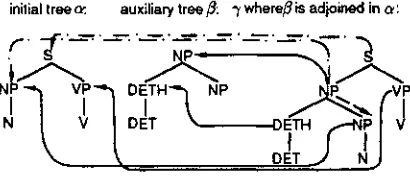
a stack element is constructed. But it's i m p o r t a n t to note that the pointers are not interpreted, so that here local in- formation is computed relative to an elementary tree.Actually, the correspondence between an ele- ment in the triangle m a t r i x and a TAG tree is represented as a pointer from the node in a tri- angle cell to a node in an elementary tree as de- scribed in Figure 2 (ignore the dotted lines at the moment). An equivalent description is presented in Figure 3 by storing the unique node number at which the pointer ends in the elementary tree and additionally a flag indicating whether the TAG tree is initial (I) or auxiliary (A) and whether the node is root node (T) of the tree or not (L). E.g., in Figure 2 the NP-son of the root node S in tree T carries the flag TA.
In this terminology, the special case that the subtree contains the foot node has to be repre- sented explicitly, because the foot node is a leaf in the sense of elementary trees, but not in the sense of a derivation tree. To know where this leaf is positioned in the triangle matrix, a
foot
node pointer (FP)
is defined from the root of the subtree to the foot node if one exists in that tree (in Figure 2 the dashed arc).initial tree ~ auxiliary tree,B: 3' where,6' is adjoined in o~:
N~'~I/
VP'~I
DETH"~II/I
~
NP
~ , ~ , . ~ rVP
. , ,
J
I°ET--
Figure 2: Example illustrating the inductive basis of the new invariant
So, the invariant in the first step of the new parsing algorithm is computed during the CKY analysis - - in our second terminology - - by re- cursively defining
extended node numbers ( ENNs)
by triples ( N N , T K , F P ) as follows: I n i t i a l i z a t i o n
Each element X in level 1 (father of a terminal t) is initialized with an ENN, where NN is the
node number
of X in a father-son-relation in an elementary tree a ( x ---* t), thetree kind
T K := LU (U=I,A) iff a E U and NN doesn't .end with zero (X is not the root of a ) else T K := TU, and thefoot node pointer
F P := nil, because the fa-288
ther of a terminal is never a foot node in the same auxiliary tree.
For each node X in level 1 the ENN := i N N = n o d e number of a foot node in an auxiliary tree, LA, pointer to t h a t ENN) is added iff X is the label of the foot node with node number NN - - to de- scribe foot node leaves.
R e c u r s i o n a l o n g t h e C K Y a n a l y s i s
For each new context-free element Z (Z ; X Y), the following tests are done in addition:
If X has an ENN ( N N i , T K 1 , F P i ) and Y has an ENN (NNz,TK2,FP2) and NNI-(1 in the last positition) = NN2-(2 in the last position) and T K i = TK2 and at least F P i or FP2 = nil then for Z an ENN ( N N I - I , T K , F P ) is added where T K = TK1 if Z is not the root node of the whole tree (in this case T K = T K I - ( L + T in the first position)); FP = FPi (i=1,2), which is not equal nil, else it is nil.
If an auxiliary tree with Z the label of the foot node exists, the ENN ( N N = n o d e number of the foot node in that tree, LA, pointer to that element) is added to Z in the currently manipu- lated triangle cell - - to represent the possibility of an adjoining in that node.
It is obvious that this invariant consisting of the nonterminal in a cell of the triangle m a t r i x to represent the context-free invariant, the pointers to elementary trees, and the foot node pointers to represent which part of an elementary tree is analyzed computes less information than an array cell in the approach of
Vijay-Shanker
andJoshi
does, where whole subtrees of the derivation tree are stored not stopping at a foot node as we do. Also, it is clear that this invariant can be com- puted recursively during the ordinary CKY steps within the upper time bound of O(n3). T h e num- ber of pointers to elementary trees at each node can be restricted by the number ofoccurences of a nonterminal as the left-hand side symbol of a rule in the context-free kernel (which is a constant). T h e number of foot node pointers is restricted by the outdegree of each cell in the triangle matrix b<e n), because only for such an edge can an F P
recursively defined.
In the second step, whole TAG derivations are computed by combining the subtrees of elemen- tary trees (represented by the invariant after step 1), according to the adjoining definition inter- preted inversely.
Inversely
means that the equiva- lence in the adjoining definition is not interpreted in the direction that a node is replaced by a tree, but in the opposite direction, where trees have to be detected and areeliminated.
Since all TAG derivation trees of a string w and a TAG G are encoded in the triangle matrix bnecessary condition w E C F K ( G ) ) and have to e found in the triangle matrix, the derivation definition has to be modified as well to support the 'inverse' adjoining definition. It means that a string w E L(G) iff there exists a tree, where recursively all complete auxiliary trees can be de- tected and replaced b y t h e label of the root node of the auxiliary tree until this process terminates in an initial tree.
[image:5.612.77.282.458.546.2]exactly this definition. An auxiliary tree in the derivation tree which contains no further adjoin- ings is called an
innermost
tree. As long as the termination condition isn't satisfied, at least one innermost tree must exist in the derivation tree.Returning to the invariant in the first step, in- nermost trees are characterized as a pointers to the root node of an auxiliary tree or in the rep- resentation of ENNs as the node number of the root node (in our numbering algorithm visible by the end number zero) and the tree kind flag TA (total auxiliary).
These trees are
eliminated
by identifying the root and the foot nodes of innermost trees, so to speak, as interpretation of the foot node point- ers as e edges. This can be represented sim- ply as propagation of the pointers from the foot node to the root node. This information is suffi- cient because the strategy of the algorithm checks whether an incoming edge in a node and the in- formation of an outgoing edge (without loss of generality represented at the start node of the edge) belong to the same elementary tree. Note that this b o t t o m - u p interpretation of the deriva- tion trees(propagation)
realizes that the finding of larger subtrees is computed only once (the father-son relation is only interpreted in the up- ward direction). In Figure 2 the dotted line from the NP node in 7 describes the elimination of/3 by propagation of the information from the foot node to the root node.Since it doesn't m a t t e r in the algorithm what history an information in a node has (especially how much and exactly what trees are eliminated) all possibilities of producing new extended node numbers - - representing the new invariant - - are simply called
elimination.
T h e information in a node represents what further parts of the same elementary tree are expected to be found in the triangle m a t r i x above that node. A subclassifica- tion differentiates what kinds of incoming edges should be compared to find these parts. One class describes whether such a further piece is detected - - by interpreting incoming and outgoing edges of the same node(simple elimination).
E.g., this is the case in the inductive basis of the invariant definition. T h e second class realizes the elimina- tion of a detected innermost tree, where its foot node pointer ends in that node. Then the neigh- borhood of the incoming edges in the root node of the innermost tree and the outgoing edges in the foot node (the currently examined node where the invariant contains the information of the outgoing edges from this node) has to be tested(complex
elimination).
By this classification, each neigh- borhood - - the explicitly represented ones in the triangle m a t r i x as well as the neighborhoods via e respectively foot node pointer edges - - is exam- ined exactly once during the algonthm.The fact t h a t a derivation tree again results after an elimination, which is encoded in the tri- angle m a t r i x as well, becomes clear by looking at the invariant after an elimination. In the first step the invariant describes complete subtrees of elementary trees. If a complete innermost tree is eliminated by propagating the complete subtrees of elementary trees derived by the foot node to the root node, this represents the fact t h a t the
289
root node can derive both trees, but the subtrees below the foot node have to be completed. This can be done again by elimination (in Figure 2 the dotted line from node S represents the computa- tion of a TAG tree after an elimination).
Since this is not the place to present the algo- rithm in detail, it is described in informal terms: ( t a g l ) Treatment o f t h e E m p t y String
A C C E P T : - false;
i f w = e t h e n i f e tree 6 I
t h e n A C C E P T := true; fi; g o t o (tagT); fi;
From now on, G is interpreted without the e tree.
( t a g 2 ) D e f i n i t i o n o f U n i q u e N o d e N u m b e r s V nodes X in ~ 6 (I t9 A) a unique node number NN is defined recursively as follows: • a has a unique number k all over the
g r a m m a r (starting with zero),
• if X is root node NN := k0, for X the left or only son of the root NN := kl, for X the right son of the root (if existing) NN := k2, and
• for the left or only son of a node with node number kx (x 6 {1,2} +) NN := kxl, for the right son of kx NN := kx2. ( t a g 3 ) C o m p u t a t i o n o f t h e C o n t e x t - F r e e
K e r n e l f o r T h e T A G ( C F K )
Each inner node of an elementary tree in G and its sons are interpreted as a context-free rule where the node number and the con- straints are represented as well.
( t a g 4 ) C o c k e - K a s a m i - Y o u n g e r - A n a l y s i s w i t h C F K a n d w
T h e slightly extended CKY algorithm is ap- plied to w and CFK. T h e result is a triangle m a t r i x if the following holds:
i f w ~ L ( C F K ) t h e n g o t o ( t a g T ) else g o t o (tagS); fi;
(tagS) C o m p u t a t i o n o f t h e Initial S t a t e All possible extended node numbers are com- puted, which means that all auxiliary trees, or respectively all subtrees of elementary trees, are computed on the triangle matrix and gathered in SAT, the set o f a c t i v e trees.
(tag6) Iteration on t h e Elimination and the Initial S t a t e
NEWSAT1 and NEWSAT2 are e m p t y sets and C O U N T : - 1.
(it0) if an extended node number with tree kind T K -- T I 6 [1,n] t h e n A C C E P T := true and C O U N T := n; fi;
( i t 3 ) V nodes k E NEWSAT1 : do all
sim-
ple
andcomplez eliminations
and add the new extended node numbers to NEWSAT2;( i t 4 ) SAT := NEWSAT2; NEWSAT1 and NEWSAT2 := ~, C O U N T := C O U N T + I and g o t o (it0).
( t a g T ) O u t p u t o f t h e R e s u l t
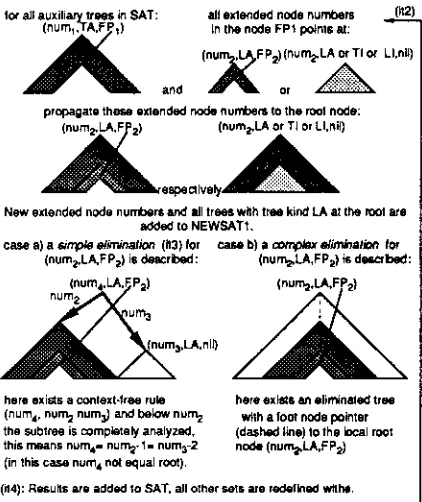
I f A C C E P T = true t h e n w E L(G) e l s e w ~ L(G); ft. Figure 3 illustrates the recursion step (tag6) for a single, but arbitrary innermost tree represent- ing an auxiliary tree with the root node number numl.
for all auxiliary trees in SAT: all extended node numbers (it2) . ( n u r n l , ~ A , F / ~ r ) in the node FP1 points at:
(nurn~,l.A~FP2) (num2,LA or TI or LI,nil)
and . ~ or A
propagate these exlanded node numbers to the mot node:
New exlended node numbers and all trees with tree kind LA at the root are
added to NEWSATI.
case a) a s/n'p/e elirru'nation (it3) for case b) a coml~x elimlnation for
(num2,LA.F P2) is de~rbed: (num2,LA,FP2) is deeo'bed: (num4'LA'~FP2)
' ~
num~
3,LA,nlI)
here exists a context-free rule here exists an eliminated tree
(nurn,p nurn 2 num3) and below nurn 2 with a foot node pointer
the subtree is cornpiste¥ analyzed, (dashed line) to the Iooal root
this means nurn 4. nurn 2. I - nurn3-2 node (num2,LA,FP2) (in this case nurn 4 not equal root).
(it4): Results are added to SAT, all other sels are redefined wlthe. START " End of recurrJon (It0) M1er at most n-1 interations (Itl).
Figure 3: Illustration of the step of recursion Here, the question of correctness is not dis- cussed in more detail (see [Harbusch 89]). It should be intuitively clear with the correspon- dence between the derivation definition and it's interpretation in the recursion step.
Actually, the main emphasis lies on the ex- planation of the time complexity (for the formal proof see [Harbusch 89]). A good intuition can be won by concentrating for a first glance on a single, but arbitrary TAG derivation tree 6 for w = tz...tn in the triangle m a t r i x after step one. It is clear t h a t (i contains at most n-1 adjoinings, because each TAG tree must produce at least one terminal. Therefore the recursion, which finds in- dependent (unnested) adjoinings simultaneously (after elimination of nested adjoinings identified in the last recursion step), terminates definitively after n-1 loops.
At the beginning, at most O(n 2) innermost trees can exist in the triangle matrix. Each ter-
2 9 0
minal can be a leaf in a constant number of ele- mentary trees and with an indegree of O(n-1) in row 1 of the triangle matrix, the number of oc- curences of elementary trees containing the input symbol tl (1 .< i < n) encoded in the invariant after step one is restricted.
Since an elimination is defined along the path between root and foot node of an auxiliary tree, which has at least length 1 (i.e., root and foot node are father and son), the foot node informa- tion is always propagated to a higher row in the triangle matrix. T h e triangle m a t r i x has depth n so that the information of a node in ~f - - our explicitly chosen derivation tree - - can only be passed to O(n-1) nodes because each node has indegree 1 in a derivation tree. T h e passing of information (propagation) stands for the elimi- nation of O(n-1) innermost trees along the path to the root node. So, the invariant of that node (a constant number of ENNs) can be propagated to O(n) nodes. As a result, the number of in- variants at a node increases to O(n). This must be done for all nodes (O(n2)) so t h a t the overall number of steps to find a special, but arbitrary TAG derivation tree is O(n3).
These suggestions can be used as a basis for finding all derivation trees in parallel instead of a single, but arbitrary one, because all intermedi- ate states in the triangle m a t r i x are shared. The only difference is t h a t the indegree of a node can- not be restricted to 1, but to O(n) so that the exponent 3 increases to 4. T h e extension "log n" results from storing the foot node pointers, where addresses have to be represented instead of num- bers of other cells as in the
Vijay-Shanker-Joshi
approach.
In other words, an intuition for an upper time bound of the algorithm is that the recursion step can be seen as a CKY analysis, because particu- larly neighboring subtrees are combined to build a larger structure, where the constant number of nonterminals in a cell has to be replaced by O(n) candidates (O(n 3) x n).
Another intuition gives a comparison with the
Vijay.Shanker
andJoshi
approach. It is obvious that our new approach has a different time bound for the best and the worst case, because all possi- bilities violating the necessary condition to have a context-free derivation are filtered out before step two is started. In theVijay-Shanker
andJoshi
ap- proach for all context-free subtrees of the triangle matrix, the invariant is computed. But this fact doesn't modify the upper time bound. T h e main difference lies in the execution time for the two different invariants. In theVijay-Shanker.Joshi
[image:7.612.86.297.226.477.2]the triangle matrix.
For both approaches, the integration of TAGs with Constraints is mentioned in common. For the new approach, this extension is obligatory be- cause the normal form transformation produces a TAGC. Anyway, this additional computation doesn't change the upper time bound, because constraints are local and their satisfaction has only to be tested iff an innermost tree should be eliminated ( i.e., a stack pointer has to be
extended). In this case it had to be checked
whether all obligatory constraints in the elimi- nated tree are satisfied and whether the adjoining was allowed (by analyzing to which tree the rule of the incoming edge in the root node belongs and what constraint the end point of that edge has).
5
S U M M A R Y
In the application domain of natural language processing, the execution time in an average case is of great interest as well. For the new parsing algorithm, a result is not yet known, but in basic considerations the main idea is to take the depth of analyzed parts of derivation trees as a constant term to come up with a result of O(n3).
Actually, an implementation of the presented formalism exists written in Common LISP on a Hewlett Packard machine of the 9000 series (for more details about the implementation see [Buschauer et al. 89]). To give an idea of the re- sponse time, the analysis of a sentence of about 10 to 15 words and a grammar of about 20 to 30 ele- mentary trees takes at most 6 milliseconds. Cur- rently, this implementation is extended to build a workbench supporting a linguist in writing and testing large TAG grammars (respectively TAGs with Unification).
Finally, other approaches for TAG parsing should be mentioned and compared with the pre-
sented result. In the literature, the two Ear-
leybased approaches of Schabes and Joshi (see
[Schabes, Joshi 89]) and of Lang ([Lang 86]) are
proposed. The lowest upper time bound for the Schabes.Joshi approach is O(n 9) and for the ap-
proach of Lang O(n6). But both algorithms come
up with better results in the best and in the av- erage case. In the framework of parallel parsing, results for TAGs are also proposed. In [Palis et al. 87] a linear time approach on O(n 5) proces- sors and in [Palis, Shende 88] a sublinear (O(log 2 n)) algorithm is described.
One future perspective is to parallelize the new approach by the same method so that the expected result should be a linear time bound on O(n 2) processors. More concretely, an op- timal layout for two processors is looked for, where independent subtrees have to be specified (candidates are not always total innermost trees, e.g., if only one TAG derivation exists where all innermost trees are nested).
Further on, we concentrate on appropriate ex- tensions of the TAG formalism for analysis as well
as generation of natural language with the ambi-
tious aim to verify that TAGs (in some extension)
are appropriate for a bidirectional and integrated
description of syntax, semantics and pragmatics.
2 9 1
A C K N O W L E D G E M E N T S
This paper is based on thesis work done under
supervision of Wolfgang Wahlster and Gffnther
Hotz. I would like to gratefully acknowledge Hans
Arz, Bela Buschauer, G*inther Hotz, Paul Moli-
tor, Peter Poller, Anne Schauder and Wolfgang
Wahlster for their valuable interactions.
I would like to thank Aravind Joshi for his helpful
comments in earlier discussions and especially on this paper.
R E F E R E N C E S
B. Buschauer, P. Poller, A. Schauder, K. Har-
busch. 1989. Parsing yon TAGs mit Unifikation.
Saarbriicken, F.R.G.: "AI-Laboratory" Memo, Dept. of Computer Science, Univ. of Saarland.
K. Harbusch. 1989. E•ziente Strukturanalyse
nat~irlicher Sprache mit Tree Adjoining Gram.
mars. PhD Thesis, Saarbriicken, F.R.G.: Dept.
of Computer Science, Univ. of Saarland.
J. E. Hopcroft, J. D. Ullman. 1979. In.
troduction to Automata Theory, Languages, and
Computation. Addison-Wesley, Reading, Mas-
sachusetts.
A. K. Joshi. 1985. An Introduction to Tree Ad-
joining Grammars. Philadelphia, Pennsylvania:
Technical Report MS-CIS-86-64, Dept. of Com- puter and Information Science, Moore School, Univ. of Pennsylvania.
A. K. Joshi, L. S. Levy, M. Takahashi. 1975.
Tree Adjoining Grammars. Journal of Computer
and Systems Science 10:1, Seite 136-163.
T. Kroch, A. K. Joshi. 1985 Linguistic Rel-
evance of Tree Adjoining Grammars. Philadel-
phia, Pennsylvania: Technical Report MS-CIS- 85-16, Dept. of Computer and Information Sci- ence, Moore School, Univ. of Pennsylvania.
B. Lang. 1989 forthcoming. A Uniform Frame-
work for Parsing, Proceedings of the Interna-
tional Workshop on Parsing Technologies in Pitts- burgh, 28~h-31 rd of August.
G. Pullum. 1984. On Two Recent Attempts to
Show That English ls Not a CFL. Computational
Linguistics 10(4): 182-186.
M. A. Pallis, S. Shende, D. S. L. Wet. 1987. An Optimal Linear-Time Parallel Parser for Tree
Adjoining Languages. Philadelphia, Pennsyl-
vania: Technical Report MS-CIS-87-36, Dept. of Computer and Information Science, Moore School, Univ. of Pennsylvania.
Y. Schabes, A. Joshi. 1988. An Earley-Type
Parsing Algorithm for Tree Adjoining Grammars. Philadelphia, Pennsylvania: Technical Rep.MS- CIS-88-36, Dept. of Computer and Information Science, Moore School, Univ. of Pennsylvania.
S. M. Shieber. 1985. Evidence against the
Context.Freeness of Natural Language. Linguis-
tics and Philosophy 8: 333-343.
K. Vijay-Shanker. 1987. A Study of Tree Ad-
joining Grammars. Philadelphia, Pennsylvania:
PhD Thesis, Dept. of Computer and Information Science, Moore School, Univ. of Pennsylvania.
K. Vijay-Shanker, A. K. Joshi. 1985.
Some Computational Properties o/ Tree Adjoin-
ing Grammars. Chicago, Illinois: Proceedings of