MultiLing 2017 Overview
George Giannakopoulos
NCSR “Demokritos”, Greece
John M. Conroy
IDA / Center for Comp. Sciences, U.S.A
Jeff Kubina
U.S. Dep. of Defense, U.S.A
Peter A. Rankel
Elder Research, U.S.A
Elena Lloret
Univ. of Alicante, Spain
Josef Steinberger
Univ. of West Bohemia, Czech Republic
Marina Litvak
Shamoon College of Engineering, Israel
Benoit Favre
LIF, France
Abstract
In this brief report we present an overview of the MultiLing 2017 effort and work-shop, as implemented within EACL 2017. MultiLing is a community-driven initia-tive that pushes the state-of-the-art in Automatic Summarization by providing data sets and fostering further research and development of summarization sys-tems. This year the scope of the work-shop was widened, bringing together re-searchers that work on summarization across sources, languages and genres. We summarize the main tasks planned and implemented this year, also providing in-sights on next steps.
1 Overview
MultiLing covers a variety of topics on Natural Language Processing, focused on the multilingual aspect of summarization:
• Multilingual summarization across genres and sources: Summarization has been re-ceiving increasing attention during the last years. This is mostly due to the increasing volume and redundancy of available online information but also due to the user created content. Recently, more and more interest arises for methods that will be able to func-tion on a variety of languages and across dif-ferent types of content and genres (news, so-cial media, transcripts).
This topic of research is mapped to different community tasks, covering different genres and source types:
– Multilingual single-document summa-rization (Giannakopoulos et al., 2015);
– user-supplied comments summarization (OnForumS task (Kabadjov et al., 2015));
– conversation transcripts summarization (see also (Favre et al., 2015)).
The spectrum of the tasks covers a vari-ety of real settings, identifying individual re-quirements and intricacies, similarly to pre-vious MultiLing endeavours (Giannakopou-los et al., 2011a; Giannakopou(Giannakopou-los, 2013; El-hadad et al., 2013; Giannakopoulos et al., 2015).
• Multilingual summary evaluation: Sum-mary evaluation has been an open question for several years, even though there exist methods that correlate well to human judge-ment, when called upon to compare systems. In the multilingual setting, it is not obvious that these methods will perform equally well to the English language setting. In fact, some preliminary results have shown that several problems may arise in the multilingual set-ting (Giannakopoulos et al., 2011a). The same challenges arise across different source types and genres. This aspect of the work-shop aims to cover and discuss these research problems and corresponding solutions. The workshop builds upon the results of a set of research community tasks, which are elabo-rated on in the following paragraphs. However, this year MultiLing also hosts works beyond the tasks themselves, but still within the scope of au-tomatic summarization and evaluation in different genres and settings.
2 Community Tasks
In this year’s MultiLing community effort we are implementing the following tasks:
• Multilingual Single-Document Summariza-tion (MSS)
• Multilingual Summary Evaluation (MSE)
• Online Forum Summarization (OnForumS)
• Call Centre Conversation Summarization (CCCS)
• Headline Generation Task (HG)
Due to time limitations, all but the MSS and OnForumS tasks will run beyond the workshop timespan, thus the proceedings will be comple-mented by the proceedings addendum 1,
contain-ing system reports and evaluation results.
3 Multilingual Single-Document Summarization Task Overview
The Multilingual Single-document Summariza-tion 2017 posed a task to measure the performance of multilingual, single-document, summarization systems using a dataset derived from the featured articles of41Wikipedias. The objective was to as-sess the performance of automatic summarization techniques on text documents covering a diverse range of languages and topics outside the news do-main. This section describes the task, the dataset and the methods to be used to evaluate the sub-mitted summaries. To give amble time for eval-uation the results and analysis will be presented at the workshop and published later. The objec-tive of this task, like the2015Multilingual Single-document Summarization Task, was to stimulate research and assess the performance of automatic single-document summarization systems on docu-ments covering a large range of sizes, languages, and topics.
3.1 Task and Dataset Description
Each participating system of the task was to com-pute a summary for each document in at least one of the datasets 41 languages. To remove any potential bias in the evaluation of generated summaries that are too small, the human sum-mary length in characters was provided for each test document and generated summaries were ex-pected to be close to it.
1Cf. http://multiling.iit. demokritos.gr/pages/view/1638/
multiling-2017-proceedings-addendum.
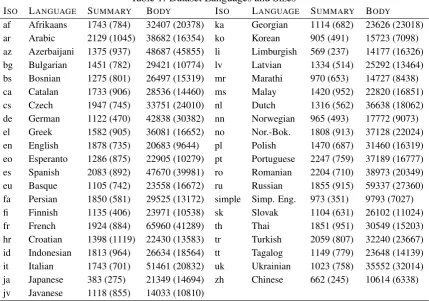
The testing dataset was created using the same steps as reported in Section 2 of (Giannakopou-los et al., 2015) and excluded the articles in the training dataset (which was the testing dataset for the task in2015). For each language Table 1 con-tains the mean character size of the summary and body of the articles selected for the test dataset. Within the dataset there is no correlation between the summary and body size of the articles, in fact, the variance in the summary size is small. This is likely because Wikipedia style requirements dic-tate that a summary be at most four paragraphs,2
regardless of article size, and paragraphs be rea-sonably sized.3
3.2 Preprocessing and Evaluation
For the evaluation the baseline summary for each article in the dataset was the prefix substring of the article’s body text having the same length as the human summary of the article. An oracle sum-mary was also computed for each article using the combinatorial covering algorithm in (Davis et al., 2012) by selecting sentences from its body text to cover the tokens in the human summary using as few sentences as possible until its size exceeded the human summary, upon which it was truncated. Preprocessing of all the submitted and human summaries was performed using the Natural Lan-guage Toolkit (Bird et al., 2009). Sentence split-ting was done usingpunkt(). Models based on the Wikipedia data were built for each language. For each summary the pre-processing steps were:
1. all multiple white-spaces and control charac-ters are convert to a single space
2. any leading space is removed
3. the resulting text string is truncated to the hu-man summary length
4. the text is tokenized and, if possible, lemma-tized
5. all tokens without a letter or number are dis-carded
6. all remaining tokens are lowercased.
2https://en.wikipedia.org/wiki/ Wikipedia:LEAD
Table 1: Dataset Languages and Sizes
ISO LANGUAGE SUMMARY BODY ISO LANGUAGE SUMMARY BODY
af Afrikaans 1743 (784) 32407 (20378) ka Georgian 1114 (682) 23626 (23018)
ar Arabic 2129 (1045) 38682 (16354) ko Korean 905 (491) 15723 (7098)
az Azerbaijani 1375 (937) 48687 (45855) li Limburgish 569 (237) 14177 (16326)
bg Bulgarian 1451 (782) 29421 (10774) lv Latvian 1334 (514) 25292 (13464)
bs Bosnian 1275 (801) 26497 (15319) mr Marathi 970 (653) 14727 (8438)
ca Catalan 1733 (906) 28536 (14460) ms Malay 1420 (952) 22820 (16851)
cs Czech 1947 (745) 33751 (24010) nl Dutch 1316 (562) 36638 (18062)
de German 1122 (470) 42838 (30382) nn Norwegian 965 (493) 17772 (9073)
el Greek 1582 (905) 36081 (16652) no Nor.-Bok. 1808 (913) 37128 (22024)
en English 1878 (735) 20683 (9644) pl Polish 1470 (687) 31460 (16319)
eo Esperanto 1286 (875) 22905 (10279) pt Portuguese 2247 (759) 37189 (16777)
es Spanish 2083 (892) 47670 (39981) ro Romanian 2204 (710) 38973 (20349)
eu Basque 1105 (742) 23558 (16672) ru Russian 1855 (915) 59337 (27360)
fa Persian 1850 (581) 29525 (13172) simple Simp. Eng. 973 (351) 9793 (7027)
fi Finnish 1135 (406) 23971 (10538) sk Slovak 1104 (631) 26102 (11024)
fr French 1924 (884) 65960 (41289) th Thai 1851 (951) 30549 (15203)
hr Croatian 1398 (1119) 22430 (13583) tr Turkish 2059 (807) 32240 (23667)
id Indonesian 1813 (964) 26634 (18564) tt Tagalog 1149 (779) 23648 (14139)
it Italian 1743 (701) 51461 (20832) uk Ukrainian 1023 (758) 35552 (32014)
ja Japanese 383 (275) 21349 (14694) zh Chinese 662 (245) 10614 (6338)
jv Javanese 1118 (855) 14033 (10810)
As of the time of publication of the proceedings, three teams have participated and automatic meth-ods of scoring the subumissions, using ROUGE (Lin, 2004) and MeMoG (Gia, ), are underway and will be presented at the EACL 2017 workshop. A human evaluation will proceed afterwards.
4 OnForumS Task
Further to the pilot of OnForumS in 2015, we or-ganized the task again in 2017 with a brand new dataset. The OnForumS task investigates how the mass of comments found on news providers web sites can be summarized. We posit that a cru-cial initial step towards that goal is to determine what comments link to, be that either specific news snippets or comments by other users. Further-more, a set of labels for a given link may be ar-ticulated to capture phenomena such as agreement and sentiment with respect to the comment target. Solving this labelled linking problem can enable recognition of salience (e.g., snippets/comments with most links) and relations between comments (e.g., agreement).
The OnForumS task is a particular specification of the linking task, in which systems take as in-put a news article with comments and were asked to link and label (sentiment, argument) each com-ment to sentences in the article, to the article topic as a whole or to other comments. The set of possi-ble labels is for sentiment is [POS, NEUT, NEG] and the set of possible argument labels is [IN FA-VOR, AGAINST, IMPARTIAL].
This year we focus on English (The Guardian) and Italian (La Repubblica) as in the previous edi-tion and we released the 2015 test data as training data.
The 2017 text collection contains 19 English and 19 Italian articles. This year we had 4 par-ticipanting teams and together with two baselines we received9runs. The evaluation focuses on how many of the links and labels were correctly iden-tified, as in the previous OnForumS run. The next step is to manually validate the links and labels us-ing CrowdFlower.
5 MultiLingual Summary Evaluation The summary evaluation task revisits the multi-lingually applicable evaluation challenge. The aim is to introduce novel, automatic evaluation meth-ods of summary evaluation. Even though, cur-rently, systems are evaluated using the ROUGE
(Lin, 2004) and MeMoG (Gia, ) metrics, there exists a big gap between automatic methods and manual annotations, especially in non-English set-tings (Giannakopoulos et al., 2011b).
This year’s task reuses the MultiLing 2013 and 2015 single-document and multi-document sum-marization corpora and evalautions. Furthermore, we generate summary variations (often through in-ducing “noise”), which the evaluation systems will be asked to grade. These variations include:
• Sentence re-ordering;
• Random sentence replacement;
• Merging between different summaries. All the above changes will be studied, to under-stand the strengths and weaknesses of different evaluation methods with respect to these synthetic deviations. Then, a human evaluation will be con-ducted to see whether humans respond similarly to the automatic methods with respect to the different noise types.
The aim of this task and study is to understand how variations of text change its perceived qual-ity of a summary. It also aims to highlight the (in)sufficiency of existing methods in the multi-lingual setting and promote new, more robust ap-proaches for summary evaluation.
6 Tasks in preparation
6.1 Headline Generation
The Headline Generation (HG) task aims to ex-plore some of the challenges highlighted by cur-rent state of the art approaches on creating infor-mative headlines to news articles: non-descriptive headlines, out-of-domain training data, and gen-erating headlines from long documents which are not well represented by the head heuristic. This task has been previously addressed in past summa-rization challenges, such as the well-known Doc-ument Understanding Conferences (DUC) for the 2002, 2003 or 2004 editions.
With the high-rate of information increase, novel summarization methods that could condense and extract relevant information in just one sen-tence (i.e., headlines) would perfectly fit in today’s society for creating better information access and processing tools. We will rerun the headline gen-eration task in DUC42002, 2003, 2004 conditions
in order to create comparable results, and deter-mine to what extent the techniques and methods have improved with respect to former participants. Moreover, we will encourage multilingual or cross-lingual approaches able to generate head-lines for at least two languages. We expect to make available a large set of training data for headline generation, and create evaluation conditions to ob-jectively assess and compare different approaches.
6.2 Call Centre Conversation Summarization
The Call Centre Conversation Summarization (CCCS) task — run for the first time as a pilot task in 2015 — consists in automatically gener-ating summaries of spoken conversations in the form of textual synopses that shall inform on the content of a conversation and might be used for browsing a large database of recordings. As in CCCS 2015, participants to the task shall gener-ate abstractive summaries from conversation tran-scripts that inform a reader about the main events of the conversations, such as the objective of the participants and how they are met. Evaluation will be performed by ROUGE-like measures based on human-written summaries as in CCCS 2015, and — if possible — will be coupled by manual evalu-ation, depending on the funding we can secure for the task.
7 Conclusion
This year MultiLing covers a number of challeng-ing problems related to summarization. In the pro-ceedings (and the addendum) one can find vari-ous methods using deep learning and word embed-dings, topic modeling, optimization and other ap-proaches to achieve summarization and summary evaluation across settings.
The rest of the proceedings will allow the reader to examine interesting challenges related to ab-stractive summarization, argument labeling, multi-genre, multi-document and query-based summa-rization. They will also identify and attemp to tackle important challenges related to summary evaluation beyond English.
We hope that the conclusion of the tasks after the workshop will provide the grounds for further research and open systems development, revising and improving the way summarization is modeled, faced, evaluated and implemented in the years to come.
8 Acknowledgements
This work was supported by project MediaGist, EUs FP7 People Programme (Marie Curie Ac-tions), no. 630786, MediaGist.
References
Steven Bird, Ewan Klein, and Edward Loper. 2009.
Natural language processing with Python: analyz-ing text with the natural language toolkit. ” O’Reilly Media, Inc.”.
Sashka T. Davis, John M. Conroy, and Judith D. Schlesinger. 2012. OCCAMS - an optimal com-binatorial covering algorithm for multi-document
summarization. In12th IEEE International
Confer-ence on Data Mining Workshops, ICDM Workshops, Brussels, Belgium, December 10, 2012, pages 454– 463.
Michael Elhadad, Sabino Miranda-Jim´enez, Josef Steinberger, and George Giannakopoulos. 2013. Multi-document multilingual summarization corpus preparation, part 2: Czech, hebrew and spanish.
MultiLing 2013, page 13.
Benoit Favre, Evgeny Stepanov, J´er´emy Trione, Fr´ed´eric B´echet, and Giuseppe Riccardi. 2015. Call centre conversation summarization: A pilot task at
multiling 2015. In 16th Annual Meeting of the
Special Interest Group on Discourse and Dialogue, page 232.
Summarization system evaluation variations based on n-gram graphs.
George Giannakopoulos, Mahmoud El-Haj, Benoit Favre, Marina Litvak, Josef Steinberger, and Va-sudeva Varma. 2011a. Tac2011 multiling pilot
overview. InTAC 2011 Workshop.
George Giannakopoulos, Mahmoud El-Haj, Benoit Favre, Marina Litvak, Josef Steinberger, and Va-sudeva Varma. 2011b. Tac2011 multiling pilot
overview. InTAC 2011 Workshop.
George Giannakopoulos, Jeff Kubina, John M. Conroy, Josef Steinberger, Benoit Favre, Mijail Kabadjov, Udo Kruschwitz, and Massimo Poesio. 2015. Mul-tiling 2015: MulMul-tilingual summarization of single and multi-documents, on-line fora, and call-center
conversations. InSIGDIAL 2015.
George Giannakopoulos. 2013. Multi-document mul-tilingual summarization and evaluation tracks in acl
2013 multiling workshop. In Proceedings of the
MultiLing 2013 Workshop on Multilingual Multi-document Summarization, pages 20–28.
Mijail Kabadjov, Josef Steinberger, Emma Barker, Udo Kruschwitz, and Massimo Poesio. 2015. Onfo-rums: The shared task on online forum
Forum for Information Retrieval Evaluation, pages 21–26. ACM.
Chin-Yew Lin. 2004. Rouge: A package for
auto-matic evaluation of summaries. InText