Proceedings of NAACL-HLT 2018, pages 315–320
A Comparison of Two Paraphrase Models for Taxonomy Augmentation
Vassilis Plachouras∗1 Rathbone Square, London, UK [email protected]
Fabio Petroni
Thomson Reuters
Corporate Research & Development 30 South Colonnade, London, UK
Timothy Nugent
Thomson Reuters
Corporate Research & Development 30 South Colonnade, London, UK
Jochen L. Leidner
Thomson Reuters
Corporate Research & Development 30 South Colonnade, London, UK
Abstract
Taxonomies are often used to look up the con-cepts they contain in text documents (for in-stance, to classify a document). The more comprehensive the taxonomy, the higher re-call the application has that uses the taxonomy. In this paper, we explore automatic taxonomy augmentation with paraphrases. We compare two state-of-the-art paraphrase models based on Moses, a statistical Machine Translation system, and a sequence-to-sequence neural network, trained on a paraphrase datasets with respect to their abilities to add novel nodes to an existing taxonomy from the risk domain. We conduct component-based and task-based evaluations. Our results show that paraphras-ing is a viable method to enrich a taxonomy with more terms, and that Moses consistently outperforms the sequence-to-sequence neural model. To the best of our knowledge, this is the first approach to augment taxonomies with paraphrases.
1 Introduction
Taxonomies are resources for organizing knowl-edge and are often used in a wide range of tasks such as document classification, search and natu-ral language understanding, among others. Since developing taxonomies is a time consuming pro-cess, there has been a significant body of work on their automatic construction. However, even with the application of automatic methods, a taxonomy may not cover all concepts of interest due to is-sues in bootstrapping the automatic construction, for example the selection of seed terms, the cover-age of the data used for mining the taxonomy, or balancing the trade-off between quality and recall.
∗work conducted whilst the author was at Thomson
Reuters.
In this work, we investigate the automatic aug-mentation of an existing taxonomy using genera-tive paraphrasing. We train a statistical machine translation model and a sequence-to-sequence neural network based model on a subset of the Paraphrase Database (PPDB 2.0). We use the two models to augment an automatically mined taxon-omy of risk terms based on (Leidner and Schilder, 2010).
The research questions we address in this work are the following:
• RQ1 Can the models generate high quality
paraphrases for automatically augmenting a taxonomy?
• RQ2How much does the coverage of the
tax-onomy increase?
• RQ3 Which model is best for generating paraphrases?
We answer these research questions by assessing the quality of the generated risk phrases and quan-tifying the number of additional sentences that the generated paraphrases match in a large corpus of news articles.
2 Related Work
Paraphrase Generation. Identifying and gen-erating paraphrases has received significant atten-tion, being useful in applications ranging from nat-ural language understanding, to query expansion for example (Madnani and Dorr, 2010; Androut-sopoulos and Malakasiotis, 2010).
A number of works treat paraphrase generation as a special case of machine translation, learning to generate paraphrases based on a large number of
aligned sentence pairs from news articles (Quirk et al., 2004), extracting paraphrases from a bilin-gual parallel corpus (Bannard and Callison-Burch, 2005), or training statistical machine translation models on news headlines (Wubben et al., 2010).
Building on the recent advances in neural net-works for machine translation, seq2seq models with attention representing input as a sequence of characters (Hasan et al., 2016), or with more layers and residual connections (Prakash et al., 2016) have been trained to generate paraphrases. Mallinson, Sennrich and Lapata (2017) applied the bilingual pivoting approach (Bannard and Callison-Burch, 2005) with neural machine trans-lation, where the input sequence is mapped to a number of translations in different languages, and then these translations are mapped back to the original language.
Taxonomy Construction & Expansion Since manually creating knowledge structures, such as taxonomies, is a time consuming process, there ex-ist several methods to automate it (Medelyan et al., 2013). Meng et al. (2015) employ techniques for automatically mining taxonomies in combination with crowd-sourcing to achieve greater coverage. Subramaniam, Nanavati and Mukherjea (2010) study the problem of merging one ontology into another one, thus asymmetrically extending one of the taxonomies. Harpy (Grycner and Weikum, 2014) addresses the sparsity of subsumption hi-erarchy of Patty, a large repository of relational paraphrases (Nakashole et al., 2013). Wang et al. (2014) automatically extend a taxonomy by identifying missing categories and predict the op-timal structure based on a hierarchical Dirichlet model. The automatic placement of new con-cepts in a taxonomy has also been investigated as a shared task in SemEval 2016 (Jurgens and Pile-hvar, 2016). However, to the best of our knowl-edge, there is no work that applies generative para-phrasing to expand a taxonomy.
3 Paraphrase Generation
In this work we approach the task of generat-ing phrasal paraphrases as monolgenerat-ingual transla-tion and we train two state-of-the-art models (Sec-tion 3.1) on an existing corpus of English phrasal paraphrases (Section 3.2).
3.1 Models
The two models we train for paraphrase genera-tion are based on Moses (Koehn et al., 2007) and attention-based sequence-to-sequence (seq2seq) neural networks (Bahdanau et al., 2015).
Moses is an open-source implementation of sta-tistical machine translation models. While it sup-ports the use of additional structure such as depen-dency trees, we focus on phrase-based translation in this work and a tri-gram language model learned from the set of target paraphrases.
The attention-based seq2seq model consists of a bi-directional LSTM encoder and an LSTM de-coder which uses an attention mechanism to learn which input words are the most important for each output word.
3.2 Training and Evaluation
For training the paraphrase generation models, we use a subset of the Paraphrase Database (PPDB 2.0) corpus. The PPDB 2.0 data set is a large-scale phrasal paraphrase data set that has been mined automatically based on (Bannard and Callison-Burch, 2005), and refined with machine learning based ranking of paraphrases based on human gerated ground-truth and assignment of textual en-tailment labels for each paraphrase pair. In this work, we used the large pack of lexical (single word to single word) and phrasal (multi-word to single or multi-word) paraphrases1. Because the
data set was automatically generated, some of the paraphrase pairs are not true paraphrases. In our experiments, we kept only pairs that do not con-tain numeric digits. We also use the textual en-tailment labels with which paraphrase pairs in the data set are annotated and keep the pairs labeled as equivalent. We split the remaining data in 757,300 training data points and 39,325 test data points. The splitting is performed by first creating a graph where phrases are nodes and edges exist between the two phrases in a paraphrase pair. In this graph, we identify connected components and we assign all data points within each connected component to either the training or the test sets. This process guarantees independence between the training and the test sets.
To train Moses, we precomputed a tri-gram lan-guage from the target phrases in the training data
1PPDB 2.0 is made available in packs of increasing size,
set and used the MERT optimizer. To train the seq2seq model, we used a batch size of 256 train-ing samples, 100-unit LSTM cells for both the en-coder and the deen-coder, dropout with keep proba-bility 0.8 at the output of cells, a bidirectional en-coder, greedy 1-best search output generation cri-teria, and an additive attention function (Bahdanau et al., 2015). For representing words, we used 100 dimensional pre-trained GloVe embeddings (Pen-nington et al., 2014). We trained using the Adam optimizer and a learning rate of 0.001 and let the models train for 200,000 steps (a step is an itera-tion over a batch of training points).
For evaluation we used the BLEU score (Pap-ineni et al., 2002; Chen and Cherry, 2014). BLEU is calculated on tokenized data using the imple-mentation provided in the nltk framework2 with
NIST geometric sequence smoothing. Moses achieved a BLEU score of 0.4098 compared to 0.3156 obtained by the seq2seq model. The differ-ence in BLEU score shows that Moses is substan-tially better than the seq2seq model for the subset of PPDB 2.0 we used.
4 Taxonomy Augmentation Evaluation
After training the paraphrase generation models, we focus on augmenting the taxonomy of risks. The risk taxonomy has been automatically mined based on the method described in (Leidner and Schilder, 2010) and subsequently has been man-ually filtered to keep high quality risk terms, re-sulting in 2,824 terms.
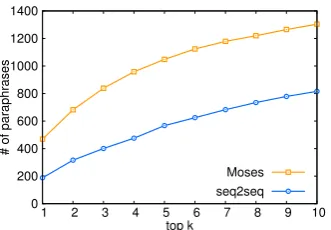
For each term in the risk taxonomy, we apply the two paraphrase generation models to obtain a maximum of top 10 paraphrased risk terms. Fig-ure 1 shows the number of generated paraphrases that are also in the original list of risk phrases. While our end goal is to generate phrases that are not in the original list of phrases, a large number of generations already appearing in the list of high-quality and manually filtered list of risk phrases is an indication of the quality of the paraphrases. As we can see from Figure 1, Moses outperforms with a wide margin the seq2seq model in gener-ating paraphrases already in the taxonomy. Ta-ble 1 shows examples of generated paraphrases by Moses and seq2seq.
Furthermore, we have manually annotated the top-1 generated paraphrases that were not already in the original risk taxonomy. Each paraphrased
2http://www.nltk.org/
0 200 400 600 800 1000 1200 1400
1 2 3 4 5 6 7 8 9 10
# of paraphrases
top k
Moses seq2seq
Figure 1: Number of top-k generated paraphrases al-ready in the list of risk phrases.
risk term was annotated as valid when it can di-rectly replace the original risk term, noisy when the meaning of the paraphrase is close to the mean-ing of the original term or the paraphrase has ad-ditional terms, andinvalidwhen the paraphrase is not suitable for substituting the original risk term. Table 2 shows for both models the number of para-phrases that were not in the original taxonomy and that were annotated with a given label.
Even though both the BLEU score and the num-ber of paraphrases that were already in the orig-inal risk taxonomy demonstrate that Moses per-forms better than seq2seq in our setting, we have also looked how often a paraphrase generated with seq2seq was annotated as being better than the paraphrase generated by Moses. For example, this is the case when one model generates a paraphrase that is annotated asvalidand the other model gen-erates for the input risk term a paraphrase that is annotated asnoisyorinvalid. We have observed that in 1211 cases, the paraphrase generated by Moses was better than the paraphrase generated by seq2seq. On the other hand, seq2seq was better only in 58 cases.
We have also looked at the lexical diversity of the generated paraphrases. We define lexical di-versity as the fraction of tokens in a paraphrase that were not in the original risk phrase. Table 3 shows that the seq2seq model results in higher lex-ical diversity than Moses for both the valid and noisy paraphrases.
[image:3.595.335.501.61.176.2]Risk Term Moses seq2seq
wind-blown debris wind-blown rubble buildings
unexpected entry of competitors unpredicted entrance of competitors accident
trafficked people trafficking in persons victims of human trafficking
demolished razed demolition
[image:4.595.108.494.62.134.2]committed fraud fraud committed the fight against fraud genetically modified food gm food genetically engineered
Table 1: Examples of paraphrases generated by Moses and seq2seq.
Model Valid Noisy Invalid Moses 1,337 337 327 seq2seq 419 175 2,042
Table 2: Number of generated paraphrases annotated as valid, noisy or invalid.
[image:4.595.100.266.179.221.2]Model Diversity (valid) Diversity (noisy) Moses 0.5455 (1,337) 0.3952 (337) seq2seq 0.6991 (419) 0.6969 (175)
Table 3: Lexical diversity of generated valid and noisy paraphrases in terms of fraction of tokens that are not in the original risk phrase.
Model Valid Noisy Moses 5,197,781 1,868,734 seq2seq 1,751,745 749,886
Table 4: The number of sentences from the news archive matching at least one of the generated valid or noisy risk paraphrases, which were not already matched by a risk phrase in the original taxonomy.
original taxonomy, corresponding to an expansion of coverage by 22%. Thevalidparaphrases gener-ated by seq2seq match 1.8M additional sentences, expanding coverage by 7.6%. A smaller increase in coverage can be achieved if we considernoisy paraphrases as well, 8.1% for Moses and 3.2% for seq2seq. However, these additional sentences may contain significantly more noise.
Overall, we have seen that the application of paraphrase generation can expand an existing tax-onomy of risk terms with high quality phrases, where 67% of the added terms by Moses have been assessed as valid paraphrases (RQ1). This has led to an increase of the coverage of the tax-onomy by 22% (RQ2). The experimental results also demonstrate that Moses outperforms the neu-ral network-based model in this setting (RQ3).
5 Discussion
Domain-specific paraphrases. During the an-notation of the generated paraphrases by the two models, we have observed a number of cases, which were annotated asinvalidbecause the gen-erated paraphrase, although it was grammatically correct and meaningful, it did not correspond to the original term in the domain of risk manage-ment. For example, the phrase “screening risk”, which refers to risks in the process of perform-ing background checks, was paraphrased to “pro-jection risk” by one of the models. Even though the latter is a grammatically correct phrase, it does not have the same meaning in the context of risk management. Similarly, the wordconcentrations has been replaced by the wordlevelsin the phrase “sector concentrations”, which may be more ap-propriate as a replacement in the domain of chem-istry. A more appropriate word to replace level would befocus. To address this issue of domain specific paraphrasing, one possible solution is to use a domain-specific corpus to train the language model used in Moses, or to pre-train the weights of the LSTM cells in the encoder and decoder of seq2seq in the context of a language modelling task (Dai and Le, 2015).
Grammatical diversity. We have quantified lexical diversity as the fraction of new words in the generated paraphrases. Another aspect of diver-sity, however, is grammatical diversity. For exam-ple, it would be interesting to quantify diversity in terms of the number of the classes of paraphrasing phenomena defined by Bhagat and Hovy (2013).
6 Conclusions
[image:4.595.101.262.395.438.2]mod-els. Our evaluation results show that Moses out-performs seq2seq in our setting and it augments the taxonomy with 67% of high quality terms, leading to an increase of coverage by 22%.
For future work, we want to investigate the im-pact of using pre-trained weights to initialize the LSTM cells in the seq2seq model from a language modelling task, as well the grammatical diversity of generated paraphrases.
References
Ion Androutsopoulos and Prodromos Malakasiotis. 2010. A survey of paraphrasing and textual entail-ment methods. J. Artif. Int. Res.38(1):135–187. Dzmitry Bahdanau, Kyung Hyun Cho, and Yoshua
Bengio. 2015. Neural machine translation by jointly learning to align and translate. InProceedings of the International Conference on Learning Representa-tions (ICLR).
Colin Bannard and Chris Callison-Burch. 2005. Para-phrasing with bilingual parallel corpora. In Pro-ceedings of the 43rd Annual Meeting on Association for Computational Linguistics. ACL ’05, pages 597– 604.
Rahul Bhagat and Eduard Hovy. 2013. What is a para-phrase? Computational Linguistics39:463–472. Boxing Chen and Colin Cherry. 2014. A systematic
comparison of smoothing techniques for sentence-level bleu.ACL 2014page 362.
Andrew M Dai and Quoc V Le. 2015. Semi-supervised sequence learning. In C. Cortes, N. D. Lawrence, D. D. Lee, M. Sugiyama, and R. Garnett, edi-tors, Advances in Neural Information Processing Systems 28, Curran Associates, Inc., pages 3079– 3087. http://papers.nips.cc/paper/ 5949-semi-supervised-sequence-learning. pdf.
Adam Grycner and Gerhard Weikum. 2014. Harpy: Hypernyms and alignment of relational paraphrases. In Proceedings of COLING 2014, the 25th In-ternational Conference on Computational Linguis-tics: Technical Papers. Dublin City University and Association for Computational Linguistics, pages 2195–2204. http://www.aclweb.org/
anthology/C14-1207.
Sadid A. Hasan, Bo Liu, Joey Liu, Ashequl Qadir, Kathy Lee, Vivek Datla, Aaditya Prakash, and Oladimeji Farri. 2016. Neural clinical paraphrase generation with attention. In Proceedings of the Clinical Natural Language Processing Workshop (ClinicalNLP). pages 42–53.
David Jurgens and Mohammad Taher Pilehvar. 2016. Semeval-2016 task 14: Semantic taxonomy enrich-ment. In Proceedings of the 10th International
Workshop on Semantic Evaluation (SemEval-2016). Association for Computational Linguistics, pages 1092–1102. https://doi.org/10.18653/ v1/S16-1169.
Philipp Koehn, Hieu Hoang, Alexandra Birch, Chris Callison-Burch, Marcello Federico, Nicola Bertoldi, Brooke Cowan, Wade Shen, Christine Moran, Richard Zens, Chris Dyer, Ondrej Bojar, Alexandra Constantin, and Evan Herbst. 2007. Moses: Open source toolkit for statistical machine translation. In
Proceedings of the 45th Annual Meeting of the As-sociation for Computational Linguistics Companion Volume Proceedings of the Demo and Poster Ses-sions. Association for Computational Linguistics, pages 177–180. http://www.aclweb.org/
anthology/P07-2045.
Jochen L. Leidner and Frank Schilder. 2010. Hunt-ing for the black swan: Risk minHunt-ing from text. In
Proceedings of the ACL 2010 System Demonstra-tions. Association for Computational Linguistics, Stroudsburg, PA, USA, ACLDemos ’10, pages 54–
59. http://dl.acm.org/citation.cfm?
id=1858933.1858943.
Nitin Madnani and Bonnie J. Dorr. 2010. Generating phrasal and sentential paraphrases: A survey of data-driven methods.Comput. Linguist.36(3):341–387.
Jonathan Mallinson, Rico Sennrich, and Mirella Lap-ata. 2017. Paraphrasing revisited with neural ma-chine translation. InProceedings of the 15th Con-ference of the European Chapter of the Association for Computational Linguistics: Volume 1, Long Pa-pers. EACL ’17, pages 881–893.
Olena Medelyan, Ian H. Witten, Anna Divoli, and Jeen Broekstra. 2013. Automatic construction of lexi-cons, taxonomies, ontologies, and other knowledge structures. Wiley Interdisciplinary Reviews: Data Mining and Knowledge Discovery 3(4):257–279.
https://doi.org/10.1002/widm.1097.
R. Meng, Y. Tong, L. Chen, and C. C. Cao. 2015. Crowdtc: Crowdsourced taxonomy construction. In
2015 IEEE International Conference on Data Min-ing. pages 913–918. https://doi.org/10.
1109/ICDM.2015.77.
Ndapandula Nakashole, Gerhard Weikum, and Fabian Suchanek. 2013. Discovering semantic relations from the web and organizing them with patty. SIG-MOD Rec. 42(2):29–34. https://doi.org/
10.1145/2503792.2503799.
Kishore Papineni, Salim Roukos, Todd Ward, and Wei-Jing Zhu. 2002. Bleu: A method for automatic eval-uation of machine translation. InProceedings of the 40th Annual Meeting on Association for Computa-tional Linguistics. ACL ’02, pages 311–318.
paraphrasing. In Proceedings of the 53rd Annual Meeting of the Association for Computational Lin-guistics and the 7th International Joint Confer-ence on Natural Language Processing (Volume 1: Long Papers). Association for Computational Lin-guistics, pages 1512–1522. https://doi.org/
10.3115/v1/P15-1146.
Jeffrey Pennington, Richard Socher, and Christopher Manning. 2014. Glove: Global vectors for word representation. In Proceedings of the 2014 Con-ference on Empirical Methods in Natural Language Processing. EMNLP ’14, pages 1532–1543.
Aaditya Prakash, Sadid A. Hasan, Kathy Lee, Vivek Datla, Ashequl Qadir, Joey Liu, and Oladimeji Farry. 2016. Neural paraphrase generation with stacked residual lstm networks. InProceedings of the 26th International Conference on Computational Linguistics: Technical Papers. COLING ’16, pages 2923–2934.
Chris Quirk, Chris Brockett, and William B. Dolan. 2004. Monolingual machine translation for para-phrase generation. InProceedings of the 2004 Con-ference on Empirical Methods in Natural Language Processing. EMNLP ’04, pages 142–149.
L. V. Subramaniam, A. A. Nanavati, and S. Mukher-jea. 2010. Enriching one taxonomy using an-other. IEEE Transactions on Knowledge and Data Engineering22(10):1415–1427. https://doi.
org/10.1109/TKDE.2009.189.
Jingjing Wang, Changsung Kang, Yi Chang, and Jiawei Han. 2014. A hierarchical dirichlet model for tax-onomy expansion for search engines. In Proceed-ings of the 23rd International Conference on World Wide Web. ACM, New York, NY, USA, WWW ’14, pages 961–970. https://doi.org/10.
1145/2566486.2568037.