Proceedings of the 57th Annual Meeting of the Association for Computational Linguistics, pages 3752–3762 3752
Comparison of Diverse Decoding Methods from Conditional Language
Models
Daphne Ippolito? Reno Kriz? Maria Kustikova Jo˜ao Sedoc Chris Callison-Burch
?Authors contributed equally
University of Pennsylvania
{daphnei,rekriz,mkust,joao,ccb}@seas.upenn.edu
Abstract
While conditional language models have greatly improved in their ability to output high-quality natural language, many NLP ap-plications benefit from being able to generate a diverse set of candidate sequences. Diverse decoding strategies aim to, within a given-sized candidate list, cover as much of the space of high-quality outputs as possible, leading to improvements for tasks that re-rank and
com-bine candidate outputs. Standard decoding
methods, such as beam search, optimize for generating high likelihood sequences rather than diverse ones, though recent work has fo-cused on increasing diversity in these meth-ods. In this work, we perform an extensive survey of decoding-time strategies for generat-ing diverse outputs from conditional language models. We also show how diversity can be improved without sacrificing quality by over-sampling additional candidates, then filtering to the desired number.
1 Introduction
Conditional neural language models, which train a neural net to map from one sequence to an-other, have had enormous success in natural lan-guage processing tasks such as machine transla-tion (Sutskever et al., 2014;Luong et al., 2015), text summarization (Nallapati et al.,2016), and di-alog systems (Vinyals and Le,2015). These mod-els output a probability distribution over the next token in the output sequence given the input and the previously predicted tokens. Since comput-ing the overall most likely output sequence is in-tractable, early work in neural machine translation found that beam search is an effective strategy to heuristically sample sufficiently likely sequences from these probabilistic models (Sutskever et al.,
2014). However, for more open-ended tasks, beam search is ill-suited to generating a set of diverse candidate sequences; this is because candidates
Beam Search
A bus is stopped at a bus stop. A bus is parked at a bus stop. A bus stopped at a bus stop in a city. A bus stopped at a bus stop at a bus stop. A bus that is parked in front of a building.
Random Sampling
[image:1.595.308.532.224.319.2]A bus parked at a bus stop at a bus stop. There is a bus that is at the station. A man standing by a bus in a city. A bus pulling away from the train station. A bus stopped at a stop on the sunny day.
Figure 1: An image with the top five captions from standard beam search and from random sampling. Note the latter set is more diverse but lower quality.
outputted from a large-scale beam search often only differ by punctuation and minor morphologi-cal variations (Li and Jurafsky,2016).
The term “diversity” has been defined in a vari-ety of ways in the literature, with some using it as a synonym for sentence interestingness or unlike-liness (Hashimoto et al.,2019), and others consid-ering it a measure of how different two or more sentences are from each other (Vijayakumar et al.,
2016; Gimpel et al., 2013). We take the latter approach, and define diversity as the ability of a generative method to create a set of possible out-puts that are each valid given the input, but vary as widely as possible in terms of word choice, topic, and meaning.
There are a number of reasons why it is de-sirable to produce a set of diverse candidate out-puts for a given input. For example, in collabo-rative story generation, the system makes sugges-tions to a user for what they should write next (Clark et al., 2018). In these settings, it would be beneficial to show the user multiple different ways to continue their story. In image captioning, any one sentence-long caption is probably missing some information about the image. Krause et al.
applica-tions that involve reranking candidate sequences, the reranking algorithms are more effective when the input sequences are diverse. Reranking di-verse candidates has been shown to improve re-sults in both open dialog and machine translation (Li et al., 2016a;Li and Jurafsky, 2016;Gimpel et al.,2013). Furthermore, in open-ended dialog, the use of reranking to personalize a model’s re-sponses for each user is a promising research di-rection (Choudhary et al.,2017).
With these sorts of applications in mind, a vari-ety of alternatives and extensions to beam search have been proposed which seek to produce a set of diverse candidate responses instead of a single high likelihood one (Li et al.,2016a;Vijayakumar et al.,2016;Kulikov et al.,2018;Tam et al.,2019). Many of these approaches show marked improve-ment in diversity over standard beam search across a variety of generative tasks. However, there has been little attempt to compare and evaluate these strategies against each other on any single task.
In this paper, we survey existing methods for promoting diversity in order to systematically in-vestigate the relationship between diversity and perceived quality of output sequences of condi-tional language models. In addition to standard beam search and greedy random sampling, we compare several recently proposed modifications to both methods. In addition, we propose the use of over-sampling followed by post-decoding clus-tering to remove similar sequences.
The main contributions of this paper can be summarized as follows:
• A detailed comparison of existing diverse de-coding strategies on two tasks: open-ended dialog and image captioning, and recommen-dations for a diverse decoding strategy. • A novel clustering-based algorithm that can
be used on the results of any decoding strat-egy to increase quality and diversity.1
2 Standard Decoding Methods
Conditional language models, which have wide applications across machine translation, text sim-plification, conversational agents, and more, gen-erally consist of an encoder, which transforms some input x into a fixed-size latent represen-tation, and a decoder which transforms these representations in order to output a conditional
1Code can be found at https://github.com/
rekriz11/DeDiv.
probability of each word in the target sequence given the previous words and the input. Let zt = f(y1, . . . , yt−1,x) represent the output of an encoder-decoder model given inputx and the sequence of tokens predicted so far,y1, . . . , yt−1, which for notational simplicity we write as y<t.
The outputzt∈RV (whereV is the cardinality of
the enumerated vocabularyV)
The probability distribution over the next possi-ble token being wordwi ∈ V is the softmax:
P(yt=wi|y<t,x) =
exp(zt,i)
PV
j=1exp (zt,j)
∀i∈ {1, . . . , V}
Most decoding strategies strive to find the most likely overall sequence, i.e. pick aˆysuch that:
ˆ
y= arg maxyP(y|x) = arg maxyQNt=1P(yt|y<t,x)
Unlike Markovian processes, no sub-exponential algorithm exists to find the optimal decoded se-quence, and thus we instead use approximations.
Arg-max The simplest approach to decoding a
likely sequence is to greedily select a word at each timestep:
ˆ
yt= arg max yt
P(yt|y<t,x)
However, because this deterministic approach typ-ically yields repetitive and short output sequences, and does not permit generating multiple samples, it is rarely used in language modelling.
Random Sampling Another option is to
ran-domly sample from the model’s distribution at ev-ery timestep. Often, a temperature parameter T is added to control the entropy of the distribution before sampling.
P(yt=wi|y<t,x) =
exp(zt,i/T)
PV
j=1exp (zt,j/T)
∀i∈ {1, . . . , V}
ˆ
yt∼yt
Choosing a temperature greater than one causes outputs to look increasingly more random, while bringing the temperature less than zero causes sequences to increasingly resemble greedy sam-pling.
at each step (Fan et al., 2018; Radford et al.,
2019). We find that top-srandom sampling’s hard-restriction on generating low probability words is more effective at controlling the stochasticity of sampled sequences than sampling with tempera-ture.
Beam Search Beam search approximates
find-ing the most likely sequence by performfind-ing breadth-first search over a restricted search space. At every step of decoding, the method keeps track ofbpartial hypotheses. The next set of partial hy-potheses are chosen by expanding every path from the existing set ofbhypotheses, and then choosing thebwith the highest scores. Most commonly, the log-likelihood of the partial sequence is used as the scoring function. We use this as our baseline.2 Since beam search only explores a limited por-tion of the overall search space, it tends to yield multiple variants of the same high-likelihood se-quence, sequences that often only differ in punc-tuation and minor morphological changes (Li and Jurafsky,2016). Therefore, standard beam search is not ideal for producing diverse outputs.
3 Extensions to Beam Search
In this section, we will discuss a variety of meth-ods that have been developed recently to eliminate redundancy during decoding and generate a wider range of candidate outputs.
Noisy Parallel Approximate Decoding
Intro-duced byCho (2016), NPAD is a technique than can be applied to any decoding setting. The main idea is that diversity can be achieved more naturally by taking advantage of the continuous manifold on which neural nets embed language. Instead of encouraging diversity by manipulat-ing the probabilities outputted from the model, diverse outputs are instead produced by adding small amounts of noise to the hidden state of the decoder at each step. The noise is randomly sam-pled from a normal distribution. The variance is gradually annealed from a startingσ0 to 0 as de-coding progresses (that isσt = σt0) under the
rea-soning that uncertainty is greatest at the beginning of decoding. NPAD can be used in conjunction with any decoding strategy; following the best re-sults from the original paper, we show rere-sults us-ing NPAD with beam search.
Extensions to NPAD have sought to learn the direction in which to manipulate the hidden states
2We present the beam search algorithm in the appendix.
using an arbitrary decoding objective (Gu et al.,
2017). Since such objectives can be highly domain-specific, we do not evaluate this method.
Top-g Capping In beam search, it is often the
case that one hypothesis h is assigned a much higher probability than all other hypotheses, caus-ing all hypotheses in the next step to havehas their parent. Following Li and Jurafsky(2016) and Li et al.(2016b), we add an additional constraint to standard beam search to encourage the model to choose options from diverse candidates. At each step t, current hypotheses are grouped according to the parental hypothesis they come from. Af-ter grouping candidates, only the topgfrom each grouping are considered. The resultingb×g can-didates are ranked, and the top b are selected as hypotheses for the next beam step.
Hamming Diversity Reward Vijayakumar
et al. (2016) proposes adding an additional diversity-promoting term, θ, to the log-likelihood before reranking. This term measures how differ-ent a candidate hypothesisc(≤i)t is from the partial hypotheses selected in the previous step. Let
Ht−1 = {c(1)≤t−1, . . .c (b)
≤t−1} be these partial hy-potheses. Then the beam search scoring function for theith candidate at timesteptbecomes:
score(c(≤i)t) =
t
X
j=1
( logP(c(ji)|c(<ji),x))
+λθ(c(≤i)t,Ht−1)
whereλis a tunable hyperparameter.Vijayakumar et al.(2016) try a variety of definitions forθ, in-cluding embedding diversity andn-gram diversity, but they find that Hamming distance, the number of tokens in the candidate sequence which exist in the previously selected partial hypotheses, is most effective. We take the negative of the Hamming distance asθ.
Iterative Beam Search In an attempt to
im-prove the size of the search space explored without sacrificing runtime,Kulikov et al.(2018) propose an iterative beam search method. Beam search is run many times, where the states explored by subsequent beam searches are restricted based on the intermediate states explored by previous itera-tions. Formally, we can define the set of all par-tial hypotheses for beam search instanceiat time step t as Ht(i). From here, the search space ex-plored by beam search instanceican be expressed asSi = ∪Tt=1H
(i)
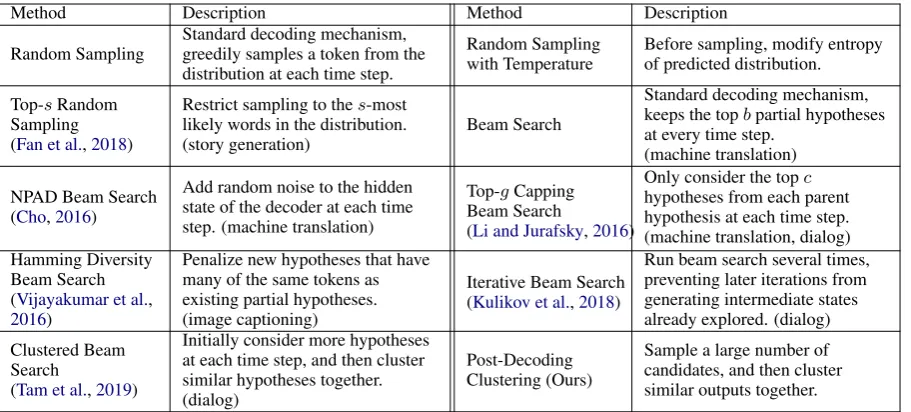
pre-Method Description Method Description Random Sampling
Standard decoding mechanism, greedily samples a token from the distribution at each time step.
Random Sampling with Temperature
Before sampling, modify entropy of predicted distribution. Top-sRandom
Sampling (Fan et al.,2018)
Restrict sampling to thes-most likely words in the distribution. (story generation)
Beam Search
Standard decoding mechanism, keeps the topbpartial hypotheses at every time step.
(machine translation) NPAD Beam Search
(Cho,2016)
Add random noise to the hidden state of the decoder at each time step. (machine translation)
Top-gCapping Beam Search
(Li and Jurafsky,2016)
Only consider the topc
hypotheses from each parent hypothesis at each time step. (machine translation, dialog) Hamming Diversity
Beam Search (Vijayakumar et al.,
2016)
Penalize new hypotheses that have many of the same tokens as existing partial hypotheses. (image captioning)
Iterative Beam Search (Kulikov et al.,2018)
Run beam search several times, preventing later iterations from generating intermediate states already explored. (dialog) Clustered Beam
Search
(Tam et al.,2019)
Initially consider more hypotheses at each time step, and then cluster similar hypotheses together. (dialog)
Post-Decoding Clustering (Ours)
[image:4.595.74.530.61.267.2]Sample a large number of candidates, and then cluster similar outputs together.
Table 1: Brief high-level descriptions of each decoding method we consider in this paper. In parentheses we give the applications on which the technique was originally applied.
vented from generating any partial hypothesis that has previously been generated, that is, any hypoth-esis found inS<i=∪ii−0=01Si0.
The authors also attempt a soft inclusion cri-terion, where any states within Hamming dis-tance from a previously explored state are also excluded. During the experimentation of Ku-likov et al.(2018), however, the soft-inclusion was found to not be beneficial; thus, we only restrict exact matches of previous states in our implemen-tation. In practice, this means after the first beam search instance runs as normal, the first step of the second beam search instance will contain theb+1 to 2b-most likely starting tokens; this pattern holds for the third beam search instance, and so on.
Clustered Beam Search Most recently, Tam
et al. (2019) proposed a clustering-based beam search method to help condense and remove meaningless responses from chatbots. Specifi-cally, at each decoding stept, this method initially considers the top2∗bcandidates. From there, each candidate sequence is embedded3, and the embed-dings are clustered intocclusters usingK-means. Finally, we take the top bc candidates from each cluster. Note that in the case any clusters have size less than bc, we then include the highest-ranked candidates not found after clustering.
3We followTam et al.(2019) and used averaged GloVe
word embeddings (Pennington et al.,2014).
4 Clustering Post-Decoding (PDC)
In the previous section, we discuss several diversity-promoting methods that can be applied during the decoding process. However, it is also possible to encourage additional diversity post-hoc. On the task of sentence simplification, after decoding using a large-scale diversity-promoting beam search (beam size 100), Kriz et al. (2019) then clustered similar sentences together to fur-ther increase the variety of simplifications from which to choose. Document embeddings gener-ated via Paragraph Vector (Le and Mikolov,2014) were used as the sentence embeddings with which to performK-means.
In this work, we extend this post-decoding clus-tering idea in three key ways. First, we make use of sentence-level embeddings which lever-age the pre-trained langulever-age representations from the Bidirectional Encoder Representations from Transformers (BERT) (Devlin et al.,2018).4 Sec-ond, after clustering, Kriz et al. (2019) took the sentence closest to the centroid of each cluster as the representative candidate; we instead choose the highest-ranked candidate (according to log-likelihood) from each cluster to ensure the best candidates are still selected. Finally, after per-forming standard K-means clustering, we found that it was often the case that some clusters con-tained large numbers of good candidates, while others contained very few candidates that are also
4BERT sentence-level embeddings were obtained using
either ungrammatical or otherwise inferior. Thus, in our implementation, we remove clusters con-taining two or fewer sentences, and then sample a second candidate from each of the remaining clus-ters, prioritizing selecting candidates from larger clusters first.
5 Experimental Setup
We evaluate the decoding strategies described in the previous sections under the following settings. For each of the published beam search algorithms, we choose the hyperparameters that were found to be best in the original publications.
RS Random sampling with temp = 0.5, 0.7, 1.0, or 1.0 with top-10 capping. Standard BS Standard beam search
Top5Cap BS Top-gcapping withg= 3
Iter5 BS Iterative beam search with 5 iterations HamDiv0.8 BS Hamming Diversity withλ= 0.8
Cluster5 BS Clustered beam search with 5 clusters NPAD0.3 BS Noisy Decoding withσ0= 0.3 For random sampling, we sample 10 outputs, and with beam-search based methods, we use a beam size of 10 to generate 10 outputs. In ad-dition, we show results from oversampling then filtering. We use a beam size of 100 or gener-ate 100 samples through random sampling, and then we select 10 from the 100, either through post-decoding clustering (PDC) or by taking the 10 candidates with highest likelihood.
We examine these decoding strategies on two tasks: open ended dialog and image captioning. For each task, we evaluate both the quality and di-versity of the 10 outputs from each strategy.
5.1 Open-ended Dialog Task
In the dialog domain, we use an LSTM-based sequence-to-sequence (Seq2Seq) model imple-mented in the OpenNMT framework (Klein et al.,
2017). We match the model architecture and train-ing data of Baheti et al. (2018). The Seq2Seq model has four layers each in the encoder and de-coder, with hidden size 1000, and was trained on a cleaned version of OpenSubtitles (Tiedemann,
2009) to predict the next utterance given the pre-vious one.
Evaluation is performed on 100 prompts from the Cornell Movie Dialog Corpus ( Danescu-Niculescu-Mizil and Lee, 2011). These prompts are a subset of the 1000 prompts used in Baheti et al. (2018), which were filtered using item re-sponse theory for discriminative power.
We report perplexity (PpL), averaged over all
the top 10 outputs for each example.5 Since the quality of open-ended dialog is notoriously difficult to evaluate automatically, we ran a hu-man evaluation task on Amazon Mechanical Turk where annotators were shown a prompt and 5 po-tential responses generated by any of our decoding methods. Evaluators were asked to provide binary ratings on fluency, adequacy, and interestingness for each response. Overall, we collected 3 hu-man judgments for each of the top ten responses for each of our decoding methods; in other words, we collected 3,000 judgments per method.6
5.2 Image Captioning Task
For image captioning, we use a state-of-the-art model introduced in Anderson et al. (2018). We take advantage of Luo (2017)’s open-source implementation and released model parameters trained on MSCOCO (Lin et al.,2014). We evalu-ate on a test set containing 5000 images.
We report Semantic Propositional Image Cap-tion EvaluaCap-tion (SPICE) scores, an automatic eval-uation metric that has been shown to correlate well with human judgments of quality(Anderson et al., 2016). SPICE measures how well the se-mantic scene graph induced by the proposed cap-tion matches one induced by the ground truth. In addition to computing SPICE on the top-scoring caption (SPICE@1), we followVijayakumar et al.
(2016) in reporting Oracle SPICE@10 scores. This is done to show the upper bound on the po-tential impact diversity can have. We also com-pute the mean SPICE score across all of the candi-date captions for an image. Unlike SPICE@1 and SPICE@10, this metric shows the overall quality ofallof the candidate captions, which is useful to know for applications that combine diverse candi-date output sequences (Krause et al.,2017).
5.3 Evaluating Diversity
To measure the diversity across the generated can-didate sequences for a given input, we report Dist-k, the total number of distinct k-grams divided by the total number of produced tokens in all of the candidate responses for a prompt (Li et al.,
2016a). We report Dist-2 and Dist-4 averaged over the prompts in the test set.
5
This differs from existing work which computes perplex-ity over only the top output for each example. For our task we are interested in the quality of all of the generated responses.
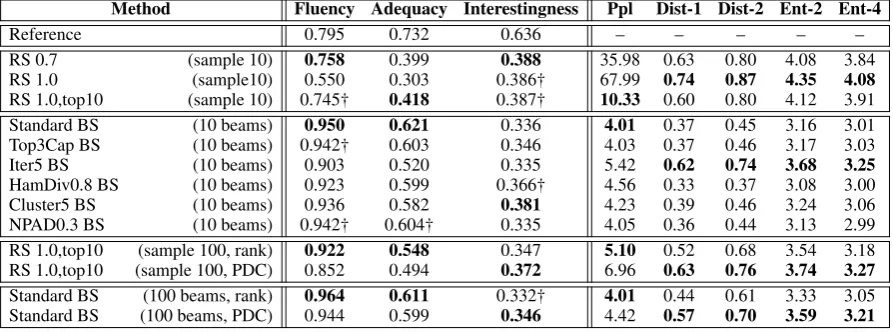
Method Fluency Adequacy Interestingness Ppl Dist-1 Dist-2 Ent-2 Ent-4
Reference 0.795 0.732 0.636 – – – – –
RS 0.7 (sample 10) 0.758 0.399 0.388 35.98 0.63 0.80 4.08 3.84 RS 1.0 (sample10) 0.550 0.303 0.386† 67.99 0.74 0.87 4.35 4.08 RS 1.0,top10 (sample 10) 0.745† 0.418 0.387† 10.33 0.60 0.80 4.12 3.91 Standard BS (10 beams) 0.950 0.621 0.336 4.01 0.37 0.45 3.16 3.01 Top3Cap BS (10 beams) 0.942† 0.603 0.346 4.03 0.37 0.46 3.17 3.03 Iter5 BS (10 beams) 0.903 0.520 0.335 5.42 0.62 0.74 3.68 3.25 HamDiv0.8 BS (10 beams) 0.923 0.599 0.366† 4.56 0.33 0.37 3.08 3.00 Cluster5 BS (10 beams) 0.936 0.582 0.381 4.23 0.39 0.46 3.24 3.06 NPAD0.3 BS (10 beams) 0.942† 0.604† 0.335 4.05 0.36 0.44 3.13 2.99 RS 1.0,top10 (sample 100, rank) 0.922 0.548 0.347 5.10 0.52 0.68 3.54 3.18 RS 1.0,top10 (sample 100, PDC) 0.852 0.494 0.372 6.96 0.63 0.76 3.74 3.27 Standard BS (100 beams, rank) 0.964 0.611 0.332† 4.01 0.44 0.61 3.33 3.05 Standard BS (100 beams, PDC) 0.944 0.599 0.346 4.42 0.57 0.70 3.59 3.21
Table 2: Results on 100 dialog prompts. The first row shows the mean human ratings of the single reference response available for each prompt. The next three rows show results for random sampling, with 10 samples drawn per prompt. The next six rows are variants of beam search using beam size 10. The last four rows use random sampling or standard beam search to generate 100 outputs, then filter down to 10 outputs either through ranking by log-likelihood or by performing post-decoding clustering (PDC). In each section, the highest value is bolded, and statistical ties are marked †.
SPICE
[image:6.595.76.523.63.229.2]Method Mean @1 @10 Dist-1 Dist-2 Ent-2 Ent-4 RS 0.7 (sample10) 0.170 0.192 0.278 0.31 0.52 3.67 4.00 RS 1.0 (sample10) 0.133 0.167 0.247 0.44 0.71 4.17 4.26 RS 1.0,top10 (sample10) 0.159 0.183 0.272 0.33 0.59 3.90 4.17 Standard BS (10 beams) 0.194 0.193 0.283 0.18 0.26 2.94 3.18 Top3Cap BS (10 beams) 0.195 0.196 0.282 0.17 0.26 2.93 3.17 HamDiv0.8 BS (10 beams) 0.194 0.194 0.282 0.18 0.27 2.98 3.19 Cluster5 BS (10 beams) 0.191 0.194 0.285 0.19 0.28 3.04 3.25 NPAD0.3 BS (10 beams) 0.191 0.192 0.280 0.18 0.26 2.94 3.17 RS 1.0,top10 (sample100, rank) 0.182 0.188 0.284 0.25 0.41 3.31 3.64 RS 1.0,top10 (sample100, PDC) 0.169 0.188 0.282 0.31 0.52 3.62 3.91 Standard BS (100 beams, rank) 0.188 0.190 0.279 0.20 0.31 3.04 3.32 Standard BS (100 beams, PDC) 0.186 0.192 0.288 0.24 0.38 3.25 3.57
Table 3: Image captioning results for selected random sampling and beam search methods. SPICE@1 measures the SPICE score of the most likely caption. SPICE@10 is the maximum score across the 10 candidates generated by each method. Mean SPICE is the mean score over all 10 candidates. In each section, the best value is bolded.
A limitation of Dist-kis that allk-grams that ap-pear at least once are weighted the same, ignoring the fact that infrequentk-grams contribute more to diversity than frequent ones. Zhang et al. (2018) instead propose an entropy metric,Ent-k, defined as:
Ent-k= P −1
w∈SF(w)
X
w∈S
F(w) logP F(w)
w0∈SF(w0)
where S is the set of all k-grams that appear in candidate responses for an example, and F(w) denotes the frequency of w in the candidate re-sponses.
6 Results
We report results on dialog systems and image captioning in Tables2and3, respectively. As ex-pected, random sampling-based approaches yield outputs with greater diversity but worse qual-ity than beam search-based approaches. Over-sampling then filtering increases the quality of out-puts while still ensuring high diversity. In the fol-lowing sections, we discuss the diversity-quality tradeoff, and then delve further into the results for each method group.
6.1 The Quality Diversity Tradeoff
Dist-2
Mean Score across Annotations
0.25 0.50 0.75 1.00
0 0.25 0.5 0.75 1 Fluency Adequacy Interestingness Dist-2 vs. Human Scores (corr = -0.41)
Perplexity
Mean Score across Annotations
0.25 0.50 0.75 1.00
3 3.25 3.5 3.75 4 4.25 Fluency Adequacy Interestingness Ent-4 vs. Human Scores (corr = -0.77)
Perplexity
Mean Score across Annotations
0.25 0.50 0.75 1.00
0 20 40 60
[image:7.595.91.508.69.228.2]Fluency Adequacy Interestingness Perplexity vs. Human Scores (corr = -0.77)
Figure 2: Each decoding strategy is plotted, showing that human-perceived quality is negatively correlated with diversity. The Pearson Correlation coefficients between each statistic and the average of fluency, coherence, and interestingness are shown in parentheses.
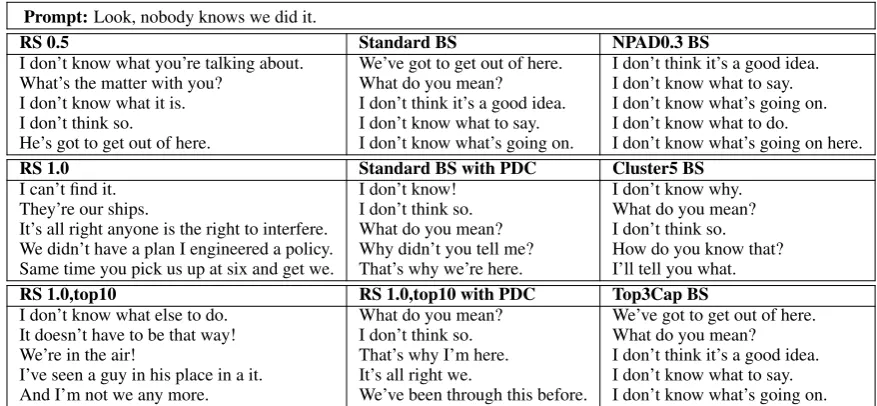
Prompt:Look, nobody knows we did it.
RS 0.5 Standard BS NPAD0.3 BS
I don’t know what you’re talking about. What’s the matter with you?
I don’t know what it is. I don’t think so.
He’s got to get out of here.
We’ve got to get out of here. What do you mean? I don’t think it’s a good idea. I don’t know what to say. I don’t know what’s going on.
I don’t think it’s a good idea. I don’t know what to say. I don’t know what’s going on. I don’t know what to do.
I don’t know what’s going on here. RS 1.0 Standard BS with PDC Cluster5 BS
I can’t find it. They’re our ships.
It’s all right anyone is the right to interfere. We didn’t have a plan I engineered a policy. Same time you pick us up at six and get we.
I don’t know! I don’t think so. What do you mean? Why didn’t you tell me? That’s why we’re here.
I don’t know why. What do you mean? I don’t think so. How do you know that? I’ll tell you what. RS 1.0,top10 RS 1.0,top10 with PDC Top3Cap BS I don’t know what else to do.
It doesn’t have to be that way! We’re in the air!
I’ve seen a guy in his place in a it. And I’m not we any more.
What do you mean? I don’t think so. That’s why I’m here. It’s all right we.
We’ve been through this before.
[image:7.595.78.517.290.493.2]We’ve got to get out of here. What do you mean? I don’t think it’s a good idea. I don’t know what to say. I don’t know what’s going on.
Table 4: Responses to an example prompt for selected methods. More examples can be seen in the appendix.
However, we find there to be a marked trade-off between diversity and quality. This can be seen in Figure2, where we plot the human-judged quality score for each dialog experiment against our pri-mary diversity descriptive statistics. Fluency and adequacy are both strongly negatively correlated with diversity. While we had expected interest-ingness to be positively correlated with diversity, the fact that it is not suggests that existing diver-sity statistics are insufficient for capturing what it means to humans for outcomes to be interesting.
Likewise, in image captioning, the mean SPICE score of the 10 candidate captions (averaged over all examples for each experimental setting) is strongly anti-correlated with diversity, with a Pear-son correlation coefficient of -0.83 with the Ent-4
measure and -0.84 with Dist-2. Clearly it remains an open challenge to generate a diverse set of im-age captions that are all high-quality.
encouraging diversity will continue to decrease. In the interest of reporting a single overall best method for each task, we computed a sum-of-ranks score for each method. For dialog, we ranked the methods each by fluency, coher-ence, interestingness, and Ent-4, and then took a weighted sum of the four ranks, with 50% of the weight assigned to Ent-4, and 50% distributed evenly among the human evaluation ranks. Over-all, clustered beam search and standard BS (beam size 100, PDC) have the best scores, followed by clustered beam search (beam size 10). Similarly, for image captioning, we rank the methods by their mean SPICE score and by Ent-4. Summing these ranks, random sampling (temp 1.0, top-10 cap-ping, PDC) came in first. Standard beam search, Hamming Diversity beam search, and Top-g cap-ping beam search (beam size 10) tied for second.
6.2 Random Sampling-based Methods
Higher sampling temperatures result in both an in-crease in diversity in generated responses and a re-duction in overall quality. In the dialog domain, evaluators consistently rate the responses sampled with temperature 1.0 to have worse fluency, co-herence, and interestingness when those sampled with temperature 0.5. In the image captioning do-main, lower temperature improves automatic eval-uation metrics for quality while reducing diversity. For dialog, restricting sampling to the top-10 vocabulary words is a more effective strategy than adjusting temperature for ensuring balance be-tween the quality and diversity of outputs. Top-10 random sampling has the highest fluency, co-herence, and interestingness, as well as signifi-cantly lower perplexity than other random sam-pling methods. However, this trend did not ex-tend to image captioning, where top-10 random sampling results in both worse SPICE scores and lower diversity measures than setting the temper-ature to 0.7. This may be because image caption-ing is a less ambiguous task than open-ended di-alog, leading to a better-trained model that puts more probability mass on high-quality vocabulary words, ameliorating the challenge top-c filtering is designed to eliminate: that of a long tail of low probability vocabulary words taking up a large amount of probability mass.
6.3 Beam Search-based Methods
For dialog, clustered beam search (Cluster5 BS) performs the best of all beam search methods in
terms of human-judged interestingness. It ties for best with NPAD0.3BS on fluency and ties with Standard BS on coherence. Iterative beam search (Iter5 BS) achieves the greatest diversity, but at the expensive of quality. It has the lowest human-judged coherence among beam search methods; thus, we do not evaluate this method on image cap-tioning. For image captioning, Cluster5 BS has the highest diversity among beam search methods, but this difference is quite small. Cluster5 BS also has the highest SPICE@10 score, indicating it is the best method for generating at least one high qual-ity candidate. However, Top3Cap BS results in the highest mean SPICE score, suggesting it is best at ensuring all outputs are reasonable quality.
6.4 Effect of Over-sampling
In our experiments, we explore over-sampling 100 outputs, and then either using post-decoding clus-tering (PDC) or re-ranking by log-likelihood to fil-ter these 100 down to 10 diverse outputs.
In the dialog domain, this over-sampling ap-proach is a definite win. When over-sampling with random sampling both methods of filtering sub-stantially improve human judgements of fluency and adequacy compared to random sampling only 10 outputs. However, interestingness scores go down, and while the outputs are still more diverse than beam search-based methods, they are less di-verse than random sampling without filtering. In the beam search methods that use a beam size of 100 then filter down to 10, human-judged quality is on par with beam size 10 results, but diversity is considerably higher.
When comparing the two types of filtering, PDC results in higher interestingness and diver-sity statistics, while log-likelihood re-ranking im-proves fluency and adequacy. This again demon-strates the trade-off between quality and diversity.7 For image captioning, over-sampling with reranking does not consistently improve quality as it does in the dialog domain. Mean SPICE score is improved for random sampling but not for beam search. SPICE@1 becomes worse for both ran-dom sampling and decoding, while SPICE@10 improves for random sampling, and for beam search when PDC is applied. From these results,
7
we can conclude that over-sampling then ranking does not have a sizeable effect, either negative or positive, on quality. Moreover, the diversity of the captions generated by random sampling actu-ally decreases when oversampling. The diversity of beam search-generated captions does improve with over-sampling.
While oversampling does generally improve outcomes on the diversity/quality tradeoff, it is more computationally expensive, particularly with beam search. Running PDC also requires generat-ing sentence embeddgenerat-ings for every output, which adds additional computation time.
7 Additional Related Work
In this paper, we have compared a variety of post-training diversity-promoting algorithms. Here, we discuss other related works that instead promote diversity at train-time, as well as alternative qual-ity evaluation methods. We also note that concur-rent work has proposed nucleus sampling as an im-provement to the sampling strategies discussed in this paper (Holtzman et al.,2019).
Diversity Promotion During Training
Sev-eral works have attempted to encourage diver-sity during training by replacing the standard log-likelihood loss with a diversity-promoting objec-tive. Li et al.(2016a) introduces an objective that maximizes mutual information between the source and target. Zhang et al.(2018) uses an adversar-ial information maximization approach to encour-age generated text to be simultaneously informa-tive and diverse. Xu et al. (2018) also uses an adversarial loss; their loss function rewards flu-ent text and penalizes repetitive text. We do not evaluate on these methods as they tend to be task-specific and difficult to implement. All of the di-versity strategies we evaluate share the trait that they are agnostic to model architecture and to the data type of the input, as long as the output of the model is a probability distribution over tokens in a sequence.
Automatic Quality Evaluation An
impor-tant part of this work is how to accurately mea-sure not only the effect these methods have on candidate diversity, but also on the overall qual-ity of the candidates. In choosing to report hu-man scores and perplexity for the dialog domain, and SPICE for image captioning, we omitted some quality measures used in other papers.
For image captioning, BLEU (Papineni et al.,
2001), ROUGE (Lin, 2004), METEOR (Elliott and Keller, 2013), and CIDer (Vedantam et al.,
2015) scores are often reported, but SPICE has been shown to have higher correlation with hu-man judgments (Anderson et al.,2016). In the di-alog domain, single-reference BLEU score ( Pap-ineni et al.,2001) is sometimes used to measure re-sponse quality, but it has been shown to have little correlation with human-judged quality (Liu et al.,
2016). Therefore, most works in dialog systems use human evaluation as the ultimate measure of quality (Li et al.,2016a;Sedoc et al.,2018)
8 Conclusion
In this work, we perform an analysis of post-training decoding strategies that attempt to pro-mote diversity in conditional language models. We show how over-sampling outputs then filter-ing down to the desired number is an easy way to increase diversity. Due to the computational expense of running large beam searches, we rec-ommend using random-sampling to over-sample. The relative effectiveness of the various decoding strategies differs for the two tasks we considered, which suggests that choice of optimal diverse de-coding strategy is both task-specific and depen-dent on one’s tolerance for lower quality outputs.
While we have focused on evaluating each de-coding strategy under the specifics reported to be the best in the original, further work is necessary to conclude whether observed differences in qual-ity and diversqual-ity may simply be due to each work’s chosen hyperparameters. The ability to effectively generate a diverse set of responses while not de-grading quality is extremely important in a variety of generation tasks, and is a crucial component to harnessing the power of state-of-the-art generative models.
9 Acknowledgements
References
Peter Anderson, Basura Fernando, Mark Johnson, and
Stephen Gould. 2016. Spice: Semantic
proposi-tional image caption evaluation. InEuropean Con-ference on Computer Vision.
Peter Anderson, Xiaodong He, Chris Buehler, Damien Teney, Mark Johnson, Stephen Gould, and Lei
Zhang. 2018. Bottom-up and top-down attention for
image captioning and visual question answering. In
Proceedings of the IEEE Conference on Computer Vision and Pattern Recognition, pages 6077–6086.
Ashutosh Baheti, Alan Ritter, Jiwei Li, and Bill Dolan.
2018. Generating more interesting responses in
neural conversation models with distributional
con-straints. In Conference on Empirical Methods in
Natural Language Processing (EMNLP 2018).
Kyunghyun Cho. 2016. Noisy parallel approximate de-coding for conditional recurrent language model.
Sajal Choudhary, Prerna Srivastava, Lyle H. Ungar, and Jo˜ao Sedoc. 2017. Domain aware neural dialog sys-tem. volume abs/1708.00897.
Elizabeth Clark, Anne Spencer Ross, Chenhao Tan,
Yangfeng Ji, and Noah A. Smith. 2018. Creative
writing with a machine in the loop: Case studies on slogans and stories. In23rd International Confer-ence on Intelligent User Interfaces, IUI ’18, pages 329–340, New York, NY, USA. ACM.
Cristian Danescu-Niculescu-Mizil and Lillian Lee.
2011. Chameleons in imagined conversations: A
new approach to understanding coordination of lin-guistic style in dialogs. InProceedings of the 2nd Workshop on Cognitive Modeling and Computa-tional Linguistics, pages 76–87, Portland, Oregon, USA. Association for Computational Linguistics.
Jacob Devlin, Ming-Wei Chang, Kenton Lee, , and Kristina Toutanova. 2018. Bert: Pre-training of deep bidirectional transformers for language understand-ing.
Desmond Elliott and Frank Keller. 2013. Image
de-scription using visual dependency representations. In Proceedings of the 2013 Conference on Empiri-cal Methods in Natural Language Processing, pages 1292–1302, Seattle, Washington, USA. Association for Computational Linguistics.
Angela Fan, Mike Lewis, and Yann Dauphin. 2018.
Hierarchical neural story generation. In Proceed-ings of the 56th Annual Meeting of the Association for Computational Linguistics (Volume 1: Long Pa-pers), pages 889–898, Melbourne, Australia. Asso-ciation for Computational Linguistics.
Kevin Gimpel, Dhruv Batra, Chris Dyer, and Gregory
Shakhnarovich. 2013. A systematic exploration of
diversity in machine translation. InProceedings of the 2013 Conference on Empirical Methods in Nat-ural Language Processing, pages 1100–1111.
Jiatao Gu, Kyunghyun Cho, and Victor O.K. Li. 2017.
Trainable greedy decoding for neural machine trans-lation. In Proceedings of the 2017 Conference on Empirical Methods in Natural Language
Process-ing, pages 1968–1978, Copenhagen, Denmark.
As-sociation for Computational Linguistics.
Tatsunori B. Hashimoto, Hugh Zhang, and Percy
Liang. 2019. Unifying human and statistical
eval-uation for natural language generation. CoRR, abs/1904.02792.
Ari Holtzman, Jan Buys, Maxwell Forbes, and Yejin Choi. 2019. The curious case of neural text
degen-eration. CoRR, abs/1904.09751.
Guillaume Klein, Yoon Kim, Yuntian Deng, Jean
Senellart, and Alexander M. Rush. 2017.
Open-NMT: Open-source toolkit for neural machine trans-lation. InProc. ACL.
Jonathan Krause, Justin Johnson, Ranjay Krishna, and Li Fei-Fei. 2017. A hierarchical approach for
gen-erating descriptive image paragraphs. InComputer
Vision and Pattern Recognition (CVPR), 2017 IEEE Conference on, pages 3337–3345. IEEE.
Reno Kriz, Jo˜ao Sedoc, Marianna Apidianaki, Carolina Zheng, Gaurav Kumar, Eleni Miltsakaki, and Chris
Callison-Burch. 2019. Complexity-weighted loss
and diverse reranking for sentence simplification.
Ilya Kulikov, Alexander H Miller, Kyunghyun Cho, and Jason Weston. 2018. Importance of a search strategy in neural dialogue modelling.
Quoc Le and Tomas Mikolov. 2014. Distributed
repre-sentations of sentences and documents. In
Proceed-ings of the 31st International Conference on Inter-national Conference on Machine Learning - Volume
32, ICML’14, pages 1188–1196.
Jiwei Li, Michel Galley, Chris Brockett, Jianfeng Gao,
and Bill Dolan. 2016a. A diversity-promoting
ob-jective function for neural conversation models. In
Proceedings of the 2016 Conference of the North American Chapter of the Association for Computa-tional Linguistics: Human Language Technologies, pages 110–119, San Diego, California. Association for Computational Linguistics.
Jiwei Li and Dan Jurafsky. 2016. Mutual information and diverse decoding improve neural machine trans-lation.
Jiwei Li, Will Monroe, and Dan Jurafsky. 2016b. A simple, fast diverse decoding algorithm for neural generation.
Chin-Yew Lin. 2004. ROUGE: A package for
Tsung-Yi Lin, Michael Maire, Serge Belongie, James Hays, Pietro Perona, Deva Ramanan, Piotr Doll´ar,
and C Lawrence Zitnick. 2014. Microsoft coco:
Common objects in context. In European confer-ence on computer vision, pages 740–755. Springer.
Chia-Wei Liu, Ryan Lowe, Iulian Serban, Mike Nose-worthy, Laurent Charlin, and Joelle Pineau. 2016.
How NOT to evaluate your dialogue system: An empirical study of unsupervised evaluation metrics for dialogue response generation. InProceedings of the 2016 Conference on Empirical Methods in Natu-ral Language Processing, pages 2122–2132, Austin, Texas. Association for Computational Linguistics.
Ruotian Luo. 2017. An image captioning
code-base in pytorch. https://github.com/
ruotianluo/ImageCaptioning.pytorch.
Thang Luong, Hieu Pham, and Christopher D.
Man-ning. 2015. Effective Approaches to
Attention-based Neural Machine Translation. In Proceed-ings of the 2015 Conference on Empirical Methods in Natural Language Processing, pages 1412–1421, Lisbon, Portugal.
Ramesh Nallapati, Bowen Zhou, C´ıcero Nogueira dos Santos, aglar G¨ulehre, and Bing Xiang. 2016. Ab-stractive Text Summarization using
Sequence-to-sequence RNNs and Beyond. InProceedings of The
20th SIGNLL Conference on Computational Natural Language Learning (CoNLL), pages 280–290.
Kishore Papineni, Salim Roukos, Todd Ward, and
Wei-Jing Zhu. 2001. Bleu: a method for automatic
eval-uation of machine translation. In Association for Computational Linguistics.
Jeffrey Pennington, Richard Socher, and
Christo-pher D. Manning. 2014. Glove: Global vectors for
word representation. InEmpirical Methods in Nat-ural Language Processing (EMNLP), pages 1532– 1543.
Alec Radford, Jeffrey Wu, Rewon Child, David Luan, Dario Amodei, and Ilya Sutskever. 2019. Language
models are unsupervised multitask learners. OpenAI
Blog, 1:8.
Jo˜ao Sedoc, Daphne Ippolito, Arun Kirubarajan, Jai Thirani, Lyle Ungar, and Chris Callison-Burch. 2018. Chateval: A tool for the systematic
evalua-tion of chatbots. InProceedings of the Workshop on
Intelligent Interactive Systems and Language Gen-eration (2IS&NLG), pages 42–44. Association for Computational Linguistics.
Ilya Sutskever, Oriol Vinyals, and Quoc V Le. 2014.
Sequence to sequence learning with neural net-works. In Z. Ghahramani, M. Welling, C. Cortes,
N. D. Lawrence, and K. Q. Weinberger, editors,
Ad-vances in Neural Information Processing Systems
27, pages 3104–3112. Curran Associates, Inc.
Yik-Cheung Tam, Jiachen Ding, Cheng Niu, and Jie Zhou. 2019. Cluster-based beam search for
pointer-generator chatbot grounded by knowledge. In
Dia-log System TechnoDia-logy Challenges 7 at AAAI 2019.
J¨org Tiedemann. 2009. News from opus-a collection of multilingual parallel corpora with tools and
inter-faces. InRecent advances in natural language
pro-cessing, volume 5, pages 237–248.
Ramakrishna Vedantam, C. Lawrence Zitnick, and
Devi Parikh. 2015. Cider: Consensus-based image
description evaluation. pages 4566–4575.
Ashwin K Vijayakumar, Michael Cogswell, Ram-prasath R Selvaraju, Qing Sun, Stefan Lee, David
Crandall, and Dhruv Batra. 2016. Diverse beam
search: Decoding diverse solutions from neural se-quence models.
Oriol Vinyals and Quoc V. Le. 2015. A neural
conver-sational model. volume abs/1506.05869.
Jingjing Xu, Xuancheng Ren, Junyang Lin, and
Xu Sun. 2018. Diversity-promoting gan: A
cross-entropy based generative adversarial network for di-versified text generation. InProceedings of the 2018 Conference on Empirical Methods in Natural Lan-guage Processing, pages 3940–3949.
Yizhe Zhang, Michel Galley, Jianfeng Gao, Zhe Gan, Xiujun Li, Chris Brockett, and Bill Dolan. 2018.
Generating informative and diverse conversational responses via adversarial information maximization. InAdvances in Neural Information Processing