John M. Salsman, PhD Zeeshan Butt, PhD Paul A. Pilkonis, PhD Jill M. Cyranowski, PhD Nicholas Zill, PhD Hugh C. Hendrie, MB,
ChB, DSc Mary Jo Kupst, PhD Morgen A. R. Kelly, PhD Rita K. Bode, PhD Seung W. Choi, PhD Jin-Shei Lai
PhD, OTR/L James W. Griffith, PhD Catherine M. Stoney,
PhD
Pim Brouwers, PhD Sarah S. Knox, PhD David Cella, PhD
Correspondence to Dr. Salsman:
Supplemental data at www.neurology.org
Emotion assessment using the NIH
Toolbox
ABSTRACT
One of the goals of the NIH Toolbox for Assessment of Neurological and Behavioral Function was to identify or develop brief measures of emotion for use in prospective epidemiologic and clinical research. Emotional health has significant links to physical health and exerts a powerful effect on perceptions of life quality. Based on an extensive literature review and expert input, the Emotion team identified 4 cen-tral subdomains: Negative Affect, Psychological Well-Being, Stress and Self-Efficacy, and Social Rela-tionships. A subsequent psychometric review identified several existing self-report and proxy measures of these subdomains with measurement characteristics that met the NIH Toolbox criteria. In cases where adequate measures did not exist, robust item banks were developed to assess con-cepts of interest. A population-weighted sample was recruited by an online survey panel to provide ini-tial item calibration and measure validation data. Participants aged 8 to 85 years completed self-report measures whereas parents/guardians responded for children aged 3 to 12 years. Data were analyzed using a combination of classic test theory and item response theory methods, yielding efficient meas-ures of emotional health concepts. An overview of the development of the NIH Toolbox Emotion battery is presented along with preliminary results. Norming activities led to further refinement of the battery, thus enhancing the robustness of emotional health measurement for researchers using the NIH Toolbox.Neurologyâ2013;80 (Suppl 3):S76–S86
GLOSSARY
IRT5item response theory;NA5negative affect;PROMIS5Patient Reported Outcomes Measurement Information Sys-tem;RFI5Request for Information.
In everyday terms, the word
“emotion”
evokes connotations of strong feelings, often negative and
distressing when they tax our capacity to maintain our poise. It is unpleasant when we are extended
beyond our usual resources by stressful life events including poverty, unemployment, oppression,
discrimination, and disease. However, positive emotions can be reflections of well-being in our lives,
and positive social relationships can buffer stress and enhance health. Recognizing the full spectrum
of emotional life and its impact on health, the mandate for the NIH Toolbox was to develop
assessments with a broad focus, beyond just negative emotion, or emotional distress. The original
Request for Proposals alluded to several additional aspects of the experience and expression of
emotion relevant to health in the general population including the importance of psychological
well-being, the role of important aspects of positive functioning, such as adaptability, resilience, and
self-efficacy, and the importance of the interpersonal and social context in which emotions arise and
may be expressed.
Feedback provided through an NIH Toolbox Expert Request for Information (RFI) was also
con-sistent with this desire for a broad emphasis on emotional health. As part of this RFI, we obtained
input from 147 experts (64% of 232 invited experts), including key opinion leaders from the NIH
research program staff and NIH-funded investigators with a broad focus in neurologic and behavioral
From the Departments of Medical Social Sciences (J.M.S., Z.B., S.W.C., J.-S.L., J.W.G., D.C.) and Physical Medicine & Rehabilitation (R.K.B.), North-western University Feinberg School of Medicine, Chicago; Robert H. Lurie Comprehensive Cancer Center of NorthNorth-western University (J.M.S., J.-S.L., D.C.), Chicago; Comprehensive Transplant Center (Z.B.), Northwestern University, Chicago; Center for Patient-Centered Outcomes (J.M.S., Z.B., J.-S.L., J.W.G., D.C.), Northwestern University, Chicago, IL; Department of Psychiatry (P.A.P., J.M.C., M.A.R.K.), University of Pittsburgh Medical Center, Pittsburgh, PA; Westat, Inc. (N.Z.), Rockville, MD; Center for Aging Research (H.C.H.), Indiana University School of Medicine, Indianapolis, IN; Department of Pediatrics (M.J.K.), Medical College of Wisconsin, Milwaukee; Family Services of Western Pennsylvania, and VA Pittsburgh Healthcare System (M.A.R.K.), Pittsburgh, PA; National Heart, Lung, and Blood Institute (C.M.S.), National Institutes of Health, Bethesda; Division of AIDS Research (P.B.), National Institute of Mental Health, Bethesda; and Department of Community Medicine (S.S.K.), West Virginia University School of Medicine, Morgantown.
research. Fifty-eight percent of those experts who
responded indicated sufficient familiarity with
emotional health measurement to provide more
targeted feedback. Each expert nominated what
he or she considered to be the top 4 components
of emotional health that would have most
rele-vance in a battery to be used with general or
at-risk populations for large-scale longitudinal
and epidemiologic studies and clinical trials.
The 4 areas most frequently endorsed were
neg-ative affect (NA) (98%; n
5
83), adaptability
(74%; n
5
63), positive affect (73%; n
5
62),
and self/emotional regulation (68%; n
5
58).
Important considerations for the work of the
Emotion team involved integrating the input of
the experts with the goals of the NIH Toolbox
and the published literature on emotional health.
Our primary objective was to develop tools that
reflected health status and function over time,
and that would be responsive to change,
includ-ing the impact of interventions beinclud-ing tested in
clinical research with community-dwelling or
at-risk individuals. Given the internal nature of
emotional experience, self-reports are the most
preferred and practical mode of assessment for
adults. For younger children, however, measures
of emotion often must rely on behavioral
observations by knowledgeable informants
(e.g., parents, teachers). As a result, we focused
on self-report measures for adults and older
children and on proxy measures for younger
children in the proposed work.
Regarding the particular subdomains assessed
within emotional health, there is good evidence
that negative and positive emotions are best
understood as independent of each other, rather
than opposite extremes of a single continuum.
1This perspective led us to separate development
of assessments for negative and positive mood
(and of emotional distress vs positive
psycholog-ical functioning more generally). Emotion has
important adaptive and communicative
func-tions in humans; it serves
“signal”
functions for
both self and others. Thus, we also considered
emotion in an interpersonal context and assessed
its reciprocal relationships with interpersonal
functioning and behavior.
Guided by a review of the literature (discussed
in more detail below), the RFI survey of experts
in the area of emotional health, follow-up
semi-structured interviews with a subset of these
experts, and discussion within the Emotion
domain team and among the Emotion expert
consultants, we identified 4 subdomains central
to the assessment of emotional health: Negative
Affect, Psychological Well-Being, Stress and
Self-Efficacy, and Social Relationships. Our next
task was to identify psychometrically sound and
free-for-use instruments. Where these did not
exist, we considered development of new
meas-ures including item banks wherever possible,
which are large pools of questions from which
multiple equivalent measurement tools can be
derived. A subsequent review of available
instru-ments identified more than 600 existing
meas-ures covering relevant concepts. Self-report
instruments were targeted for children and
adults (ages 8 years and older) and proxy
instru-ments were targeted for children (ages 3–12
years). Instruments that were lengthy or designed
for diagnostic purposes were eliminated from
consideration. Instruments were reviewed for
intellectual property considerations, and
confir-mation of free-for-use status was sought from
authors and/or publishers. Final psychometric
review resulted in selection of measures and
development of item banks representing the 4
emotional health subdomains to be tested in the
calibration and validation stage of the NIH
Toolbox.
DATA COLLECTION AND ANALYTIC APPROACH Our data collection and analytic approach relied heavily on item response theory (IRT), an alternate approach to traditional test construction.2–5 IRT-based approaches
and more efficient assessments and assessment of more symptoms and domains of interest than have been typ-ically feasible, all of which are central goals of the NIH Toolbox.
A detailed data sampling plan was developed for collecting initial item responses to the candidate items and measures from the targeted Emotion subdomains (see figure).
This sampling plan was designed to accommodate a number of purposes: 1) create item calibrations for all of the items in each of the subdomains; 2) when possible, provide convergent validity estimates with legacy ques-tionnaires (e.g., the Center for Epidemiologic Studies– Depression Scale); 3) confirm the factor structure of the
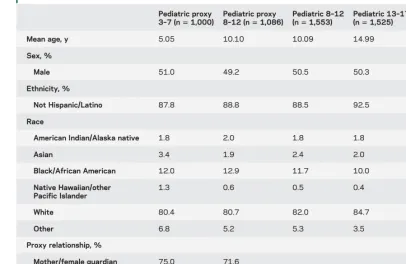
subdomains and content areas; and 4) conduct item and bank analyses. However, because of the large total num-ber of items (.600), it was not possible for participants to respond to the entire set of items in each pool. Based on an estimate of 6 questions per minute for adults (5 questions per minute for children), the length of the Emotion questionnaires in the calibration and validation wave of testing was limited to approximately 180 items for adults (150 items for children), which were expected to take approximately 30 minutes to answer. A block administration was implemented for data collection, and 5 community-dwelling Internet panel samples were recruited (see table 1) by an online research panel.
Subsequent data analyses included evaluation of item and scale properties using both traditional (classic test theory) and modern (IRT) psychometric methods. Fac-tor analysis was used to examine the underlying structures of the measured constructs and to evaluate the unidimen-sionality and local independence assumptions of the IRT model. Differential item functioning was examined to evaluate whether items performed differently across key demographic groups when statistically controlling for the underlying level of the trait assessed by the scale. Finally, items were calibrated using an IRT model to facilitate development of short forms and a computerized adaptive test. The subscales we developed were based on the psychometric analyses and consistent with the NIH Toolbox purposes. Acceptable psychometric properties were defined a priori as a comparative fit index.0.90, a root mean square error of approximation,0.10, and Cronbach a .0.70. In some cases, we recommend modified versions of existing measures (please contact the corresponding author for details and view appendix e-1 on theNeurology®Web site at www.neurology.org
for measure references).
SUBDOMAIN-SPECIFIC DISCUSSION AND PRELIMINARY RESULTS Negative affect.Negative affect is a phrase used to describe unpleasant feelings or emotions, which exist on a continuum ranging from common feelings to more extreme indicators of these same affects (appendix e-2). Negative emotions have been associated with both the incidence and progression of some diseases, such as cardiovascular disease and cer-tain autoimmune diseases. The mechanisms underlying these associations are not well understood, but they can be organized into 2 general families: direct effects via physiologic pathways and indirect effects via the impact of NA on health-related behaviors. Accurate measure-ment of NA may lead to improvemeasure-ments in our under-standing of the impact of emotions on general health of the individual as well as mechanisms of certain disease processes.
Our focus in the NA subdomain is on 3 principal negative emotions: sadness, fear, and anger. Given the overlap among the cognitive, affective, and somatic
Figure Emotion Domain framework
symptoms of sadness, fear, and anger, a number of con-ceptual models have been proposed to account for the shared vs unique variance captured in measures of NA. In the Watson and Clark model,6a second-order,
non-specific factor reflecting high levels of negative affect (or
“general distress”) was common to these 3 emotions. Angry mood tends to have smaller loadings on the gen-eral factor than fear and sadness, but it still is a strong marker of the dimension. In addition, the Watson and Clark model included first-order factors that are specific to, and help to differentiate, the 3 affects. Symptoms specific to sadness are those that reflect low levels of positive affect. Symptoms that best differentiate fear are those that reflect autonomic arousal and perceptions of threat. The affective expression of anger includes symp-toms that reflect irritation, frustration, and resentment.7,8
NA can be understood as a set of related but distinguish-able concepts.
Sadness, fear, and anger are experienced throughout the lifespan, and, thus, they are amenable to assessment by self-report. We have selected age-appropriate measures for respondents aged 8 years and older. Given the lifespan emphasis of the NIH Toolbox, special assessment issues arise with young children. Measures of NA in children often must rely on behavioral observation reports by parents and teachers, and we propose to include such proxy measures for younger children. Factor analytic studies of such ratings are generally consistent with the Watson and Clark hierarchical model of NA described above. At the same time, the analyses also capture sepa-rable subdimensions, specifically, an “internalizing”
factor with item loadings reflecting sadness and fear and an“externalizing”factor reflecting anger as well as stubbornness, sullenness, impulsivity, and defiance.
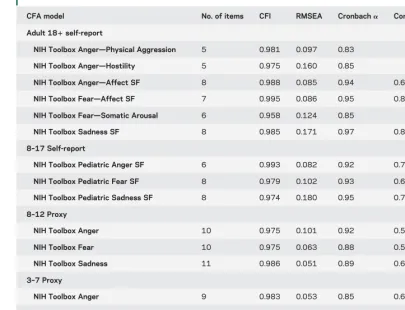
Our initial psychometric (calibration) data have been used to identify brief scales that can assess these negative emotions efficiently. In some cases, our explorations of the dimensionality of the item banks and legacy scales used in the initial psychometric testing led us to articu-late specific facets of these negative emotions. In adults, for example, somatic anxiety was distinguished from gen-eralized anxiety, which has primarily cognitive and affec-tive components. The larger goal, however, has remained consistent throughout, that is, to identify brief measures of sadness, fear, and anger that are age-appropriate and can be used to measure these constructs throughout the lifespan. Table 2 provides summary data on the scales recommended for inclusion in the NIH Toolbox.
Psychological Well-Being.The Psychological Well-Being subdomain includes positive affect (happiness, serenity, and cognitive engagement), life satisfaction, and meaning and purpose in life. Psychological well-being has been conceptualized as having hedonic and eudaimonic com-ponents.9Hedonic aspects of well-being are often more
experiential in nature and emphasize pleasure (e.g., pos-itive affect), whereas eudaimonic aspects of well-being are more evaluative in nature and emphasize human flourish-ing (e.g., meanflourish-ing, life satisfaction). Positive affect has been characterized as“feelings that reflect a level of plea-surable engagement with the environment such as hap-piness, joy, excitement, enthusiasm, and contentment”
Table 1 Demographic characteristics for the NIH Toolbox calibration and validation samples
Pediatric proxy 3–7 (n51,000)
Pediatric proxy 8–12 (n51,086)
Pediatric 8–12 (n51,553)
Pediatric 13–17 (n51,525)
Adults 181 (n52,551)a
Mean age, y 5.05 10.10 10.09 14.99 45.56
Sex, %
Male 51.0 49.2 50.5 50.3 43.3
Ethnicity, %
Not Hispanic/Latino 87.8 88.8 88.5 92.5 90.0
Race
American Indian/Alaska native 1.8 2.0 1.8 1.8 2.7
Asian 3.4 1.9 2.4 2.0 3.6
Black/African American 12.0 12.9 11.7 10.0 10.3
Native Hawaiian/other Pacific Islander
1.3 0.6 0.5 0.4 0.6
White 80.4 80.7 82.0 84.7 81.6
Other 6.8 5.2 5.3 3.5 3.9
Proxy relationship, %
Mother/female guardian 75.0 71.6
Father/male guardian 17.4 22.5
Grandmother 4.8 4.3
and describe both activated, excited and nonactivated, peaceful components of positive affect.10Diener et al.11
note that well-being may include correlated but separable components of high positive affect, life satisfaction, and low NA. A closely related construct to life satisfaction is life purpose or meaning, often considered a key aspect of
“living well.”12Together, these concepts are considered
critical components of psychological well-being through-out the lifespan.
The relationship between psychological well-being and health is well documented, with a majority of this research focusing on the role of positive affect.13–20
How-ever, the mechanisms by which psychological well-being affects health remain unclear. Pressman and Cohen14
have suggested that positive affect has both direct and stress-buffering effects on health outcomes. In the direct effect model, physiologic states associated with positive
affect (e.g., sympathetic/parasympathetic and brain activation patterns) are directly associated with health outcomes, and in the stress-buffering model, positive affect moderates the relationships between stress and poor health outcomes. Fredrickson21suggests that
pos-itive affect is also beneficial because it serves a“ broaden-and-build”function in individuals, enhancing one’s repertoire of social cognitive and problem-solving capabilities, and thereby strengthening personal and interpersonal resources.
Parent proxy reports were used for the youngest chil-dren (aged 3–12 years) and self-report for children aged 8 to 17 years and adults aged 18 to 85 years. Our initial psychometric (calibration) data were used to shorten scales to more efficiently assess psychological well-being across the lifespan. The expression of positive emotions demonstrated a developmental sequence with greater
Table 2 Confirmatory factor analysis by Negative Affect instrument—single-factor model
CFA model No. of items CFI RMSEA Cronbacha Convergent validity
Adult 181self-report
NIH Toolbox Anger—Physical Aggression 5 0.981 0.097 0.83
NIH Toolbox Anger—Hostility 5 0.975 0.160 0.85
NIH Toolbox Anger—Affect SF 8 0.988 0.085 0.94 0.61a
NIH Toolbox Fear—Affect SF 7 0.995 0.086 0.95 0.86b
NIH Toolbox Fear—Somatic Arousal 6 0.958 0.124 0.85
NIH Toolbox Sadness SF 8 0.985 0.171 0.97 0.88c
8–17 Self-report
NIH Toolbox Pediatric Anger SF 6 0.993 0.082 0.92 0.73d
NIH Toolbox Pediatric Fear SF 8 0.979 0.102 0.93 0.68e
NIH Toolbox Pediatric Sadness SF 8 0.974 0.180 0.95 0.75f
8–12 Proxy
NIH Toolbox Anger 10 0.975 0.101 0.92 0.54g
NIH Toolbox Fear 10 0.975 0.063 0.88 0.57g
NIH Toolbox Sadness 11 0.986 0.051 0.89 0.67g
3–7 Proxy
NIH Toolbox Anger 9 0.983 0.053 0.85 0.64h
NIH Toolbox Fear—Overanxious 6 0.969 0.090 0.79 0.60i
NIH Toolbox Fear—Separation Anxiety 7 0.982 0.057 0.83 0.71j
NIH Toolbox Sadness 7 0.992 0.031 0.77 0.38k
Abbreviations: CFA5confirmatory factor analysis; CFI5comparative fit index; RMSEA5root mean square error of approximation; SF5short form.
Validation scales:
aBuss-Perry Aggression Questionnaire, combined subscales for anger and verbal aggression.
bGeneralized Anxiety Disorder-7.
cCenter for Epidemiologic Studies Depression Scale.
dAnger Expression Scale for Children.
eScreen for Anxiety Related Disorders.
fShort Mood and Feelings Questionnaire.
gPositive and Negative Affect Schedule for Children–negative subscale. hChildren’s Behavior Questionnaire–anger/frustration subscales. iPreschool Anxiety Scale–general anxiety subscale.
variability in range and intensity in adulthood. As a consequence, less-activated components of positive affect (serenity and cognitive engagement) were more readily differentiated and measured in adults relative to children whereas the more activated expressions of positive affect (i.e., happiness) were easily detectable throughout the lifespan.
Similarly, although aspects of global life satisfaction were easily assessed throughout the lifespan, the life purpose/meaning component was expressed differently at different ages. For children, life purpose and mean-ing was expressed through satisfaction with domain-specific activities (e.g., I am satisfied with the friends I have, I am satisfied with my skills and talents), whereas for adults it took on a more abstract and phil-osophical connotation closely linked to life satisfaction and associated with human flourishing and “living
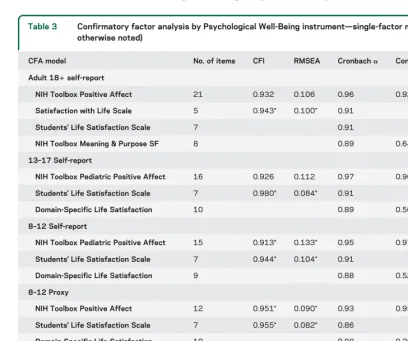
well”(e.g., My life has a clear sense of purpose, I value my activities a lot). We anticipate that meaning and purpose expressed by children through domain-specific satisfaction will be associated with the more abstract perspectives of adulthood, thus enabling a lifespan assessment of meaning and purpose. Table 3 provides summary data on the scales recommended for inclu-sion in the NIH Toolbox.
Stress and Self-Efficacy. Instruments in this subdomain measure perception of the nature of events, cognitions, and experiences and one’s ability to respond to these challenges. The specific concepts assessed include per-ceived stress and self-efficacy. In the NIH Toolbox assessment, we are concerned with measuring how indi-viduals perceive and report these variables in order to explore relationships with health status and function.
Table 3 Confirmatory factor analysis by Psychological Well-Being instrument—single-factor model (unless otherwise noted)
CFA model No. of items CFI RMSEA Cronbacha Convergent validity
Adult 181self-report
NIH Toolbox Positive Affect 21 0.932 0.106 0.96 0.92a
Satisfaction with Life Scale 5 0.943* 0.100* 0.91
Students’Life Satisfaction Scale 7 0.91
NIH Toolbox Meaning & Purpose SF 8 0.89 0.64b
13–17 Self-report
NIH Toolbox Pediatric Positive Affect 16 0.926 0.112 0.97 0.96c
Students’Life Satisfaction Scale 7 0.980* 0.084* 0.91
Domain-Specific Life Satisfaction 10 0.89 0.50d
8–12 Self-report
NIH Toolbox Pediatric Positive Affect 15 0.913* 0.133* 0.95 0.97c
Students’Life Satisfaction Scale 7 0.944* 0.104* 0.91
Domain-Specific Life Satisfaction 9 0.88 0.52d
8–12 Proxy
NIH Toolbox Positive Affect 12 0.951* 0.090* 0.93 0.95c
Students’Life Satisfaction Scale 7 0.955* 0.082* 0.86
Domain-Specific Life Satisfaction 10 0.88 0.28d
3–7 Proxy
NIH Toolbox Positive Affect 9 0.973* 0.073* 0.92 0.95c
Students’Life Satisfaction Scale 7 0.981* 0.058* 0.86
Domain-Specific Life Satisfaction 8 0.87 0.28d
Abbreviations: CFA5confirmatory factor analysis; CFI5comparative fit index; RMSEA5root mean square error of approximation; SF5short form.
Validation scales:
aPositive and Negative Affect Schedule
—positive subscale. bSatisfaction with Life Scale.
cPositive and Negative Affect Schedule for Children—positive subscale. dStudents’Life Satisfaction Scale.
Psychological definitions of stress focus on percep-tions about the nature of events and their relapercep-tionship to the values and perceived coping resources of an individual.22 We chose perceived stress rather than an
objective list of stressors because we are more interested in people’s experience and perception of situations. In general, psychological stress is said to occur when an individual perceives that environmental or internal de-mands that are personally meaningful exceed his or her perceived adaptive capacity.23This definition was chosen
because it is the perception of distress that triggers the cascade of neuroendocrine changes that can negatively affect health outcomes. This definition of stress integrates the nature of the threat and the perceived coping capaci-ties of the individual.
Self-efficacy is a person’s belief in his/her capacity to manage his/her life and have control over mean-ingful events.24 Self-efficacy varies across situations
and skills needed to accomplish necessary tasks. Per-ceived self-efficacy can serve as a mediator between stress and health outcomes.
There is much literature in behavioral health research on the relationships among perceived stress, self-efficacy, and health. Mechanisms of these associations with health have typically supported mediation effects. For example, models of stress and immunity suggest that dysregulated hormone secretion or maladaptive health practices may operate as mediational pathways and
result in suppressed immune functioning.25,26
Self-effi-cacy has been shown to mediate the link between ther-apeutic interventions and health behaviors, including pain experience and management, control of eating and weight, success of recovery from myocardial infarc-tion, and adherence to preventive health programs.27
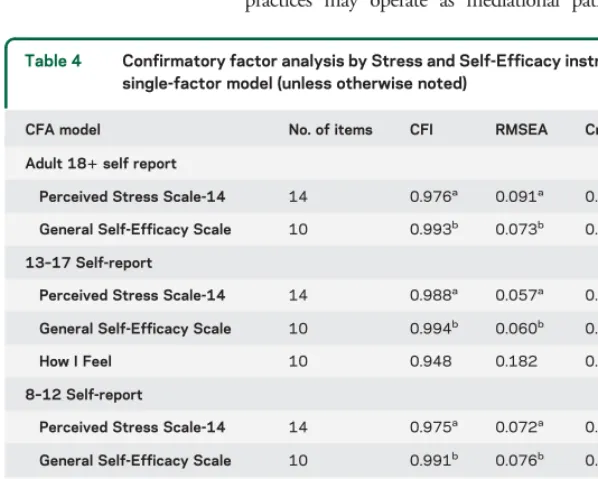
The essential cognitive and emotional abilities to perceive situations, to reflect on one’s efficacy, and to manage situations and emotional reactions are dependent on developmental processes. We have selected age-appropriate, self-report items and meas-ures for children aged 8 years and older and supple-mented these self-reports with proxy reports from parents or other caregivers for children aged 8 to 12 years. Thus, although assessment of these constructs may differ with respect to item content, our goal was to measure the same constructs equivalently across the lifespan. We were able to accomplish this in most cases. Given the limited development of cognitive and emotional abilities for children aged 3 to 7 years and the inherent difficulty for parents or other caregivers to speculate on their children’s perceptions of stress and self-efficacy, we do not assess these concepts for this age group. Table 4 shows the summary data on the scales recommended for inclusion in the NIH Toolbox for Stress and Self-Efficacy.
Social Relationships. There are several dimensions of social relationships, including their structure, extent, and quality.28,29For the purpose of the NIH Toolbox,
we have focused on assessing concepts related to the perceived availability and quality of one’s social relation-ships, including perceptions of social support, loneli-ness, and social distress. Self-report scales have been developed when developmentally appropriate (i.e., for respondents aged 8 years and older). In contrast, paren-tal proxy scales have been developed to measure analo-gous aspects of these social relationship constructs in younger age cohorts (i.e., for children aged 3–12 years), and to assess early behavioral indicators of positive social development (i.e., empathic behaviors).
Social relationships can have a significant impact on both emotional and physical health outcomes across the lifespan.30–33Whereas positive and
support-ive social relationships may improve health and well-being, perceptions of social isolation, loneliness, or relationship distress can be associated with negative health outcomes. Mechanisms by which social rela-tionships affect health may include both the direct and indirect impact of social relationships on emo-tional and physiologic responses (e.g., oxytocin release), the ability to cope with changing life stressors, or the patterning of sleep and health behaviors.28,29
Social support refers to the extent to which an individual views social networks as available to pro-vide aid in times of need, and may serve to protect
Table 4 Confirmatory factor analysis by Stress and Self-Efficacy instrument— single-factor model (unless otherwise noted)
CFA model No. of items CFI RMSEA Cronbacha
Adult 181self report
Perceived Stress Scale-14 14 0.976a 0.091a 0.91
General Self-Efficacy Scale 10 0.993b 0.073b 0.93
13–17 Self-report
Perceived Stress Scale-14 14 0.988a 0.057a 0.89
General Self-Efficacy Scale 10 0.994b 0.060b 0.90
How I Feel 10 0.948 0.182 0.93
8–12 Self-report
Perceived Stress Scale-14 14 0.975a 0.072a 0.87
General Self-Efficacy Scale 10 0.991b 0.076b 0.90
How I Feel 10 0.939 0.176 0.92
8–12 Proxy
Perceived Stress Scale-14 14 0.986a 0.056a 0.87
General Self-Efficacy Scale 10 0.995b 0.060b 0.92
How I Feel 10 0.948 0.203 0.94
Abbreviations: CFA5confirmatory factor analysis; CFI5comparative fit index; RMSEA5
root mean square error of approximation.
aResults from a bifactor analysis with group factors for positively and negatively scored
items.
individuals from the negative emotional and physical effects of life stress.29,33In our adult self-report forms,
perceived social support is assessed with 2 related but distinguishable scales, emotional support, or the per-ceived availability of someone to provide empathy or advice in times of need, and instrumental support, or the perceived availability of someone to provide aid with basic daily activities when needed, such as shop-ping, cleaning, or preparing meals. Given the particular importance of perceived parental support for pediatric samples, self-report assessment of perceived social sup-port in samples for ages 8 to 17 years includes brief scales assessing perceived closeness within parental re-lationships, as well as more general perceptions of emo-tional support experienced across relationships (paralleling the adult emotional support scale). Simi-larly, assessment of social support by parental proxy in children aged 3 to 12 years focuses on the assessment of parent-child relationships.
Companionship refers to the perceived availability and closeness of friends or companions with whom to interact, vs feelings of loneliness or social isolation. Research suggests that self-reported loneliness pre-dicts a variety of negative health outcomes, including depression, sleep disturbance, cardiovascular risk in-dicators, and increased mortality.30–32Our initial
psy-chometric testing identified 2 related but distinguishable scales related to the companionship construct: loneli-ness and friendship. Analogous constructs are also included in parental proxy forms for assessment of children aged 3 to 12 years, in which parents rate the target child’s engagement in social withdrawal from peers and positive peer interactions.
Social distress refers to the extent to which individuals perceive their daily social relationships or interactions to be negative. Negative aspects of social relationships, such as perceptions of hostility, criticism, or rejection experi-enced in one’s daily social interactions, may have pow-erful, deleterious effects on emotional and physical health across the lifespan. For the purpose of the NIH Toolbox, social distress items were designed to capture the per-ceived frequency of hostile, critical, insensitive, or reject-ing social exchanges. In our adult (age 18 years and older) self-report forms, this construct is assessed with 2 related but distinguishable scales: perceived hostility and perceived rejection. Similar self-report scales have been developed for use in pediatric (ages 8–17 years) samples. Analogous assessment of social distress experi-enced by 3- to 12-year-old children is included in paren-tal proxy reports of the target child’s experience of rejection by peers and rejection by siblings. Finally, given its importance both as an indicator of a child’s current emotional health and positive social development, and as a predictor of positive and supportive social relationships in adolescence and adulthood, parental proxy assessment includes the parent’s evaluation of the target child’s
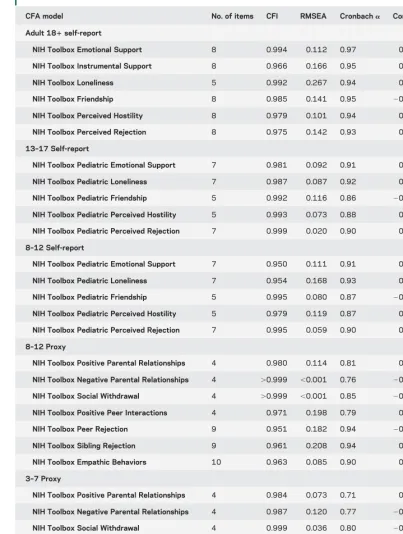
empathic behaviors. Table 5 provides a summary of the psychometric data for the scales recommended for the Social Relationships subdomain of Emotion.
LIMITATIONSThe convergent validity coefficients, reported in the tables, are initial attempts to examine re-lationships with other existing measures that assess simi-lar concepts. Some of these relationships are modest (coefficient range50.10–0.30). In some cases, the con-ceptual link between the NIH Toolbox measure and the comparison (“validating”) measure is weak. In other cases, the psychometric properties (e.g., internal consis-tency reliability) of the identified comparison measures were not strong, which will attenuate correlation coeffi-cients. In addition, some of these data are from different informants, which also tends to decrease the magnitude of association. These mitigating considerations can account for some of the relatively lower correlations between the NIH Toolbox measures and the selected comparison measures. Another limitation is the use of informants in general for some concepts in children. Although this was deemed necessary in order to obtain reasonable measures among young children, there is potential for the informant ratings to be inaccurate re-flections of the child’s emotional health. This can be especially problematic when the informant may be a cause of NA or stress in the child. A more detailed and comprehensive treatment of the psychometric issues will be addressed in forthcoming publications on specific measures developed within the Emotion Domain for Negative Affect, Psychological Well-Being, Stress and Self-Efficacy, and Social Relationships.
CONCLUSIONS The NIH Toolbox is a broad and extensive measurement project that provides tools to assess emotional, cognitive, sensory, and motor
health, as opposed to symptoms, impairment, or dis-ability. That said, many of the concepts measured by the NIH Toolbox bear a close and at times even direct relationship to other large NIH initiatives, such as the Patient Reported Outcomes Measurement Information System (PROMIS; www.nihpromis.org), Quality of Life Outcomes in Neurological Disorders (Neuro-QOL; www.neuroqol.org), and the National Institute of Neurological Disorders and Stroke Common Data El-ements project (http://www.commondataelements. ninds.nih.gov). For example, in the emotional health area, NIH Toolbox NA assessments for sadness, fear, and anger draw from the same pool of questions as the PROMIS item banks do for depression, anxiety, and anger, respectively. We see this overlap as advantageous, allowing researchers across a wide variety of ongoing and future studies to share a common metric for these impor-tant concepts.
Table 5 Confirmatory factor analysis by Social Relationships instrument—single-factor model
CFA model No. of items CFI RMSEA Cronbacha Convergent validity
Adult 181self-report
NIH Toolbox Emotional Support 8 0.994 0.112 0.97 0.78a
NIH Toolbox Instrumental Support 8 0.966 0.166 0.95 0.69a
NIH Toolbox Loneliness 5 0.992 0.267 0.94 0.83b
NIH Toolbox Friendship 8 0.985 0.141 0.95 20.80b
NIH Toolbox Perceived Hostility 8 0.979 0.101 0.94 0.64c
NIH Toolbox Perceived Rejection 8 0.975 0.142 0.93 0.60c
13–17 Self-report
NIH Toolbox Pediatric Emotional Support 7 0.981 0.092 0.91 0.66d
NIH Toolbox Pediatric Loneliness 7 0.987 0.087 0.92 0.70e
NIH Toolbox Pediatric Friendship 5 0.992 0.116 0.86 20.55e
NIH Toolbox Pediatric Perceived Hostility 5 0.993 0.073 0.88 0.28f
NIH Toolbox Pediatric Perceived Rejection 7 0.999 0.020 0.90 0.18f
8–12 Self-report
NIH Toolbox Pediatric Emotional Support 7 0.950 0.111 0.91 0.55d
NIH Toolbox Pediatric Loneliness 7 0.954 0.168 0.93 0.68e
NIH Toolbox Pediatric Friendship 5 0.995 0.080 0.87 20.59e
NIH Toolbox Pediatric Perceived Hostility 5 0.979 0.119 0.87 0.38f
NIH Toolbox Pediatric Perceived Rejection 7 0.995 0.059 0.90 0.33f
8–12 Proxy
NIH Toolbox Positive Parental Relationships 4 0.980 0.114 0.81 0.21g
NIH Toolbox Negative Parental Relationships 4 .0.999 ,0.001 0.76 20.07g
NIH Toolbox Social Withdrawal 4 .0.999 ,0.001 0.85 20.15g
NIH Toolbox Positive Peer Interactions 4 0.971 0.198 0.79 0.26g
NIH Toolbox Peer Rejection 9 0.951 0.182 0.94 20.18g
NIH Toolbox Sibling Rejection 9 0.961 0.208 0.94 0.02g
NIH Toolbox Empathic Behaviors 10 0.963 0.085 0.90 0.24g
3–7 Proxy
NIH Toolbox Positive Parental Relationships 4 0.984 0.073 0.71 0.13g
NIH Toolbox Negative Parental Relationships 4 0.987 0.120 0.77 20.15g
NIH Toolbox Social Withdrawal 4 0.999 0.036 0.80 20.03g
NIH Toolbox Positive Peer Interactions 4 0.958 0.195 0.73 0.25g
NIH Toolbox Peer Rejection 9 0.944 0.160 0.92 0.07g
NIH Toolbox Sibling Rejection 9 0.956 0.156 0.93 0.08g
NIH Toolbox Empathic Behaviors 10 0.970 0.086 0.90 0.31g
Abbreviations: CFA5confirmatory factor analysis; CFI5comparative fit index; RMSEA5root mean square error of approximation.
Validation scales:
aInterpersonal Support Evaluation List.
bUCLA Loneliness Scale.
cNegative Interactions Scale.
dMonitoring the Future–support scale. eMonitoring the Future
–loneliness scale. fNCS Sibling Scale.
gSocial Network Index
use in large-scale, longitudinal, epidemiologic, or clinical trial studies. The Emotion Domain has identified 4 subdomains of particular relevance to health outcomes: Negative Affect, Psychological Well-Being, Stress and Self-Efficacy, and Social Relationships. Preliminary calibration and validation data have guided item and measure selection across the lifespan for each emotional health concept. Subse-quent norming activites, to be reported in the future, enabled cross-domain comparisons, further refined the assessments, and enhanced the quality of the NIH Tool-box to ensure efficient measurement of key emotional health factors linked to health outcomes.
AUTHOR CONTRIBUTIONS
Drs. Cella, Pilkonis, Choi, Butt, Salsman, and Zill: study concept and design. Drs. Butt, Salsman, Lai, Choi, Bode, and Griffith: acquisition of data. Drs. Salsman, Butt, Pilkonis, Cyranowski, Zill, Hendrie, Kupst, Kelly, Bode, Choi, Lai, Griffith, Stoney, Browers, and Cella: analysis and interpretation. Drs. Sals-man, Butt, Pilkonis, Cyranowski, Zill, Hendrie, Kupst, Kelly, Bode, Choi, Lai, Griffith, Stoney, Browers, Knox, and Cella: critical revision of the manuscript for important intellectual content. Drs. Cella and Pilkonis: study supervision.
ACKNOWLEDGMENT
The authors express their appreciation to Tara L. Moore, MA, MPH, who coor-dinated the NIH Toolbox work at the University of Pittsburgh Medical Center. The authors thank the subdomain consultants and Gitanjali Taneja, PhD, of the NIH project team, for providing critical and constructive expertise during the development of the NIH Toolbox Emotion measurement battery.
STUDY FUNDING
This study is funded in whole or in part with Federal funds from the Blueprint for Neuroscience Research and the Office of Behavioral and Social Sciences Research, NIH, under contract no. HHS-N-260-2006-00007-C.
DISCLOSURE
J. Salsman served as an independent contractor for the RTOG (Study no. 0841) and has received research support from the NIH (Contract no. HHSN265200423601C), GlaxoSmithKline, the American Cancer Society–
Illinois Division (PSB-08-15), and the NIH (U01 AR052177-05). He cur-rently receives research support from the National Cancer Institute (5K07CA158008-01A1). Z. Butt served as a consultant for Johnson & John-son and the American Society of Transplant Surgeons. He received support from Boehringer Ingelheim, Pfizer, the Patient-Centered Outcomes Research Institute (PCORI), and NIH grant KL2RR0254740. He currently receives research support from Daiichi Sankyo, Inc., the Frankel Foundation, and NIH grants HD067440, DK091786, 10, and DK062467-08S1. P. Pilkonis served as a consultant for Lundbeck Pharmaceuticals. He currently receives support from NIH grants AR052155, AT006453, MH056888, MH066302, and MH090333. J. Cyranowski has received research funding from the Pittsburgh Foundation and from NIH grants HL076852, AR52155, and MH37896; she currently receives research support from NIH grants MH085874, MH083647, AG012546, AR052186, and MH086637. N. Zill received research support from the National Council for Adoption, the Brookings Institution, and the Marriage and Religion Research Institute. He served as a reviewer for an NIH SBIR Review Panel. He holds a TIAA-CREF Retirement Annuity Contract that invests in US Treasury Bonds and an International Stock Index Fund. He received consulting income and income from selling stock and exercising stock options from West-at, an employee-owned S Corporation. He holds an IRA and brokerage account with Vanguard that includes holdings in the Vanguard Health Care, Precious Metals and Mining, High-Yield Corporate Bond, High-Yield Tax Exempt Bond, and Long-Term Corporate Bond mutual funds, as well as the Vanguard Consumer Discretionary, Consumer Staples, FTSE International Small Cap, and Corporate Long-Term Bond Exchange Traded Funds. He has holdings in a number of closed-ended mutual funds, including the Aberdeen Asia Pacific
Income Fund, Templeton Global High Income Fund, Templeton Dragon Fund, Alliance-Bernstein Global High Income Fund, Alliance-Bernstein Cor-porate Income Fund, Blackrock Income Opportunity Trust, Putnam Master Intermediate Income Trust, Nuveen Floating Rate Income Opportunity Fund, India Fund, Morgan Stanley India Investment Fund, Latin American Discovery Fund, Aberdeen Latin American Equity Fund, Singapore Fund, and Turkish Investment Fund. He has stock holdings in AT&T, Boardwalk Pipeline Part-ners, Banco de Columbia, Consolidated Edison, Exxon, Frontier Communi-cations, GlaxoSmithKline, Honeywell, Huntington Ingalls Industries, IBM, Intel, 3M, MeadWestvaco, Newell Rubbermaid, Northrop Grumman, Occi-dental Petroleum, SCANA, Sherwin-Williams, Siemens, Southern, Verizon, Johnson Controls, American Superconductor, Ocean Power Technology, and Maxwell Technology. Dr. Zill’s wife, Karen, prepared discussion guides for the
Independent Lensprogram on PBS. She holds a TIAA Retirement Annuity Contract that invests in US Treasury Bonds. H. Hendrie currently receives research funding from NIH/NIA grant R01AG009956, R24MH080827, 5R01AG026096-05, UF20303/U01AG022376, R01AG031222, R01AG019181, and R01AG029884. M. Kupst reports no disclosures. M. Kelly has been employed by the University of Pittsburgh School of Medicine and Family Services of Western Pennsylvania. Dr. Kelly is the co– principal investigator on a study sponsored by Ortho McNeil Janssen for which Family Services of Western Pennsylvania receives remuneration. Dr. Kelly does not receive direct remuneration for her role in that study. R. Bode reports no disclosures. S. Choi has received research support from Boehringer-Ingelheim, Novartis, and the NIH. J.-S. Lai has received research support from the NIH, Agency for Healthcare Research and Quality, and Pfizer, Inc. J. Griffith has received financial support from NorthShore University HealthSystem, the Cleveland Clinic Foundation/Teva Neurosciences, Inc., Ironwood Pharmaceut-icals, Inc., and Forest Laboratories, Inc., the NIH, the Department of Defense (DOD)–United States Army, and the FWO, Belgium. In addition to NIH Toolbox funding, he receives funding from the NIH for other research (grant U01 DK082342). He has also been a paid consultant to Dr. Kathryn Grant of DePaul University, and maintains a clinical psychology practice for which he bills for his services. C. Stoney reports no disclosures. P. Brouwers and S. Knox report no disclosures. D. Cella serves on the editorial board of theJournal of Supportive Oncology, has received travel support from Pfizer, honoraria from Virginia Commonwealth University and Moffit Cancer Center for speaking engagements, and research support from Boehringer-Ingelheim, Novartis, and the NIH. He also receives royalties fromUp to Date. Go to Neurology.org for full disclosures.
Received June 6, 2012. Accepted in final form October 3, 2012.
REFERENCES
1. Watson D, Tellegen A. Toward a consensual structure of mood. Psychol Bull 1985;98:219–235.
2. Anastasi A, Urbina S. Psychological Testing. Upper Saddle River, NJ: Prentice Hall; 1997.
3. Lord FM. Applications of Item Response Theory to Practical Testing Problems. Hillsdale, NJ: Lawrence Erlbaum; 1980. 4. Richardson M. The relation between the difficulty and
the differential validity of a test. Psychometrika 1936;1: 33–49.
5. Streiner DL, Norman GR. Health Measurement Scales: A Practical Guide to Their Development and Use. New York: Oxford University Press; 1995.
6. Watson D, Clark LA. Affects separable and inseparable: on the hierarchical arrangement of the negative affects. J Pers Soc Psychol 1992;62:489–505.
7. Stith SM, Hamby SL. The anger management scale: develop-ment and preliminary psychometric properties. Violence Vict 2002;17:383.
8. Suchday S, Carter MM, Ewart CK, Larkin KT, Desiderato O. Anger cognitions and cardiovascular recovery following provo-cation. J Behav Med 2004;27:319–341.
Indicators. Oxford: University of Oxford Poverty and Human Development Initiative; 2007.
10. Cohen S, Pressman SD. Positive affect and health. Curr Dir Psychol Sci 2006;15:122–125.
11. Diener E, Suh EM, Lucas RE, Smith HL. Subjective well-being: three decades of progress. Psychol Bull 1999;125: 276–302.
12. Ryan RM, Huta V, Deci E. Living well: a self-determination theory perspective on eudaimonia. J Happiness Stud 2008;9: 139–170.
13. Danner DD, Snowdon DA, Friesen WV. Positive emo-tions in early life and longevity: findings from the nun study. J Pers Soc Psychol 2001;80:804–813.
14. Pressman SD, Cohen S. Does positive affect influence health? Psychol Bull 2005;131:925–971.
15. Fredrickson BL, Levenson RW. Positive emotions speed recovery from the cardiovascular sequelae of negative emo-tions. Cogn Emot 1998;12:191–220.
16. Richman LS, Kubzansky L, Maselko J, Kawachi I, Choo P, Bauer M. Positive emotion and health: going beyond the negative. Health Psychol 2005;24:422–429. 17. Diener E. Subjective well-being: the science of happiness and
a proposal for a national index. Am Psychol 2000;55:34–43. 18. Koizumi M, Ito H, Kaneko Y, Motohashi Y. Effect of having a sense of purpose in life on the risk of death from cardiovascular diseases. J Epidemiol 2008;18:191–196. 19. Verduin PJ, de Bock GH, Vliet Vlieland TP, Peeters AJ,
Verhoef J, Otten W. Purpose in life in patients with rheu-matoid arthritis. Clin Rheumatol 2008;27:899–908. 20. Mascaro N, Rosen DH. Existential meaning’s role in the
enhancement of hope and prevention of depressive symptoms. J Pers 2005;73:985–1013.
21. Fredrickson BL. The role of positive emotions in positive psychology: the broaden-and-build theory of positive emo-tions. Am Psychol 2001;56:218–226.
22. Lazarus RS, Folkman S. Stress, Appraisal, and Coping. New York: Springer Publishing Co.; 1984.
23. Cohen S, Kessler RC, Gordon LU. Strategies for measur-ing stress in studies of psychiatric and physical disorder. In: Cohen S, Kessler RC, Gordon LU, editors. Measuring Stress: A Guide for Health and Social Scientists. New York: Oxford University Press; 1997:3–26.
24. Bandura A. Self-efficacy: The Exercise of Control. New York: Freeman; 1997.
25. Cohen S, Miller GE, Rabin BS. Psychological stress and anti-body response to immunization: a critical review of the human literature. Psychosom Med 2001;63:7–18.
26. Segerstrom SC, Miller GE. Psychological stress and the human immune system: a meta-analytic study of 30 years of inquiry. Psychol Bull 2004;130:601–630.
27. O’Leary A. Self-efficacy and health. Behav Res Ther 1985; 23:437–451.
28. Cohen S, Gordon LU, Gottlieb BH, Fetzer I. Social Support Measurement and Intervention: A Guide for Health and Social Scientists. New York: Oxford University Press; 2000. 29. Cohen S. Social relationships and health. Am Psychol
2004;59:676–684.
30. Cacioppo JT, Hawkley LC, Crawford LE, et al. Loneliness and health: potential mechanisms. Psychosom Med 2002; 64:407–417.
31. Cacioppo JT, Hughes ME, Waite LJ, Hawkley LC, Thisted RA. Loneliness as a specific risk factor for depressive symptoms: cross-sectional and longitudinal analyses. Psychol Aging 2006;21:140–151.
32. Seeman TE. Health promoting effects of friends and family on health outcomes in older adults. Am J Health Promot 2000; 14:362–370.
DOI 10.1212/WNL.0b013e3182872e11
2013;80;S76-S86
Neurology
John M. Salsman, Zeeshan Butt, Paul A. Pilkonis, et al.
Emotion assessment using the NIH Toolbox
This information is current as of March 11, 2013
Services
Updated Information &
http://n.neurology.org/content/80/11_Supplement_3/S76.full
including high resolution figures, can be found at:
Supplementary Material
S76.DC1
http://n.neurology.org/content/suppl/2013/03/09/80.11_Supplement_3.
Supplementary material can be found at:
References
http://n.neurology.org/content/80/11_Supplement_3/S76.full#ref-list-1
This article cites 24 articles, 2 of which you can access for free at:
Citations
cles
http://n.neurology.org/content/80/11_Supplement_3/S76.full##otherarti
This article has been cited by 2 HighWire-hosted articles:
Subspecialty Collections
http://n.neurology.org/cgi/collection/outcome_research Outcome research
http://n.neurology.org/cgi/collection/neuropsychological_assessment Neuropsychological assessment
http://n.neurology.org/cgi/collection/all_neuropsychology_behavior All Neuropsychology/Behavior
following collection(s):
This article, along with others on similar topics, appears in the
Permissions & Licensing
http://www.neurology.org/about/about_the_journal#permissions
its entirety can be found online at:
Information about reproducing this article in parts (figures,tables) or in
Reprints
http://n.neurology.org/subscribers/advertise
Information about ordering reprints can be found online:
rights reserved. Print ISSN: 0028-3878. Online ISSN: 1526-632X.
1951, it is now a weekly with 48 issues per year. Copyright © 2013 American Academy of Neurology. All ® is the official journal of the American Academy of Neurology. Published continuously since