An Effectual Approach in Biased Shape
Matching for Gesture Recognition using LTrP
and SIFT Algorithm
Nitin Raut
1, Dr. S S Lomte
2, Prof. R A Auti
3, Prof. B K Patil
4, Prof. Y R Nagargoje
5Student, Department of CSE, Everest College of Engineering and Tech, Aurangabad, India1 Professor, Department of Computer, Everest College of Engineering and Tech, Aurangabad, India2 Assistant Professor, Department of Computer, Everest College of Engineering and Tech, Aurangabad, India3,4,5
ABSTRACT: Here a new approach for matching partially provided more efficiently and easily using local standard Tetra (LTrP) algorithm to extract size and feature a constant feature transformation (SIFT) for matching points function. The main idea and the major contributors to this work lies in matching textures and recognition and thus provide some special features such as the stability of size, deformation and orientation tolerance and free nature. In the heart of the proposed system is As if new format also allows measuring the local level. Calculated descriptors form an open or closed manner along the spatially non-uniform features. LTrP model proposes to extract the fabric texture image properties Sift then able to implement texture classification and recognition algorithm. Due to the properties of descriptor newly proposed format, and the method used for extraction and matching technology, the proposed approach and takes the form of a partial match more efficiently.
KEYWORDS:Gesture recognition, Biased shape matching, Scale Invariant Feature Transformation (SIFT), Shape descriptor, Local Tetra Pattern
I. INTRODUCTION
Shape matching is a fundamental problem in computer vision and pattern recognition. It amounts to developing computational methods for comparing shapes that agree as much as possible with the human notion of shape similarity. The problem has significant theoretical interest and a wide range of applications, including, but not limited to object detection and recognition, content based retrieval of images and image registration.
on pattern recognition technique developed by McConnell employing histograms of local orientation[3]. Naidoo and Glaser [4] developed a system that is recognized static hand gesture against complex backgrounds based on South African Sign Triesch and Malsburg [5] loyed the elastic graph matching technique to classify hand postures over complicated backgrounds, hand postures were represented by graphs with an underlying two dimensional topology, attached to the nodes called jets. A jet is a local image description based on Gabor filters. Mentioned approach can gives a scale invariant and user-independent recognition which does not need hand segmentation. As using one graph for one hand posture is not sufficient one, the approach is not view-independent.
To perform shape matching, most of the existing methods define shape representations and descriptors which are then compared through appropriately selected methods and metrics. The quality of the shape matching process depends on whether its final outcome agrees with human judgment. Shape matching is a very challenging problem. Shapes to be matched are typically the result of some kind of segmentation process which, being imperfect, may introduce a considerable amount of noise that needs to be tolerated. In most of the cases, arbitrary differences in scale and orientation should not affect the matching process. Due to viewpoint dependencies and shape articulations and deformations, different 2D image projections of the shape of the same 3D object may differ considerably. Further complications are caused by occlusions which force shape matching to be based on partial evidence. In this particular case, the best matching of an open contour with part of a closed contour needs to be established [6, 13]. Last but not least, in realistic settings, all of the above complicating factors do not appear in isolation, but contribute collectively to increasing the complexity of the matching problem.
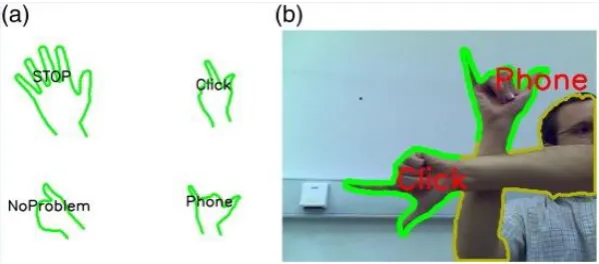
In the context of this work, we are interested in addressing the 2D shape matching problem. Shapes are represented as binary images depicting foreground objects over their background. Consider, for example, Figure 1(a) which shows four prototype silhouettes corresponding to parts of the outline of a human hand. Given another in Figure 1(b), possibly scaled, rotated and deformed silhouette, we are interested in determining the best match between a part of it and the prototypes of Figure 1(a) [6].
Figure 1: A simple gesture recognition. (a) Four basic prototype contour parts and (b) prototypes get matched with parts of the contour and at which positions the best matches were achieved
It can be verified that all the aforementioned difficulties may contribute to complicating this 2D partial shape matching problem. As stated in [16], none of the currently available, state of the art shape matching techniques provides solutions to all of these problems.
matching technique that accomplishes global 2D shape matching based on the computed shape descriptors. The key novelty in this variant is its ability to handle partial matching. Thus, matching of a source, open contour to the best matching part of another target, closed contour can be established. On top of a distance measure between shapes, the proposed method provides, as a by product , an alignment of the silhouette part to the complete silhouette (shown in Fig. 1(b)). Although primarily developed for matching open to closed contours, the proposed scheme treats the matching of two closed contours as a special case. This can be effectively achieved by treating one of the two closed contours as an open one that starts and ends at the same point.
Experimental results have been obtained for contour matching (open to closed and closed to closed) in benchmark data sets but also in datasets that have been compiled in the context of this study. The results demonstrate that the proposed approach outperforms existing methods and is capable of dealing with the shape matching problem in challenging situations.
II. RELATED WORK
The basic need for the purpose of good recognition rate is a well-organized hand model. Pavlovic et al. in [7] covered a review of more than hundred papers related to visual interpretation of hand gestures in context to HCI. Method used for modeling, analyzing and recognizing gestures are discussed in detail. And it suggests integration of hand gestures with gaze, speech and other naturally related modes of communication in multimodal interface for raising these limitations toward gestural HCI. Wu and Huang in [8] had done a survey on vision based gesture recognition approaches. It focused on different recognition techniques which comprises of recognition done by modeling the dynamics, modeling the semantics, HMM framework etc and there key findings laid emphasis on the complexity of gesture for which efforts in computer vision, machine learning and psycholinguistics will be needed. Static hand posture recognition techniques try to achieve rotation invariant and view-independent recognition which needs to be more investigated detail. Moeslund and Granum in [9] proposed a system with a scope of analysis over initialization, pose estimation, tracking and for recognition of a motion capture system. With performance characteristics related to system functionality and modern advancements in each of these fields are comprehensively evaluated. But there are various problems predominant throughout the domain such as the lack of training data, the large amount of time required for gesture capture, lack of invariance and robustness are explored and possible solutions such as the employment of a approach similar to speech recognition, abstracting the motion layer have to be investigated in detail.
The main issues regarding various problems of vision-based hand gesture recognition is to handle the large variety of gesture data. Recognizing gestures involve handling vast variances of the 2D appearance depending on the camera view point even for the same gesture, different silhouette scales and many resolutions for the temporal dimension. Moreover, it need also to go through various parameters such as the accuracy, performance, usefulness according to the type of application‟s use, robustness, scalability and user-independence.
III.PROPOSED APPROACH
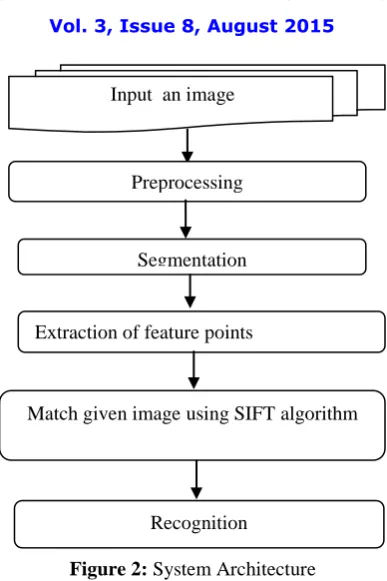
In our proposed work, we implement image feature extraction and matching by using SIFT algorithm. This feature concept is scale and rotational invariant feature vector and classifies the image accordingly. SIFT feature concept is a type of feature used for classification in computer vision. SIFT feature point is the particular case of the texture model. It has since been found to be a powerful feature for texture classification. Here, feature values are extracted from the segmented image then extract the SIFT feature for it then SIFT feature concept is used to extract the feature points from the image then extracted SIFT feature points are used to match the gesture images. The advantages of this approach are its performance related things and computational easiness, due to which it makes possible to analyse images in challenging real-time environments. Here feature points are detected by searching over all scales and image locations. Finding locations which are invariant to the scale change of the image can be accomplished by searching for stable features across all the scales, by using a function of scale which is known as scale space which consists of a group of blurred and subsampled versions of the original image. For an image, the scale space is constructed using a Gaussian kernel G(x, y, σ) with various values of σ.
L(x, y, σ) = G(x, y, σ) ∗ I(x, y) (1)
where ∗ is the convolution operation in x and y and
2 2 2 2 ) ( 2 2 1 ) , , (
y x e z y xG
(2)
Starting with the original image , an initial step is to convolve the image with G(x, y, σ), which leads to a blurred image L(x, y, σ). This function is repeated using G(x, y, kσ) and it gives a further blurred image L(x, y, kσ). The difference between the two nearby blurred images is defined as a difference-of-gaussian image D(x, y, σ) which is given by
)
,
,
(
)
,
,
(
)
,
,
(
x
y
L
x
y
k
L
x
y
D
(3)Figure 2: System Architecture
IV.EXPERIMENTAL WORK AND RESULTS
The Table 1 shows the comparative analysis of the result of proposed approach with some already developed techniques. For the purpose of experimental setup we have created our own database and trained it. To evaluate the results for proposed approach the evaluation parameters like sensitivity, specificity and accuracy has been calculated. These parameters are determined from the values of True Positive (TP), True Negative (TN), False Positive (FP) and False Negative (FN). The formulae for accuracy, sensitivity and specificity are as follows:
Accuracy = ((TP+TN) / (TP+TN+FP+FN))*100 Sensitivity = TP / (TP+FN) *100
Specificity = TN / (TN+FP) *100
Table 1: Performance evaluation metrics
Figure 3 shows the comparative analysis of all the methods specified in table 1 in graphical notation. Approach Method Sensitivity Specificity Accuracy
Dr.E.Annasaro
et al.in [15]
Canny 90.9337 80.7851 86.9174 Sobel 87.4499 76.7933 83.3197 Prewitt 86.9029 64.9826 76.6149 Robert 82.1839 63.3776 74.08013 Damien
Michel et al.
in [6]
DTW -- -- 89.9000
Our Approach LTrP+SIFT
Algorithm 92.3077 100 95.8333 Input an image
Preprocessing
Segmentation s
Extraction of feature points
Match given image using SIFT algorithm
Figure 3: Comparative analysis of all the methods
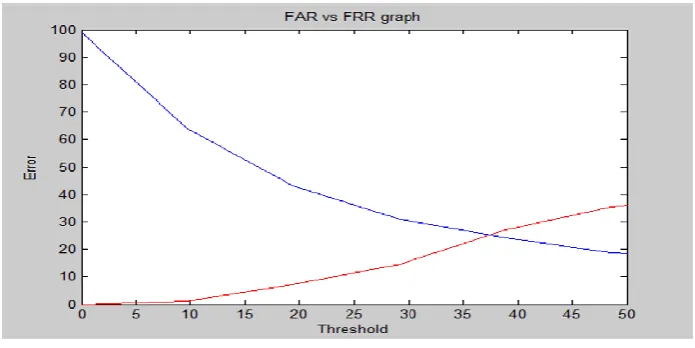
The results in the form of False Acceptance Rate (FAR) and Recognition Rate (RR) for different inputs has been observed under various values of threshold. The results observed from all analysis part ensures that as the value of threshold change the performance of system get changed at some point gets stable for a specific range of threshold value.
The overall evaluation of the performance of a system is shown in following figure:
Figure 4: FAR vs FRR Graph
Receiver Operating Characteristic (ROC) curve: This curve is used to summarize the performance of a biometric verification system. An ROC curve plots, parametrically as a function of the decision threshold, the percentage of impostor attempts accepted (i.e. false acceptance rate (FAR)) on the x-axis, against the percentage of genuine attempts accepted (i.e. 1 - false rejection rate (FRR)) on the y-axis (Figure 5). The ROC curve is threshold independent, allowing
0 10 20 30 40 50 60 70 80 90 100
Canny Sobel Prewitt Robert DTW LTrP+SIFT
Per
ce
n
tage
(%
)
Methods
Sensitivity
Specificity
Figure 5: Receiver Operating Characteristic (ROC) curve
Detection Error Trade-off (DET) curve: In the case of biometric systems, the DET curve is often preferred to the ROC curve. Indeed, the DET curve plots error rates on both axes (FAR on the x-axis against FRR on the y-axis) using normal deviate scale (Figure 4), what spreads out the plot and distinguishes different well-performing systems more clearly.
Operating Point (OP): In practice, biometric systems operate at a low FAR instead of the equal error rate in order to provide high security. This operating point is defined in terms of FRR (%) achieved for a fixed FAR. The fixed value of FAR depends on the security level required by the verification system. In practice, the OP is computed as follows:
)}
(
|
{
|
)
(
max
}
{
FRR
t
t
t
FAR
t
OP
S t OP OP
FAR
Where S is the set of thresholds used to calculate the score distributions.
V. CONCLUSION AND FUTURE WORK
We propose a method for feature extraction to match and recognize the gesture of given image. We extract the texture features for the input image. The gesture region of a given template is defined as the set of all points that lie closer to this template than to any other of the available templates. The recognition method therefore consists in finding the template that is closest to the input vector. By using SIFT algorithm, we extract matching point of given image with database. The proposed approach provides a fine solution to the problem of partial shape matching. The key idea and main contribution of this paper lies in by using proposed technique increasing the accuracy and performance of the system. According to the results evaluated, this technique has given the sensitivity 92.3077%, specificity 100% and accuracy up to 95.8333%. Finally, these comparative experimental results demonstrate the effectiveness and usefulness of the proposed method compared to existing ones.
This work may extend to make actions according to eye movement, secondly we can increase number of features to be matched, perform matching over 3D images also.
REFERENCES
1. [P. Jenifer Martina, P. Nagarajan and P. Karthikeyan, Hand Gesture Recognition Based Real-time Command System, International Journal of Computer Science and Mobile Computing, 2013, pp. 295-297.
3. Chang, J. Chen, W. Tai, and C. Han, New Approach for Static Gesture Recognition, Journal of Information Science and Engineering22, pp. 1047-1057, 2006.
4. S. Naidoo, C. Omlin and M. Glaser, Vision-Based Static Hand Gesture Recognition Using Support Vector 5. Machines, 1998, p. 88 – 94.
6. J. Driesch, and C. von der Malsburg, Robust classification of hand postures against complex backgrounds, in Proc. Second International Conference on Automatic Face and Gesture Recognition, p. 170 – 175.
7. Damien Michel, Iasonas Oikonomidis and Antonis Argyros, Scale invariant and deformation tolerant partial shape matching, Image and Vision Computing 29 (2011) 459–469.
8. Pavlovic VI, Sharma R and Huang TS, Visual interpretation of hand gestures for human–computer interaction: A review, Trans Pattern Anal Mach Intell 19(7) (1997) : 677–695.
9. Wu Y and Huang T, Vision-based gesture recognition: A review in gesture-based communications in HCI, Lecture Notes in Computer Science, vol. 1739 (1999a), Springer, Berlin.
10. Moeslund T and Granum E, A survey of computer vision based human motion capture, Comput Vis Image Underst 81 (2001):231–268. 11. [DerpanisKG, A review of vision-based hand gestures (2004), http://cvr.yorku.ca/members/gradstudents/kosta/
publications/file_Gesture_review.pdf.
12. [Chaudhary A, Raheja JL, Das K and Raheja S, Intelligent approaches to interact with machines using hand gesture recognition in natural way:
13. A survey, Int J Comput Sci Eng Survey (IJCSES) 2(1) (2011):122–133.
14. Wachs JP, Kolsch M, Stern H and Edan Y, Vision-based hand-gesture applications, Commun ACM 54 (2011):60–71.
15. Corera S and Krishnarajah N, Capturing hand gesture movement: A survey on tools techniques and logical considerations, In Proceedings of Chi Sparks 2011 HCI research, innovation and implementation, Arnhem, Netherlands.
16. Kanniche MB, Gesture recognition from video sequences, PhD Thesis, University of Nice(2009).
17. Dr.E. Annasaro and A. Hema, Color and shape feature extraction and matching in pill identification systems, International Journal of Computer Science and Information Technologies, Vol. 5 (2), 2014, 1011-1015.
18. L.J. Latecki, V. Megalooikonomou, Q.A. Wang, and D. Yu. An elastic partial shape matching technique. Pattern Recognition, 40(11):3069– 3080, 2007.
19. S. Mitra, and T. Acharya. ( 2007 ) . “Gesture Recognition: A Survey” IEEE Transactions on systems, Man and Cybernetics, Part C: Applications and reviews, vol. 37 ( 3 ) , pp. 311- 324, doi: 10.1109/TSMCC.2007.893280.
20. Simei G. Wysoski, Marcus V. Lamar, Susumu Kuroyanagi, Akira Iwata, ( 2002 ) . “A Rotation Invariant Approach On Static-Gesture Recognition Using Boundary Histograms And Neural Networks,” IEEE Proceedings of the 9th International Conference on Neural Information Processing, Singapura.
21. Joseph J. LaViola Jr., ( 1999 ) . “A Survey of Hand Posture and Gesture Recognition Techniques and Technology”, Master Thesis, Science and Technology Center for Computer Graphics and Scientific Visualization, USA.
BIOGRAPHY