Available online:
https://edupediapublications.org/journals/index.php/IJR/
P a g e | 370A Secure, Scalable, Flexible and Fine-Grained Access Control
Using Attribute-Set-Based Encryption (ABE) in Cloud Computing
Mr.Mekala Veeranjaneyulu & T.Kishore Babu
1PG Scholar, Dept of CSE, MalineniLakshmaiah Engineering College, Singarayakonda,
Prakasam(Dt), AP, India.
2Associate Professor, Dept of CSE, MalineniLakshmaiah Engineering College,
Singarayakonda, Prakasam(Dt), AP, India.
Abstract:
Cloud computing is a radically new
computing paradigm, which enables
flexible, on-demand, and low-cost usage of computing resources , but the data is deployed to some cloud servers, and various privacy concerns emerge from it. Various layouts based on the attribute-based encryption have been proposed to secure the cloud storage. However, most work targets on the data contents privacy and the access control, while less attention is paid to the privilege control and the identity privacy. In this paper, a semi-anonymous privilege control scheme AnonyControl to address not only the data privacy, but also the user identity privacy in current access control schemes. AnonyControl decentralizes the central authority to limit the identity origin and thus achieves semi anonymity. Besides, it also generalizes the file access control to the privilege control, which privileges of all operations on the cloud data can be managed in a compact structured manner.
Subsequently, we present the
AnonyControl-F, which fully prevents the identity leakage and achieve the full anonymity. Our security presentation shows that both AnonyControl and AnonyControl-F are secure under the Diffie Hellman assumption, and our performance estimation exhibits the feasibility of our schemes.
Keywords: Cloud Computing, Access Control, Privilege Control, Anonycontrol, Semi Anonymity, Fully Anonymity.
I. INTRODUCTION
Available online:
https://edupediapublications.org/journals/index.php/IJR/
P a g e | 3712. RELATED WORK
This section contains the comparative study and overall analysis of the existing systems. Literature Survey of these systems is as follows:
A. Literature Survey
[1] Vipul et al. published ―Attribute-Based Encryption for Fine-Grained Access Control of Encrypted Data.‖ which states that as more sensitive data is shared and stored by third-party sites on the Internet, there will be a need to encrypt data stored at these sites. One drawback of encrypting data is that it can be selectively shared only at a coarse-grained level (i.e., giving another party your private key). A new cryptosystem is developed for fine-grained sharing of encrypted data that we call Key-Policy Attribute-Based Encryption (KP-ABE). In the cryptosystem, ciphertexts are labeled with sets of attributes and private keys are associated with access structures that control which ciphertexts a user is able to decrypt. It demonstrates the applicability of the construction to sharing ofaudit-log information and broadcast encryption. The construction supports delegation of private keys which subsumes Hierarchical Identity-Based Encryption (HIBE).
[2]Rakesh et al. published
―Attribute-Sets: A Practically Motivated
Enhancement to Attribute-Based
Encryption.‖ elaborates that in distributed systems users need to share sensitive objects with others base on the recipients ability to satisfy a policy. Attribute- Based Encryption (ABE) is a new paradigm where such policies are specified and
cryptographically enforced in the encryption algorithm itself. Ciphertext-Policy ABE (CP- ABE) is a form of ABE where policies are associated with encrypted data and attributes are associated with keys. In this work focus is on improving the flexibility of representing user attributes with keys. Specifically, it proposes the Ciphertext Policy Attribute Set Based Encryption (CP-ASBE) - a new form of CP-ABE - which, unlike existing CP- ABE schemes that represent user attributes as a monolithic set in keys, organizes user attributes into a recursive set based structure and allows users to impose dynamic constraints on how those attributes may be combined to satisfy a policy. It shows that the proposed scheme is more versatile and supports many practical scenarios more naturally and efficiently. It provides a prototype implementation of the scheme and evaluates its performance overhead.
[3]Pankaj et al. published ―Cloud
Computing Security Issues in
Available online:
https://edupediapublications.org/journals/index.php/IJR/
P a g e | 372Availability, Authenticity, and Privacy are essential concerns for both Cloud providers and consumers as well. Infrastructure as a Service (IaaS) serves as the foundation layer for the other delivery models, and a lack of security in this layer will certainly affect the other delivery models, i.e., PaaS, and SaaS that are built upon IaaS layer. It presents an elaborated study of IaaS components security and
determines vulnerabilities and
countermeasures. Service Level
Agreement should be considered very much importance.
[4]John et al. published ―Ciphertext-Policy Attribute-Based Encryption (CP-ABE).‖ explains that in several distributed systems a user should only be able to access data if a user possesses a certain set of credentials or attributes. Currently, the only method for enforcing such policies is to employ a trusted server to store the data and mediate access control. However, if any server storing the data is compromised, then the confidentiality of the data will be compromised. In this paper we present a system for realizing complex access control on encrypted data that we call Ciphertext-Policy Attribute-Based Encryption. By using this technique encrypted data can be kept confidential even if the storage server is untrusted; moreover, the methods are secure against collusion attacks. Previous Attribute-Based Encryption systems used attributes to describe the encrypted data and built policies into users keys; while in this system attributes are used to describe the users credentials, and a party encrypting data determines a policy for who can decrypt. Thus, these methods are conceptually closer to traditional access control methods such as Role-Based
Access Control (RBAC). In addition, it provides an implementation of system and gives performance measurements.
[5]Suhair et al. Published ―Designing a Secure Cloud-Based EHR System using Ciphertext-Policy Attribute-Based
Encryption. ―which shows that as more and more healthcare organizations adopt electronic health records (EHRs), the case for cloud data storage becomes compelling for deploying EHR systems; not only is it inexpensive but it also provides the flexible, wide-area mobile access increasingly needed in the modern world. However, before cloud-based EHR systems can become a reality, issues of data security, patient privacy, and overall performance must be addressed. As standard encryption (including symmetric key and public-key) techniques for EHR encryption/decryption caused increased access control and performance overhead, the scheme proposes the use of Ciphertext-Policy Attribute-Based Encryption (CP-ABE) to encrypt EHRs based on healthcare providers' attributes or credentials; to decrypt EHRs, they must possess the set of attributes needed for proper access. It motivates and presents the design and usage of a cloud-based EHR system based on CP-ABE, along with preliminary experiments and analysis to investigate the flexibility and scalability of the proposed approach.
Available online:
https://edupediapublications.org/journals/index.php/IJR/
P a g e | 373them. The proposed scheme has four important features: (i) it allows the owner to outsource sensitive data to a CSP, and perform full block-level dynamic operations on the outsourced data, i.e., block modification, insertion, deletion and
append, (ii) it ensures that authorized users (i.e., those who have the right to access the owners file) receive the latest version of the outsourced data, (iii) it enables indirect mutual trust between the owner
and the CSP, and (iv) it allows the owner to grant or revoke access to the outsourced data. The security issues of the proposed scheme are discussed. Besides, it justifies its performance through theoretical analysis and experimental evaluation of storage, communication, and computation overheads.
[7]Chandana et al. published ―GASBE: A Graded Attribute-Based Solution for Access Control in Cloud Computing.‖ which states that cloud computing is an emerging computing paradigm in which resources of the computing infrastructure are provided as services over the Internet. As promising as it is, this paradigm also brings forth many new challenges for data security and access control when users outsource sensitive data for sharing on cloud servers, which are not within the same trusted domain as data owners. To keep sensitive user data confidential against un-trusted servers, existing solutions usually apply cryptographic methods by disclosing data decryption keys only to authorized users. However, in doing so, these solutions inevitably introduce a heavy computation overhead on the data owner for key distribution and data management when _ne grained data access control is desired, and thus do not scale well. The problem of simultaneously achieving fine-graininess, scalability, and data confidentiality of access control still remains unresolved. It addresses this challenging open issue by defining and
enforcing access policies based on data attributes on one hand and allowing the data owner to delegate most of the computation tasks involved in fine grained data access control to untrusted cloud servers without disclosing the underlying data contents, on the other hand. It achieves this goal by exploiting and uniquely combining techniques of attribute-based encryption (ABE), proxy re-encryption, and lazy re-encryption.
[8] Guojun et al. published
Available online:
https://edupediapublications.org/journals/index.php/IJR/
P a g e | 374applying proxy re-encryption (PRE) and lazy re-encryption (LRE) to the HABE scheme, so as to efficiently revoke access rights from users.
[9]Qin et al. published ―Hierarchical Attribute-Based Encryption for Fine-Grained Access Control in Cloud Storage
Services.‖ which states that cloud computing, as an emerging computing paradigm, enables users to remotely store their data into a cloud so as to enjoy scalable services on-demand. Especially for small and medium-sized enterprises with limited budgets, they can achieve
cost savings and productivity
enhancements by using cloud-based services to manage projects, to make collaborations, and the like.However, allowing cloud service providers (CSPs), which are not in the same trusted domains as enterprise users, to take care of confidential data, may raise potential security and privacy issues. To keep the sensitive user data confidential against untrusted CSPs, a natural way is to apply cryptographic approaches, by disclosing decryption keys only to authorized users. However, when enterprise users outsource confidential data for sharing on cloud servers, the adopted encryption system should not only support fine-grained access control, but also provide high performance, full delegation, and scalability, so as to best serve the needs of accessing data anytime and anywhere, delegating within enterprises, and achieving a dynamic set of users. In this it propose a scheme to help enterprises to efficiently share confidential data on cloud servers. The goal is achieved by first combining the hierarchical identity-based encryption (HIBE) system and the ciphertext-policy attribute-based
encryption (CP-ABE) system, and then making a performance-expressivity tradeoff, finally applying proxy re-encryption and lazy re-re-encryption to our scheme.
Available online:
https://edupediapublications.org/journals/index.php/IJR/
P a g e | 375B. Summary of Literature Review Table I Summary of Literature Review
Sr. Parameters vs. ABE Author Year Fine-Grained Access Efficiency
No. techniques Control
1 KP-ABE V. Goyal, O. 2006 Low Average
(Key Policy Attribute Pandey, A. based encryption) Sahai, and
B.Waters
2 EKP-ABE S. Yu, C. Wang, 2010 Better Access control Higher than KP-ABE,
(Expressive Key K. Ren, and W. than that of allows
Policy Attribute Based Lou KP-ABE constant cipher text
Encryption) only
3 CP-ABE J. Bethencourt, 2007 Average Realization Average Not efficient (Ciphertext Policy A. Sahai, and B. of complex for modern
Attribute Based Waters Access Control enterprise environments
Encryption)
4 CP-ASBE R. Bobba, H. 2009 Better Access Control Better than CP-ABE as
(Ciphertext Policy Khurana, and M. than that of there is
Attribute Set Based Prabhakaran CP-ABE Less collusion attacks
Encryption)
5 HIBE A. Sahai and B. 2005 Lower than CP-ASBE Better, Lower as
(Hierarchical Identity Waters compared to
Based Encryption) ABE schemes
6 HASBE Zhiguo Wan, 2012 Better Access control Most efficient and
(Hierarchical Atrribute Jun’e Liu, and flexible
Set Based Encryption) Robert H. Deng
information, or other users might be able to infer careful information from the outsourced computation. Therefore, not only the access but also the operation should be managed. Secondly, personal information (defined by each user‟s attributes set) is at risk because user's identity is authenticated based on his information for the purpose of access control (or privilege control in this paper). As everyone is becoming more concerned about their identity privacy these days, the identity privacy also has to be protected before the cloud enters our life. Preferably, any authorityor server alone should not know any
client‟s personal data. Last but not least, the cloud computing system should be resilient in the case of security breach in which half part of the system is compromised by attackers. [1]
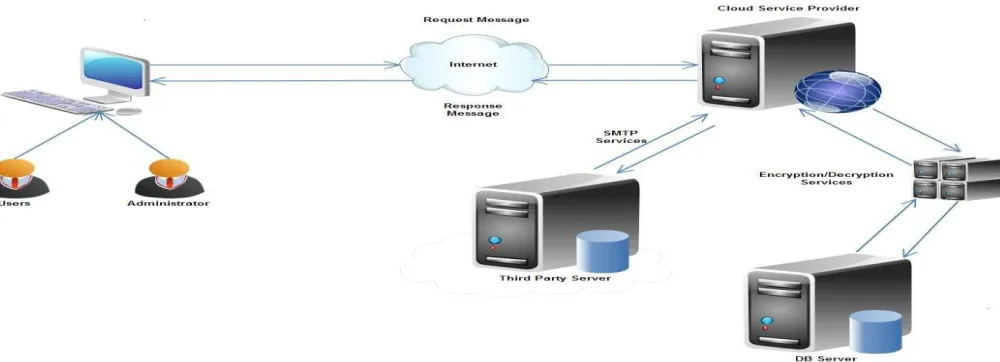
3.PROPOSED SYSTEM A.System Architecture
Systems architecture is the conceptual model that defines the structure, behavior, and more views of a system. An architecture description is a formal description and representation of a system, organized in a way that supports reasoning about the structures of the system. The proposed system architecture is as shown in figure 1.
B.Attribute Based Encryption
Available online:
https://edupediapublications.org/journals/index.php/IJR/
P a g e | 376Available online:
https://edupediapublications.org/journals/index.php/IJR/
P a g e | 377C. Proposed System Architecture Description
The HASBE scheme is for realizing scalable, flexible and fine-grained access control in cloud computing. The HASBE scheme seamlessly incorporates a hierarchical structure of system users by applying a delegation algorithm to ASBE. HASBE not only supports compound attributes due to flexible attribute set combinations, but also achieves efficient user revocation because of multiple value assignments of attributes. Thus it formally proves that the security of HASBE based on the security of CP-ABE. Finally, in the implementation of the proposed scheme,
and conductance of comprehensive
performance analysis and evaluation, this shows its efficiency and advantages over existing schemes. In the proposed system instead of showing complete data from cloud only those data is fetched which is essential for that user. The whole data is not fetched so it takes less time for fetching data and hence the system response time is very less due to which system performance increases. The encryption is performed before storing data so even if data get hack by hacker data cannot be easily understand by hacker. The hierarchical structure is used, so even if lower authority is absent for particular days at that time higher authority handle all work of lower authority so work of company will not be stopped.
D. Project Scope
1.This system is designed to provide security to data stored on cloud and improve performance of system by showing only the required details requested by an employee.
2.Security is provided by generating a secret key from the various attributes stated in the form which is filled by the employee at the time of registration.
3.This system is designed to provide flexibility of the data where in case of transfer of employee, his data could be transferred to respective location with ease.
4.It also provides scalability in case when an employee is absent his work could be handled by the senior employee securely
E. Methodology
1. Registration and login by user:
In this user fill his/her own complete data. Request is sent to the CEO for confirmation. CEO confirms his/her request and assigns attribute and time period for that user. Once Account get confirm password and key is sent to that user by email so he/she can access his/her account.
2. Approve User and Assign attributes:
Out of the selected attributes according the roles defined in hierarchy of the system the attribute visibility access is decided. Each attribute is encrypted.
3. Key Generation and Verification
Key is generated based on the attributes filled by the user in registration form. In attribute key verification, when a key is used for login ,it is first checked with the key stored in the database. If a match is found then user is allowed for further process else the user is rejected for further process.
4. Encryption and decryption of data
Available online:
https://edupediapublications.org/journals/index.php/IJR/
P a g e | 3785. Access Right:
The user can view the selected attributes of the same level as well as other levels according to the access authority using
attribute key.
6. Fine Grained Access
In our propose system instead of showing complete data, the fetching of necessary data is allowed. Due to this system provides a quick response time.
7. Request for extra attribute:
The user can access attributes of same level as inter level counterparts. He can request for extra attributes in case of emergency as well as ease of work.
8. Flexibility
In this module suppose when user transfer from one location to another location at that time new location does not having rights to access data of that user .In this situation request to view attributes of required user and grant for accessing data of that user by admin is necessary. When user’s data is accessible from new location then it cannot access from old location.
9. Scalability:
Since performing hierarchical structure so even if lower authority is absent for particular days at that time higher authority handles all work of lower authority so work of company will not be stopped.
10. Efficient User Revocation:
It can be done by two steps request to the admin and response to the user from admin within expiration time.
11. Privacy:
Default it is public but a user can set intra-level privacy by restricting access to attributes.
4.PROPOSED ALGORITHM A. Key Generation Algorithm i)Set of Attribute List= {li1, li2, li3….}
ii)Set of Employee E= {e1, e2, e3….}
a) List = List of Attribute assign to the user(E).—get list of attribute each user having
b) Foreach ( string Attribute in List ) …retrieve one by one attribute from list {
Foreach (char ch in Attribute ) …get one by one character from attribute {
AK =AK + ch ;…get ASCII value of that character and make summation
Set of attribute key AK= {ak1, ak2, ak3….} ; }
}
c)In the Value we get ASCII value of that character.
d)ASCII values save into database
e)Above approach generates attribute key secrete key using this secret key which has minimum length key
f)The RSA algorithm generates minimum lengths key
g)To process key an attributes with RSA it takes minimum time
B. Algorithmic flow with mathematically equations
The model consists of a root master(admin RM) that corresponds to the domain masters (DMs) in which the top-level DMs i) CreateDM(params,MKi,PKi+1) →(MK
Available online:
https://edupediapublications.org/journals/index.php/IJR/
P a g e | 379first picks a random element mki+1 Ζq, and
then computes SKi+1= SKi +mkiPi+1
where
Pi+1=H1(PKi+1) G1, and Qi+1 =mki+1P0 G
1,
finally sets
MKi+1 =(mki+1 ,SKi+1,Q-tuplei+1)
where
Q-tuplei+1= (Q-tuple i,Qi+1)
, and chosen by the RM and
shared in a domain. Here, we assume that SK0 is an
identity element of G1, and Q-tuple0= (Q0).
ii)CreateUser(params,MKi,PKu,PKa)→(SK
i,uKi,u,a) : To generate a secret key for user
U with PKu on attribute a with PKa,
DMifirst checks whether U is eligible for a,
and a is administered by itself. If so, it first sets
mku =HA(PKu) Zq, Ski,u =mkimkuP0 G1,
and
Ki,u,a = SKi +mkimkuPa G1,
Where
Pa=H1(PKa) 1,
and then gives Q-tuplei. Otherwise, it
outputs―NULL‖. iii)Encryption
Encryption is done using AES algorithm for search attribute and RSA algorithm is used to encrypt the user data on cloud
iv) Decryption
Decryption is done using AES decryption algorithm for accessing users personal
credentials whereas RSA is used for accessing user data on cloud.
VI. CONCLUSION AND FUTURE
WORK
Thus, the system efficiently provides a fine-grained access control with flexibility and scalability with a hierarchical structure in the HASBE system. The system will be providing security to the users from outsiders or intruders by implementing session hijacking and session fixation security in our system with SQL injection attack prevention. The core is for sure, a cloud-base thus giving users a choice of multi-user access including security from intruder attacks. Hence it benefits the users with attack handling and many advantages over the existing systems.
We provide a secure and practical mechanism design which fulfills input/output privacy and efficiency.
We can extend our result to any organization for secure outsourcing in cloud
.
REFERENCES
[1] V. Goyal, O. Pandey, A. Sahai, and B.Waters, ―Attibute-based encryption for fine-grained access control of encrypted data,‖ in Proc. ACM Conf.
Computer and Communications
Security (ACM CCS), Alexandria, VA, 2006.
Available online:
https://edupediapublications.org/journals/index.php/IJR/
P a g e | 380―A novel ultrathin elevated channel low-temperature poly-Si TFT,‖ IEEE Electron Device Lett., vol. 20, pp. 569–571, Nov. 1999.
[3] S. Yu, C. Wang, K. Ren, and W. Lou, ―Achieving secure, scalable, and fine-grained data access control in cloud computing,‖ in Proc. IEEE INFOCOM 2010, 2010, pp. 534–542.
[4] J.Bethencourt, A. Sahai, and B. Waters. ―Ciphertext-Policy Attribute- Based Encryption.‖ In Proc. of SP’07, Washington, DC, USA, 2007.
[5] Zhibin Zhou, Dijiang Huang‖ On Efficient Ciphertext-Policy Attribute Based Encryption and Broadcast Encryption‖.
[6] R.Ostrovsky, A. Sahai, and B. Waters. ―Attribute-based encryption with non-monotonic access structures‖. In Proc. of CCS’06, New York, NY, 2007
[7] D.Boneh and M. Franklin. ―Identity-Based Encryption from the Weil Pairing.‖ In Proc. of CRYPTO’01, Santa
Barbara, California, USA, 2001.
[8] Guojun Wang, Qin Liu , Jie Wu
―Hierarchical attribute-based
encryption and scalable user revocation for sharing data in cloud services‖, 2011.
[9] G.Wang, Q. Liu, and J.Wu,
―Hierachical attibute-based
encryption for fine-grained access control in cloud storage services,‖ in Proc. ACM Conf. Computer and
Communications Security (ACM
CCS), Chicago, IL, 2010.
[10] P. D. McDaniel and A. Prakash, ―Methods and limitations of security policy reconciliation,‖ in Proc. IEEE Symp. Security and Privacy, Berkeley, CA, 2002.
[11] A.Sahai and B. Waters. ―Fuzzy Identity-Based Encryption.‖ In Proc.
Of EUROCRYPT’05, Aarhus,
Denmark,
[12] Zhiguo Wan, Jun’e Liu, and Robert H.
Deng, ―HASBE:A Hierarchical
Attribute-Based Solution for Flexible and Scalable Access Control in Cloud Computing‖ IEEE Transactions On Information Forensics And Security, Vol. 7, No.2,April2012.
Author’s profile
Mr.Mekala Veeranjaneyulu
received B.Tech in
Information Technology from
Malineni Lakshmaiah
Available online:
https://edupediapublications.org/journals/index.php/IJR/
P a g e | 381T.Kishore Babu is completed his B.Techin
Malineni Lakshmaiah
Engineering College in Singarayakonda,prakadamdt and Completed his M.Tech in VidyaVikas Institute of Technology(Autonomous) Chevella, Ranga reddy dist. He is interested in the subjects of Networks and Database. He was guided 18 batches of B.Tech students and 7 batches of M.Tech students. He has a total of 9 years experience in teaching .He is working as an associate professor in CSE department in Malineni
Lakshmaiah Engineering College,