Differential Attacks on LILLIPUT cipher
Valérie Nachef1, Nicolas Marrière1, and Emmanuel Volte1 Department of Mathematics, University of Cergy-Pontoise, CNRS UMR 8088
2 avenue Adolphe Chauvin, 95011 Cergy-Pontoise Cedex, France [email protected]
[email protected] [email protected]
Abstract. In SAC 2013, Berger et al. defined Extended Generalized Feistel Net-works (EGFN) and analyzed their security. Later, they proposed a cipher based on this structure:LILLIPUT. Impossible differential attacks and integral attacks have been mounted onLILLIPUT. We propose a tool which has found some classical, impossible and improbable differential attacks by using the variance method. It has highlighted unusual differential conditions which lead to efficient attacks by the complexity. Moreover, it is the first time we apply the generic variance method to a concrete cipher.
Key words: Differential cryptanalysis, Improbable differential cryptanalysis, Automated research of attacks
1
Introduction
Lightweight cryptography has become an important field of research with the develop-ment of IoT. As a solution, a lot of symmetric block ciphers have been built. Some of them are SPN ciphers like SERPENT [5], PRESENT [9] or more recently SKINNY [2]. Others are Feistel ciphers like SIMON [1], CLEFIA [18] or PICCOLO [17]. In this context, a new variant of generalized Feistel network has been designed: the Extended Generalized Feistel Network [4] (EGFN). It is based on a matrix representation and provides an efficient diffusion. In comparison to the generalized Feistel networks, the distinctive feature in the EGFN is a linear layer after the confusion step. Moreover, an efficient differential analysis method remains unknown [15] because of this linear layer. A cipher based on the EGFN structure calledLILLIPUT[3] has been designed. It is a 30 rounds block cipher. Several kinds of attacks onLILLIPUT have been provided as shown in Table 1.
Differential attacks [7] consist in putting a specific difference in inputs and looking how it propagates through the cipher into the outputs in order to highlight a bias. Differ-ential cryptanalysis is an efficient statistical attack and some attacks are derived from it: truncated differential ones [11], boomerang ones [22] or impossible differential ones [6] for example. A differential analysis based on the variance method [13] has been made on the EGFN [12]. In this article, we have applied this method toLILLIPUT.
Our contribution. In this paper, we provide some differential cryptanalysis attacks
Table 1.Best Attacks onLILLIPUT.
Variety Distinguisher Key recovery Source Impossible differential 9 rounds N/A [16]
Division property 13 rounds 17 rounds [15] Differential 8 rounds 12 rounds Section 4
NCPA (Non-Adaptive Chosen Plaintext Attack) ones. These are based on the variance method [13] that was already used on the EGFN and on some generalized Feistel net-work [14, 21]. For the first time, we apply this generic method to a concrete cipher. These differential attacks do not rely on the key schedule, the structure ofLILLIPUTis the only way used. One can see in [15] that there are 15 active sboxes forLILLIPUT reduced to 8 rounds. The involved sboxes work on 4-bits words. Since the differen-tial probability of an active sbox is at most 2−3, then the differential probability is at most 2−45. In this paper, we will see an implemented differential attack with complex-ity of 2−25. This is why this method is interesting. Moreover, we have made a tool in Python to process an automated research of differential attacks. There are generic tools devoted to different kinds of attacks: meet-in-the-middle and impossible differential at-tacks in [10], or only for impossible differential atat-tacks in [16], in [23] or in [24] for example. Contrary to others generic tools, our program is designed to apply the vari-ance method to a concrete cipher. It can be used on some block ciphers and allows to get differential attacks, impossible differential attacks and improbable differential at-tacks. Indeed, we have found empirically some improbable differential attacks [20, 19] and we provide explanations of how it works. Improbable differential cryptanalysis is a statistical cryptanalytic technique for which some attacks have been invalidated [8] when built from an impossible distinguisher. In the theory, an improbable differential attack is like a classical differential attack but the expected differences occur less for a permutation generated by the studied cipher than for a random permutation. In this paper, the attacks we describe work in practice and we provide simulations of them.
This paper is organized as follow: In Section 2, we will describeLILLIPUT. Then in Section 3 we will detail the general structure of our attacks and describe the tool that allows to find attacks. Section 4 is devoted to the presentation of distinguishing attacks up to 8 rounds. Conclusion is given in Section 5.
2
LILLIPUT
The input is denoted by 16 nibbles of 4-bits:I= [I16,I15,· · ·,I1]. Similarly, the output is
denoted by:S= [S16,S15,· · ·,S1]. We describe one round ofLILLIPUTin the figure 1.
We can see there are three steps in a round:
– NonLinearLayerstep with the sbox. There is only one 4-bits sbox inLILLIPUT
and it is descibred in the table 2.
– LinearLayerstep: this is a step with some xor operations between the left side
I1
S1 I2
S2 I3
S3 I4
S4 I5
S5 I6
S6 I7
S7 I8
S8 I9
S9 I10
S10 I11
S11 I12
S12 I13
S13 I14
S14 I15
S15 I16
S16
S RK0
S
RK1
S
RK2
S
RK3
S
RK4
S
RK5
S
RK6
S
RK7
π= (1,14,7,13,3,15)(2,10,6,12)(4,9,5,11)(8,16)
Fig. 1.One round ofLILLIPUT.
– PermutationLayer: there is a permutation step and we have described the
modifica-tion of the different branches in the table 3.
One can notice that there are two sides and the left side branches go to the right side through the permutation step and vice versa.
Table 2.Sbox ofLILLIPUT.
Input branch 0 1 2 3 4 5 6 7 8 9 A B C D E F Ouput branch 4 8 7 1 9 3 2E 0B 6F A 5 D C
LILLIPUTis an instance of Extended Generalized Feistel Network, a generic family
Table 3.Permutation ofLILLIPUT.
Input 1 2 3 4 5 6 7 8 9 10 11 12 13 14 15 16 Output 14 10 15 9 11 12 13 16 5 6 4 2 3 7 1 8
As previously said, differential attacks on EGFN have already been proposed. These attacks are based on the variance method [13] that we will use onLILLIPUTas well. However, we can not use the same differential trails or use the same kind of relations between inputs and outputs because inLILLIPUTthe sbox is a bijection. In order to find a solution, we have made a tool in Python which has tested many kinds of differential relations and it has highlighted a specific and unusual sort of conditions which are not intuitive.
3
Structure of the attacks
3.1 Variance method
Our attacks are based on variance method [13]. With this method, we can make a further analysis than a classical differential attack. The aim of the attack is to distinguish a permutation obtained withLILLIPUTfrom a random permutation. Just like the authors of the variance method, we will generate a lot of pairs of messages and count how many of them satisfy specific differential relations between inputs and outputs. The number of such pairs is denoted byNpermfor a random permutation and byNLfor aLILLIPUT
permutation.
Then, the attack is a success ifNperm is significantly different fromNL. If it is
smaller, we obtain an impossible or an improbable differential attack and if it is greater, we have a classical differential one. But if NL andNperm have the same order, then
the attack can be successful thanks to the expectation and standard deviation functions if|E(NL)−E(Nperm)|>max(σ(Nperm),σ(NL)), whereEstands for the expectation function andσfor the standard deviation function. In that case, the attacks work thanks to the Chebychev formula, which states that for any random variableX, and anyα> 0, we haveP(|X−E(X)| ≥α σ(x))≤ 1
α2. Using this formula, it is then possible to
construct a prediction interval forNLfor example, in which future computations will
fall, with a good probability. It is important to notice that for our attacks, it is enough to computeE(Nperm),E(NL)andσ(Nperm). For more details about the variance method
see [13], Chapter 5 for example.
Moreover, for all attacks we will see, the condition on the outputs is an equality on 4 bits. So, it is easy to check that ifmis the number of messages for a given attack, then for a random permutation:E(Nperm)'m
·(m−1)
2 ×
1
24 andσ(Nperm)'
p
E(Nperm).
3.2 Conditions on the inputs and the outputs
side[S16,· · ·,S9]of the outputs. Indeed, one can check that, if we found an interesting
distinguisher which uses the right side of the output, it leads to a distinguisher which uses the left side of the output and reaches one more round. It is because in a round the right side goes to the left side with probability 1 without changes.
We have found by hand distinguishers up to 4 rounds and for more rounds with the tool. Most attacks are based on a common structure. Each pair(m1,m2)of messages
that we study has to verify that:m1andm2are equal on all branches but some on the
left side. Moreover, on the branches involved, the non-zero differences have to be equal. For example, this condition on branch number 9 will be writtenI9(m1)⊕I9(m2) =∆or if more simply∆I9=∆.
On the outputs, ifc1=LILLIPUT(m1)andc2=LILLIPUT(m2)we will look at
the xor between some branches of c=c1⊕c2. For example, if we are interested in
the branchesS12andS10, we will computeS12⊕S10oncand it is denoted by∆S12⊕
∆S10. One can notice that if one is interested in only one branch, it leads to a classical
differential attack.
3.3 Complexity
In our differential attacks we use structures of messages. Let (m1,m2) be a pair of
messages. As we have said earlier, there are 2 properties the pairs have to follow. First, m1andm2are equal on all branches but some on the left side. Then, for the non zero
branches ofm1⊕m2, the difference has to be the same. Thus, a structure is based on a
messagemthat is randomly chosen. As we want the same difference on some branches, it leads to 15 more messages. Indeed, the non zero difference can be ∆ ∈[1· · ·15] because branches have 4 bits. So, a structure has 16 messages, and it leads to 16× 15/2=120 pairs.
For example, if we are interested in the branchesI10andI13, a pair will be(m1,m2)
such that:m1⊕m2= [0,0,0,∆,0,0,∆,0,0,0,0,0,0,0,0,0]. There are exactly 24×14of
such structures.
The main drawback of our attacks is the data complexity. Indeed for a given attack which requires 27messages, the number of pairs is 27×(227−1) =8,128. With our kinds of attacks, because we need the same ∆ difference on several branches, we need 68 structures of 120 pairs (68×120=8,160 pairs) and it corresponds to 68×16=1,088 messages instead of 27. But, thanks to these new conditions, one can see special
rela-tions between internal variables which can be used to build a differential attack.
3.4 Automated research of attacks
To extend this kind of attacks, we have implemented a tool1 in Python to process an exhaustive research of such conditions. We describe it in the algorithm 1.
In order to optimise this algorithm, we test on a small number of samples and if we found an interesting result, then we test again in a more meaningful number of samples. It appears that the most efficient attacks are based on having 2 branches involved on the 1Our tool is available on the Internet at this anonymous link:
Algorithm 1Automated research of attacks
for allinputCondition=Combination of branches in the left side of inputs:do
Generate a sample of pairs which verify the condition on the input: Equal on all branches but the inputCondition.
for alloutputCondition=Combination of branches in the left side of outputs:do
Count how many pairs verify the outputCondition: the xor between some branches of the difference of the outputs equals to 0.
ifthis result is significantly different than the one expected for a random permutation. then
We have found a distinguisher. end if
end for end for
inputs and 2 branches involved on the ouput. We detail the best attacks we have found in Section 4.
4
Distinguishing attacks
In this Section, we will describe the different distinguishers we have found by hand or thanks to the tool. We have made simulations of these attacks. Input is denoted by: I16,· · ·,I1. After the first NonLinearLayerandLinearLayer steps and before the
permutation, the output is: X81,X71,X61,X51,X41,X31,X21,X11,I8,I7,I6,I5,I4,I3,I2,I1. Here
X11, . . . ,X81 denote the internal variable that appear at round 1. More generally, Xij, 1≤j≤16 represent the internal variable that are introduced at roundi. In the sequel, to simplify the notation, we always denote by f the round functions. But the even though we always use the same bijective sbox, since the entry is xored with a sub-key, for the same round we note that f(Xij) =f(Xki)does not mean thatXij=Xki.
4.1 First rounds
In the first rounds, we can mount differential attacks with probability 1 onLILLIPUT with only 1 or 2 messages. So let (m1,m2) be a couple of messages. We will note
c1=LILLIPUT(m1),c2=LILLIPUT(m2)andc=c1⊕c2.
Attack on one round. After one round, the output is given by:
[I8,I3,I1,I7,I6,I5,I2,I4,X81,X61,X21,X11,X31,X51,X41,X71]with
X11=I9⊕f(I8),
X21=I10⊕I8⊕f(I7),
X31=I11⊕I8⊕f(I6),
X41=I12⊕I8⊕f(I5),
X51=I13⊕I8⊕f(I4),
X71=I15⊕I8⊕f(I2),
X81=I16⊕I8⊕I2⊕I3⊕I4⊕I5⊕I6⊕I7⊕f(I1).
So there is an attack with one message: one has to encrypt one message and check if S16is equal toI8. This is done with probability 1 forLILLIPUTand with probability214
for a random permutation because it is an equality on 4 bits.
Attack on two rounds. After two rounds, the output is given by:
[X1
8,X51,X71,X61,X21,X11,X41,X31,X82,X62,X22,X12,X32,X52,X42,X72]with
X12=I4⊕f(X81),
X22=I2⊕X81⊕f(X61),
X32=I5⊕X81⊕f(X21),
X42=I6⊕X81⊕f(X11),
X52=I7⊕X81⊕f(X31),
X62=I1⊕X81⊕f(X51),
X72=I3⊕X81⊕f(X41),
X82=I8⊕X11⊕X21⊕X31⊕X41⊕X51⊕X61⊕X81⊕f(X71).
So there is an NCPA attack with 2 messages. As input condition, we have I8(m1) =
I8(m2). Then, one has to check ifS11(c) =I9(m1)⊕I9(m2). This is done with probability
1 forLILLIPUT and with probability 1
24 for a random permutation because it is an
equality on 4 bits.
Property 1 After r rounds (r≥3), the output is:
[X8r−1,X5r−1,X7r−1,X6r−1,X2r−1,X1r−1,X4r−1,X3r−1,X8r,X6r,X2r,X1r,X3r,X5r,X4r,X7r]. We have the following formulas:
X1r =X3r−2⊕f(X8r−1), X2r =X4r−2⊕X8r−1⊕f(X6r−1), X3r =X1r−2⊕X8r−1⊕f(X2r−1), X4r =X2r−2⊕X8r−1⊕f(X1r−1), X5r =X6r−2⊕X8r−1⊕f(X3r−1), X6r =X7r−2⊕X8r−1⊕f(X5r−1), X7r =X5r−2⊕X8r−1⊕f(X4r−1),
X8r =X8r−2⊕X8r−1⊕X6r−1⊕X5r−1⊕X4r−1⊕X3r−1⊕X2r−1⊕X1r−1⊕f(X7r−1).
Attack on three rounds. After three rounds, there is an NCPA attack with 2 messages.
Thanks to Property 1, one can see thatS11=X12=I4⊕f(X81). Thus, we put as input
conditions:Ii(m1) =Ii(m2),∀i∈ {1,· · ·,8,16}. Then, one has to check ifS11(c) =0.
This is done with probability 1 for LILLIPUT and with probability 1
24 for a random
Attack on four rounds. After four rounds, there is an NCPA attack that needs only 2 messages. As input condition we haveIi(m1)6=Ii(m2)only fori=15. Then, one has
to check ifS13(c)⊕S9(c) =I15(m1)⊕I15(m2). We now show that this is done with
probability 1 forLILLIPUTand with probability 1
24 for a random permutation because
we have an equality on 4 bits.
Here we have:S13=X63andS9=X33. According to Property 1, we obtain:
S13⊕S9=X33⊕X63
=X11⊕X71⊕f(X52)⊕f(X22)
=I9⊕f(I8)⊕I15⊕I8⊕f(I2)⊕f(I7⊕X81⊕f(X31))⊕f(I2⊕X81⊕f(X61)).
Using the input conditions, we obtain:
∆S9⊕∆S13=∆I15⊕∆f(I7⊕X81⊕f(X31))⊕∆f(I2⊕X81⊕f(X61)).
But, we have:
X31=I11⊕I8⊕f(I6)and∆X31=0, X61=I14⊕I8⊕f(I3)and∆X61=0,
X81=I16⊕I2⊕I3⊕I4⊕I5⊕I6⊕I7⊕I8⊕f(I1)andX81=0.
since the input conditions areIi(m1)⊕Ii(m2) =0,∀i∈ {1,· · ·,14,16}. Finally we
obtain,∆S13⊕∆S9=∆I15with probability 1.
Attack on five rounds. After five rounds, there is an NCPA attack that needs only 2
messages. As input condition we haveIi(m1)6=Ii(m2)only fori∈ {9,10}. Moreover,
we setI9(m1)⊕I9(m2) =I10(m1)⊕I10(m2). Then, one has to check ifS9(i)⊕S9(j)⊕
S10(i)⊕S10(j) =0. This is satisfied with probability 214 for a random permutation.
We now explain why this is true with probability 1 for a permutation obtained with LILLIPUT.
According to Property 1:
S9=X34=X12⊕X83⊕f(X23)andS10=X44=X22⊕X83⊕f(X13).
X12=I14⊕f(X81),
X23=X41⊕X82⊕f(X62),
X22=I2⊕X81⊕f(X61),
X13=X31⊕f(X82).
Using the input conditions, we obtain∆X81=0,∆X12=0,∆X61and∆X22=0. This gives ∆S9⊕∆10=∆f(X23)⊕∆f(X13). Moreover,∆X31=0 and∆X82=∆X11⊕∆X21=I9⊕
∆I10=0. This implies that∆f(X13) =0. It is easy to check that we also have∆f(X23) =
0. This shows that we have∆S9⊕∆S10=0 with probability 1.
We have found 26 of such attacks.2
4.2 Further attacks
As we have said in Section 3, our attacks are based on a specific structure: for each pair we have equalities on all but some branches and this non zero difference is the same on the different branches. So, we will detail for each attack, the input branches involved. Similarly, we have said that the output condition is the xor between some branches of c=c1⊕c2. So, we will precise which output branches are involved. In order to obtain
E(NL), we will use the mean value obtained from some samples. Thus, we will also
detail the number of samples, the number of pairs for each sample and the results we have obtained.
6 rounds. The tool has found a lot of attacks on 6 rounds.3We present here the most
efficient of these. With only one structure (so 120 pairs of messages, this corresponds to 24messages since ifmis the number of messages, then we have m(m2−1) pairs of distinct messages) we will see that we can distinguishLILLIPUTfrom a random permutation. The output condition is∆S9⊕∆S15=0. It is an equality on 4 bits, so for a random
permutation, the mean value is expected to beE(Nperm) = m(2m·2−41) =7.5. The results
we have obtained are shown in Table 4. We notice that the number of pairs of message satisfying the conditions is 32. This provides a distinguishing attack.
Moreover, this attack is still valid with only 4 messages: the last version of our tool works with structures of messages so the minimal number is 24but, one can reduce this attack to 4 messages. Indeed, the mean value of pairs which satisfy the output condition for a random permutation is then expected to beE(Nperm) =0.375 and we
have obtained by simulation:4E(NL) =1.7128. We now explain how the structure of
LILLIPUTleads to this result.
Table 4.Attack on 6 rounds.
Input branches Output branches #Sample #Pairs in a sample #Pairs in average I10,I14 S9,S15 100 120 32
At the end of round 6 (see Property 1) we have:S15=X55andS9=X35and
X55=X63⊕X84⊕f(X34),
X63=X71⊕X82⊕f(X52),
X71=I15⊕I8⊕f(I2),
X52=I7⊕X81⊕f(X31).
X35=X13⊕X84⊕f(X24),
X13=X31⊕f(X82),
X31=I11⊕I8⊕f(I6),
So we have:∆X71=0,∆X31=0,∆X52=0. Or,∆X82=∆I10⊕∆I14=0. So,∆X13=0 and∆X63=0. Thus∆S9⊕∆S15=∆f(X4
2)⊕∆f(X34).
3See appendix C.
X24=X42⊕X83⊕f(X63),
X42=I6⊕X81⊕f(X11),
X11=I9⊕f(I8),
X34=X12⊕X83⊕f(X23),
X12=I4⊕f(X81),
X23=X41⊕X82⊕f(X62).
So∆X11=0,∆X42=0,∆X23=0,∆X12=0. So∆f(X23) =0,∆X34=∆X24=∆X83. Or, we have:
∆X83=∆X22⊕∆X32
=∆f(X61)⊕∆f(X21)
= f(X61)⊕f(X61⊕∆I14)⊕f(X21)⊕f(X21⊕∆I10).
So we have:∆S9⊕∆S15=f(X24)⊕f(X24⊕∆X83)⊕f(X34)⊕f(X34⊕∆X83).
The bias is obtained if f(X24) = f(X34)note that the round key is not the same for these two values so it does not lead to X24=X34. We can also follow the differential trail ifX83=0. This happens at random or if f(X61) = f(X21)and, similarly, it does not meanX61=X21. Thus we are able to distinguish a random permutation from aLILLIPUT permutation. We can also turn this attack into a related key attack with probability 1.5
7 rounds. Just like the attacks for 6 rounds, our program has found some attacks6and we will describe the most efficient of them. The tool found an improbable differential attack onLILLIPUTreduced to 7 rounds. For this attack, we use samples of 8,160 pairs, so 68 structures of 120 pairs of messages each. This corresponds to about 27messages,
but with this kind of attack, about 210messages are needed (see Subsection 3.3). The
output condition is an equality on 4 bits:∆S10⊕∆S12=0. Thus, for a random
per-mutation, the number of pairs verifying this condition is expected to be 510 in average, since we haveE(Nperm)'m(m
−1)
2.·24 and we obtain thatσ(Nperm)'
p
E(Nperm)is about
22.58. If we look at the values we have obtained and that are given in Table 5, we see that |E(NL)−E(Nperm)|>σ(Nperm). This shows that, as explained in Section 3.1,
the attack is successful. Moreover, sinceE(NL)<E(Nperm), we have an improbable
attack.
Table 5.Attack simulation on 7 rounds.
Input branches Output branches #Sample #Pairs in a sample #Pairs in average
I10,I12 S10,S12 500 8,160 477
We describe now the details of the equations and explain why it leads to an improb-able differential attack. At the end of round 6 (see Property 1) we have:S10=X46and
S12=X26.
X46=X24⊕X85⊕f(X15),
X24=X42⊕X83⊕f(X63),
X42=I6⊕X81⊕f(X11),
X11=I9⊕f(I8),
X63=X71⊕X82⊕f(X52),
X71=I15⊕I8⊕f(I2),
X26=X44⊕X85⊕f(X65),
X44=X22⊕X83⊕f(X13),
X22=I2⊕X81⊕f(X61),
X61=I14⊕I8⊕f(I3),
X13=X31⊕f(X82),
X31=I11⊕I8⊕f(I6).
So,∆X31=0,∆X13=0,∆X61=0,∆X22=0. Similarly,∆X71=0,∆X63=0,∆X11=0 and∆X42=0. So,∆X46⊕∆X26=∆f(X65)⊕∆f(X15). Moreover we have:∆X65=∆X33⊕ ∆f(X84)and∆X65=∆84⊕∆f(X33)It is easy to check that∆X33=0 and∆X54=∆X62⊕ ∆X83⊕∆f(X33) =∆X83. We also have∆X84=∆X83⊕∆X53. This gives:
∆S10⊕∆S12= f(X15)⊕f
X15⊕f(X84)⊕f(X84⊕∆X84)
⊕ f(X65)⊕fX65⊕∆X84⊕f(X54)⊕f(X54⊕∆X83)
.
Suppose that ∆X83=∆X53. This implies that∆X84=0 and we have:∆S10⊕∆S12=
f(X5
6)⊕f X65⊕f(X54)⊕f(X54⊕∆X83)
. Sincef is bijective, we obtain:
∆S10⊕∆S12=0⇔f(X54)⊕f(X54⊕∆X83) =0⇔∆X83=0.
This also gives∆X53=0. But∆X53=0⇔∆X32=0⇔∆I10=0 which is not
possi-ble. We now compute the probabilities. We have:
P[∆S10⊕∆S12=0] =P∆S10⊕∆S12=0/∆X536=∆X83
P∆X536=∆X83
+P
∆S10⊕∆S12=0/∆X53=∆X83
P∆X53=∆X83.
The previous computations show that:P∆S10⊕∆S12=0/∆X53=∆X83=0. Thus we obtain, ifmis the number of messages.
P[∆S10⊕∆S10=0] =P∆S10⊕∆S10=0/∆X536=∆X83
P∆X536=∆X83
= m(m−1) 2·24
1− 1 24
.
Withm=27, this is the value given in Table 5. This shows that we have here an im-probable attack.
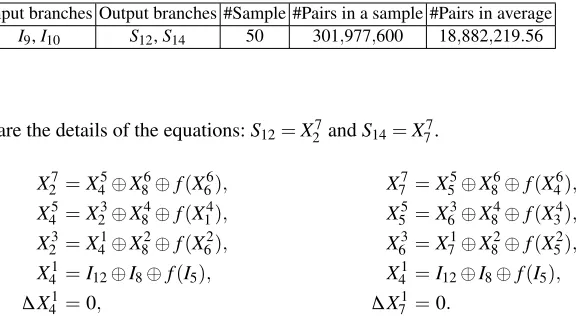
8 rounds. The tool have found a differential attack onLILLIPUTreduced to 8 rounds. For this attack, we use samples of 301,977,600 pairs, so 2,516,480 structures. This corresponds to about 1.5×214messages, but with this kind of attack, about 225
∆S12⊕∆S14=0. For a random permutation, the number of pairs verifying this
con-dition is expected to be 18,873,600 in average, i.e.E(Nperm)'m(m
−1)
2.·24 , and the
stan-dard deviation is about the square root of the mean value which gives: 4344. Since the mean value obtained for aLILLIPUT permutation is 18,882,219.56, we can see that |E(NL)−E(Nperm)|>σ(Nperm). This shows that, as explained in Section 3.1,
the attack is successful. The simulations described in Table 6 have taken 65.6 hours of computation on a virtual machine with a E8500 as processor and 4Go of RAM.
Table 6.Attack simulation on 8 rounds.
Input branches Output branches #Sample #Pairs in a sample #Pairs in average I9,I10 S12,S14 50 301,977,600 18,882,219.56
Here are the details of the equations:S12=X27andS14=X77.
X27=X45⊕X86⊕f(X66),
X45=X23⊕X84⊕f(X14),
X23=X41⊕X82⊕f(X62),
X41=I12⊕I8⊕f(I5),
∆X41=0,
X77=X55⊕X86⊕f(X46),
X55=X63⊕X84⊕f(X34),
X63=X71⊕X82⊕f(X52),
X41=I12⊕I8⊕f(I5),
∆X71=0.
Or∆f(X2
5) =0 and∆f(X62) =0. So∆S12⊕∆S14=∆f(X66)⊕∆f(X46)⊕∆f(X14)⊕
∆f(X4
3). We can observe that the condition ∆S12⊕∆S14=0 can be satisfied if for
example: f(X4
1) = f(X34),f(X14⊕∆X14) = f(X34⊕∆X34),f(X46) = f(X66), and f(X46⊕
∆X46) =f(X6
6⊕∆X66). But other equalities are also possible.
5
Conclusion
We have seen some differential attacks onLILLIPUT. These attacks were found by a tool we have made and are based on the variance method. This is the first time this method is applied to a concrete cipher. The tool has highlighted unusual differential conditions for whichLILLIPUTis sensitive. We can see our distinguishers do not reach more rounds than the previous analysis. But, contrary to these attacks, we have found our results empirically and since the last attack require 225messages, one can see that it is far from the maximum and from the complexity of 245 based on the number of active sboxes. Thus, we can look for distinguishers which reach more rounds with a devoted equipment. We have described how the key recovery works with our attacks in the appendix A. Finally, we have also seen improbable differential attacks which work well in simulations. This scheme can be an efficient support to study this kind of attacks thanks to the complexity of relations between internal variables inLILLIPUTdue to the
References
1. R. Beaulieu, D. Shors, J. Smith, S. Treatman-Clark, and al. The SIMON and SPECK Fami-lies of Lightweight Block Ciphers. Cryptology ePrint archive: 2013/404: Listing for 2013. 2. C. Beierle, J. Jean, S. Kölbl, and al. The SKINNY Family of Block Ciphers and its
Low-Latency Variant MANTIS.Cryptology ePrint archive: 2016/660: Listing for 2016. 3. T. P. Berger, J. Francq, M. Minier, and G. Thomas. Extended generalized feistel networks
using matrix representation to propose a new lightweight block cipher: Lilliput.IEEE Trans-actions on Computers, 65(7):2074–2089, July 2016.
4. T.P. Berger, M. Minier, and G. Thomas.Extended Generalized Feistel Networks Using Ma-trix Representation, pages 289–305. Springer Berlin Heidelberg, Berlin, Heidelberg, 2014. 5. E. Biham, R.J. Anderson, and L.R. Knudsen. Serpent: A new block cipher proposal. In
Proceedings of the 5th International Workshop on Fast Software Encryption, FSE ’98, pages 222–238, London, UK, UK, 1998. Springer-Verlag.
6. E. Biham, A. Biryukov, and A. Shamir. Cryptanalysis of Skipjack Reduced to 31 Rounds Using Impossible Differentials. In J. Stern, editor,Advances in Cryptology – EUROCRYPT 99, volume 1592 ofLecture Notes in Computer Science, pages 12–23. Springer-Verlag, 1999. 7. E. Biham and A. Shamir. Differential Cryptanalysis of DES-like Cryptosystems.J.
Cryptol-ogy, 4(1):3–72, 1991.
8. C. Blondeau. Improbable Differential from Impossible Differential: On the Validity of the Model, pages 149–160. Springer International Publishing, Cham, 2013.
9. A. Bogdanov, L.R. Knudsen, G. Leander, C. Paar, A. Poschmann, M.J.B. Robshaw, Y. Seurin, and C. Vikkelsoe. PRESENT: An Ultra-Lightweight Block Cipher, pages 450– 466. Springer Berlin Heidelberg, Berlin, Heidelberg, 2007.
10. Patrick Derbez and Pierre-Alain Fouque. Automatic Search of Meet-in-the-Middle and Im-possible Differential Attacks, pages 157–184. Springer Berlin Heidelberg, Berlin, Heidel-berg, 2016.
11. L.R. Knudsen. Truncated and higher order differentials. In B. Preneel, editor,Fast Software Encrytion – FSE ’94, volume 1008 ofLecture Notes in Computer Science, pages 291–311. Springer-Verlag, 1994.
12. V. Nachef, N. Marrière, and E. Volte. Improved Attacks on Extended Generalized Feistel Networks, pages 562–572. Springer International Publishing, Cham, 2016.
13. V. Nachef, J. Patarin, and E. Volte.Feistel Ciphers. Springer International Publishing, 2017. 14. V. Nachef, E. Volte, and J. Patarin. Differential Attacks on Generalized Feistel schemes. In M. Abdalla, C. Nita-Rotaru, and R. Dahab, editors,CANS 2013, volume 8257 ofLecture Notes in Computer Science, pages 1–19. Springer-Verlag, 2013.
15. Y. Sasaki and Y. Todo. New differential bounds and division property of lilliput: Block cipher with extended generalized feistel network. InSelected Areas in Cryptography – SAC 2016. Springer, 2016.
16. Y. Sasaki and Y. Todo. New impossible differential search tool from design and cryptanalysis aspects - revealing structural properties of several ciphers. InEUROCRYPT (3), pages 185– 215. Springer, 2017.
17. K. Shibutani, T. Isobe, H. Hiwatari, A. Mitsuda, T. Akishita, and T. Shirai.Piccolo: An Ultra-Lightweight Blockcipher, pages 342–357. Springer Berlin Heidelberg, Berlin, Heidelberg, 2011.
18. T. Shirai, K. Shibutani, T. Akishita, S. Moriai, and T. Iwata.The 128-Bit Blockcipher CLEFIA (Extended Abstract), pages 181–195. Springer Berlin Heidelberg, Berlin, Heidelberg, 2007. 19. C. Tezcan. Truncated, impossible, and improbable differential analysis of ascon.Cryptology
20. C. Tezcan. The Improbable Differential Attack: Cryptanalysis of Reduced Round CLEFIA, pages 197–209. Springer Berlin Heidelberg, Berlin, Heidelberg, 2010.
21. E. Volte, V. Nachef, and N. Marrière. Automatic Expectation and Variance Computing for Attacks on Feistel Schemes.Cryptology ePrint archive: 2016/136: Listing for 2016. 22. D. Wagner. The boomerang attack. InProceedings of the 6th International Workshop on Fast
Software Encryption, FSE ’99, pages 156–170, London, UK, UK, 1999. Springer-Verlag. 23. Shengbao Wu and Mingsheng Wang. Automatic Search of Truncated Impossible
Differen-tials for Word-Oriented Block Ciphers, pages 283–302. Springer Berlin Heidelberg, Berlin, Heidelberg, 2012.
24. Y. Luoand Z. Wu, X. Lai, and G. Gong. A Unified Method for Finding Impossible Differen-tials of Block Cipher Structures. 2009. http://eprint.iacr.org/.
A
Key recovery
In this appendix, we describe how the key recovery works in order to show what we can do. We process the key recovery on LILLIPUT reduced to 7 and 8 rounds. We have used the distinguishing attack on 6 rounds to attack 7 then 8 rounds in order to do simulations because the distinguishing attack on 8 rounds require 225messages to be processed. Nevertheless, it will work similarly for this distinguishing attack.
A.1 Key schedule description
LILLIPUT uses a 80-bit master key. The key schedule is managed by an internal state
denoted by 20 nibbles (4-bit words):Y19, . . . ,Y0. It is initialized with the master key and
is processed by the algorithm 2 in order to build the round keysRK0, . . . ,RK29. The
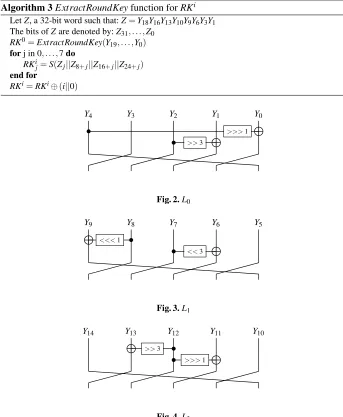
ExtractRoundKeyfunction is described in the algorithm 3. Note that the SboxSused
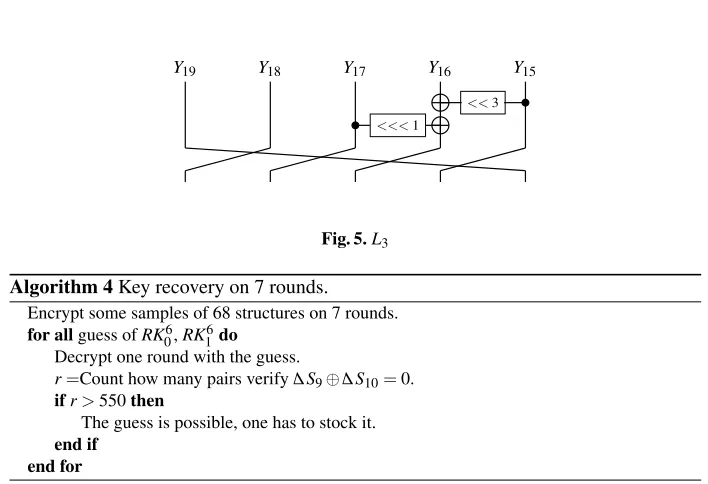
in theExtractRoundKeyfunction is the same as the one inLILLIPUT. The functions L0,L1,L2andL3are generalized Feistel schemes with 5 branches and a bit size of 4.
They are described in Fig 2, Fig 3, Fig 4 and Fig 5 respectively.
Algorithm 2LILLIPUT key schedule Y19, . . . ,Y0=MasterKey
RK0=ExtractRoundKey(Y19, . . . ,Y0)
fori in 1, . . . ,29do
(Y4, . . . ,Y0) =L0(Y4, . . . ,Y0)
(Y9, . . . ,Y5) =L1(Y9, . . . ,Y5)
(Y14, . . . ,Y10) =L2(Y14, . . . ,Y10)
(Y19, . . . ,Y15) =L3(Y19, . . . ,Y15) RKi=ExtractRoundKey(Y19, . . . ,Y0)
Algorithm 3ExtractRoundKeyfunction forRKi LetZ, a 32-bit word such that:Z=Y18Y16Y13Y10Y9Y6Y3Y1 The bits ofZare denoted by:Z31, . . . ,Z0
RK0=ExtractRoundKey(Y19, . . . ,Y0)
forj in 0, . . . ,7do
RKij=S(Zj||Z8+j||Z16+j||Z24+j)
end for
RKi=RKi⊕(i||0)
Y0 Y1
Y2 Y3
Y4
>>>1
>>3
Fig. 2.L0
Y5 Y6
Y7 Y8
Y9
<<<1
<<3
Fig. 3.L1
Y10 Y11
Y12 Y13
Y14
>>>1
>>3
Fig. 4.L2
A.2 Key recovery analysis on 7 rounds
This attack is based on some distinguishing attacks on 6 rounds. As usual, a plaintext structure contains 16 messages (thus 120 different pairs) which are different only on 2 branches. Moreover, the difference has to be the same on these branches.
OnLILLIPUTreduced to 6 rounds, there are some differential attacks based on our
attacks. The involved input branches areI9andI10. On the outputs, the conditions can
be: ∆S9⊕∆S10=0 or ∆S9⊕∆S14=0 or ∆S10⊕∆S14=0. Based on one of these
Y15 Y16
Y17 Y18
Y19
<<3
<<<1
Fig. 5.L3
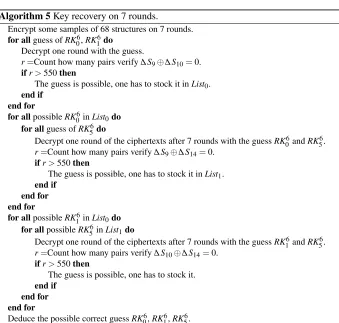
Algorithm 4Key recovery on 7 rounds.
Encrypt some samples of 68 structures on 7 rounds. for allguess ofRK06,RK16do
Decrypt one round with the guess.
r=Count how many pairs verify∆S9⊕∆S10=0.
ifr>550then
The guess is possible, one has to stock it. end if
end for
This algorithm allows to get a list of possibleRK06,RK16. There are 28possibilities for the guess. In simulations, one can find directly the correct guess (list of one element) with 5 or 10 samples. But with less samples, one get a list of several possibilities. With the knowledge ofRK06,RK16, one get the following bits of the correspondingZ: Z0Z1Z8Z9Z16Z17Z24Z25. Even if there are severalRK06,RK16, the cost of the brute-force
attack is reduced from 280to about 274. Of course, one can optimize this algorithm. Indeed, one can use several attacks in order to get a better attack. It is described in the algorithm 5. In simulations, we have always get the correct guessRK06,RK16and RK6
5. As we do not test all the possibilities for the second and third attack but only the
ones which work from the previous, the number of possibilities is lower than 3×28. With the algorithm 5, one has the knowledge ofRK06,RK16andRK56. It corresponds to the following bits of Z:Z0Z1Z5Z8Z9Z13Z16Z17Z21Z24Z25Z29. Then, the cost of the
brute-force attack is reduced from 280to 268.
We can also improve the algorithm 5 by using the following improbable differential attacks:∆S9⊕∆S15=0,∆S10⊕∆S15=0 and∆S14⊕∆S15=0. There are 24
possibil-ities forRK66, the corresponding round key forS15, and we test only with the possible
RK06,RK16andRK56. Thus, the cost of the brute-force attack is reduced from 280to 264. Starting from these attack, one can get additional details by using distinguishing attacks onLILLIPUTreduced to 5 rounds. Indeed, based on the same input conditions, there are the following attacks on 5 rounds:∆S13⊕∆S15=0, ∆S13⊕∆S14=0 and
∆S14⊕∆S15=0. These attacks require the previous guessRK06,RK16andRK66. One
can use the same method from the algorithm 5 to get RK45,RK55andRK65. Thus, the corresponding bits ofZ for the round 5 are:Z4Z5Z6Z12Z13Z14Z20Z21Z22Z28Z29Z30. In
the key schedule, these bits correspond toY3,Y9,Y13 andY18. Then, for the round 6,
they shift to:Y4,Y5,Y14andY19. For this step, the number of possibilities is lower than
Algorithm 5Key recovery on 7 rounds.
Encrypt some samples of 68 structures on 7 rounds. for allguess ofRK06,RK16do
Decrypt one round with the guess.
r=Count how many pairs verify∆S9⊕∆S10=0.
ifr>550then
The guess is possible, one has to stock it inList0.
end if end for
for allpossibleRK06inList0do
for allguess ofRK56do
Decrypt one round of the ciphertexts after 7 rounds with the guessRK06andRK56. r=Count how many pairs verify∆S9⊕∆S14=0.
ifr>550then
The guess is possible, one has to stock it inList1.
end if end for end for
for allpossibleRK16inList0do
for allpossibleRK56inList1do
Decrypt one round of the ciphertexts after 7 rounds with the guessRK16andRK56. r=Count how many pairs verify∆S10⊕∆S14=0.
ifr>550then
The guess is possible, one has to stock it. end if
end for end for
Deduce the possible correct guessRK06,RK16,RK56.
There is a efficient attack with the same input condition onLILLIPUT reduced to 5 rounds and we can exploit it in our key recovery attack. The output condition is ∆S9⊕∆S10=0. This condition is always verified, so we can test it on smaller samples
in order to decrease the global complexity. One can look which round keys are involved from the end of round 7:RK05,RK15,RK46andRK76. The number of possibilities is 216.
Table 7.Round key recover at the end of round 6.
Table 8.Round key recover at the end of round 5.
Round key Corresponding bits on Z Corresponding Y RK05 Z0,Z8,Z16,Z24 Y1,Y6,Y10,Y16 RK15 Z1,Z9,Z17,Z25 Y1,Y6,Y10,Y16 RK45 Z4,Z12,Z20,Z28 Y3,Y9,Y13,Y18 RK55 Z5,Z13,Z21,Z29 Y3,Y9,Y13,Y18 RK65 Z6,Z14,Z22,Z30 Y3,Y9,Y13,Y18
Finally, we have attackedLILLIPUT reduced to 7 rounds using distinguishing at-tacks on 6 and 5 rounds. One can see the round keys recovered in the table 7 and table 8. Here is the state7at the end of round 6:Y1=??||,Y3=||||,Y6=??||,Y9=||||,Y10=??||,
Y13=||||,Y16=??||,Y18=||||. At the end of the round 5, it is similar, we have the
knowl-edge of:Y1=??||,Y3=?|||,Y6=??||,Y9=?|||,Y10=??||,Y13=?|||,Y16=??||,Y18=?|||.
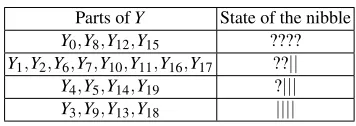
But, these bits shift for the round 6. Thus, at the end of round 6, we also have more details described in table 9. We can see in this table that we have recovered 44 bits of the internal state. Thus, the cost of the brute-force is reduced from 280to 236. The cost for all guess is less than:c=216+6∗28+24. We can continue to use the previous rounds with more distinguishing attacks in order to reduce the complexity.
Table 9.Internal state at round 6.
Parts ofY State of the nibble Y0,Y8,Y12,Y15 ???? Y1,Y2,Y6,Y7,Y10,Y11,Y16,Y17 ??||
Y4,Y5,Y14,Y19 ?||| Y3,Y9,Y13,Y18 ||||
A.3 Key recovery analysis on 8 rounds
We have seen how the key recovery works based on our attacks. Now, we will see how it can be extend. In this subsection, we will see how it works onLILLIPUTreduced to 8 rounds.
First, we want to use our distinguishing attack on 6 rounds:∆S9⊕∆S10=0. If
we look the branches involved until 8 rounds, we can see which round key we have to guess. We summarize the analysis in the table 10. To mount a key recovery attack
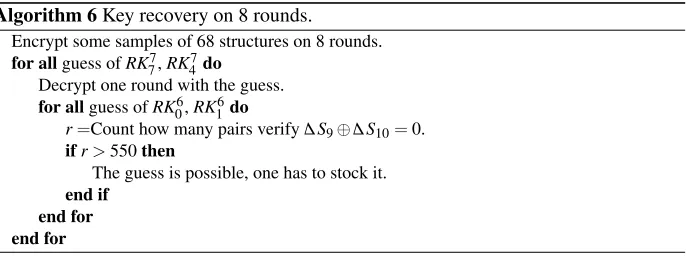
onLILLIPUT reduced to 8 rounds, one can use the algorithm 6. As is it described in
the table 10, if one wants to exploit∆S9⊕∆S10=0, the round key to guess will be:
RK06,RK16,RK77andRK47. Thus the number of possibilities is 216. We can use more distinguishing attacks in order to get more round keys: ∆S9⊕∆S10=0 and ∆S9⊕
Table 10.Round key involved for key recovery on 8 rounds.
Branch involved Round key and involved branches Round key for internal variables
X35 RK06,X86 RK77
X45 RK16,X66 RK47
X75 RK56,X56 RK67
X55 RK66,X46 RK17
∆S10=0 for example. Moreover, there are the same improbable differential attacks as
in the Section A.2:∆S9⊕∆S15=0,∆S10⊕∆S15=0 and∆S14⊕∆S15=0.
Algorithm 6Key recovery on 8 rounds.
Encrypt some samples of 68 structures on 8 rounds. for allguess ofRK77,RK47do
Decrypt one round with the guess. for allguess ofRK06,RK16do
r=Count how many pairs verify∆S9⊕∆S10=0.
ifr>550then
The guess is possible, one has to stock it. end if
end for end for
We can use the same method as the algorithm 5. Thanks to this algorithm, we have recovered 24 bits of data as described in the table 11 and table 12. Then we will see how much is the cost of the brute-force attack without using previous rounds method.
Table 11.Round key recover at the end of round 6.
Round key Corresponding bits on Z Corresponding Y RK06 Z0,Z8,Z16,Z24 Y1,Y6,Y10,Y16 RK16 Z1,Z9,Z17,Z25 Y1,Y6,Y10,Y16 RK56 Z4,Z12,Z20,Z28 Y3,Y9,Y13,Y18
Table 12.Round key recover at the end of round 7.
Round key Corresponding bits on Z Corresponding Y RK47 Z4,Z12,Z20,Z28 Y3,Y9,Y13,Y18 RK67 Z6,Z14,Z22,Z30 Y3,Y9,Y13,Y18 RK77 Z7,Z15,Z23,Z31 Y3,Y9,Y13,Y18
Table 13.Internal state at round 6.
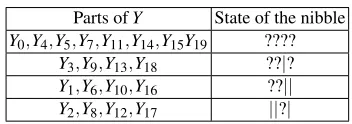
Parts ofY State of the nibble Y0,Y4,Y5,Y7,Y11,Y14,Y15Y19 ????
Y3,Y9,Y13,Y18 ??|? Y1,Y6,Y10,Y16 ??|| Y2,Y8,Y12,Y17 ||?|
A.4 Key recovery analysis on more rounds
We have seen how to attack 2 rounds more than the distinguisher. In order to attack more rounds, we need the internal variable on the branchI16. Thus we will need to guess all
the round keys for this round. So, it costs 232. Similarly, if we want to attack 4 rounds more than the distinguisher attack, it will cost 264. It is possible to reduce enough the
complexity to do that but we can not process one more round with this method. Based on the distinguisher on 8 rounds, it is then possible to attack 12 rounds.
B
Related key attack on 6 rounds
In this appendix, we describe the related key attack onLILLIPUT reduce to 6 rounds. To recall the attack, the input branches involved areI10andI14. Ifc=c1⊕c2, the ouput
condition isS9(c)⊕S15(c) =0.
IfI10=I14andRK11=RK51 andRK12=RK22, the differential trail is verified with
probability 1. This attack was verified in practice. The aim of the attack is to make∆X83=0.
We have seen that∆X83=f(X61)⊕f(X61⊕∆I14)⊕f(X21)⊕f(X21⊕∆I10). Moreover,
we know that∆I14=∆I10.
But, it is important to notice that f(X61) =sbox(X61⊕RK11). Similarly, f(X21) = sbox(X21⊕RK21). So,∆X83=0 if and only ifsbox(X21⊕RK21) =sbox(X61⊕RK11). It can happens at random but if we have the condition on the keyRK11=RK21, then(X61= X21)⇒∆X83=0.
Then, we haveX61⊕X21=I14⊕I10⊕sbox(I3⊕RK50)⊕sbox(I7⊕RK10). So ifI10=
I14, then (X61⊕X21=0 if and only ifI3⊕RK50=I7⊕RK10).
Now we will see what kind of conditions on the master key we have.
The key state is denoted by 20 nibbles of 4 bits:Y = [Y19,· · ·,Y0]Each round there
First, we haveZ= [Y18,Y16,Y13,Y10,Y9,Y6,Y3,Y1]. LetZ=Z31,· · ·,Z0the bits ofZ.
Then, we have:
RK11=sbox([Z1,Z9,Z17,Z25]),
RK51=sbox([Z5,Z13,Z21,Z29]),
RK12=sbox([Z1,Z9,Z17,Z25])⊕1,
RK22=sbox([Z2,Z10,Z18,Z26])⊕1.
Note that the xor with 1 is processed to flip the bit at the left.RK11=RK51if and only ifsbox([Z1,Z9,Z17,Z25]) =sbox([Z5,Z13,Z21,Z29]). SoRK11=RK51if and only if
[Z1,Z9,Z17,Z25] = [Z5,Z13,Z21,Z29].
SoRK1
1=RK51ifZ1=Z5,Z9=Z13,Z17=Z21andZ25=Z29. IfK=K79,· · ·,K0is
the master key, these conditions lead to:K5=K13,K25=K38,K41=K53andK65=K73
SimilarlyRK12=RK22ifZ1=Z2,Z9=Z10,Z17=Z18 andZ25=Z26. Note that it
is theZ of the second round, so theZ9 is not the same. It leads to these conditions
on the master key:K1⊕K18=K2⊕K19,K21=K22,K58=K57 andK61=K62. With
these 8 conditions on 1 bit on the master key, we have the attack with probability 1 on
LILLIPUTreduced to 6 rounds.
C
Attacks on 5, 6 and 7 rounds
In this appendix, we describe some attacks onLILLIPUTreduced to 5, 6 and 7 rounds. These attacks are based on 500 samples of 8,160 couples of messages. This corresponds to 27messages. We count how many couples verify a property. The average result for
a random permutation is 8160
24 =510 because it is an equality on 4 bits. The results
obtained with the attacks we described below are significantly greater or significantly smaller than this value. In fact, in order to obtain an attack, the difference between these values is expected to be 8160
28 =32. As said in Section 4, these attacks are based on an
non zero difference put on two input branches. We detail these branches involved, the differential condition on the ouput and the average result obtained.
Table 14.Differential attacks which require only 2 messages.
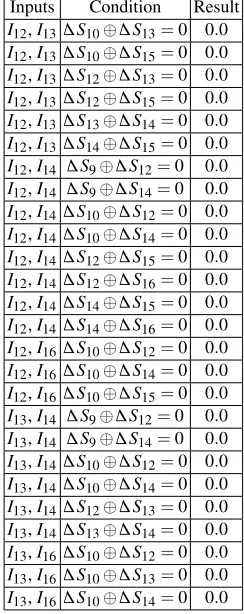
Table 15.Impossible differential attacks on 5 rounds.
Inputs Condition Result I9,I10 ∆S9⊕∆S12=0 0.0 I9,I10 ∆S9⊕∆S13=0 0.0 I9,I10 ∆S9⊕∆S14=0 0.0 I9,I10 ∆S9⊕∆S15=0 0.0 I9,I10 ∆S10⊕∆S12=0 0.0 I9,I10 ∆S10⊕∆S13=0 0.0 I9,I10 ∆S10⊕∆S14=0 0.0 I9,I10 ∆S10⊕∆S15=0 0.0 I9,I11 ∆S9⊕∆S10=0 0.0 I9,I11 ∆S9⊕∆S14=0 0.0 I9,I11 ∆S9⊕∆S15=0 0.0 I9,I11 ∆S10⊕∆S13=0 0.0 I9,I11 ∆S13⊕∆S14=0 0.0 I9,I11 ∆S13⊕∆S15=0 0.0 I9,I12 ∆S9⊕∆S10=0 0.0 I9,I12 ∆S9⊕∆S14=0 0.0 I9,I12 ∆S10⊕∆S12=0 0.0 I9,I12 ∆S10⊕∆S13=0 0.0 I9,I12 ∆S10⊕∆S15=0 0.0 I9,I12 ∆S10⊕∆S16=0 0.0 I9,I12 ∆S12⊕∆S14=0 0.0 I9,I12 ∆S13⊕∆S14=0 0.0 I9,I12 ∆S14⊕∆S15=0 0.0 I9,I12 ∆S14⊕∆S16=0 0.0 I9,I13 ∆S9⊕∆S10=0 0.0 I9,I13 ∆S9⊕∆S13=0 0.0 I9,I13 ∆S9⊕∆S14=0 0.0 I9,I13 ∆S10⊕∆S12=0 0.0 I9,I13 ∆S12⊕∆S13=0 0.0 I9,I13 ∆S12⊕∆S14=0 0.0 I9,I14 ∆S9⊕∆S10=0 0.0 I9,I14 ∆S9⊕∆S12=0 0.0 I9,I14 ∆S9⊕∆S13=0 0.0 I9,I14 ∆S10⊕∆S14=0 0.0 I9,I14 ∆S12⊕∆S14=0 0.0 I9,I14 ∆S13⊕∆S14=0 0.0 I9,I16 ∆S10⊕∆S13=0 0.0 I9,I16 ∆S10⊕∆S14=0 0.0 I10,I11 ∆S9⊕∆S10=0 0.0 I10,I11 ∆S9⊕∆S12=0 0.0 I10,I11 ∆S9⊕∆S13=0 0.0 I10,I11 ∆S10⊕∆S15=0 0.0
Table 16.Impossible differential attacks on 5 rounds.
Table 17.Differential attacks on 5 rounds.
Inputs Condition Result I9,I10 ∆S9⊕∆S16=0 542.59 I9,I10 ∆S10⊕∆S16=0 542.59 I9,I10 ∆S11⊕∆S12=0 1,284.936 I9,I10 ∆S11⊕∆S14=0 615.462 I9,I10 ∆S11⊕∆S15=0 616.796 I9,I10 ∆S12⊕∆S13=0 550.578 I9,I10 ∆S12⊕∆S14=0 1,276.944 I9,I10 ∆S12⊕∆S15=0 1,284.72 I9,I10 ∆S13⊕∆S14=0 550.61 I9,I10 ∆S13⊕∆S15=0 551.39 I9,I10 ∆S14⊕∆S15=0 1,282.128 I9,I11 ∆S9⊕∆S11=0 1,743.32 I9,I11 ∆S9⊕∆S12=0 550.684 I9,I11 ∆S9⊕∆S16=0 543.678 I9,I11 ∆S10⊕∆S14=0 1,278.672 I9,I11 ∆S10⊕∆S15=0 1,252.536 I9,I11 ∆S11⊕∆S13=0 1,743.32 I9,I11 ∆S12⊕∆S13=0 550.684 I9,I11 ∆S13⊕∆S16=0 543.678 I9,I11 ∆S14⊕∆S15=0 1,282.344 I9,I12 ∆S9⊕∆S12=0 1,271.76 I9,I12 ∆S9⊕∆S13=0 1,252.968 I9,I12 ∆S9⊕∆S15=0 1,278.024 I9,I12 ∆S9⊕∆S16=0 550.794 I9,I12 ∆S10⊕∆S11=0 1,053.244 I9,I12 ∆S11⊕∆S14=0 1,053.244 I9,I12 ∆S12⊕∆S13=0 1,260.96 I9,I12 ∆S12⊕∆S15=0 1,271.76 I9,I12 ∆S12⊕∆S16=0 595.752 I9,I12 ∆S13⊕∆S15=0 1,281.696 I9,I12 ∆S13⊕∆S16=0 550.948 I9,I12 ∆S15⊕∆S16=0 551.776 I9,I13 ∆S9⊕∆S12=0 549.68 I9,I13 ∆S10⊕∆S11=0 1,744.92 I9,I13 ∆S10⊕∆S15=0 1,270.464 I9,I13 ∆S11⊕∆S13=0 1,744.92 I9,I13 ∆S11⊕∆S14=0 1,744.92 I9,I13 ∆S11⊕∆S15=0 610.29 I9,I13 ∆S13⊕∆S15=0 1,270.464 I9,I13 ∆S14⊕∆S15=0 1,270.464
Table 18.Differential attacks on 5 rounds.
Inputs Condition Result I10,I13 ∆S11⊕∆S15=0 1,270.896 I10,I13 ∆S13⊕∆S14=0 550.548 I10,I13 ∆S13⊕∆S15=0 550.54 I10,I13 ∆S14⊕∆S15=0 1,265.928 I10,I14 ∆S9⊕∆S13=0 594.642 I10,I14 ∆S9⊕∆S16=0 611.952 I10,I14 ∆S10⊕∆S11=0 1,283.208 I10,I14 ∆S10⊕∆S14=0 1,267.224 I10,I14 ∆S10⊕∆S15=0 593.402 I10,I14 ∆S11⊕∆S14=0 613.168 I10,I14 ∆S12⊕∆S13=0 594.642 I10,I14 ∆S12⊕∆S16=0 611.952 I10,I14 ∆S14⊕∆S15=0 552.278 I10,I15 ∆S9⊕∆S10=0 1,054.44 I10,I15 ∆S9⊕∆S15=0 1,741.32 I10,I15 ∆S10⊕∆S15=0 1,056.38 I10,I15 ∆S11⊕∆S16=0 566.092 I10,I15 ∆S12⊕∆S14=0 1,279.32 I10,I16 ∆S10⊕∆S13=0 544.0 I10,I16 ∆S10⊕∆S14=0 596.114 I10,I16 ∆S12⊕∆S15=0 613.966 I11,I12 ∆S9⊕∆S10=0 1,266.36 I11,I12 ∆S9⊕∆S12=0 551.74 I11,I12 ∆S9⊕∆S13=0 1,268.304 I11,I12 ∆S9⊕∆S14=0 1,273.704 I11,I12 ∆S10⊕∆S12=0 550.054 I11,I12 ∆S10⊕∆S13=0 1,282.56 I11,I12 ∆S10⊕∆S14=0 1,280.616 I11,I12 ∆S11⊕∆S15=0 1,051.468 I11,I12 ∆S12⊕∆S13=0 548.646 I11,I12 ∆S12⊕∆S14=0 595.28 I11,I12 ∆S12⊕∆S16=0 544.0 I11,I12 ∆S13⊕∆S14=0 1,248.648 I11,I12 ∆S14⊕∆S16=0 544.0 I11,I13 ∆S9⊕∆S10=0 550.208 I11,I13 ∆S9⊕∆S12=0 549.644 I11,I13 ∆S9⊕∆S14=0 550.648 I11,I13 ∆S9⊕∆S15=0 595.88 I11,I13 ∆S10⊕∆S12=0 550.288 I11,I13 ∆S10⊕∆S14=0 1,266.144
Table 19.Differential attacks on 5 rounds.
Table 20.Improbable differential attacks on 5 rounds.
Inputs Condition Result I9,I10 ∆S9⊕∆S11=0 456.406 I9,I10 ∆S10⊕∆S11=0 456.406 I9,I11 ∆S10⊕∆S11=0 427.664 I9,I11 ∆S10⊕∆S12=0 459.68 I9,I11 ∆S11⊕∆S14=0 455.106 I9,I11 ∆S11⊕∆S15=0 428.986 I9,I11 ∆S12⊕∆S14=0 456.43 I9,I11 ∆S12⊕∆S15=0 460.224 I9,I12 ∆S9⊕∆S11=0 477.28 I9,I12 ∆S11⊕∆S13=0 470.25 I9,I12 ∆S11⊕∆S15=0 476.564 I9,I12 ∆S11⊕∆S16=0 473.812 I9,I13 ∆S9⊕∆S11=0 426.94 I9,I13 ∆S9⊕∆S15=0 454.32 I9,I13 ∆S11⊕∆S12=0 455.378 I9,I13 ∆S12⊕∆S15=0 382.816 I9,I14 ∆S10⊕∆S11=0 457.022 I9,I14 ∆S10⊕∆S15=0 458.88 I9,I14 ∆S11⊕∆S12=0 457.022 I9,I14 ∆S11⊕∆S13=0 429.452 I9,I14 ∆S12⊕∆S15=0 456.974 I9,I14 ∆S13⊕∆S15=0 457.692 I9,I15 ∆S9⊕∆S15=0 453.836 I9,I15 ∆S12⊕∆S15=0 455.466 I9,I15 ∆S13⊕∆S15=0 452.946 I9,I15 ∆S14⊕∆S15=0 453.876 I10,I11 ∆S9⊕∆S11=0 456.658 I10,I11 ∆S10⊕∆S14=0 383.872 I10,I11 ∆S11⊕∆S14=0 453.642 I10,I11 ∆S11⊕∆S15=0 456.658 I10,I11 ∆S11⊕∆S16=0 475.422 I10,I11 ∆S12⊕∆S14=0 455.266 I10,I11 ∆S13⊕∆S14=0 460.764 I10,I12 ∆S9⊕∆S13=0 459.58 I10,I12 ∆S13⊕∆S14=0 458.946 I10,I13 ∆S10⊕∆S11=0 456.836 I10,I13 ∆S11⊕∆S12=0 456.836 I10,I14 ∆S9⊕∆S11=0 457.08 I10,I14 ∆S10⊕∆S13=0 456.904 I10,I14 ∆S11⊕∆S12=0 457.08
Table 21.Improbable differential attacks on 5 rounds.
Table 22.Differential attacks on 6 rounds.
Table 23.Improbable differential attacks on 6 rounds.
Inputs Condition Result I9,I10 ∆S9⊕∆S15=0 413.818 I9,I10 ∆S10⊕∆S15=0 431.676 I9,I10 ∆S14⊕∆S15=0 392.032 I9,I11 ∆S10⊕∆S14=0 432.738 I9,I11 ∆S10⊕∆S15=0 429.832 I9,I11 ∆S12⊕∆S14=0 389.782 I9,I11 ∆S12⊕∆S15=0 388.614 I9,I12 ∆S9⊕∆S14=0 458.15 I9,I12 ∆S10⊕∆S14=0 472.758 I9,I12 ∆S12⊕∆S14=0 431.422 I9,I12 ∆S14⊕∆S15=0 432.224 I9,I13 ∆S9⊕∆S12=0 413.908 I9,I13 ∆S9⊕∆S14=0 413.084 I9,I13 ∆S10⊕∆S12=0 431.656 I9,I13 ∆S10⊕∆S14=0 431.802 I9,I13 ∆S12⊕∆S15=0 387.35 I9,I13 ∆S14⊕∆S15=0 388.41 I9,I14 ∆S9⊕∆S10=0 460.36 I9,I14 ∆S9⊕∆S15=0 414.122 I9,I14 ∆S10⊕∆S12=0 434.114 I9,I14 ∆S12⊕∆S15=0 391.38 I10,I11 ∆S10⊕∆S13=0 431.58 I10,I11 ∆S13⊕∆S15=0 391.014 I10,I12 ∆S9⊕∆S14=0 435.314 I10,I12 ∆S9⊕∆S15=0 430.81 I10,I12 ∆S13⊕∆S14=0 432.612
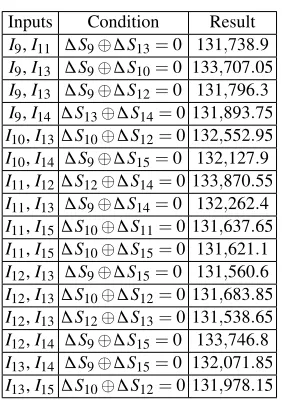
Table 24.Differential attacks on 7 rounds.
Inputs Condition Result I9,I11 ∆S9⊕∆S13=0 131,738.9 I9,I13 ∆S9⊕∆S10=0 133,707.05 I9,I13 ∆S9⊕∆S12=0 131,796.3 I9,I14 ∆S13⊕∆S14=0 131,893.75 I10,I13 ∆S10⊕∆S12=0 132,552.95 I10,I14 ∆S9⊕∆S15=0 132,127.9 I11,I12 ∆S12⊕∆S14=0 133,870.55 I11,I13 ∆S9⊕∆S14=0 132,262.4 I11,I15 ∆S10⊕∆S11=0 131,637.65 I11,I15 ∆S10⊕∆S15=0 131,621.1 I12,I13 ∆S9⊕∆S15=0 131,560.6 I12,I13 ∆S10⊕∆S12=0 131,683.85 I12,I13 ∆S12⊕∆S13=0 131,538.65 I12,I14 ∆S9⊕∆S15=0 133,746.8 I13,I14 ∆S9⊕∆S15=0 132,071.85 I13,I15 ∆S10⊕∆S12=0 131,978.15
Table 25.Improbable differential attacks on 7 rounds.