A Punctured Programming Approach to Adaptively Secure
Functional Encryption
Brent Waters
∗University of Texas at Austin
[email protected]
Abstract
We propose the first construction for achieving adaptively secure functional encryption (FE) for poly-sized circuits (without complexity leveraging) from indistinguishability obfuscation (iO). Our reduction has polynomial loss to the underlying primitives. We develop a “punctured programming” approach to constructing and proving systems where outside of obfuscation we rely only on primitives realizable from pseudo random generators.
Our work consists of two constructions. Our first FE construction is provably secure against any attacker that is limited to making all of its private key queries after it sees the challenge ciphertext. (This notion implies selective security.) Our construction makes use of an we introduce called puncturable deterministic encryption (PDE) which may be of independent. With this primitive in place we show a simple construction FE construction.
We then provide a second construction that achieves adaptive security from indistinguishability ob-fuscation. Our central idea is to achieve an adaptively secure functional encryption by bootstrapping from a one-bounded FE scheme that is adaptively secure. By using bootstrapping we can use“selective-ish” techniques at the outer level obfuscation level and push down the challenge of dealing with adaptive security is then FE scheme, where it has been already been solved. We combine our bootstrapping framework with a new “key signaling” technique to achieve our construction and proof.
∗Brent Waters is supported by NSF CNS-0915361 and CNS-0952692, CNS-1228599 DARPA through the U.S. Office of
1
Introduction
In traditional encryption systems a message,m, is encrypted with a particular user’s public key PK. Later a user that holds the corresponding secret key will be able to decrypt the ciphertext and learn the contents of the message. At the same time any computationally bounded attacker will be unable to get any additional information on the message.
While this communication paradigm is appropriate for many scenarios such as targeted sharing between users, there exist many applications that demand a more nuanced approach to sharing encrypted data. For example, suppose that an organization encrypts video surveillance images and stores these ciphertexts in a large online database. Later, we would like to give an analyst the ability to view all images that match a particular pattern such as ones that include a facial image that pattern matches with a particular individual. In a traditional encryptions system we would be forced to either give the analyst the secret key enabling them to view everything or give them nothing and no help at all.
The concept of functional encryption (FE) was proposed to move beyond this all or nothing view of decryption. In a functional encryption system a secret key SKf is associated with a function f. When a user attempts to decrypt a ciphertext CT encrypted for message m with secret key SKf, he will learn f(m). The security of functional encryption states that an attacker that receives keys for any polynomial number of functions f1, . . . , fQ should not be able to distinguish between an encryption of m0, m1 as long as∀i fi(m0) =fi(m1).
The concept of functional encryption first appeared under the guise of predicate encryption [BW07, KSW08] with the nomenclature later being updated[SW08, BSW11] to functional encryption. In addition, functional encryption has early roots in Attribute-Based Encryption [SW05] and searching on encrypted data [BCOP04].
A central challenge is to achieve functional encryption for as expressive functionality classes as pos-sible — ideally one would like to achieve it for any poly-time computable function. Until recently, the best available was roughly limited to the inner product functionality proposed by Katz, Sahai, and Wa-ters [KSW08]. This state of affairs changed dramatically with the introduction of a candidate indistin-guishability obfuscation [BGI+12] system for all poly-size circuits by Garg, Gentry, Halevi, Raykova, Sahai, and Waters [GGH+13] (GGHRSW). The authors showed that a functional encryption system for any poly-sized circuits can be built from an indistinguishability obfuscator plus public key encryption and statistically simulation sound non-interactive zero knowledge proofs.
Thinking of Adaptive Security While the jump from inner product functionality to any poly-size circuit is quite significant, one limitation of the GGHRSW functional encryption system is that it only offers a
selectiveproof of security where the attacker must declare the challenge messages before seeing the parameters of the FE system. Subsequently, Boyle, Chung and Pass [BCP14] proposed an FE construction based on an obfuscator that is differing inputs secure. We briefly recall that an obfuscatorOis indistinguishability secure if it is computationally difficult for an attacker to distinguish between obfuscationsO(C0) andO(C1) for any two (similar sized) circuits that are functionally equivalent (i.e. ∀x C0(x) =C1(x)). Recall, that differing inputs [BCP14, ABG+13] security allows for an attacker to use circuits C0 andC1 that are not functionally equivalent, but requires that for any PPT attacker that distinguishes between obfuscations of the two circuits there must a PPT extraction algorithm that finds somexsuch that C0(x)6=C1(x). Thus, differing inputs obfuscation is in a qualitatively different class of “knowledge definitions”. Furthermore, there is significant evidence [GGHW14] that there exist certain functionalities with auxiliary input that are impossible to build obfuscate under the differing inputs definition.
note that our focus is on indistinguishability notions of functional encryption as opposed to simulation definitions [BSW11, O’N10].
Our Results In this work we propose two new constructions for achieving secure functional encryption (for poly-sized circuits) from indistinguishability obfuscation. We develop a “punctured programming” approach [SW14] to constructing and proving systems where our main tools in addition to obfuscation are a selectively secure puncturable pseudo random functions. We emphasize puncturable PRFs are themselves constructible from pseudo random generators [GGM84, BW13, BGI13, KPTZ13].
We start toward our FE construction which is provably secure against any attacker that is limited to making all of its private key queries after it sees the challenge ciphertext.1 While this is attacker is still restricted relative to a fully adaptive attacker, we observe that such a definition is already stronger than the commonly used selective restriction.
To build our system we first introduce an abstraction that we call puncturable deterministic encryp-tion (PDE). The main purpose of this abstracencryp-tion is to serve in some places as a slightly higher level and more convenient abstraction to work with than puncturable PRFs. A PDE system is a symmetric key and deterministic encryption scheme and consists of four algorithms: SetupPDE(1λ),EncryptPDE(K, m),
DecryptPDE(K,CT), and PuncturePDE(K, m0, m1). The first three algorithms have the usual correctness se-mantics. The fourth puncture algorithm takes as input a master key and two messages (m0, m1) and outputs a punctured key that can decrypt all ciphertexts except for those encrypted for either of the two messages — recall encryption is deterministic so there are only two such ciphertexts. The security property of PDE is stated as a game where the attacker gives two messages (m0, m1) to the attacker and then returns back a punctured key as well as two ciphertexts, one encrypted under each message. In a secure system no PPT attacker will be able to distinguish which ciphertext is associated with which message.
Our PDE encryption mechanism is rather simple and is derived from the hidden trigger mechanism from the Sahai-Waters [SW14] deniable encryption scheme. PDE Ciphertexts are of the form:
CT = (A=F1(K1, m), B =F2(K2, A)⊕m).
whereF1 andF2are puncturable pseudo random functions, withF1being an injective function. Decryption requires first computingm0=B⊕F2(K2, A) and then checking thatF1(K1, m0) =A. 2
With this tool in place we are now ready to describe our first construction. The setup algorithm will first choose a puncturable PRF key K for functionF. Next, it will create the public parameters PP as an obfuscation of a program calledInitialEncrypt. TheInitialEncrypt program will take in randomness rand compute a tagt= PRG(r). Then it will outputtand a PDE keykthat is derived fromF(K, t). The encryption algorithm can use this obfuscated program to encrypt as follows. It will simply choose a random valuer ∈ {0,1}λ, where λis the security parameter. It then runs the obfuscated program on r to receive (t, k) and then creates the ciphertext CT as (t, c=EncryptPDE(k, m)).
The secret key SKf for a functionf will be created as an obfuscated program. This program will take as input a ciphertext CT = (t, c). The program first computes kfrom F(K, t), then uses k to decryptc to a messagemand outputs f(m). The decryption algorithm is simply to run the obfuscated program on the ciphertext.
The proof of security of our first system follows what we can a “key-programming” approach. The high level idea is that for each key we will hardwire in the decryption response into each secret key obfuscated program for when the input is the challenge ciphertext. For all other inputs the key computes decryption normally. Our key-programming approach is enabled by two important factors. First, in the security game there is a single challenge ciphertext so only one hardwiring needs to be done per key. Second, since all queries come after the challenge messages (m0, m1) are declared we will know where we need to puncture to create our hardwiring.
1This model has been called semi-adaptive in other contexts [CW14].
2Despite sharing the term deterministic, our security definition of PDEs does not have much in common with deterministic
Intuitively, our proof can be broken down into two high level steps. First, we will perform a set of steps that allow us to hardwire the decryption answers to all of the secret keys for the challenge ciphertext. Next, we use PDE security to move from encrypting mb for challenge bit b ∈ {0,1} to always encrypting m0— independent of the bitb. (The actual proof of Section 5 contains multiple hybrids and is more intricate.)
Handling Full Security We now move to dealing with full security where we need to handle private key queries on both sides of the challenge ciphertext. At this point it is clear that relying only on key-programming will not suffice. First, a pre-challenge ciphertext key for function f will need to be created before the challenge messages (m0, m1) are declared, so it will not even be known at key creation time what f(m0) =f(m1) will be.
Our central idea is to achieve an adaptively secure functional encryption by bootstrapping from a one-bounded FE scheme that is adaptively secure. At a high level a ciphertext is associated with a tagtand a private key with a tagy. From the pair of tags (t, y) one can (with the proper key material) pseudorandomly derive a master secret keykfor a one bounded FE system. The ciphertext will be equipped with an obfuscated program, C, which on input of a key tagy will generate the one bounded key k(associated with the pair (t, y)) and then uses this to create an encryption of the messagemunder the one-bounded scheme with key k. Likewise, the private key for functionality f comes equipped with an obfuscated program Pf which on input of a ciphertext tagtderives the one bounded secret keykand uses this to create a one-bounded secret key.
The decryption algorithm will pass the key tag y to the ciphertext program to get a one bounded ciphertext CTOBand the ciphertext tagtto the key program to get a one bound key SKOB. Finally, it will apply the one bounded decryption algorithm asDecryptOB(CTOB,SKOB) to learn the messagem. The one bounded key and ciphertext are compatible since they are both derived psuedorandomly from the pair (t, y) to getsameone-bounded keyk. (Note a different pair (t0, y0)6= (t, y) corresponds to a different one bounded FE keyk0 with high probability.)
Our bootstrapping proof structure allows us to develop “selective-ish” techniques at the outer level since in our reductions the ciphertext and private key tags can be chosen randomly ahead of time before the challenge message or any private key queries are known. Then the challenge of dealing with adaptive security is then “pushed down” to the one bounded FE scheme, where it has been solved in previous work [GVW12].
In the description above we have so far omitted one critical ingredient. In addition to generating a one bounded secret key on input t, the program Pf on input t will also generate an encrypted signal athat is passed along with the tagy to the ciphertext program C on decryption to let it know that it is “okay” to generate the one-bounded ciphertext for the pair (t, y). In the actual use of the system, this is the only functionality of the signal. However, looking ahead to our proof we will change the signal encrypted to tell the programCto switch the message for which it generates one bounded encryption encryptions of.
Our proof replaces key programming with a method we call “key-signaling”. In a key-signaling system a normal ciphertext will be associated with a single message m which we refer to as an α-message. The decryption algorithm will use the secret key to prepare an α-signal for the ciphertext which will enable normal decryption. However, the ciphertext can also have a second form in which it is associated with two messages mα and mβ. The underlying semantics are that if it receives an α-signal it uses mα and if it receives aβ-signal it usesmβ.
These added semantics open up new strategy for proving security. In the initial security game the challenge ciphertext encrypts mb for challenge bit b. It will only receive α-signals from keys. Next we (indistinguishably) move the challenge ciphertext to encryptmbas theα-message andm0as theβ-message. All keys still send only α-signals. Now one by one we change each key to send anβ-signal to the challenge ciphertext as opposed to an α-signal. This step is feasible since for any queried function f we must have thatf(mb) =f(m0). Finally, we are able to erase the messagemb since no key is signaling for it.
Stepping back we can see that instead of storing the response of decryption for the challenge ciphertext at each key, we are storing the fact that it is using the second message in decryption.
from IND-CPA secure public key encryption. Since we actually only need master key encryption, we observe that this can be achieved from IND-CPA symmetric key encryption. Thus, we maintain our goal of not using heavy weight primitives outside of obfuscation. One important fact is that the GVW scheme is proven to be 1-bounded adaptively secure regardless of whether the private key query comes before or after the challenge ciphertext. We note that the GVW system actually allows for a single key, but many ciphertexts; however, we only require security for a single ciphertext.
The actual proof of security requires several hybrid steps and we defer further details to Section 6.
Recent Work Recently, Garg, Gentry, Halevi, and Zhandry [GGHZ14a] showed how to realize adaptively secure Attribute-Based Encryption from multilinear graded encodings. It is based onU-graded encodings.
Subsequent to both of these works, the same authors [GGHZ14b] gave a construction of Functional Encryption from multilinear encodings. This construction required a new multilinear encoding functionality of allowing the “encoding grades” to be dynamically extended by any party using just the public parameters. Their scheme crucially leverages this capability and is also reflected in the assumption.
There are different tradeoffs between and pure indistinguishability obfuscation approach and that used in [GGHZ14b]. On one hand the approach of [GGHZ14b] allows one to directly get to mutlilinear encodings. On the other hand the novel use of extensions of grades both gives a novel technical idea, but possibly presents new risks. For example, there has been a flurry of recent activity consisting of attacks and responses to certain candidate constructions and assumptions of multilinear enocdings [CHL+14, BWZ14, GHMS14, CLT14].
If one reduces to indistinguishability obfuscation, it can potentially be realized from different types of assumptions, including different forms of multilinear encodings or potentially entirely different number theory. An interesting open question is whether indistinguishability obfuscation or some close variant of it can be reduced to a basic number theoretic assumption that does not rely on sub exponential hardness. One interesting variant of this direction is to consider different variations of iOthat are more amenable to such proofs, but can be leveraged in similar ways.
Bootstrapping with a Flipped One-time FE Scheme More recently, Ananth, Brakerski, Segev and Vaikuntanathan [ABSV14] showed an eloquent adaptation of our technique of bootstrapping from an adap-tive 1-bounded scheme. Instead of starting with the 1-bounded FE scheme of GVW, they use a simple transformation on GVW due Brakerski and Segev[BS14] and applying universal circuits to create a flipped version of it. While the GVW scheme we used can handle a single key and many ciphertexts, the flipped version does the opposite. It can handle multiple keys, but only generating one ciphertext (this is done with secret key encryption).
They go on to show that using the flipped version of one-bounded FE for bootstrapping enables simplifi-cations in the construction and proof. Instead of having attaching an obfuscated program to the ciphertext to generate one-bounded ciphertexts, the composite ciphertext contains a single 1-bounded ciphertext. In addition, it has a separate (“trojan”) component that allows for transmitting the 1-bounded secret key used create a ciphertext to a program on the key side. Taken together the flipping and the trojan transmission allow for the private key to consist of a selectively secure functional encryption system.
2
Preliminaries
In this section, we define indistinguishability obfuscation, and puncturable pseudo random functions (PRFs). All the variants of PRFs that we consider can be constructed from one-way functions.
2.1
Indistinguishability Obfuscation and PRFs
Definition 1(Indistinguishability Obfuscator (iO)). A uniform PPT machineiOis called an indistinguisha-bility obfuscator for circuits if the following conditions are satisfied:
• For all security parametersλ∈N, for all circuitsC, for all inputsx, we have that
Pr[C0(x) =C(x) :C0 ←iO(λ, C)] = 1
• For any (not necessarily uniform) PPT adversariesSamp,D, there exists a negligible function αsuch that the following holds: if Pr[|C0|=|C1|and∀x, C0(x) =C1(x) : (C0, C1, σ)←Samp(1λ)]>1−α(λ), then we have:
Pr
D(σ, iO(λ, C0)) = 1 : (C0, C1, σ)←Samp(1λ)
−Pr
D(σ, iO(λ, C1)) = 1 : (C0, C1, σ)←Samp(1λ) ≤α(λ)
Such indistinguishability obfuscators for circuits were constructed under novel algebraic hardness as-sumptions in [GGH+13].
2.2
Puncturable PRFs
Puncturable PRFs were defined by Sahai and Waters [SW14] as a simple type of constrained PRF [BW13, BGI13, KPTZ13]. They define apuncturable PRFs as a PRF for which a key can be given out that allows evaluation of the PRF on all inputs, except for a designated polynomial-size set of inputs.
Definition 2. A puncturable family of PRFs F mapping is given by a triple of Turing Machines (KeyF, PunctureF, andEvalF), and a pair of computable functionsn(·) andm(·), satisfying the following conditions:
• [Functionality preserved under puncturing]For every PPT adversaryAsuch thatA(1λ) outputs a setS⊆ {0,1}n(λ), then for allx∈ {0,1}n(λ) wherex /∈S, we have that:
PrEvalF(K, x) =EvalF(KS, x) :K←KeyF(1λ), KS = PunctureF(K, S)
= 1
• [Pseudorandom at punctured points] For every PPT adversary (A1, A2) such that A1(1λ) out-puts a set S ⊆ {0,1}n(λ) and state σ, consider an experiment where K ← Key
F(1λ) and KS = PunctureF(K, S). Then we have
Pr
A2(σ, KS, S,EvalF(K, S)) = 1−PrA2(σ, KS, S, Um(λ)·|S|) = 1
=negl(λ)
whereEvalF(K, S) denotes the concatenation ofEvalF(K, x1)), . . . ,EvalF(K, xk)) whereS={x1, . . . , xk} is the enumeration of the elements ofS in lexicographic order,negl(·) is a negligible function, andU` denotes the uniform distribution over `bits.
For ease of notation, we write F(K, x) to represent EvalF(K, x). We also represent the punctured key PunctureF(K, S) byK(S).
The GGM tree-based construction of PRFs [GGM84] from one-way functions are easily seen to yield puncturable PRFs where the punctured size sizes are polynomial in the size of the set S, as recently observed by [BW13, BGI13, KPTZ13]. Thus we have:
Theorem 1. [GGM84, BW13, BGI13, KPTZ13] If one-way functions exist, then for all efficiently computable functionsn(λ) andm(λ), there exists a puncturable PRF family that mapsn(λ) bits tom(λ) bits.
Definition 3. A statistically injective(puncturable) PRF family with failure probability (·) is a family of (puncturable) PRFs F such that with probability 1−(λ) over the random choice of key K ←KeyF(1λ), we have thatF(K,·) is injective.
If the failure probability function(·) is not specified, then(·) is a negligible function.
Theorem 2. If one-way functions exist, then for all efficiently computable functions n(λ),m(λ), and e(λ) such that m(λ) ≥ 2n(λ) +e(λ), there exists a puncturable statistically injective PRF family with failure probability 2−e(λ)that maps n(λ) bits tom(λ) bits.
The proof of this theorem is contained in Sahai-Waters [SW14].
Sampling Master Keys At times instead of running the KeyF(1λ) algorithm to generate the master key for a puncturable PRF we will generate the master key by simply sampling a uniformly random string K∈ {0,1}λwhereλis the security parameter. We argue that we can do this without loss of generality. First, suppose there exists a puncturable PRF system as defined above. Then we can create another puncturable PRF system which uses the random coins,rused in KeyF(1λ;r) as the master secret key. Since the original master secret key can be generated from these coins, we can adapt the algorithms to use r as the master secret key — any algorithm that needs to use the original master key K will simply first generate it by calling KeyF(1λ;r). Second, suppose there is an algorithm that chooses a master secret key as a random string of lengthz > λ. Then we can always create another puncturable PRF system with length λ secret keys that simply using a pseudo random generator to expand the key fromλtoz bits.
The above transformations are standard observations used in cryptography. We mention this here since in our constructions we will often sample a directly as a random string instead of going through the process of picking randomness and then generating a key from the randomness. The reason is simply to cut down on the number of steps we need in our exposition.
3
Functional Encryption
Our syntax for functional encryption roughly follows in the line of Boneh-Sahai-Waters [BSW11] except we specialize our notation for the case where the private key is a functionf and the ciphertext input is a message m. This is without loss of generality when f can be any poly-sized circuit and thus includes a universal circuit.
For security we use the indistinguishability notion, which was the first one considered for functional encryption (as well as predicate encryption [BW07, KSW08]). De Caro et. al. [CJO+13] show how in the random oracle model one can transform a system with indistinguishability secure into one with strong simulation security.
Definition 4 (Functional Encryption). A functional encryption scheme for a class of functions F =F(λ) over message spaceM=M(λ) consists of four algorithmsF E={Setup,KeyGen,Encrypt,Decrypt}:
Setup(1λ) – a polynomial time algorithm that takes the unary representation of the security parameterλ and outputs public parameters PP and a master secret key MSK.
KeyGen(MSK, f) – a polynomial time algorithm that takes as input the master secret key MSK and a description of functionf ∈ F and outputs a corresponding secret key SKf.
Encrypt(PP, x) – a polynomial time algorithm that takes the public parameters PP and a string x and outputs a ciphertext CT.
Decrypt(SKf,CT) – a polynomial time algorithm that takes a secret key SKf and ciphertext encrypting message m∈ Mand outputsf(m).
A functional encryption scheme is correct forF if for all f ∈ F and all messagesm∈ M:
Indistinguishability Security for Functional Encryption
We describe indistinguishability security as a multi-phased game between an attackerAand a challenger.
Setup: The challengers runs (PP,MSK)←Setup(1λ) and gives PP toA.
Query Phase 1: Aadaptively submits queriesf inFand is given SKf ←KeyGen(MSK, f). This step can be repeated any polynomial number of times by the attacker.
Challenge: Asubmits two messages m0, m1 ∈ Msuch that f(m0) =f(m1) for all functionsf queried in the key query phase. The challenger then samples CT∗←Encrypt(PP, mb) for the attacker.
Query Phase 2: A continues to issue key queries as before subject to the restriction that any f queried must satisfyf(m0) =f(m1).
Guess: Aeventually outputs a bitb0 in {0,1}.
The advantage of an algorithmAin this game isAdvA= Pr[b0 =b]−12.
Definition 5. A functional encryption scheme is indistinguishability secure if for all poly-timeAthe function
AdvA(λ) is negligible.
Definition 6. In the above security game we define apost challenge ciphertextattacker as one that does not make any key queries in Phase 1. We define a functional encryption scheme to bepost challenge ciphertext
indistinguishability secure if for any poly-time algorithm Athat is a post challenge ciphertext attacker the advantage ofAis negligible in the indistinguishability security game.
Remark 1. We remark that any system that is post challenge ciphertext secure must also be selectively secure. Recall that a selective attacker is required to give the challenge messages m0, m1 before seeing the parameters and then can make as many queries as desired. We first observe that if there exists a selective attacker on a system that makes both Phase 1 and Phase 2 queries, then there exists a selective attacker that makes only Phase 2 queries. Intuitively, even though a selective attacker it can then make both Phase 1 and Phase 2 queries, the abilitiy to make Phase 1 queries does not provide any additional leverage (over only making Phase 2 queries) since the selective committed to the challenge messages. With this observation in mind we now see that a post challenge ciphertext attacker has the same power except it has the additional leverage in that it can delay its decision of what challenge messages to commit to until after seeing the public parameters.
3.1
One Bounded FE schemes
In our main construction we will use as a building block adaptively secure one-bounded secure functional encryption schemes. These are functional encryption schemes in which the attacker is allowed to make at most one private key query. Gorbunov, Vaikuntanathan and Wee [GVW12] proved adaptive security of a 1-bounded scheme from IND-CPA secure public key encryption. (They later use this to build k-bounded schemes for largerk.) Following Sahai and Seyalioglu [SS10], they base their construction off of Yao garbled circuits [Yao82]. An important point is that the GVW 1-bounded security proof holds whether they key query comes before or after the challenge ciphertext.
4
Puncturable Deterministic Encryption
In this section we define a primitive of puncturable deterministic encryption and show how to build it from (injective) puncturable PRFs. The main purpose of this abstraction is to give a slightly higher level tool (relative to puncturable PRFs) to work with in our punctured programming construction and proofs.
4.1
Definition
Definition 7(Puncturable Deterministic Encryption). Apuncturable deterministic encryption(PDE) scheme is defined over a message spaceM=M(λ) and consists of four algorithms: (possibly) randomized algorithms
SetupPDE, and PuncturePDE along with deterministic algorithms EncryptPDE andDecryptPDE. All algorithms
will be poly-time in the security parameter.
SetupPDE(1λ) The setup algorithm takes a security parameter and uses its random coins to generate a key
K from a keyspaceK.
EncryptPDE(K, m) The encrypt algorithm takes as input a keyKand a messagem. It outputs a ciphertext
CT. The algorithm is deterministic.
DecryptPDE(K,CT) The decrypt algorithm takes as input a keyK and ciphertext CT. It outputs either a
message m∈ Mor a special reject symbol⊥.
PuncturePDE(K, m0, m1) The puncture algorithm takes as input a key K ∈ K as well as two messages
m0, m1. It creates and outputs a new keyK(m0, m1)∈ K. The parentheses are used to syntactically indicate what is punctured.
Correctness A punctured deterministic encryption scheme is correct if there exists a negligible function negl such that the following holds for allλand all pairs of messagesm0, m1∈ M(λ).
LetK=SetupPDE(1λ) andK(m0, m1)←PuncturePDE(K, m0, m1). Then for allm6=m0, m1
Pr[DecryptPDE(K(m0, m1),EncryptPDE(K, m))6=m] = negl(λ).
In addition, we have that for allm(includingm0, m1)
Pr[DecryptPDE(K,EncryptPDE(K, m))6=m] = negl(λ).
Definition 8. We say that a correct scheme is perfectly correct if the above probability is 0 and otherwise say that it is statistically correct.
(Selective) Indistinguishability Security for Punctured Deterministic Encryption
We describe indistinguishability security as a multi-phased game between an attackerAand a challenger.
Setup: The attacker selects two messages m0, m1 ∈ Mand sends these to the challenger. The challenger runs K = SetupPDE(1λ) and K(m0, m1) = PuncturePDE(K, m0, m1). It then chooses a random bit
b∈ {0,1} and computes
T0=EncryptPDE(K, mb), T1=EncryptPDE(K, m1−b).
It gives the punctured keyK(m0, m1) as well asT0, T1to the attacker.
Guess: Aoutputs a bitb0 in{0,1}.
Definition 9. A puncturable deterministic encryption scheme is indistinguishability secure if for all poly-timeAthe functionAdvA(λ) is negligible.
One can also consider an adaptive game of security where the attacker can probe an encryption oracle on multiple messages before committing tom0, m1. However, we do not explore this further in this paper.
Remark 2. Our definition allows for a key to be punctured at two messages. One possibility is to extend this abstraction to allow for puncturing at many messages (and likewise adapt the security game). However, we chose a narrower definition since it is simpler and sufficient to suit our purposes.
Sampling Master Keys At times instead of running theSetupPDE(1λ) algorithm to generate the master
key for a puncturable PRF we will generate the master key by simply sampling a uniformly random string k ∈ {0,1}λ where λ is the security parameter. We can also do this without loss of generality from an argument similar to the one we gave for sampling puncturable PRF keys (see Section 2.2). Our motivation again is to cut down on the description length of our primitives and proofs.
4.2
A Construction from Puncturable PRFs
We now describe our PDE construction which is derived from the mechanism used to implement “hidden triggers” in the Sahai-Waters [SW14] deniable encryption system. The PDE scheme we provide is param-eterized over a security parameter λand has message space M =M(λ) = {0,1}λ. It makes use off two puncturable PRF families. The first is a statistically injective puncturable PRFF1 that takes inputs from λbits to`=`(λ) bits and the secondF2goes from` bits toλbits.
SetupPDE(1λ) The setup algorithm samples keys K1←KeyF1(1
λ) andK1←Key F2(1
λ).
EncryptPDE(K= (K1, K2), m) The encryption algorithm (deterministically) computes a ciphertext as:
CT = (A=F1(K1, m), B=F2(K2, A)⊕m).
DecryptPDE(K,CT = (A, B)) The decryption algorithm first computesm0=F2(K2, A)⊕B. Next, it checks ifF1(K1, m0)=? A. If so, it outputs m0, otherwise it outputs⊥.
PuncturePDE(K, m0, m1) The algorithm computesdA=F1(K1, m0) andeA=F1(K1, m1). It setsK1(m0, m1) = PunctureF1(K,{m0, m1}) and K2(dA, eA) = PunctureF2(K,{dA, eA}).
3 The output PDE key is K(m0, m1) = (K1(m0, m1), K2(dA, eA)).
Correctness. Correctness holds in the case whereK1 is sampled such that the functionF(K1,·) is injec-tive. For use of non-punctured keys, correctness follows from observation. The encryption and decryption algorithms can also be used on punctured keys . Here correctness will follow for key K(m0, m1) on all messages m6=m0, m1 as long asF1(K1, m)=6 F1(K1, m0) orF1(K1, m1). This bad event will not occur as long asF(K1,·) is injective.
4.2.1 Security
We sketch a proof of security via a sequence of hybrid games.
3We assume that the distribution of Puncture
Game1
1. Attacker declares (m0, m1) and challenger samplesK= (K1, K2).
2. Challenger computes dA=F1(K1, m0), eA=F1(K1, m0). 3. Challenger computes dB =F2(K2, dA), eB=F2(K2, eA).
4. Challenger outputsK(m0, m1) = (K1(m0, m1), K2(dA, eA)).
5. Challenge flips a coinband outputs: Tb= (dA, dB⊕m0) T1−b= (eA, eB⊕m1).
6. Attacker guessesb0 and wins ifb=b0.
Game2
Line 2. Challenger chooses randomdA, eA.
By punctured PRF security no attacker can distinguish Game1 andGame2.
Game3
Line 3. Challenger chooses randomdB, eB.
By punctured PRF security no attacker can distinguish Game2 andGame3.
However, we can now see that sincedA, dB, eA, eBare all chosen uniformly at random inGame3 we have that T0, T1 information theoretically hide the bit b. This final information theoretic argument depends on the fact that the distribution of PunctureF1(K1,{m0, m1}) is the same as PunctureF1(K1,{m1, m0}).
5
A Post Challenge Ciphertext Secure Construction
We now describe our construction for a functional encryption (FE) scheme that is post challenge ciphertext secure. We let the message spaceM=M(λ) ={0,1}`(λ) for some polynomial function`and the function class beF =F(λ).
We will use a puncturable PRF F(·,·) such that when we fix the key K we have that F(K,·) takes in a 2λ bit input and outputs λ bits. In addition, we use a puncturable deterministic encryption scheme (PDE) where the message space M is the same as that of the (FE) system. In our PDE systems master (non-punctured) keys are sampled uniformly at random from{0,1}λ. Finally, we use an indistinguishability secure obfuscator and a length doubling pseudo random generator PRG :{0,1}λ→ {0,1}2λ.
Our Construction In our system the setup algorithm will produce an obfuscated programP that serves as the public parameters. Encryption proceeds in two steps. First the encryptor will choose a random string r and runP(r). The obfuscated program will first user to generate a tagt. Next the program will apply a (puncturable) psuedorandom function on t with global key K to generate a PDE key k. The program outputs both the tagt and PDE keyk to the encryptor. Finally, the encryptor will usek to perform an encryption of the actual messagemgetting PDE ciphertextc. The (total) ciphertext CT consists of the tag t andc. Intuitively, the ciphertext component c is the “core encryption” of the message and the tagttells how one can derive the PDE keyk (if one knows the system’s puncturable PRF key).
The authority generates a private key for functionfas an obfuscated programPf. To decrypt a ciphertext CT = (t, c) the decrypt or simply runs Pf(t, c). The obfuscated program will first generatethe same PDE keykthat was used to encrypt the ciphertext
We make two intuitive remarks about security. First, we note that the system’s puncturable PRF keyK only appears in obfuscated programs and not in the clear. Second, it is not necessarily a problem perform the core encryption of the message under a deterministic scheme. The reason is that the encryption procedure implicitly chooses a freshkso with high probability any single PDE key should only be used once. (Clearly, performing a deterministic encryption step more than once with the same key would be problematic.)
Setup(1λ)
The setup algorithm first chooses a random punctured PRF keyK←KeyF(1λ) and sets this as the master se-cret key MSK. Next it creates an obfuscation of the program Initial-Encrypt asP ←iO(1λ,
Initial-Encrypt:1[K]).4 (See Figure 1.) This obfuscated program,P, serves as the public parameters PP.
Encrypt(PP =P(·), m∈ M)
The encryption algorithm chooses randomr∈ {0,1}λ. It then runs the obfuscated programP onrto get:
(t, k)←P(r).
It then computesEncryptPDE(k, m) =c. The output ciphertext is CT = (t, c).
KeyGen(MSK, f∈ F(λ)) The KeyGen algorithm produces an obfuscated programPf by obfuscating
Pf ←iO(Key-Eval:1[K, f]).5
Decrypt(CT = (t, c),SK =Pf) The decryption algorithm takes as input a ciphertext CT and a secret key SK which is an obfuscated programPf. It runsPf(t, c) and outputs the response.
Correctness Correctness follows in a rather straightforward manner from the correctness of the underlying primitives. We briefly sketch the correctness argument. Suppose we call the encryption algorithm for message m with randomness r. The obfuscated program generates (t, k) = (PRG(r), F(K, t)). Then it creates the ciphertext CT = (t, c=EncryptPDE(k, m)). Now let’s examine what occurs whenDecrypt(CT = (t, c),SKf =
Pf) is called where Pf was a secret key created from function f. The decryption algorithm calls Pf(t, c). The (obfuscated) program will compute the same PDE key k =F(K, t) as used to create the ciphertext. Then it will use the PDE decryption algorithm and obtainm. This follows via the correctness of the PDE scheme. Finally, it outputsf(m) which is the correct output.
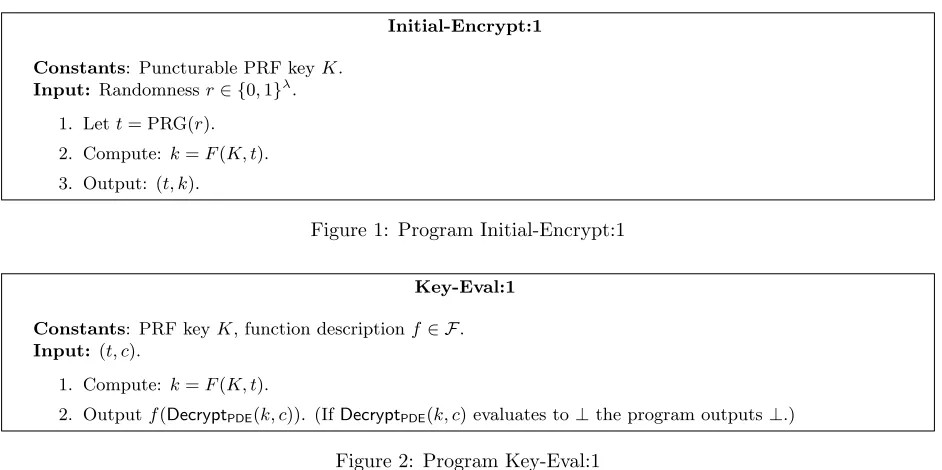
Initial-Encrypt:1
Constants: Puncturable PRF keyK.
Input: Randomnessr∈ {0,1}λ
.
1. Lett= PRG(r).
2. Compute: k=F(K, t).
3. Output: (t, k).
Figure 1: Program Initial-Encrypt:1
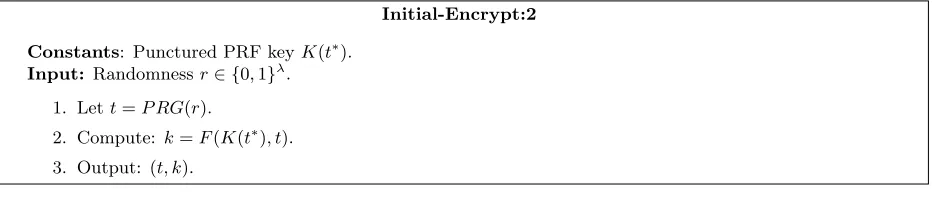
Key-Eval:1
Constants: PRF keyK, function descriptionf∈ F.
Input: (t, c).
1. Compute: k=F(K, t).
2. Outputf(DecryptPDE(k, c)). (IfDecryptPDE(k, c) evaluates to⊥the program outputs⊥.)
Figure 2: Program Key-Eval:1
4The program
Initial-Encrypt:1is padded to be the same size asInitial-Encrypt:2.
5The program
5.1
Proof of Security
Before delving into our formal security proof we give a brief overview with some intuition. In our system a challenge ciphetext CT∗ will be a pair (t∗, c∗) of a tag and PDE ciphertext. The first step of our proof is to use pseudorandom generator security to (indetectably) movet∗ out of the set of tagsT that might be generated from the programP. (Note the set T corresponds to the possible outputs of the pseudorandom generator.) This then enables us to perform multiple puncturing and hardwiring steps detailed below. Eventually, instead deriving the PDE keyk∗ asF(K, t∗), it will be chosen uniformly at random. (Herek∗ is the PDE key used in creating the challenge ciphertext.)
Furthermore, instead of putting the PDE keyk∗ into the obfuscated programs given out as keys we will put a punctured versionk0. This punctured version is can decrypt all ciphertextsexcept it cannot tell the difference between a PDE encryption of the challenge messagem0 from m1. However, by the rules of the security game it must be the case that the bitdf =f(m0) =f(m1) for any queried private key functionf. Therefore, an obfuscated program for private keyf can outputdf when either of the two PDE ciphertexts arises without knowing which one is which. We note that the reduction knows which messages (m0, m1) to puncture the PDE key kat since in this security game all keys are given out after the challenge ciphertext is generated.
Finally, at this stage we can simply apply the PDE security game to argue that the message is hidden. We note that the first steps of the proof have similarities to prior programming puncturing proofs [SW14], but we believe the introduction of and the way we utilize puncturable deterministic encryption are novel to this construction. Our formal proof follows.
Theorem 3. The above functional encryption scheme is post challenge ciphertext secure if it is instantiated with a secure punctured PRF, puncturable deterministic encryption scheme, pseudo random generator, and indistinguishability secure obfuscator.
Proof. To prove the above theorem, we first define a sequence of games where the first game is the original FE security game. Then we show (based on the security of different primitives) that any poly-time attacker’s advantage in each game must be negligibly close to that of the previous game. We begin by with describing
Game1 in detail, which is the (post challenge ciphertext) FE security game instantiated with our construc-tion. From there we describe the sequence of games where each game is described by its modification from the previous game. We continue to enumerate each step in every game in order to ease verification of our lemmas.
Game1 The first game is the original security game instantiated for our construction.
1. Challenger computes K←KeyF(1λ) and randomly chooses the challenge bitb∈ {0,1}.
2. Challenger chooses randomr∗∈ {0,1}λ and computest∗= PRG(r∗).
3. Challenger createsP ←iO(1λ,Initial-Encrypt:1[K]) and passesP to attacker.
4. Attacker gives messagesm0, m1∈ Mto challenger. (No Phase 1 queries.)
5. Challenger computes k∗←F(K, t∗).
6. Challenger computes c∗←EncryptPDE(k∗, mb) and outputs challenge ciphertext as CT∗= (t∗, c∗).
7. On attacker key query for functionf ∈ F the challenger responds withPf ←iO(Key-Eval:1[K, f]).
Game2
1. Challenger computes K←KeyF(1λ) and randomly chooses the challenge bitb∈ {0,1}.
2. Challenger chooses randomt∗∈ {0,1}2λ. 3. Challenger createsP ←iO(1λ,
Initial-Encrypt:1[K]) and passesP to attacker.
4. Attacker gives messagesm0, m1∈ Mto challenger. (No Phase 1 queries.)
5. Challenger computes k∗←F(K, t∗).
6. Challenger computes c∗←EncryptPDE(k∗, mb) and outputs challenge ciphertext as CT∗= (t∗, c∗).
7. On attacker key query for functionf ∈ F the challenger responds withPf ←iO(Key-Eval:1[K, f]).
8. The attacker gives a bitb0 and wins ifb0=b.
Game3 Parameters program is now punctured att∗.
1. Challenger computes K←KeyF(1λ) and randomly chooses the challenge bitb∈ {0,1}.
2. Challenger chooses randomt∗∈ {0,1}2λ and computes computesK(t∗) = PunctureF(K, t∗). 3. Challenger createsP ←iO(1λ,
Initial-Encrypt:2[K(t∗)]) and passesP to attacker.
4. Attacker gives messagesm0, m1∈ Mto challenger. (No Phase 1 queries.)
5. Challenger computes k∗←F(K, t∗).
6. Challenger computes c∗←EncryptPDE(k∗, mb) and outputs challenge ciphertext as CT∗= (t∗, c∗).
7. On attacker key query for functionf ∈ F the challenger responds withPf ←iO(Key-Eval:1[K, f]).
8. The attacker gives a bitb0 and wins ifb0=b.
Game4 Obfuscated programs in secret keys are punctured and hardwired.
1. Challenger computes K←KeyF(1λ) and randomly chooses the challenge bitb∈ {0,1}.
2. Challenger chooses randomt∗∈ {0,1}2λ and computes computesK(t∗) = PunctureF(K, t∗). 3. Challenger createsP ←iO(1λ,
Initial-Encrypt:2[K(t∗)]) and passesP to attacker.
4. Attacker gives messagesm0, m1∈ Mto challenger. (No Phase 1 queries.)
5. Challenger computes k∗←F(K, t∗).
6. Challenger computes c∗←EncryptPDE(k∗, mb) and outputs challenge ciphertext as CT∗= (t∗, c∗).
7. Letk0=PuncturePDE(k∗, m0, m1). Letc00=EncryptPDE(k∗, m0) and letc01=EncryptPDE(k∗, m1). Then
letc0, c1consist ofc00, c01 in lexicographic order.6 Consider each attacker key query for functionf ∈ F. Letdf =f(m0) =f(m1). The challenger responds withPf ←iO(Key-Eval:2[K(t∗), t∗, f, c0, c1, df, k0]).
8. The attacker gives a bitb0 and wins ifb0=b.
Remark 3. We remark that the lexicographic ordering is so that the to put the ciphertexts in the program is based on the form of the ciphertext and not (directly) on the messages they encode.7 This property will be important later for arguing security fromGame5 toGame6.
6Ifc0
0< c01 thenc0=c00, c1=c01; otherwise,c0=c01, c1=c00.
Game5
1. Challenger computes K←KeyF(1λ) and randomly chooses the challenge bitb∈ {0,1}.
2. Challenger chooses randomt∗∈ {0,1}2λ and computes computesK(t∗) = Puncture
F(K, t∗).
3. Challenger createsP ←iO(1λ,
Initial-Encrypt:2[K(t∗)]) and passesP to attacker.
4. Attacker gives messagesm0, m1∈ Mto challenger. (No Phase 1 queries.)
5. Challenger chooses randomk∗∈ {0,1}λ.
6. Challenger computes c∗←EncryptPDE(k∗, mb) and outputs challenge ciphertext as CT∗= (t∗, c∗).
7. Letk0 =PuncturePDE(k∗, m0, m1). Letc00=EncryptPDE(k∗, m0) and letc01=EncryptPDE(k∗, m1). Then
letc0, c1 consist ofc00, c01in lexicographic order. Consider each attacker key query for functionf ∈ F. Letdf =f(m0) =f(m1). The challenger responds withPf ←iO(Key-Eval:2[K(t∗), t∗, f, c0, c1, df, k0]).
8. The attacker gives a bitb0 and wins ifb0=b.
Game6
1. Challenger computes K←KeyF(1λ) and randomly chooses the challenge bitb∈ {0,1}.
2. Challenger chooses randomt∗∈ {0,1}2λcomputes computesK(t∗) = Puncture
F(K, t∗).
3. Challenger createsP ←iO(1λ,
Initial-Encrypt:2[K(t∗)]) and passesP to attacker.
4. Attacker gives messagesm0, m1∈ Mto challenger. (No Phase 1 queries.)
5. Challenger chooses randomk∗∈ {0,1}λ.
6. Challenger computes c∗←EncryptPDE(k∗, m0) and outputs challenge ciphertext as CT∗= (t∗, c∗).
7. Letk0 =PuncturePDE(k∗, m0, m1). Letc00=EncryptPDE(k∗, m0) and letc01=EncryptPDE(k∗, m1). Then
letc0, c1 consist ofc00, c01in lexicographic order. Consider each attacker key query for functionf ∈ F. Letdf =f(m0) =f(m1). The challenger responds withPf ←iO(Key-Eval:2[K(t∗), t∗, f, c0, c1, df, k0]). 8. The attacker gives a bitb0 and wins ifb0=b.
We observe that in this final game the attacker has no information on the challenger’s bit b since the game always just encryptsm0.
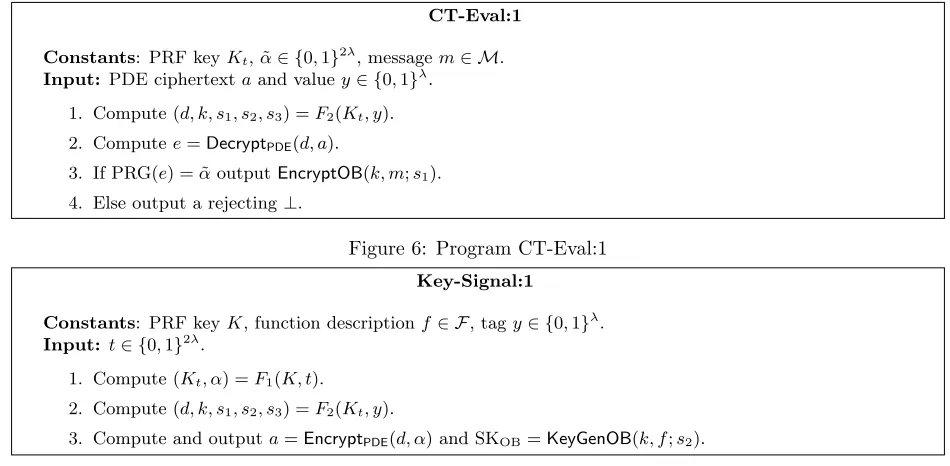
Initial-Encrypt:2
Constants: Punctured PRF keyK(t∗).
Input: Randomnessr∈ {0,1}λ.
1. Lett=P RG(r).
2. Compute: k=F(K(t∗), t).
3. Output: (t, k).
Figure 3: Program Initial-Encrypt:2
Key-Eval:2
Constants: PRF keyK(t∗), tag value t∗∈ {0,1}2λ, function description f ∈ F, PDE ciphertextsc
0, c1,
df ∈ {0,1}, and punctured deterministic encryption keyk0=kt∗(m0, m1).
Input: (t, c).
1. Ift=t∗ANDc6=c0, c1 outputf(DecryptPDE(k0, c)).
2. Ift=t∗AND (c=c0 ORc=c1) outputdf.
3. Otherwise compute: k=F(K, t).
4. Outputf(DecryptPDE(k, c)).
Figure 4: Program Key-Eval:2
Lemma 1. If our pseudo random generator PRG is secure then for all PPTAwe have thatAdvA,1−AdvA,2= negl(λ) for some negligible function negl.
Proof. We describe and analyze a PPT reduction algorithm B that plays the pseudo random generator security game. Bfirst receives a PRG game challenge T ∈ {0,1}2λ. It then runs the attacker and executes the security game as described in Game1 with the exception that in Step 2 it lets t∗ =T. If the attacker wins (i.e. b0 =b), then B guesses ‘1’ to indicated that T was in the image of a PRG; otherwise, it outputs ‘0’ to indicate thatT was chosen randomly.
We observe that when T is generated as T = PRG(r), then B gives exactly the view of Game1 to A. Otherwise ifT is chosen randomly the view is ofGame2. Therefore ifAdvA,1−AdvA,2 is non-negligble,B must also have non-negligible advantage against the pseudo random generator security game.
Lemma 2. If iO is a secure indistinguishability obfuscator, then for all PPT A we have that AdvA,2− AdvA,3= negl(λ) for some negligible function negl.
Proof. We describe and analyze a PPT reduction algorithm B that plays the indistinguishability obfus-cation security game with A. B runs steps 1-2 as in Game2. Next it creates two circuits as C0 = Initial-Encrypt:1[K] and C1 = Initial-Encrypt:2[K(t∗)]. It submits both of these to the IO chal-lenger and receives back a program P which it passes to the attacker in step 3. It executes steps 4-8 as in
Game2. If the attacker wins (i.e. b0=b), thenBguesses ‘0’ to indicated thatP was and obfuscation ofC0; otherwise, it guesses ‘1’ to indicate it was an obfuscation ofC1.
We observe that whenP is generated as and obfuscation ofC0, thenB gives exactly the view ofGame2 toA. Otherwise ifP is chosen as an obfuscation ofC1 the view is ofGame2. In addition, the programs are functionally equivalent with all but negligible probability. The reason is thatt∗ is outside the image of the pseudo random generator with probability at least 1−2λ. Therefore if Adv
A,2−AdvA,3 is non-negligble,B must also have non-negligible advantage against the indisguishability obfuscation game.
Lemma 3. If iO is a secure indistinguishability obfuscator, then for all PPT A we have that AdvA,3− AdvA,4= negl(λ) for some negligible function negl.
We describe and analyze a PPT reduction algorithm B that plays the indistinguishability obfuscation security game withA. Bruns steps 1-6 as inGame3. For the firstiqueries of step 7 it answers as inGame4. For queryi+ 1 it creates two circuits asC0=Key-Eval:1[K, f] wheref is the function queried for. Next, letk0 =PuncturePDE(k∗, m0, m1). Let c00 =EncryptPDE(k∗, m0) and letc01 =EncryptPDE(k∗, m1). Then let c0, c1 consist ofc00, c01 in lexicographic order. Letdf =f(m0) =f(m1), wheref is the key queried for. It createsC1=Key-Eval:2[K(t∗), t∗, f, c0, c1, df, k0].
It submits both of these to the IO challenger and receives back a program P which it passes to the attacker asPf. It answers the rest of the queries of step 7 as inGame3 and completes step 8. If the attacker wins (i.e. b0=b), thenBguesses ‘0’ to indicated thatP was and obfuscation ofC0; otherwise, it guesses ‘1’ to indicate it was an obfuscation ofC1.
We observe that whenPis generated as and obfuscation ofC0, thenBgives exactly the view ofGame3, i to A. Otherwise if P is chosen as an obfuscation of C1 the view is of Game3, i+ 1. In addition, the programs are functionally equivalent with all but negligible probability. The reason is that correctness holds for all messages with all but negligible probability. The only difference in the programs is that the response is hardwired in for two inputs. Therefore ifAdvA,3,i−AdvA,3,i+1 is non-negligble,Bmust also have non-negligible advantage against the indisguishability obfuscation game.
Lemma 4. IfF is a selectively secure puncturable PRF then for all PPTAwe have thatAdvA,4−AdvA,5= negl(λ) for some negligible function negl.
Proof. We describe and analyze a PPT reduction algorithm B that plays the selective puncturable PRF security game. B first runs step 1, then chooses t∗ and submits it back to the punctured PRF challenger. It receives back a punctured key K(t∗) and a challenge value z. It runs steps 3-4 for A as inGame4. In step 5 it sets k∗ =z. It then runs step 6-8 as inGame4. We note that in step 7 the punctured keyK(t∗) is sufficient to create the challenge ciphertext and answer all private key queries. If the attacker wins (i.e. b0 = b), then B guesses ‘1’ to indicated that z = F(K, t∗); otherwise, it outputs ‘0’ to that z was chosen randomly.
We observe that whenzis generated asF(K, t∗), thenBgives exactly the view ofGame4 toA. Otherwise ifz is chosen randomly, the view is of Game5. Therefore ifAdvA,4−AdvA,5 is non-negligble, Bmust also have non-negligible advantage against the security of the puncturable PRF.
Lemma 5. If our puncturable deterministic encryption scheme is secure, then for all PPTAwe have that
AdvA,5−AdvA,6= negl(λ) for some negligible function negl.
Proof. We begin by observing that the difference betweenGame5 andGame6 is that inGame6 the message encrypted in step 6 is always m0 and in Game5 the message could be m0 or m1 depending on b. When the coin flip ofb = 0 the views of the two games are identical. So if there is a difference in an attacker’s advantage in guessing b between Game5 and Game6 it must solely concentrated on the condition where b= 1 from step 1.
We describe and analyze a PPT reduction algorithmBthat plays the puncturable deterministic encryp-tion security game. Bfirst executes steps 1-4 of Game5, with the bit of step 1 being set to b= 1. Then it submits messagesm0, m1to the PDE challenger and receives backk0 =PuncturePDE(k∗, m0, m1) andT0, T1. On step 6 it setsc∗=T0.
In step 7 let c0, c1 consist of T0, T1 in lexicographic order. Here we see the point of demanding lex-icographic ordering on the PDE ciphertexts in previous games as the reduction algorithm here does not know whether m0 is in T0 or T1. Let df = f(m0) = f(m1), where f is the key queried for. It creates C1=Key-Eval:2[K(t∗), t∗, f, c0, c1, df, k0].
Finally, if the attacker wins (i.e. b0=b), thenBguesses ‘1’ to indicated thatc∗=T1 was an encryption ofm1; otherwise, it outputs ‘0’ to thatc∗=T1 was an encryption ofm0.
We observe that when c∗ = T1 is generated as EncryptPDE(k∗, m1) then B gives exactly the view of
Game6. Therefore ifAdvA,5−AdvA,6 is non-negligble, B must also have non-negligible advantage against the puncturable deterministic encryption system.
Now with all the lemmas in place we can pull our main theorem together. By a simple hybrid argument it follows that any PPT attacker’s advantage in the original securityGame1 can be at most negligibly greater than its advantage in Game6. However, the advantage of any attacker in Game6 is 0 since it gives no information on the bitband thus the scheme is secure.
6
An Adaptively Secure Construction
We now describe our construction of a functional encryption (FE) scheme that is adaptively secure. We let the message spaceM={0,1}`(λ) for some polynomial function`and the function class beF(λ) =F.
We will use two puncturable PRFs F1, F2 such that when we fix the keysK we have thatF1(K,·) takes in a 2λbit input and outputs two bit strings of lengthλandF2(K,·) takesλbits to five bitstrings of length λ. In addition, we use a puncturable deterministic encryption scheme where the message space is{0,1}λ. In our Puncturable PRF and PDE systems master keys are sampled uniformly at random from{0,1}λ. Finally, we use an indistinguishability secure obfuscator and an injective length doubling pseudo random generator PRG :{0,1}λ→ {0,1}2λ.
Finally, we use a one-bounded secure functional encryption system with master key encryption consisting of algorithms: KeyGenOB,EncryptOB,DecryptOB. We assume without loss of generality that the master key is chosen uniformly from{0,1}λ. The message spaceMand key description spacef ∈ Fof the one bounded scheme is the same as the scheme we are constructing.
Our Construction Our construction achieves an adaptively secure functional encryption by bootstrapping from a one-bounded FE scheme that is adaptively secure. At a high level a ciphertext is associated with a tag t and a private key with a tag y. From the pair of tags (t, y) one can (with the proper key material) pseudorandomly derive a master secret keykfor a one bounded FE system. The ciphertext will be equipped with an obfuscated program,C, which on input of a key tagywill generate the one bounded keyk(associated with the pair (t, y)) and then uses this to create an encryption of the message m under the one-bounded scheme with keyk. Likewise, the private key for functionalityf comes equipped with an obfuscated program Pf which on input of a ciphertext tagt derives the one bounded secret keyk and uses this to create a one-bounded secret key.
The decryption algorithm will pass the key tag y to the ciphertext program to get a one bounded ciphertext CTOBand the ciphertext tagtto the key program to get a one bound key SKOB. Finally, it will apply the one bounded decryption algorithm asDecryptOB(CTOB,SKOB) to learn the messagem. The one bounded key and ciphertext are compatible since they are both derived psuedorandomly from the pair (t, y) to getsameone-bounded keyk. (Note a different pair (t0, y0)6= (t, y) corresponds to a different one bounded FE keyk0 with high probability.)
Our bootstrapping proof structure allows us to develop “selective-ish” techniques at the outer level since in our reductions the ciphertext and private key tags can be chosen randomly ahead of time before the challenge message or any private key queries are known. Then the challenge of dealing with adaptive security is then “pushed down” to the one bounded FE scheme, where it has been solved in previous work [GVW12].
Setup(1λ)
The algorithm first chooses a random punctured PRF keyK←KeyF1(1
λ) which is set as the master secret
key MSK. Next it creates an obfuscation of the program Initial-Encrypt asP ←iO(1λ,
Initial-Encrypt:1[K]).8
Encrypt(PP =P(·), m∈ M)
The encryption algorithm performs the following steps in sequence.
1. Chooses randomr∈ {0,1}λ.
2. Sets (t, Kt, α)←P(r).
3. Sets ˜α= PRG(α).
4. Creates the programC←iO(1λ,CT-Eval:1[Kt,α, m˜ ]).9 5. The output ciphertext is CT = (t, C).
KeyGen(MSK, f ∈ F(λ))
The KeyGen algorithm first chooses a randomy ∈ {0,1}λ. It next produces an obfuscated program P f by obfuscatingPf ←iO(Key-Signal:1[K, f, y]). 10
The secret key is SK = (y, Pf).
Decrypt(CT = (t, C),SK = (y, Pf))
The decryption algorithm takes as input a ciphertext CT = (t, C) and a secret key SK = (y, Pf). It first computes (a,SKOB) =Pf(t). Next it computes CTOB=C(a, y). Finally, it will use the produced secret key to decrypt the produced ciphertext asDecryptOB(CTOB,SKOB) and outputs the result.
Correctness We briefly sketch a correctness argument. Consider a ciphertext CT = (t, C) created for messagemthat is associated with tagtand a key for functionf that is associated with tagy. On decryption the algorithm first calls (a,SKOB) = Pf(t). Here the obfuscated program computes: (Kt, α) = F1(K, t), (d, k, s1, s2, s3) =F2(Kt, y), anda=EncryptPDE(d, α) and SKOB=KeyGenOB(k, f;s2).
Next, it calls CTOB=C(a, y), whereCwas generated as an obfuscation of programCT-Eval:1[Kt,α, m˜ ] where ˜α= PRG(α). This obfuscated program will compute the same values of (d, k, s1, s2, s3) =F2(Kt, y) as the key signal program. By correctness of the PDE system we will have thatDecryptPDE(d, a) =αand
thus the program will outputEncryptOB(k, m;s1). At this point the decryption algorithm has a one bounded private key for functionf and a one bounded ciphertext for messagemboth created under the same master keyk. Therefore, running the one-bounded decryption algorithm will producef(m).
Initial-Encrypt:1
Constants: Puncturable PRF keyK.
Input: Randomnessr∈ {0,1}λ.
1. Lett= PRG(r).
2. Compute (Kt, α) =F1(K, t).
3. Output: (t, Kt, α).
Figure 5: Program Initial-Encrypt:1
8The program
Initial-Encrypt:1is padded to be the same size asInitial-Encrypt:2.) This obfuscated program,Pserves as the public parameters PP.
9The program
CT-Eval:1is padded to be the same size as the maximum ofCT-Eval:2andCT-Eval:3.
10The program
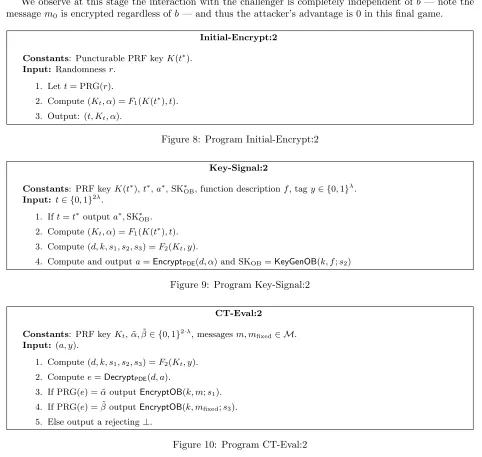
CT-Eval:1
Constants: PRF keyKt, ˜α∈ {0,1}2λ, messagem∈ M.
Input: PDE ciphertextaand valuey∈ {0,1}λ
.
1. Compute (d, k, s1, s2, s3) =F2(Kt, y).
2. Computee=DecryptPDE(d, a).
3. If PRG(e) = ˜αoutputEncryptOB(k, m;s1).
4. Else output a rejecting⊥.
Figure 6: Program CT-Eval:1
Key-Signal:1
Constants: PRF keyK, function descriptionf∈ F, tagy∈ {0,1}λ
.
Input: t∈ {0,1}2λ
.
1. Compute (Kt, α) =F1(K, t).
2. Compute (d, k, s1, s2, s3) =F2(Kt, y).
3. Compute and outputa=EncryptPDE(d, α) and SKOB=KeyGenOB(k, f;s2).
Figure 7: Program Key-Signal:1
6.1
Proof of Security
Before delving into our formal security proof we will give a brief intuitive overview of its structure and sequence of games steps. In the first steps of our sequence of games proof we will use pseudorandom generator security to (indetectably) move t∗ out of the set of tags T that might be generated from the programP.11 Then we use use puncturing techniques to remove the key material, K∗
t∗, associated with t∗
from the obfuscated program given in the public parameters. In addition, the proof will hardwire in the response of all private keysPf1, . . . , PfQ to the input of t
∗, whereQis the number of queries issued. These
actions are covered in moving fromGame1 toGame5.
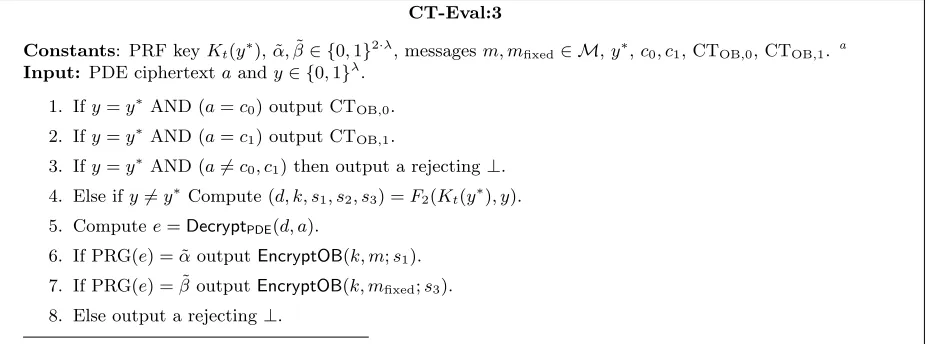
In the next grouping of steps we will introduce a second alternative message m0 into the challenge ciphertext program C∗ to go along with the message mb for b ∈ {0,1}. The behavior of the obfuscated program is now (byGame7) such that ifC∗receives an an “α-signal” as input it will output a one-bounded FE encryption of mb and if it receives a “β-signal” it will output a one-bounded FE encryption of m0. However, the private key programsPfi are only set to generateαsignals. Before this grouping of steps was
executed onlyα-signals existed.
Subsequently, each private key programPf is transformed one by one such that they are programmed to send outβ-signals upon receiving the tagt∗. When used in decryption this will cause the challenge ciphertext to output one time encryptions ofm0instead ofm1. Intuitively, this is undetectable becausef(mb) =f(m0) for all private key functionsf that can legally be requested. Executing this transformation requires multiple sub steps and is the most complex piece of the proof. It is also where the security one bounded FE scheme is invoked.
Finally, after the above transformations are made we are able to execute two final cleanup steps that remove the message mb from the ciphertext programC∗. At this point all information about the bit b is removed from the challenge ciphertext and the advantage of any attacker is 0.
Theorem 4. The above functional encryption scheme is adaptively secure if instantiated with a secure punctured PRF, puncturable deterministic encryption scheme, pseudo random generator, an adaptively secure one-bounded functional encryption scheme and indistinguishability secure obfuscator.
To prove the above theorem, we first define a sequence of games where the first game is the original FE
security game. Then we show (based on the security of different primitives) that any poly-time attacker’s advantage in each game must be negligibly close to that of the previous game. We begin by with describing
Game1 in detail, which is the adaptive FE security game instantiated with our construction. From there we describe the sequence of games, where each game is described by its modification from the previous game. We continue to enumerate each step (in most descriptions) to ease verification of our claims. For an attack algorithm A we let Q(λ) = Qbe a polynomial that bounds the maximum number of private key queries issued byA.
Game1 The first game is the original security game instantiated for our construction.
1. Challenger computes keysK←KeyF1(1λ) and randomly chooses the challenge bitb∈ {0,1}.
2. Challenger chooses randomr∗∈ {0,1}λ and computest∗= PRG(r∗).
3. Challenger computes Kt∗∗, α∗=F1(K, t∗).
4. Challenger sets ˜α∗= PRG(α∗).
5. Challenger createsP ←iO(1λ,
Initial-Encrypt:1[K]) and passesP to attacker.
6. Phase 1 Queries: Letfjbe the function of associated with thej-th query. Choose randomyj∈ {0,1}λ. Generate the j-th private key by computing Pfj ←iO(Key-Signal:1[K, fj, yj]). Output the key as
(yj, Pfj).
7. Attacker gives messagesm0, m1∈ Mto challenger.
8. Challenger sets the programC∗←iO(1λ,CT-Eval:1[Kt∗∗,α˜∗, mb]).
9. The output ciphertext is CT = (t∗, C∗).
10. Phase 2 Queries: Same as Phase 1 in step 6.
11. The attacker gives a bitb0 and wins ifb0=b.
Game2
1. Challenger computes keysK←KeyF
1(1
λ) and randomly chooses the challenge bitb∈ {0,1}.
2. Challenger chooses randomt∗∈ {0,1}2λ. 3. Challenger computes Kt∗∗, α∗=F1(K, t∗).
4. Challenger sets ˜α∗= PRG(α∗).
5. Challenger createsP ←iO(1λ,Initial-Encrypt:1[K]) and passesP to attacker.
6. Phase 1 Queries: Letfjbe the function of associated with thej-th query. Choose randomyj∈ {0,1}λ. Generate the j-th private key by computing Pfj ←iO(Key-Signal:1[K, fj, yj]). Output the key as
(yj, Pfj).
7. Attacker gives messagesm0, m1∈ Mto challenger.
8. Challenger sets the programC∗←iO(1λ,
CT-Eval:1[Kt∗∗,α˜∗, mb]).
9. The output ciphertext is CT = (t∗, C∗).
10. Phase 2 Queries: Same as Phase 1 in step 6.
Game3
1. Challenger computes keysK←KeyF
1(1
λ) and randomly chooses the challenge bitb∈ {0,1}.
2. Challenger chooses randomt∗∈ {0,1}2λ and computes computesK(t∗) = Puncture
F(K, t∗).
3. Challenger computes Kt∗∗, α∗=F1(K, t∗). 4. Challenger sets ˜α∗= PRG(α∗).
5. Challenger createsP ←iO(1λ,
Initial-Encrypt:2[K(t∗)]) and passesP to attacker.
6. Phase 1 Queries: Letfjbe the function of associated with thej-th query. Choose randomyj∈ {0,1}λ. Generate the j-th private key by computing Pfj ←iO(Key-Signal:1[K, fj, yj]). Output the key as
(yj, Pfj).
7. Attacker gives messagesm0, m1∈ Mto challenger.
8. Challenger sets the programC∗←iO(1λ,CT-Eval:1[Kt∗∗,α˜∗, mb]).
9. The output ciphertext is CT = (t∗, C∗).
10. Phase 2 Queries: Same as Phase 1 in step 6.
11. The attacker gives a bitb0 and wins ifb0=b.
Game4
1. Challenger computes keysK←KeyF1(1λ) and randomly chooses the challenge bitb∈ {0,1}.
2. Challenger chooses randomt∗∈ {0,1}2λ and computes computesK(t∗) = PunctureF(K, t∗). 3. Challenger computes Kt∗∗, α∗=F1(K, t∗).
4. Challenger sets ˜α∗= PRG(α∗).
5. Challenger createsP ←iO(1λ,
Initial-Encrypt:2[K(t∗)]) and passesP to attacker.
6. Phase 1 Queries: Letfj be the function of associated with thej-th query.
(a) Choose randomyj ∈ {0,1}λ.
(b) Compute (d∗j, k∗j, s∗1,j, s∗2,j, s∗3,j) =F2(Kt∗, yj).
(c) Computea∗j =EncryptPDE(d∗j, α∗) and SK ∗
OB,j =KeyGenOB(kj∗, fj;s∗2,j). (d) ComputePfj ←iO(Key-Signal:2[K(t
∗), t∗, a∗ j,SK
∗
OB,j, fj, yj]). (e) Output the key as (yj, Pfj).
7. Attacker gives messagesm0, m1∈ Mto challenger.
8. Challenger sets the programC∗←iO(1λ,CT-Eval:1[Kt∗∗,α˜∗, mb]).
9. The output ciphertext is CT = (t∗, C∗).
10. Phase 2 Queries: Same as Phase 1 in step 6. (These are also changed as described above.)
Game5
1. Challenger computes keysK←KeyF
1(1
λ) and randomly chooses the challenge bitb∈ {0,1}.
2. Challenger chooses randomt∗∈ {0,1}2λ and computes computesK(t∗) = PunctureF(K, t∗). 3. Challenger chooses randomKt∗∗, α∗.
4. Challenger sets ˜α∗= PRG(α∗).
5. Challenger createsP ←iO(1λ,
Initial-Encrypt:2[K(t∗)]) and passesP to attacker.
6. Phase 1 Queries: Letfj be the function of associated with thej-th query.
(a) Choose randomyj ∈ {0,1}λ.
(b) Compute (d∗j, k∗j, s∗1,j, s2∗,j, s∗3,j) =F2(Kt∗, yj).
(c) Computea∗j =EncryptPDE(d∗j, α∗) and SK ∗
OB,j =KeyGenOB(kj∗, fj;s∗2,j). (d) ComputePfj ←iO(Key-Signal:2[K(t
∗), t∗, a∗ j,SK
∗
OB,j, fj, yj]). (e) Output the key as (yj, Pfj).
7. Attacker gives messagesm0, m1∈ Mto challenger.
8. Challenger sets the programC∗←iO(1λ,CT-Eval:1[Kt∗∗,α˜∗, mb]).
9. The output ciphertext is CT = (t∗, C∗).
10. Phase 2 Queries: Same as Phase 1 in step 6.
11. The attacker gives a bitb0 and wins ifb0=b.
Game6
1. Challenger computes keysK←KeyF1(1λ) and randomly chooses the challenge bitb∈ {0,1}.
2. Challenger chooses randomt∗∈ {0,1}2λcomputes computesK(t∗) = PunctureF(K, t∗). 3. Challenger chooses randomKt∗∗, α∗.
4. Challenger sets ˜α∗= PRG(α∗) and chooses random ˜β∗∈ {0,1}2λ. 5. Challenger createsP ←iO(1λ,
Initial-Encrypt:2[K(t∗)]) and passesP to attacker.
6. Phase 1 Queries: Letfj be the function of associated with thej-th query.
(a) Choose randomyj ∈ {0,1}λ.
(b) Compute (d∗j, k∗j, s∗1,j, s2∗,j, s∗3,j) =F2(Kt∗, yj).
(c) Computea∗j =EncryptPDE(d∗j, α∗) and SK ∗
OB,j =KeyGenOB(kj∗, fj;s∗2,j). (d) ComputePfj ←iO(Key-Signal:2[K(t
∗), t∗, a∗ j,SK
∗
OB,j, fj, yj]). (e) Output the key as (yj, Pfj).
7. Attacker gives messagesm0, m1∈ Mto challenger.
8. Challenger sets the programC∗←iO(1λ,CT-Eval:2[Kt∗∗,α˜∗,β˜∗, mb, m0]).
9. The output ciphertext is CT = (t∗, C∗).
10. Phase 2 Queries: Same as Phase 1 in step 6.