Reversible Data Hiding in Images using Circular
Hough Transform
Sukhdeep Kaur#1, Manshi Shukla*2
#
M. Tech, Research Scholar, Department of Computer Science And Engineering, RIMT-IET, Mandi Gobindgarh, Fatehgarh Sahib, Punjab, India.
*Assistant Professor , Department of Computer Science And Engineering,RIMT-IET, Mandi Gobindgarh, Fatehgarh Sahib, Punjab, India.
Abstract-- Recently reversible data hiding (RDH) is getting more and more attention in encrypted images, as it maintains the excellent property that the original image cover can be losslessly recovered after the embedded data is extracted while image and data are protected and are confidential.This paper presents a method for reversible data hiding using circular hough transformation(CHT). CHT detects the presence of circular shapes.The experimental results reveal that the proposed method offers better performance over previous work.
Keywords--Reversible data hiding (RDH), Hough Transform (HT), Circular Hough Transform (CHT), Cover image.
I INTRODUCTION
REVERSIBLE data hiding, is to hide data invisibly which is called as payload into host data i.e., pixels in image in a reversible fashion. Being reversible, the main responsibility is both the original data and the embedded data can be completely restored. Two important measures of reversible data hiding are embedding capacity and quality degradation[1]. Sometimes, expressions like distortion-free, lossless, invertible or erasable watermarking are used as synonyms for reversible data hiding[2].
Reversible data hiding (RDH) techniques are designed for lossless embedding of large messages in digital images so that after the embedded message is extracted, the image can be restored completely to its original state as it was before embedding occurred. Data hiding is the science as well as art of communicating secret data in an appropriate multimedia carrier, e.g., image, audio, and video files[3]. Applications, such as remote sensing, medical imaging, military imaging and high-energy particle physical experimental investigation where it is desired that the original cover media or image should be recovered because of the requirement of high-precision nature[4].
To embed the data in the image we need three inputs: data to be embedded ,cover image and the key.
By the combination of these three inputs a suitable algorithm is generated which produce a stego image ( stego cover) that can be stored or transmitted. To the other end the decoder or extractor receives the stego image and the stego key (optional) and extracts the data. In some algorithms the decoder works only to check that data is actually embedded in the file or not. It is in the case where the hidden data are a watermark originally placed in the cover to prove ownership.
The performance of reversible data hiding algorithm is to be determined with the help of important metrics [5][6]
1) Payload capacity limit: determines how much
information can be embedded
2) Visual quality: determines visual quality on the
embedded image
3) Complexity: determines algorithm complexity
A considerable amount of research on reversible data hiding has been done over the past few years and many techniques[7] [8]are used to extract the data. Reversible data hiding has the ability of exactly recovering the host image as well as extracting the hidden data.
In this paper we used circular hough transformation approach to embed data. Hough transform is also a feature extraction technique used in image analysis,digital image processing and computer vision. The Hough transform is a method that can be used to find features of any shape in an image[9].
Circular hough transformation is a kind of Hough transform that can extract circular objects from an image. In many research work CHT had been used like in detecting fingertips position, iris detection for face recognition , automatic ball recognition[10][11].Hough has proposed an interesting and computationally efficient procedure for detecting lines in an images. In this paper we show how the method can be used for circle detection. The CHT is one of the modified versions of the HT. The CHT aims to find circular patterns within an image and can detect object even polluted by noise.
The circle can be represented in the parameter space in a simpler way.The equation of the circle is:
r² = (x – a)² + (y – b)² (1)
The circle has its three parameter r, a & b, where r is the radius and where a & b are the centre of the circle in the direction x & y respectively. The parameter representation of the circle is:
x=a + r cos (θ) (2)
When the angle θ sweeps through the full 360 degree range the points (x, y) trace the perimeter of a circle[12][13].
To find circles in an image using CHT :
First we find the edges in the image. At each edge point with the desired radius we draw a circle with center in the point. This circle is drawn in the parameter space, such that the x axis is the a value and the y axis is the b value while the z axis is the radii.
The following figure 1 represents the circular hough transformation with the same radius in the x,y space[14]
Figure 1 Circular HT from the x,y-space (left) to the parameter space (right), for a constant radius
This paper proposes a novel scheme for reversible data hiding in encrypted image.The motivation of our work is to decrease the error rate as much as possible and recover the cover media that is the image and data completely.Section II describes about the proposed work.Experimental results of the work are described in section III.Section IV gives the conclusion of the work done and the future scope.
II PROPOSED WORK
In [15], the side-match scheme is used to decrease the error rate of extracted-bits. However the experimental results reveal that the side match method offers better performance over original work of Zhang[16]. For example, when the section size is set to 8*8, the extracted bit error rate of the Lena image of the previous method is 0. 34%, which is significantly lower than 1.21% of Zhang’s work, but there exists the error rate with the method so we are going to propose a method which minimize the error rate.
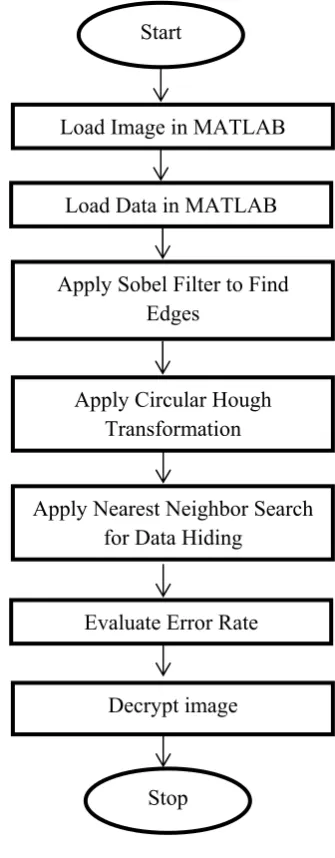
Figure 2 represents various steps of the proposed work.
At the very first level we read the host image file on which we are going to implement our algorithm to MATLAB workspace and do the needful changes. If the format of an image is in RGB then first we convert it into gray scale and then the method is proceeded further.
If the size of the image is too big or small then convert it to the nominal size.The standard size taken for this method is 512*512.
Figure 2. Flow chart of the approach
Simliarly the data is also loaded in the workspace which we want to hide in an image from the file where it is stored.
In this step Image processing is started.First the edges of an image are detected using a specific edge detector.Here we use sobel filter to find edges.
In this step, to determine the circular sections/blocks constant value of radius is used .The value of radius used in this process is from 8 to 40 with the increment of 4.
Using circular hough transform we will work in the presence of circular sections in the block. Circular Hough Transform is a kind of Hough transform whose aim is to extract circular objects from an image. Energy density of the pixels are given in this step.
Different colormaps are used in matlab to distinguish the intensities. The MATLAB has built in colormaps as Jet, HSV, Cool, Hot,
Start
Load Image in MATLAB
Load Data in MATLAB
Apply Sobel Filter to Find Edges
Apply Circular Hough Transformation
Apply Nearest Neighbor Search for Data Hiding
Evaluate Error Rate
The range of Jet colormap is from blue to red, which passes through the cyan, yellow, and orange colors. It is a variation of the hsv colormap.
Next step is to apply the nearest neighbor search.In this we find the value of pixels which are near about the value of data to be hidden so the distortion in an image is less.
Then we add our data to them and save the positions where we are going to fuse our data in an image.The key is generated in which all positions are saved where we hide our data.
The pseudo code describing the working of circular hough transformation method is given as:
for i = 1 to i = m
for j = 1 to j = n
if ( I(i, j)=1)
[i, j] ∑ Dis_mat
End if
end for
end for
for i = 1 to i = m
for j=1 to j=n
NN(∝) ={ if √(Dis_matₓ-i) + Dis_ma -j) < rad
then NN(∝) =1
Otherwise NN(∝)=0
Ih(I,j)= ∝NN(k)
end for
end for
where,
m and n are the dimensions of an image,
Dis_mat is a variable to store logical position of edge image I,
Ih is a circular hough transformed image and
where rad is a radian distance for circular hough transformation.
In this step results are evaluated. Extracted bit error rate is determined for the comparison with previous work.
Last step is of decryption. In this step first the data which we hide in the image is extracted using the key which we generate in the previous step.Then the decrypted image is generated.In the end we are able to get both the image as well as data in its original state.
III. EXPERIMENTAL RESULTS
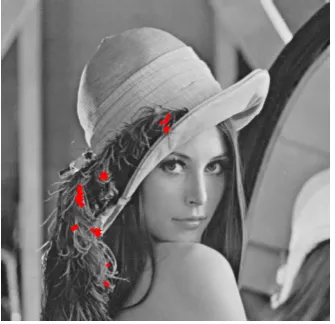
We applied this method on different images. Here to demonstrate the performance we used four images of size 512* 512, including Lena, Baboon, Sailboat, and Splash as the test images, as shown in Figure 3 to make comparison with the previous methods. These images can be obtained from the USC-SIPI image database [18]. The experimental results are compared with [15][16].Figure 4 plots the block size versus extraction error rate of the proposed method and [15][16]. Figure 4 reveals that the proposed method offers lower error rates than that of [15] and [16]. For example, for the Lena image at block size 8 8, the error rate of the proposed method is 0 whereas the error in [15] is 0.34%whereas the error rate of [16] is 1.21%.The Splash image, the error rate of the proposed method is 0 at block size 8 8, however, [16] has to choose a block size of 16 16 to achieve a zero error rate.We got effective results for all the image as getting error rate of zero.The distortion in an image after hiding data is minimum in our method.The highlighted dots in figure 5 shows the positions where the data is hidden in Lena image
Figure 3. Four test images. (a) Lena. (b) Baboon. (c) Sailboat. (d) Splash
Figure 4 The error rate comparison. (a) Lena. (b) Baboon. (c) Sailboat. (d) Splash.
Figure 5 Dots showing position of hidden data in Lena image
IV.CONCLUSION
The motivation of reversible data embedding is distortion-free data embedding. This paper proposes the improved method so that the image distortion is as minimum as
proposedmethod effectively improves Hong’s and Zhang’s method, especially in the case where the block size is small. The future work will be to develop an algorithm by using some other techniques for effective results and have
5 10 15 20 25 30 35 40
0 0.5 1 1.5
side length of each block
E
x
tr
ac
ted bi
t er
ror
r
a
te
(%
)
Splash image
Orignal Method Side Match Method Circular hough transformation
5 10 15 20 25 30 35 40
0 1 2 3 4 5 6
side length of each block
E
x
tr
a
c
te
d
b
it e
rr
o
r r
a
te
(
%
)
Sailboat image
Orignal Method Side Match Method Circular hough transformation
5 10 15 20 25 30 35 40
0 2 4 6 8 10 12 14 16
side length of each block
E
x
tr
ac
ted bi
t
er
ror r
at
e
(%
)
Baboon image
Orignal Method Side Match Method Circular hough transformation
5 10 15 20 25 30 35 40
0 0.2 0.4 0.6 0.8 1 1.2 1.4
side length of each block
E
x
tr
ac
ted bi
t err
o
r rat
e
(
%
)
Lena image
ACKNOWLEDGMENT
The author would like to thank the RIMT Institutes, Mandi Gobindgarh, Fatehgarh Sahib, Punjab, India. Author would also wish to thank editors and reviewers for their valuable suggestions and constructive comments that help in bringing out the useful information and improve the content of paper.
REFERENCES
[1] Hyoung Joong Kim, Vasiliy Sachnev, and Dong Hoi Kim “New reversible data hiding algorithm based on difference expansion method” pp. 112-119.
[2] Masoud Nosrati, Ronak Karimi, Mehdi Hariri “Reversible Data Hiding: Principles, Techniques, and Recent Studies”World Applied Programming, Vol (2), Issue (5), May 2012. 349-353.
[3] D.R.Denslin Brabin, Dr.J.Jebamala Tamilselvi “Reversible Data Hiding: A Survey” International Journal of Innovative Research in Computer and Communication Engineering Vol. 1, Issue 3, May 2013.
[4] Zhicheng Ni, Yun-Qing Shi, Nirwan Ansari, and Wei Su “Reversible Data Hiding” IEEE Transactions on Circuits and Systems for Video Technology, Vol. 16, No.3, 2006, pp. 354–362.
[5] Jun Tian. "Reversible data embedding using a difference expansion." IEEE Transaction on Circuits and Systems for Video Technology, Vol. 13. No. 8. August 2003, pp. 890-896.
[6] P.H.Pawar and K.C.Jondhale “Histogram Based Reversible Data Hiding Using Block Division” International Conference on Advanced Communication Control and Computing Technologies ICACCCT,2012,pp-295-299.
[7] Sukhdeep Kaur, Manshi Shukla” Reversible Data Hiding and its Methods: A Survey”IJCSMC, Vol. 3, Issue. 5, May 2014, pg.821 – 826.
[8] Harshavardhan Kayarkar and Sugata Sanyal “A Survey on Various Data Hiding Techniques and their Comparative Analysis”.
[9] Pramod Kumar Pandey, Nitin Khurana, and Ashish Aggarwal, Amit Manocha “Comparative Analysis Of Image Segmentation Using Hough Transform” International Journal of Applied Engineering Research, ISSN 0973-4562 Vol.7 No.11 2012.
[10] Mohamed Rizon, Haniza Yazid, Puteh Saad, Ali Yeon Md Shakaff, Abdul Rahman Saad, Masanori Sugisaka, Sazali Yaacob, M.Rozailan Mamat and M.Karthigayan “Object Detection using Circular Hough Transform” American Journal of Applied Sciences 2(12): pp. 1606-1609, 2005.
[11] Online Available: http://en.wikipedia.org/wiki/Hough_transform [12] Fatoumat Dembele ,”Object Detection using Circular Hough
Transform”.
[13] Sukhdeep Kaur, Manshi Shukla “An Approach for Reversible Data Hiding using Circular Hough Transform” Global Journal of Advanced Engineering Technologies, Vol 3, Issue 3- 2014 pp. 264-268.
[14] Sirisak Liangwongsan, Boonraung Marungsri, Ratchadaporn Oonsivilai, Anant Oonsivilai “Extracted Circle Hough Transform and Circle Defect Detection Algorithm” World Academy of Science, Engineering and Technology Vol:5 pp. 316-321 , 2011-12-21. [15] Wien Hong,Tung-Shou Chen,Han-Yan Wu “An Improved
Reversible Data Hiding in Encrypted Images Using Side Match” IEEE Signal Processing Letters, vol. 19, no. 4, pp. 199-202, April 2012.
[16] X. Zhang, “Reversible data hiding in encrypted images,” IEEE SignalProcess. Letter., vol. 18, no. 4, pp. 255–258, 2011.