© 2015, IRJET.NET- All Rights Reserved Page 1010
DC MOTOR CONTROL SYSTEM USING MODEL PREDICTIVE
CONTROLLER
Sakshi Bangia
1, Sheilza Jain
2, Neha
312
Assistant Professor, Electrical Engineering Department, YMCA University of Science and Technology, Faridabad,
Haryana, India
3
M.tech Student, Electrical Engineering Department, YMCA University of Science and Technology, Faridabad,
Haryana, India
---***---Abstract -
DC motors have been widely used in theelectromechanical systems due to its simple
structure, ease of implementing variable speed control and low cost. DC motors have traditionally been modeled as second order linear system, which
ignores the dead nonlinear zone of the motor.In this
paper, the analysis and design of linearized control systems such as DC Motor is taken into consideration by applying Model Predictive Control strategies to diagnose the issues related to run time failures. They can be improved by adjusting the tuning weights and varying the constraints of the various parameters taken into consideration. Also, the stability and the system performance of the close loop networked control system are analyzed.
Key Words:
Dc motor, model predictive control,
matlab modeling, simulink
1. INTRODUCTION
DC motors are used extensively in adjustable speed drives and position control applications. Their speeds below the base speed can be controlled by armature voltage control. Speeds above the base speed are obtained by field-flux control. As speed control method for DC motors are simpler and less expensive than those for the AC motors, DC motors are preferred where wide speed range control is required. There are various techniques to control the speed of DC motor. One such technique is implemented in this paper in order to control the speed of DC Motor using MPC controller toolbox in MATLAB. The term Model Predictive Control does not designate a specific control strategy but a very ample range of control methods which make an explicit use of a model of the process to obtain the control signal by minimizing an objective function. These design methods lead to linear controllers which have practically the same structure and present adequate degrees of freedom. The various MPC algorithms only differ amongst themselves in the model used to represent the process and the noises and the cost function to be minimized. The MPC Toolbox is a collection of functions
(commands) developed for the analysis and design of MPC systems. At present, it is the most widely used multivariable control algorithm in the chemical process industries and in other areas. While MPC is suitable for almost any kind of problem, it displays its main strength when applied to problems with:
•A large number of manipulated and controlled variables.
•Constraints imposed on both the manipulated and
controlled variables
•Changing control objectives and/or equipment
(sensor/actuator) failure available in today’s control computer hardware.
This paper basically focuses on nonlinear modelling and proposes an innovative MATLAB model on MPC Toolbox to study of dynamic response of DC motors in open loop for changes in speed and armature voltage to identify the effects of dead zone nonlinearities. The results of this MATLAB model shall prove to be very useful in designing the control strategy for applications involving DC motors.
2. DC MOTOR MODELLING
The equation for the electrical circuit of the DC motor is
and the mechanical torque is
Where
is the armature input voltage
© 2015, IRJET.NET- All Rights Reserved Page 1011 is the armature current,
R is the armature resistance
J is the system moment of inertia
B is the system damping coefficient
K and Kb are the torque constant and the back emf
constant, respectively
Tlis the load torque
ω is the angular velocity of the rotor.
Fig.1. Schematic diagram of dc motor representation
The DC motor has a driven load that can be a robot arm or
an unmanned electric vehicle.
Using u = ea as the control signal for the DC motor and
introducing two state variables, the armature current and
the angular velocity of the rotor, that is
= ω
The dynamics of the DC motor can be described by the following continuous-time state space description
Where is the system state, u(t) Î is the
system input, y(t) Î2 is the system output,
Are the system matrices.
2.
MODEL PREDICTIVE CONTROL FOR A DC
SERVO SYSTEM
MPC is a type of control in which the current control signal is determined such that a desirable output behavior results in the future. Thus we need the ability to efficiently predict the future output behavior of the system. This future behavior is a function of past inputs to the process as well as the inputs that we are considering to take in the future. In MPC structure there is a feedback or feed forward path to compute the process measurements. There are mainly three components are available in MPC structure:
1. The process model
2. The cost function
3. The optimizer
The information about the controlled process and prediction of the response of the process values according to the manipulated control variables are done by the process model. Then the error is reduced by the minimization of the cost function. In the last step various types of optimization techniques are used and the output gives to the input sequence for the next prediction horizon. The general structure of Model Predictive Controller is shown in Fig.2
© 2015, IRJET.NET- All Rights Reserved Page 1012
3. SIMULATION ENVIRONMENT
Using the appropriate values of the parameters and the state space model given in equation for DC Servo system, the MPC control strategy was simulated. The simulink diagram for the DC Motor using MPC Controller is as shown in the Fig.3.
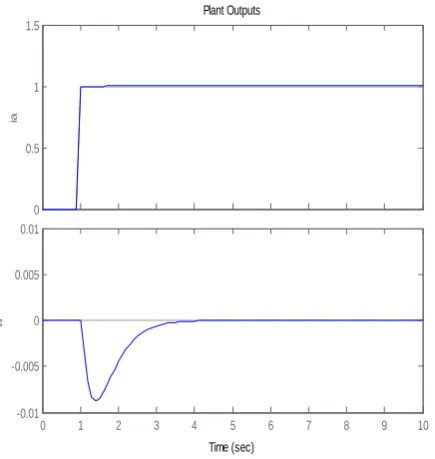
The DC Motor plant model is simulated using MPC Controller and the results after simulation are shown as below in the Fig. 4.
The staircase signal is applied as an armature input signal,
ea, to the MPC controller. The plant outputs are
correspondingly controlled by MPC as armature current and angular velocity.
Fig: 1.5 Response to manipulated variable, Armature voltage using MPC Controller
The key features of the simulink diagram are as described below. The plant output is a vector signal. The first
The figure 1.6 shows the variation of angular velocity and armature current & their tracking after applying MPC strategies.
Fig 1.6 Simulation scopes of output model
© 2015, IRJET.NET- All Rights Reserved Page 1013
4. RESULTS AND DISCUSSION
The DC motor control system was simulated using Model Predictive Control (MPC), a simulator developed in MATLAB using the varied values of the parameters used in simulations. Here DC motor control system was simulated using MPC with considering delay effects. The constraints value can be varied to a desired value by using MPC
3. CONCLUSIONS
The aim of this paper is to give insight into model predictive control and run Matlab simulations to show some of the theory for linear systems using a generalized system. MPC is popular due to its ability to yield high performance control systems capable of operating without expert involvement for longer periods of time and also its
ability to handle constraints. In this work, the importance of MPC, components of MPC are mentioned and some of its practical applications on DC Motor is presented. It can be concluded that using MPC of MATLAB is very beneficial in designing of controller. It is less time consuming and also robust. Input and output constraints are also taken care of by the controller. Here different Model Predictive Control schemes have designed and studied to compensate the network delays in network control systems.
REFERENCES
[1] Gonzalo Farias, Robin De Keyser, Sebastián
Dormido, and Francisco Esquembre:"Developing Networked Control Labs:A Matlab and Easy Java
Simulations Approach, ”IEEE Trans. OnInd.
Electronics, Vol.57,No.10,October2010.
[2] P.E.Orukpe,“Basics of Model Predictive
Control,”ICM, EEE-CAP, ImperialCollege,
London,April2005.
[3] C.F.Caruntu C.Lazar: “Robustly stabilizing model
predictive control design for networked control systems with an application to direct current motors,”IET Control Theory and Appl.Vol. 6,Iss.7, pp. 943–952,2012
[5] N.N.P.Mahalik and K.K.Kim, “A prototype for hardware
in the loop simulation of a distributed control architecture,”IEEE Trans. Syst., vol.38, no.2, pp.189– 200, Mar. 2008.
[6] J.Nilsson.“Real-Time Control Systems with Delays,
”PhD thesis, Department of Automatic Control, Lund Institute of Technology, 1998.
[7] G.P.Liuand D.Reesand S.C.Chai, “Design and Practical
Implementation of Networked Predictive Control Systems,”IEEE,7803-8812-7/05/$20.000,2005.
[8] Yavin Y, Kemp PD,“Modeling and control of the
© 2015, IRJET.NET- All Rights Reserved Page 1014 operation with real time experiments”, Energy
Conversion and Management xxx (2003) xxx–xxx
[10]J. A. Rossiter, Model-Based Predictive Control - A
Practical Approach.CRC Press, 2003.
BIOGRAPHIES
Dr.Sakshi Bangia is working as
Assistant Professor in Electrical
Engineering Department at YMCA UST Faridabad.She received her B.Tech degree in Instrumentation and Control from MDU Rohtak and M.Tech degree in Electrical Engg. from YMCA UST in 2004 and 2006,respectively. She did her Ph.D(Electrical Engineering) in 2014 from Maharashi Dyanand University, Rohtak, India .She has around 20 publications in national, international
journals and in international
conferences to her credit
Sheilza Jain is currently working as an Assistant Professor in Electronics Engineering Department at YMCA University of Science and Technology, Faridabad, India.She did B.Tech in
Electronics and Communication
Engineering from Kurukshetra
University Kurukshetra, India and M.Tech with specialization in Control System from Maharshi Dayanand
University, Rohtak, India. She
obtained her Ph.D from Maharshi Dayanand University, Rohtak, India,
in the area of control of
nanopositioning system. She has 35 publications in International/National Journal and international/National Conferences.
NEHA received her B.Tech degree in
Electronics and Communication from MDU Rohtak in 2012 and presently
pursuing her M.Tech degree in
Electronics and Instrumentation from YMCA UST, Faridabad.