Optimizing Authenticated Garbling for Faster Secure Two-Party
Computation
Jonathan Katz University of Maryland
Samuel Ranellucci University of Maryland George Mason University
Mike Rosulek Oregon State University [email protected]
Xiao Wang University of Maryland [email protected]
October 10, 2018
Abstract
Wang et al. (CCS 2017) recently proposed a protocol for malicious secure two-party compu-tation that represents the state-of-the-art with regard to concrete efficiency in both the single-execution and amortized settings, with or without preprocessing. We show here several opti-mizations of their protocol that result in a significant improvement in the overall communication and running time. Specifically:
• We show how to make the “authenticated garbling” at the heart of their protocol com-patible with the half-gate optimization of Zahur et al. (Eurocrypt 2015). We also show how to avoid sending an information-theoretic MAC for each garbled row. These two optimizations give up to a 2.6×improvement in communication, and make the commu-nication of the online phase essentially equivalent to that of state-of-the-artsemi-honest secure computation.
• We show various optimizations to their protocol for generating AND triples that, over-all, result in a 1.5× improvement in the communication and a 2× improvement in the computation for that step.
1
Introduction
One-way comm. Two-way comm.
Dep. + online Total Dep. + online Total
semi-honest 0.22 0.22 0.22 0.22
Single-execution setting
[NST17] 0.22 15 0.22 15
[WRK17a] 0.57 3.43 0.57 6.29
[HIV17] 3.39 3.39 3.39 3.39
This work, v. 1 0.33 2.24 0.33 4.15
This work, v. 2 0.22 2.67 0.22 5.12
Amortized setting (1024 executions)
[RR16] 1.60 1.60 3.20 3.20
[NST17] 0.22 6.6 0.22 6.6
[WRK17a] 0.57 2.57 0.57 4.57
[KNR+17] 1.59 1.59 1.59 1.59
This work, v. 1 0.33 1.70 0.33 3.07
This work, v. 2 0.22 2.13 0.22 4.04
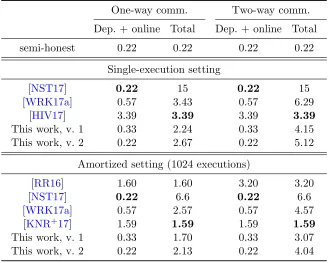
Table 1: Communication complexity of different protocols (in MB) for evaluating an AES circuit. One-way communication refers to the maximum communication one party sends to the other; two-way communication refers to the sum of both parties’ communication. The best prior number in each column is bolded for reference. Note that our protocol version 1 requires number of rounds proportional to the circuit depth in the function dependent phase.
evaluate up to 1,000 gates at the rate of 1 gate/second [PSSW09], the current state-of-the-art pro-tocol by Wang et al. [WRK17a] (the WRK protocol) can compute tens of millions of gates at a rate up to 700,000×faster. With this steady stream of improvements, it has become more and more dif-ficult to squeeze out additional performance gains; as an illustrative example, Zahur et al. [ZRE15] introduced a highly non-trivial optimization (“half-gates”) just to reduce communication by 33%. We show several improvements to the WRK protocol that, overall, improve its performance by 2–3×. Recall their protocol can be divided into three phases: a function-independent phase (Ind.) in which the parties know an upper bound on the number of gates in the circuit to be evaluated and the lengths of their inputs; a function-dependent phase (Dep.) in which the parties know the circuit, but not their inputs; and anonline phase in which the parties evaluate the circuit on their respective inputs. Our results can be summarized as follows:
• The function-dependent phase of the WRK protocol involves the computation of (shared) “AND triples” between the parties. We show various optimizations of that step that result in a 1.5×improvement in the communication and a 2×improvement in the computation. Our optimizations also simplify the protocol significantly.
We can combine these improvements in various ways, and suggest in particular two instantiations of protocols with malicious security: one that minimizes the total communication across all phases, and one that trades off increased communication in the function-independent phase for reduced communication in the function-dependent phase. These protocols improve upon the state-of-the-art by a significant margin, as summarized in Table 1. For example, compared to the protocol of Nielsen et al. [NST17] we achieve the same communication across the function-dependent and online phases, but improve the total communication by more than 6×; compared to the prior work with the best total communication [HIV17], we achieve a 1.5× improvement overall and, at the same time, push almost all communication to the function-independent preprocessing phase. (Our protocol also appears to be significantly better than that of Hazay et al. [HIV17] in terms of computation. See Section6 for a more detailed discussion.)
The multi-party case. It is natural to wonder whether we can extend our improved technique for authenticated garbling to the multi-party case, i.e., to improve upon [WRK17b]. Unfortunately, we have not yet been able to do so. In Section7, we discuss some of the difficulties that arise.
1.1 Outline
In Section 2 we provide some background about the WRK protocol. We provide the high-level intuition behind our improvements in Section3. In Section4, we describe in detail our optimizations of the online phase of the WRK protocol, and in Section 5 we discuss our optimizations of the preprocessing phase. In Section6, we compare our resulting protocols to prior work.
2
Background
We begin by describing some general background, followed by an in-depth review of the authenticated-garbling technique introduced in [WRK17a]. In the section that follows, we give a high-level overview of our optimizations and improvements.
We use κ and ρ to denote the computational and statistical security parameters, respectively. We sometimes use “:=” to denote assignment.
Information-theoretic MACs. As in prior work, we authenticate bits using a particular information-theoretic MAC. Let ∆B ∈ {0,1}κbe a value known toPBthat is chosen at the outset of the protocol.
We say a bit b known toPA is authenticated to PB if PB holds a key K[b] and PA holds the
corre-sponding tagM[b] = K[b]⊕b∆B. We abstractly denote such a bit by [b]A; i.e., for some fixed ∆B,
when we say the parties hold [b]A we mean that PA holds (b,M[b]) and PB holds K[b] such that M[b] =K[b]⊕b∆B. We analogously let [b]B denote a bit bknown to PB and authenticated toPA.
A pair of authenticated bits [b1]A,[b2]B, each known to a different party, form anauthenticated share of b1⊕b2. We denote this byhb1|b2i, where the value in the left slot is known to PA, and the value in the right slot is known to PB. Both authenticated bits and authenticated shares are
Functionality Fabit
Honest case:
1. Upon receiving init from both parties, choose uniform ∆A,∆B ∈ {0,1}κ; send ∆A toPA
and ∆B toPB.
2. Upon receiving (random,A) from both parties, choose uniform x ∈ {0,1} and K[x] ∈ {0,1}κ, setM[x] :=K[x]⊕x∆B, and send (x,M[x]) toPA and K[x] toPB.
3. Upon receiving (random,B) from both parties, generate an authenticated bit forPB in a manner symmetric to the above.
Corrupted parties: A corrupted party can specify the randomness used on its behalf by the functionality.
Global-key queries: A corruptedPA(resp.,PB) can, at any time, send ∆, and is told whether
∆ = ∆B (resp., ∆ = ∆A).
Figure 1: The authenticated-bits functionality.
Authenticated bits can be computed efficiently based on oblivious transfer [NNOB12,NST17]. We abstract away the particular protocol used to generate authenticated bits, and design our protocols in the Fabit-hybrid model (cf. Figure 1) in which there is an ideal functionality that provides them.
Opening authenticated values. An authenticated bit [b]A known to PA can be opened by
having PA sendb and M[b] to PB, who then verifies thatM[b] = K[b]⊕b∆B. As observed in prior
work [DPSZ12], it is possible to opennauthenticated bits with less thanntimes the communication. Specifically,PA can open [b1]A, . . . ,[bn]A by sendingb1, . . . , bnalong withh:=H(M[b1], . . . ,M[bn]),
where H is a hash function modeled as a random oracle. PA then simply checks whether h =
H(K[b1]⊕b1∆B, . . . ,K[bn]⊕bn∆B).
We letOpen([b1]A, . . .) denote the process of opening one or more authenticated bits in this way,
and overload this notation so thatOpen(hb1|b2i) denotes the process of having each party open its
portion of an authenticated share.
Circuit-dependent preprocessing. We consider boolean circuits with gates represented as a tuple (α, β, γ, T), where α and β are (the indices of) the input wires of the gate, γ is the output wire of the gate, and T ∈ {⊕,∧}is the type of the gate. We useW to denote the output wires of all AND gates, I1,I2 to denote the input wires for each party, andO to denote the output wires.
Wang et al. [WRK17a] introduced an ideal functionality calledFpre(cf. Figure2) that is used by
the parties in a circuit-dependent, but input-independent, preprocessing phase. This functionality sets up information for the parties as follows:
1. For each wire wthat is either an input wire of the circuit or an output wire of an AND gate, generate a random authenticated sharehrw|swi. We refer to the valueλw
def
= rw⊕sw as the
Functionality Fpre
1. Choose uniform ∆A,∆B ∈ {0,1}ρ. Send ∆A toPA and ∆B toPB.
2. For each wire w∈ W ∪ I, generate a random authenticated sharehrw|swi.
3. For each gate G= (α, β, γ, T), in topological order:
• If T = ⊕, generate a random authenticated share hrγ|sγi for which rγ ⊕sγ =
rα⊕sα⊕rβ⊕sβ.
• If T = ∧, generate a random authenticated share hrγ∗|s∗γi for which r∗γ ⊕s∗γ = (rα⊕sα)∧(rβ ⊕sβ).
Figure 2: Preprocessing functionality for some fixed circuit.
2. For the output wireγ of each XOR gate (α, β, γ,⊕), generate a random authenticated share
hrγ|sγi whose value rγ⊕sγ is the XOR of the masks on the input wires α, β.
3. For each AND gate (α, β, γ,∧), generate a random authenticated share hr∗γ|s∗γi such that
r∗γ⊕s∗γ = (rα⊕sα)∧(rβ∧sβ).
We refer to a triple of authenticated shares (hrα|sαi,hrβ|sβi,hr∗γ|s∗γi) for which rγ∗ ⊕s∗γ= (rα⊕
sα)∧(rβ⊕sβ) as anauthenticated AND triple. These are just (authenticated) Beaver triples [Bea92]
over the field F2.
Authenticated garbling. We now describe the idea behind the authenticated garbling technique from the WRK protocol. We assume the reader is familiar with basic concepts of garbled circuits, e.g., point-and-permute [BMR90], free-XOR [KS08], etc.
Following the preprocessing phase described above, every wire w is associated with a secret mask λw, unknown to either party. If the actual value on that wire (when the circuit is evaluated
on the parties’ inputs) is zw, then the masked value on that wire is defined to be ˆzw = zw⊕λw.
We focus on garbling a single AND gate (α, β, γ,∧). Assume PA is the circuit garbler and PB is
the circuit evaluator. Say the garbled wire labels are (Lα,0,Lα,1) and (Lβ,0,Lβ,1) for wiresα andβ,
respectively. Since we apply the free-XOR optimization,PA also holds ∆ such thatLw,0⊕Lw,1 = ∆
for any wire w. The protocol inductively ensures that the evaluator PB knows the wire labels Lα,ˆzα,Lβ,zˆβ and masked values ˆzα,zˆβ for both input wires. Note that the correct masked value for the output wire is then
ˆ
zγ = (λα⊕zˆα)∧(λβ⊕zˆβ)⊕λγ,
and we need to ensure that PB learns this value.
To achieve this, PA generates a garbled gate consisting of 4 rows (one for eachu, v∈ {0,1})
Gu,v=H(Lα,u,Lβ,v)⊕(ru,v,M[ru,v],[Lγ,zˆu,v]),
with bit ˆzu,v defined as
ˆ
Here, [Lγ,zˆu,v] isPA’s share of the garbled label;ru,v is PA’s share of the bit ˆzu,v; andPB holds the corresponding share su,v such thatru,v⊕su,v = ˆzu,v. The valueM[ru,v] is the MAC authenticating
the underlying bit to PB. Also note that the definition of ˆzu,v indicates that when u = ˆzα and
v= ˆzβ then ˆzu,v = ˆzγ.
Suppose the evaluator PB holds (u,Lα,u) and (v,Lβ,v), where u= ˆzα and v= ˆzβ. ThenPB can
evaluate this AND gate by decrypting Gu,v to obtainru,v and PA’s share ofLγ,ˆzu,v. After verifying the MAC onru,v, partyPB can combine these values with its own shares to reconstruct the masked
output value ˆzu,v (that is, ˆzγ) and its corresponding labelLγ,zˆu,v (that is, Lγ,ˆzγ).
Assuming that the authenticated bits and shares of the labels can be computed securely, the above protocol is secure against malicious adversaries. In particular, even if PA cheats and causes PB to abort during evaluation, any such abort depends only on the masked values on the wires.
Since the masks are random and unknown to either party, this means that any abort is input-independent. The MACs checked byPB ensure correctness, namely that evaluation has resulted in
the correct (masked) output-wire value.
From authenticated shares to shared labels. Another important optimization in the WRK protocol is to compute shares of labels efficiently using authenticated shares. Assume the parties hold an authenticated share hr|si of some mask λ=s⊕r. It is then easy to compute a share of
λ∆A, since
λ∆A = (r⊕s)∆A =
r∆A⊕K[s]
⊕M[s].
SincePA hasr, ∆A, andK[s] whilePB hasM[s], the two parties can locally compute shares ofλ∆A
(namely, [λ∆A]) given onlyhr|si.
We can use this fact to compute shares of labels for a secret masked bit efficiently. Assuming the global authentication key (i.e., ∆A) is also used as the free-XOR shift, then it holds that Lγ,ˆzu,v = Lγ,0⊕zˆu,v∆A. Therefore, the task of computing shares of labels reduces to the task of computing shares of ˆzu,v∆A, sinceLγ,0 is known toPA.
Notice that
ˆ
zu,v∆A= ((λα⊕u)∧(λβ⊕v)⊕λγ) ∆A
=λαλβ∆A⊕uλα∆A⊕vλβ∆A⊕uv∆A⊕λγ∆A.
If the parties hold an authenticated AND triple (hrα|sαi,hrβ|sβi,hrγ∗|s∗γi) and a random
authen-ticated share hrγ|sγi such that λα =rα⊕sα,λβ =rβ⊕sβ,λα∧λβ =r∗γ⊕s∗γ, andλγ =rγ⊕sγ.
The parties can then locally compute shares ofλα∆A,λβ∆A,λγ∆A, and (λα∧λβ)∆A, and finally
compute shares of ˆzu,v∆A by linearly combining the above shares.
3
Overview of Our Optimizations
We separately discuss our optimizations for the authenticated garbling and the preprocessing phases. Details and proofs can be found in Sections 4and 5.
3.1 Improving Authenticated Garbling
ensure correctness of the garbled tables. In the original protocol by Wang et al., these two aspects are tightly integrated: each garbled row includes an encryption of the corresponding MAC tag, so the evaluator only learns one such tag for each gate.
Here, we take a slightly different perspective on how authenticated garbling works. In particular, we (conceptually) divide the protocol into two parts:
• In the first part, the parties compute a shared garbled circuit, without any authentication, and let the evaluator reconstruct and evaluate that garbled circuit. We stress here that, even though there is no authentication, corrupting one or more garbled rows does not allow a selective-failure attack for the same reason as in the WRK protocol: any failure depends only on the masked wire values, but neither party knows those masks.
This part is achieved by the encrypted wire labels alone, which have the formH(Lα,u,Lβ,v)⊕
[Lγ,zˆu,v].These require 4κ bits of communication per gate.
• In the second part, the evaluator holds masked wire values for every wire of the circuit. It then checks correctness of all these masked values. For example, it will ensure that for every AND gate, the underlying (real) values on the wires form an AND relationship. Such verification is needed for masked values thatPB obtains during the evaluation of the garbled circuit.
The WRK protocol achieves this by encryptingauthenticated sharesof the formH(Lα,u,Lβ,v)⊕
(ru,v,M[ru,v]) in each row of a garbled table. The evaluator decrypts one of the rows and checks
the appropriate tag. These encrypted tags contribute 4ρ bits of communication per gate.
With this new way of viewing authenticated garbling, we can optimize each part independently. By doing so, we are able to reduce the communication of the first part to 2κ+ 1 bits per gate, and reduce the communication of the second part to 1 bit per gate. In the process, we also reduce the computation (in terms of hash evaluations) by about half. In the following, we discuss intuitively how these optimizations work.
Applying row-reduction techniques. In garbled circuits, row reduction refers to techniques that use fewer than four garbled rows per garbled gate [NPS99, PSSW09, ZRE15, GLNP15]. We review the simplest row-reduction technique here, describe the challenge of applying the technique to authenticated garbling, and then show how we overcome the challenge. This will serve as a warm-up to our final protocol that is compatible with the half-gate technique.
In classical garbling, a garbled AND gate can be written as (in our notation):
G0,0 =H(Lα,0,Lβ,0)⊕Lγ,zˆ0,0 =H(Lα,0,Lβ,0)⊕Lγ,0⊕z0ˆ,0∆A
G0,1 =H(Lα,0,Lβ,1)⊕Lγ,zˆ0,1 =H(Lα,0,Lβ,1)⊕Lγ,0⊕z0ˆ,1∆A
G1,0 =H(Lα,1,Lβ,0)⊕Lγ,zˆ1,0 =H(Lα,1,Lβ,0)⊕Lγ,0⊕z1ˆ,0∆A
G1,1 =H(Lα,1,Lβ,1)⊕Lγ,zˆ1,1 =H(Lα,1,Lβ,1)⊕Lγ,0⊕zˆ1,1∆A.
The idea behind GRR3 row reduction [NPS99] is to choose wire labels so G0,0 = 0κ. That is, the
garbler chooses
Lγ,0 :=H(Lα,0,Lβ,0)⊕zˆ0,0∆A.
The garbler now needs to send only (G0,1, G1,0, G1,1), reducing the communication from 4κ to 3κ
bits. If the evaluator has input wires with masked values (0,0), it can simply set G0,0 = 0κ and
In authenticated garbling, the preprocessing results in shares of {zˆu,v∆A}. Hence, ifPA could
compute Lγ,0 then the parties could locally compute shares of the {Gu,v} (since PA knows all the Lα,u,Lβ,v values and their hashes). PA could then send its shares to PB to allow PB to recover the
entire garbled gate. Unfortunately,PA cannot computeLγ,0 becausePAdoes not know ˆz0,0! Indeed,
that value depends on the secret wire masks, unknown to either party.
Summarizing, row-reduction techniques in general compute one (or both) of the output-wire labels as a function of the input-wire labels and the secret masks, making them a challenge for authenticated garbling.
Our observation is that although PA does not know ˆz0,0, the garbling requires only ˆz0,0∆A for
which the parties do have shares. Let SA and SB denote the parties’ shares of this value, so that
SA⊕SB = ˆz0,0∆A. Our main idea is for the parties to “shift” the entire garbling process by the
valueSB, as follows:
1. PA computes Lγ,0 := H(Lα,0,Lβ,0)⊕SA. Note this value differs from the standard garbling
value by a shift ofSB. Intuitively, instead of choosingLγ,0so thatG0,0 = 0κ, we set implicitly
setG0,0 =SB. AlthoughPA does not knowSB, it only matters that the evaluatorPB knows
it.
2. Based on this value ofLγ,0, the parties locally compute shares of the garbled gateG0,1, G1,0, G1,1
defined above, and open them toPB.
3. When PB evaluates the gate on input Lα,u,Lβ,v, if (u, v)6= (0,0) then evaluation is the same
as usual. If (u, v) = (0,0) then PB setsG0,0 =SB. This is equivalent to PB doing the usual
evaluation but shifting the result by SB.
Using the half-gate technique. The state-of-the-art in semi-honest garbling is the half-gate construction of Zahur et al. [ZRE15]. It requires 2κ bits of communication per AND gate, while being compatible with free-XOR. We describe this idea, translated from the original work [ZRE15] to be written in terms of masks and masked wire values so as to match our notation.
The circuit garbler computes a garbled gate as:
G0 :=H(Lα,0)⊕H(Lα,1)⊕λβ∆A
G1 :=H(Lβ,0)⊕H(Lβ,1)⊕Lα,0⊕λα∆A,
and computes the 0-label for that gate’s output wire as:
Lγ,0 :=H(Lα,0)⊕H(Lβ,0)⊕(λαλβ⊕λγ)∆A.
If the evaluatorPB holds masked values u, v and corresponding labelsLα,u,Lβ,v, it computes:
Eval(u, v,Lα,u,Lβ,v) :=H(Lα,u)⊕H(Lβ,v)⊕uG0⊕v(G1⊕Lα,u).
This results in the value
Eval(u, v,Lα,u,Lβ,v) =H(Lα,0)⊕H(Lβ,0)⊕(uv⊕vλα⊕uλβ)∆A
=H(Lα,0)⊕H(Lβ,0)⊕
(u⊕λα)(v⊕λβ)⊕λαλβ
∆A
which is the correct output Lγ,zˆu,v =Lγ,0⊕zˆu,v∆A.
As before, this garbling technique is problematic for authenticated garbling, because the garbler
PA cannot compute Lγ,0 as specified. (PA does not know the wire masks, so cannot compute the
term (λαλβ ⊕λγ)∆A.)
However, the parties hold1 shares of this value; say, SA⊕SB = (λαλβ ⊕λγ)∆A. We can thus
conceptually “shift” the entire garbling procedure bySBto obtain the following interactive variant
of half-gates:
1. PA computes the output wire label as
Lγ,0 :=H(Lα,0)⊕H(Lβ,0)⊕SA,
which is “shifted” by SB from what the half-gates technique specifies.
2. The parties locally compute shares ofG0, G1 as per the half-gates technique described above.
These shares are opened to PB, so PB learns (G0, G1).
3. To evaluate the gate on inputs Lα,u,Lβ,v, the evaluator PB performs standard half-gates
evaluation and then adds SB as a correction value. This results in the correct output-wire
label, since:
Eval(Lα,u,Lβ,v)⊕SB =Eval(Lα,u,Lβ,v)⊕(λαλβ ⊕λγ)∆A⊕SA
=H(Lα,0)⊕H(Lβ,0)⊕zˆu,v∆A⊕SA
=Lγ,0⊕zˆu,v∆A
=Lγ,ˆzu,v.
Authentication almost for free. In the WRK scheme, suppose the actual values on the wires of an AND gate are zα, zβ, zγ with zα ∧zβ = zγ. During evaluation, PB learn masked values
ˆ
zα=zα⊕λα, ˆzβ =zβ⊕λβ, and ˆzγ=zγ⊕λγ. For correctness it suffices to show that
zα∧zβ =zγ ⇐⇒ (ˆzα⊕λα)∧(ˆzβ⊕λβ) = (ˆzγ⊕λγ)
⇐⇒ (ˆzα⊕λα)∧(ˆzβ⊕λβ)⊕λγ
| {z }
ˆ
zα,β
= ˆzγ.
Note the parties already have authenticated shares of λα, λβ,λγ, and (λα∧λβ), so they can also
derive authenticated shares of related values.
In the WRK scheme the garblerPA prepares an authenticated share (MAC) of ˆzα,β
correspond-ing to each of the 4 possible values of ˆzα,zˆβ. It encrypts this share so that it can only be opened
using the corresponding wire labels. PB can then decrypt and verify the relevant ˆzα,β value (and
take it to be the masked output value ˆzγ).
Our approach is to apply a technique suggested for the SPDZ protocol [DPSZ12]: evaluate the circuit without authentication and then perform batch authentication at the end. Thus, in our new protocol authentication works as follows:
1. PB evaluates the circuit, obtaining (unauthenticated) masked values ˆzα for every wire α.
1
2. PB reveals the masked values of every wire (1 bit per wire). Revealing these to PA does not
affect privacy because the masks are hidden from both parties (except for certain input/output wires where one or both of the parties already know the underlying values).
3. PA generates authenticated shares of only the relevant ˆzα,βvalues and sends them. PB verifies
the authenticity of each share. This is equivalent to sending a MAC of PA’s shares. As
described in Section 2, this can be done by sending only a hash of the MACs.
This technique for authentication adds an extra round, but it makes the authentication almost free in terms of communication. PB sends 1 bit per wire and PA sends only a single hash value to
authenticate.
Details of the optimizations described above can be found in Section 4.
3.2 Improving the Preprocessing Phase
We also improve the efficiency of preprocessing in the WRK protocol significantly; specifically: (1) we design a new protocol for generating so-called leaky-AND triples. Compared to the best previous protocol by Wang et al., it reduces the number of hash calls by 2.5×and reduces commu-nication by κ bits. (2) we propose a new function-dependent preprocessing protocol that can be computed much more efficiently. We remark that the second optimization is particularly suitable for RAM-model secure computation, where CPU circuits are fixed ahead of time.
To enable the above optimizations, we needlsb(∆A) = 1 andlsb(∆B) = 0, wherelsb(x) denotes
the least significant bit ofx.
A new leaky-AND protocol. The output of a leaky-AND protocol is a random authenticated AND triple (hrα|sαi,hrβ|sβi,hr∗γ|s∗γi) with one caveat: the adversary can choose to guess the
value of rα⊕sα. A correct guess remains undetected while an incorrect guess will be caught. (See
Figure 4 for a formal definition.) The leaky-AND protocol by Wang et al. works in two steps. Two parties first run a protocol whose outputs are triples that are leaky without any correctness guarantee; then a checking procedure is run to ensure correctness. The leakage is later eliminated by bucketing. In our new protocol, we observe that these two steps can be computed at the same time, reducing the number of rounds as well as the amount of computation (i.e., H-evaluations). Moreover, computing and checking can be further improved by adopting ideas from the half-gate technique. Details are below.
Recall that in the half-gate approach, if a wire is associated with wire labels (L0,L1 =L0⊕∆A),
the first row of the gate computed by the garbler has the form
G=H(L0)⊕H(L1)⊕C,
for someC. An evaluator holding (b,Lb) can evaluate it as
E=bG⊕H(Lb)
=b(H(L0)⊕H(L1)⊕C)⊕H(Lb)
=b(H(L0)⊕H(L1))⊕H(Lb)⊕bC
=H(L0)⊕bC.
(1)
Correctness ensures that E⊕H(L0) = bC, which means that after the evaluation the two parties
(L0,L1) and the IT-MAC for a bit (i.e., (K[b],M[b])) have the same structure. Therefore the above
can be reformulated and extended as follows:
G=H(K[b])⊕H(M[b])⊕C1
E=bG⊕H(M[b])⊕bC2
. Assuming the two parties have an authenticated bit [b]B, then E⊕H(K[b]) =b(C1⊕C2). If we
view C1 and C2 as shares of some value C = C1 ⊕C2, then this can be interpreted as a way to
select on a shared value such that the selection bit b is known only to one party and at the same time the output (namely,bC =H(K[b])⊕E) is still shared.
Now we are ready to present our protocol. We will start with a set of random authenticated bits (hx1|x2i,hy1|y2i,hz1|ri). We want the two parties to directly compute shares of
S= ((x1⊕x2)∧(y1⊕y2)⊕z1⊕r) (∆A⊕∆B).
Assuminglsb(∆A⊕∆B) = 1, revealingd=lsb(S) allows the parties to “fix” these random
authen-ticated shares to a valid triple (by computing [z2]B = [r]B⊕d). Once the parties hold shares of S
(for example, PA holds S1 and PB holds S2 =S⊕S1), checking the correctness ofdalso becomes easy: d is valid if and only if S1 ⊕d∆A from PA equals to S2 ⊕d∆B from PB. A wrong d can
pass the equality check only if the adversary guesses the other party’s ∆value. Now the task is to compute shares ofS, where S can be rewritten as
S=x1(y1⊕y2)(∆A⊕∆B)⊕x2(y1⊕y2)(∆A⊕∆B)⊕(z1⊕r)(∆A⊕∆B).
Here, we will focus on how to compute shares of
x2(y1∆A⊕y1∆B⊕y2∆A⊕y2∆B).
Now we apply the half-gate observation: PA has C1 = y1∆A ⊕K[y2]⊕M[y1] and PB has C2 =
y2∆B⊕K[y1]⊕M[y2], and we have
x2(C1⊕C2) =x2(y1∆A⊕y1∆B⊕y2∆A⊕y1∆B).
Therefore, this value can be computed by PA sending one ciphertext to PB. Given the above observations, the final protocol can be derived in a straightforward way. Overall this new approach improves communication by 1.2×and improves computation by 2×.
For details and a security proof corresponding to the above, see Section 5.1.
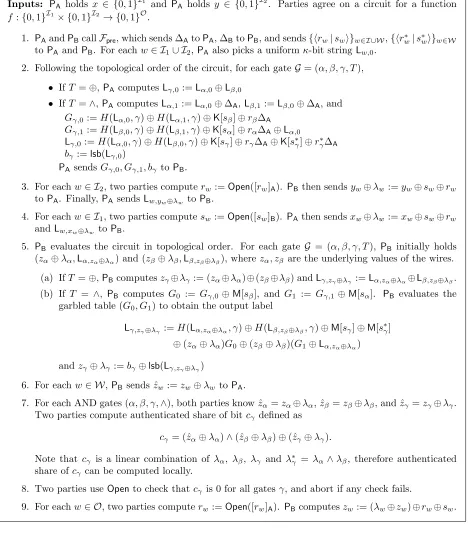
Protocol Π2pc
Inputs: PA holds x ∈ {0,1}
I1 and P
A holds y ∈ {0,1}
I2. Parties agree on a circuit for a function
f :{0,1}I1× {0,1}I2 → {0,1}O.
1. PAandPBcallFpre, which sends ∆AtoPA, ∆BtoPB, and sends{hrw|swi}w∈I∪W,{hr∗w|s∗wi}w∈W toPA andPB. For eachw∈ I1∪ I2,PA also picks a uniformκ-bit stringLw,0.
2. Following the topological order of the circuit, for each gateG= (α, β, γ, T),
• IfT =⊕,PA computesLγ,0:=Lα,0⊕Lβ,0
• IfT =∧,PA computesLα,1:=Lα,0⊕∆A,Lβ,1:=Lβ,0⊕∆A, and
Gγ,0:=H(Lα,0, γ)⊕H(Lα,1, γ)⊕K[sβ]⊕rβ∆A
Gγ,1:=H(Lβ,0, γ)⊕H(Lβ,1, γ)⊕K[sα]⊕rα∆A⊕Lα,0
Lγ,0:=H(Lα,0, γ)⊕H(Lβ,0, γ)⊕K[sγ]⊕rγ∆A⊕K[s∗γ]⊕r∗γ∆A
bγ :=lsb(Lγ,0)
PA sendsGγ,0, Gγ,1, bγ toPB.
3. For eachw∈ I2, two parties computerw:=Open([rw]A). PB then sendsyw⊕λw:=yw⊕sw⊕rw
toPA. Finally,PA sendsLw,yw⊕λw toPB.
4. For eachw∈ I1, two parties computesw:=Open([sw]B). PAthen sendsxw⊕λw:=xw⊕sw⊕rw
andLw,xw⊕λw to PB.
5. PB evaluates the circuit in topological order. For each gate G = (α, β, γ, T), PB initially holds
(zα⊕λα,Lα,zα⊕λα) and (zβ⊕λβ,Lβ,zβ⊕λβ), wherezα, zβ are the underlying values of the wires. (a) IfT =⊕,PB computeszγ⊕λγ := (zα⊕λα)⊕(zβ⊕λβ) andLγ,zγ⊕λγ :=Lα,zα⊕λα⊕Lβ,zβ⊕λβ. (b) If T = ∧, PB computesG0 := Gγ,0⊕M[sβ], and G1 := Gγ,1⊕M[sα]. PB evaluates the
garbled table (G0, G1) to obtain the output label
Lγ,zγ⊕λγ :=H(Lα,zα⊕λα, γ)⊕H(Lβ,zβ⊕λβ, γ)⊕M[sγ]⊕M[s ∗ γ] ⊕(zα⊕λα)G0⊕(zβ⊕λβ)(G1⊕Lα,zα⊕λα) andzγ⊕λγ:=bγ⊕lsb(Lγ,zγ⊕λγ)
6. For eachw∈ W,PB sends ˆzw:=zw⊕λw toPA.
7. For each AND gates (α, β, γ,∧), both parties know ˆzα=zα⊕λα, ˆzβ =zβ⊕λβ, and ˆzγ =zγ⊕λγ.
Two parties compute authenticated share of bitcγ defined as
cγ = (ˆzα⊕λα)∧(ˆzβ⊕λβ)⊕(ˆzγ⊕λγ).
Note that cγ is a linear combination of λα, λβ, λγ and λ∗γ = λα∧λβ, therefore authenticated
share ofcγ can be computed locally.
8. Two parties use Opento check thatcγ is 0 for all gatesγ, and abort if any check fails.
9. For eachw∈ O, two parties computerw:=Open([rw]A). PBcomputeszw:= (λw⊕zw)⊕rw⊕sw.
4
Technical Details: Improved Authenticated Garbling
Since we already discussed the main intuition of the protocol in the previous section, we will present our main protocol in the Fpre-hybrid model. Detailed protocol description is shown in Figure 3.
Each step in the protocol can be summarized as follows:
1. Parties generate circuit preprocessing information using Fpre.
2. PA computes its own share of the garbled circuit and sends toPB.
3-4. Parties process PA and PB’s input and let PB learn the corresponding masked input wire values and garbled labels.
5. PB locally reconstructs the garbled circuit and evaluates it.
6-8. PB sends all masked wire values (including all input, output, and internal wires) to PA; two
parties check the correctness of all masked wire values.
9. PA reveals the masks of output wires toPB, who can recover the output.
Note that steps 2 through 9 are performed in the online phase, with 2κ+ 2 bits of communication per AND gate,κ+ 1 bits of communication per input bit, and 1 bit of communication per output bit.
4.1 Proof of Security
We start by stating our main theorem.
Theorem 1. If H is modeled as a random oracle, the protocol in Figure 3 securely computes f
against malicious adversaries in the Fpre-hybrid model.
Before proceeding to the formal proof, we first introduce two important lemmas. The first lemma addresses correctness of our distributed garbling scheme in the semi-honest case; the second lemma addresses correctness of the whole protocol when PA is corrupted.
Lemma 1. When both parties follow the protocol honestly then, after step 5, for each wire w in the circuitPB holds (zw⊕λw,Lw,zw⊕λw).
Proof. We prove this by induction on the gates in the circuit.
Base case. It is easy to verify from step 3 and step 4 that the lemma holds for input wires.
Induction step. XOR-gates are trivial and so focus on an AND gate (α, β, γ,∧). First, the garbled tables are computed distributively, therefore we first write down the table afterPB merged
its own share as follows. Note that we ignore the gate id (γ) for simplicity.
G0 =H(Lα,0)⊕H(Lα,1)⊕K[sβ]⊕rβ∆A⊕M[sβ]
=H(Lα,0)⊕H(Lα,1)⊕λβ∆A
G1 =H(Lβ,0)⊕H(Lβ,1)⊕K[sα]⊕ra∆A⊕M[sα]⊕Lα,0
PA locally computes the output garbled label for 0 values, namelyLγ,0 as:
Lγ,0 :=H(Lα,0)⊕H(Lβ,0)⊕K[sγ]⊕rγ∆A⊕K[s∗γ]⊕r
∗
γ∆A.
PB, who holds (zα⊕λα,Lα,zα⊕λα) and (zβ⊕λβ,Lβ,zβ⊕λβ) by the induction hypothesis, evaluates the circuit as follows:
Lγ,zγ⊕λγ :=H(Lα,zα⊕λα)⊕H(Lβ,zβ⊕λβ)⊕(zα⊕λα)G0
⊕(zβ⊕λβ)(G1⊕Lα,zα⊕λα)⊕M[sγ]⊕M[s ∗
γ].
Observe that
(zα⊕λα)G0⊕H(Lα,zα⊕λα)
= (zα⊕λα) (H(Lα,0)⊕H(Lα,1)⊕λβ∆A)⊕H(Lα,zα⊕λα)
= (zα⊕λα) (H(Lα,0)⊕H(Lα,1)⊕λβ∆A)⊕(zα⊕λα) (H(Lα,0)⊕H(Lα,1))⊕H(Lα,0)
=H(Lα,0)⊕λβ(zα⊕λα)∆A,
and
(zβ⊕λβ)(G1⊕Lα,zα⊕λα)⊕H(Lβ,zβ⊕λβ)
= (zβ⊕λβ) (H(Lβ,0)⊕H(Lβ,1)⊕λα∆A⊕(zα⊕λα)∆A)⊕H(Lβ,zβ⊕λβ)
= (zβ⊕λβ) (H(Lβ,0)⊕H(Lβ,1)⊕zα∆A)⊕(zβ⊕λβ) (H(Lβ,0)⊕H(Lβ,1))⊕H(Lβ,0)
=H(Lβ,0)⊕(λβ⊕zβ)zα∆A.
Therefore, we conclude that
Lγ,0⊕Lγ,zγ⊕λγ
=H(Lα,0)⊕H(Lβ,0)⊕H(Lα,zα⊕λα)⊕H(Lβ,zβ⊕λβ)⊕(zα⊕λα)G0
⊕(zβ⊕λβ)(G1⊕Lα,zα⊕λα)⊕λγ∆A⊕(λα∧λβ)∆A
= (λα⊕zα)λβ∆A⊕(λβ⊕zβ)zα∆A⊕λγ∆A⊕(λα∧λβ)∆A
= ((zα∧zβ)⊕λγ)∆A = (zγ⊕λγ)∆A.
This means that, with respect to PA’s definition of Lγ,zγ⊕λγ, PB’s label is always correct. The masked value is correct because the least-significant bit of ∆A is 1; thus,
bγ⊕lsb(Lγ,zγ⊕λγ) =lsb(Lγ,0)⊕lsb(Lγ,zγ⊕λγ) =lsb(Lγ,0⊕Lγ,zγ⊕λγ)
=lsb((zγ⊕λγ)∆A) =zγ⊕λγ.
Lemma 2. Let x def= ˆxw ⊕λw and y def= ˆyw ⊕λw, where xˆw is what PB sends in step 3, yˆw is
Proof. After step 5, PB obtains a set of masked values zw⊕λw for all wires win the circuit. In the
following, we will show that if these masked values are not correct, thenPB will abort with all but
negligible probability.
Again we will prove by induction. Note that the lemma holds for all wiresw∈ I1∪I2, according to howx, y are defined, as well as for XOR-gates. In the following, we will focus on an AND gate (α, β, γ,∧). Now, according to induction hypothesis, we already know thatPB hold correct values of (zα⊕λα, zβ⊕λβ).
Recall that the checking is done by computing
c= (ˆzα⊕λα)∧(ˆzβ⊕λβ)⊕(ˆzγ⊕λγ).
The correctness of input masked values means that
c=zα∧zβ⊕zˆγ⊕λγ.
SinceOpendoes not abort,c= 0, which means that ˆzγ =zα∧zβ⊕λγ=zγ⊕λγ. This means that
the output masked wire value is also correct.
Given the above two lemmas, the proof of security of our main protocol is relatively easy. We provide all details below.
Proof. We consider separately a malicious PA and PB.
Malicious PA. Let A be an adversary corrupting PA. We construct a simulator S that runs A as a subroutine and plays the role of PA in the ideal world involving an ideal functionality F
evaluating f. S is defined as follows.
1. S plays the role of Fpre and records all values thatFpre sends to two parties.
2. S receives all values thatA sends.
3. S acts as an honestPB using inputy:= 0.
4. For each wirew∈ I1,S receives ˆxw and computesxw:= ˆxw⊕rw⊕sw, whererw, sw are the
values used by Fpre in the previous steps.
6. S picks random bits for all ˆzw and send them toA.
7–9. S acts as an honest PB If an honest PB would abort, S aborts; otherwise S computes the
input xof A. from the output of Fpre and the values A sent. S then sendsxtoF.
We show that the joint distribution of the outputs of A and the honest PB in the real world is indistinguishable from the joint distribution of the outputs of S and PB in the ideal world. We
prove this by considering a sequence of experiments, the first of which corresponds to the execution of our protocol and the last of which corresponds to execution in the ideal world, and showing that successive experiments are computationally indistinguishable.
Hybrid1. This is the hybrid-world protocol, where we imagine S playing the role of an honest
Hybrid2. Same asHybrid1, except that in step 6, for each wirew∈ I1 the simulatorSreceives
ˆ
xw and computesxw := ˆxw⊕rw⊕sw, whererw, sw are the values used by Fpre. If an honest PB would abort in any later step,S sendsabort toF; otherwise it sendsx={xw}w∈I1 toF.
The distributions on the view of A in Hybrid1 and Hybrid2 are identical. The output PB
gets are the same due to Lemma1 and Lemma2.
Hybrid3. Same asHybrid2, except that S usesy0 = 0 in step 3 and ignore whatA sends back. Then in step 6, S sends random bits instead of the value forzw⊕λw.
The distributions on the view ofA inHybrid3 and Hybrid2 are again identical (since the
{sw}w∈I2 are uniform).
Note thatHybrid3 corresponds to the ideal-world execution described earlier. This completes the proof for a maliciousPA.
Malicious PB. Let A be an adversary corrupting PB. We construct a simulator S that runs A as a subroutine and plays the role of PB in the ideal world involving an ideal functionality F
evaluating f. S is defined as follows.
1. S plays the role of Fpre and records all values sent to both parties.
2. S acts as an honestPA and send the shared garbled tables to PB.
3. For each wire w∈ I2,S receives ˆyw and computes yw := ˆyw⊕rw⊕sw, where rw, sw are the
values used by Fpre in the previous steps.
4. S acts as an honestPA using inputx= 0.
6–8. S acts as an honestPA. If an honest PA would abort,S abort.
9. S sendsy computed in step 3 to F, which returns z=f(x, y). S then computes z0 :=f(0, y) and definesr0w =zw⊕z0w⊕rw for eachw∈ O. S then acts as an honestPA and opens values
rw0 toA. If an honest PA would abort,S S outputs whateverA outputs.
We now show that the distribution on the view ofAin the real world is indistinguishable from the distribution on the view of A in the ideal world. (NotePA has no output.)
Hybrid1. This is the hybrid-world protocol, where S acts as an honest PA using PA’s actual
input x, while playing the role of Fpre.
Hybrid2. Same asHybrid1, except that in step 3,Sreceives ˆywand computesyw := ˆyw⊕rw⊕sw,
whererw, sw are the values used byFpre. If an honestPA abort in any step, sendaborttoF.
Hybrid3. Same asHybrid2, except that in step 4,S acts as an honest PA with inputx= 0. S
sends x computed in step 3 to F, which returns z =f(x, y). S then computes z0 :=f(0, y) and definesr0w =zw⊕z0w⊕rw for eachw∈ O. S then acts as an honestPA and opens values
rw0 toA. If an honest PA would abort,S S outputs whateverA outputs.
The distributions on the view of A inHybrid3 and Hybrid2 are identical.
Functionality FLand
Honest case:
1. Generate uniformhx1|x2i,hy1|y2i,hz1|z2isuch that z1⊕z2 = (x1⊕x2)∧(y1⊕y2), and send the respective shares to the two parties.
2. PA can choose to send (P1, p2, P3)∈ {0,1}κ× {0,1} × {0,1}κ. The functionality checks
P3⊕x2P1 = (p2⊕x2lsb(P1)) ∆B.
If the check fails, the functionality sends fail to both parties and abort. (PB can do the
same symmetrically.)
Corrupted parties: A corrupted party gets to specify the randomness used on its behalf by the functionality.
Figure 4: Functionality FLand for computing a leaky AND triple.
5
Technical Details: Improved Preprocessing
In this section, we provide details for our two optimizations of the preprocessing phase. The first optimization improves the efficiency to compute a leaky AND gate. Leaky AND gate is a key component towards a preprocessing with full security. This functionality (FLand) outputs triples
with guaranteed correctness but the adversary can choose to guess the x value from the honest party: an incorrect guess will be caught immediately; while a correct guess remain undetected.
The second optimization focuses on how to combine leaky triples in a more efficient way. In particular, we observe that a recent optimization in the honest-majority secret sharing protocol by Araki et al. [ABF+17], can be applied to our setting too. As a result, we can roughly reduce the bucket size by one.
5.1 Improved Leaky AND
Before giving the details, we point out a minor difference in the leaky-AND functionality (FLand)
as compared to [WRK17a]. As shown in Figure 4, instead of letting A directly learn the value ofx, the functionality allowsA to send a query in a form of (P1, p2, P3) and return ifP3⊕x2P1=
(p2⊕x2lsb(P1))∆B. It can be seen that this special way is no more than a query on x and two
queries on ∆, and the A cannot learn any information on y orz.
The main intuition of the protocol is already discussed in Section3.2. We will proceed to present the protocol, in Figure 5.
Theorem 2. The protocol in Figure 5 securely realizes FLand in the (Fabit,Feq)-hybrid model.
Proof. As the first step, we will show that the protocol is correct if both parties are honest. We recall that
ProtocolΠLand
Protocol:
1. PA and PB obtain random authenticated shares (hx1|x2i,hy1|y2i,hz1|ri).
PA locally computes CA :=y1∆A⊕K[y2]⊕M[y1], and PB locally computes CB :=y2∆B⊕M[y2]⊕K[y1].
2. PA sends G1:=H(K[x2]⊕∆A)⊕H(K[x2])⊕CA toPB. PB computes E1 :=x2G1⊕H(M[x2])⊕x2CB.
3. PB sends G2:=H(K[x1]⊕∆B)⊕H(K[x1])⊕CB toPA. PA computes E2 :=x1G2⊕H(M[x1])⊕x1CA.
4. PA computesS1 :=H(K[x2])⊕E2⊕(z1∆A⊕K[r]⊕M[z1]),PB computesS2 :=H(K[x1])⊕ E1⊕(r∆B⊕M[r]⊕K[z1]). PA sendslsb(S1) to PB;PB sends lsb(S2) to PA. Both parties
computes d:=lsb(S1)⊕lsb(S2).
5. PA sends L1 := S1 ⊕d∆A to Feq, PB sends L2 := S2 ⊕d∆B to Feq. If Feq returns 0,
parties abort, otherwise, they compute [z2]B := [r]B⊕d.
Figure 5: Our improved leaky-AND protocol.
2. G2:=H(K[x1]⊕∆B)⊕H(K[x1])⊕CB
3. CA:=y1∆A⊕K[y2]⊕M[y1]
4. CB:=y2∆B⊕M[y2]⊕K[y1]
Note that
E1⊕H(K[x2]) =x2G1⊕H(M[x2])⊕x2CB⊕H(K[x2]).
When x2 = 0, we have
E1⊕H(K[x2]) =x2G1⊕H(M[x2])⊕x2CB⊕H(K[x2])
=H(M[x2])⊕H(K[x2]) = 0 =x2(CA⊕CB).
When x2 = 1, we have
E1⊕H(K[x2]) =x2G1⊕H(M[x2])⊕x2CB⊕H(K[x2])
=x2(G1⊕CB)⊕H(M[x2])⊕H(K[x2])
=x2(G1⊕CB)⊕H(K[x2]⊕∆A))⊕H(K[x2])
=x2(CA⊕CB).
Therefore,
=x2(y1∆A⊕K[y2]⊕M[y1]⊕y2∆B⊕M[y2]⊕K[y1]))
=x2(y1∆A⊕y2∆A⊕y1∆B⊕y2∆B)
=x2(y1⊕y2)(∆A⊕∆B).
Similarly,
E2⊕H(K[x1]) =x1(y1⊕y2)(∆A⊕∆B).
Taking these two equations, we know that
S1⊕S2= (E1⊕H(K[x2]))⊕(E2⊕H(K[x1]))
⊕(z1∆A⊕K[r]⊕M[z1]⊕r∆B⊕M[r]⊕K[z1])
= (x1⊕x2)(y1⊕y2)(∆A⊕∆B)
⊕(z1∆A⊕K[z1]⊕M[z1]⊕r∆B⊕K[r]⊕M[r])
= (x1⊕x2)(y1⊕y2)(∆A⊕∆B) ⊕(z1∆A⊕z1∆B⊕r∆B⊕r∆A)
= (x1⊕x2)(y1⊕y2)(∆A⊕∆B)⊕(z1⊕r)(∆A⊕∆B)
= ((x1⊕x2)∧(y1⊕y2)⊕z1⊕r)(∆A⊕∆B).
Since lsb(∆A⊕∆B) = 1, it holds that
d=lsb(S1⊕S2) = (x1⊕x2)∧(y1⊕y2)⊕z1⊕r.
Therefore, (x1⊕x2)∧(y1⊕y2) =d⊕z1⊕r=z1⊕z2.
Now we will focus on the security of the protocol in the malicious setting. First note that the protocol is symmetric, therefore we only need to focus on the case of a malicious PA. The local
computation of both parties is deterministic, with all inputs sent fromFabit. Therefore, all messages sent during the protocol can be anticipated (emulated) bySafterSsending out the shares. This is not always possible ifA uses local random coins or if A has private inputs. This fact significantly reduces the difficulty of the proof. Intuitively, S will be able to immediately catch A cheating by comparing what it sends with what it would have sent (whichS knows by locally emulating). The majority of the work then is to extractA’s attempt to perform a selective failure attack.
Define a simulator S as follows.
0a. S interacts withFLand and obtainsPA’s share of (hx1|x2i,hy1|y2i,hz1|z2i). S also gets ∆A
fromFabit. S randomly picks ∆B andPB’s share of (hx1|x2i,hy1|y2i,hz1|z2i) in a way that
makes it consistent withPA’s share. Snow randomly picks dand computes [r]B:= [z2]B⊕d.
0b. Using values (hx1|x2i,hy1|y2i,hz1|ri) from both parties, S locally emulates all messages
sent by each party, namely (G1, d1, L1) sent by an honest PA and (G2, d2, L2) sent by an honest PB.
1. S plays the role of Fabit and sends out (hx1|x2i,hy1|y2i,hz1|ri) as defined above.
2. S acts as an honestPB and receiveG01 sent byA. S computes P1 =G01⊕G1.
3. S randomly picks a G2 and send it to A.
5. Splays the role ofFeqand obtainL1. ScomputesP3=L10 ⊕L1. Ssends (P1, p2, P3) toFLand
as the selective failure attack query. IfFLand abort, Splays the role ofFeq and aborts. If the valuedin the protocol equals tor defined in step 0a, Feq returns 0; otherwiseFeq returns 1.
6. S sends (P1, p2, P3) toFLand as the selective failure query. If FLand returnsfail,S sends 0 to A as the output of Feq.
Note that messages that S sends to A in the protocol are changed from (G2, d2, L2) to (G2, d2⊕
x2lsb(P1), L2⊕x2P1⊕d0∆B), whered0 =p2⊕x2·lsb(P1) and the equality checking in step 5 changed
from comparing L1 =L2 to
L1⊕P3 =L2⊕x2P1⊕(p2⊕x2lsb(P1)) ∆B,
that is
P3⊕x2P1 = (p2⊕x2lsb(P1)) ∆B.
This is the same form as the selective failure query in FLand.
5.2 Improved Function-Dependent Preprocessing
In this section, we will focus on improving the preprocessing in the Leaky AND triple generation (FLand) hybrid model. The main observation is that in the protocol of WRK, each wire is associated with a mask (in the authenticated share format). Then the AND of input masks are computed using one AND triple. This is a waste of randomness, since we also directly construct all triples in place for all wires. Note that the idea is similar to Araki et al. [ABF+17]. However, the downside is that this optimization requires number of roundtrips to be proportional to the circuit depth. Our online phase and function independent phase still stays constant-round.
6
Performance
In this section, we discuss the concrete efficiency of our protocol. We consider two variants of our protocol that optimize the cost of different phases: The first version of our protocol is optimized to minimize the total communication; the second version is optimized to minimize the communication in the function-dependent phase. (The cost of the online phase is identical in both versions.)
6.1 Communication Complexity
One-way Communication (Max) Two-way Communication
Ind. Dep. Online Total Ind. Dep. Online Total (MB) (MB) (KB) (MB) (MB) (MB) (KB) (MB)
Single execution
[NST17] 15 0.22 16 15 15 0.22 16 15
[WRK17a] 2.9 0.57 4.9 3.4 5.7 0.57 6.0 6.3 [HIV17] - 3.4 ≥4.9 3.4 - 3.4 ≥4.9 3.4
This work, v. 1 1.9 0.33 5.0 2.2 3.8 0.33 5.0 4.2 This work, v. 2 2.5 0.22 5.0 2.7 4.9 0.22 5.0 5.1
Amortized cost over 1024 executions
[RR16] - 1.6 17 1.6 - 3.2 17 3.2
[NST17] 6.4 0.22 16 6.6 6.4 0.22 16 6.6
[KNR+17] - 1.6 19 1.6 - 1.6 19 1.6
[WRK17a] 2.0 0.57 4.9 2.6 4.0 0.57 6.0 4.6 This work, v. 1 1.4 0.33 5.0 1.7 2.7 0.33 5.0 3.1 This work, v. 2 1.9 0.22 5.0 2.1 3.8 0.22 5.0 4.0
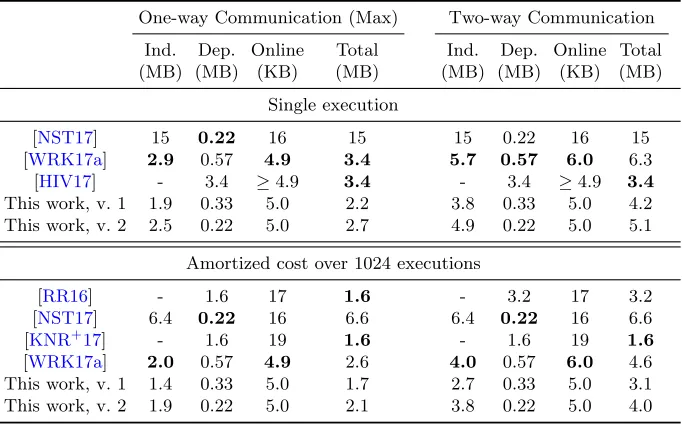
Table 2: Communication complexity of different protocols for evaluating AES, rounded to two significant figures. As in Table 1, one-way communication refers to the maximum communication one party sends to the other; two-way communication refers to the sum of both parties’ communication. The best prior number in each column is bolded for reference. Note that our work version 1 requires number of rounds proportional to the circuit depth in the function dependent phase.
We see that our protocol and the protocol by Nielsen et al. [NST17] are the only ones that, considering the function-dependent phase and the online phase, have cost similar to that of the state-of-the-art semi-honest garbled-circuit protocol. In other words, the overhead induced by malicious security can be completely pushed to the preprocessing stage. Compared to the protocol by Nielsen et al., we are able to reduce the communication in the preprocessing stage by 6×in the single-execution setting, and by 3.4×in the amortized setting. Our protocol also has the best total communication complexity in both settings, excepting the work of [RR16, KNR+17] which are 6% better but do not support function-independent preprocessing.
6.2 Computational Complexity
Since the WRK protocol represents the state-of-the-art as far as implementations are concerned, we compare the computational complexity of our protocol to theirs. We also include a comparison to the more recent protocol by Hazay et al. [HIV17] (the HIV protocol), which has not yet been implemented.
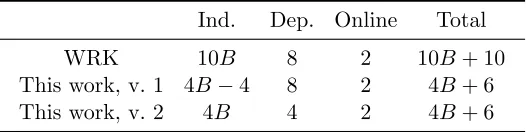
Comparing to the WRK protocol. Our protocol follows the same high-level approach as the WRK protocol. Almost all H-evaluations in our protocol can be accelerated using fixed-key AES, as done in [BHKR13]. We tabulate the number of H-evaluations for both protocols in Table 3. Due to our improved FLand, we are able to achieve a 2–2.5×improvement.
Ind. Dep. Online Total
WRK 10B 8 2 10B+ 10
This work, v. 1 4B−4 8 2 4B+ 6
This work, v. 2 4B 4 2 4B+ 6
Table 3: Number of H-evaluations. We align the security parameters in both protocols and set
B =ρ/logC+ 1 for a fair comparison. Note that our work version 1 requires number of rounds proportional to the circuit depth in the function dependent phase.
the MPC-based zero-knowledge proof by Ames et al. [AHIV17]. On the other hand, in our protocol, the computation is linear in the circuit size. Furthermore, almost all cryptographic operations in our protocol can be accelerated using hardware AES instructions.
Taking an AES circuit as example, the ZK protocol by Ames et al. for a circuit of that size has a prover running time of around 70 ms and a verifier running time of around 30 ms. Therefore, even if we ignore the cost of computing and sending the garbled circuit, the oblivious transfers, and other operations, the end-to-end running time of the HIV protocol will still be at least 100 ms. On the other hand, the entire WRK protocol runs within 17 ms for the same circuit. As our protocol results in at least a 2× improvement, our protocol will be at least an order of magnitude faster than the HIV protocol.
7
Challenges in Extending to the Multi-Party Case
Wang et al. [WRK17b] have also shown how to extend their authenticated-garbling protocol to the multi-party case. In this section, we discuss the challenges involved in applying our new techniques to that setting. Note that Ben-Efraim et al. [BE17] recently proposed new techniques for multi-party garbling, making it compatible with some of the half-gate optimizations. Despite being based on half-gates, they still require 4 garbled rows per AND gate, and thus their work still leaves open the question of reducing the communication complexity of the online phase in the multi-party case. In the multi-party WRK protocol, there are n−1 garbling parties and one evaluating party. For each wire, each garbler chooses their own set of wire labels (called “subkeys”). As in the 2-party case, the preprocessing defines some authenticated bits, and as a result all parties can locally compute additive shares ofany garbler’ssubkey corresponding to any authenticated value.
In each gate, each garbler Pi generates standard Yao garbled gate consisting of 4 rows. Each
row ofPi’s gate is encrypted by only Pi’s subkeys, and the payload of the row is Pi’s shares ofall
garblers’subkeys. That way, the evaluator can decrypt the correct row of everyone’s garbled gates, obtain everyone’s shares of everyone’s subkeys, and combine them to get everyone’s appropriate subkey for the output wire.
Now suppose we modify things so each garbler generates a half-gates-style garbled gate instead of a standard Yao garbled gate. The half-gate uses garblerPi’s subkeys as its “keys” and encodes
Pi’s shares of all subkeys as its “payloads”. Now the protocol may not be secure against an
adversary corrupting the evaluator and a garbler. In particular, half-gates garbling defines G0 =
H(Lα,0)⊕H(Lα,1)⊕λβ∆. WhenPiis acting as garbler, theseLα,uvalues correspond toPi’s subkeys.
Now supposePi colludes with the evaluator. If the evaluator comes to learnG0 (which is necessary
it is the only unknown term in G0. Clearly revealing the secret wire mask breaks the privacy of
the protocol. This is not a problem with Yao garbled gates, where each row can be written as
Gu,v =H(Lα,u,Lβ,v)⊕[payload already known to garbler]. The secret masks do not appear in the
garbled table, except indirectly through the payloads (subkey shares).
It is even unclear if row-reduction can be made possible. In the multi-party setting, the garbler has no control over the “payload” (i.e., output wire label) of the garbled gate when using row-reduction. Indeed, this is what makes it possible to reduce the size of a garbled gate. This is not a problem in the two-party case, where there is only one garbler who has control over all garbled gates and all wire labels. He generates a garbled table, and then computes his output wire label (subkey) as a function of the payload in the table. However, in the multi-party case,Pigenerates a
half-gate whose payloads includePi’s shares ofPj’s subkeys! We would needPj’s choice of subkeys
to depend on the payloads ofPi’s garbling (for alli and j!). It is not clear how this can be done,
and even if it were possible it would apparently require additional rounds proportional to the depth of the circuit.
Acknowledgments
This material is based on work supported by NSF awards #1111599, #1563722, #1564088, and #1617197. Portions of this work were also supported by DARPA and SPAWAR under contract N66001-15-C-4065. The U.S. Government is authorized to reproduce and distribute reprints for Governmental purposes not withstanding any copyright notation thereon. The views, opinions, and/or findings expressed are those of the authors and should not be interpreted as representing the official views or policies of the Department of Defense or the U.S. Government. The authors would like to thank Ruiyu Zhu for his helpful comments, and to thank Zhicong Huang and Cheng Hong for pointing out that the first version cannot be done within constant number of rounds.
References
[ABF+17] Toshinori Araki, Assi Barak, Jun Furukawa, Tamar Lichter, Yehuda Lindell, Ariel Nof, Kazuma Ohara, Adi Watzman, and Or Weinstein. Optimized honest-majority MPC for malicious adversaries - breaking the 1 billion-gate per second barrier. In2017 IEEE Symposium on Security and Privacy, pages 843–862, San Jose, CA, USA, May 22–26, 2017. IEEE Computer Society Press.
[AHIV17] Scott Ames, Carmit Hazay, Yuval Ishai, and Muthuramakrishnan Venkitasubrama-niam. Ligero: Lightweight sublinear arguments without a trusted setup. InACM CCS 17, pages 2087–2104. ACM Press, 2017.
[AMPR14] Arash Afshar, Payman Mohassel, Benny Pinkas, and Ben Riva. Non-interactive secure computation based on cut-and-choose. In Phong Q. Nguyen and Elisabeth Oswald, editors,EUROCRYPT 2014, volume 8441 ofLNCS, pages 387–404, Copenhagen, Den-mark, May 11–15, 2014. Springer, Heidelberg, Germany.
[Bea92] Donald Beaver. Efficient multiparty protocols using circuit randomization. In Joan Feigenbaum, editor,CRYPTO’91, volume 576 ofLNCS, pages 420–432, Santa Barbara, CA, USA, August 11–15, 1992. Springer, Heidelberg, Germany.
[BHKR13] Mihir Bellare, Viet Tung Hoang, Sriram Keelveedhi, and Phillip Rogaway. Efficient garbling from a fixed-key blockcipher. In2013 IEEE Symposium on Security and Pri-vacy, pages 478–492, Berkeley, CA, USA, May 19–22, 2013. IEEE Computer Society Press.
[BMR90] Donald Beaver, Silvio Micali, and Phillip Rogaway. The round complexity of secure protocols. In Proceedings of the twenty-second annual ACM symposium on Theory of computing, pages 503–513. ACM, 1990.
[Bra13] Lu´ıs T. A. N. Brand˜ao. Secure two-party computation with reusable bit-commitments, via a cut-and-choose with forge-and-lose technique - (extended abstract). In Kazue Sako and Palash Sarkar, editors, ASIACRYPT 2013, Part II, volume 8270 of LNCS, pages 441–463, Bengalore, India, December 1–5, 2013. Springer, Heidelberg, Germany.
[DPSZ12] Ivan Damg˚ard, Valerio Pastro, Nigel P. Smart, and Sarah Zakarias. Multiparty com-putation from somewhat homomorphic encryption. In Reihaneh Safavi-Naini and Ran Canetti, editors,CRYPTO 2012, volume 7417 ofLNCS, pages 643–662, Santa Barbara, CA, USA, August 19–23, 2012. Springer, Heidelberg, Germany.
[FJN+13] Tore Kasper Frederiksen, Thomas Pelle Jakobsen, Jesper Buus Nielsen, Peter Sebastian Nordholt, and Claudio Orlandi. MiniLEGO: Efficient secure two-party computation from general assumptions. In Thomas Johansson and Phong Q. Nguyen, editors, EU-ROCRYPT 2013, volume 7881 of LNCS, pages 537–556, Athens, Greece, May 26–30, 2013. Springer, Heidelberg, Germany.
[GLNP15] Shay Gueron, Yehuda Lindell, Ariel Nof, and Benny Pinkas. Fast garbling of circuits under standard assumptions. In Indrajit Ray, Ninghui Li, and Christopher Kruegel:, editors,ACM CCS 15, pages 567–578, Denver, CO, USA, October 12–16, 2015. ACM Press.
[HEKM11] Yan Huang, David Evans, Jonathan Katz, and Lior Malka. Faster secure two-party computation using garbled circuits. InUSENIX Security 2011, 2011.
[HIV17] Carmit Hazay, Yuval Ishai, and Muthuramakrishnan Venkitasubramaniam. Actively secure garbled circuits with constant communication overhead in the plain model. In TCC 2017, Part II, LNCS, pages 3–39. Springer, Heidelberg, Germany, March 2017.
[HKE13] Yan Huang, Jonathan Katz, and David Evans. Efficient secure two-party computa-tion using symmetric cut-and-choose. In Ran Canetti and Juan A. Garay, editors, CRYPTO 2013, Part II, volume 8043 of LNCS, pages 18–35, Santa Barbara, CA, USA, August 18–22, 2013. Springer, Heidelberg, Germany.
[IKNP03] Yuval Ishai, Joe Kilian, Kobbi Nissim, and Erez Petrank. Extending oblivious transfers efficiently. In Dan Boneh, editor,CRYPTO 2003, volume 2729 ofLNCS, pages 145–161, Santa Barbara, CA, USA, August 17–21, 2003. Springer, Heidelberg, Germany.
[KMR14] Vladimir Kolesnikov, Payman Mohassel, and Mike Rosulek. FleXOR: Flexible garbling for XOR gates that beats free-XOR. In Juan A. Garay and Rosario Gennaro, editors, CRYPTO 2014, Part II, volume 8617 of LNCS, pages 440–457, Santa Barbara, CA, USA, August 17–21, 2014. Springer, Heidelberg, Germany.
[KNR+17] Vladimir Kolesnikov, Jesper Buus Nielsen, Mike Rosulek, Ni Trieu, and Roberto Tri-filetti. DUPLO: Unifying cut-and-choose for garbled circuits. In ACM CCS 17, pages 3–20. ACM Press, 2017.
[KS08] Vladimir Kolesnikov and Thomas Schneider. Improved garbled circuit: Free XOR gates and applications. In Luca Aceto, Ivan Damg˚ard, Leslie Ann Goldberg, Magn´us M. Halld´orsson, Anna Ing´olfsd´ottir, and Igor Walukiewicz, editors, ICALP, Part II, vol-ume 5126 of LNCS, pages 486–498, Reykjavik, Iceland, July 7–11, 2008. Springer, Heidelberg, Germany.
[KSS12] Benjamin Kreuter, Abhi Shelat, and Chih-Hao Shen. Billion-gate secure computation with malicious adversaries. In USENIX Security 2012, 2012.
[Lin13] Yehuda Lindell. Fast cut-and-choose based protocols for malicious and covert adver-saries. In Ran Canetti and Juan A. Garay, editors, CRYPTO 2013, Part II, volume 8043 of LNCS, pages 1–17, Santa Barbara, CA, USA, August 18–22, 2013. Springer, Heidelberg, Germany.
[LP07] Yehuda Lindell and Benny Pinkas. An efficient protocol for secure two-party computa-tion in the presence of malicious adversaries. In Moni Naor, editor,EUROCRYPT 2007, volume 4515 ofLNCS, pages 52–78, Barcelona, Spain, May 20–24, 2007. Springer, Hei-delberg, Germany.
[LP11] Yehuda Lindell and Benny Pinkas. Secure two-party computation via cut-and-choose oblivious transfer. In Yuval Ishai, editor, TCC 2011, volume 6597 of LNCS, pages 329–346, Providence, RI, USA, March 28–30, 2011. Springer, Heidelberg, Germany.
[LR14] Yehuda Lindell and Ben Riva. Cut-and-choose Yao-based secure computation in the online/offline and batch settings. In Juan A. Garay and Rosario Gennaro, editors, CRYPTO 2014, Part II, volume 8617 of LNCS, pages 476–494, Santa Barbara, CA, USA, August 17–21, 2014. Springer, Heidelberg, Germany.
[LR15] Yehuda Lindell and Ben Riva. Blazing fast 2PC in the offline/online setting with secu-rity for malicious adversaries. In Indrajit Ray, Ninghui Li, and Christopher Kruegel:, editors,ACM CCS 15, pages 579–590, Denver, CO, USA, October 12–16, 2015. ACM Press.
[NNOB12] Jesper Buus Nielsen, Peter Sebastian Nordholt, Claudio Orlandi, and Sai Sheshank Burra. A new approach to practical active-secure two-party computation. In Rei-haneh Safavi-Naini and Ran Canetti, editors, CRYPTO 2012, volume 7417 of LNCS, pages 681–700, Santa Barbara, CA, USA, August 19–23, 2012. Springer, Heidelberg, Germany.
[NO09] Jesper Buus Nielsen and Claudio Orlandi. LEGO for two-party secure computation. In Omer Reingold, editor,TCC 2009, volume 5444 ofLNCS, pages 368–386. Springer, Heidelberg, Germany, March 15–17, 2009.
[NO16] Jesper Buus Nielsen and Claudio Orlandi. Cross and clean: Amortized garbled circuits with constant overhead. In Martin Hirt and Adam D. Smith, editors, TCC 2016-B, Part I, volume 9985 ofLNCS, pages 582–603, Beijing, China, October 31 – November 3, 2016. Springer, Heidelberg, Germany.
[NPS99] Moni Naor, Benny Pinkas, and Reuban Sumner. Privacy preserving auctions and mech-anism design. In1st ACM Conference on Electronic Commerce, 1999.
[NST17] Jesper Nielsen, Thomas Schneider, and Roberto Trifiletti. Constant-round maliciously secure 2PC with function-independent preprocessing using LEGO. In Network and Distributed System Security Symposium (NDSS), 2017.
[PSSW09] Benny Pinkas, Thomas Schneider, Nigel P. Smart, and Stephen C. Williams. Secure two-party computation is practical. In Mitsuru Matsui, editor, ASIACRYPT 2009, volume 5912 ofLNCS, pages 250–267, Tokyo, Japan, December 6–10, 2009. Springer, Heidelberg, Germany.
[RR16] Peter Rindal and Mike Rosulek. Faster malicious 2-party secure computation with online/offline dual execution. InUSENIX Security 2016, 2016.
[SS11] Abhi Shelat and Chih-Hao Shen. Two-output secure computation with malicious ad-versaries. In Kenneth G. Paterson, editor,EUROCRYPT 2011, volume 6632 ofLNCS, pages 386–405, Tallinn, Estonia, May 15–19, 2011. Springer, Heidelberg, Germany.
[SS13] Abhi Shelat and Chih-Hao Shen. Fast two-party secure computation with minimal assumptions. In Ahmad-Reza Sadeghi, Virgil D. Gligor, and Moti Yung, editors,ACM CCS 13, pages 523–534, Berlin, Germany, November 4–8, 2013. ACM Press.
[WMK17] Xiao Wang, Alex J. Malozemoff, and Jonathan Katz. Faster secure two-party computa-tion in the single-execucomputa-tion setting. In Jean-S´ebastien Coron and Jesper Buus Nielsen, editors, EUROCRYPT 2017, Part II, volume 10211 of LNCS, pages 399–424, Paris, France, May 8–12, 2017. Springer, Heidelberg, Germany.
[WRK17a] Xiao Wang, Samuel Ranellucci, and Jonathan Katz. Authenticated garbling and effi-cient maliciously secure two-party computation. InACM CCS 17, pages 21–37. ACM Press, 2017.
[Yao86] Andrew Chi-Chih Yao. How to generate and exchange secrets (extended abstract). In27th FOCS, pages 162–167, Toronto, Ontario, Canada, October 27–29, 1986. IEEE Computer Society Press.
[ZH17] Ruiyu Zhu and Yan Huang. JIMU: Faster LEGO-based secure computation using additive homomorphic hashes. In ASIACRYPT 2017, Part II, LNCS, pages 529–572. Springer, Heidelberg, Germany, December 2017.