weak keys with practical key recovery
Stanislav Bulygin1,2 and Michael Walter1
1
Center for Advanced Security Research Darmstadt - CASED Mornewegstraße 32, 64293 Darmstadt, Germany
2 Technische Universit¨at Darmstadt, Department of Computer Science
Hochschulstraße 10, 64289 Darmstadt, Germany [email protected]
Abstract. In this paper we investigate the invariant property of PRINTcipher first discovered by Leanderet al. in their CRYPTO 2011 paper. We provide a thorough study and show that there exist 64 families of weak keys for PRINTcipher–48 and many more for PRINTcipher–96. Moreover, we show that searching the weak key space may be substantially sped up by splitting the search into two consecutive steps. We show that for many classes of weak keys key recovery can be done in a matter of minutes in the chosen/known plaintext scenario. In fact, at least 245 weak keys can be recovered in less than 20 minutes on a single PC using only a few chosen and one known plaintext(s). We provide detailed treatment of the methods and put them in a more general context that opens new interesting directions of research for PRESENT-like ciphers.
Keywords: PRINTcipher, invariant coset attack, mixed integer linear programming, weak keys, chosen plaintext attack, key recovery
1 Introduction
Lightweight cryptography gained its importance due to emergence of many applications that involve using small and resource constraint devices like RFID tags, smart cards, and sensors. Conventional cryptographic algorithms turned out to be too massive to be implemented on such devices. Therefore the need for new cryptographic primitives arose in the community. In particular, the whole arsenal of lightweight block ciphers has been developed in recent years to satisfy the needs for secure usage of small devices. The block cipher PRESENT is one outstanding example that gained popularity [1]. Other block ciphers, such as KATAN and KTANTAN family [2], LED block cipher [3] and many others were presented recently. Following the design principle of PRESENT, several block ciphers with even more lightweight structure have been proposed. PRINTcipher [4] and EPCBC [5] are immediate examples, as well as SPONGENT hash family [6].
able to break more than 23 of PRINTcipher’s rounds1.
At CRYPTO 2011 Leander et al. proposed a very powerful attack, which they called the
invariant coset attack [12]. Using this attack it is possible to break the full PRINTcipher (both the 48- and the 96-bit versions) for a large portion of weak keys using only a few chosen plaintexts. Note, however, that despite the fact that distinguishing a weak key can be done in unit time, the complete key recovery still is a challenging task in practice (see specific figures in Section 3.4). The authors of [12] presented two families of weak keys for PRINTcipher–48, each having 251 keys as well as two families for PRINTcipher–96.
This paper has initially been motivated by the problem of finding optimal propagations of known bits to facilitate algebraic attacks using e.g. SAT-solvers following the ideas of [10]. With the methods employed, however, we ended up providing a thorough study of the in-variant coset attack. In particular, we were able to recover all 64 families of weak keys for PRINTcipher–48. The same method can be applied to PRINTcipher–96 as well. We observed that among the found 64 families, many families are composed of weak keys that can be recovered in a matter of minutes on a single PC. Thus we provide a key recovery for many weak keys that can be done very efficiently for a cipher that is otherwise quite secure. Follow-ing [12] we analyze protectFollow-ing techniques against the attack and show that the situation for PRINTcipher–96 is not obvious. Nevertheless, it is still possible to counter the attacks quite easily. Summing up, in this paper we provide a complete study of the invariant coset attack of [12] with methods that have value on their own and potentially can be employed to obtain interesting results on other similar ciphers.
The outline of the paper is as follows. In Section 2 we briefly recall the definition of PRINTci-pher and outline its properties that are relevant for the further exposition; we also recall the attack of [12]. Section 3 presents methods of obtaining and using invariant cosets (or invari-ant projected subsets as we call them). Section 3.1 presents the general background, as well as the first methods to find invariant projected subsets. Section 3.2 develops the idea further and proposes an alternative method based on Mixed Integer Linear Programming that turns out to be highly efficient in practice. Section 3.3 summarizes the results for PRINTcipher–48 obtained by our methods, listing all invariant projected subsets (theirdefining setsto be pre-cise), computing the number of the corresponding weak keys in each class and complexity of key recovery, protecting measures, and outlining results for PRINTcipher–96. Section 3.4 is explicitly considering the situation when the weak key recovery is particularly fast, providing specific figures that estimate practical key recovery using only very moderate computational resources. Finally, Section 4 presents a retrospective of the proposed methods and puts them in a more general context providing possible further directions for research.
2 The block cipher PRINTcipher
2.1 Description of the cipher
PRINTcipher [4] is a substitution-permutation network, which design is largely inspired by the block cipher PRESENT [1]. The main differences to PRESENT is the absence of the key schedule (all round keys are the same and are equal to the master key) and key-dependent S-Boxes. PRINTcipher comes in two variations: PRINTcipher-48 encrypts 48-bits blocks with an 80-bit key and has 48 rounds, PRINTcipher-96 encrypts 96-bit blocks with a 160-bit key
1 The best attack of [9] can break 31 out of 48 rounds of PRINTcipher–48 for the fraction of 0.036% of keys
and has 96 rounds. Here we present a short overview of the cipher, referring the reader to [4] for a more detailed description and analysis.
The encryption process of PRINTcipher–𝑛for𝑛= 48,96 is organized as in Algorithm 1.
Algorithm 1Encryption function of PRINTcipher–𝑛
Require:
-𝑛-bit plaintext𝑝 - 5
3𝑛-bit key𝑘= (𝑠𝑘1, 𝑠𝑘2), where𝑠𝑘1 is𝑛bits and𝑠𝑘2 is 2 3𝑛bits Ensure: 𝑛-bit ciphertext𝑐
Begin 𝑠𝑡𝑎𝑡𝑒:=𝑝
for𝑖= 1, . . . , 𝑛do
𝑠𝑡𝑎𝑡𝑒:=𝑠𝑡𝑎𝑡𝑒⊕𝑠𝑘1
𝑠𝑡𝑎𝑡𝑒:=𝑃 𝑒𝑟𝑚(𝑠𝑡𝑎𝑡𝑒) 𝑠𝑡𝑎𝑡𝑒:=𝑠𝑡𝑎𝑡𝑒⊕𝑅𝐶𝑖
𝑠𝑡𝑎𝑡𝑒:=𝑆𝐵𝑂𝑋(𝑠𝑡𝑎𝑡𝑒, 𝑠𝑘2) end for
𝑐:=𝑠𝑡𝑎𝑡𝑒
return 𝑐 End
Some comments to Algorithm 1 follow. The linear diffusion layer𝑃 𝑒𝑟𝑚implements a bit permutation similar to PRESENT and is given by the map𝑃:
𝑃(𝑖) =
{
3𝑖 mod𝑛−1 for 0≤𝑖≤𝑛−2,
𝑛−1 for𝑖=𝑛−1, (1)
so that the 𝑖−th bit of the state is moved to the position 𝑃(𝑖). The round counter 𝑅𝐶𝑖 for
𝑖 = 1, . . . , 𝑛 is a 6-bit binary representation of 𝑖 that is placed in the last two triplets. The S-Box layer 𝑆𝐵𝑂𝑋 is a layer of 𝑛/3 3-bit S-Boxes, where each S-Box is chosen according to the value of the two corresponding bits of the subkey 𝑠𝑘2. Therewith, there are 4 possible
S-Boxes at each position called 𝑉0, 𝑉1, 𝑉2, 𝑉3 in [4]. One may also consider such an S-Box as
a composition of a key dependent bit permutation that acts on groups of three bits and then followed by the layer of fixed S-Boxes, each one being a 3-bit S-Box with the truth table as in Table 1. This S-Box, called 𝑉0 in [4], is preceded by a key-dependent permutation defined by
Table 2. In Table 2 the three input bits are permuted according to the two consecutive key bits from the subkey𝑠𝑘2 called𝑎0 and𝑎1. Figure 1 provides an illustration for one encryption
round of PRINTcipher-48.
Table 1.Truth table for the S-Box𝑉0.
𝑥 0 1 2 3 4 5 6 7
𝑆[𝑥] 0 1 3 6 7 4 5 2
Table 2.Key depended permutation
𝑎1𝑎0 Permutation
0 0 (0,1,2) 0 1 (0,2,1) 1 0 (1,0,2) 1 1 (2,1,0)
xorsk1
xorrc𝑖
S S S S S S S S S S S S S S S S
𝑝 𝑝 𝑝 𝑝 𝑝 𝑝 𝑝 𝑝 𝑝 𝑝 𝑝 𝑝 𝑝 𝑝 𝑝 𝑝
Fig. 1.Round function of PRINTcipher-48, cf. Figure 1 of [4].
not (−). For example, the first row says that if we have a mask where the first two bits of both input and output to a keyed S-Box are known, then both S-Boxes with𝑎0 = 0 satisfy
the mask. Moreover, the two known output bits of the mask, as well as the two input bits, must be 0. Table 3 plays an important role in studying the invariant coset attack of [12].
Table 3.1-masks for PRINTcipher S-Boxes
Input mask Output mask Values of (𝑎0, 𝑎1) log(# valid a-pairs) input values output values
+ +− + +− 0* 1 00* 00*
+ +− +−+ 10 0 10* 1*1
+ +− −+ + 11 0 11* *10
+−+ + +− 10 0 0*0 00*
+−+ +−+ 𝑎0=𝑎1 1 0*1 or 1*0 1*1
+−+ −+ + 01 0 1*1 *10
−+ + + +− 11 0 *00 00*
−+ + +−+ 01 0 *10 1*1
−+ + −+ + *0 1 *11 *10
2.2 Invariant coset attack of Leander et al.
In their work [12] Leanderet al.showed that for PRINTcipher there exist subsets of plaintexts which, when encrypted with keys from certain other subsets, end up in the same subset. Thus they showed an invariant property for PRINTcipher under certain weak keys. The subsets they presented are of quite special form: they are linear cosets. The invariant coset for the plaintexts is of the form 𝑈 +𝑑 for some linear subspace 𝑈 ≤ 𝔽𝑛2 and some vector 𝑑 ∈ 𝔽𝑛2;
the weak keys are from the coset 𝑈 +𝑐+𝑑 for some other vector 𝑐 ∈𝔽𝑛
are linear subspaces of a special kind. Namely, they are linear subspaces where all vectors have the value 0 at certain positions. The vectors 𝑐 and 𝑑 then “adjust” the zeros, so that the invariant property holds. The authors of [12] show that distinguishing the weak keys so obtained can be done using only a few chosen plaintexts, thus presenting a powerful attack. In theinvariant coset attack they heavily use the property of 1-masks presented in Table 3. In [12] two families of weak keys for PRINTcipher–48 are presented, both having 251 weak keys. In this paper we study the invariant coset attack further exploiting many more new families of weak keys.
3 Obtaining and using invariant projected subsets
In this section we describe methods of obtaining all invariant cosets for both versions of PRINTcipher. These invariant cosets are of the same type as in [12], i.e. we only consider cosets that are described by the “projection” equations specifying values of vectors at certain positions. In Section 3.1 we present the first method based on orbits ofℤ𝑛under the
permuta-tion𝛱𝑠𝑘2 =𝑃∘𝜋𝑠𝑘2 for some permutation key𝑠𝑘2. In Section 3.2 we suggest another method
that is based on describing invariant cosets via polytopes in ℤ𝑛 and show its connection to
the previous method. In Section 3.3 we provide specific results, presenting all defining sets of invariant projected subsets and the corresponding weak key classes for PRINTcipher–48 and outlining results for PRINTcipher–96. We provide the number of elements in each class, thus providing an estimate on the overall number of weak keys. We also provide complexity of the key recovery for each class. In Section 3.4 we show that for a considerable number of keys, the key recovery can be done in practical time using only very modest computational resources.
3.1 Invariant projected sets via orbits
In this subsection we investigate the structure of invariant cosets of PRINTcipher from the point of view of orbits under the action of the augmented permutation layer𝛱𝑠𝑘2.
Let 𝑛 ∈ {48,96} be the block size and 𝑙 ∈ {80,160} be the key size of PRINTcipher-𝑛. Next, let 𝑃 be the bit permutation defined by (1) and let𝜋𝑠𝑘2 be a permutation defined as
a concatenation of permutations of bit triplets according to the permutation key𝑠𝑘2 ∈𝔽𝑙−𝑛2 .
Then 𝛱𝑠𝑘2 = 𝑃 ∘𝜋𝑠𝑘2 is the augmented permutation. So now the S-Box layer 𝑆 does not
depend on the key. Note that we will often be interested in the augmented permutation𝛱𝑠𝑘2
rather than the augmented linear map𝑃∘𝑅𝐶𝑖∘𝜋𝑠𝑘2, since the round counter will not affect
positions our subsets are projected on. We do a distinction, though, when the role of 𝑅𝐶𝑖 is
important.
Now, let𝑆𝑛 be the symmetric group defined on𝑛elements. Obviously𝛱𝑠𝑘2 ∈𝑆𝑛, i.e.𝛱𝑠𝑘2 is
a permutation of the 𝑛 positions in a block. It is a well-known fact that each element of 𝑆𝑛
is a product of disjoint cycles and such a product is unique up to permutation of its factors. Recall that a cycle is a permutation of the form (𝑖1. . . 𝑖𝑡) for some 0≤𝑖1 <⋅ ⋅ ⋅< 𝑖𝑡≤𝑛−1,
i.e.𝑖1 gets permuted to𝑖2,𝑖2to𝑖3and so on, and𝑖𝑡permutes to𝑖1; other elements stay intact.
Definition 1. Let 𝑠𝑘2 ∈𝔽𝑙−𝑛2 and 𝑎∈ ℤ𝑛, then an orbit of 𝑎 w.r.t 𝑠𝑘2 is a subset 𝑂𝑎𝑠𝑘2 :=
{𝑖∈ℤ𝑛∣∃𝑗 ≥0 :𝑖=𝛱𝑠𝑘2(𝑗)(𝑎)} ⊂ℤ𝑛. Here 𝛱𝑠𝑘2(𝑗)(𝑎) :=𝛱𝑠𝑘2(. . . 𝛱𝑠𝑘2(𝑎). . .) is the composition
of 𝛱𝑠𝑘2 𝑗 times.
We have a natural correspondence between the cycles in the representation of 𝛱𝑠𝑘2 and
𝑂𝑠𝑘2𝑖𝑡 is the orbit of 𝑖1 (as well as of𝑖2, . . . , 𝑖𝑡) w.r.t 𝑠𝑘2.
Next we define the type of subsets we will be dealing with. Definition 2. A projected subset 𝑈 ⊂𝔽𝑛
2 is defined as
𝑈 :={𝑢= (𝑢0, . . . , 𝑢𝑛−1)∈𝔽𝑛2∣𝑢𝑖1 =𝑎1, . . . , 𝑢𝑖𝑡 =𝑎𝑡 for some 𝑡≥0 and
0≤𝑖1<⋅ ⋅ ⋅< 𝑖𝑡≤𝑛−1 and some 𝑎= (𝑎1, . . . , 𝑎𝑡)∈𝔽𝑡2}.
We define defU to be the subset of indexes 𝑖1, . . . , 𝑖𝑡 with the above property and for such
a subset we define a vector 𝑣𝑎𝑙𝑈 ∈ (𝔽2 ∪ {′∗′})𝑛 as follows: 𝑣𝑎𝑙𝑈[𝑖𝑗] = 𝑎𝑗,1 ≤ 𝑗 ≤ 𝑡 and
𝑣𝑎𝑙𝑈[𝑖] =′ ∗′, 𝑖∈ℤ𝑛∖𝑑𝑒𝑓𝑈. We call defU the defining set of 𝑈.
Definition 3. Let 𝑉 ⊂ ℤ𝑛 with 𝑛 divisible by 3, then 𝑉 is a ¯1−subset iff ∀ 0 ≤𝑗 < 𝑛/3 : ∣{3𝑗,3𝑗+ 1,3𝑗+ 2} ∩𝑉∣ ∕= 1.
The above definition calls a subset of positions a ¯1−subset iff in each consecutive triplet of positions there are 0, 2, or 3 elements from that subset.
Definition 4. Let 𝑈 be a projected subset with the defining set defU. For𝑠∈ {2,3} define
𝑈𝑠:=
∪
0≤𝑗<𝑛/3 ∣{3𝑗,3𝑗+1,3𝑗+2}∩defU∣=𝑠
[
{3𝑗,3𝑗+ 1,3𝑗+ 2} ∩defU ]
.
Now let𝐸𝑠𝑘1,𝑠𝑘2,𝑖=𝑋𝑂𝑅𝑠𝑘1∘𝑃∘𝑅𝐶𝑖∘𝜋𝑠𝑘2∘𝑆 be the round function of PRINTcipher-𝑛for
the round 1≤𝑖≤𝑛.
The next proposition collects properties of projected subsets, in case they define invariant cosets for PRINTcipher.
Theorem 1. If 𝐸𝑠𝑘1,𝑠𝑘2,𝑖(𝑈) =𝑈 for all 1≤𝑖≤𝑛 for some 𝑠𝑘1 ∈𝔽𝑛2, 𝑠𝑘2 ∈𝔽𝑙−𝑛2 and some
projected subset𝑈 ⊂𝔽𝑛 2, then:
a. 𝛱𝑠𝑘2(defU) =defU;
b. defU ∩ {𝑛−6, 𝑛−5, . . . , 𝑛−1}=⊘;
c. defU is a union of orbits w.r.t 𝑠𝑘2;
d. Both defU and𝑃(defU)are¯1-subsets such that∀0≤𝑗 < 𝑛/3 :∣{3𝑗,3𝑗+1,3𝑗+2}∩defU∣=
∣{3𝑗,3𝑗+ 1,3𝑗+ 2} ∩𝑃(defU)∣.
Proof. a. We have𝑋𝑂𝑅𝑠𝑘1(𝑈) =𝑉, where𝑉 is also a projected subset withdef(𝑉) =defU.
Next, (𝑃∘𝑅𝐶𝑖∘𝜋𝑠𝑘2)(𝑉) =𝑊, where𝑊 is again projected withdef(𝑊) =𝛱𝑠𝑘2(def(𝑉)) =
𝛱𝑠𝑘2(defU). Finally, we have at the end of the round𝑖that𝑈′ =𝑆(𝑊), which can be written
as
(𝑈0′, . . . , 𝑈𝑛/3−1′ ) = (𝑆(𝑊0), . . . , 𝑆(𝑊𝑛/3−1)),
by dividing the state into groups of three bits and applying the S-Box𝑆(=𝑉0, see Section 2)
to each triplet. Now note that since𝑊 is projected, so is 𝑊𝑖 ⊂𝔽32 for each𝑖. Also we know
that we must have𝑈′ =𝑈 and so𝑈′ as well as all 𝑈𝑖′ are projected. So the question is now, under which conditions does the S-Box𝑆 map a projected subset of𝔽32 to a projected subset.
Note that𝑆 is now the “keyless” S-Box 𝑉0 with the truth table as in Table 1 that is defined
by𝑎0 =𝑎1 = 0. Moreover, observe that for 𝑆 only the 1-masks
are possible, see rows 1, 5, 9 of Table 3. Now, obviously,𝔽32 is mapped to𝔽32 and it is projected.
Since there are no other 1-masks for𝑆 and no 2-masks, we conclude thatdef(𝑈𝑖′) =def(𝑊𝑖)
for all 𝑖. Therewith, defU =def(𝑈′) =def(𝑊) =𝛱𝑠𝑘2(defU) as claimed.
b. Assume there exists𝑗 ∈ {𝑛−6, . . . , 𝑛−1} ∩defU. So𝑗 is an output position to one of the
last two S-Boxes. Note that the value valU[𝑗] is fixed due to the invariant property. Next,𝑗
belongs to some def(𝑈ℎ′) forℎ either𝑛/3−2 or𝑛/3−1. In case∣def(𝑈ℎ′)∣= 2 we know that the input of a 1-mask is defined by the output. This is impossible, since the action of 𝑅𝐶𝑖
for 𝑖such that +1 is added to an input of the S-Boxℎ produces a different input value than the one where addition +0 at that input position. The case ∣def(𝑈ℎ′)∣= 3 is obvious: we then have two different inputs to 𝑆 that should yield the same output, which is impossible. c. Assume there exists an orbit𝑂w.r.t.𝑠𝑘2such that there exist𝑖∈𝑂∩defU and𝑗∈𝑂∖defU.
By the definition of 𝑂 we have that there exists 𝛼:𝑗=𝛱𝑠𝑘2(𝛼)(𝑖)∈𝛱𝑠𝑘2(𝛼)(defU) =defU, where
the last equality is due to (a.). We have that𝑗∈defU, which is a contradiction. So we proved
that is no orbit such that it has elements in defU and also elements not indefU. Two things
are possible now: either an orbit is entirely in defU, or this orbit is entirely not in defU.
Therefore, defU is a union of some orbits w.r.t 𝑠𝑘2.
d. Follows from the proof of [𝑎.], the part discussing the subsets𝑈𝑖′.
Note that in the case Theorem 1 holds, we have 𝐸𝑠𝑘1,𝑠𝑘2,𝑖(𝑉 +𝑑) = 𝑉 +𝑑 for a certain
linear subspace 𝑉 ≤𝔽𝑛
2 and 𝑑∈𝔽𝑛2. We see now that𝑉 +𝑑is aninvariant coset as per [12].
In order to follow our terminology, we prefer the term invariant projected subset.
Now we go in the opposite direction and answer the question, when a certain subset of 𝔽𝑛2 is
a defining set for an invariant projected subset. Theorem 2. Let 𝑇 ⊂ℤ𝑛 with 𝑛 divisible by 3 and
1. 𝑇∩ {𝑛−6, . . . , 𝑛−1}=⊘; 2. 𝑇 is a¯1−subset of ℤ𝑛.
3. ∀ 0≤𝑗 < 𝑛/3 :∣{3𝑗,3𝑗+ 1,3𝑗+ 2} ∩𝑇∣=∣{3𝑗,3𝑗+ 1,3𝑗+ 2} ∩𝑃(𝑇)∣.
Then there exists an invariant projected subset 𝑈 ⊂𝔽𝑛2 with defU =𝑇. Moreover, {𝑣𝑎𝑙𝑈[𝑖] :
𝑖∈𝑈2} are uniquely determined.
Proof. We want to show that there exist𝑠𝑘1 ∈𝔽𝑛2 and𝑠𝑘2 ∈𝔽𝑙−𝑛2 such that𝐸𝑠𝑘1,𝑠𝑘2,𝑖(𝑈) =𝑈
for all 1≤𝑖≤𝑛for some projected subset 𝑈 withdefU =𝑇.
First, define 𝑈 as a projected subset with defU = 𝑇. We will specify valU later. For the
construction, we browse through triplets corresponding to inputs of S-Boxes. Note that due to properties (2.) and (4.), the subset 𝑃(𝑇) is also a ¯1−subset of ℤ𝑛. Therefore we are guaranteed that for each keyed S-Box we have 0, 2, or 3 active bits in both input (positions from 𝑃(𝑇)) and output (positions from 𝑇) and the numbers of active bits in input and output to a given S-Box are the same (property (3.)). Now let us look closely at the case ∣{3𝑗,3𝑗+ 1,3𝑗+ 2} ∩𝑇∣=∣{3𝑗,3𝑗+ 1,3𝑗+ 2} ∩𝑃(𝑇)∣= 2 for some 0≤𝑗 < 𝑛/3. This exactly corresponds to a 1-mask situation. Here Table 3 comes in hand. From this table we see that each possible combination of two active input/output bits for an S-Box is satisfied for some values of 𝑠𝑘2[2𝑗] and𝑠𝑘2[2𝑗+ 1]. Moreover, output values for active bits are now fixed. These
fixed values are assigned to corresponding bits ofvalU (recall thatdefU =𝑇 for the subset𝑈
we want to construct). For input values there exists ambiguity in the case of +−+→+−+ mask. In this case take 𝑠𝑘2[2𝑗] =𝑠𝑘2[2𝑗+ 1] = 0 and therewith the input mask will be 1∗0.
In the case∣{3𝑗,3𝑗+ 1,3𝑗+ 2} ∩𝑇∣=∣{3𝑗,3𝑗+ 1,3𝑗+ 2} ∩𝑃(𝑇)∣= 3 we assign corresponding 3 bits ofvalU arbitrary values, assign arbitrary values to 𝑠𝑘2[2𝑗] and𝑠𝑘2[2𝑗+ 1]. Therewith,
we obtain input values of the 𝑗-th S-Box that correspond to the three active bits of 𝑃(𝑇). The positions of𝑇 just considered correspond to𝑈3 of defU. From the proof of Theorem 1,
(a.) we have thatdefU =𝑈2∪𝑈3. At this point valU is completely defined and so is 𝑈.
In the case∣{3𝑗,3𝑗+ 1,3𝑗+ 2} ∩𝑇∣=∣{3𝑗,3𝑗+ 1,3𝑗+ 2} ∩𝑃(𝑇)∣= 0 we just assign arbitrary values to𝑠𝑘2[2𝑗] and 𝑠𝑘2[2𝑗+ 1].
We observe that input bits to keyed S-Boxes (corresponding to 𝑃(𝑇)) match active bits of 𝑇 and thus output bits of the S-Boxes. Note that all these active bits are assigned specific values at this point. Therewith we can uniquely determine values of𝑠𝑘1 at positions given by
𝑇 =defU. Other values of 𝑠𝑘1 can be assigned arbitrarily.
Now it is clear that we have 𝐸𝑠𝑘1,𝑠𝑘2,1(𝑈) = 𝑈 for so constructed 𝑈, 𝑠𝑘1, 𝑠𝑘2. Property (1.)
guarantees then that𝐸𝑠𝑘1,𝑠𝑘2,𝑖(𝑈) =𝑈 for all 𝑖.
Remark 1. Note that for a subset𝑇 ⊂ℤ𝑛 that satisfy (1.)–(3.) from Theorem 2 it holds that
𝑇 is a union of orbits w.r.t 𝑠𝑘2 for some 𝑠𝑘2 ∈𝔽𝑙−𝑛2 or, equivalently, 𝑇 =𝛱𝑠𝑘2(𝑇) for some
𝑠𝑘2.
As a result we have the following one-to-one correspondence shown in Figure 2.
Defining sets of
invariant projected subsets of PRINTcipher-𝑛
⇐⇒ Subsets ofℤ𝑛
that satisfy (1.)–(3.) of Theorem 2
Fig. 2.One-to-one correspondence between defining sets of invariant projected subsets and subsets from The-orem 2.
Now that we have the correspondence in Figure 2 and Remark 1, we may identify two possible ways of finding defining sets for invariant projected subsets and therewith families of weak keys.
1. Start with an 𝑠𝑘2-candidate and look for orbits w.r.t. this 𝑠𝑘2 that are not active in the
last 6 bits and then check conditions (2.)–(3.) for each such orbit.
2. Start with a candidate ¯1−subset𝑇 and check if conditions (1.)–(3.) hold.
We present the solution from (1.) in Algorithm 2. The algorithm uses a subroutine𝐼𝑛𝑣 𝑠𝑘2
that is described in Algorithm 3. Algorithm 3 uses the function 𝑐ℎ𝑒𝑐𝑘 ¯1 𝑝𝑟𝑜𝑝𝑒𝑟𝑡𝑦that checks properties (2.)–(3.) from Theorem 2. Regarding the complexity of the algorithm, note that we need to search through𝔽𝑙−𝑛−42 for the part of the subkey 𝑠𝑘2 that defines all S-Boxes except
for the last two. Now in the for-loop of Algorithm 2 the defining factor of complexity is calling 𝐼𝑛𝑣 𝑠𝑘2, see Algorithm 3. In its turn, the complexity of Algorithm 3 is defined by the average
number of orbits inℤ𝑛w.r.t. a candidate𝑠𝑘2. For𝑛= 48, 𝑙= 80, we have that𝑙−𝑛−4 = 28
and the algorithm terminates in a reasonable time. However, for 𝑛 = 96, 𝑙 = 160, we have 𝑙−𝑛−4 = 60 and it is infeasible to get all possibledefU in a reasonable time.
Algorithm 2Algorithm for finding defining sets of invariant projected subsets via orbits
Require:
- Block length𝑛of PRINTcipher-𝑛
Ensure: List of defining sets of invariant projected subsets of PRINTcipher-𝑛 Begin
𝑙:= 5/3⋅𝑛 𝑖𝑛𝑣 𝑠𝑒𝑡𝑠:= []
for𝑠𝑘2∈ {0,1}𝑙−𝑛−4do
Append𝑠𝑘2with random values to a vector in{0,1}𝑙−𝑛
Construct𝛱𝑠𝑘2=𝑃∘𝜋𝑠𝑘2 Add𝐼𝑛𝑣 𝑠𝑘2(𝑛, 𝛱𝑠𝑘2) to𝑖𝑛𝑣 𝑠𝑒𝑡𝑠
end for
return 𝑖𝑛𝑣 𝑠𝑒𝑡𝑠 End
Algorithm 3Subroutine 𝐼𝑛𝑣 𝑠𝑘2 Require:
- Block length𝑛 - Permutation𝛱
Ensure: List of subsets that are unions of orbits under𝛱 and satisfy (1.)–(4.) of Theorem 2. Begin
𝑜𝑟𝑏𝑖𝑡𝑠:= [] 𝑟𝑒𝑠𝑢𝑙𝑡:= []
𝑤𝑜𝑟𝑘 𝑠𝑒𝑡:={0,1, . . . , 𝑛−1}
while𝑤𝑜𝑟𝑘 𝑠𝑒𝑡∕=⊘do
Take𝑎∈𝑤𝑜𝑟𝑘 𝑠𝑒𝑡
𝑜𝑟𝑏𝑖𝑡𝑎:=the orbit of𝑎w.r.t𝛱 as a subset ofℤ𝑛
Add𝑜𝑟𝑏𝑖𝑡𝑎to𝑜𝑟𝑏𝑖𝑡𝑠
𝑤𝑜𝑟𝑘 𝑠𝑒𝑡:=𝑤𝑜𝑟𝑘 𝑠𝑒𝑡∖𝑜𝑟𝑏𝑖𝑡𝑎
end while
for𝑐𝑎𝑛𝑑𝑖𝑑𝑎𝑡𝑒∈2𝑜𝑟𝑏𝑖𝑡𝑠do
Concatenate elements in𝑐𝑎𝑛𝑑𝑖𝑑𝑎𝑡𝑒to form a subset of indexes =:𝑐
if 𝑐ℎ𝑒𝑐𝑘¯1𝑝𝑟𝑜𝑝𝑒𝑟𝑡𝑦(𝑐) and𝑐∩ {𝑛−6, . . . , 𝑛−1}=⊘then
Append𝑐to𝑟𝑒𝑠𝑢𝑙𝑡
3.2 Defining sets via polytopes in ℤ𝒏
In this subsection we provide an alternative method of finding invariant projected subsets. The method is based on providing a one-to-one correspondence between defining sets of the invariant projective subsets of PRINTcipher–𝑛and points of a certain polytope inℤ𝑛. One can
then efficiently find these points by applying techniques of Mixed Integer Linear Programming (MILP).
Theorem 3. Let 𝐼𝑃𝑛 be a subset in {0,1}𝑛 ⊂ ℤ𝑛,3∣𝑛, defined as a subset of those 𝑥 =
(𝑥0, . . . , 𝑥𝑛−1)∈ {0,1}𝑛 that satisfy2
𝑥𝑛−6 =⋅ ⋅ ⋅=𝑥𝑛−1= 0,
for all 0≤𝑗 < 𝑛/3 : 𝑥3𝑗+𝑥3𝑗+1+𝑥3𝑗+2 =𝑥𝑃−1(3𝑗)+𝑥𝑃−1(3𝑗+1)+𝑥𝑃−1(3𝑗+2)
𝑥3𝑗+𝑥3𝑗+1≥𝑥3𝑗+2 (2)
𝑥3𝑗+𝑥3𝑗+2≥𝑥3𝑗+1
𝑥3𝑗+1+𝑥3𝑗+2 ≥𝑥3𝑗 𝑛−1 ∑
𝑖=0
𝑥𝑖 >0
For each 𝑣∈𝐼𝑃𝑛 define𝑇𝑣 :={𝑖∣𝑣𝑖 = 1} ⊂ℤ𝑛. Then for every 𝑣∈𝐼𝑃𝑛 the set 𝑇𝑣 satisfies:
1. 𝑇𝑣∩ {𝑛−6, . . . , 𝑛−1}=⊘;
2. 𝑇𝑣 is a¯1−subset of ℤ𝑛.
3. ∀ 0≤𝑗 < 𝑛/3 :∣{3𝑗,3𝑗+ 1,3𝑗+ 2} ∩𝑇𝑣∣=∣{3𝑗,3𝑗+ 1,3𝑗+ 2} ∩𝑃(𝑇𝑣)∣.
Proof. For the proof we need the following lemma
Lemma 1. For a pair of vectors 𝑎 = (𝑎0, 𝑎1, 𝑎2) and 𝑏 = (𝑏0, 𝑏1, 𝑏2) from ℤ3∩ {0,1}3 that satisfy
𝑏0+𝑏1+𝑏2=𝑎0+𝑎1+𝑎2, 𝑏0+𝑏1 ≥𝑏2, 𝑏0+𝑏2 ≥𝑏1, 𝑏1+𝑏2 ≥𝑏0,
only the following cases for Hamming weights of𝑎 and 𝑏 are possible: 𝑤𝑡(𝑎) =𝑤𝑡(𝑏) =𝑖 for
𝑖= 0,2,3.
Proof. The claim follows by direct inspection.
Now property (1.) follows directly from the condition in the first line of (2). It is not hard to see that the above Lemma easily yields claimed properties (2.)–(3.).
Now combining Theorem 2 and Theorem 3 we obtain the one-to-one correspondence as in Figure 3.
So now the question is how to compute all elements of 𝐼𝑃𝑛 for 𝑛= 48,96. One possible
solution is to use the MILP. Recall that the problem of the MILP is to optimize (i.e. either maximize or minimize) a linear objective function under linear constraints with solutions lying inℤ𝑝×ℝ𝑛−𝑝. In our case the feasible solutions are all in {0,1}𝑛 as per (2) and we thus have
2
Defining sets of
invariant projected subsets of PRINTcipher-𝑛
⇐⇒ Elements of𝐼𝑃𝑛⊂ℤ𝑛∩ {0,1}𝑛
Fig. 3.One-to-one correspondence between defining sets of the invariant projected subsets and elements of 𝐼𝑃𝑛
a binary integer program – a certain kind of MILP. Therefore, we can use an MILP solver with the additional requirement that the solutions should lie in{0,1}𝑛. Also, in our case we
do not actually have an optimization problem, but rather an enumeration problem. However, we can utilize the MILP by using an objective function that is constant on the subset defined by (2) and then solve this “optimization” problem with the constraints defined by (2) for all “optimal” solutions, i.e. find𝐼𝑃𝑛 as the feasible set for this optimization problem. In our
specific case, we may set as an objective function 𝐹(𝑥0, . . . , 𝑥𝑛−1) ≡ 0 The last line of the
conditions (2) makes sure that we do not include the trivial all-zero solution. See the next subsection for specific results of applying this technique.
3.3 Obtaining the weak key classes
In this subsection we provide detailed results for PRINTcipher–48 that can be obtained by the methods from Sections 3.1 and 3.2. We also provide brief overview of the results for PRINTcipher–96. To implement the search algorithms from Section 3.1 we used SAGE computer algebra system [13]. For the method from Section 3.2 we use the MILP solver CPLEX3 through the SAGE interface.
Table 4, presents the results. Overall, for PRINTcipher–48 we have 64 different defining sets for invariant projected sets each giving rise to a family of weak keys. each family is composed of potentially severalclasses of weak keys. By a class we understand a set of weak keys that ensure the invariant property for certain sets plaintexts, see more on that below. that were presented in [12] are marked in bold. In the course of this subsection we will explain how we obtained the numbers in the last two columns of Table 4: the number of weak keys in all classes corresponding to a given defining set and the work factor of the key recovery.
Description of weak key classes From Theorem 2 we know that once we have a subset of positions 𝑇 ⊂ℤ𝑛 that satisfies conditions (1.)–(3.) there exists a key𝑘= (𝑠𝑘1, 𝑠𝑘2) and a
projected subset 𝑈 with 𝑑𝑒𝑓𝑈 = 𝑇 such that 𝐸𝑠𝑘1,𝑠𝑘2,𝑟(𝑈) =𝑈 for all 𝑟 ≥1. Moreover, the
set of projected values {𝑣𝑎𝑙𝑈[𝑖] :𝑖∈𝑈2} is uniquely determined by 𝑇. Now we would like to
have more: we want to have a description of all classes of weak keys (i.e. those that preserve the invariant property) that correspond to𝑇 =𝑑𝑒𝑓𝑈.
For this we first need to fix values for all elements in{𝑣𝑎𝑙𝑈[𝑖] :𝑖∈𝑑𝑒𝑓𝑈}. Values{𝑣𝑎𝑙𝑈[𝑖] :𝑖∈
𝑈2} are uniquely determined as per Theorem 2. Then choose a vector 𝑣3 ∈𝔽∣𝑈32 ∣ and assign
𝑣𝑎𝑙𝑈[𝑖𝑗] = 𝑣3[𝑗],1 ≤ 𝑗 ≤ ∣𝑈3∣, where 𝑈3 = {𝑖1, . . . , 𝑖∣𝑈3∣} with 𝑖1 < ⋅ ⋅ ⋅ < 𝑖∣𝑈3∣. So now the
invariant projected subset 𝑈 is fully defined. Let us show that there exists a class of weak keys 𝑊 𝐾(𝑑𝑒𝑓𝑈, 𝑣3) such that for any (𝑠𝑘1, 𝑠𝑘2) =𝑘∈𝑊 𝐾(𝑑𝑒𝑓𝑈, 𝑣3) :𝐸𝑠𝑘1,𝑠𝑘2,𝑟(𝑈) = 𝑈 for
3
Table 4.Defining sets of invariant projected subsets of PRINTcipher–48
No. defU #𝑘 log𝑊 𝐹 Gain
1 [0, 2, 3, 4, 6, 7, 8, 9, 11, 12, 13, 16, 17, 18, 19, 21, 22, 23, 24, 25, 27, 28, 29, 33, 34, 36, 37, 39, 41] 36⊥ 25 11 2 [0, 1, 3, 4, 5, 6, 8, 9, 11, 12, 13, 16, 17, 18, 19, 22, 23, 24, 25, 27, 28, 29, 33, 34, 36, 37, 39, 41] 42 26 10 3 [0, 2, 3, 5, 6, 8, 9, 11, 12, 13, 16, 17, 19, 20, 22, 23, 24, 25, 27, 28, 29, 33, 34, 36, 37, 39, 41] 37 27 7 4 [0, 2, 3, 4, 6, 7, 8, 9, 11, 12, 13, 16, 17, 18, 19, 21, 22, 24, 25, 27, 28, 29, 33, 34, 36, 37, 39, 41] 41 25 10 5 [0, 2, 4, 5, 6, 8, 9, 11, 12, 13, 16, 17, 18, 19, 22, 23, 24, 25, 27, 28, 29, 33, 35, 36, 37, 39, 41] 37 27 7 6 [0, 2, 3, 5, 6, 8, 9, 11, 12, 13, 16, 17, 18, 20, 22, 23, 24, 25, 27, 28, 29, 33, 35, 36, 37, 39, 41] 36 27 6 7 [0, 1, 4, 5, 6, 8, 9, 11, 12, 13, 16, 17, 18, 19, 22, 23, 24, 25, 27, 28, 29, 34, 35, 36, 37, 39, 41] 37 27 7 8 [0, 1, 3, 5, 6, 8, 9, 11, 12, 13, 16, 17, 18, 20, 22, 23, 24, 25, 27, 28, 29, 34, 35, 36, 37, 39, 41] 37 27 7 9 [0, 2, 3, 5, 6, 7, 8, 9, 11, 12, 13, 16, 17, 18, 19, 20, 21, 22, 23, 24, 25, 27, 28, 29, 33, 34, 36, 38, 39, 41] 34⊥ 24 10 10 [0, 2, 3, 5, 7, 8, 9, 11, 12, 13, 16, 17, 19, 20, 21, 22, 23, 24, 25, 27, 28, 29, 33, 34, 36, 38, 39, 41] 39 24 9 11 [0, 1, 3, 4, 5, 7, 8, 9, 11, 12, 13, 16, 17, 18, 19, 21, 22, 23, 24, 25, 27, 28, 29, 33, 34, 36, 38, 39, 41] 44 25 10 12 [0, 2, 3, 5, 6, 7, 8, 9, 11, 12, 13, 16, 17, 18, 19, 20, 21, 22, 24, 25, 27, 28, 29, 33, 34, 36, 38, 39, 41] 33⊥ 24 9
13 [0, 2, 3, 5, 7, 8, 9, 11, 12, 13, 16, 17, 19, 20, 21, 22, 24, 25, 27, 28, 29, 33, 34, 36, 38, 39, 41] 35 24 8 14 [0, 1, 3, 4, 5, 7, 8, 9, 11, 12, 13, 16, 17, 18, 19, 21, 22, 24, 25, 27, 28, 29, 33, 34, 36, 38, 39, 41] 40 25 9 15 [0, 1, 3, 4, 5, 6, 8, 9, 11, 12, 13, 16, 17, 18, 19, 21, 23, 24, 25, 27, 28, 29, 33, 34, 36, 38, 39, 41] 39 26 7 16 [0, 2, 3, 5, 6, 8, 9, 11, 12, 13, 16, 17, 19, 20, 21, 23, 24, 25, 27, 28, 29, 33, 34, 36, 38, 39, 41] 35 24 8 17 [0, 2, 3, 5, 7, 8, 9, 11, 12, 13, 16, 17, 18, 20, 21, 22, 23, 24, 25, 27, 28, 29, 33, 35, 36, 38, 39, 41] 38 26 6 18 [0, 2, 4, 5, 7, 8, 9, 11, 12, 13, 16, 17, 18, 19, 21, 22, 23, 24, 25, 27, 28, 29, 33, 35, 36, 38, 39, 41] 38 26 6 19 [0, 2, 3, 5, 7, 8, 9, 11, 12, 13, 16, 17, 18, 20, 21, 22, 24, 25, 27, 28, 29, 33, 35, 36, 38, 39, 41] 34 26 5 20 [0, 2, 4, 5, 7, 8, 9, 11, 12, 13, 16, 17, 18, 19, 21, 22, 24, 25, 27, 28, 29, 33, 35, 36, 38, 39, 41] 34 26 5 21 [0, 2, 3, 5, 6, 8, 9, 11, 12, 13, 16, 17, 18, 20, 21, 23, 24, 25, 27, 28, 29, 33, 35, 36, 38, 39, 41] 35 27 5 22 [0, 2, 4, 5, 6, 8, 9, 11, 12, 13, 16, 17, 18, 19, 21, 23, 24, 25, 27, 28, 29, 33, 35, 36, 38, 39, 41] 34 27 4 23 [6, 8, 9, 11, 12, 13, 18, 19, 20, 22, 23, 24, 25, 27, 28, 29, 34, 35, 36, 38, 39, 41] 50 38 6 24 [0, 1, 3, 5, 7, 8, 9, 11, 12, 13, 16, 17, 18, 20, 21, 22, 23, 24, 25, 27, 28, 29, 34, 35, 36, 38, 39, 41] 40 26 8 25 [0, 1, 4, 5, 7, 8, 9, 11, 12, 13, 16, 17, 18, 19, 21, 22, 23, 24, 25, 27, 28, 29, 34, 35, 36, 38, 39, 41] 39 26 7 26 [0, 1, 3, 5, 7, 8, 9, 11, 12, 13, 16, 17, 18, 20, 21, 22, 24, 25, 27, 28, 29, 34, 35, 36, 38, 39, 41] 36 26 7 27 [0, 1, 4, 5, 7, 8, 9, 11, 12, 13, 16, 17, 18, 19, 21, 22, 24, 25, 27, 28, 29, 34, 35, 36, 38, 39, 41] 35 26 6 28 [0, 1, 3, 5, 6, 8, 9, 11, 12, 13, 16, 17, 18, 20, 21, 23, 24, 25, 27, 28, 29, 34, 35, 36, 38, 39, 41] 36 27 6 29 [0, 1, 4, 5, 6, 8, 9, 11, 12, 13, 16, 17, 18, 19, 21, 23, 24, 25, 27, 28, 29, 34, 35, 36, 38, 39, 41] 34 27 4 30 [0, 2, 3, 4, 6, 7, 8, 9, 11, 12, 13, 16, 17, 18, 19, 20, 21, 22, 23, 24, 25, 27, 28, 29, 33, 34, 37, 38, 39, 41] 30⊥ 25 11 31 [0, 2, 3, 4, 7, 8, 9, 11, 12, 13, 16, 17, 19, 20, 21, 22, 23, 24, 25, 27, 28, 29, 33, 34, 37, 38, 39, 41] 41 24 11 32 [0, 1, 3, 4, 5, 6, 8, 9, 11, 12, 13, 16, 17, 18, 19, 20, 22, 23, 24, 25, 27, 28, 29, 33, 34, 37, 38, 39, 41] 45 25 11 33 [0, 2, 3, 4, 6, 7, 8, 9, 11, 12, 13, 16, 17, 18, 19, 20, 21, 22, 24, 25, 27, 28, 29, 33, 34, 37, 38, 39, 41] 35⊥ 24 11 34 [0, 2, 3, 4, 7, 8, 9, 11, 12, 13, 16, 17, 19, 20, 21, 22, 24, 25, 27, 28, 29, 33, 34, 37, 38, 39, 41] 37 24 10 35 [0, 2, 3, 4, 6, 8, 9, 11, 12, 13, 16, 17, 19, 20, 21, 23, 24, 25, 27, 28, 29, 33, 34, 37, 38, 39, 41] 37 24 10 36 [0, 2, 4, 5, 6, 8, 9, 11, 12, 13, 16, 17, 18, 19, 20, 22, 23, 24, 25, 27, 28, 29, 33, 35, 37, 38, 39, 41] 40 26 8 37 [0, 2, 3, 4, 7, 8, 9, 11, 12, 13, 16, 17, 18, 20, 21, 22, 23, 24, 25, 27, 28, 29, 33, 35, 37, 38, 39, 41] 40 26 8 38 [0, 2, 3, 4, 7, 8, 9, 11, 12, 13, 16, 17, 18, 20, 21, 22, 24, 25, 27, 28, 29, 33, 35, 37, 38, 39, 41] 36 26 7 39 [0, 2, 3, 4, 6, 8, 9, 11, 12, 13, 16, 17, 18, 20, 21, 23, 24, 25, 27, 28, 29, 33, 35, 37, 38, 39, 41] 37 27 7 40 [0, 1, 4, 5, 6, 8, 9, 11, 12, 13, 16, 17, 18, 19, 20, 22, 23, 24, 25, 27, 28, 29, 34, 35, 37, 38, 39, 41] 40 26 8 41 [0, 1, 3, 4, 7, 8, 9, 11, 12, 13, 16, 17, 18, 20, 21, 22, 23, 24, 25, 27, 28, 29, 34, 35, 37, 38, 39, 41] 43 26 11 42 [0, 1, 3, 4, 7, 8, 9, 11, 12, 13, 16, 17, 18, 20, 21, 22, 24, 25, 27, 28, 29, 34, 35, 37, 38, 39, 41] 39 26 10 43 [0, 1, 3, 4, 6, 8, 9, 11, 12, 13, 16, 17, 18, 20, 21, 23, 24, 25, 27, 28, 29, 34, 35, 37, 38, 39, 41] 39 27 9
44 [0, 1, 4, 5, 12, 13, 16, 17, 24, 25, 28, 29, 36, 37, 40, 41] 51 48 3
45 [0, 1, 3, 4, 5, 6, 7, 9, 11, 12, 13, 16, 17, 18, 19, 22, 23, 24, 25, 27, 28, 29, 33, 34, 36, 37, 40, 41] 40 26 8 46 [0, 2, 3, 5, 6, 7, 9, 11, 12, 13, 16, 17, 19, 20, 22, 23, 24, 25, 27, 28, 29, 33, 34, 36, 37, 40, 41] 34 27 4
47 [0, 1, 3, 4, 5, 9, 11, 12, 13, 16, 17, 24, 25, 27, 28, 29, 33, 35, 36, 37, 40, 41] 51 38 7
all𝑟 ≥1.
Let us describe separately the two parts𝑠𝑘1 and𝑠𝑘2 of a key𝑘= (𝑠𝑘1, 𝑠𝑘2)∈𝑊 𝐾(𝑑𝑒𝑓𝑈, 𝑣3).
We start with𝑠𝑘2. Define for 0≤𝑗≤3
𝑆𝑗 :={0≤𝑖 < 𝑛/3 :∣{3𝑖,3𝑖+ 1,3𝑖+ 2} ∩𝑑𝑒𝑓𝑈∣=𝑗}.
So𝑆𝑗 collects numbers of those S-Boxes that have 𝑗 bits both in input and output masks (a
𝑗–𝑗 mask). We construct the 𝑠𝑘2-part of 𝑘as follows.
- Bits 𝑠𝑘2[2𝑖] and 𝑠𝑘2[2𝑖+ 1] for 𝑖 ∈ 𝑆3 can attain arbitrary values. There are 23∣𝑈3∣ such
bits.
- For𝑖∈𝑆2, the bits𝑠𝑘2[2𝑖] and𝑠𝑘2[2𝑖+ 1] get their values according to column 3 of Table
3 by examining the corresponding parts of𝑈2 and𝑃(𝑑𝑒𝑓𝑈)2 to get +/−masks. The star
sign ’*’ means that the corresponding bit of 𝑠𝑘2 can attain arbitrary value. Denote by
∗(𝑑𝑒𝑓𝑈) ⊂ ℤ2𝑛/3 the set of positions of 𝑠𝑘2 that correspond to ’*’s. In the case of the
+−+→+−+ mask assign arbitrary values 𝑠𝑘2[2𝑖] =𝑠𝑘2[2𝑖+ 1]. Let us denote the set
of positions of S-Boxes yielding the +−+→+−+ mask by≡(𝑑𝑒𝑓𝑈)⊂ℤ𝑛/3.
- Bits𝑠𝑘2[2𝑖] and𝑠𝑘2[2𝑖+1] for𝑖∈𝑆0can attain arbitrary values. There are 23𝑛−23∣𝑈3∣−∣𝑈2∣
such bits. Indeed, from the length of 𝑠𝑘2, which is 23𝑛, we subtract positions from 𝑆3
(= 23∣𝑈3∣) and𝑆2 (=∣𝑈2∣).
Now determine the𝑠𝑘1 part. Let the choice of 𝑠𝑘2 be done as above and fixed.
- Denote 𝑌 =𝑋𝑂𝑅𝑠𝑘1(𝑋). Note that {𝑣𝑎𝑙𝑈[𝑖] :𝑖∈𝑑𝑒𝑓𝑈} are fixed, therefore𝑋𝑖, 𝑖∈𝑑𝑒𝑓𝑈
have fixed values. Now, since the choice of 𝑠𝑘2 bits for active S-Boxes (i.e. those with
𝑖 ∈ 𝑆2∪𝑆3) has been fixed, we have that inputs to S-Boxes at positions 𝑃(𝑑𝑒𝑓𝑈) have
fixed values. Therefore 𝑌𝑖,∈𝑃−1(𝑃(𝑑𝑒𝑓𝑈)) =𝑑𝑒𝑓𝑈 are fixed as well. As a result𝑠𝑘1[𝑖] =
𝑋𝑖⊕𝑌𝑖, 𝑖∈𝑑𝑒𝑓𝑈 are now determined.
- Bits𝑠𝑘1[𝑖], 𝑖∈ℤ𝑛∖𝑑𝑒𝑓𝑈 can attain arbitrary values. There are 𝑛− ∣𝑑𝑒𝑓𝑈∣such bits.
Summing up we have the following
Proposition 1. Let 𝑇 ⊂ ℤ𝑛 satisfy (1.)–(3.) of Theorem 2. Let 𝑣3 ∈ 𝔽∣𝑇3∣2 and 𝑈 ⊂ 𝔽𝑛2 be
a projected subset with 𝑑𝑒𝑓𝑈 = 𝑇 and 𝑣𝑎𝑙𝑈 composed of unique values for {𝑣𝑎𝑙𝑈 : 𝑖 ∈ 𝑈2}
and{𝑣𝑎𝑙𝑈(𝑈3[𝑖]) =𝑣3[𝑖] : 1≤𝑖≤ ∣𝑈3∣}. Then for the set 𝑊 𝐾(𝑑𝑒𝑓𝑈, 𝑣3) constructed as above
holds
𝐸𝑠𝑘1,𝑠𝑘2,𝑟(𝑈) =𝑈, 𝑟≥1,
for any(𝑠𝑘1, 𝑠𝑘2)∈𝑊 𝐾(𝑑𝑒𝑓𝑈, 𝑣3).
The following observation is very important for reducing the work factor of the key recovery in the text below. It can be shown that if 𝑝 ∈ 𝑈 is fixed and 𝑐 = 𝐸𝑠𝑘1,𝑠𝑘2,𝑟(𝑝) for some
𝑟 ≥ 1 and (𝑠𝑘1, 𝑠𝑘2) = 𝑘 ∈ 𝑊 𝐾(𝑑𝑒𝑓𝑈, 𝑣3), then the bits 𝑠𝑘2[2𝑖], 𝑠𝑘2[2𝑖+ 1], 𝑖 ∈ 𝑆3∪ ≡
(𝑑𝑒𝑓𝑈) and 𝑠𝑘2[𝑖] for 𝑖 ∈ ∗(𝑑𝑒𝑓𝑈) may attain arbitrary values still encrypting 𝑝 to 𝑐. An
arbitrary assignment of the key bits 𝑠𝑘2[2𝑖], 𝑠𝑘2[2𝑖+ 1], 𝑖 ∈ 𝑆3 is “adjusted” by the bits
𝑠𝑘1[𝑃−1(3𝑖)], 𝑠𝑘1[𝑃−1(3𝑖+ 1)], 𝑠𝑘1[𝑃−1(3𝑖+ 2)] that are now uniquely determined. For the
S-Boxes described by the key bits𝑠𝑘2[2𝑖], 𝑠𝑘2[2𝑖+ 1], 𝑖∈≡(𝑑𝑒𝑓𝑈) and𝑠𝑘2[𝑖] for𝑖∈ ∗(𝑑𝑒𝑓𝑈)
How to distinguish the weak keys? Now let us detail how to distinguish in the chosen plaintext scenario the weak keys belonging to𝑊 𝐾(𝑑𝑒𝑓𝑈, 𝑣3) for some defining set 𝑑𝑒𝑓𝑈 from
Table 4 that gives rise to an invariant projected set 𝑈 with a fixed choice of bits {𝑣𝑎𝑙𝑈[𝑖] :
𝑖∈𝑈2} and {𝑣𝑎𝑙𝑈[𝑈3[𝑖]] =𝑣3[𝑖] : 1≤𝑖≤ ∣𝑈3∣}. Now the attacker chooses an arbitrary 𝑝∈𝑈
and encrypts𝑝with a key𝑘∈𝔽𝑙
2 obtaining 𝑐=𝐸𝑘(𝑝). If𝑐[𝑖] =𝑝[𝑖] for all𝑖∈defU, i.e.𝑐∈𝑈
then𝑘is a candidate element of𝑊 𝐾(𝑑𝑒𝑓𝑈, 𝑣3). To be sure we need several chosen plaintexts,
since with probability 2−∣defU∣one has𝑝[𝑖] =𝑐[𝑖], 𝑖∈def
U, where the key𝑘can be any key. So
in order to distinguish we need #𝐶𝑃 =⌈𝑙/∣defU∣⌉plaintexts from𝑈 and their corresponding
encryptions. For𝑙= 80 it is at most 5 chosen plaintexts, see also [12].
How many weak keys are there for each 𝒅𝒆𝒇𝑼? For a given 𝑑𝑒𝑓𝑈 there are 2∣𝑈3∣
possibilities to assign values for the vector 𝑣3. Therefore, each family of weak keys has 2∣𝑈3∣
classes. We want to determine
∪
𝑣3∈𝔽∣𝑈3∣ 2
𝑊 𝐾(𝑑𝑒𝑓𝑈, 𝑣3) .
The following bounds for the figure above hold:
2∣𝑈3∣∣𝑊 𝐾(𝑑𝑒𝑓𝑈,0)∣ ≥
∪ 𝑣3∈𝔽∣2𝑈3∣
𝑊 𝐾(𝑑𝑒𝑓𝑈, 𝑣3) ≥
≥ ∣𝑊 𝐾(𝑑𝑒𝑓𝑈,0)∣.
(3)
Indeed, if we fix vector 𝑣3 = 0, then the number of elements in all classes is at least the
number of elements in one class and is at most 2∣𝑈3∣ times the number of elements in that class, since
∣𝑊 𝐾(𝑑𝑒𝑓𝑈, 𝑎)∣=∣𝑊 𝐾(𝑑𝑒𝑓𝑈, 𝑏)∣ ∀𝑎, 𝑏∈𝔽∣𝑈32 ∣. We cannot simply say that∣ ∪
𝑣3∈𝔽∣𝑈3∣ 2
𝑊 𝐾(𝑑𝑒𝑓𝑈, 𝑣3)∣is equal to the upper bound, since it may
happen that two different vectors𝑣3(1), 𝑣3(2)∈𝔽∣𝑈3∣2 , equal assignment of 𝑠𝑘2[2𝑖], 𝑠𝑘2[2𝑖+ 1], 𝑖∈
𝑆3 yields equal values for {𝑠𝑘1[𝑖] : 𝑖 ∈ 𝑃−1(𝑈3)}. Note, however, that for many 𝑑𝑒𝑓𝑈’s the
value∣ ∪
𝑣3∈𝔽∣2𝑈3∣
𝑊 𝐾(𝑑𝑒𝑓𝑈, 𝑣3)∣ does attain the upper bound. To see this, we need to take a
look at the intersection 𝑈3∩𝑃−1(𝑈3). Suppose that this intersection is empty. Then from
the equation 𝑌 = 𝑋𝑂𝑅𝑠𝑘1(𝑋) = 𝑠𝑘1 ⊕𝑋, we have that for different vectors 𝑣3(1) and 𝑣 (2) 3
yield different values for{𝑠𝑘1[𝑖] : 𝑖∈𝑃−1(𝑈3)}, since the values {𝑣𝑎𝑙𝑈[𝑖] : 𝑖∈𝑃−1(𝑈3)} are
now fixed and{𝑣𝑎𝑙𝑈[𝑖] :𝑖∈𝑈3} are different. The latter yields different values for𝑌 and the
former the fixed value for𝑋, so the argument holds. Moreover, even if∣𝑈3∩𝑃−1(𝑈3)∣= 1 the
same argument can be applied. Indeed, we want to show that once𝑠𝑘2[2𝑖], 𝑠𝑘2[2𝑖+ 1], 𝑖∈𝑆3
are fixed, different vectors 𝑣(1)3 and 𝑣3(2) will yield different values for {𝑠𝑘1[𝑖] :𝑖∈ 𝑃−1(𝑈3)}
for at least one 𝑖. Since 𝑣3(1) ∕= 𝑣3(2), there exists 𝑗 : 𝑣(1)3 [𝑗] ∕= 𝑣3(2)[𝑗]. Then there exists 𝑖∈ 𝑈3 : 𝑣𝑎𝑙(1)𝑈 [𝑃−1(𝑖)] ∕= 𝑣𝑎𝑙𝑈(2)[𝑃−1(𝑖)]. If 𝑖 /∈ 𝑈3 ∩𝑃−1(𝑈3), the same argument as for the
empty intersection works. Let us take a look st the case when 𝑖 ∈ 𝑈3 ∩𝑃−1(𝑈3) (and is
the only element in the intersection). We have then that𝑣𝑎𝑙(1)𝑈 [𝑃−1(𝑗)] =𝑣𝑎𝑙(2)𝑈 [𝑃−1(𝑗)] and 𝑠𝑘(1)1 [𝑃−1(𝑗)] =𝑠𝑘1(2)[𝑃−1(𝑗)] for 𝑗 /∈𝑈3∩𝑃−1(𝑈3) as well as𝑣𝑎𝑙(1)𝑈 [𝑃−1(𝑖)]∕=𝑣𝑎𝑙(2)𝑈 [𝑃−1(𝑖)].
Now the equation 𝑌 = 𝑠𝑘1 ⊕𝑋 yields 𝑠𝑘(𝑚)1 [𝑃−1(𝑗)] = 𝑣𝑎𝑙 (𝑚) 𝑈 [𝑃
−1(𝑖)]⊕𝐼𝑛(𝑚)[𝑖], 𝑚 = 1,2.
from𝑈3∖ {𝑖}. These values were assumed to be equal and so𝐼𝑛(1)[𝑃(𝑖)] =𝐼𝑛(2)[𝑃(𝑖)] (recall
that the corresponding𝑠𝑘2 bits are also equal). Therefore, 𝑠𝑘(1)1 [𝑃−1(𝑗)]∕=𝑠𝑘 (2)
1 [𝑃−1(𝑗)]. So
we actually have two different keys.
For 59 out of 64 𝑑𝑒𝑓𝑈’s in Table 4 we have that ∣𝑈3 ∩𝑃−1(𝑈3)∣ ≤1 and the upper bound
in (3) is tight. 𝑑𝑒𝑓𝑈′ s no. 1, 12, and 33 have ∣𝑈3 ∩𝑃−1(𝑈3)∣ = 2 and no. 9 and 30 have
∣𝑈3∩𝑃−1(𝑈3)∣= 5. So for these cases we have only the lower bound from (3). Nevertheless,
we believe that the actual value of∣∪
𝑣3∈𝔽∣2𝑈3∣
𝑊 𝐾(𝑑𝑒𝑓𝑈, 𝑣3)∣should be quite close to the upper
bound as well.
Now as to the computation of∣𝑊 𝐾(𝑑𝑒𝑓𝑈,0)∣ (or, equivalently ∣𝑊 𝐾(𝑑𝑒𝑓𝑈, 𝑎)∣ for any other
𝑎∈ 𝔽∣𝑈3∣2 ), we just follow the lines of the argument preceding Proposition 1. Namely, if we compute the number of free key bits, we need to add the numbers of free bits from𝑠𝑘1[𝑖], 𝑖∈
ℤ𝑛∖𝑑𝑒𝑓𝑈 (=𝑛− ∣𝑑𝑒𝑓𝑈∣), from𝑠𝑘2[2𝑖], 𝑠𝑘2[2𝑖+ 1] for 𝑖∈𝑆0 and 𝑖∈𝑆3 (= 23𝑛−23∣𝑈3∣ − ∣𝑈2∣
and = 23∣𝑈3∣ resp.), as well as bits from ∗(𝑑𝑒𝑓𝑈) ⊂ ℤ2𝑛/3 (= ∣ ∗(𝑑𝑒𝑓𝑈)∣) and one bit per
≡(𝑑𝑒𝑓𝑈)⊂ℤ𝑛/3 (=∣ ≡(𝑑𝑒𝑓𝑈)∣). Summing up, we obtain
log2∣𝑊 𝐾(𝑑𝑒𝑓𝑈,0)∣=𝑛− ∣𝑑𝑒𝑓𝑈∣+
2 3𝑛−
2
3∣𝑈3∣ − ∣𝑈2∣+ 2
3∣𝑈3∣+∣ ∗(𝑑𝑒𝑓𝑈)∣+∣ ≡(𝑑𝑒𝑓𝑈)∣= 5
3𝑛− ∣𝑑𝑒𝑓𝑈∣ − ∣𝑈2∣+∣ ∗(𝑑𝑒𝑓𝑈)∣+∣ ≡(𝑑𝑒𝑓𝑈)∣. (4) Therewith the upper bound (and often the actual value) is
log2
∪
𝑣3∈𝔽∣2𝑈3∣
𝑊 𝐾(𝑑𝑒𝑓𝑈, 𝑣3)
≥ ∣𝑈3∣+
5
3𝑛− ∣𝑑𝑒𝑓𝑈∣ − ∣𝑈2∣+∣ ∗(𝑑𝑒𝑓𝑈)∣+∣ ≡(𝑑𝑒𝑓𝑈)∣= 5
3𝑛−2∣𝑈2∣+∣ ∗(𝑑𝑒𝑓𝑈)∣+∣ ≡(𝑑𝑒𝑓𝑈)∣. (5) Column 3 of Table 4 is filled with values obtained via (5) except for the cases where the upper bound is not known to be tight (5 cases). There we use lower bound from (3) and the corresponding value is marked with⊥.
Remark 2. Interestingly enough, the classes of weak keys in Table 4 may very well intersect. For example, the two classes no. 44 and no. 47 from [12] have a non-trivial intersection. It has 245elements. Therewith, the actual number of weak keys found in [12] is 252−245≈251.989.
Due to Remark 2 we cannot claim that the overall number of weak keys is simply the sum of the numbers ∣ ∪
𝑣3∈𝔽∣𝑈3∣ 2
𝑊 𝐾(𝑑𝑒𝑓𝑈, 𝑣3)∣. Still if we sum up these numbers over all 𝑑𝑒𝑓𝑢 (and
upper bounds thereof for those cases when the bound is not known to be tight) we have an upper bound on the overall number of weak keys, which is 252.51. As we can see, this upper bound does not differ significantly from the number of keys found in [12], since Leanderet al.
recovered the two largest classes out of possible 64.
What is the complexity of the weak key recovery? Once a weak key is distinguished, the attacker wants to recoverthe remaining key bits that do not follow immediately from the distinguishing phase. Of course we may simply use several known plaintexts and brute force the keys in 𝑊 𝐾(𝑑𝑒𝑓𝑈, 𝑣3), but we can actually do better: we can separate the key recovery
Step 1.Using chosen plaintexts from the distinguishing phase brute force inactive key bits, i.e.𝑠𝑘1[𝑖], 𝑖∈ℤ𝑛∖𝑑𝑒𝑓𝑈 and 𝑠𝑘2[2𝑖], 𝑠𝑘2[2𝑖+ 1], 𝑖∈𝑆0. For the actual implementation of this
step we assign arbitrary values to𝑠𝑘2[2𝑖], 𝑠𝑘2[2𝑖+ 1], 𝑖∈𝑆3,𝑠𝑘2[2𝑖] =𝑠𝑘2[2𝑖+ 1], 𝑖∈≡(𝑑𝑒𝑓𝑈),
𝑠𝑘2[𝑖], 𝑖∈ ∗(𝑑𝑒𝑓𝑈) and compute the corresponding𝑠𝑘1 bits to get candidate keys for testing.
Note that after assigning arbitrary values to certain key bits, we rely on the assumption that the remaining “cipher” behaves as a random function mapping plaintext bits at positions
ℤ𝑛 ∖𝑑𝑒𝑓𝑈 under the action of remaining key bits. Since the the number of plaintext bits
in several pairs exceeds the number of key bits we brute force here we expect, as usual, that we have a unique solution for these key bits. Due to certain degeneration properties of PRINTcipher it is not always true, however.
Let us consider a specific example. Take the defining set no. 10 from Table 4.
𝑑𝑒𝑓𝑈 ={0,2,3,5,7,8,9,11,12,13,16,17,19,20,21,22,23,24,25,27,28,29,33,34,36,38,39,41}.
We see that 6,18∈ℤ48∖𝑑𝑒𝑓𝑈. Observe that 𝑃(6) = 18, 𝑃(18) = 7 and 7∈ℤ48∖𝑑𝑒𝑓𝑈. Note
that bits 6 and 7 belong to the S-Box number 2 and bit 18 to S-Box number 6. S-Boxes no. 2 and 6 have masks +−+→ −+ + and −+ +→ −+ + resp., see Table 3. Consider the S-Box number 2. Its mask is provided by (𝑎0, 𝑎1) = (0,1) and the full mask is 1∗1→ ∗10. In
the case (𝑎0, 𝑎1) = (0,1) the algebraic expression for the first output bit𝑦0 is𝑦0=𝑥0𝑥2+𝑥1,
where (𝑥0, 𝑥1, 𝑥2) is the input. Provided that𝑥0 =𝑥2= 1, we have𝑦0 =𝑥1+ 1. Similarly, for
the S-Box number 6 we have (𝑎0, 𝑎1) = (∗,1) and the full mask∗11→ ∗10. So the expression
𝑦0=𝑥1𝑥2+𝑥0 yields𝑦1 =𝑥0+ 1. So we have a kind of local invariant property as we will see
below. Let𝑝= (𝑝0, . . . , 𝑝47)∈𝑈, where 𝑈 is an invariant projected subset with the defining
set𝑑𝑒𝑓𝑈 and some values for 𝑣3. Let (𝑠𝑘1, 𝑠𝑘2)∈𝑊 𝐾(𝑑𝑒𝑓𝑈, 𝑣3). Denote 𝑋𝑖 the output after
round𝑖, 𝑖≥1 with 𝑋0=𝑝 and 𝑌𝑖−1 be the output of the XOR layer in round 𝑖. It is easy to
see that the computation in the following table takes place:
Variable Position 6 Position 18
𝑋0 𝑝6 𝑝18
𝑌0 𝑠𝑘1,6⊕𝑝6 𝑠𝑘1,18⊕𝑝18
𝑋1 𝑠𝑘1,18⊕𝑝18⊕1 𝑠𝑘1,6⊕𝑝6⊕1
𝑌1 𝑠𝑘1,6⊕𝑠𝑘1,18⊕𝑝18⊕1𝑠𝑘1,6⊕𝑠𝑘1,18⊕𝑝6⊕1
𝑋2 𝑠𝑘1,6⊕𝑠𝑘1,18⊕𝑝6 𝑠𝑘1,6⊕𝑠𝑘1,18⊕𝑝18
𝑌2 𝑠𝑘1,18⊕𝑝6 𝑠𝑘1,6⊕𝑝18
𝑋3 𝑠𝑘1,6⊕𝑝18⊕1 𝑠𝑘1,18⊕𝑝6⊕1
𝑌3 𝑝18⊕1 𝑝6⊕1
𝑋4 𝑝6 𝑝18
Since 4 divides 48, we have that for𝑐=𝐸𝑠𝑘1,𝑠𝑘2,48(𝑝)∈𝑈 holds 𝑐6 =𝑝6 and 𝑐18=𝑝18 which
is not what one should expect from the ciphertext bits inℤ48∖𝑑𝑒𝑓𝑈. So actually the invariant
property extends to these two additional bit positions. Note that𝑐6 and𝑐18do not depend on
any key bits and moreover, the key bits𝑠𝑘1,6 and𝑠𝑘1,18do not influence any of the ciphertext
bits and therefore they may attain arbitrary values in the chosen plaintext scenario.
So there exist a certain amount of positions at which bits of 𝑠𝑘1 may attain arbitrary values
Now the computation of the work factor is similar to the one for the number of weak keys as above. We have the work factor of the first step:
log2𝑊 𝐹1 =𝑛− ∣𝑑𝑒𝑓𝑈∣+
2 3𝑛−
2
3∣𝑈3∣ − ∣𝑈2∣ −𝑤= 5
3(𝑛− ∣𝑑𝑒𝑓𝑈∣)− 1
3∣𝑈2∣ −𝑤. (6)
Note that the number of chosen plaintexts from the distinguishing phase is indeed enough, since the remaining “block length”𝑛− ∣𝑑𝑒𝑓𝑈∣times #𝐶𝑃 exceeds log2𝑊 𝐹1 for all𝑑𝑒𝑓𝑈 from
Table 4.
Step 2. This is as far as we can go with chosen plaintexts. We cannot distinguish bits 𝑠𝑘2[2𝑖], 𝑠𝑘2[2𝑖+ 1], 𝑖 ∈ 𝑆3∪ ≡ (𝑑𝑒𝑓𝑈) and 𝑠𝑘2[𝑖] for 𝑖 ∈ ∗(𝑑𝑒𝑓𝑈) having only them.
There-fore, for the second phase we take another known plaintext (i.e. arbitrary plaintext4) and brute force these bits. Note, however, that now the 𝑠𝑘1-bits 𝑠𝑘1[𝑃−1(3𝑖)], 𝑠𝑘1[𝑃−1(3𝑖+
1)], 𝑠𝑘1[𝑃−1(3𝑖+ 2)] corresponding to 𝑖 ∈ 𝑆3 cannot be determined from one round as in
the case of chosen plaintexts where the invariant property holds. Similar situation is with the bits 𝑠𝑘1[𝑃−1(3𝑖)], 𝑠𝑘1[𝑃−1(3𝑖+ 2)] with𝑖∈≡(𝑑𝑒𝑓𝑈). So we have to brute force these bits as
well. We also brute force the weird bits in this step. We have
log2𝑊 𝐹2 =
5
3∣𝑈3∣+∣ ∗(𝑑𝑒𝑓𝑈)∣+ 3⋅ ∣ ≡(𝑑𝑒𝑓𝑈)∣+𝑤. (7) Combining (6) and (7) we have that the overall work factor for the key recovery is
log2𝑊 𝐹 ≈max{log2𝑊 𝐹1,log2𝑊 𝐹2}=
max
{5
3(𝑛− ∣𝑑𝑒𝑓𝑈∣)− 1
3∣𝑈2∣ −𝑤, 5
3∣𝑈3∣+∣ ∗(𝑑𝑒𝑓𝑈)∣+ 3⋅ ∣ ≡(𝑑𝑒𝑓𝑈)∣+𝑤
}
. (8)
Column 4 of Table 4 is filled up with the values obtained via (8). Remarkably, for PRINTcipher– 48 we always have log2𝑊 𝐹1 >log2𝑊 𝐹2 with the exception of the defining set no. 30, where
equality takes place. Therefore, Step 1 dominates the complexity of the attack.
Remark 3. Note that in Table 4 for each𝑑𝑒𝑓𝑈 we have several possible𝑈 in the third column
we provide (a lower bound for)∣ ∪
𝑣3∈𝔽∣2𝑈3∣
𝑊 𝐾(𝑑𝑒𝑓𝑈, 𝑣3)
. Whereas for the attack we consider
specific𝑊 𝐾(𝑑𝑒𝑓𝑈, 𝑣3) for some concrete𝑣3. The overall number of weak key classes is 306.
In Table 4, the last column, we provide figures for the gain we obtain using the mixed cho-sen/known plaintext scenario with two consecutive steps as above with the plain brute force method that just searches through a weak key class𝑊 𝐾(𝑑𝑒𝑓𝑈, 𝑣3). The gain is computed by
subtracting the value in (8) from the value in (4). As we see we sometimes obtain a speed up factor of 211= 2048 and always have a speed up of at least factor 8.
The attack is implemented and tested for the weak key classes that have practical complexity. Results of our experiments confirm theoretical reasoning of this section.
Example 1. In this example we would like to provide a detailed workout of the computations discussed in Section 3.3. For this example let us take class no. 5 from Table 4:
𝑑𝑒𝑓𝑈 ={0,2,4,5,6,8,9,11,12,13,16,17,18,19,22,23,24,25,27,28,29,33,35,36,37,39,41}.
In the table below, we provide input/output masks, input/output values, and the value ∣ ∗(𝑑𝑒𝑓𝑈)∣for each S-Box; the corresponding values of key bits in 𝑠𝑘2 are given as well:
4
S-Box in mask out mask star (𝑎0, 𝑎1) in vals out vals
0 + +− +−+ 0 (1,0) 10* 1*1
1 −+ + −+ + 1 (∀,0) *11 *10
2 + +− +−+ 0 (1,0) 10* 1*1
3 −+ + +−+ 0 (0,1) *01 1*1
4 +−+ + +− 0 (1,0) 0*0 00*
5 +−+ −+ + 0 (0,1) 1*1 *10
6 + +− + +− 1 (0,∀) 00* 00*
7 −+ + −+ + 1 (∀,0) *11 *10
8 + +− + +− 1 (0,*) 00* 00*
9 + + + + + + 0 (E,F) ABC XYZ
10 − − − − − − 0 (*,*) *** ***
11 + +− +−+ 0 (1,0) 10* 1*1
12 + +− + +− 1 (0,∀) 00* 00*
13 + +− +−+ 0 (1,0) 10* 1*1
14 − − − − − − 0 (*,*) *** *** 15 − − − − − − 0 (*,*) *** ***
Sum 5
In this table the symbol∀ means that any value of the corresponding 𝑠𝑘2-bit works for the
invariant property; for “ABC” and “XYZ” it holds that𝑆𝐵𝑂𝑋𝐸𝐹(𝐴𝐵𝐶) =𝑋𝑌 𝑍. Note that
“XYZ” itself can attain arbitrary values and “ABC” is determined by these and “EF”. The values we have no control over are denoted with “*” and can be arbitrary. We also have ∣𝑈2∣= 24,∣𝑈3∣= 3,∣ ∗(𝑑𝑒𝑓𝑈)∣= 5,∣ ≡(𝑑𝑒𝑓𝑈)∣= 0, 𝑤= 0.
Next, let us see how the values from the table above are distributed in one round: 𝑖𝑛= 1*1 *10 1*1 1*1 00* *10 00* *10 00* XYZ *** 1*1 00* 1*1 *** *** 𝑠𝑘1 = 0*0 *11 1*1 K*0 01* *11 00* *11 0B* XYZ *** 0*0 01* 0*L *** ***
𝑋𝑂𝑅= 1*1 *01 0*0 A*1 01* *01 00* *01 0B* 000 *** 1*1 01* 1*C *** *** 𝑃 = 10* *11 10* *01 0*0 1*1 00* *11 00* ABC *** 10* 00* 10* *** *** 𝑠𝑘2 = 10 ∀0 10 01 10 01 0∀ ∀0 0∀ EF ** 10 0∀ 10 ** **
𝑜𝑢𝑡= 1*1 *10 1*1 1*1 00* *10 00* *10 00* XYZ *** 1*1 00* 1*1 *** ***
In this table the values in𝑜𝑢𝑡and 𝑖𝑛are the same and are taken from the𝑜𝑢𝑡 𝑣𝑎𝑙𝑠column of the first table. Then, the values in𝑃 correspond to the inputs to the S-Boxes (or, equivalently, to the outputs of the layer𝑃) and are taken from the column 𝑖𝑛 𝑣𝑎𝑙𝑠 of the first table. We then permute the values in 𝑃 with the map𝑃−1 to get the output of the𝑋𝑂𝑅𝑠𝑘1 operation.
Having that we may compute many values of𝑠𝑘1 right away. Note that𝐾= 1 +𝐴, 𝐿= 1 +𝐶
and are determined by the values of “XYZ” and “EF”.
For a specific example, let us take 𝑋𝑌 𝑍 = 000 so that𝑣3 = (0,0,0). So we are working now
with
𝑈 = 1∗1 ∗10 1∗1 1∗1 00∗ ∗10 00∗ ∗10 00∗ 000 ∗ ∗ ∗ 1∗1 00∗ 1∗1 ∗ ∗ ∗ ∗ ∗ ∗,
Note that independent on the values of EF we have 𝑆𝐵𝑂𝑋𝐸𝐹−1(000) = 000 = 𝐴𝐵𝐶 and so 𝐾 =𝐿= 1. The weak keys from 𝑊 𝐾(𝑑𝑒𝑓𝑈, 𝑣3) are of the form (𝑠𝑘1, 𝑠𝑘2), where
𝑠𝑘2 = 10 ∗0 10 01 10 01 0∗ ∗0 0∗ ∗ ∗ ∗ ∗ 10 0∗ 10 ∗ ∗ ∗ ∗
Now let us compute the number of elements in𝑊 𝐾(𝑑𝑒𝑓𝑈,0). Using (4) we have
∣𝑊 𝐾(𝑑𝑒𝑓𝑈,0)∣= 280−27−24+5 = 234.
Since in this case we have𝑈3∩𝑃−1(𝑈3) =⊘, the upper bound provided by (3) is tight and
∪
𝑣3∈𝔽3 2
𝑊 𝐾(𝑑𝑒𝑓𝑈, 𝑣3)
= 23⋅234= 237.
Now as to complexity of the key recovery. We have
log2𝑊 𝐹 = max{5 3 ⋅21−
1 3 ⋅24,
5 3 ⋅3 + 5
}
= max{27,10}= 27.
So for the key recovery it takes around 227encryptions having 3 chosen and 1 known plaintext. We have a gain of 34−27 = 7 bits compared to the plain brute force attack.
It is not hard to see that the set of weak keys𝑊 𝐾(𝑑𝑒𝑓𝑈,0) is different from the ones presented
in [12]. Indeed, for example the keys with
𝑠𝑘1 = 000 ∗11 1∗1 1∗0 01∗ ∗11 00∗ ∗11 00∗ 000 ∗ ∗ ∗ 0∗0 01∗ 0∗1 ∗ ∗ ∗ ∗ ∗ ∗
do not belong to the class defined by𝑑𝑒𝑓𝑈 no. 44, since there 𝑠𝑘1[1] = 1 and the keys with
𝑠𝑘1 = 0∗0 ∗11 1∗1 1∗0 01∗ ∗11 00∗ ∗11 00∗ 000 ∗ ∗ ∗ 0∗0 01∗ 001 ∗ ∗ ∗ ∗ ∗ ∗
do not belong to the class defined by𝑑𝑒𝑓𝑈 no. 47, since there 𝑠𝑘1[40] = 1, see [12].
Protecting against the attack Note that due to existence of the round counter 𝑅𝐶𝑖 in
the last 6 bits (corresponding to the S-Boxes 14 and 15), our invariant projected subsets are not active in the last two S-Boxes. As can be seen from Table 4 there exist no defU that
avoids the last three S-Boxes. So, as has already been pointed out in [12], spreading out the round counter over the last three S-Boxes (two bits of the counter per S-Box) protects against the attack. Note, however, that this choice is not as obvious as it may seem. For example, a SPONGENT-like solution [6], where S-Boxes 0,1 and 14,15 are used for the round counter (or any three of them) does not provide a secure solution, since classes no. 23 and 58 avoid them, providing at least 250 weak keys. Still, the “SPONGENT” solution obviously defeats the classes no. 44 and 47 of [12].
Results forPRINTcipher–96 In order to get all invariant projected subsets for PRINTcipher– 96, the method of Section 3.2 has to be used, since the one of Section 3.1 is not feasible any more (see the end of that subsection).
It turns out that PRINTcipher–96 has as many as 115,669 different defining sets of invari-ant projected subsets. We could obtain these after around 10 seconds of computations using CPLEX for solving the MILP problem as per Section 3.2.
The largest family of weak keys has 2102keys, whereas overall number of weak keys is at most 2117.7. A class with the fastest key recovery has key recovery complexity of 230. The largest gain over the plain brute force method is a factor of 227.
the last three S-Boxes. In fact, there are 28 such classes. So the countermeasure suggested in [12] does not work. Still, there is a collection of combinations of three S-Boxes that cannot be avoided by any invariant projected subset. The S-Boxes 0,1,23 is one possible solution among many others. So, in order to counter the attack, one has to spread out the round counter over these S-Boxes. These results are obtained by replacing the condition on the last two S-Boxes in the first line of (2) with the 0-conditions on the variables𝑥𝑖 that correspond to a choice of
three S-Boxes in question.
3.4 Fast key recovery for many weak keys of PRINTcipher–48
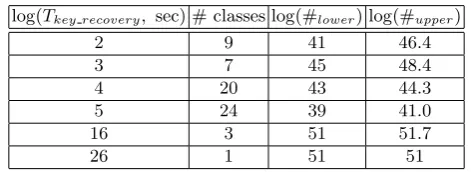
As we may see from Table 4, column 4, the work factor for the key recovery of many classes is very low. Therewith, weak key recovery for these classes may be done very fast in the chosen/known plaintext scenario. We can estimate practical time for the key recovery using figures for a software implementation of PRINTcipher–48 reported in [4]. There the authors claim 72–95 CPU cycles per byte for PRINTcipher–48. For our estimates we take 95 cycles per byte as a pessimistic figure. Now let us assume doing key recovery using a 64-bit processor with 2.4 GHz frequency, e.g. AMD Athlon 64 4000+, whereby only one core is doing the computation. We may estimate that 1 CPU cycle takes 1/(2.4)⋅10−9 seconds. In our estimates
we only compute the time needed to do the necessary number of trial encryptions, not counting overhead that appears in actually implementing the brute force attack. Still, it is quite clear that such an overhead is negligible compared to the time needed for the trial encryptions. So now we have
𝑇𝑘𝑒𝑦 𝑟𝑒𝑐𝑜𝑣𝑒𝑟𝑦=𝑊 𝐹𝑘𝑒𝑦 𝑟𝑒𝑐𝑜𝑣𝑒𝑟𝑦⋅95⋅
1
2.4⋅109 ⋅6 sec,
where the “6” is the number of bytes in 48 bits. Table 5 shows the results obtained using the above formula. The table lists the time to do the brute force search assuming the worst case where an attacker has to look through the entire search space. In the table we also indicate the number of different defU’s, i.e. families of weak keys for which corresponding timings for
the key recovery are obtained, as well as the lower and upper bounds on the number of weak keys with the corresponding time recovery. For the lower bound we took the number of keys in the largest family and as an upper bound the sum of keys in all families with the same key recovery complexity. As we may see the bounds are not far from each other, so we have a pretty good idea about the actual number of weak keys in each case.
Table 5.Expected timings for weak key recovery for PRINTcipher–48
log(𝑇𝑘𝑒𝑦 𝑟𝑒𝑐𝑜𝑣𝑒𝑟𝑦, sec) # classes log(#𝑙𝑜𝑤𝑒𝑟) log(#𝑢𝑝𝑝𝑒𝑟)
2 9 41 46.4
3 7 45 48.4
4 20 43 44.3
5 24 39 41.0
16 3 51 51.7
26 1 51 51
As a result of Table 5 we see that at least 245 weak keys can be recovered in less than 20 minutes and at least 241 weak keys can be recovered in about 4 seconds or less using just
example in [12], would take about 2 years and the one from Appendix A in [12] about a day with our two-step recovery procedure and around half a year with the plaint brute force. Therewith, along with known classes we showed existence of classes that allow very fast key recovery.
4 Related and future work
Finally, in this section we would like to briefly discuss the initial motivation of this work and show its relation to the material of the paper.
Initially we were interested in the question of how to maximize the number of internal bits known when describing the encryption function algebraically given a plaintext and a part of a key. That is, having a plaintext and knowing (or guessing) certain key bits, which (and how many) internal bits can we learn from that.
Let us consider a PRESENT-like primitive interleaving a permutation layer𝑃 and a substi-tution layer, in this order. Note that constant additions can be ignored here, since constants are publicly known and do not constrain information flow. Observe that the value of a bit of the state is known if it is either known initially (or guessed) or if it is learned through propagation from known values in the previous round. Our goal is to maximize the number of known values using a Mixed Integer (or, strictly speaking, Binary Integer) Linear Program. For this we can introduce two variables for each bit 𝑖 in each round 𝑗: 𝑥𝑖,𝑗 = 1 iff the 𝑗-th
bit is known after round 𝑖, and 𝑔𝑖,𝑗 = 1 iff it is initially known (or guessed). The objective
function is simply the sum of all𝑥𝑖,𝑗. Restricting the number of the initially known bits to a
certain threshold is similarly straightforward and can be done by introducing a constraint re-quiring the sum of all𝑔𝑖,𝑗 to be smaller than this threshold. The non-trivial part of the model
is including the propagation and relating 𝑥- and 𝑔-variables. For this, let us assume a very strong S-Box, where the outputs of an S-Box are only known if the full input is known (for PRINTcipher that would be the 3 – 3 case). So, let{𝑥𝑖,𝑃−1(𝑗0), 𝑥𝑖,𝑃−1(𝑗1),⋅ ⋅ ⋅, 𝑥𝑖,𝑃−1(𝑗
𝑙−1)}be the set of variables of the input bits of a certain S-Box in round𝑖, where 𝑙is the block length of an S-Box. Then {𝑥𝑖+1,𝑗0, 𝑥𝑖+1,𝑗1,⋅ ⋅ ⋅, 𝑥𝑖+1,𝑗𝑙−1} is the set of variables of the output bits of
that S-Box. The model can now be completed by introducing the following set of constraints for every S-Box:
𝑥𝑖+1,𝑗𝑡 ≤𝑥𝑖,𝑃−1(𝑗𝑠)+𝑔𝑖+1,𝑗𝑡 for all 𝑡, 𝑠∈ {0,1,⋅ ⋅ ⋅, 𝑙−1}.
If other masks are to be considered, these constraints need to be adjusted accordingly. One approach to do this is to consider each possible mask as a vertex of a high dimensional 0-1 polyhedron (the dimension depending on𝑙, e.g. for PRINTcipher this would be 2⋅𝑙= 2⋅3 = 6). The polyhedron so constructed can be converted to its half-space representation, which can then be used to model the information flow.
Applying this approach to PRINTcipher (incorporating constraints accommodating the key addition), surprisingly or may be not really, ended up producing invariant projected subsets as results, in particular also those that were known from [12]. Refinement of the approach led to the results of Section 3.2 and to the overall study undertaken in Section 3. We would like to mention the paper [14] where techniques of MILP were used to facilitate differential and linear cryptanalysis.
out to be extremely useful in the question of the complete study of the invariant coset attack from [12]. Still, the optimization method outlined here may be used with its initial purpose in mind. Note that having more bits known internally in the course of the encryption process facilitates other cryptanalytic methods, such as algebraic cryptanalysis [15,16]. Basically, one has more variables resolved “for free” in an algebraic system describing a primitive in question. Especially PRESENT-like ciphers seem to be good targets for this method: PRESENT itself [1], SPONGENT hash family [6], EPCBC block cipher [5]. SP-network LBlock [17] also has all properties in its description to apply the technique. It would be interesting to see how the proposed optimization technique works in this context. This is a research in progress and is an interesting research direction combining techniques like algebraic system solving (Gr¨obner bases, SAT-solvers) and optimization techniques (e.g. MILP).
Acknowledgements
The first author is supported by the German Science Foundation (DFG) grant BU 630/22-1. The first author is thankful to anonymous referees, Johannes Buchmann, Yue Sun and especially to Gregor Leander for useful discussions. The authors are thankful to Mohamed Ahmed Abdelraheem for providing a C implementation of PRINTcipher that was used in the implementation of the attacks.
References
1. A. Bogdanov, L.R. Knudsen, G. Leander, C. Paar, A. Poschmann, M.J.B. Robshaw, Y. Seurin, C. Vikkelsoe, “PRESENT – An Ultra-Lightweight Block Cipher”. In P. Pailier, I. Verbauwhede (Eds.) CHES 2007, LNCS 4727, pp.450–466.
2. C. de Canni´ere, O. Dunkelman, M. Knezevi´c, “KATAN and KTANTAN A Family of Small and Efficient Hardware-Oriented Block Ciphers”. In C. Clavier, K. Gaj (Eds.) CHES 2009, LNCS 5747, pp. 272-288.
3. J. Guo, T. Peyrin, A. Poschmann, M. Robshaw, “The LED Block Cipher”. In B. Preneel, T. Takagi (Eds.) CHES 2011, LNCS 6917, pp. 326–341.
4. L. Knudsen, G. Leander, A. Poschmann, M.J.B. Robshaw, “PRINTcipher: A Block Cipher for IC-Printing”. In S. Mangard and F.-X. Standaert (Eds.) CHES 2010, LNCS 6225, pp.16–32, 2010. 5. H. Yap, K. Khoo, A. Poschmann, M. Henricksen, “EPCBC – A Block Cipher Suitable for Electronic
Product Code Encryption”. In D. Lin, G. Tsudik, X. Wang (Eds.) CANS 2011, LNCS 7092, pp. 76–97. 6. A. Bogdanov, M. Knezevi´c, G. Leander, D. Toz, K. Varici, I. Verbauwhede, “SPONGENT: A Lightweight Hash Function”. In B. Preneel, T. Takagi (Eds.) CHES 2011, LNCS 6917, pp. 312–325. 7. M.A. Abdelraheem, G. Leander, E. Zenner, “Differential cryptanalysis of round-reduced
PRINTci-pher: Computing roots of permutations”. In A. Joux (Ed.) FSE 2011, LNCS 6733, pp. 1–17. 8. M, Agren, T. Johansson, “Linear Cryptanalysis of PRINTcipher - Trails and Samples Everywhere”.
In D.J. Bernstein, S. Chatterjee (Eds.) INDOCRYPT 2011, LNCS 7107, pp. 114–133.
9. F. Karakoc, H. Demirci, A. Emre Harmanci, “Combined Differential and Linear Cryptanalysis of Reduced-Round PRINTcipher”. In A. Miri, S. Vaudenay (Eds.) SAC 2011, LNCS 7118.
10. S. Bulygin, J. Buchmann, “Algebraic Cryptanalysis of the Round-Reduced and Side Channel Analysis of the Full PRINTcipher–48”. In D. Lin, G. Tsudik, X. Wang (Eds.) CANS 2011, LNCS 7092, pp. 54–75.
11. X. Zhao, T. Wang, S. Guo, “Fault Propagate Pattern Based DFA on SPN Structure Block Ciphers using Bitwise Permutation, with Application to PRESENT and PRINTcipher”, ePrint, available at http://eprint.iacr.org/2011/086.pdf
12. G. Leander, M.A. Abdelraheem, H. AlKhzaimi, E.Zenner, “A Cryptanalysis of PRINTcipher: The Invariant Coset Attack”. In P. Rogaway (Ed.) CRYPTO 2011, LNCS 6841, pp. 206–221.
![Fig. 1. Round function of PRINTcipher-48, cf. Figure 1 of [4].](https://thumb-us.123doks.com/thumbv2/123dok_us/7893852.1310140/4.595.138.465.207.322/fig-round-function-printcipher-cf-figure.webp)