An Efficient Learning Using Iris and Fingerprint Multi-Modal
Biometirc Authentication System
Rupinder Kaur, Dr. Naresh Kumar Garg
Computer Science and Engineering CSE Department, MRSPTU, Bathinda, India
ABSTRACT
Biometrics deals with the technical field for body dimensions and controls. It states various metrics related to characteristics of the human. Biometrics verification is used in processors as a method of access control. It deals with the identification of the individuals in clusters that are under investigation. Biometric are the unique, measurable features used to tag and describe entities. Biometric are often considered as physical versus behavioral features. Physical features are related to the form of the physique. Examples comprises of fingerprint, veins, recognition of face, palm pattern, hand, iris acknowledgement. Behavioral features are related to the shape of a person which are not limited to gait, and voice. Various researchers have invented the term performance metrics to define the latter discussion of biometrics. So this paper deals with the biometric fusion of iris and fingerprint which provides more security for the authentication of authentic individual and the performance will be evaluated in terms of false acceptance rate, false rejection rate and accuracy of the system.
Keywords : Biometrics, Security, Classification, Iris, Fingerprint
I.
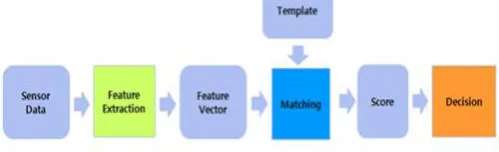
INTRODUCTIONBiometrics process is used to recognize an individual on the physical features. There are a lot of acknowledgement technologies with fingerprint, iris, hand, and voice acknowledgment. Among those fingerprint acknowledgment is recognized to be the supreme advanced and inexpensive technology, which is extensively used in various safety application zones. Multimodal biometrics authentications are one of the main topics in biometrics expertise. As an alternative of single characteristic, multiple biometric statistics are developed simultaneously and attached to provide additional reliable credentials outcomes. Moreover, subsequently it is much difficult to parody multiple instruments concurrently multimodal biometrics can deliver enhanced strength to spoofing occurrences. In overall, biometric acknowledgment is skilled by four phases
1.Raw statistics attainment from sensor 2.Feature or characteristics
3.Matching
4.Final decision on the corresponding score.
Figure 1. Generalized Block Diagram
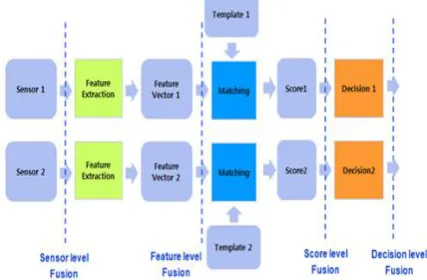
fusion is the score level that performs synthesis of scores gained from each identical process. Fourth level deals with the decision level combination which brings out final decision grounded on the grouping of individual conclusion results. Decision fusion is the supreme simple and extensively used fusion technique. Though, performance development is inadequate due to the obtain ability of limited information. While feature level fusion can operate richer information associated to the difficult level fusion which is difficult to apply due to the unsuitability among dissimilar modalities. Thus, score level synthesis is expected to deliver the most efficient synthesis solution in reality.
Figure 2. Structural block level diagram for multimodal fusion
II.
RELATED WORKSThis section deals with the effectual literature survey which deals with the efficient performance evaluation of the system done by the various researchers. Sheetal Chaudhary, Rajender Nath et al. [1] presented a vigorous multimodal biometric acknowledgment system participating iris, expression and fingerprint based on counterpart score level synthesis using multiple support vector machines. Here, MSVM are realistic in parallel manner to overcome the difficulty of absent biometric traits. It reflects every possible mixture of all the three biometric behaviors individually. They have used support vector machines as their approach and
Kihal, Salim Chitroub and Jean Meunier et al. [5] proposed a multimodal biometric scheme for verification, based on the synthesis of iris and palm print. They have proposed a method for feature abstraction of each modality using wavelet packet
corrosion at four levels. This stretches 256 packets which can produce a compact binary cipher.
III.
PROPOSED WORK
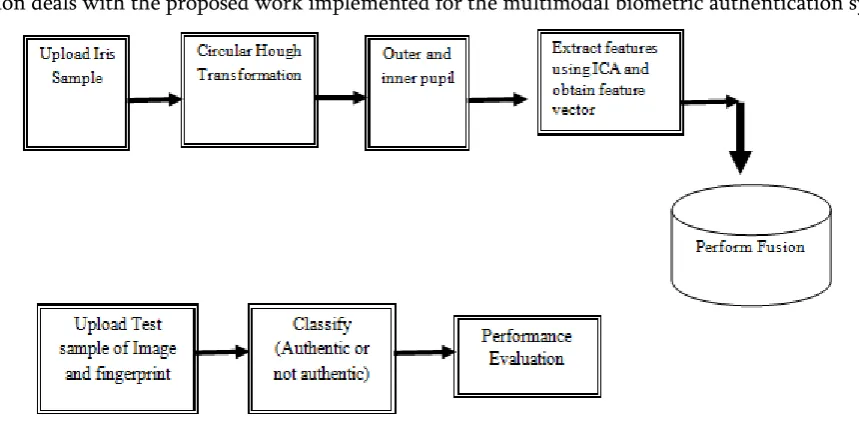
This section deals with the proposed work implemented for the multimodal biometric authentication system
Figure 3. Proposed Flow Diagram
IV.
RESULT AND DISUCSSIONS
The below are the results and simulation of the work done till now. The whole simulation is done in MATLAB environment of 2016 version using graphical user interface.
Figure 4. Main panel
The figure 4 shows the iris panel in which the graphical user interface is used using push buttons, edit texts, static texts. The figure shows the upload button in which the image will be uploaded and are used for the processing for the edge detection.
Figure 5. Iris Panel
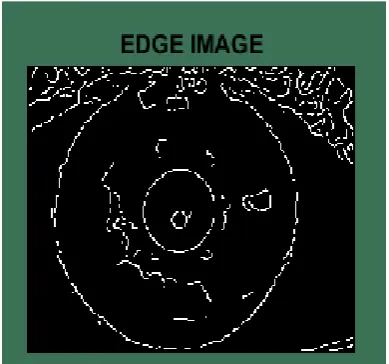
Figure 6. Edge Sample
The figure 6 shows the edges of the uploaded sample. The edge detection is done using canny edge detector which obtain the appropriate edges of the image samples
Figure 7. Feature Extraction
The figure 7 shows the feature extraction approach which deals with the extraction of the feature vector using independent component analysis and shows the extracted feature values in the figure in terms of feature vectors
Figure 8. Final Segmented
The figure 8 shows the final segmented image of the pupil on which the scanning is done in the real time. This will expel the unnecessary outer boundaries of the iris sample and will obtain the necessary part of the iris pupil on the basis of which the authentication is done
Figure 9. Fingerprint Panel
Figure 10. Fingerprint Processing
The figure 10 shows the fingerprint panel in which the processing is done using bifurcation and extraction of ridges in terms of extracted munities. This is one of the main part in the processing of the fingerprint images and shows the thinning and munities extraction of the image samples
Figure 11. Fused Data
The figure 11 shows the fusion data in which the iris and fingerprint features are fused and shown in the graphical manner
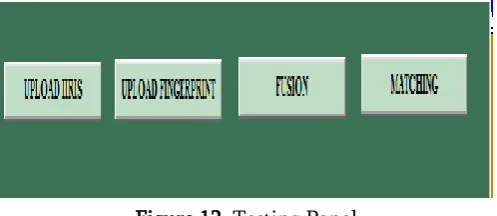
Figure 12. Testing Panel
The figure 12 shows the testing panel in which the uploading buttons are built for the uploading of the
testing samples for fingerprint and iris and also the user interface for the fusion and matching of the samples
Figure 13.
Performance evaluation
The fig 13 shows the performance evaluation of the proposed approach and shows that the proposed approach is able to achieve high. detection accuracy and less error rate which is our desired output.
The result shows that the proposed approach is able to match with the right record and shows the accurate authenticity. Also it shows the detection accuracy of recognition rate which is approximate 96 % and also the error rate which act as a classification error which is 0.048246 to have low error rates. This must be low for false detections and high true positive rates.
V.
CONCLUSION AND FUTURE SCOPE
more compensation than any other biometric technology as it offers an outstanding recognition performance. Iris patterns with fingerprint extraction are invented to be exceptional due to the complexity of the fundamental environmental and genetic processes that influence the generation of iris pattern. In this research our proposed system is able to comparison of iris recognition using principal component analysis, independent component analysis, and Gabor wavelets." Computer Science and Information Technology(ICCSIT), 2010 3rd IEEE International Conference on. Vol. 1. IEEE, 2010
[2]. K. P. Hollingsworth, K. W. Bowyer and P. J. Flynn "Improved iris recognition through the fusion of hamming distance and fragile bit distance", IEEE Trans. Pattern Anal. Mach. Intel., vol. 33, no. 12, pp.2465 -2476 2011 [3]. Kocer, H. Erdinc, and N.Allahverdi. "An
efficient iris recognition system based on modular neural networks." Proceedings of the 9th WSEAS International Conference on Neural Networks. World Scientific and Engineering Academy and Society (WSEAS), 2008
[4]. Kshamaraj, Gulmire, and Sanjay Ganorkar. "Iris Recognition Using Independent Component Analysis." International journal of emerging technology and advanced engineering 2.7 (2012): 433-437.
[5]. K. Saminathan, M. Chithra Devi, and T. Chakravarthy. "Pair of Iris Recognition for Personal Identification Using Artificial Neural Networks." IJCSI International Journal of Computer Science (2012)
[6]. Chaudhary, Sheetal, and Rajender Nath. "A Robust Multimodal Biometric System Integrating Iris, Face and Fingerprint using Multiple SVMs." International Journal of Advanced Research in Computer Science 7, no. 2 (2016).
[7]. Meva, Divyakant T., and C. K. Kumbharana. "Design and evaluation of multimodal biometric system with fingerprint and face recognition." International Journal of Scientific and Research Publications 5, no. 4 (2015): 1-4. [8]. Hassan, Norsalina, Dzati Athiar Ramli, and
Shahrel Azmin Suandi. "Fusion of Face and Fingerprint for Robust Personal Verification System." International Journal of Machine Learning and Computing 4, no. 4 (2014): 371 [9]. Dandawate, Yogesh H., and Sajeeda R.
Inamdar. "Fusion based multimodal biometric cryptosystem." In Industrial Instrumentation and Control (ICIC), 2015 International Conference on, pp. 1484-1489.IEEE, 2015. [10]. Kihal, Nassima, Salim Chitroub, and Jean