Double-Blind Peer Reviewed Refereed Open Access International e-Journal - Included in the International Serial Directories
Aryabhatta Journal of Mathematics and Informatics
http://www.ijmr.net.in email id- [email protected] Page 708 Triangular Difference Graphs
Asif Navas KR Research Scholar kannur University
kannur- 670 567 kerala, india
Dr Ajitha V
Department of Mathematics M. G. College
Iritty-670703, Kerala, India
Abstract
A (p, q) graph is said to admit triangular difference labeling if its vertex can be labeled by positive integers such that the induced edge labels obtained by the absolute difference of the labels of end vertices are the triangular numbers. A graph G which admit triangular difference labeling is called Triangular difference graph. In this paper, we prove path, combs, stars, bistars and subdivision of stars admit Triangular Difference labeling and also cycle is not Triangular Difference graph when and complete graph doesn't admit triangular difference labeling. Also admits Triangular Difference labeling iff the set of all first triangular numbers is a zero sum set.
.
Keywords
Triangular Difference graph, zero sum set
Introduction
All graphs in this paper are finite, simple and undirected. The vertex set and edge set of graph G are denoted by V(G) and E(G) respectively. For various graph theoretic notations and terminology we follow Harry [1] and for number theory we follow Burton [2]. A graph labeling is an assignment of integers to the vertices or edges or both subject to certain conditions. A dynamic survey on graph labeling is regularly updated by Gallian [3] and it is published by Electronic Journal of Combinatorics. Vast amount of literature is available on different types of graph labeling and more than 1000 research papers have been published so far in last four decades.
Definition 1.1
A triangular number is a number obtained by adding all positive integers less than or equal to a given positive integer . If the triangular number is denoted by then
Double-Blind Peer Reviewed Refereed Open Access International e-Journal - Included in the International Serial Directories
Aryabhatta Journal of Mathematics and Informatics
http://www.ijmr.net.in email id- [email protected] Page 709 A triangular difference labeling of a graph G is a one-one function (where N is set of non-negative integers) that induces a bijection of the edges defined by
E(G). The graph which admit such labeling is called a Triangular Difference graph.
Definition 1.3
A finite subset of positive integers is said to be zero sum set if there exist a linear combination, ∑ for and for
Definition 1.4
A subset M with k elements of a finite set of positive integers is said to be zero sum subset, if M itself a zero sum set.
Definition 1.5
The sum of triangular numbers is denoted by , ∑
Main Results
Here we prove that path, combs, stars, bistars, coconut trees and subdivision of stars admit Triangular Difference labeling. The complete graph is not triangular difference graph and cycle is not Triangular Difference graph when Also admits Triangular Difference labeling iff the set of all first triangular numbers is a zero sum set.
Theorem 2.1
The path admits triangular difference labeling. Proof:
Let : be the path and let (1 be the edges. for defined
We will show that the induced edge labels obtained by the absolute difference of end vertices are the first triangular numbers.
For ,
|
|
Double-Blind Peer Reviewed Refereed Open Access International e-Journal - Included in the International Serial Directories
Aryabhatta Journal of Mathematics and Informatics
http://www.ijmr.net.in email id- [email protected] Page 710
Thus the induced edge labels are the first triangular numbers. Thus path admits triangular difference labeling .
Example 2.2
The triangular difference labeling of is shown below.
Figure 1
Theorem 2.3
The comb admits triangular difference labeling . Proof:
Let be the path and let be the edges. Let be the pendant vertices adjacent to respectively and
be the edges.
for define
Then,
Thus the induced edge labels are the first triangular numbers. Hence comb admits triangular difference labeling .
Double-Blind Peer Reviewed Refereed Open Access International e-Journal - Included in the International Serial Directories
Aryabhatta Journal of Mathematics and Informatics
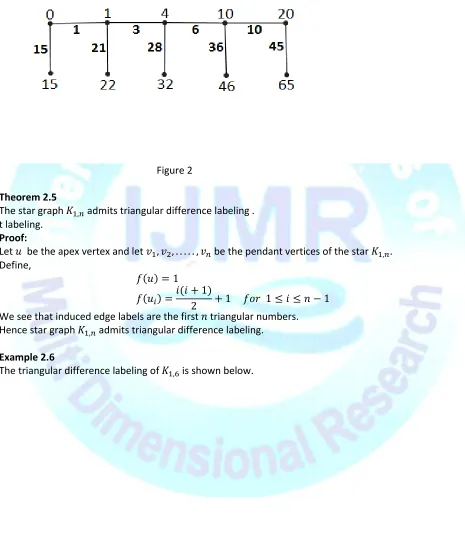
http://www.ijmr.net.in email id- [email protected] Page 711 Figure 2
Theorem 2.5
The star graph admits triangular difference labeling . t labeling.
Proof:
Let be the apex vertex and let be the pendant vertices of the star . Define,
We see that induced edge labels are the first triangular numbers. Hence star graph admits triangular difference labeling.
Example 2.6
Double-Blind Peer Reviewed Refereed Open Access International e-Journal - Included in the International Serial Directories
Aryabhatta Journal of Mathematics and Informatics
http://www.ijmr.net.in email id- [email protected] Page 712 Figure 3
Theorem 2.7
The bistar admits triangular difference labeling.
Proof:
Let, V ,
Define f by,
( )
we see that induced edge labels are the first triangular numbers. Hence bistar admits triangular difference labeling.
Example: 2.8
Double-Blind Peer Reviewed Refereed Open Access International e-Journal - Included in the International Serial Directories
Aryabhatta Journal of Mathematics and Informatics
http://www.ijmr.net.in email id- [email protected] Page 713 Figure: 4
Theorem: 2.9
the subdivision of the star ,$admits triangular difference labeling. Proof:
Let ={ } . Define f by,
we see that induced edge labels are the first triangular numbers. Hence, the subdivision of the star admits triangular difference labeling.
Example: 2.10
Double-Blind Peer Reviewed Refereed Open Access International e-Journal - Included in the International Serial Directories
Aryabhatta Journal of Mathematics and Informatics
http://www.ijmr.net.in email id- [email protected] Page 714
Figure: 5
Result: 2.11
The sum of triangular numbers is denoted by ,
.
Theorem: 2.12 [3]
If be a zero sum set then is an even number, where ∑
Theorem: 2.13
An cycle admits triangular difference labeling iff } is a zero sum set. Proof:
Suppose admits triangular difference labeling. Let : be the cycle. Let for
Then, we have,
.
. .
Double-Blind Peer Reviewed Refereed Open Access International e-Journal - Included in the International Serial Directories
Aryabhatta Journal of Mathematics and Informatics
http://www.ijmr.net.in email id- [email protected] Page 715 Above equations can be written as
(1) (2) . . . Adding , we get
∑
Which implies, ∑
Thus is a zero sum set.
Conversly, suppose is azero sum set. We have to prove -cycle admits triangular difference labeling.
Since, ∑ for
Thus , we have,
Where , Now, we define ,
( ) ( ) ( ) we see that induced edge labels are the first triangular numbers.
Thus is triangular difference graph.
Corollary 2.14
Let (p, q) graph G be a Triangular Difference graph with k-cycle , Then there is a k-zero sum subset in .
Theorem: 2.15
The complete graph doesn't admit triangular difference labeling. Proof:
In for any three vertices , there is a -cycle connecting vertices
Since , then , there is cycle with edges where . By Corollary 2.14,
is a zero sum subset . But it is impossible.
Thus, complete graph doesn't admit triangular difference labeling.
Theorem 2.16
Double-Blind Peer Reviewed Refereed Open Access International e-Journal - Included in the International Serial Directories
Aryabhatta Journal of Mathematics and Informatics
http://www.ijmr.net.in email id- [email protected] Page 716 Proof:
For for integer k , The sum of triangular numbers is is an odd number.
For, we have to show is not congruent to 0(mod 2). For that,
By Division algorithm, consider the cases for and for integer s. For k=3s,
Thus , is not congruent to 0 (mod 12) .
Similarly, for and It can be easily verify that is not congruent to 0 (mod 12) .
Thus is an odd number .
Therefore , } is not a zero sum set .
Thus by theorem: 2.13 , Cycle is not triangular difference graph for .
Concluding Remarks
In this paper, we introduce a new concept of Triangular difference graph labeling, we proved Triangular difference graph labeling of standard graphs and introduced zero sum set and its application in labeling of graphs. To investigate analogues result for different graphs and extend the labeling further towards a generalization is an open area of research.
References
[1] F. Harary Graph Theory, Addition-Wesley, Reading, Mass, 1972.
[2] David M. Burton, Elementary Number Theory, Second Edition, Wm. C. Brown Company Publishers, 1980.
[3] J.A. Gallian, A dynamic survey of graph labelling, Electronic Journal of Combinatorics, 17 (2010), DS6.
[4] Aryabhatta Journal of Mathematics and Informatics (Impact Factor- 5.856), Vol.09 Issue-01, (January - June, 2017) ISSN: 2394-9309 (E) / 0975-7139 (P)
.
[5] S. Murugesan,D. Jayaraman,J. Shiama Tetrahedral and Pentatopic Sum Labeling of Graphs, International Journal of Applied Information Systems (IJAIS) ISSN : 2249-0868 Foundation of Computer Science FCS,New York, USA Volume 5 - No. 6, April 2013 - www.ijais.org.
Double-Blind Peer Reviewed Refereed Open Access International e-Journal - Included in the International Serial Directories
Aryabhatta Journal of Mathematics and Informatics
http://www.ijmr.net.in email id- [email protected] Page 717 [7] S. Murugesan, D. Jayaraman, J. Shiama Some Higher Order Triangular Sum Labeling of