Document of
The World Bank
FOR OFFICIAL USE ONLY
Report No. MOR
IMPLEMENTATION COMPLETION REPORT
KINGDOM OF MOROCCO
GREATER CASABLANCA SEWERAGE PROJECT
December 10, 1997
Infrastructure Development Group Middle East and North Africa Region
This document has a restricted distribution and may be used by recipients only in the
performance of their official duties. Its contents may not otherwise be disclosed without
World Bank authorization.
Public Disclosure Authorized
Public Disclosure Authorized
Public Disclosure Authorized
DH equivalent of US$1 At appraisal 8.4882 At closing date 9.3040 FISCAL YEAR January 1 - December 31 ANNUAL AVERAGES 1987 8.3263 1988 8.2029 1989 8.5041 1990 8.2740 1991 8.7497 1992 8.5479 1993 9.3437 1994 9.2339 1995 8.5753 1996 8.8018 1997 (June) 9.3040
PRINCIPAL ABBREVIATIONS AND ACRONYMS USED
APD Avant projet deitaillM (Detailed Engineering Study) CFD Caisse ftanqaise de developpement (formerly the CCCE)
DAO Dossier d'appel d'offres (Bidding Documents)
DCE Dossier de consultation des entreprises (Request for Proposals - RFP)
DRSC Direction des regies et des services conc'des (Department in charge of the regies)
EIB European Investment Bank
FEC Fonds d'Equipement Communal (Municipal Development Fund)
RAD Regie of Casablanca
RADEEF Regie of Fes
RADEEM Regie of Meknes
RADEEMA Regies of Marrakech
RAID Regie of Tangier
RAK Regie of Kenitra
RAMSA Regie of Agadir
RED Regie of Rabat
SAR Staff Appraisal Report
SDAU Schema directeur d 'ameinagement urbain (Urban Development Master Plan) Vice President: Kemal Dervis
Director SMU: Jean-Claude Villiard Director CMU: Christian Delvoie
Project Officers: Fathi Ben Slimane, Senior Financial Analyst (MNSID) Sergio Calegari, Principal Sanitary Engineer (MNSID) Ahmed El-Hamri, Economist-(MNSID)
FOR OFFICIAL USE ONLY
KINGDOM OF MOROCCO
GREATER CASABLANCA SEWERAGE PROJECT
IMPLEMENTATION COMPLETION REPORT TABLE OF CONTENTS
PREFACE
EVALUATION SUMMARY
PART I: Review of Objectives and Assessment of Outcome Page
A. Review of Objectives and Assessment of Outcome I
B. Achievement of Objectives 2
C. Major Factors Affecting the Project 5
D. Project Sustainability 5
E. Bank Performance 6
F. Borrower Performance 6
G. Overall Project Assessment 7
H. Future Operations 8
I. Key Lessons Learned 8
PART II: Statistical Tables
Table 1. Summary of Assessments 11
Table 2. Related Bank Loans/Credits 13
Table 3. Project Timetable 14
Table 4. Loan/Credit Disbursements: Cumulative Estimated and Actual 15
Table 5A. Performance Indicators 16
Table 5B. Financial Statements 17
Table 6. Studies Included in the Project 20
Table 7. Project Costs and Financing 22
Table 8. Status of Legal Covenants 23
Table 9. Bank Resources: Staff Input 25
Table 10. Bank Resources: Missions 26
Annex: Report Prepared by the Borrower 27
Maps: No 19884R and 19885
This document has a restricted distribution and may be used by recipients only in the
performance of their official duties. Its contents may not otherwise be disclosed without
World Bank authorization.
GREATER CASABLANCA SEWERAGE PROJECT
(LOAN 2826-MOR)
IMPLEMENTATION COMPLETION REPORT
Preface
This is the Implementation Completion Report (ICR) for the Greater Casablanca Sewerage
Project carried out by the
Regie
autonome intercommunale de distribution d'eau et d'electricitede Casablanca (RAD), for which Loan 2826-MOR to the Kingdom of Morocco, onlent to RAD,
in the amount of US$60 million, was approved on June 24, 1987 by the Bank's Board of Directors. The loan was signed on July 27, 1987, became effective on October 14, 1988, and closed on June 30, 1997 after an extension of one year. The last disbursement was made on November 13, 1997. The total amount disbursed was US$46,855,301.71, or 78 percent of the loan. The undisbursed balance of US$13,144,698.29 was canceled on that date.
The total disbursement would have been about US$49 million, or 82 percent if withdrawal requests corresponding to invoices for supplies, services and works carried out before June 30, 1997 in the amount of US$ 2.5 million, introduced by RAD to the Ministry of Finance, were sent to the Bank. The Ministry of Finance withheld them in order to reduce the debt amount vis-a-vis the Bank. These invoices will be settled by the Communaute Urbaine de Casablanca in the framework of the contract made with the Lyonnaise des Eaux de Casablanca.
The ICR was prepared by Fathi Ben Slimane (Senior Financial Analyst, MNSID), Sergio Calegari (Principal Sanitary Engineer, MNSID) Mohamed Larbi Khrouf (Consultant Engineer), and Ahmed El-Hamri (Economist, MNSID). An ICR review meeting was held on November 3, 1997 and comments provided during the meeting have been incorporated into the final report. Preparation of the ICR began with a Bank mission from June 18 to July 6, 1997.
The Borrower has prepared its own assessment report. A copy of its summary is included as an annex to this ICR.
KINGDOM OR MOROCCO
GREATER CASABLANCA SEWERAGE PROJECT (LOAN 2826-MOR)
IMPLEMENTATION COMPLETION REPORT
EVALUATION SUMMARY
Objectives set by the Staff Appraisal Report (SAR)
i. The main objectives of the Greater Casablanca Sewerage Project were to: a) prevent further deterioration of the existing sewer systems in the Casablanca area; b) keep abreast of the growing domestic and industrial demand for sewerage and storm drainage; c) identify the least-cost alternatives for the treatment, disposal and possible reuse of wastewater and reduce the impact of wastewater discharge on the environment; d) provide for effective operation and maintenance of sewerage facilities and standardization in the quality of design and implementation of the sewer extension works; and e) promote the creation and development of appropriate institutional, financial and technical structures to manage sewerage services in urban centers. To achieve these objectives, the project identified a priority program of investment works and master plan studies, as well as actions of an institutional and financial nature, the transfer of sewerage responsibilities to the regies, settlement of arrears, budgetary allocations to local governments and municipalities to pay for their water consumption, and sewer charges. The main risk identified in the SAR related to the transfer of sewerage responsibilities from municipalities to the regies and the creation of a sewerage department in the Regie of Casablanca (RAD). The SAR considered that this risk could be minimized through the technical assistance program, and through financial measures to improve the viability of RAD.
Assessment of development objectives
ii. The objectives were partially met (para. 3 of Part One). The shortcomings of the existing network, the weakness of the institutions, and the lack of human and financial resources to maintain, operate and expand the existing systems were the major causes of RAD's poor performance. The project was the first large-scale operation in Morocco's sewerage sector, and was designed as a pilot project to test an appropriate approach to solve the sector's institutional and financial problems. Three other regies were also assigned responsibility for sewerage in their areas of activity during project implementation.
Achievement of project objectives
iii. The physical objectives as defined were substantially achieved. The urgent sewerage works identified in 1994-1995 have been completed in Casablanca and an appropriate system was implemented to clean and reduce pollution in the Mellah river in Mohammedia. However, the scope of initially selected components appears to have been overly ambitious regarding the pressing needs of the Greater Casablanca metropolitan area as well as the absorptive capacity of RAD. This was addressed during implementation by shifting the focus to appropriate rehabilitation works on the existing networks and provision of sewer connections to the population instead of expanding the network to new areas.
Institutional objectives
iv. With respect to institutional and financial aspects, the project objectives were satisfactorily achieved (para. 7). The institutional objective of transferring sewerage responsibility from the municipalities to RAD was met. The training of technical staff, in particular on procurement and transfer of technical know-how to prepare projects, provided through seminars and limited programs, had littele impact during the early stage of project implementation. However, this situation was addressed later in the process through improved customer management, introduction of a computerized information system, and supervision of works. In addition, RAD succeeded in setting up its sewerage department, as well as an internal
audit and management department.
v. The dialogue between the Bank and the authorities regarding private involvement in development of the sector was successful. The Moroccan authorities themselves took the initiative and signed a management agreement with a private water and sewerage operator, Lyonnaise des Eaux de Casablanca, to manage sewerage, water supply and electricity distribution in the Greater Casablanca area for a period of thirty years, starting August 1, 1997. This initiative will help promote private sector involvement and give the Moroccan authorities an incentive to privatize other regies' activities. The Bank has recommended proceeding through international bidding and consultations, and on the basis of well-prepared technical, financial and legal documentation, to subcontract sector activities to private operators.
Financial objectives
vi. Financial performance was satisfactory (para. 6, table 5). Although there were only two increases in sewer charges (the first in 1987 when sewerage activities were transferred to RAD, and the second in 1993), the operating revenues generated from 1987 to 1996 covered RAD's working expenses, and RAD's net internal cash covered about 60 percent of its investments, compared to the 40 percent target. The situation began to deteriorate slightly in 1994 and thereafter due to a lack of sewer tariff adjustment in 1996 and large investments in 1995 and 1996, to build the sea outfall at El-Hank. RAD's performance in recovering arrears was below expectations: the average collection period in 1996 was about 14 months of its annual turnover, compared to the 3 month target. The Government is currently paying regularly, although with
- iii
-some months delay its water and electricity bills. Several attempts were made to resolve the arrears situation in general and of the Collectivites locales in particular, but with very limited success due to insufficient budget allocations to local governement. This problem, common to all sectors and all regies, is the Borrower's major shortcoming in fulfilling its contractual obligations.
vii. RAD submitted regular audit reports. However, the auditors added disclaimers to their opinions on RAD's financial statements and accounting procedures because of discrepancies in its accounts, poor financial management and lack of internal audits. To overcome this managerial shortcoming, RAD, following the Bank's advice, hired in 1995 an independent consulting firm and auditors to adjust the discrepancies, implement the new accounting procedures, and organize the internal audit. These actions started in 1995 and continued until the newly created private enterprise took over RAD's activities on August 1, 1997.
Achievement of physical objectives
viii. Project components were unevenly carried out, depending on the priority identified during implementation (paras. 8-14). The civil works component was not implemented as defined during appraisal, because of the lack of technical documentation available at the time of appraisal. Instead, RAD and the Bank identified another, more appropriate solution to clean and divert pollution from the Mellah river. In addition, the option of regrouping several lots and simultaneously launching all the bids generated savings on the total amount defined at appraisal. Supply of equipment, technical assistance and consulting services reached a satisfactory level of achievement. At closing date, total disbursement reached 78 percent. The replacement, rehabilitation, and construction of sewers and pumping stations reached 60 percent completion. Supply of equipment reached 56 percent of the allocated amount. Expenses related to sewerage master plans for the nine cities were 84 percent of the SAR estimates.
ix. About 200 km of sewerage network and one pumping station were rehabilitated. Operating equipment was provided to RAD under the project; however, no training equipment was purchased. The Technical Assistance component was completed in the same number of man-months as originally planned. RAD used consultants to carry out sewerage system feasibility studies for future urban settlements. The Wastewater Treatment and Reuse Study for Greater Casablanca was not completed, and the contract was canceled because of the poor performance of the consultant. RAD, in consultation with the Bank, realized that the study was premature and that wastewater reuse. in Morocco would be difficult to implement due to the high investment costs and the difficulty of recovering investment and operating costs, estimated at about US$400 million and DH5/m`, respectively. The sewerage master plan studies for the eight other cities were completed to the satisfaction of the re'gies, despite some desagreement between the consultant and the regies of Fes, Rabat and Agadir due to the consultant unsatisfactory performance.
Major factors affecting the project
x. The progress reports highlighted several important issues that delayed implementation of the project (paras. 15-16). The use of land, the focus on future urban development, and the centralized and cumbersome procurement procedures were the major causes of delay, which was exacerbated by the a priori control of the overseeing authorities. Technical assistance, which was an important component of the project, only partially achieved the know-how transfer, consisting mainly of improving RAD's ability to prepare, plan and organize its operations.
Implementation delays
xi. Project implementation was first delayed by 14.5 months due to the delay in loan effectiveness. Other delays were caused by the lengthy procurement process, the weak technical and financial capacities of some contractors, the low performance of some consultants, the land use issues, RAD's disagreement on some basic assumptions that had been discussed during earlier missions, and the lack of commitment of some municipalities.
Project sustainability
xii. The project had significant impact and provided several lessons for the sewerage sub-sector in Morocco (para. 17). It helped define an appropriate approach for addressing the institutional and financial issues in Morocco's sewerage sector. Studies carried out under the project allowed the Moroccan authorities, the Bank, and the Caisse FranVaise de DIveloppement (CFD) to undertake a sewerage project with the regie of Fes that included a wastewater treatment component and wastewater reuse component (the Second Sewerage and Water Reuse Project, Loan 4010-MOR). It helped the authorities to undertake another project with the European Investment Bank (EIB) for the regie of Marrakech. The process of transferring sewerage services from the municipalities to the respective regies is already underway, following RAD's experience. Despite the difficulties encountered in implementing the project, the Moroccan authorities appreciate its positive impact on developing the subsector, and the rehabilitation works and planning mechanisms that have been put in place.
Bank performance
xiii. The Bank's performance improved as the project progressed. The Bank focused mainly on improving the existing system and connection to the network, and removing pollution in the Mohammedia area and the Mellah river. On the institutional and financial side, late in project implementation the focus was on implementing internal audit and appropriate accounting and financial management procedures. Discussions on sector development resulted in speeding up the transfer of sewerage responsibilities to the regies of Agadir, Fes, Meknes and Marrakech. The Bank allocated an average of 18.5 staffweeks per year for project supervision. The supervision missions concentrated on physical components as well as on institutional, financial and administrative aspects.
Borrower performance
xiv. After almost eight years of implementation, the implementation rate for the project must be regarded as satisfactory. RAD experienced difficulties in managing the project, which caused substantial delays in implementing some of its components. It should also be noted that while implementing the project, the Moroccan authorities, with the French cooperation, built the El Hank outfall, which they considered crucial for the Casablanca sewerage system and for the environmental protection of the Casablanca Bay. The El-Hank outfall, although costing US$100 million, is by far the least cost solution compared with the alternative, which consisted of treating, pumping and transporting the treated wastewater at a cost of US$400 million.
Overall project assessment
xv. The project was the first large-scale sewerage investment undertaken in Morocco. It was, then, expected that during implementation some assumptions and options would be reconsidered due to the insufficient information in the very beginning included in the sewerage master plan. However, it is clear that the completed components will facilitate new urban development. The project enabled RAD to improve its capacity to operate a modem system, and to build up a large resource base and database out of the completed studies. In addition, the project has had other benefits: (a) RAD personnel became familiar with implementation of large sewerage works, (b) eight of the country's major cities now have a sewerage planning and management tools in place that have allowed them to transfer sewerage services to the regies, (c) two new projects have been launched, and (d) the process of privatizing the regies has started. The project increased the number of house connections to the sewerage network by about 15,000, serving 300,000 additional people, partly through the project itself and partly through developers.
Future operations
xvi. Future sewerage operations in Casablanca will be carried out by the newly created private
company (Lyonnaise des Eaux de Casablanca), which is committed to an investment program of
DH 30 billion over the next 30 years. The database and the studies prepared under the project will facilitate the identification and implementation of new projects. The sewerage master plan study for the eight cities has helped to identify two new projects (IBRD 4010-MOR in Fes, and an EIB project in Marrakech).
Key lessons learned
* The institutional development of the sewerage sector in Morocco has been the major objective of the project.
* The local and regional authorities should have been involved since the beginning in making the major decisions, to ensure their commitment and agreement on administrative and land use approvals necessary to carry out the project.
* More realistic assumptions could have been made during the appraisal stage if the sewerage master plan had been available.
* Studies should anticipate potential implementation problems.
* In selecting contractors and suppliers, attention must be paid to their technical, human and financial capacity to carry out the project.
KINGDOM OF MOROCCO
GREATER CASABLANCA SEWERAGE PROJECT
(LOAN 2826-MOR)
PART ONE: IMPLEMENTATION ASSESSMENT
A. REVIEW OF OBJECTIVES AND
ASSESSMENT OF OUTCOME
Objectives at Appraisal
1. The principal objectives of the Greater Casablanca Sewerage Project were to: (a) prevent firther deterioration of the existing sewer systems in the Casablanca area through an extensive rehabilitation program; (b) keep abreast of the growing domestic and industrial demand for sewerage and storm drainage; (c) identify the least-cost alternatives for the treatment, disposal and possible reuse of wastewater and reduce the impact of wastewater discharge on the environment; (d) provide for effective operation and maintenance of sewerage facilities and standardization in the quality of design and implementation of the sewer extension works; and (e) promote the creation and development of appropriate institutional, financial and technical structures to manage sewerage services in urban centers.
2. To achieve these objectives, the project identified a program of physical investments as well as institutional and financial measures at a total estimated cost of US$116.91 million, of which US$33.4 million was in foreign exchange (table 7 of the SAR). The project was financed by a Bank loan in the amount of US$60 million (Loan 2826-MOR). The physical components related to Greater Casablanca, and included: (a) replacement of 60 km of primary, secondary and tertiary sewers and three pumping stations located in Mohammedia, Ain Sebaa and the Eastern Industrial Zone; (b) rehabilitation and repair of 1 km of two major collectors and 200 km of secondary and tertiary sewers, as well as inspection, cleaning and mapping of 1,000 km of the system; (c) construction of 410 km of new sewers in new development areas and existing unserviced areas; (d) provision of operating equipment and training for RAD's sewerage department; (e) technical assistance and training for RAD through a specialized sewerage company, consultants' services for studies and works supervision, and a study to assess wastewater treatment and disposal needs in Casablanca; and (f) preparation of sewerage master plans and feasibility studies, as well as of final design for the first phase sewerage works of Agadir, Fes, Marrakech, Meknes, Nador, Rabat, Settat and Tangiers. Bidding documents for the priority sewerage works for Casablanca was also carried out.
Assessment of objectives and risks
3. These objectives were defined based on the shortcomings of the existing network, weaknesses of the institutions, and the lack of human and financial resources to maintain, operate
and expand the existing systems. The physical objectives, redefined on a realistic basis in 1994 were achieved. The high costs of the unrealistic investments proposed by the consultant to treat and purify water used in Casablanca (400,000 m3 a day, for total cost of US$400 million), the construction of the outfall in Mohammedia (US$70 million), the construction of a 10 km gallery and a pumping station under the ocean, and the sewerage charge needed to recover investment and operating costs (DH5 m3) led the Moroccan authorities to cancel the contract and to postpone the proposed schemes and the treatment plant until a later stage. Instead the project focused on two other alternatives that included improvement of the design of the outfall system of El Hank, financed by the French, and construction of an appropriate system to divert sewage from the Mellah river in Mohammedia and direct it to the ocean after preliminary treatment. The project also focused on equipping future urban development areas, and on overcoming the backlog in providing about 15,000 sewer connections to inhabitants. Moreover, the rehabilitation of sewers and pumping stations was completed. Equipment purchased for the cleaning operation and the training provided by the technical assistance enabled RAD to carry out the cleaning and inspection of some segments of the network by its own staff.
4. With respect to the institutional and financial aspects of the project, these were satisfactorily achieved. On the organizational front, technical assistance later in the process provided basic know-how to RAD staff in the design, operation and maintenance of the Casablanca sewerage system. This situation improved in the final years of project implementation through better targeting of technical assistance for customer management, introduction of a computerized information system and construction site supervision and management. RAD did succeed in setting up its sewerage department, as well as an internal audit and management department, in 1993 and 1995, respectively.
B. ACHIEVEMENT OF OBJECTIVES
Assessment of development objectives
5. Sectoral policy objectives. This was the first major undertaking in the sewerage sector,
and was designed as a pilot project to address sewerage problems in Morocco of both an institutional and financial nature. As the result of the project, three other regies have been assigned responsibility for sewerage operations.
6. Financial objectives. Financial perforTnance under the sewerage project was more
satisfactory (table 5). Although there were only two increases in sewer charges, one at the time responsibility was transferred to RAD and another in 1993, revenues flowing to RAD from 1987 to 1996 were enough to cover all operating costs, and to generate net earnings equal to 60 percent of capital spending, versus the 40 percent called for in the agreements. The situation began to deteriorate in 1994, but was still judged acceptable, when RAD was made responsible for financing and carrying the debt service of the sea outfall at El Hank. Normally the Government should have contributed to the El-Hank outfall investment, as environmental protection of the Casablanca Bay was a joint RAD/Government issue. Furthermore, RAD's performance in terms of recovering arrears was below expectations: the average collection period represented about
3
-14 months of turnover, against the 3 months stipulated in the agreement. This weak performance was due essentially to difficulties in recovering arrears from local govermmens and municipalities, which in turn were caused by insufficient budget allocation to them. This problem, which was common to all sectors and all regies, constituted the Borrower's principal shortcoming in terms of fulfilling its contractual commitments. Several attempts were made to resolve the problems of arrears, but with only sporadic success. RAD met its commitments with respect to audits. The accounts, however, could not be certified, in light of the inadequacies and anomalies found by the auditors. To rectify this situation, the Bank advised RAD to hire an outside accounting expert to help rectify the accounts and to set up a new accounting plan. These steps were initiated in 1995 and will be continued by the newly created enterprise.
7. Institutional development objectives. These objectives were substantially achieved.
The project succeeded to some extent in strengthening the capacities of the Sewerage Department within RAD, by involving it in the studies and in executing sewerage works. The department was also supplied with modern equipment for operating the system. Some steps were taken to provide training, in cooperation with the company supplying technical assistance services (9 percent of its working time was spent on training activities). The dialogue between the Bank and the authorities regarding encouragement of the private sector as an alternative for developing the sewerage system proved to be useful. The Moroccan authorities themselves took the initiative of launching the process, which resulted in the granting of a management contract by the Casablanca Urban Community for all RAD activities (sewerage, water supply and electricity) to a private company, Lyonnaise des Eaux de Casablanca, for a period of thirty years, on August 1, 1997. This is a promising approach, in the sense that it could serve as a point of departure for other regies seeking to involve the private sector in their operations. The Bank, however, has
recommended that this be done on the basis of International Competitive Bidding and Requests for Proposals, using carefully prepared technical, financial and legal documentation.
8. Physical objectives. Due to the nonavailability and insufficiency of the sewerage master
plan, the physical components selected during appraisal were redefined later during implementation, in 1994. Originally 340 km of new sewers in future urban growth areas were proposed. The project replaced 60 km of existing primary sewers and rehabilitated 200 km of secondary and tertiary sewers, which contributed to the development of several Casablanca quarters. In addition, the project allocated US$3.56 million (net of physical and price contingencies) to clean 1,000 km of sewers, which was done with the cleaning trucks purchased through the loan proceeds.
9. Physical objectives were partially achieved (table 7). The completion rate varied from one component to the next. Generally speaking, implementation of the works components was weaker than expected. The components relating to equipment supply, technical assistance and consulting services were to a large degree completed. The project helped in the construction of an appropriate pollution control system for Mohammedia and its river, Mellah. In addition, 5.5 km of primary sewers and a pumping station were rehabilitated, as were 105 km of secondary and tertiary network sewers (including 1 km of the trunk collector). Furthermore, RAD personnel performed the cleaning work using the operating equipment purchased under the project. Topographical mapping was carried out for 90 km. Some 16.5 km of new main sewers
were laid , and 15.5 km of new secondary and tertiary sewers were completed. RAD completed about 59 km of sewers in zones not initially included in the project. In sum, 200 km of collectors of various sizes were laid and one pumping station in Mohammedia rehabilitated. The project enabled RAD to acquire operating equipment (15 cleaning trucks of differing capacities), light transport vehicles (25 vans and pickup trucks), and heavy transport equipment (6 dump trucks, 8 trucks and 2 tanker trucks) for the Sewerage Department.
10. The Technical Assistance component achieved virtually the same man-month levels as planned (424 man-months versus 420 in the SAR). Of the technical assistance resources, 91 percent was used for technical studies and works supervision, while training accounted for 9 percent. RAD made use of consultant services to prepare prefeasibility studies for sewerage systems in future urban growth zones. These studies were parceled out in 6 lots to three different consulting groups. The wastewater treatment and reuse study for Greater Casablanca was not completed, and the contract was canceled. RAD, in consultation with the Bank, realized that the study was premature and that wastewater reuse in Morocco would be difficult to implement due to the high investment costs, as well as to the difficulties of recovering investnent and operating costs, estimated to reach about US$400 million for DH5/m3, respectively. The sewerage master plan studies for the eight cities other than Casablanca were virtually all completed to the satisfaction of the respective regies, although difficulties arose with the consultants doing the work for Fes Rabat and Agadir; in the case of Fes, these problems led to cancellation of the first contract and the selection of another consultant to complete the study. The studies were pursued to the point of preparing implementation plans for priority sections for eight regies.
11. Much of the work carried out was based on studies carried out by RAD personnel. As of the closing date of the loan, three of the eight lots of sewerage works for specific sectors of Casablanca had been completed; the others were completed in December 1997.
12. Lags accumulated in implementing some of the project components. Some 14.5 months elapsed between signing of the loan and its effectiveness. Additional delays were due to a priori control of the contract (administrative procedures, affected approval and implementation). The delays varied from 19 to 6 months for studies and 16 to 12 months for civil works. For the 8 lots of sewerage and pollution control works, contracts were launched simultaneously, awarded 2 months after bid opening, and signed 3 months after bid evaluation. The related works started in October 1996. For the studies, six contracts were completed on time, but others took up to 2 to 4 years due to review of consultant conclusions by the Bank and RAD.
13. There were several reasons for these delays: (a) deadlines set for the consultants were often too short, given the scope of the study and/or of the work required; (b) the density of the sewer system within the study zones were identified on a preliminary basis; (c) some of the firms contracted were technically and financially weak; (d) technical problems appeared only during project implementation (soil conditions, subsoil rights); (e) there were administrative problems relating to land use authorizations and construction permits, (the Casablanca Urban Community was slow to provide basic data, and urban development plans were subject to change); f) there were problems with land use and the nature of the works themselves, which involved installing sewers in areas where access roads had to be built or slums had to be removed from the primary
5
-sewer route; and g) there was a lack of commitment to the project on the part of some of the municipalities (Ain Dhiab, Oulfa, and Sidi El Khadir).
14. The cost of the project was originally estimated at US$116.91 million; of this amount, US$91.1 million, or 78 percent of the total cost, had been spent by the closing date. RAD purchased operating equipment that allowed for better operation of the systems. The final cost of the studies was US$10.45 million, against the US$12.51 shown in the SAR.
C. MAJOR FACTORS AFFECTING THE PROJECT Factors generally subject to Government control
15. Administrative procedures (a priori control) for awarding contracts held up progress on several components. The financial situation of RAD, due largely to payment arrears on the part of local and central governments, meant that RAD was late in making payments to suppliers, contractors and consultants. The Government's efforts to address the arrears issue did not succeed in resolving the problem completely. It took 14.5 months for the loan to become effective.
Factors generally subject to the control of the implementing agency
16. Technical assistance, an important component of the project (representing 15 percent of the RAD project cost and 26 percent of disbursements under the loan), partially achieved its objectives in terms of training and management assistance. The purpose of the training was to equip RAD in preparing, planning and organizing operations under the project; however, its long duration and the number of man-months devoted to it was not in proportion to the transfer of know-how. Some difficulties arose because of insufficient preparation. Some land use and administrative issues were addressed only after contracts had been awarded.
D. PROJECT SUSTAINABILITY
17. The work carried out under this project represents virtually the first major action of its kind in Morocco's sewerage subsector. While a few objectives were not achieved, the project nonetheless has been a useful experience for Morocco. The national authorities and the Bank have also undertaken another sewerage project in the cities of Fes (Loan 4010-MOR) and Marrakech (EIB loan), incorporating wastewater treatment components as well as treatment of industrial waste. The experiment of transferring responsibility for sewerage services from the municipalities to the respective regies is already underway, following the example set by RAD. Currently, a management contract for water, sewerage and electricity services in Casablanca has been awarded to the company Lyonnaise des Eaux de Casablanca. Other major Moroccan cities
18. Environmental impact. This project has had a major and beneficial impact on environmental policy, since the regies have undertaken technical and economic studies to determine the ecological effects of installing wastewater treatment facilities. These studies have resulted in the introduction of environmental protection measures. The measures adopted for Mohammedia and Mellah river will improve the water sewerage system as well the environment in the region. About 500 ha of land located along the Oued Mellah, which were a "non aedificandi zone", are being transformed into a residential area.
E. BANK PERFORMANCE
19. Bank performance was satisfactory. However, the conceptual approach adopted during the project identification phase did not identify the optimal solution for the sewerage network in the Casablanca area due to absence of a master plan. The situation led the Bank and RAD to redesign investment priorities for civil works, and eight lots were defined between 1993 and 1994. The related works are expected to be completed in December 1997. In view of the shortcomings of the regies in managing bidding and contracting procedures and techniques, the Bank could have held training seminars from the beginning of the project (1987) to help the Borrower manage this key aspect more effectively (such seminars were in fact introduced later on). In addition, the Bank could have included a training component (completely separate from the technical assistance component) to prepare RAD personnel to manage the project and equip them with the techniques for implementing a water distribution and sewerage project. A total of 236 staffweeks was devoted to the project, of which 137 were for supervision, characterized by efficiency of effort and frequent visits (table 10). As part of its supervision, the Bank was also careful to organize some important training seminars and to ensure adherence to financial and accounting conditions. This aspect of the supervision produced an improvement in project implementation and management.
F. BORROWER PERFORMANCE
20. An assessment of RAD's performance shows that the project completion rate, after nearly 9 years of implementation, reached 78 percent. RAD's and Government's commitment to the project improved during project implementation. Rad's management capacities were deficient when implementation began, but improved gradually as the project progressed. In addition, the limited commitment of other interested parties (ministries, municipalities, administration and industries) tended to delay project implementation.
21. Over the period 1988-1995, RAD experienced a number of difficulties in establishing and managing the structures needed to ensure proper implementation of the project. These difficulties had several consequences: (a) RAD's organizational structure never underwent the changes needed to reflect the largely successful deconcentration and decentralization of technical and administrative management at the municipal level; (b) some serious institutional and organizational problems (such as the autonomy of RAD, the relationship between the regie and the supervisory authorities and financial controls) held back development of the regie and
-7-hampered its short-and medium-term operations; (c) RAD had great difficulty developing a computerized information system for administering its billing system and its customer accounts, which are essential to effective business and accounts management (the handling of arrears proved to be a particularly difficult problem); (d) RAD's lack of experience in contracting procedures led to significant delays in the implementation of some of the project's components. 22. In retrospect, the project has helped RAD to improve its financial management, due mainly to the continuous dialogue with the Bank's task team and the introduction of an internal audit system which has given the regie the capacity to manage its accounts effectively. RAD has also acquired a computerized information management system for its business transactions, which has enabled it to improve administration of customer accounts and arrears with a view to reestablishing its financial and economic viability.
G. OVERALL PROJECT ASSESSMENT
23. Since this was the first large-scale sewerage project to be undertaken in Morocco, the search for a suitable method and approach was naturally an integral feature of the experience. Although the completion rate for the Casablanca project was relatively low, the work accomplished will allow new urban development areas to be opened up. About 15,000 sewerage house connections were established under the project itself, and through developers and private concessionaires. The project has enabled RAD to acquire new, up-to-date operating equipment for the system. RAD has built up substantial capital in the form of a database of feasibility studies for some 6,835 ha, involving 420 km of sewers. However, the usefulness of these studies will depend on the progress of urbanization programs. The project has also succeeded in familiarizing RAD personnel with the demands of large and complex sewerage works. It has provided eight of the country's largest cities with a solid tool for planning and managing sewerage projects. The sewerage master plans have already been of help to some municipalities in transferring sewer services to the regies.
24. An interceptor was built under this project to intercept the sewage flow and to divert it toward the ocean after preliminary treatment through an appropriate rocky discharge coastal zone. This solution eliminated existing pollution and transformed about 500 ha of "non aedificandi" zone into a residential area.
25. Most importantly, the project, and the other sewerage works that have been undertaken, have allowed Casablanca to increase the rate of residential sewer connections, which rose from 60 percent in 1985 to 62.6 percent in 1996. By contrast, the rate of potable water connections has gone from 64 percent in 1985 to 78 percent in 1995.
26. On the institutional front, the project has certainly promoted the concept of granting management contract for sewerage services in Casablanca to private operators. The company that provided the technical assistance to RAD under the project is in fact the guiding force of the group that has taken over the management contract. The municipalities of Agadir, Fes, Meknes,
and Marrakech have already transferred their sewerage services to their respective regies, and Tangier, Marrakech and Meknes are preparing to do so in the near future.
H. FUTURE OPERATIONS
27. Future sewerage operations in Casablanca will be in the hands of the newly created private company, which is committed to an investment program with the Moroccan authorities of about US$30 billion over 30 years. The studies prepared under the present project will certainly serve as a useful basis for other projects. The studies for sewerage master plans for the eight cities have already led to a new IBRD project, 4010-MOR, Second Sewerage and Waste Water Treatment and Reuse Project for the City of Fes, and to the identification of the proposed National Water Supply and Sewerage Project. Marrakech and Agadir have issued invitations to bid for sewerage works resulting from these studies.
I. KEY LESSONS LEARNED Development objectives
28. The issues relating to development objectives, including the institutional and organizational structures needed to promote the sewerage sector, should be identified at the project preparation stage, along with the appropriate actions and measures for achieving them. The project focused essentially on the physical components for Casablanca and on sewerage master plans for 9 cities. For example, there was no progran for transferring sewerage services from the municipalities involved in the project to the eight corresponding regies. There was no organizational component for the RAD sewerage department.
29. The SAR should have provided criteria for evaluating the technical assistance component, which was a major part of the project in terms of the funds devoted to it.
30. Implementation. The rehabilitation program, which was an important part of the
project, would have been more effective if it had been based on the results of a TV cameras inspection campaign and a topographical mapping exercise.
31. Project ownership. The ownership of the project and its objectives is very important to
the success of any project. In the case of this project, the local and regional authorities (i.e., interested parties or stakeholders) should have been involved since the beginning in making the major project decisions, to ensure their commitment and avoid obstacles when it came to securing administrative approvals. Land use problems should have been settled as soon as the sites were identified, to avoid delays in project implementation.
32. Financial capacity. During the project appraisal stage steps should have been taken to
assess the financial capacity of RAD and to verify that its cash flow was sufficient to finance the local counterpart contribution not covered by the loan. Such an assessment requires cautious
assumptions about self-financing capacity and the contributions of customers and housing developers.
33. Organization of technical assistance. Technical assistance should not have been the
direct responsibility of the Director General of RAD, as the SAR recommended (see SAR para. 4.12), but rather should have been assigned to a specially designated official responsible for its implementation. As it turned out, the Director General did not have the time to make effective use of the experts nor to evaluate and follow up on their work.
34. Adapting objectives to capacities. No specific goal was set in terms of the number of
residential connections, which is surely a major target for any sewerage project. However, about 15,000 sewerage house connections were created by the project, partly through the project itself and partly through developers. The implementation study zones under future loans should coincide with the zones where works are to be financed, or else the studies will be obsolete when it comes to implementation. Time limits on contractors and consultants must be realistic and commensurate with the scale and difficulty of the services and works required. Steps should be taken to ensure that the studies are of high quality and that they anticipate implementation difficulties. Pre or post-qualification procedures should follow the project's example, so that only contractors with sufficient technical, human and financial capacities are deemed eligible to carryout the project.
PART II
STATISTICAL TABLES
Table 1. Summary of Assessments Table 2. Related Bank Loans/Credits Table 3. Project Timetable
Table 4. Loan/Credit Disbursements: Cumulative Estimated and Actual Table 5A. Performance Indicators
Table 5B. Financial Statements
Table 6. Studies Included in the Project Table 7. Project Costs and Financing Table 8. Status of Legal Covenants Table 9. Bank Resources: Staff Input Table 10. Bank Resources: Missions
Implementation Completion Report Kingdom of Morocco
Greater Casablanca Sewerage Project (Loan 2826-MOR)
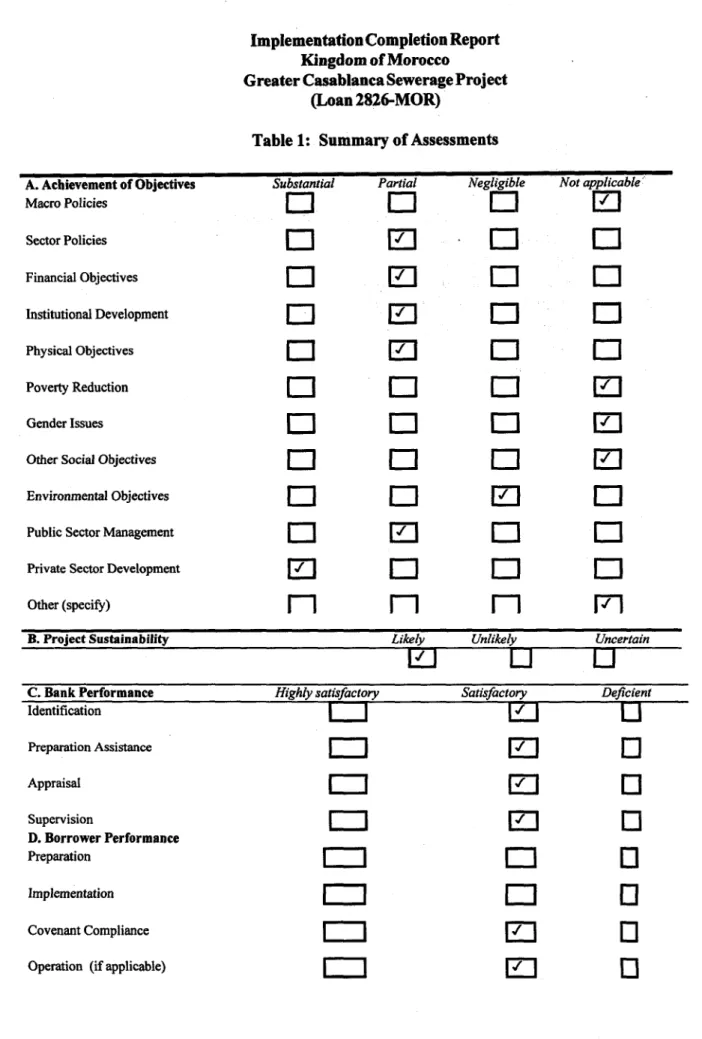
Table 1: Summary of Assessments
A. Achievement of Objectives Substantial Partial Negligible Not applicable"
Macro Policies
EJ
E
nJ
Sector Policies
E
E
El
Financial Objectives
E
]
E
E
Institutional Development
E
E
El3
Physical Objectives
n
E
E
E
Poverty Reduction
[
El
E
Gender Issues
E
El
Other Social Objectives
E
E
E
]
Environmental Objectives
E
E
[Z
E
Public Sector Management
j
IB
I l
Private Sector Development
]l
EJ
Other (specify)
n
n
nl
B. Project Sustainability Likely Unlikely Uncertain
-
LiU
Li
C. Bank Performance Highly satisfactory Satisfactory Deficient
Identification
L
]
L
Preparation AssistanceI1
2]
E
AppraisalI
E[
Supervisionl
iB
° D. Borrower Performance Preparationi
E
0
ImplementationE
0
Covenant Compliance2
Q
Table 1: Continued
E. Assessment of Outcome Highly Satisfactory Unsatisfactory Deficient Satisfactory
- 13
-Implementation Completion Report Kingdom of Morocco
Greater Casablanca Sewerage Project (Loan 2826-MOR)
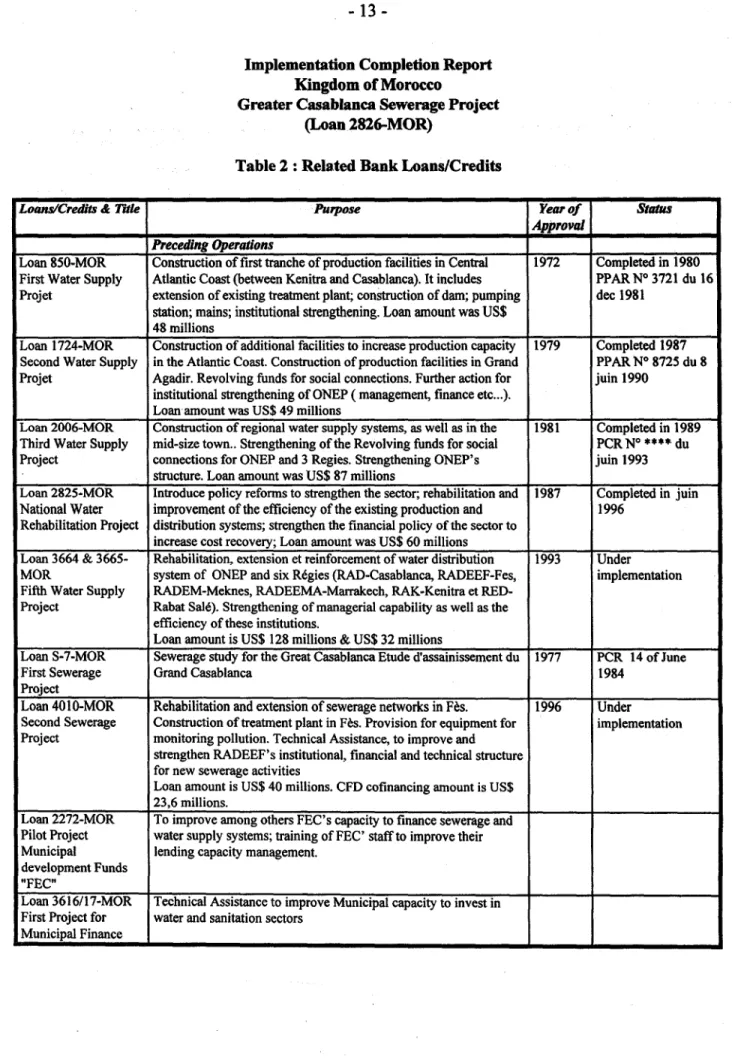
Table 2: Rela.ted Bank Loans/Credits
Loans/Credits & Thk Purpose Year of Status Approval
Preceding Operations
Loan 850-MOR Construction of first tranche of production facilities in Central 1972 Completed in 1980 First Water Supply Atlantic Coast (between Kenitra and Casablanca). It includes PPAR NO 3721 du 16 Projet extension of existing treatment plant; construction of dam; pumping dec 1981
station; mains; institutional strengthening. Loan amount was US$ 48 millions
Loan 1724-MOR Construction of additional facilities to increase production capacity 1979 Completed 1987 Second Water Supply in the Atlantic Coast. Construction of production facilities in Grand PPAR N° 8725 du 8 Projet Agadir. Revolving funds for social connections. Further action for juin 1990
institutional strengthening of ONEP ( management, finance etc...). Loan amount was US$ 49 millions
Loan 2006-MOR Construction of regional water supply systems, as well as in the 1981 Completed in 1989 Third Water Supply mid-size town.. Strengthening of the Revolving funds for social PCR N° **** du Project connections for ONEP and 3 Regies. Strengthening ONEP's juin 1993
structure. Loan amount was US$ 87 millions
Loan 2825-MOR Introduce policy reforms to strengthen the sector; rehabilitation and 1987 Completed in juin National Water improvement of the efficiency of the existing production and 1996
Rehabilitation Project distribution systems; strengthen the financial policy of the sector to increase cost recovery; Loan amount was US$ 60 millions
Loan 3664 & 3665- Rehabilitation, extension et reinforcement of water distribution 1993 Under
MOR system of ONEP and six Regies (RAD-Casablanca, RADEEF-Fes, implementation Fifth Water Supply RADEM-Meknes, RADEEMA-Marrakech, RAK-Kenitra et
RED-Project Rabat Sale). Strengthening of managerial capability as well as the efficiency of these institutions.
Loan amount is US$ 128 millions & US$ 32 millions
Loan S-7-MOR Sewerage study for the Great Casablanca Etude d'assainissement du 1977 PCR 14 of June
First Sewerage Grand Casablanca 1984
Project
Loan 401 0-MOR Rehabilitation and extension of sewerage networks in Fes. 1996 Under
Second Sewerage Construction of treatment plant in Fes. Provision for equipment for implementation Project monitoring pollution. Technical Assistance, to improve and
strengthen RADEEF's institutional, financial and technical structure for new sewerage activities
Loan amount is US$ 40 millions. CFD cofinancing amount is US$ 23,6 millions.
Loan 2272-MOR To improve among others FEC's capacity to finance sewerage and Pilot Project water supply systems; training of FEC' staff to improve their
Municipal lending capacity management. development Funds
"FEC"
Loan 3616/17-MOR Technical Assistance to improve MunicipaFicapacityto invest in First Project for water and sanitation sectors
Implementation Completion Report Kingdom of Morocco
Greater Casablanca Sewerage Project (Loan 2826-MOR)
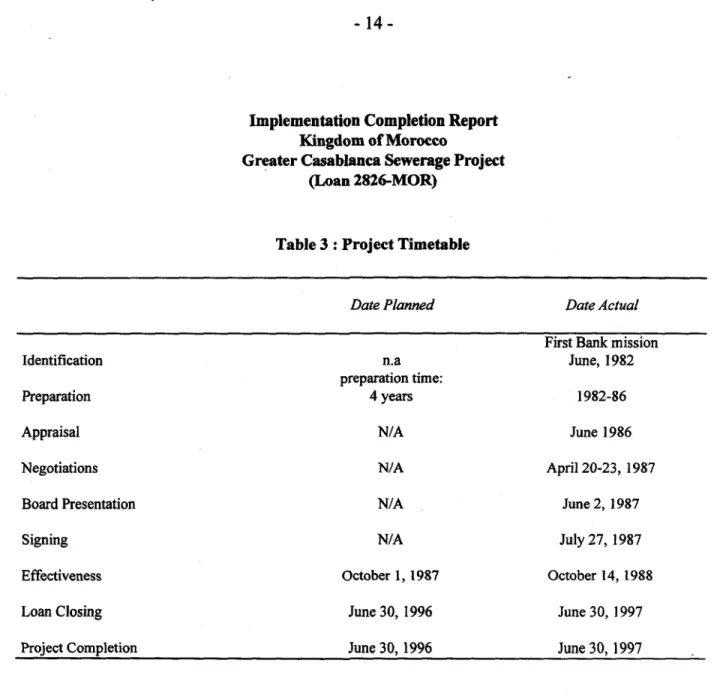
Table 3 Project Timetable
Date Planned Date Actual
First Bank mission
Identification n.a June, 1982
preparation time:
Preparation 4 years 1982-86
Appraisal N/A June 1986
Negotiations N/A April 20-23, 1987
Board Presentation N/A June 2, 1987
Signing N/A July 27, 1987
Effectiveness October 1, 1987 October 14, 1988
Loan Closing June 30, 1996 June 30, 1997
Implementation Completion Report Kingdom of Morocco
Greater Casablanca Sewerage Project (Loan 2826-MOR)
Table 4: Loan Disbursements-Cumulative Actual (in US S millions)
Fiscal Year 1988 1989 1990 1991 1992 1993 1994 1995 1996 1997 1998 Appraisal Estimate-annual 6.23 6.36 9.25 9.83 8.68 7.50 5.77 4.63 1.75 0.00 0.00 Appraisal Estimate-cumulative 6.23 12.59 21.84 31.67 40.35 47.85 53.62 58.25 60.00 60.00 60.00 Actual annual 0.00 0.63 0.68 8.04 4.76 6.01 8.00 9.20 4.03 2.89 2.57 Actual cumulative 0.00 0.63 1.31 9.34 14.10 20.12 28.11 37.32 41.35 44.24 46.81 Actual as % of Estimate 0.00 0.05 0.06 0.30 0.35 0.42 0.52 0.64 0.69 0.74 0.78 Date of Final Disbursement 31-Oct-97
Graph 1: Loan 2826-Dlsbursements
60.00 50.00 V 40.00 ,30.00 20.00 t sat.hbrepn 10.00 0.00 1988 1989 1990 1991 1992 1993 1994 1995 1996 1997 1998 Fiscal Year
1987 1988 1989 1990 1991 1992 1993 1994 1995 1996
Production 000m3 165.42 171.87 173.03 174.38 185.71 193.80 182.98 178.93 174.35 175.76 Consommations 110.55 111.17 119.61 114.68 130.63 130.34 124.65 121.83 121.70 120.58 Rendement 66.83% 64.68% 69.13% 65.76% 70.34% 67.25% 68.12% 68.09% 68.50% 69.80%
Tarifs moyens vente (DH/m3) 3.07 3.22 3.51 4.51 4.74 5.38 5.69
Tarifd'achateau(DH/m3) 1.40 1.55 1.58 1.76 1.80 1.92 5.42 2.70 3.08 3.17 Redevances Assainissement DH/m3) 0.37 0.81 0.86 0.89 0.84 5.66 2.72 0.94 1.42 1.50 Ratio d'exploitation I (avant amortiss.) % 45.00 4.61 47.89 69.19 67.26 69.30 60.69 53.70 44.62 53.04 Ratio d'exploitation 2 (apres amortiss.)% 71.81 36.54 50.09 72.98 76.78 82.05 84.7 93.47 73.45 90.04
Ratio de liquidite 1.43 7.52 8.83 8.49 9.49 5.06 2.72 0.94 1.42 1.80
Dettes a Long Terms/Capitaux Permanents % N/A N/A 1.98% 5.48% 10.28% 11.98% 34.12% 48.85% 48.28% 34.81%
Autofinancement
*avec contribution des abonnes < 60.60% ~ -- ->
*sans contribution des abonnes - __ -- - 16.49% -
--Service de la Dette
j
1.9 ___ ______Population desservie par Branchements prives 2,530,000 2,940,000 3,140,000
Population totale desservie par assainissement 1,612,000 1,881,000 2,260,000
Taux de raccordement 64% 64% 72%
Longueur du Reseau d'Assainissement (en Krn) 3,100 3,200 3,500
Milieu Recepteur Mer, Oueds Mer, Oueds Mer, Oueds
Reutlisation des eaux usees non-traitees
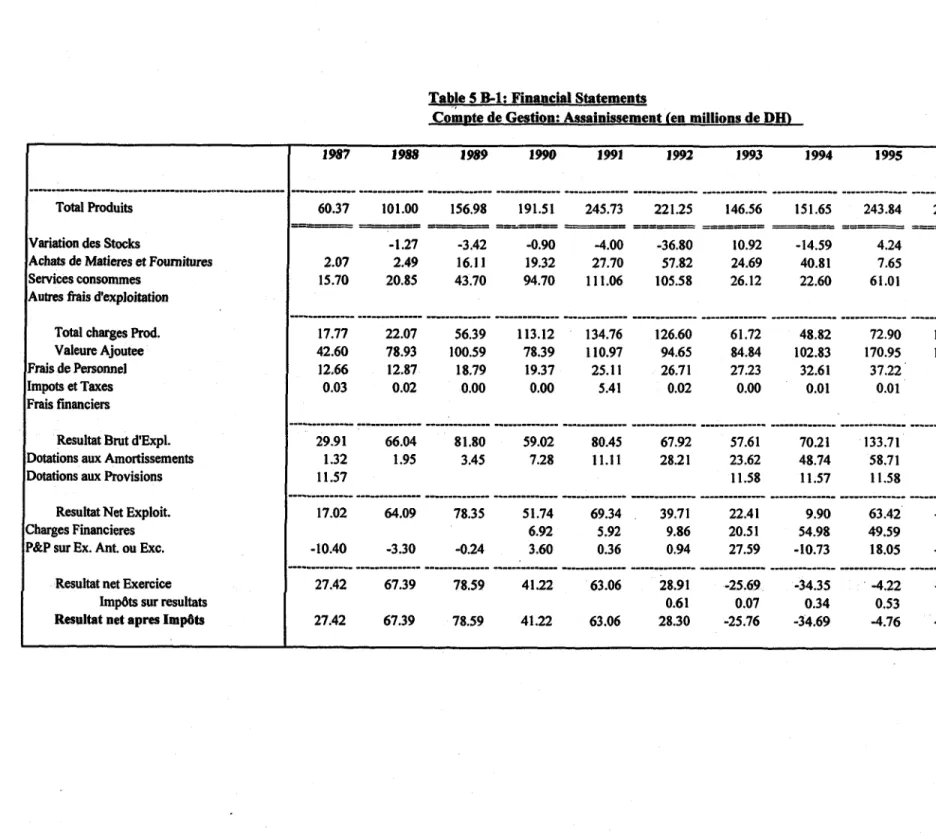
Table S B-1: Financial Statements
Compte de Gestion: Assainissement (en millions de DM)
1987 1988 1989 1990 1991 1992 1993 1994 1995 1996
…---Total Produits 60.37 101.00 156.98 191.51 245.73 221.25 146.56 151.65 243.84 252.74 Variation des Stocks -1.27 -3.42 -0.90 -4.00 -36.80 10.92 -14.59 4.24 25.32 Achats de Matieres et Fournitures 2.07 2.49 16.11 19.32 27.70 57.82 24.69 40.81 7.65 76.59 Services consommes 15.70 20.85 43.70 94.70 111.06 105.58 26.12 22.60 61.01 10.49 Autres fiais d'exploitation
Total charges Prod. 17.77 22.07 56.39 113.12 134.76 126.60 61.72 48.82 72.90 112.40 Valeure Ajoutee 42.60 78.93 100.59 78.39 110.97 94.65 84.84 102.83 170.95 140.34 FraisdePersonnel 12.66 12.87 18.79 19.37 25.11 26.71 27.23 32.61 37.22 63.03
Impots et Taxes 0.03 0.02 0.00 0.00 5.41 0.02 0.00 0.01 0.01 0.40
Frais financiers
ResultatBrutd'Expl. 29.91 66.04 81.80 59.02 80.45 67.92 57.61 70.21 133.71 76.91 Dotations aux Amortissements 1.32 1.95 3.45 7.28 11.11 28.21 23.62 48.74 58.71 81.93
Dotations aux Provisions 11.57 11.58 11.57 11.58 11.58
Resultat Net Exploit. 17.02 64.09 78.35 51.74 69.34 39.71 22.41 9.90 63.42 -16.60
Charges Financieres 6.92 5.92 9.86 20.51 54.98 49.59 58.22
P&P sur Ex. Ant. ou Exc. -10.40 -3.30 -0.24 3.60 0.36 0.94 27.59 -10.73 18.05 -55.13 Resultat net Exercice 27.42 67.39 78.59 41.22 63.06 28.91 -25.69 -34.35 -4.22 -19.70
Imp6ts sur resultats 0.61 0.07 0.34 0.53 1.16
1987 1988 1989 1990 1991 1992 1993 1994 1995 1996 … .
.. - ... -- -- -- -- - .... - - - ... - - - .... ---Immobilisations 247.43 256.81 302.66 380.14 493.02 581.18 1105.98 1584.96 1454.29 1972.24 Valeurs d'Exploitation 0.00 1.27 4.68 5.58 9.58 46.39 35.47 50.06 45.82 20.50 Valeurs Realisables (Compte Clients) 78.38 103.09 177.06 223.98 317.52 314.60 161.73 105.22 233.80 223.54
Autres Valeurs Realisables 0.51 247.19 240.49 211.61
Total Valeurs realisables 78.38 104.36 181.74 229.56 327.10 360.99 197.71 157.47 279.88 244.30 Total Valeurs Real.& Dispo. 78.38 104.36 181.47 229.56 327.10 360.99 197.71 402.47 520.10 455.65 Total Actifs 325.81 361.17 484.13 609.70 820.12 942.17 1303.69 1987.49 1974.39 2427.89
Capital Social 233.80 233.56 233.32 233.08 233.08 244.65 256.22 256.22 256.22 256.22
co
Participations des Abonnes 9.62 18.93 47.90 103.31 194.10 215.81 274.48 296.06 335.15 941.34 Reports aNouveau 27.52 94.81 173.40 214.62 277.68 305.97 280.22 245.53 240.77 219.91 Totaux Fonds Propres 270.94 347.30 454.62 551.01 704.86 766.43 810.92 797.81 832.14 1417.47 Dettes a Long Termes 0.00 9.20 31.65 80.80 104.36 420.01 762.03 776.75 757.01
Dettes a court terme 54.97 13.87 20.58 27.04 34.47 71.38 72.76 427.33 365.48 253.39 Total DCT. 54.97 13.87 20.58 27.04 34.47 71.38 72.76 427.33 365.48 253.39 Total Passifs 325.91 361.17 484.40 609.70 820.70 942.17 1303.69 1987.43 1974.43 2427.88
Table S B-3: Cash Flow-Assainissement- (en millions de DH)
1987 1988 1989 1990 1991 1992 1993 1994 1995 1996 88/96 Resultats nets apres impots 27.42 67.39 78.59 41.22 63.06 28.30 -25.76 -34.69 -4.76 -20.86 192.50 Plus Dotations aux Amortissements 1.32 1.95 3.45 7.28 11.11 28.21 23.62 48.74 58.71 81.93 265.00 Plus charges Financieres 0.00 0.00 0.00 6.92 5.92 9.86 20.51 54.98 50.91 99.99 249.09 Generation interne de fonds 28.74 69.34 82.04 55.42 80.09 66.37 18.37 69.03 104.86 161.06 706.58 Variation des besoins en F.R. 78.38 25.98 77.38 47.82 97.54 33.89 -163.28 -395.08 184.52 76.51 -14.72 Service de la Dette 0.00 0.00 0.00 6.92 5.92 9.86 23.72 76.21 130.17 122.92 375.72 Participation des Abonnes 9.62 9.31 28.97 55.41 90.79 21.71 58.67 21.58 21.58 606.19 931.72 Generation nette de fonds -40.02 52.67 33.63 56.09 67.42 44.33 216.60 409.48 -170.73 567.82 1277.31 Emprunts 54.97 -41.10 6.71 6.46 7.43 36.91 315.66 363.24 93.98 31.39 820.68 Subventions 232.48 -0.87 -1.74 -4.07 -3.83 -5.53 16.16 134.93 -28.20 106.85 Autres ressources (reintegrations) 0.00 0.00 0.00 0.00 0.00 0.00 0.00 0.00 115.05 0.00 115.05 Total Fonds disponibles 247.43 10.70 38.60 58.48 71.02 75.71 548.42 772.72 173.23 571.01 2319.89 Nouveaux Investissements 247.43 24.71 73.97 46.92 93.54 104.80 548.42 527.72 178.01 599.88 2197.97
Autres Emplois 0.00 -14.01 -35.37 11.56 -22.52 -29.09 -89.43
Variation de tresorerie 0.00 0.00 0.00 0.00 0.00 0.00 0.00 245.00 -4.78 -28.88 211.35 245.00 240.22 211.35
Implementation Completion Report Kingdom of Morocco
Greater Casablanca Sewerage Project (Loan 2826-MOR)
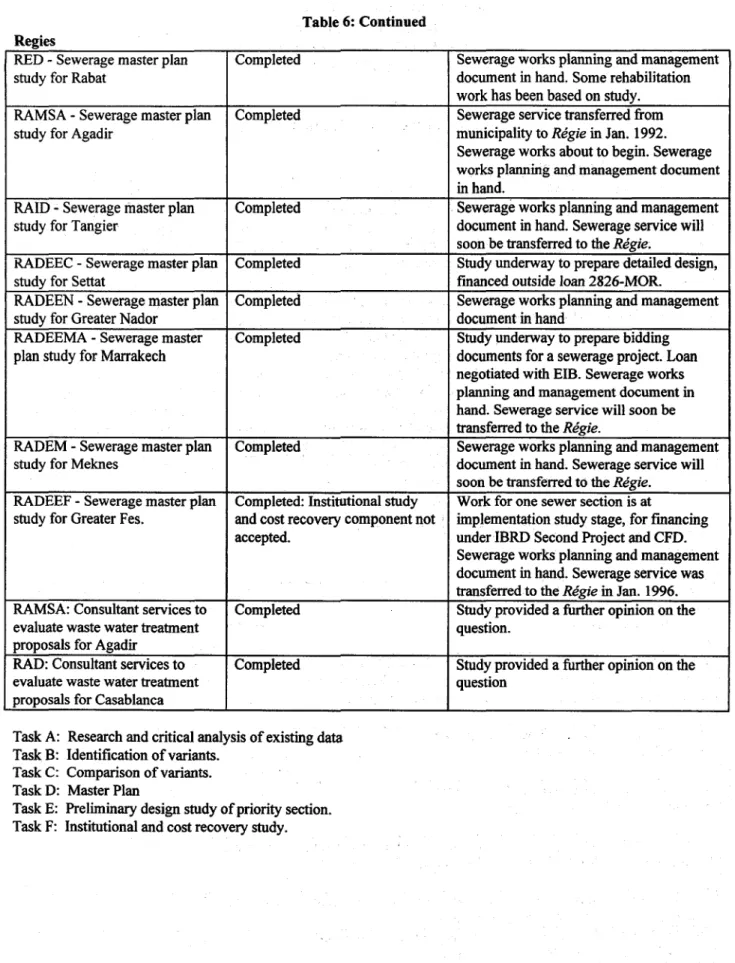
Table 6: Studies Included in the Project RAD: Technical assistance
Study and Purpose Status Impact
TA and training for RAD TA was provided to RAD by an Helped RAD to manage project. Training personnel by a sewerage operating company from 1987- component was weak (only 9 percent of specialist company to help RAD 1994, for 425 man-months, same total time). Informal training effect develop its sewerage as called for in SAR (420) resulted from direct contact between management capacity experts and RAD personnel. Study for Greater Casablanca 3 of 5 tasks were achieved. Task Promoted thinking on waste water Antipollution System Master Plan relating to Master Plan itself was discharge elimination but did not resolve
not achieved, and that relating to problem. Not only was study not fnished supporting measures was not (basic assumptions were rejected) but undertaken. Project manager, on urban data were changed (mosque district
advice of TA company, rejected and Mohammedia). RAD has assigned basic assumptions already study to another consultant to determine
accepted by previous mission. discharge elimination options. Rest of Contract canceled after 4 12 years study must be updated.
Study of priority section of Study not completed. Contract No positive impact. Greater Casablanca Antipollution canceled after 3 years, due to
System changes in mosque district and Mohammedia.
Environmental impact study of Not done Greater Casablanca Antipollution
System
Topographical mapping for sewer Done Improved knowledge of network in areas rehabilitation in low-lying areas studied, but not followed by any major of Mohammedia -Ain Sebaa - rehabilitation program. No provision for
Bemoussa updating maps.
APS + DCE sector study for Hay Underway. Two first tasks Part of study was used for work in Sidi Hassani Northwest-Route d'El completed. Third (last) task more El Khadir, Dar Bouazza East and Oulfa Jadida-Dar Bouazza-East. Lot than 90 percent complete. sectors. Rest of study is in projects bank.
N°l.
APS + DCE sector study for Sidi Completed. Minor portion of study was used for Moumen East - Mellil North. Lot works at Sidi Barnoussi. Rest of study is
No 2. in projects bank.
APS + DCE sector study for Ain Completed. Part of study used for Ain Harrouda Harrouda. Lot NO 3. transfer project. Rest of study is in
projects bank. APS + DCE sector study for Underway. Pending preparation Projects bank. Mohammedia - Ben Yakhlef. Lot of fnal bidding documents.
NO
4
APS + DEC sector study for Dar Study suspended at provisional No positive impact Bouazza Coastal sector. Lot N° 5. APS stage
APS + DCE study of Bouskra- Study suspended at provisional No positive impact. Oueled Salah sector. Lot NO 6. APS stage. I
21
-Table 6: Continued
Regies
RED - Sewerage master plan Completed Sewerage works planning and management
study for Rabat document in hand. Some rehabilitation
work has been based on study. RAMSA - Sewerage master plan Completed Sewerage service transferred from
study for Agadir municipality to Regie in Jan. 1992.
Sewerage works about to begin. Sewerage works planning and management document
in
hand.RAID - Sewerage master plan Completed Sewerage works planning and management
study for Tangier document in hand. Sewerage service will
soon be transferred to the Regie.
RADEEC - Sewerage master plan Completed Study underway to prepare detailed design,
study for Settat financed outside loan 2826-MOR.
RADEEN - Sewerage master plan Completed Sewerage works planning and management
study for Greater Nador document in hand
RADEEMA - Sewerage master Completed Study underway to prepare bidding plan study for Marrakech documents for a sewerage project. Loan
negotiated with EIB. Sewerage works planning and management document in hand. Sewerage service will soon be transferred to the
Regie.
RADEM - Sewerage master plan Completed Sewerage works planning and management
study for Meknes document in hand. Sewerage service will
soon be transferred to the Rfgie. RADEEF - Sewerage master plan Completed: Institutional study Work for one sewer section is at
study for Greater Fes. and cost recovery component not implementation study stage, for fmancing accepted. under IBRD Second Project and CFD.
Sewerage works planning and management document in hand. Sewerage service was transferred to the
Regie
in Jan. 1996. RAMSA: Consultant services to Completed Study provided a further opinion on theevaluate waste water treatment question.
proposals for Agadir
RAD: Consultant services to Completed Study provided a further opinion on the
evaluate waste water treatment question
proposals for Casablanca
Task A: Research and critical analysis of existing data Task B: Identification of variants.
Task C: Comparison of variants. Task D: Master Plan
Task E: Preliminary design study of priority section. Task F: Institutional and cost recovery study.
Appraisal estimate Actual Completion Bank
Local Foreign Total Local Foreign Total Rates Loan
Greater Casablanca 78.12 26.28 104.40 57.54 23.11 80.65 77.25% 37.21
I - Replacement of Sewers &
Pumping Stations (RAD) 67.14 16.64 83.78 52.03 3.70 55.73 66.52% 28.05
II - Supply of Equipment (RAD) 4.57 3.88 8.45 4.21 5.23 9.44 111.72% -0.99
III-Technical Assistance 6.41 5.76 12.17 1.30 14.18 15.48 127.20% -3.31
R6fies SeweraEe Studies 5.39 7.12 12.51 0.75 9.70 10.45 0.84 9.70
RED 1.51 1.95 3.46 0.06 1.83 1.89 54.62% 1.83 RAMSA 0.58 0.77 1.35 0.03 1.17 1.20 88.89% 1i .17 RAID __|_ 0.63 0.83 1.46 0.04 1.90 1.94 132.88% 1.90 RADEEC 0.28 0.39 0.67 0.06 0.57 0.63 94.03% 0.57 RADEEN 0.28 0.39 0.67 0.14 0.60 0.74 110.45% 0.60 RADEEMA 0.63 0.84 1.47 0.04 0.98 1.02 69.39% 0.98 RADEEM 0.66 0.87 1.53 0.08 1.10 1.18 77.12% 1.10 RADEEF 0.82 1.08 1.90 0.30 1.55 1.85 97.37% 1.55 Total 83.51 33.40 116.91 58.29 32.810 91.10 77.92% 46.90
-23
-Implementation Completion Report Kingdom of Morocco
Greater Casablanca Sewerage Project (Loan 2826-MOR)
Table 8: Status of Legal Covenants
Loan Covenant type Present Fulfillment Description Comments
Reference Status Date
Loan Financial NC N/A Special Account to be at GOM responsible for S.A
Agreement Central
II b Bank.
L.A Audit/Accounts CD N/A Submission of audit reports Ministry of Interior, Regies IV (b.ii) not later than six months responsible for
after the end of each fiscal audit reports year.
L.A. Implementation C 03/88 Agreement between GOM GOM & Regies were Sc l(b) (i) Operational 09/88 and responsible for such an
1989 every Regie involved in the agreement. However subject to
1994 project. delays.
L.A. Financial NC N/A Loan agreements to be
Sc I (b) (ii) signed
between Regies and FEC
L.A. Implementation CD 04/89 Recruiting of Consultants Delays in studies and selection Section 3.03 Operational 06/89,09/89 for of consultants
11/89,01/90 project and feasibility 01/91,02/94 studies
04/95.
L.A Implementation CD 06/3011990. Studies included in section Regies were responsible Section 3.03 Operational 05/93 B of L.A are to be for studies.
& P.A 07/95 completed and sent to the Delays occurred.
section 2.03 Bank including all
recommendations
L.A Implementation C 01/91 The Borrower shall Implementation of
Section 3.03 Operational implement all management and accounting recommendations (of study recommendations studies)as mentioned in
Table 8: Continued
L.A Financial C covenant fulfilled The Borrower must make sure that Regies provided Section 4.02 account/audit yearly municipalities include, in their counterpart funds
accounts and budgets, the debt and bear the debt service of the loan service of the loan. L.A Financial CD Complied with in Payables dues to RAD by delays in compliance, Section 4.03 1988 and 1993 institutions and Public enterprises new procedures
must be settled by 04/30/88 implemented. C.L arrears are
.__ _ _ _ _ _ _ _ _ _ _ _ _ _ _ _ _ _ _ _ _ _ _ _ _ _ _ _ _ _ _ _ _ _ _ _ _ _ _ _ _ _ _ _ _ _ _ _ _ _ _ _ _ _ _ _ _ _ _ _ _ _ _ b u il d i ngn u p
L.A Financial CD, CP. Public Enterprises must pay RAD's Complied with Section 4.03 sewerage services within 90 days
P.A Management and CD Quarterly RAD shall provide the Bank as well Complied with Section 2.04 operations as the GOM, a progress report on
project operations (quarterly).
P.A IV (b) Financial review CD Yearly Submission of audit reports not later RAD and GOM (ii) account/audit than six months after the end of each responsibility.
fiscal year. Compliance was delayed. Ad hoc audit unit created. Audit reports up to date. Reserve opinion P.A Financial C Yearly Internal cash generation ratio should Complied with Section 4.02 performance equal or greater than 40 percent,
Covenant types that apply: I. Accounts/audits 2. Financial performance
3. Flow and utilization of project funds 4. Counterpart funding
5. Management aspects of the project or the executing agency 9. Monitoring, review and reporting
10. Project implementation not covered by categories 1-9
11. Sectoral or cross sectoral budgetary or other resource allocation 12. sectoral or cross sectoral policy/regulatory/institutional action 13. Other.
Status:
C = Complied with CD = Compliance after delay CP = Complied with partially NC = Not complied with