IMT School for Advanced Studies Lucca
Lucca, Italy
Distributed Proximal Algorithms for
Large-Scale Structured Optimization
PhD Program in Institutions, Markets and Technologies
Curriculum in Control Systems
XXX Cycle
Puya Latafat
2020
The dissertation of Puya Latafat is approved.
Program Coordinator: Prof. Rocco De Nicola, IMT Lucca Supervisor: Prof. Panagiotis Patrinos, KU Leuven Supervisor: Prof. Alberto Bemporad, IMT Lucca
The dissertation of Puya Latafat has been reviewed by: Prof. Mikael Johansson, KTH Royal Institute of Technology Prof. Volkan Cevher, École polytechnique fédérale de Lausanne
IMT School for Advanced Studies Lucca
2020
To Nadira, Hamid and Hamed. To Giovanna and Andreas.
Preface
I wish to express my deepest appreciation to my advisor Prof. Panagi-otis Patrinos without whom this thesis would never have been possible. Panos introduced me to a fascinating area of research I knew nothing about and guided me patiently every step of the way. I cannot thank him enough for everything that I have learned from him, for the amaz-ingly friendly environment and the perfect balance between freedom in research and guidance. It has been a great privilege and a delight to study with him.
I am deeply grateful to Prof. Alberto Bemporad for accepting me in his research group, the exceptional working environment, and all the support throughout the past five years.
I wish to thank the members of my examination committee, Prof. Volkan Cevher, Prof. Mikael Johansson, Prof. Alexander Bertrand, Prof. Goele Pipeleers and Prof. Mario Zanon for their efforts in reviewing this thesis and their insightful comments that have helped improve the quality of this work.
I would like to thank IMT Lucca, KU Leuven, and the Research Foun-dation Flanders (FWO) for supporting my studies in Italy and Belgium during the past five years. I am grateful to the staff for their relentless sup-port. My special thanks to Daniela Giorgetti, Sara Olsun, Maria Mateos Irigoyen and Serena Argentieri in Lucca; Ida Tassens, Aldona Niemiro Sznajder, Elsy Vermoesen and Graziella Del Savio at KU Leuven.
I am especially thankful to Nick, for his encouragements and sharp observations, Lorenzo, whose many developed packages I have used throughout my PhD and learned a lot from, and Andreas, for volunteering his time, math and TEX skills without hesitation.
I also wish to thank all my friends and colleagues from IMT Lucca with whom I have shared many ping pong matches, Turkish baths, road trips, cycling lessons, ice creams, and stories of statues coming to life. Thank you Vasilis, Valerio, Veronique G., Vigneswarangovindarajan, Valentina C., Double Kumar, Dilip Mejari, Kulynovic, Carollo, Ilkay, Unal, Domagoj, Haneen, Van Tien, Anita, Soumali, Vincenzo, Paolo, Mogens, Alessandro, Luca and somebody random.
I have also shared many fond memories with friends and colleagues in Leuven: Bottegaal, Federica, Leen, Qinghua, Zahra, Reza, Kim, Koen, Riccardo, Bertrand, Mathjis, Arun, Joachim, Michael, Peter, Olga, Rocco, Carlos, Orest, Daniele, Ilyar, Oscar, Yinxue, Yingyi, Angela, Marcin,
Man-ish, and Prof. Borgioli. I specially thank Silvio who has made everything less bad by holding out his hand.
Even though continents apart, I thank Ilyar for sharing precious life lessons on how digesting stones can repulse policemen, and how certain sweets age well, Ehsan, for his battle with concupiscence and appar-ent childhood osteoporosis, Gaban, for his stable and reassuring rate of mysterious disappearances, Sasha, for being a role model of tranquil-ity, Crispy, for making me live through the eighteenth century culture, Cansu, for being so taarof, Ali and Sina, for their expertise in forgery re-lated sciences, Peyman, for having a dream, and Rinel, for still waiting for his colors.
I had the original idea of writing a six page long acknowledgment mostly about having a low SES, and with secret messages embedded inside the paragraphs. But then I realized that I was beaten to it by certain individuals. Besides, I cannot possibly express the true magnitude of my gratitude to Andreas for all the soothing whistles, educational videos on wildlife, and most importantly, for introducing me to the godly words of Mosconi. Neither can I really articulate the degree of disgust and horror that I have been subjected to by the many graphic tales casually told by Veronique. How can I truly express the sempiternal effects of Pantelis’ whimsy, the importance of helmets among shepherds of Veneto, the cultural significance of buffoons in Hindi language and civilization, or how impressed I was with the sheer amount of wealth that a single Shabi could amass. How could I do justice to the kindness of Masoud and Julia and their companion Suzan, to the most mighty and kind President, Daniele, or to the promising young graphic designer Sureman. On a more serious note, I thank Hothouse co. for their essential role in my battle against fungi in Leuven.
I wish to sincerely thank Anna, Maria Pia, Lala, Franca and D’Inverno family who have been so kind to me, and have helped me in my hour of need; Grazie per la vostra gentilezza, per essermi state vicino ed avermi aiutato nei momenti in cui ne ho avuto bisogno.
Finally, I would not be here if it was not for my parents Nadira and Hamid, and their thoughtful support throughout my life. I am specially indebted to my brother Hamed for giving me the opportunity to learn from his mistakes. I am also grateful to my grandma and my aunts for their encouragements throughout my childhood.
Puya Latafat Leuven, June 2020
Contents
Preface v
Abstract xi
Index of Symbols xiii
Index of Abbreviations xv
Vita & publications xvii
1 Introduction 1
1.1 Overview of the thesis . . . 6
1.2 Preliminary material . . . 9
1.2.1 Vector notation . . . 9
1.2.2 Sequences . . . 9
1.2.3 Functions and operators . . . 10
1.2.4 Subgradients . . . 12
1.2.5 Conjugate functions and infimal convolution . . . 13
1.2.6 Proximal mappings and Moreau envelopes . . . 14
2 Asymmetric forward-backward-adjoint splitting 15 2.1 Introduction . . . 15
2.2 Asymmetric forward-backward-adjoint splitting . . . 17
2.2.1 Convergence analysis . . . 18
2.3 Operator splitting schemes as special cases . . . 30
2.3.1 Forward-backward splitting . . . 30
2.3.2 Solodov and Tseng . . . 31
2.3.3 Forward-backward-forward splitting . . . 31
2.3.4 Douglas-Rachford type with a forward term . . . 32
2.4 Conclusions . . . 40
3 A unifying framework for primal-dual proximal algorithms 41 3.1 Introduction . . . 41
3.2 A simple framework for primal-dual algorithms . . . 42
3.2.1 Primal-dual algorithms with constant stepsize . . . 44
3.3 Simplified asymmetric forward-backward-adjoint splitting . . 51
3.4 A unified convergence analysis for primal-dual algorithms . . 57
3.4.1 Linear convergence . . . 59
3.5 Stepsize selection and simulations . . . 64
3.6 Conclusions . . . 69
4 A randomized block-coordinate primal-dual proximal algorithm 71 4.1 Introduction . . . 71
4.2 Triangularly preconditioned primal-dual algorithm . . . 75
4.2.1 Related primal-dual algorithms . . . 81
4.3 A randomized block-coordinate algorithm . . . 83
4.4 Linear convergence . . . 88
4.5 Distributed optimization . . . 94
4.6 Application: formation control . . . 99
4.7 Conclusions . . . 103
5 Plug and play distributed model predictive control 105 5.1 Introduction . . . 105
5.2 Problem setup . . . 107
5.3 A primal-dual algorithm for DMPC . . . 109
5.4 Deriving the algorithm and convergence results . . . 113
5.5 Numerical simulations . . . 116
5.6 Conclusions . . . 119
6 A primal-dual proximal algorithm for distributed optimization over graphs 121 6.1 Introduction . . . 121
6.2 Problem formulation . . . 124
6.3 Distributed primal-dual algorithms . . . 125
6.3.1 Special case . . . 129
6.4 Numerical simulations . . . 130
7 Multi-agent structured optimization with bounded communica-tion delays 133 7.1 Introduction . . . 133
7.1.1 Motivating examples . . . 137
7.1.2 Main contributions . . . 138
7.2 Problem setup . . . 139
7.3 Notation and preliminary results . . . 142
7.5 The case of total coupling . . . 150
7.5.1 An AHU-type primal-dual algorithm . . . 150
7.5.2 Randomized variant . . . 155
7.6 Numerical simulations . . . 161
7.7 Conclusions . . . 162
8 Block-coordinate and incremental aggregated proximal gradient methods 163 8.1 Introduction . . . 163
8.1.1 The main block-coordinate algorithm . . . 165
8.1.2 Contributions . . . 166
8.1.3 Organization . . . 167
8.2 Convergence analysis . . . 168
8.2.1 The forward-backward envelope . . . 168
8.2.2 A sure descent lemma . . . 171
8.2.3 Randomized sampling . . . 173
8.2.4 Cyclic, shuffled and essentially cyclic samplings . . . 177
8.2.5 Global and linear convergence with KL inequality . . . 181
8.3 Nonconvex finite sum problems: the Finito/MISO algorithm . 183 8.3.1 A low memory variant . . . 187
8.4 Nonconvex sharing problem . . . 188
8.5 Numerical simulations for the regularized finite sum problem 191 8.6 Conclusions . . . 193
8.7 The key tool: the forward-backward envelope . . . 195
8.7.1 Further results . . . 195
Conclusions 199 Future directions . . . 200
Abstract
Efficient first-order algorithms for large-scale distributed op-timization is the main subject of investigation in this thesis. The algorithms considered cover a wide array of applications in machine learning, signal processing and control.
In recent years, a large number of algorithms have been in-troduced that rely on (possibly a reformulation of) one of the classical splitting algorithms, specifically forward-backward, Douglas-Rachford and forward-backward-forward splittings. In this thesis a new three term splitting technique is devel-oped that recovers forward-backward and Douglas-Rachford splittings as special cases. In the context of structured opti-mization, this splitting is leveraged to develop a framework for a large class of primal-dual algorithms providing a uni-fied convergence analysis for many seemingly unrelated al-gorithms. Moreover, linear convergence is established for all such algorithms under mild regularity conditions for the cost functions.
As another notable contribution we propose a randomized block-coordinate primal-dual algorithm that leads to a fully distributed asynchronous algorithm in a multi-agent model. Moreover, when specializing to multi-agent structured opti-mization over graphs, novel algorithms are proposed. In ad-dition, it is shown that in a multi-agent model bounded com-munication delays are tolerated by primal-dual algorithms provided that certain strong convexity assumptions hold. In the final chapter we depart from convex analysis and con-sider a fully nonconvex block-coordinate proximal gradient algorithm and show that it leads to nonconvex incremental aggregated algorithms for regularized finite sum and sharing problems with very general sampling strategies.
Index of Symbols
Natural numbers{0,1,2, . . .}
Real numbers
Extended real numbers∪ {∞} n×m Space of realn×mmatrices
Sn Space of realn×nsymmetric matrices
S+n Space of realn×nsymmetric positive semidefinite matrices
S++n Space of realn×nsymmetric positive definite matrices
∅ Empty set
H,G Real Hilbert spaces
B(H,G) Space of bounded linear operators fromHtoG
B(H) SpaceB(H,H)
Γ0(H) Set of proper lsc convex functions fromHto
(Ω,F,P) Probability space
wk*w Weak convergence
wk→w Strong convergence
M> Transpose of matrixM ranM Range of matrixM
blkdiag Creates a block diagonal matrix
In Identityn×nmatrix
0n Zeron×nmatrix
id Identity mapping
F:A⇒B A set-valued operator
domF Domain of operatorF graF Graph of operatorF zerF Set of zeros of operatorF fixF Set of fixed points of operatorF F−1 Inverse of operatorF
JF Resolvent of operatorF
NX Normal cone operator of setX
domf Domain of extended-real-valued function f epif Epigraph of function f
lev≤α α-(sub)level set off f∗ Fenchel conjugate
fg Infimal convolution of functionsf andg
δX Indicator function of setX
f:A→B Single-valued function
riC Relative interior
[r]+ Positive part ofr:max{0,r}
PVX Projection onto setXwrtk · kV
proxV
distV(x,X) Distance ofxfrom setXwrtk · kV ˆ ∂f Regular subdifferential off ∂f (Limiting) subdifferential of f ∂Bf Bouligand subdifferential of f ∇f Gradient off ∇2f Hessian off
O(·) Big-OBachmann–Landau notation
Index of Abbreviations
a.s. Almost surely
ADMM Alternating direction method of multipliers
AFBA Asymmetric forward-backward-adjoint splitting
DMPC Distributed model predictive control
DRS Douglas-Rachford splitting
ERM Empirical risk minimization
FBFS Forward-backward-forward splitting
FBE Forward-backward envelope
FBS Forward-backward splitting
FNE Firmly nonexpansive
iff If and only if
i.i.d. Independent and identically distributed
lsc Lower semicontinuous
LP Linear program
MPC Model predictive control
osc Outer semicontinuous
PLQ Piecewise linear-quadratic
QP Quadratic program
SVM Support vector machine
Vita
Sept. 23, 1989 Born, Tabriz, Iran
2007-2011 B.Sc. in Electrical Engineering-Control Systems University of Tabriz, Iran
2012-2014 M.Sc. Mathematical Modeling in Engineering (MathMods, Erasmus Mundus Master Program)
Final mark: 110/110 cum laude
University of L’Aquila, Italy - University of Hamburg, Ger-many
Since 2014 Ph.D. in Control Systems
IMT School for Advanced Studies Lucca, Italy 2015-2016 Visiting student
KU Leuven, Belgium
ESAT - Departmet of Electrical Engineering Since 2016 Ph.D. student jointly at KU Leuven, Belgium
ESAT - Departmet of Electrical Engineering Since 2017 FWO Ph.D. fellow, Belgium
Publications
Journal papers
[101] P. Latafat, A. Themelis and P. Patrinos.
Block-coordinate and incremental aggregated proximal gradient methods for non-smooth nonconvex problems.
arXiv:1906.10053 (submitted 2019).
https://arxiv.org/abs/1906.10053
[99] P. Latafatand P. Patrinos.
Primal-dual algorithms for multi-agent structured optimization over message-passing architectures with bounded communication delays.
arXiv:1809.07199 (submitted 2019).
https://arxiv.org/abs/1809.07199
[95] P. Latafat, N. M. Freris and P. Patrinos.
A new randomized block-coordinate primal-dual proximal algorithm for distributed optimization.
IEEE Transactions on Automatic Control, vol. 64, no. 10, Oct. 2019, pp. 4050-4065
https://ieeexplore.ieee.org/document/8673559
[96] P. Latafatand P. Patrinos.
Asymmetric forward-backward-adjoint splitting for solving monotone inclusions involving three operators.
Computational Optimization and Applications, vol. 68, no. 1, Sep. 2017, pp. 57-93.
https://doi.org/10.1007/s10589-017-9909-6
Contributions to books
[98] P. Latafatand P. Patrinos.Primal-dual proximal algorithms for structured convex optimization: a unifying framework.
In Chapter 5 of Large-Scale and Distributed Optimization, (Giselsson P., and Rantzer A., eds.), vol. 2227 of Lecture Notes in Mathematics, Springer International Publishing, 2018, pp. 97-120.
Conference papers
[100] P. Latafat, L. Stella and P. Patrinos.
New primal-dual proximal algorithms for distributed optimization.
In Proc. of the 2016 IEEE 55th Conference on Decision and Control (CDC 2016), Las Vegas, USA, Dec. 2016, pp. 1959-1964.
https://ieeexplore.ieee.org/document/7798551
[94] P. Latafat, A. Bemporad and P. Patrinos.
Plug and play distributed model predictive control with dynamic coupling: a randomized primal-dual proximal algorithm.
In Proc. of the European Control Conference (ECC), Limassol, Cyprus, Jun. 2018, pp. 1160-1165.
https://ieeexplore.ieee.org/document/8550270
[97] P. Latafatand P. Patrinos.
Multi-agent structured optimization over message-passing architectures with bounded communication delays.
In Proc. of the 57th IEEE Conference on Decision and Control (CDC), Miami Beach, Florida, Dec. 2018, pp. 1688-1693.
Chapter 1
Introduction
One of the main goals of current distributed optimization research is to develop easy-to-implement iterative schemes for structured problems. To this end, proximal algorithms have become the standard tool; they are suitable for large-scale, nonsmooth problems with different compu-tational models. These methods operate bysplittingthe original problem into simpler subproblems that involve one function at a time and can of-ten be solved efficiently. The most widely used proximal algorithms are the proximal gradient and Douglas-Rachford methods that are based on the classical two term splittings, forward-backward splitting (FBS) and Douglas-Rachford splitting (DRS).
Consider the structured convex optimization problem
minimize
x∈n ϕ(x)
f(x)+g(x)+h(Lx), (1.1)
whereLis a linear mapping,gandhare extended-real-valued nonsmooth functions, andf is continuously differentiable with Lipschitz continuous gradient. The proximal gradient method solves (1.1) whenh◦L≡0, and the Douglas-Rachford algorithm solves it whenf ≡0 andLis the identity. The idea here is that in many applications (1.1) is formulated such that the proximal mappings (cf. to §1.2.6) of g and h are easy to compute (refer to [14, §6 and §7], [49,130] for extensive lists of commonproximable
functions) but this is not the case forg+h◦Lor f+h◦L. In fact, in general
even the proximal mapping ofh◦Lcannot be efficiently computed based on that ofh. Therefore, having algorithms for the sum of more terms would allow us to effectively tackle larger classes of applications.
A recent trend for solving problem (1.1), possibly with the smooth
inclusion defined by the primal-dual optimality conditions [38,67,31,50,
53,170,62,96,32]. The popularity of this approach is mainly due to the fact that it results infully splitprimal-dual algorithms, in the sense that the proximal mappings ofgandh, the gradient off, the linear mapping
L and its adjoint are evaluated individually. In particular, there are no matrix inversions or inner loops involved.
Different convergence analysis techniques have been proposed in the literature for primal-dual algorithms. Some can be viewed as in-telligent applications of classical splitting methods such as backward splitting (FBS), Douglas-Rachford splitting (DRS) and forward-backward-forward splitting (FBFS), see for example [170,53,31,27,50], while others employ different tools to show convergence [38,84,62,39]. Convergence rates of primal-dual schemes have also been analyzed using different approaches, see for example [104,55,113,39].
Our approach here is a systematic one and relies on first introducing a new three term operator splitting method,asymmetric forward-backward-adjoint(AFBA) splitting that is designed for solving monotone inclusions involving the sum of three terms, a maximally monotone, a cocoercive and a bounded linear operator. While AFBA cannot be recovered from existing operator splitting methods, classical splittings DRS and FBS are its special cases. These are discussed in detail inSection 2.3. InChapter 3we develop a simple primal-dual framework (cf.Alg. 3.1) for problems of the form (1.1) by solving the primal-dual optimality conditions using the splitting methodAFBA. Based on this approach one can obtain a wide range of algorithms by selecting different values for two scalar parametersθ andµ (cf.Alg. 3.1). Many of the resulting algorithms are
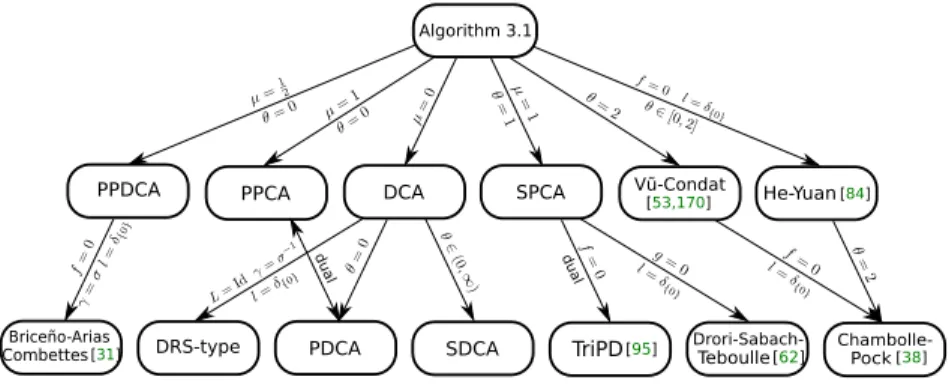
new, while some extend previously proposed algorithms and/or result in less conservative stepsize conditions.Figure 1.1provides an overview of several prominent special cases. The functionl, stepsizes and other parameters are defined inSection 3.2for the more general problem (3.1). These special cases are implemented in the open-source Julia Package
ProximalAlgorithms1as primal-dual AFBA solver.
Next, let us consider some motivating examples most of which are revisited throughout this thesis. Many machine learning applications involve solving empirical risk minimizations (ERM) of the form
minimize
x∈n 1 N N Õ i1 L(bi,hai,xi)+λΩ(x), (1.2) 1https://github.com/kul-forbes/ProximalAlgorithms.jlAlgorithm 3.1 II SPCA PPDCA dual PDCA DCA PPCA SDCA DRS-type dual Vũ-Condat [53,170] He-Yuan[84] Pock[38] Briceño-Arias
Combettes[31] TriPD[95] Drori-Sabach- Teboulle[62]
Figure 1.1:Algorithm 3.1and its special cases
where Ω is a regularizer (e.g., `1 norm or `2 norm, elastic net, etc), λ is a positive constant and the pair (ai,bi) represents the ith data. The
loss function denoted by L measures the mismatch of the model and
the observed data. This formulation includes many important problems such as LASSO, logistic regression, SVM [83,152]. Clearly, the ERM prob-lem (1.2) can be written in the form of (1.1) by setting g(x) λΩ(x), h(u) 1
N ÍNi1L(Yi,ui) (where u (u1,u2, . . . ,uN)) representing the
loss function with the rows ofLconsisting of a>
i , and f ≡ 0. When the loss function is smooth one may choose to represent it usingf and setting
h◦L0.
Another popular example in machine learning is the dual support vector machine problem [83]
minimize
α1,...,αN 1 2k N Õ i1 αibiaik2− N Õ i1 αi (1.3a)subject to
0≤αi ≤C, i1, . . . ,N (1.3b) N Õ i1 αibi0. (1.3c)This problem can be written in the form of (1.1) by letting f represent the quadratic cost,gthe indicator of box[0,C]N,hthe indicator of zero, andLb>whereb(b1, . . . ,bN). This problem is used inSection 3.5to
Total variation denoising is another popular problem encountered in image processing applications [145,37,54]:
minimize
x∈n1
2kAx−bk2+λkDxk1,2
subject to
x ∈CwhereDis the discrete gradient operator,k · k1,2is the`1,2 norm, andC enforces prior information on the target image,e.g., the pixels being in the range[0,255]. This problem is written in the form of (1.1) by setting
f(x) 1
2kAx−bk2, gthe indicator function of the setC,h(x) k · k1,2, andLD.
Model predictive control (MPC) is another application that can be formulated as in (1.1); the quadratic cost function may be represented by the smooth term f, the input and state constraints byg as the indicator function of the corresponding set, and the linear dynamics by h ◦L. Therefore, the resulting algorithm would involve simple matrix-vector products, and projection onto boxes and points.
Note that in many of the applications considered in this thesis we are interested in distributed algorithms in amulti-agentsetting where a group of “agents” solve a minimization problem cooperatively. For ex-ample, in distributed MPC one may have several physically separate sys-tems/agents each with its own dynamics who share a common goal, or in an ERM problem the data may be stored across multiple machines. A distributed algorithm would entail local computations by the systems/a-gents, and exchange of information with other agents.
Distributed algorithms are often derived by simply formulating a given problem in the form of (1.1) in such a way that solving it using a proximal algorithm (e.g., one of the special cases ofAlgorithm 3.1) results in a desired distributed implementation. Let us clarify by considering as an example the problem of minimizing a finite sum problem:
minimize
x∈n N Õ i1 fi(x),where fiare convex continuously differentiable functions with Lipschitz-continuous gradient. In order to solve this problem in a distributed way over a network of agents, one may consider the equivalent problem
minimize
x1,...,xN∈n N Õ i1 fi(xi),subject to
xixj (i,j) ∈ E,whereEdenotes the edge set of an underlying graph structure. We have effectively introduced slack variables for each agent in order to decou-ple the cost. The two problems are equivalent as long as the graph is connected. This problem can be written in the form of (1.1) with
f(x) ÍN
i1 fi(xi), and g ≡ 0,h the indicator of vector of zeros (of
ap-propriate dimension), andLB>⊗InwithBrepresenting the oriented
node-arc incidence matrix (cf.§6.2for details). Solving this problem with any of the special cases ofAlgorithm 3.1results in schemes where theith agent performs gradient operations onfi, as well as some consensus-type updates using variables that it exchanges with relevant agents (neigh-bors). In such an algorithm, fi (which may represent private data) does not need to be shared with other agents. This type of problem is studied in detail inChapter 6.
Our focus so far has been on methods that split the cost function as the sum of several functions, with iterations that involve gradient or proximal operations on each function separately. However, in many large-scale applications updating the variables only after a full gradient or proximal update may be too costly, slow or physically infeasible. A simple and powerful idea is instead to update a subset of coordinates at every iteration. These methods are hereafter broadly referred to as block coordinate (BC) methods. BC methods have a long history and have been studied under various settings [19,163,166,125,15,25,106,51,22,14].
In the context of multi-agent optimization, randomized BC methods admit updates that involve random activation of (subsets of) agents to perform local updates. These are sometimes referred to as asynchronous [88, 22, 134]. In this sense, occasionally, we also use the terminology synchronous to emphasize that at each clock tick all agents must perform their tasks and the iteration cannot proceed if any agent fails to do so. Note that this notion of asynchrony is quite different from the notions of
partialandtotal asynchronyintroduced in [20], since the information used by each agent must be up to date. We defer further details about notions of asynchrony and common computational models toSection 7.1.
Another interesting application of the BC framework is studied in
Chapter 8in the context of nonconvex optimization. It is shown that BC proximal gradient updates with a nonseparable nonsmooth term lead to stochastic and incremental methods for regularized finite sum and shar-ing problems. The analysis of this chapter is a departure from previous chapters where monotone operator theory and Fejér monotonicity made up most of the narrative. The Lyapunov function typically used in the
con-vergence analysis of the nonconvex proximal gradient method is the cost function; however, in the BC setting with nonseparable nonsmooth term even in expectation it does not necessarily decrease along the trajectories. Instead we show that the forward-backward envelope (FBE) [132,158] is a suitable Lyapunov function.
1.1
Overview of the thesis
We briefly describe the structure and content of the chapters. In Chapter 2 a three term operator splitting method,asymmetric forward-backward-adjoint splitting (AFBA) is introduced. Its convergence rate is studied under different assumptions and some prominent special cases are dis-cussed. As depicted inFigure 1.2 this splitting is instrumental in the developments of the subsequent five chapters. In particular, as discussed above, inChapter 3a general primal-dual framework is developed (see
Fig. 1.1) that relies on solving the primal-dual optimality conditions us-ing AFBA. Moreover, inSection 3.4.1 linear convergence is established for all the special cases under mild regularity assumptions for the cost functions.
Chapters2and3are based on:
Latafat, P., and Patrinos, P.Asymmetric forward–backward–adjoint splitting for solving monotone inclusions involving three operators.Computational Opti-mization and Applications 68, 1 (Sep 2017), 57–93.
Latafat P., Patrinos P.,Primal-Dual Proximal Algorithms for Structured Con-vex Optimization: A Unifying Framework, in Chapter 5 of Large-Scale and Distributed Optimization, (Giselsson P., and Rantzer A., eds.), vol. 2227 of Lecture Notes in Mathematics, Springer International Publishing, 2018, pp. 97-120.
InChapter 4a randomized block-coordinate primal-dual algorithm is introduced. The proposed algorithm features linear convergence rate when the functions involved are either piecewise linear-quadratic, or when they satisfy certain quadratic growth conditions. The developed al-gorithm is applied to the problem of multi-agent optimization on a graph, resulting in novel synchronous and asynchronous distributed methods. The proposed algorithms are fully distributed in the sense that the up-dates and the stepsizes of each agent only depend on local information. In fact, no (prior) global coordination is required. We showcase an ap-plication of our algorithm in distributed formation control. Moreover, as another application inChapter 5the problem of distributed model
pre-Chapter 2 Chapter 6 Chapter 4 Chapter 5 Chapter 3 Chapter 7 Convex Optimization Nonconvex Optimization Chapter 8 Monotone Inclusion Distributed Applications
Figure 1.2:Overview of the chapters
dictive control (DMPC) with coupling in the dynamics of the systems is considered. The resulting scheme does not require strong convexity, in-volves one round of communication at every iteration and allows a plug-and-play implementation where addition or removal of a subsystem only affects the neighboring nodes without the need for global coordination.
Chapter 4is based on:
Latafat, P., Freris, N. M., and Patrinos, P.A new randomized block-coordinate primal-dual proximal algorithm for distributed optimization.IEEE Transactions on Automatic Control 64, 10 (10 2019), 4050–4065.
Chapter 5is based on:
Latafat, P., Bemporad, A., and Patrinos, P.Plug and play distributed model predictive control with dynamic coupling: A randomized primdual proximal al-gorithm.In European Control Conference (ECC) (June 2018), pp. 1160–1165. Chapter 6considers a network of agents, each with its own private cost consisting of the sum of two possibly nonsmooth convex functions, one of which is composed with a linear operator. At every iteration each agent performs local calculations and can only communicate with its neigh-bors. The goal is to minimize the aggregate of the private cost functions and reach a consensus over a graph. A special case of AFBA is used to
develop a primal-dual algorithm for solving this minimization over the communication graph. It is demonstrated through computational exper-iments how suitably selecting the parameters of our algorithm can lead to larger stepsizes and yield better performance.
Chapter 6is based on:
Latafat, P., Stella, L., and Patrinos, P. New primal-dual proximal algorithm for distributed optimization. In 55th IEEE Conference on Decision and Control (CDC) (Dec 2016), pp. 1959–1964.
Chapter 7 considers primal-dual algorithms over message-passing (multi-agent) architectures with communication delays. It is assumed that the delay with respect to each neighbor is bounded but otherwise ar-bitrary. The global optimization problem is the aggregate of the local cost functions and a common Lipschitz differentiable function. When the cou-pling between agents is represented only through the common function, the primal-dual algorithm proposed by V ˜u and Condat [170,53] is em-ployed. In the case when the linear maps introduce additional couplings between agents a new algorithm is developed. Moreover, a randomized variant of this algorithm is presented that allows the agents to wake up at random and independently from one another. The convergence of the proposed algorithms is established under strong convexity assumptions.
Chapter 7is based on:
Latafat P.and Patrinos. P.Primal-dual algorithms for multi-agent structured optimization over message-passing architectures with bounded communication delays(submitted 2019).
Chapter 8deals with block-coordinate proximal gradient methods for minimizing the sum of a separable smooth function and a (nonsepara-ble) nonsmooth function, both of which are allowed to be nonconvex. The main tool in our analysis is the forward-backward envelope (FBE), which serves as a particularly suitable continuous and real-valued Lyapunov function. Global and linear convergence results are established when the cost function satisfies the Kurdyka-Łojasiewicz property without im-posing convexity requirements on the smooth function. Two prominent special cases of the investigated setting are regularized finite sum mini-mization and the sharing problem; in particular, an immediate byproduct of our analysis leads to novel convergence results and rates for the popu-lar Finito/MISO algorithm in the nonsmooth and nonconvex setting with very general sampling strategies.
Chapter 8is based on:
Latafat P., Themelis A. and Patrinos P.Block-coordinate and incremental ag-gregated proximal gradient methods for nonsmooth nonconvex problems.
arXiv:1906.10053 (submitted 2019).
1.2
Preliminary material
In this section we recap some standard definitions and results that are used throughout the thesis [143,13,144,18,14].
The set of real numbers is denoted by . The set of extended real numbers is defined as ∪ {∞}. We denote(a,b) B {x | a < x < b} where a,b can be taken to be ±∞, and square brackets[a,b] when equality is allowed in the definition. Intervals(a,b]and[a,b)are defined accordingly.
1.2.1
Vector notation
We denote bynthe standardn-dimensional Euclidean space with inner producth·,·iand induced normk · k. Forw(w1, . . . ,wN) ∈n,wi∈ni
is used to denote itsi-th (block) coordinate.
The sets of symmetric, symmetric positive semi-definite and sym-metric positive definiten-by-n matrices are denoted bySn,S+n andSn++,
respectively. We also writeP 0 andP 0 forP ∈ Sn+ andP ∈ Sn++,
respectively. ForP ∈S++n we define the scalar producthx,yiP hx,P yi
and the induced normkxkP phx,xiP. The identity matrix is denoted by
I
n∈n×n; we writeI
when no ambiguity occurs.1.2.2
Sequences
We use the notation (wk)
k∈I to denote a sequence with indices in the setI ⊆. Occasionally, when dealing with scalar sequences we use the subscript notation(γk)k∈I.
Definition 1.1(Fejér monotonicity). A sequence(wk)k∈is said to beFejér
monotone with respect to a nonempty setU ⊆nif for allv∈ Uand allk∈ kwk+1
−vk ≤ kwk−vk.
It is said to bequasi-Fejérmonotone with respect toU ⊆n if for allv ∈ U,
there exists a summable nonnegative sequence(εk)k∈such that for allk∈ kwk+1
Moreover, givenS∈S++n , we say that a sequence isS-(quasi)-Fejér monotone
with respect toU ⊆nif it is (quasi)-Fejér monotone with respect toUin the
space equipped withh·,·iS.
We use the following notions of linear convergence: • A sequence(wk)
k∈is said to converge to a point w
?(at least)Q
-linearly(with quotient rate) withQ-factor given byσ∈ (0,1), if there existsk0∈such that for allk≥k0,
kwk+1
−w?k ≤σkwk−x?k. • A sequence(wk)
k∈ is said to converge to a pointw?(at least)R
-linearly(with root rate) if there exists a sequence of nonnegative scalars(vk)
k∈ such that kwk−w?k ≤ vk and (vk)k∈ converges Q-linearly to zero.
1.2.3
Functions and operators
An operator (or set-valued mapping) F : n ⇒ d maps each point
x ∈nto a subsetFxofd. We denote the domain ofFby
dom
F B{x∈n |Fx,∅},its graph by
gra
F B{(x,y) ∈n×d | y∈ Fx},the set of its zeros by
zer
F B {x ∈ n | 0 ∈ Fx}, and the set of its fixed points byfix
F B {x | x ∈ Fx}. The inverse of F is defined through its graph:gra
F−1 B {(y,x) | (x,y) ∈gra
F}. TheresolventofFis defined byJ
F B(id
+F)−1, whereid
denotes the identity operator. The mappingF is calledmonotoneif for all(x,y),(x0,y0) ∈gra
F0≤ hx−x0,y−y0i,
and is said to be maximally monotone if its graph is not strictly contained in the graph of another monotone operator. The mappingFis said to be
nonexpansiveif for all(x,y),(x0,y0) ∈
gra
F ky−y0k ≤ kx−x0k, andfirmly nonexpansiveifThe resolvent
J
F is firmly nonexpansive (withdom J
F n) if and only ifFis (maximally) monotone [13, Prop. 23.8].OperatorFisouter semicontinuous (osc)at ¯x ∈
dom
Fiflimsup
x→¯x FxB {y |∃x
k→x¯,∃yk→ ywithyk∈ Fxk} ⊆Fx¯. (1.4) OperatorFis osc everywhere if and only if its graph is closed inn×d. Next, let us define the notion of metric subregularity which is used throughout the thesis for establishing linear convergence. Metric subreg-ularity is a “one-point” version of metric regsubreg-ularity. We refer the interested reader to [61, §3] and [144, §9] for further discussion.
Definition 1.2(metric subregularity). A set-valued mappingF:n ⇒d
ismetrically subregularatx¯for y¯if(x¯,y¯) ∈
gra
Fand there exists a positive constantηtogether with aneighborhood of subregularityUofx¯such thatdist
(x,F−1y¯) ≤ηdist
(y¯,Fx) ∀x ∈ U. (1.5) If the following stronger condition holdskx−x¯k ≤η
dist
(y¯,Fx) ∀x ∈ U, (1.6) thenFis said to bestrongly subregularatx¯fory¯.Moreover, we say thatFis globally (strongly) subregular atx¯fory¯if (strong) subregularity holds withUn.
Definition 1.3(cocoercivity). An operatorC:p →pis said to be
cocoer-cive with respect tok · kVwithV∈S++p if for allz,z0∈p
hCz−Cz0,z−z0i ≥ kCz−Cz0k2
V−1. (1.7)
For an extended-real-valued function f :n→, itsdomainis the set
dom
f B{x∈n | f(x)<∞}.Function f is said to be proper if its domain is a nonempty set. The
epigraphof f is
epi
f B{(x, α) ∈n×| f(x) ≤α},and f is said to be closed if
epi
f is a closed set inn+1. For anyα ∈ ,α-(sub)level setof f is
Function f is calledlower semicontinuous (lsc)at ¯x ∈nif f(x¯) ≤
lim inf
x→x¯ f(x).It is called lsc if it is lsc at all pointsn. For extended-real-valued func-tions, lower semicontinuity, closedness, and all level sets being closed are equivalent [144, Thm 1.6].
Theindicator functionof a setX⊆nis given by
δX(x)B
0 if
x∈ X +∞ if x<X.
The indicator functionδX is closed if and only ifX is a closed set. The projection onto and the distance fromXwith respect tok · kVare denoted by
PVX(z)B
argmin
w∈X {kw−xkV},dist
V(z,X)Binf
x∈X{kz−xkV}, respectively. The absence of super/subscriptV implies the same defini-tions with respect to the canonical norm.
A set X ⊆ n is said to be polyhedral if it can be expressed as the intersection of finitely many closed half-spaces and/or hyperplanes.
An important class of functions prevalent in optimization is the class ofpiecewise linear-quadratic(PLQ) functions, which is closed under scalar multiplication, addition, conjugation and Moreau envelope [144]. Definition 1.4(piecewise linear-quadratic). A function f : n → is
called piecewise linear-quadratic (PLQ) if its domain can be represented as the union of finitely many polyhedral sets, and in each such set f(x)is given by an expression of the form 1
2hx,Qxi+hd,xi+c, for somec ∈ ,d ∈ n, and Q∈Sn.
1.2.4
Subgradients
Let f : n → be a proper lsc function. Then, v ∈ n is a regular
subgradientof f at ¯xif
lim inf
x→x¯ x,x¯ f(x) − f(x¯) − hv,x−x¯i kx−x¯k ≥0.The set of all regular subgradient of f at ¯xis called the subdifferential of
f at ¯xand is denoted by∂ˆf(x¯). The regular subdifferential is closed and convex.
A vectorv ∈ n is a(limiting) subgradientof f at ¯x ∈
dom
f if there exists sequences xk → x¯ with f(xk) → f(x¯), and vk → v such that vk ∈ ˆ∂f(xk). The set of all subgradients of f at ¯x is called the limiting subdifferential of f at ¯xand is denoted∂f(x¯). Local minimizers of f are characterized by the following extension of Fermat’s rule [144, Thm. 10.1]. Lemma 1.5. Let f :n→be a proper lsc function. If f has a local minimumatx¯, then0 ∈ ˆ∂f(x¯). If f is also convex, then this condition is equivalent to
¯
x ∈
argmin
f.The regular and limiting subdifferentials coincide with the usual no-tion of subdifferential for convex funcno-tions [144, Prop. 8.12].
Lemma 1.6. Let f :n → be a proper lsc convex function. For anyx ∈
dom
f∂f(x)∂ˆf(x){y ∈n |∀z∈n, hz−x,yi+ f(x) ≤ f(z)}.
We conclude by noting that if f is a proper lsc convex function, then
∂f is maximally monotone [143, Cor. 31.5.2].
1.2.5
Conjugate functions and infimal convolution
TheFenchel conjugateof an extended-real-valued function f : n → , denoted f∗, is defined by
f∗(v)B
sup
x∈n{hv,xi −f(x)}.
The conjugate function f∗is lsc and convex. TheFenchel-Younginequality states that for allx,u∈n
hx,ui ≤ f(x)+ f∗(u).
In the special case when f 12k · k2
Vfor some symmetric positive definite matrixV, this gives:
Theinfimal convolutionof two proper extended-real-valued functionsf,g: n →is defined by
(f
g)(x)Binf
z∈n{f(z)
+g(x−z)},
and the conjugate of the infimal convolution is given by (f
g)∗ f∗+g∗.1.2.6
Proximal mappings and Moreau envelopes
For a proper lsc functionf :n→andV∈Sn++, theV-proximal mapping
of f is defined as the following set-valued mapping
prox
Vf(x)B
argmin
w∈n {f(w)+1
2kx−wkV2}.
When V γ−1
I
n is a multiple of the identity matrixI
n, the notationprox
γf is typically used and γ is referred to as a stepsize. The value function associated to the minimization defining the proximal mapping is theMoreau envelopefV(x)B
min
w∈n
f(w)+1
2kw−xkV2 . Function f is called prox-boundedif f + 1
2γk · k2 is lower bounded for
someγ >0. The supremum of the set of all suchγis the thresholdγf of
prox-boundedness for f.
If f is a proper lsc convex function, then theV-proximal mapping is uniquely determined by the resolvent ofV−1∂f:
prox
Vf(x)(
id
+V−1∂f)−1x, and the Moreau decomposition is given byprox
V−1Chapter 2
Asymmetric forward-backward-adjoint
splitting
This chapter is based on:
Latafat, P., and Patrinos, P.Asymmetric forward–backward–adjoint split-ting for solving monotone inclusions involving three operators.Computational Optimization and Applications 68, 1 (Sep 2017), 57–93.
2.1
Introduction
The focus of this chapter is on solving monotone inclusion problems of the form
0∈Ax+Mx+Cx, (2.1)
whereAis a maximally monotone operator,Mis a bounded linear op-erator and C is cocoercive. The most well known algorithms for solv-ing monotone inclusion problems are forward-backward (FBS), Douglas-Rachford (DRS) and forward-backward-forward (FBFS) splittings [118,
108,49,130,29,162]. The operator splitting schemes FBS and DRS are not well suited to handle (2.1) since they are designed for monotone in-clusions involving the sum of two operators. The FBFS can solve (2.1) by consideringM+Cas one Lipschitz continuous operator. However, being
blind to the fact thatCis cocoercive, it would require two evaluations of
Cper iteration. Many other variations of the three main splittings have been proposed over time that can be seen as intelligent applications of these classical methods (see for example [30,38,31,170,53]).
In this chapter a new algorithm called asymmetric-forward-backward-adjoint splitting(AFBA) to solve the monotone inclusion (2.1), without resorting to any kind of reformulation of the problem. One important property of AFBA is that it includes asymmetric preconditioning. This gives great flexibility to the algorithm, and indeed it is the key for re-covering and unifying existing primal-dual proximal splitting schemes for convex optimization and devising new ones. More importantly, it can deal with problems involving three operators, one of which is cocoercive. It is observed that FBS, DRS, and the Proximal Point Algorithm (PPA) can be derived as special cases of our method. Another notable special case is the method proposed by Solodov and Tseng for variational inequal-ities in [151, Alg. 2.1]. Moreover, when the cocoercive term Cis absent in (2.1), in a yet another special case it coincides with the FBFS when its Lipschitz operator is skew-adjoint. Recently, a new splitting scheme was proposed in [58] for solving monotone inclusions involving the sum of three operators, one of which is cocoercive. This method can be seen as Douglas-Rachford splitting with an extra forward step for the cocoercive operator. As a special case of our scheme, we propose an algorithm that also bears heavy resemblance to the classic Douglas-Rachford splitting with an extra forward step (seeAlgorithm 2.2). The proposed algorithm differs from that of [58], in that the forward step precedes the two back-ward updates.
As another contribution, big-O(1/(k+1))and little-o(1/(k+1))
con-vergence rates are derived for AFBA (seeTheorem 2.3). It is observed that in many cases these convergence rates are guaranteed under mild condi-tions. In addition, under metric subregularity of the underlying operator, linear convergence is guaranteed without restrictions on the parameters (seeTheorem 2.4). Given that AFBA generalizes a wide range of algo-rithms, this analysis provides a systematic way to deduce convergence rates for many algorithms.
Notation:In this section, we consider real Hilbert spaces. We denote the scalar product and the induced norm of a Hilbert space by h·,·i
and k · k respectively. Let H and G be real Hilbert spaces. We denote
by B(H,G) the space of bounded linear operators from H to G and setB(H)B(H,H). The space of self-adjoint operators is denoted by
S(H) {L ∈ B(H)|L L∗}, where L∗ denotes the adjoint of L. The Loewner partial ordering onS(H) is denoted by . Let τ ∈]0,+∞[and
define the space ofτ-strongly positive self-adjoint operators bySτ(H)
the norm byhx,yiU hx,U yi, andkxkU phx,Uxi. We also define the Hilbert spaceHU by endowingHwith the scalar producthx,yiU.
All other preliminary definitons and notations inSection 1.2extend directly to real Hilbert spaces considered in this chapter.
2.2
Asymmetric forward-backward-adjoint
splitting
LetHbe a real Hilbert space and consider the problem of findingz∈ H such that
0∈Tz where T BA+M+C, (2.2)
where operatorsA,M,Csatisfy the following assumption: Assumption 2.I. Throughout the chapter the following hold:
(i) Operator A :H ⇒ H is maximally monotone andM ∈ B(H)is
monotone.
(ii) OperatorC :H → H isβ-cocoercive with respect tok · kP, where
β∈]1/4,+∞)andP∈Sρ(H)for someρ ∈ (0,∞),i.e.,
(∀z∈ H)(∀z0∈ H) hCz−Cz0,z−z0i ≥βkCz−Cz0k2 P−1.
It is important to notice that the freedom in choosingPis a crucial part of our method. InAssumption 2.I(ii) we consider cocoercivity with respect tok · kPwithβ∈]1/4,+∞). However, this is by no means a restriction of our setting; another approach would have been to consider cocoercivity with respect to the canonical normk · kwithβ∈]0,+∞)but this would
lead to statements involving kPk and kP−1k. Indeed convergence with respect tok · kandk · kPare equivalent but in usingk · kPwe simplify the notation substantially.
In addition, let S be a strongly positive, self-adjoint operator, K ∈ B(H)a skew-adjoint operator,i.e.,K∗ −K,HP+Kand(λk)
k∈ is a sequence satisfying (2.5). Then, the algorithm for solving the monotone inclusion described above is as follows:
Algorithm 2.1Asymmetric Forward-Backward-Adjoint Splitting (AFBA) Inputs:z0 ∈ H fork0,1, . . . ,do ¯ zk(H+A)−1(H−M−C)zk ˜ zkz¯k−zk αk λkkz˜kkP2 k(H+M∗)z˜kk2 S−1 zk+1zk+ αkS−1(H+M∗)z˜k
Before proceeding with the convergence analysis let us define
D(H+M∗)∗S−1(H+M∗). (2.3)
SinceP ∈Sρ(H)for someρ∈ (0,∞),Kis skew-adjoint, andM ∈B(H) is monotone, it follows thath(H+M∗)z,zi ≥ρkzk2for allz∈ H, and we
have
(∀z∈ H) hz,Dzik(H+M∗)zk2
S−1 ≥ρ2kSk−1kzk2. (2.4)
Hence,D∈Sν(H)withνρ2kSk−1. Notice that the denominator ofαk inAlgorithm 2.1is equal to the left hand side of (2.4) forzz˜kand thus
it is bounded below byρ2kSk−1kz˜kk2.
2.2.1
Convergence analysis
In this section we analyze convergence and rate of convergence ofAl
-gorithm 2.1. We also consider a special case of the algorithm in which it is possible to relax strong positivity ofP to positivity. We begin by stating our main convergence result. The proof relies on showing that the sequence(zk)
k∈is Fejér monotone with respect to
zer
(A+M+C)in the Hilbert spaceHequipped with the scalar producth·,·iS.Theorem 2.1. ConsiderAlgorithm 2.1underAssumption 2.Iand assume that
zer
(T),∅whereT A+M+C. Letσ∈ (0,∞),S∈Sσ(H),K∈B(H)a skew-adjoint operator, andHP+K. Let(λk)k∈be a sequence such that (λk)k∈ ⊆ [0, δ] with δ2−
1
2β, δ >0,
lim inf
k→∞ λk(δ−λk)>0. (2.5)(i) (zk)
k∈isS-Fejér monotone with respect to
zer
(T).(ii) (z˜k)
k∈converges strongly to zero.
(iii) (zk)
k∈converges weakly to a point in
zer
(T).Furthermore, whenC≡0all of the above statements hold withδ2.
Proof. The operators ˜AP−1(A+K)and ˜BP−1(M+C−K)are monotone
in the Hilbert spaceHP. We observe that ¯
zk (H+A)−1(H−M−C)zk(
id
+A˜)−1(id
−B˜)zk.Thereforezk−Bz˜ k∈ z¯k+A˜z¯k, or−z˜k−Bz˜ k ∈A˜z¯k. Since−Bz˜ ?∈Az˜ ?for z?∈
zer
(T)by monotonicity of ˜AonH Pwe have hBz˜ k−Bz˜ ?+z˜k,z?−z¯ki P≥0. Then, 0≤ hBz˜ k−Bz˜ ?+z˜k,z?−z¯ki P hP−1(M+C−K)zk−P−1(M+C−K)z?+z˜k,z?−z¯kiP. h(M−K)(zk−z?)+Czk−Cz?+Pz˜k,z?−z¯ki. (2.6)On the other hand
hCzk−Cz?,z?−z¯kihCzk−Cz?,zk−z¯ki+hCzk−Cz?,z?−zki ≤ 2kz˜kk2 P+21kCzk−Cz?kP2−1 +hCzk−Cz?,z?−zki ≤ 2kz˜kk2 P+ 1− 2β1 hCzk−Cz?,z?−zki. The first inequality follows from Fenchel-Young inequality for
2k · kP2, while the second from β-cocoercivity of C with respect to k · kP. Set
B 2β1 so that
hCzk−Cz?,z?−z¯ki ≤ 1 4βkz˜
kk2
P. (2.7)
In turn, (2.6), (2.7) and monotonicity ofM−K, yield 0≤ h(M−K)(zk−z?)+Czk−Cz?+Pz˜k,z?−z¯ki
≤ h(M−K)(zk−z?),z?−zki+h(M−K)(zk−z?),zk−z¯ki + 1 4βkz˜ kk2 P+hPz˜k,z?−zki+hPz˜k,zk−z¯ki ≤ hzk−z?,(M∗+K)(zk−z¯k)i+ 1 4βkz˜kk 2 P+hPz˜k,z?−zki − kz˜kkP2 hzk−z?,−(M∗+H)z˜ki − 1−41β kz˜kk2P, or equivalently hzk−z?,(M∗+H)z˜ki ≤ − 1−41β kz˜kk2 P. (2.8)
For notational convenience defineδB2−2β1 . We show thatkzk−z?kS2is decreasing using (2.8) together withstep 3and4ofAlgorithm 2.1:
kzk+1 −z?k2 Skzk−z?+αkS−1(H+M∗)z˜kkS2 kzk−z?k2 S+2αkhzk−z?,(H+M∗)z˜ki+α2kk(H+M∗)z˜kkS2−1 ≤ kzk−z?k2 S−αkδkz˜kkP2+αk2k(H+M∗)z˜kk2S−1 kzk−z?k2 S−δλk k ˜ zkk4 P k(H+M∗)z˜kk2 S−1 +λ2 k kz˜kk4 P k(H+M∗)z˜kk2 S−1 kzk−z?k2 S−λk(δ−λk)k(H+M∗)z˜kkS−2−1kz˜kkP4 (2.9) kzk−z?k2 S−λk(δ−λk)kP−1/2S−1/2(H+M∗)z˜kk−2P kz˜kkP4 ≤ kzk−z?k2 S−λk(δ−λk)kP−1/2S−1/2(H+M∗)kP−2kz˜kk2P kzk−z?k2 S−λk(δ−λk)kS−1/2(H+M∗)P−1/2k−2kz˜kkP2. (2.10) Furthermore, whenC≡0 all the above analysis holds withδ2.
(i): Inequality (2.10) and(λk)k∈ ⊆ [0, δ]show that(zk)k∈isS-Fejér monotone with respect to
zer
(T).(ii): From (2.10) and
lim inf
k→∞ λk(δ−λk)>0, it follows that ˜z k→0. (iii): Define
wk B−(H−M)z˜k+Cz¯k−Czk. (2.11)
It follows from (2.11), linearity ofH−M, cocoercivity ofCand (ii) that
Bystep 1ofAlgorithm 2.1we have (H−M−C)zk ∈ (H+A)z¯k, which
together with (2.11) yields
wk∈Tz¯k. (2.13)
Now letzbe a weak sequential cluster point of(zk)
k∈ , sayzkq * z. It
follows from (ii) that ¯zkq * z, and from (2.12) thatwkq →0. Altogether,
by (2.13), the members of the sequence (z¯kq,wkq)q∈ belong to
gra
(T). Additionally, by [13, Ex. 20.31, 20.34 and Cor. 25.5(i)], T is maximally monotone. Then, an appeal to [13, Prop. 20.38(ii)] yields(z,0) ∈gra
(T). This together with (i) and [13, Thm. 5.5] completes the proof.Remark 2.2. It can be shown based on (2.8) that for a constantλn λ∈
]0, δ], the fixed-point mapping behindAlgorithm 2.1isδ−λ
λ -strongly
quasi-nonexpansive(SQNE), in the sense of [35, Def. 2.1.38]. It is well known that an averaged operator is also SQNE. In fact if an operator is λ
δ-averaged then it isδ−λ
λ -SQNE. But the converse is not true in general. See [35, Fig. 2.10] for an overview of the relation between algorithmic operators.
Equation (2.10) implies that the sequence(
min
i1...kkz˜ikP2)k∈, the cu-mulative minimum of(kz˜kk2P)k∈, converges sublinearly. Next, we derive big-O(1/(k+1))and little-o(1/(k+1))convergence rates for the sequence
itself. This is established below, under further restrictions on(λk)k∈, by showing that the sequence kz˜kk2
D
k∈ is monotonically nonincreasing and summable.
Theorem 2.3(convergence rates). ConsiderAlgorithm 2.1under the
assump-tions ofTheorem 2.1. Letc1andc2be two positive constants satisfying
c1PDc2P, (2.14)
withDdefined in(2.3). Assume
(λk)k∈ ⊆ ]0,c1δ/c2], (2.15)
whereδis defined in(2.5). Suppose thatτB
inf
k∈λk(δ−λk)>0. Then, thefollowing convergence estimates hold:
kz˜kk2 D ≤ c22 τ(k+1)kz 0−z?k2 S and kz˜kkD2 o(1/(k+1)). Proof. Using the monotonicity ofAandStep 1ofAlgorithm 2.1
0≤ h(H−M)(zk−zk+1
) −H(z¯k−z¯k+1
)+Czk+1−Czk,z¯k−z¯k+1i.
On the other hand we have hCzk+1 −Czk,z¯k−z¯k+1 ihCzk+1−Czk,z˜k−z˜k+1i +hCzk+1−Czk,zk−zk+1i ≤ 2kz˜k−z˜k+1kP2+21 kCzk+1−CzkkP2−1 +hCzk+1−Czk,zk−zk+1i ≤ 2kz˜k−z˜k+1kP2 + 1− 1 2βhCzk+1−Czk,zk−zk+1i. The first inequality follows from the Fenchel-Young inequality for
2k · kP2, and the second inequality follows fromβ-cocoercivity ofCwith respect tok · kP. Set 2β1 so that
hCzk+1
−Czk,z¯k−z¯k+1
i ≤ 4β1 kz˜k−z˜k+1kP2. (2.17) Using (2.16), (2.17) and monotonicity ofMwe have
0≤ 4β1 kz˜k−z˜k+1 k2P+h−M(zk−zk+1) −H(z˜k−z˜k+1),z¯k−z¯k+1i 1 4βkz˜k−z˜k+1kP2+h−M(zk−zk +1 ) −H(z˜k−z˜k+1 ),z˜k−z˜k+1 i +h−M(zk−zk+1) −H(z˜k−z˜k+1),zk−zk+1i ≤ 4β1 kz˜k−z˜k+1k2P+h−M(zk−zk +1 ) −H(z˜k−z˜k+1 ),z˜k−z˜k+1 i +h−H(z˜k−z˜k+1),zk−zk+1i (2.18) −1− 1 4β kz˜k−z˜k+1 kP2 − h(M+H∗)(zk−zk +1 ),z˜k−z˜k+1 i. (2.19)
It follows from (2.19) andStep 4ofAlgorithm 2.1that 1−4β1 kz˜k−z˜k+1 kP2 ≤ h−(M+H∗)(zk−zk +1 ),z˜k−z˜k+1 i hαk(H+M∗)∗S−1(H+M∗)z˜k,z˜k−z˜k+1i ≤ hαkDz˜k,z˜k−z˜k+1i. (2.20) Let us show that(kz˜kk2
D)k∈ is monotonically nonincreasing. Using the identity
we have kz˜kk2 D− kz˜k +1 kD2 2hDz˜k,z˜k−z˜k +1 i − kz˜k−z˜k+1 kD2 ≥ α2k(1− 1 4β)kz˜k−z˜k+1kP2 − kz˜k−z˜k+1kD2 ≥ c1δ λkkz˜ k−z˜k+1 k2P− kz˜k−z˜k+1kD2 ≥ c1δ c2λk −1 kz˜k−z˜k+1 k2D
where the inequalities follow from (2.20), the definition ofαkand (2.14). Thereforekz˜kk2
D is nonincreasing as long as (2.15) is satisfied. It follows from (2.9) and (2.14) that
kzk+1 −z?k2 S≤ kzk−z?kS2−λk(δ−λk)k(H+M∗)z˜kkS−2−1kz˜kkP4 kzk−z?k2 S−λk(δ−λk)kz˜kkD−2kz˜kkP4 ≤ kzk−z?k2 S−c−22 λk(δ−λk)kz˜kk2D. Summing overkyieldsÍ∞
i0λi(δ−λi)kz˜ik2D ≤c22kz0−z?kS2. Therefore we have Í ∞ i0kz˜ik2D ≤ c2 2 τkz0−z?k2S. (2.22)
On the other hand, sincekz˜kk2
D is nonincreasing, it follows thatkz˜kk2D ≤ 1
k+1
Ík
i0kz˜ikD2. Combining this with (2.22) establishes the big-O
conver-gence. The little-oconvergence follows from [57, Lem. 3-(1a)].
Recall the notion ofmetric subregulariyinDefinition 1.2. InTheorem 2.4, we derive linear convergence rates when the operatorTA+M+Cis
metrically subregular at allz?∈
zer
(T)for 0. Metric subregularity is used in [104] to show linear convergence of Krasnosel’skiˇı-Mann iterations for finding a fixed point of a nonexpansive mapping (seeLemma 4.12and the preceding discussion).Theorem 2.4 (linear convergence). Consider Algorithm 2.1 under the
as-sumptions ofTheorem 2.1. Suppose thatTis metrically subregular at allz?∈
zer
(T) for 0, cf. (1.5). If either H is finite-dimensional or U H, then(
dist
S(zk,zer
(T)))k∈ convergesQ-linearly to zero, (zk)k∈ and (kz˜kkP)k∈convergeR-linearly to somez?∈
zer
(T)and zero, respectively.Proof. It follows from metric subregularity ofT at allz? ∈
zer
(T)for 0 thatfor some ν ∈ (0,∞)and η ∈ [0,∞)and a neighborhoodU of
zer
(T). Considerwk defined in (2.11). It was shown in (2.12) that wk → 0 and ifH is a finite-dimensional Hilbert space,Theorem 2.1(ii)-(iii) yield that ¯zk converges to a point in
zer
(T). Then there exists ¯k ∈ such that for k > k¯ we have kwkk ≤ ν and a neighborhoodU ofzer
(T)exists with ¯zk ∈ U (This holds trivially whenU H). Consequently (2.23) yields
dist
(z¯k,zer
(T)) ≤ ηkwkk. In addition, triangle inequality and Lipschitz continuity ofCyield kwkk kHz˜k−Mz˜k−Cz¯k+Czkk ≤ k(H−M)z˜kk+kCz¯k−Czkk ≤ kH−Mk+ 1 βkPk kz˜kk.Consider the projection of ¯zkonto
zer
(T),Pzer(T)(z¯k). By definitionkz¯k− Pzer(T)(z¯k)k
dist
(z¯k,zer
(T))(the minimum is attained sinceTis maxi-mally monotone [13, Proposition 23.39]), and we havekzk− P
zer(T)(z¯k)k ≤ kz¯k− Pzer(T)(z¯k)k+kz˜kk
dist
(z¯k,zer
(T))+kz˜kk ≤ξηkz˜kk+kz˜kk ≤ (ξη+1)kP−1k1/2kz˜kkP, (2.24)whereξkH−Mk+1
βkPk. It follows from (2.24) that
dist
2S(zk,
zer
(T))≤ kzk−Pzer(T)(z¯k)kS2≤(ξη+1)2kP−1kkSkkz˜kk2P. (2.25) By definition we have kzk− PSzer(T)(zk)kS
dist
S(zk,zer
(T)), and since inequality (2.9) holds for allz?∈zer
(T), it follows thatdist
2 S(zk+1,zer
(T))≤ kzk+1−PSzer(T)(zk)kS2 ≤ kzk−PS zer(T)(zk)kS2−λk(δ−λk)k(H+M∗)z˜kkS−2−1kz˜kkP4dist
2 S(zk,zer
(T))−λk(δ−λk)k(H+M∗)z˜kkS−2−1kz˜kkP4 (2.26) ≤dist
2S(zk,zer
(T))−λk(δ−λk)kS−1/2(H+M∗)P−1/2k−2kz˜kk2P (2.27)≤
dist
2S(zk,zer
(T))−λk(δ−λς k)dist
2S(zk,zer
(T)),where ς (ξη+1)2kP−1kkSkkS−1/2(H+M∗)P−1/2k2 and in the last
in-equality we used (2.25). It follows from (2.5) that there exists ˜k ∈ such that(λk(δ−λk))k>k˜ ⊆ [τ,¯ ∞)for some ¯τ >0. Hence, the sequence
(