Resource Allocation in SDN/NFV-Enabled
Core Networks
by
Junling Li
A thesis
presented to the University of Waterloo in fulfillment of the
thesis requirement for the degree of Doctor of Philosophy
in
Electrical and Computer Engineering
Waterloo, Ontario, Canada, 2020
c
Examining Committee Membership
The following served on the Examining Committee for this thesis. The decision of the Examining Committee is by majority vote.
External Examiner: Amiya Nayak
Professor, University of Ottawa
Supervisor(s): Xuemin (Sherman) Shen
University Professor, University of Waterloo
Internal Member: Zhou Wang
Professor, University of Waterloo
Internal Member: Xiaodong Lin
Adjunct Associate Professor, University of Waterloo
Internal-External Member: Wei-Chau Xie
Author’s Declaration
I hereby declare that I am the sole author of this thesis. This is a true copy of the thesis, including any required final revisions, as accepted by my examiners.
Abstract
For next generation core networks, it is anticipated to integrate communication, stor-age and computing resources into one unified, programmable and flexible infrastructure. Software-defined networking (SDN) and network function virtualization (NFV) become two enablers. SDN decouples the network control and forwarding functions, which facilitates network management and enables network programmability. NFV allows the network func-tions to be virtualized and placed on high capacity servers located anywhere in the network, not only on dedicated devices in current networks. Driven by SDN and NFV platforms, the future network architecture is expected to feature centralized network management, virtualized function chaining, reduced capital and operational costs, and enhanced service quality.
The combination of SDN and NFV provides a potential technical route to promote the future communication networks. It is imperative to efficiently manage, allocate and optimize the heterogeneous resources, including computing, storage, and communication resources, to the customized services to achieve better quality-of-service (QoS) provisioning. This thesis makes some in-depth researches on efficient resource allocation for SDN/NFV-enabled core networks in multiple aspects and dimensionality. Typically, the resource allocation task is implemented in three aspects. Given the traffic metrics, QoS require-ments, and resource constraints of the substrate network, we first need to compose a virtual network function (VNF) chain to form a virtual network (VN) topology. Then, virtual re-sources allocated to each VNF or virtual link need to be optimized in order to minimize the provisioning cost while satisfying the QoS requirements. Next, we need to embed the virtual network (i.e., VNF chain) onto the substrate network, in which we need to assign the physical resources in an economical way to meet the resource demands of VNFs and links. This involves determining the locations of NFV nodes to host the VNFs and the routing from source to destination. Finally, we need to schedule the VNFs for multiple services to minimize the service completion time and maximize the network performance. In this thesis, we study resource allocation in SDN/NFV-enabled core networks from the aforementioned three aspects. First, we jointly study how to design the topology of a VN and embed the resultant VN onto a substrate network with the objective of minimizing the embedding cost while satisfying the QoS requirements. In VN topology design, optimizing the resource requirement for each virtual node and link is necessary. Without topology optimization, the resources assigned to the virtual network may be insufficient or redundant, leading to degraded service quality or increased embedding cost. The joint problem is formulated as a Mixed Integer Nonlinear Programming (MINLP), where queueing theory is utilized as the methodology to analyze the network delay and
help to define the optimal set of physical resource requirements at network elements. Two algorithms are proposed to obtain the optimal/near-optimal solutions of the MINLP model. Second, we address the multi-SFC embedding problem by a game theoretical approach, considering the heterogeneity of NFV nodes, the effect of processing-resource sharing among various VNFs, and the capacity constraints of NFV nodes. In the proposed re-source constrained multi-SFC embedding game (RC-MSEG), each SFC is treated as a player whose objective is to minimize the overall latency experienced by the supported ser-vice flow, while satisfying the capacity constraints of all its NFV nodes. Due to processing-resource sharing, additional delay is incurred and integrated into the overall latency for each SFC. The capacity constraints of NFV nodes are considered by adding a penalty term into the cost function of each player, and are guaranteed by a prioritized admission con-trol mechanism. We first prove that the proposed game RC-MSEG is an exact potential game admitting at least one pure Nash Equilibrium (NE) and has the finite improvement property (FIP). Then, we design two iterative algorithms, namely, the best response (BR) algorithm with fast convergence and the spatial adaptive play (SAP) algorithm with great potential to obtain the best NE of the proposed game.
Third, the VNF scheduling problem is investigated to minimize the makespan (i.e., overall completion time) of all services, while satisfying their different end-to-end (E2E) delay requirements. The problem is formulated as a mixed integer linear program (MILP) which is NP-hard with exponentially increasing computational complexity as the network size expands. To solve the MILP with high efficiency and accuracy, the original problem is reformulated as a Markov decision process (MDP) problem with variable action set. Then, a reinforcement learning (RL) algorithm is developed to learn the best scheduling policy by continuously interacting with the network environment. The proposed learning algo-rithm determines the variable action set at each decision-making state and accommodates different execution time of the actions. The reward function in the proposed algorithm is carefully designed to realize delay-aware VNF scheduling.
To sum up, it is of great importance to integrate SDN and NFV in the same network to accelerate the evolution toward software-enabled network services. We have studied VN topology design, multi-VNF chain embedding, and delay-aware VNF scheduling to achieve efficient resource allocation in different dimensions. The proposed approaches pave the way for exploiting network slicing to improve resource utilization and facilitate QoS-guaranteed service provisioning in SDN/NFV-enabled networks.
KEY WORDS: Core network, network function virtualization, software-defined net-working, VN topology design, VNF chain embedding, VNF scheduling.
Acknowledgements
I would like to express my sincere appreciation to my supervisor, Professor Xuemin (Sherman) Shen for the constant support and expert guidance during my Ph.D. study in University of Waterloo. His rigorous academic attitude, warmth encouragement, and innovative insights have broadened my academic vision and improved my research abilities. His great support has not only gave me the direction to march forward on the academic road but also helped me made a clear career plan. It is my great honor to work under his supervision and guidance.
I would also like to express my appreciation to Professor Weihua Zhuang. It is my great honor to participate in the Huawei SONAC project under the knowledgeable instructions of Professor Zhuang and Professor Shen. The three years’ guidance and inspiration in the Huawei Project has greatly motivated me to do in-depth thinking on my research.
Specially, I would like to gratefully acknowledge the members of my Ph.D. thesis exam-ination committee: Prof. Amiya Nayak, Prof. Wei-Chau Xie, Prof. Zhou Wang, and Prof. Xiaodong Lin for their time, invaluable suggestions and corrections. Their suggestions and valuable questions have helped me significantly to improve the quality of my thesis.
I would like to thank all the BBCR members. The weekly group meetings gave me a great opportunity to enrich my knowledge and improve my presentation skills. The harmo-nious and friendly learning atmosphere has also helped me to discover new research topics and improved my problem-solving skills. Except for the group meeting, the individual meetings also allows us to discuss the most recent research works between each other and learn from each other.
I would like to thank all the BBCR-SDN subgroup members for their enthusiasm and valuable discussions. I would like to especially thank Dr. Qiang Ye, Dr. Ning Zhang, Dr. Shan Zhang, Dr. Wei Quan, Dr. Phu Thinh Do, Dr. Peng Yang, Weisen Shi, Omar Alhussein, Kaige Qu, Jiayin Chen, Si Yan for their inspiring discussions and valuable insights on my research and life.
Finally, I wish to thank my parents and my grandparents for their love, belief, support, and encouragement throughout my study. A special thank to my husband Jianan Zhang for his constant accompany, encouragement, and motivation. The nine years’ company through my undergraduate, master, and Ph.D. studies have encouraged me to keep pursuing my dream. Together we have enjoyed countless happy times and overcome many challenges through my whole academic career.
Junling Li May 13, 2020 Waterloo, Ontario, Canada
Dedication
Table of Contents
List of Figures xii
List of Tables xv
List of Abbreviations xvi
1 Introduction 1
1.1 Overview of NFV and SDN for Next Generation Networks . . . 1
1.1.1 Network Virtualization/Slicing . . . 4
1.1.2 Network Function Virtualization . . . 6
1.1.3 Software-Defined Networking . . . 9
1.1.4 Relationships Between NFV and SDN . . . 12
1.2 Resource Allocation in Core Networks . . . 13
1.3 Research Motivations and Contributions . . . 15
1.4 Thesis Outline . . . 16
2 Background and Literature Survey 17 2.1 VNF Chain Topology Design . . . 18
2.1.1 Problem Description . . . 20
2.1.2 Related Works . . . 22
2.2 VNF Chain Embedding . . . 23
2.2.2 Centralized Approaches to VNF Chain Embedding . . . 25
2.2.3 Distributed Approaches to VNF Chain Embedding . . . 26
2.2.4 Processing-Resource Sharing . . . 26
2.2.5 Challenges of Multi-VNF Chain Embedding . . . 28
2.3 VNF Scheduling . . . 28
2.3.1 Static VNF Scheduling . . . 29
2.3.2 Dynamic VNF Scheduling . . . 31
3 Joint VN Topology Design and Embedding for Service-Oriented Core Networks 35 3.1 Introduction . . . 36
3.2 Related Works . . . 37
3.3 System Model . . . 39
3.3.1 Network Architecture . . . 39
3.3.2 Traffic Aggregation and Traffic Grouping . . . 40
3.3.3 Service Request . . . 40
3.3.4 Substrate Network . . . 41
3.3.5 Embedded VN Topology . . . 42
3.4 Problem Formulation . . . 42
3.5 Problem Transformation and Optimal Solutions . . . 48
3.5.1 Enhanced Brute-Force Search Algorithm . . . 49
3.6 Low-Complexity Heuristic Algorithm . . . 50
3.6.1 Single-Service Scenario . . . 51
3.6.2 Handling Online Service Requests . . . 52
3.7 Performance Evaluation . . . 52
3.7.1 Single-Service VN Topology Design and Embedding . . . 54
3.7.2 Online VN Topology Design and Embedding . . . 58
4 Multi-VNF Chain Embedding 62
4.1 Introduction . . . 62
4.2 System Models and Game Formulation . . . 65
4.2.1 Network Model . . . 66
4.2.2 Multi-SFC Processing-Resource Sharing Model . . . 66
4.2.3 Delay Models and Capacity Constraints . . . 67
4.2.4 Game Formulation . . . 69
4.3 Algorithm Design . . . 74
4.3.1 Best Response Iterative Algorithm . . . 74
4.3.2 Spatial Adaptive Play Algorithm . . . 75
4.3.3 Proposed Prioritized Admission Control Mechanism . . . 78
4.4 Performance Evaluation . . . 79
4.4.1 Optimality at Convergence of the Proposed Algorithms . . . 80
4.4.2 Performance Comparison Between Proposed Algorithms . . . 80
4.4.3 Performance Verification of the Proposed Admission Control Mech-anism . . . 86 4.5 Summary . . . 87 5 Delay-Aware VNF Scheduling 88 5.1 Introduction . . . 88 5.2 System Model . . . 91 5.3 Problem Formulation . . . 95 5.3.1 Continuous-Time Formulation . . . 96 5.3.2 Discrete-Time Transformation . . . 97
5.4 A Single Agent Q-Learning Algorithm . . . 100
5.4.1 System State . . . 100
5.4.2 Action and Variable Action Set . . . 102
5.4.4 Reward Function . . . 104
5.4.5 Q-Learning Algorithm for Optimal VNF Scheduling . . . 105
5.5 Performance Evaluation . . . 109
5.5.1 Convergence of the Proposed RL Approach . . . 110
5.5.2 Verification of Delay-Guaranteed VNF Scheduling Using the Pro-posed RL Approach . . . 112
5.5.3 Running Time Comparison . . . 114
5.5.4 Performance Comparison with Heuristic Algorithms . . . 115
5.5.5 Performance Comparison with Decentralized Solution . . . 117
5.6 Summary . . . 118
6 Conclusions and Future Research 119 6.1 Main Research Contributions . . . 119
6.2 Future Research . . . 120
References 122
List of Figures
1.1 A high-level overview of SDN/NFV-enabled core networks. . . 3
1.2 Network virtualization environment. . . 5
1.3 Network function virtualization architecture. . . 7
1.4 Conventional (non-virtualized) SDN network. . . 10
1.5 Virtualization of the SDN network. . . 11
1.6 Global resource management and allocation via centralized SDN controller in core networks. . . 14
2.1 Example of (a) a VNFR and (b) two possible VNF chain topology design results. . . 19
2.2 Illustration of VNF chain embedding, the left side shows three basic types of VNF chains, while the right side shows the physical NFV-enabled infras-tructure and the VNF chain embedding results. . . 24
2.3 Illustration of static VNF scheduling. . . 29
2.4 Illustration of dynamic VNF scheduling. . . 32
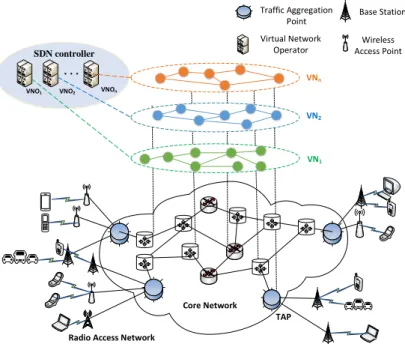
3.1 The NV-based network architecture to support E2E service deliveries in 5G core networks. . . 39
3.2 Illustration of the substrate network and two E2E VN requests. The joint VN topology design and embedding problem includes determining the set of physical resources for the VN and embedding the resultant VN onto the substrate network. . . 41
3.3 The queueing network to determine the optimal set of physical resource requirements at virtual nodes and links for each E2E VN. . . 45
3.4 An illustration of the exponential unit cost function for utilizing substrate node resources. . . 48 3.5 Online VN topology design and embedding procedure. . . 53 3.6 Comparison of VN embedding costs between the four algorithms under
dif-ferent delay requirements over the 50-node substrate network (traffic arrival rate is set as 150 packets/s). . . 55 3.7 Comparison of VN embedding costs between the proposed algorithms and
the two benchmarks over the 50-node substrate network (packet delay re-quirement is set as 35 ms). . . 56 3.8 Optimal allocation of CPU processing rate at various substrate nodes under
different arrival data rates (packet delay requirement is 35 ms). . . 56 3.9 Optimal allocation of transmission rate over various substrate links under
different arrival data rates (packet delay requirement is 35 ms). . . 57 3.10 Performance comparison between the proposed low-complexity heuristic
al-gorithm and the two benchmarks from different aspects: (a) Varying average arrival data rate of VN requests, (b) Varying average delay requirement of VN requests, (c) Average node/link capacities of the substrate network. . . 59 3.11 Performance comparison between the proposed heuristic algorithm and the
two benchmarks over different substrate networks: (a) Substrate I, (b) Sub-strate II, (c) SubSub-strate III. . . 60 4.1 Illustration of multi-service SFC embedding, where different VNFs can share
the physical resources of a common NFV node and different SFCs can share the same VNF. . . 67 4.2 Illustration of the definitions of F¯a−¯b, V¯a\¯b, and V¯b\¯a. . . 72
4.3 Illustration of the relationships between the sets V¯a\¯b, V¯b\¯a, V1, V2, and V3. 73
4.4 Performance of the BR and SAP algorithms at convergence, where N = 4,
V = 5, and |Fi|= 3, ∀i∈ N. . . 81
4.5 Comparison between BR and SAP algorithms in terms of the value of po-tential function. . . 82 4.6 Comparison between BR and SAP algorithms in terms of the sum of overall
latency for all the SFCs. . . 82 4.7 Dynamic evolution of the costs of the five chosen players when using the BR
4.8 Dynamic evolution of the costs of the five chosen players when using the SAP algorithm with β = 4.0 for the scenario N = 20, V = 8, and |Fi| ∈ {3,4,5}. 84
4.9 VNF embedding strategy evolution using the BR algorithm. . . 84
4.10 VNF embedding strategy evolution using SAP algorithm (β = 4.0). . . 85
4.11 Dynamic evolution of the penalty term of the BR algorithm. . . 85
4.12 Dynamic evolution of the penalty term of the SAP algorithm. . . 86
4.13 Comparison of resource utilization ratio between the BR algorithm with admission control and that without admission control. . . 87
5.1 An SDN/NFV-enabled network architecture. . . 92
5.2 A simple example to illustrate the VNF scheduling process. . . 95
5.3 Illustration of reducing JSP to JSSD. . . 99
5.4 Reinforcement learning framework for VNF scheduling. . . 101
5.5 Convergence of the proposed RL approach over the medium-scale network. 111 5.6 Convergence of the RL algorithm over the small-scale, medium-scale and large-scale networks: (a) Average reward ratio to optimal, and (b) Average makespan ratio to optimal. . . 112
5.7 Verifying delay-guaranteed VNF scheduling using the proposed RL approach over the medium-scale network: (a) Case 1 withc3 = 1.0,c6 = 1.0,c10= 1.0, and (b) Case 2 with c1 = 1.0, c4 = 1.0,c7 = 1.0. . . 113
5.8 Performance comparison of the four methods in terms of the average re-ward and average makespan over the three scale networks: (a) small-scale network, (b) medium-scale network, and (c) large-scale network. . . 115
5.9 Comparison between the proposed centralized approach and the decentral-ized approach in terms of makespan. . . 117
List of Tables
3.1 Summary of Important Symbols . . . 43
3.2 Decision Variables . . . 43
3.3 Parameters of The Three Substrate Networks . . . 57
3.4 Comparison of the Running Time Between the Two Algorithms Over Three Substrate Networks . . . 58
4.1 Summary of Important Notations . . . 65
4.2 Parameters Used in Simulations . . . 80
5.1 Summary of Important Notations and Decision Variables . . . 93
5.2 Parameter Ranges in Simulation for Different Network Scales . . . 109
List of Abbreviations
5G Fifth generationB5G Beyond 5G
BR Best Response
CAPEX Capital Expenditure
CN Core Network
eMBB enhanced Mobile Broadband
E2E End-to-End
FIP Finite Improvement Property InP Infrastructure Provider IoT Internet-of-Things ISP Internet service provider JSP Job-Shop Problem
JSSD Job-Shop Scheduling Problem with Deadlines MDP Markov Decision Process
MILP Mixed Integer Linear Programming MINLP Mixed Integer Nonlinear Programming mMTC massive Machine-type Communication NBI Northbound Interface
NE Nash Equilibrium NF Network Function
NFV Network Function Virtualization
NFVI Network Function Virtualization Infrastructure NFV-RA NFV Resource Allocation
NV Network Virtualization QoS Quality-of-Service
OPEX Operational Expenditure PSO Particle Swarm Optimization RAN Radio Access Network
RL Reinforcement Learning SDN Software-Defined Networking SFC Service Function Chain SAP Spatial Adaptive Play SBI Southbound Interface TAP Traffic Aggregation Points
URLLC Ultra-reliable and Low-latency Communication VN Virtual Network
VNE Virtual Network Embedding VNF Virtual Network Function VNO Virtual Network Operator
Chapter 1
Introduction
With the prevalence of Internet-of-Things (IoT), the communication networks are envi-sioned to accommodate a proliferation of connected devices and diversified services, with largely increased traffic volume and differentiated quality-of-service (QoS) demands [1], [2]. These rapid-growing and on-demand services require efficient and effective network organization and configuration to achieve fast service provisioning. To realize service ori-ented networking, significant changes are to be made in the currently deployed networking architecture and a number of technical challenges arise for resource management [3]. Core networks as the central element of current communication networks can provide customized services to end users connected by the access networks. Software-defined networking (SDN) and network function virtualization (NFV) are two promising and complementary tech-nologies to reduce the function provisioning cost and improve the heterogeneous resource utilization for customized end-to-end (E2E) service deliveries [4]. In this chapter, we pro-vide an overview of SDN and NFV, followed by the new challenges of resource allocation in SDN/NFV-enabled core networks. Finally, we present three key components/stages for efficient resource allocation in SDN/NFV-enabled core networks.
1.1
Overview of NFV and SDN for Next Generation
Networks
The fifth generation networks (5G) and beyond, which are commercially available in 2020, will unlock the possibilities to enhance people’s life while bringing in many new opportu-nities and user experiences. Massive number of intelligent devices (e.g., sensors, vehicles, wearable devices) are expected to be connected to accommodate various newly emerging
services [5] [6], including ultra-reliable and low-latency communication (URLLC) services, massive machine-type communication (mMTC) services, and enhanced mobile broadband (eMBB) services [5], [7]. These new services demonstrate highly diversified traffic char-acteristics and differentiated quality-of-service (QoS) requirements [8] in terms of latency, security, reliability, and complexity [9]. In particular, URLLC is crucial to many prospec-tive applications, such as industry automation, autonomous driving, and remote surgery, which require a low end-to-end (E2E) communication delay in the order of milliseconds. Meanwhile, the reliability requirements of URLLC services can be higher than 99.999% [8]. mMTC services usually have to support massive number of devices with low mobility, thus having less stringent requirements on connection delay and reliability. In contrast, eMBB services require high data rates (up to the order of Gbps) supported on moving de-vices over a wide coverage area. Typical applications include 4K/8K ultra-high definition video streaming, virtual reality, and augmented reality. In addition, in the 5G era, new requirements arise for the evolving network paradigm, including 1) cost-effective network deployment for seamless device access, 2) enhanced resource utilization to accommodate high traffic volume, and 3) flexible function placement for service customization [10][11]. The current one-type-fits-all network is not able to provide customized services with various quality-of-service (QoS) requirements well.
Therefore, how to satisfy diverse and stringent E2E QoS requirements for multiple services remains a significant challenge. Moreover, to accommodate the aforementioned differentiated services, heterogeneous resources should be intelligently integrated into 5G networks with efficient allocation [9]. The physical resource pool manifests high hetero-geneity, ranging from radio access networks (RANs) to core networks (CNs). For the RAN segment, spectrum and time slots are the major resources that can be allocated by opera-tors, while for the CN segment, the resources include computing, storage and networking resources at each CN element (nodes and links). In addition, to support massive connected intelligent terminals and provide seamless connectivity, macro-cells, small cells, and femto-cells are expected to be densely deployed, which composite heterogeneous multi-tier access networks in 5G networks and beyond [12]. Various wireless access technologies (e.g. LTE, Wi-Fi, WCDMA, etc.) will coexist and cooperate with each other to better utilize network resources. Through efficient integration, the service quality is expected to be enhanced. The heterogeneity in services, resources, and access technologies increases the complexity of 5G networks, leading to high costs of deployment and maintenance. Second, to provide customized services, the strict service isolation is a necessity when considering the dynam-ics of one service, such as the topology changes and traffic fluctuations. Last, to better support the heterogeneity of services without increasing the network deployment cost, it is expected to have a unified framework to integrate computing, networking, and storage resources for more efficient global resource allocation. Therefore, the development of 5G
VNF1 VNF2 VNF2 VNF3 VNF2 VNF3 VNF1VNF4 VNF2VNF3 Healthcare service Internet of Things service Mobile broadband service NFV Infrastructure Global controller Local controller Centralized SDN controller C on tr o l P la n e D ata P la n e
Open Southbound Interface (SBIs)
Global Network View
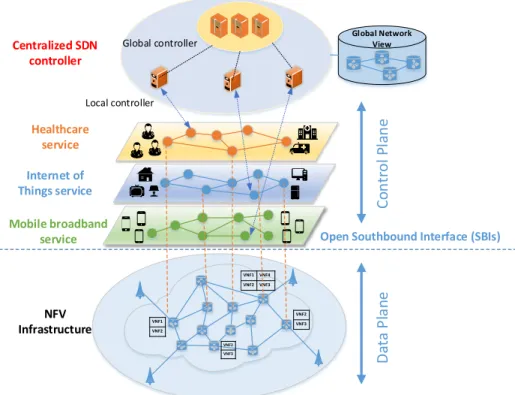
Figure 1.1: A high-level overview of SDN/NFV-enabled core networks.
networks is not simply an inheritance from the current 3GPP mobile network, but an evo-lution of the network architecture. The B5G networks are expected to feature enhanced mobile broadband, massive machine-type communication, and ultra reliable low latency. A scalable, delay-optimal, highly adaptable and flexible network architecture is desired, which has attracted great attentions from both the industry and the academia.
Software-Defined Networking (SDN) and Network Function Virtualization (NFV) are recognized as the two most promising technologies to address the aforementioned challenges [4], [13]. SDN decouples the network control and forwarding functions, which facilitates network management and enables network programmability. NFV allows the network functions to be virtualized and placed on high capacity servers located anywhere in the network, not only on dedicated devices in traditional networks. Fig. 1.1 illustrates a typical SDN/NFV-enabled core network scenario. Each customized service is supported by chaining several virtual network functions (VNFs) and embedding the VNF chain onto the substrate network. To support the diversified services, a SDN-based hierarchical controller is employed to manage virtual networks on top of a NFV infrastructure. The logically
centralized controller has a global view of the whole network to monitor the network states and manage the traffic flows. Additionally, the central controller also helps to achieve better load balancing in both control plane and data plane. In this way, different services are strictly isolated and can be managed and operated independently. Bringing SDN and NFV into 5G mobile communication creates unique benefits, such as flexible service deployment, reduced costs, and enhanced service quality.
In the following sections, I illustrate the fundamental concepts of network virtualiza-tion (NV), network funcvirtualiza-tion virtualizavirtualiza-tion and software-defined networking. The typical network architectures as well as the the main network features enabled by the three tech-nologies are provided.
1.1.1
Network Virtualization/Slicing
Network virtualization (NV), or network slicing, holds a great potential to support various services by logically partitioning the network resources into multiple virtual slices for cus-tomized services [14], [15] [16] [17]. For 5G core networks, with network virtualization, each Internet service providers (ISPs) is decomposed into two network entities: the infrastruc-ture provider (InP) and the virtual network operator (VNO). InPs take charge of deploying and maintaining network infrastructures. Each VNO partitions the computing/bandwidth resources on network elements (i.e., network servers, routers, and transmission links) to cre-ate different virtual network slices, a. k. a. virtual networks (VNs), for supporting different customized end-to-end (E2E) services over a physical substrate network. As shown in Fig. 1.2, NV creates multiple VNs on top of a common physical substrate network. Each of the VNs represents a customized end-to-end service and is composed of a set of virtual nodes interconnected by virtual links. Each virtual node (virtual link) is physically operated on a network server/switch (transmission link) and occupies a portion of physical comput-ing (bandwidth) resources. Through NV, multiple VNs coexist on a common substrate network and their resources are logically isolated and managed independently by different VNOs, which not only allows efficient resource sharing among heterogeneous services but also improves resource utilization and provide more flexibilities for the network.
1.1.1.1 Virtual Network Embedding
A VN typically consists of several virtual nodes interconnected via (either wired or wireless) virtual links. Those virtual nodes and links form a virtual topology. By virtual-izing both node and link resources of a SN, multiple VNs can be co-hosted and existing on the same physical hardware. The problem of embedding multiple virtual networks onto a
Physical Infrastructure Virtual Network1 Virtual Network2
Figure 1.2: Network virtualization environment.
common substrate network is the main resource allocation task in network virtualization and is usually termed as Virtual Network Embedding (VNE). Efficient VNE algorithms can dramatically maximize physical resource utilization via resource sharing. There are various metrics to measure the optimality of VNE algorithms, such as the acceptance ratio, revenue, and revenue-to-cost ratio, etc.
VNE algorithms deal with the allocation of virtual resources in both nodes and links, so it can be divided into two sub-problems, i.e., Virtual Node Mapping (VNoM) and Virtual Link Mapping (VLiM) [18]. VNoM deals with how to allocate virtual nodes in physical nodes while VLiM focuses on how to map the virtual links connecting these virtual nodes to paths connecting the corresponding physical nodes. The node mappings are usually achieved by employing greedy methods, while the link mappings are typically obtained using shortest path,k-shortest paths [19], and multi-commodity flow algorithms [18]. Both of these two sub-problems are NP-hard problems [18], and can be jointly studied to achieve better mapping strategy but with increased complexity.
In last few years, many research efforts have been devoted to the development of VNE approaches for different scenarios. In what follows, we give a brief overview of the seminal works. A comprehensive survey of existing VNE approaches can be found in [18]. The authors of [20] first introduced path splitting and path migration to VNE. The original VNE problem is first divided into two sub-problems, i.e., the node mapping problem and the link
mapping problem, then the two sub-problems are solved independently. The coordination in node mapping and link mapping was first illustrated by the approach presented in [21], [22]. The node mapping is solved by a relaxed MIP formulation. The substrate nodes are chosen in a way so that the mapping cost for the virtual links are likely to be low. It is widely recognized that the end-to-end delay requirement is one of the most important QoS requirements for customized services in B5G networks. The satisfaction of the delay requirement of each VN remains an important aspect of VNE. There exist some works in the VNE literature that try to consider the delay requirement as a constraint for the VNE problem, such as [23] and [24]. In [23], the VNE problem with node and link resource constraints and path delay constraint has been considered for evolving networks. The problem has been formulated as integer programming then solved by a heuristic algorithm. In [24], an optimization framework that minimizes the end-to-end delay for VNE in mobile networks has been proposed.
1.1.2
Network Function Virtualization
Network services provided by operators can be considered as chains of network functions (NFs). Various NFs, such as firewall, deep packet inspection, data monitoring, encryption and decryption, have specific hardware requirements and configurations. Currently, these NFs are implemented on physical middleboxes (hardware appliances). Due to the explo-sive development of mobile Internet and Internet of things, the number of diversified new services will prominently increase in B5G networks [25]. High capital and operational ex-penditures are demanded for network operators to deploy, maintain, and upgrade physical middleboxes when new network services are offered.
Network function virtualization, which was initiated in October 2012 [26], is a promising technology to address the aforementioned challenges. As the home of the Industry Specifi-cation Group for NFV, the European TelecommuniSpecifi-cations Standards Institute (ETSI) has proposed a number of use cases driven by NFV since its initiative [27]. The new use cases include a variety of novel applications not only for individual customers but also for the evolved core network.
The basic concept of NFV is to decouple the functions from the hardware equipment on which they run [28]. In NFV, the NFs, which can only run on dedicated devices in traditional networks, are virtualized to be placed on high capacity servers located anywhere in the network. By implementing NFV, the physical resources in the network can be virtualized to allow efficient resource sharing among different services. The customized services can also be accommodated in a cost-effective, agile and flexible manner [10].
Network Function Virtualization Infrastructure (NFVI) Resource Abstraction
Computing resources Storage resources Networking resources Virtual computing resources Virtual storage resources Virtual networking resources Virtualization layer Service requests OSS/BSS VNF 1 VNF 2 VNF 3 . . . VNF n MANO Orchestrator VNF Manager NFVI Manager
Figure 1.3: Network function virtualization architecture.
1.1.2.1 NFV Architecture
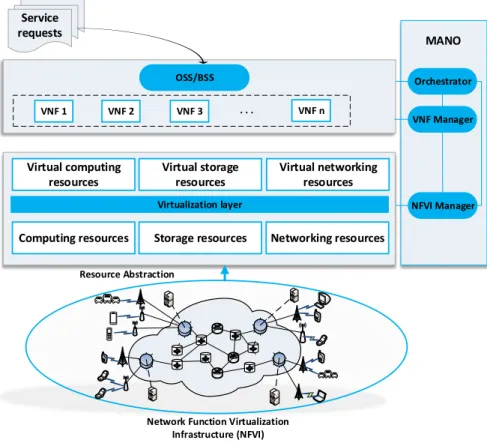
As presented in Fig. 1.3, the NFV architecture has three key components: NFVI, VNFs, and NFV Management and Orchestration (MANO) [29]. NFVI contains all the hardware and software resources which are utilized to run the VNFs. The physical resources may include computing, storage and networking resources. Through a virtualization layer, the physical resources are abstracted as virtual resources.
Network functions (NFs) are functional building blocks implemented on specific net-work elements (middleboxs), which have well-defined interfaces to end users and specific functional behaviors. In the NFV environment, a network service is a set of chained VNFs, defined by its types of VNFs, their respective order in the chain, and the resource alloca-tion of the chain in the NFVI. Network services can be supported by chaining the VNFs to form VNF chains then embedding the resultant chains onto an NFV-enabled infrastructure
[30] [31]. VNF chain is in fact an ordered list of network function instances that traffic traverses through. It can be considered as a novel service chain deployment model in NFV and SDN environment.
The role of the NFV MANO is to fulfill all the tasks for virtualizing the network func-tions and the infrastructure [29]. Specifically, those tasks include orchestrating and man-aging the resources (including hardware and software) for virtualizing the infrastructure and executing the VNFs, and also include defining the interfaces to allow communications between different network elements in the NFV infrastructure.
1.1.2.2 Benefits of NFV
As a new network architecture, network function virtualization enables network func-tions to be implemented through software running on general-purpose high volume servers. These network functions were traditionally implemented on dedicated hardware such as middleboxes or network appliances. The key benefits brought by NFV can be summarized as follows [26],[32]
1. Increased Deployment Flexibility
In the core network domain of the current network architecture, a set of dedicated middleboxes is deployed for each specific network service. When new services are required, new middleboxes have to be deployed, while increasing the number of net-work elements for service customization. With NFV, one can use commodity servers to host VNFs and deploy a new service by installing VNFs on commodity servers instead of adding new hardware devices. In this way, flexible function placement can be achieved for service customization.
2. Reduced Capital Expenditure (CAPEX) and Operational Expenditure (OPEX) With increased deployment flexibility and agility to integrate new network services, significant reductions in CAPEX and OPEX are expected to be obtained. With the help of software, NFV allows a common physical network to support multiple customized services simultaneously. Improved hardware upgrading and maintaining efficiency also leads to reduced CAPEX and OPEX.
3. Faster Service Life Cycle
Compared with the time-consuming and costly function update process in an existing network, in an NFV-enabled network, adding new functions is much easier. The function update can be completed by only updating the software. Because of this,
the life cycle of VNFs can be much shorter and services deployment time can be greatly reduced.
4. Better Network Function Provisioning and Isolation
In the NFV framework, traditional middleboxes are managed and orchestrated in the form of VNFs, which are in fact software modules that can be installed on general-purpose commodity servers. This allows programmability and isolation of each function, so they can be managed independently.
5. Improved Resource Utilization
Through network virtualization, the whole network is sliced into multiple virtual networks. Each VN is used to support a customized service in a specific scenario. Multiple VNs are mutually isolated and can coexist in the common infrastructure sharing the same physical resource pool. The heterogeneous resources are virtualized to allow resource sharing among different VNs and to improve resource utilization in both RANs and CNs.
1.1.3
Software-Defined Networking
1.1.3.1 Conventional SDN
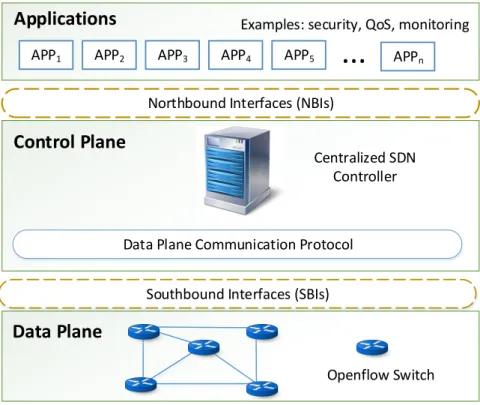
In the traditional networking approaches, most network functionalities are implemented using dedicated hardware, i.e., router, switch, and firewall. In the contrast, SDN net-working architectures aim to separate the network control plane from data plane, so that hardware products can be standardized and the whole network can be made directly pro-grammable. As a result, enterprises can get rid of hardware restrictions of the network architecture. Network adjustment, expansion and upgrade can be completed by installing and upgrading the software. Both the capital and operational costs are reduced while sim-pler management and more flexible control are achieved. Fig. 1.4 shows the illustration of a conventional physical SDN network, where network applications (App1, ..., Appn) interact through the Northbound Interfaces (NBIs) with the SDN controller, which in turn interact with the physical SDN network through Southbound Interfaces (SBIs) [33].
1.1.3.2 Combining NV and SDN
In the last a few years, network virtualization and software-defined networking have been the two hottest topics in networking. They both have their own distinct advantages
APP1 APP2 APP3 APP4 APP5
...
APPn Northbound Interfaces (NBIs)Southbound Interfaces (SBIs)
Control Plane
Data Plane
Applications
Examples: security, QoS, monitoringOpenflow Switch Data Plane Communication Protocol
Centralized SDN Controller
Figure 1.4: Conventional (non-virtualized) SDN network.
and can be combined to enable more powerful technologies for future networks. Different from NV, SDN requires the construction of new network where the control and data layers are decoupled. In other words, SDN modifies the physical network, while NV can reside on the servers of the existing network. SDN creates network abstractions to enable faster innovation, open innovation creates competitive supply of innovative applications by third parties, while NV reduces CAPEX, OPEX, space and power consumption.
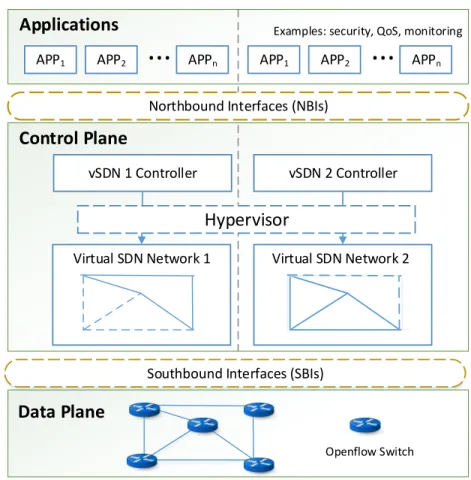
One of the enablers for future networking technologies is virtual SDN networks, in which a hypervisor is incorporated between the physical SDN network and the SDN control plane [33]. The hypervisor has a global view of the whole physical SDN network and interacts with it via the Southbound API. The physical SDN network is virtualized to create isolated virtual SDN networks, which are controlled by different virtual SDN controllers. Each virtual SDN controller is able to perceive the status and interact with the virtual SDN network under its management. An illustration of the concept of SDN network virtualization is shown in Fig. 1.5.
APP1 APP2 APPn vSDN 1 Controller Virtual SDN Network 1 vSDN 2 Controller Virtual SDN Network 2
Hypervisor
...
APP1 APP2...
APPnNorthbound Interfaces (NBIs)
Southbound Interfaces (SBIs)
Control Plane
Data Plane
Applications
Examples: security, QoS, monitoringOpenflow Switch
Figure 1.5: Virtualization of the SDN network.
1.1.3.3 Benefits of SDN
SDN enables the programmability of networks such that operators are able to support services with finite network resources [34]. The biggest promise of SDN is that it will cen-tralize and simplify the control of network management by separating the network control plane from data plane. Below we summarize some highlights of the specific advantages of SDN [34]-[35]:
1. Centralized Control Provisioning
SDN provide a centralized view of the whole network, which enables easier centralized network management and provisioning. Through separating the control and data
planes, SDN is able to facilitate service delivery and offer more agility in provisioning both virtual and physical network resources at a central location.
2. Comprehensive Infrastructure Management
Many new applications and virtual machines have to be set up in order to accom-modate new processing requests such as big data. SDN allows IT teams to be able to run experiments with network configurations without causing any effects to the network. Moreover, in SDN, there exists a single centralized controller that manages physical and virtual switches and network equipment. This cannot be achieved with simple network management protocol (SNMP).
3. Reduced Capital and Operational Expenditures (CAPEX and OPEX)
The implementation of SDN makes the optimization of existing network devices eas-ier. Existing hardware can be re-purposed with the instruction given by the SDN controller. In addition, since all the intelligence of new devices are centered at the SDN controller, new devices actually becomes “white box” switches and less expen-sive hardware can be deployed. On the other hand, the operating expenditures can also be reduced due to administrative efficiency, centralized management, and better control of virtualization.
4. Guaranteed Data Delivery
One of the primary advantages of SDN is the ability to shape and control data traffic. The QoS requirements of multimedia services can be better guaranteed as SDN is able to direct and automate data traffic.
5. Enhanced Security
SDN centralizes security control into one entity, such as the SDN controller. By doing this, SDN can be used effectively to manage security throughout the whole network provided that it is securely and properly implemented.
1.1.4
Relationships Between NFV and SDN
NFV and SDN share a lot of similarities as they both pursue the openness of network and the use of standard network hardware. Both of them attempt to exploit virtualization and automation to achieve their own potential goals. Actually, they are highly complementary to each other and may be combined to enable more beneficial networking technologies. NFV is able to support SDN and vice versa. The performance of NFV can be enhanced
via SDN-based approaches and vice versa, though most of the advantages coming from combining the two technologies have not been observed in practice.
On the other hand, there are also significant differences between SDN and NFV since they are different concepts. One of the differences is that, SDN aims to separate the control and forwarding planes and orchestrate the network-wide resources via a centralized con-troller. On contrary, NFV focuses on optimizing network services themselves by replacing the expensive dedicated middleboxes with generic servers that can provide a number of different VNFs through software. Another difference is that, NFV can be implemented on the servers of an existing network and thus does not require the construction of new network. On contrary, the deployment of SDN relies on decoupled control and data layers, therefore, it requires the construction of a new network architecture.
It is possible and important to integrate SDN and NFV in the same network to accel-erate the evolution toward software-enabled network services. NFV promotes the diversity of network functions offered by service providers [36]. SDN has been recognized as a key technology for the realization of a more efficient and flexible data center infrastructure, which enables network services to be dynamically deployed among shared NFV nodes. It is also a key driver for the development of edge computing and cloud computing. With the help of SDN, it becomes easier for the service provider to support diversified services with the most cost-effective resources.
1.2
Resource Allocation in Core Networks
As mentioned above, SDN and NFV are able to create more efficient and centralized networking management, reduce operational costs, and enable other new technologies. Thus, integrating SDN and NFV into the design of next generation networks remains a hot research topic in recent years. However, one important yet challenging problem of implementing SDN and NFV is how to manage and allocate the physical resources in an efficient and cost-effective manner, which is usually referred to as the NFV resource allocation (NFV-RA) problem.
Traditionally, network infrastructure are managed and maintained by different network operators independently. In this business model, to deploy a network service for each net-work operator, the data traffic needs to flow through a certain fixed group of middleboxes, such as firewall, DNS (Domain Name System), and IDS (Intrusion Detection System), in a predetermined order [37]. The problem of choosing the set of required middleboxes and deciding the corresponding routing paths is called “middleboxes orchestration.” In an ex-isting network, this task is manually executed through a “trial-and-error” approach, which
Centralized control Transmission link Traffic flow direction Middlebox
Switch Commodity server SDN controller
Figure 1.6: Global resource management and allocation via centralized SDN controller in core networks.
is very costly and time-consuming. Furthermore, once placed, it is costly and impractical to change the location of a middlebox according to the variations of network conditions.
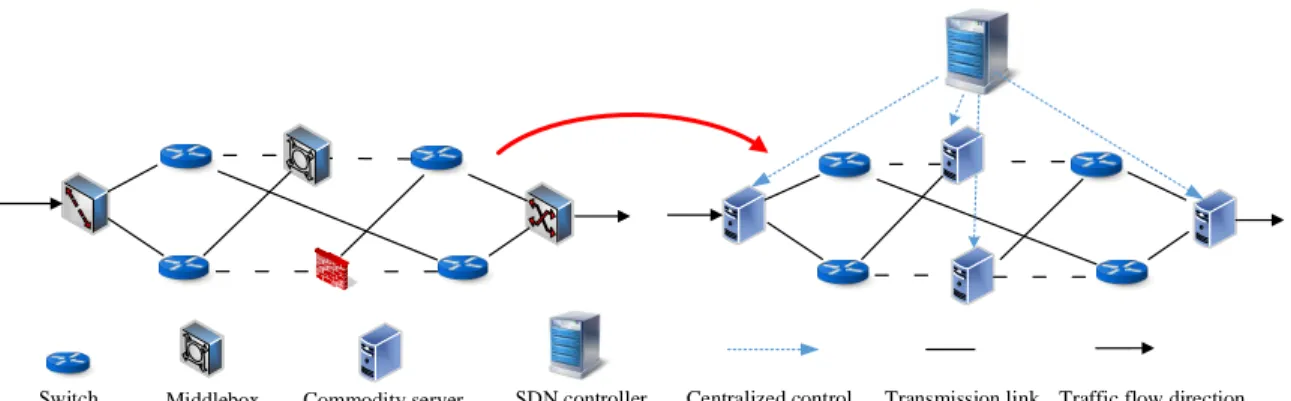
In the context of SDN/NFV-enabled core networks, a network service can be formed with a set of chained virtual network functions (VNFs). Therefore, a network service is typically defined by the types of the VNFs chained, the processing order of the VNFs in the chain, and the embedding of the chain onto the network function virtualization infras-tructure (NFVI). Fig. 1.6 illustrates the transition from traditional network to SDN/NFV-enabled core network. Note that the function-specific middleboxes are replaced by com-modity servers to host VNFs. A logically centralized SDN controller, which has a global view of the whole network, is used to manage and allocate the resources in the network. By doing this, new services can be deployed by installing VNFs on commodity servers instead of adding new hardware devices to the network, leading to reduced CAPEX and OPEX. Such a network service has its specific time-varying and stochastic properties in terms of traffic volume and user distribution. Additionally, to accommodate the differentiated network services with diverse QoS requirements, heterogeneous resources (i.e., computing, storage and networking resources) need to be allocated to the services simultaneously and efficiently. There exist significant challenges in achieving a fast, efficient, and dynamic resource allocation scheme to accommodate multiple network services since efficient algo-rithms are desired to (1) compose the VNFs chain for a network service; (2) embed the chained network functions onto the substrate network (SN); and (3) schedule the VNFs of the network service to minimize the execution time and obtain improved performance. Through virtualizing network functions, new services can be accommodated by updating
the software on the network servers instead of deploying new devices. In this way, the service provisioning cost can be reduced while the resource utilization can be improved. On the other hand, the use of SDN facilitates the realization of network openness and pro-grammability. Despite the benefits brought by NFV and SDN, one of the main challenges in SDN/NFV-enabled core networks is, how to efficiently manage, allocate, and optimize the heterogeneous resources, including computing, storage, and networking resources, to the customized services for better QoS provisioning [38].
1.3
Research Motivations and Contributions
In the 5G era, new requirements arise for the evolving network paradigm, including 1) cost-effective network deployment for seamless device access, 2) enhanced resource utilization to accommodate high traffic volume, and 3) flexible function placement for service customiza-tion [3], [11]. However, the heterogeneity in services, resources, and access technologies increases the complexity of 5G networks. Therefore, heterogeneous resources should be intelligently integrated into 5G networks with efficient allocation. On the other hand, the centralized networking management offered by SDN and the increased service deployment flexibility provided by NFV create new opportunities for the development of resource allo-cation schemes for 5G networks. Therefore, resource alloallo-cation becomes one of the most crucial problems that calls for in-depth investigations for deploying SDN/NFV-enabled 5G networks. With efficient and dynamic resource allocation algorithms, the advantages ob-tained from existing hardware service can be maximized. In addition, optimally dynamic resource allocation helps the network to provide QoS-guaranteed services and accommodate services in a flexible, agile, and cost-effective manner.
The objective of this research is to develop efficient resource allocation schemes for SDN/NFV-enabled core networks to improve resource utilization, enable better QoS provi-sioning, and increase the network capability of accommodating customized services. Specif-ically, we will focus on the following three problems:
• In a single-service scenario, we investigate how to design the VN topology (i.e., reasonably allocate physical resources to the virtual nodes and virtual links) and embed the resultant VN onto substrate network to guarantee that the embedding cost is minimized and the QoS requirement can be satisfied. The objective is to find the optimal VN topology design and embedding solutions that can assign optimal physical resources for VNFs and virtual links so as to reduce the deployment cost and to increase the number accommodated services in the long run.
• In a multi-service scenario, we devise a game theoretical approach to address the multi-VNF chain embedding problem taking into account the additional latency in-crease introduced by processing-resource sharing and the node capacity constraints. The objective is to minimize the overall latency experienced by the traffic flow asso-ciated with each VNF chain so as to facilitate QoS-guaranteed service provisioning. An efficient embedding algorithm can not only find the optimal VNF placement and traffic routing strategies but also achieve fairness among NFV nodes to realize load balancing.
• In a multi-service scenario, we develop a reinforcement learning based VNF schedul-ing scheme to minimize the completion time of network services while satisfyschedul-ing their different E2E delay requirements. The original formulation of VNF scheduling falls into the class of NP-complete problems. To make it tractable, we reformulate it as an MDP and leverage a modified RL approach to solve it with reduced complexity and high accuracy. An efficient scheduling algorithm can minimize service completion time to improve the resource utilization.
1.4
Thesis Outline
The remainder of the thesis is organized as follows: Chapter 2 presents a comprehensive background and overview of related works of resource allocation in SDN/NFV-enabled core networks. We introduce the RA task from three aspects, i.e, VNF chain topology design, VNF chain embedding, and VNF scheduling. In Chapter 3, we jointly study how to design the topology of a VN and embed the resultant VN onto a substrate network with the objective of minimizing the embedding cost while satisfying the QoS requirements. In Chapter 4, a game theoretical approach is proposed to address the multi-VNF chain embedding problem. Then, two iterative algorithms are designed to find the NE of the proposed potential game. routes. In Chapter 5, the VNF scheduling problem is investigated to minimize the makespan (i.e., overall completion time) of all services, while satisfying their different E2E delay requirements. Then, a reinforcement learning based approach is developed to learn the best scheduling policy by continuously interacting with the network environment. Finally, Chapter 6 concludes the thesis and presents future works.
Chapter 2
Background and Literature Survey
In SDN/NFV-enabled core networks, a network service has its specific time-varying and stochastic properties in terms of traffic volume and user distribution. To accommodate the differentiated network services with diverse QoS requirements, heterogeneous resources (i.e., computing, storage and networking resources) need to be allocated to the services si-multaneously and efficiently. Moreover, both the number and the types of network services will grow exponentially in the evolution of 5G networks. There exist significant challenges in achieving a fast, efficient, and dynamic resource allocation scheme to accommodate mul-tiple network services. The resource allocation task (also referred to as network function virtualization resource allocation, NFV-RA) is implemented in three steps [32], i.e., given the traffic metrics, QoS requirements, and resource constraints of the substrate network, we first need to compose a VNF chain to form a virtual network (VN) topology. Then virtual resources allocated to each element (VNF or virtual link) need to be optimized in order to minimize the provisioning cost and to satisfy the QoS requirements. This process is usually referred to as VNF chain topology design. Next, we need to embed the virtual network (i.e., the VNF chain) onto the substrate network. During this stage, we need to assign the physical resources in an economical way to meet the resource demands of virtual nodes and links. This involves determining the locations of NFV nodes to host the VNFs and the routing from source to the destination. This process is referred to as VNF chain embedding. Finally, we need to schedule the VNFs for multiple services to minimize the service completion time and maximize the network performance. In other words, when multiple VNFs are embedded on the same NFV node, each of them should be assigned an optimal time slot. This process is referred to asVNF scheduling [39]. The main outcome for each step can be summarized as follows [32]:re-quired VNFs of the service, we need to determine the rere-quired physical resources of the VNFs and virtual links, and chain them together to form a VNF chain; A optimized topol-ogy design can assign optimal physical resources for VNFs and virtual links to reduce deployment cost.
2) VNF chain embedding: Given the VNF chain and the resource constraints of the substrate network, we need to first determine the locations of NFV nodes onto which the VNFs should be placed, then determine the corresponding routing from source to destination in the NFVI. An efficient embedding algorithm can not only find optimal VNF placement and traffic routing strategy but also achieve fairness among VNFs embedded onto the same NFV node to realize load balancing.
3) VNF scheduling: When multiple VNFs are placed on the same NFV node, the execution time of each VNF needs to be scheduled to minimize the total execution time and achieve efficient resource sharing. An efficient scheduling algorithm can minimize service completion time to improve the resource utilization.
In what follows, we provide a detailed description of the three steps, along with some research challenges and existing approaches proposed in the literature.
2.1
VNF Chain Topology Design
In the NFV environment, a network service request, or a VNF request (VNFR), is an entity composed by a number of VNFs in a predetermined order [29]. This means, the data traffic should pass through a given number of VNFs in a given order to complete the execution of the network service. Different from an existing network where network functions are run on dedicated hardware appliances which have fixed locations, VNFs are software with much higher deployment flexibility, leading to increased complexity in composing the VNF chains. Therefore, it is crucial to investigate the chain composition process so that VNF chains can be efficiently composed to deploy customized and dynamic NFV-enabled network services.
For a given network service request, the following information is typically known:
• Set of VNFs in the request and the dependencies between them;
• Fixed substrate nodes of initial and terminal points for the traffic flow, denoted as
ns and nd, respectively;
VNFR 80% 40% 120% 60% 1 f f2 3 f f4 f5 50/Gbps 20/Gbps 30/Gbps 50/Gbps 10/Gbps 150% : 1 Gbps r d (a) (b)
Figure 2.1: Example of (a) a VNFR and (b) two possible VNF chain topology design results.
• The ratio of outgoing to incoming data rate of each VNF;
• The processing capacity demand per bandwidth unit of each VNF.
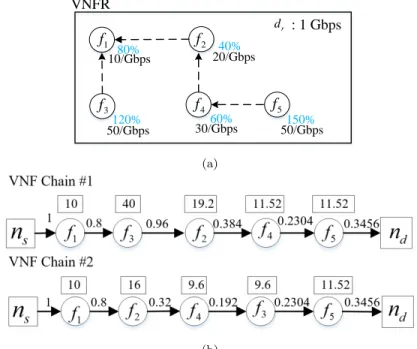
Fig. 2.1(a) shows an example of a VNFR, where the number of required VNFs is 5 and the initial date rate entering the chained functions is 1 Gbps. The percentage (indicated as blue) beside each VNF represents the ratio of outgoing to incoming data rate for each VNF. For example, when dr = 1, the capacity demand for processing f1 = 10 units. The
outcome data rate off1 is 0.8 Gbps. The dependencies between multiple VNFs are denoted
by dashed arrows. For example, the dashed arrow from f4 pointing to f2 indicates that
f4 must be processed after f2. Two possible VNF chain topology design based on the
VNFR information are shown in Fig. 2.1(b). The numbers on the links represent the bandwidth requirements (in GBps) while the numbers in the rectangles indicate the CPU requirements.
2.1.1
Problem Description
The task of allocating physical resources to a service request consists of two major parts, i.e., composing a VNF chain for the VNFR in an optimal way and embedding the resultant VNF chain onto the substrate network efficiently. Specifically, the following five aspects have to be taken into consideration:
1) Design the objective function for optimization
Let C(G0) represent the embedding cost of the VNF chain. C(G0) can be defined as follows [22] C(G0) = αX l0∈L0 X l∈L bll0 +β X n0∈N0 c(n0) (2.1)
wherebll0 represents the total amount of bandwidth resource allocated on the substrate link
l for virtual link l0, α and β are parameters to weigh the contributions of node and link resources to C(G0). To allow efficient resource sharing among customized services, C(G0) should be minimized.
2) Determine the order of VNFs in the chain
The inputs of the problem in the preliminary study are static VN topologies in which the nodes order are fixed and pre-determined. As the inputs are changed to network service requests composed of several VNFs. The order of the VNFs needs to be determined where the dependencies between any two VNFs should be respected.
3) Determine the optimal resources allocated to each VNF and virtual link in the VNF chain
Given the end-to-end delay requirement D, initial data rate entering the chained func-tions dinit, and the ratio of outgoing to incoming data rate r(fi) of each VNF fi, we need
to find the optimal physical resources allocated to each VNF and virtual link to minimize the overall embedding cost C(G0) while satisfying the delay requirement. This work can be solved together with VNF ordering.
4) Find the locations of NFV nodes to host the VNFs in the chain
The VNF chain embedding process need to consider both the host ability and resource constraints of each NFV node. During the node embedding process, we try to find a embedding MN : N0 → N from the virtual nodes to substrate nodes, such that for all
n0 ∈N0
MN(n0
)∈N
subject to
c(MN(n0
))≥c(n0). (2.3)
Constraint (2.2) ensures that the VNF corresponding to n0 can be hosted by the sub-strate node to whichn0 is embedded, while constraint (2.3) ensures that the CPU require-ment ofn0 can be satisfied.
5) Determine the routing from source to destination, passing through all the deployed VNFs
In the link embedding step, one aims to find a mapping ML from the virtual links to
substrate paths, such that for alll0 ∈L0
ML(l0)∈ Ps
subject to
b(ML(l0))≥b(l0) (2.4) Constraint (2.4) ensures that the bandwidth requirement ofl0 can be satisfied.
Some other constraints also need to be included in formalizing the optimization. For example, routing constraints have to be satisfied, which ensures that there is a path from the source to the first VNF, from each VNF to its consecutive VNF, and from the last VNF to the destination. Also, the delay constraint has to be satisfied, which guarantees that the total end-to-end delay does not violate the delay requirement. The delay analysis need to consider both the propagation and transmission delay over the links and the processing delay on the NFV nodes. In terms of the objective function, it should include the binary variables indicating whether a node is used to host a specific function, and the binary variables indicating whether a link is used to forwarding the data traffic between source and destination.
There are many factors that increase the complexity and hardness of the VNF chain topology design problem: First of all, the ordering of VNFs are flexible and has to respect the dependencies of the VNFs. Different ordering of VNFs may result in different physical resources requirements (which is related to the embedding cost) for the resultant VNF chain. This flexibility increases the searching space of the optimal VNF chaining. Secondly, traffic splitting may be required in situations where the residual physical resources of a node (or a link) are not enough to support the network service. In such scenarios, some VNF has to be instantiated on multiple NFV-enabled nodes and the data traffic has to traverse through different VNF instances running on multiple nodes. This will further increase the hardness of the VNF chain topology design problem. Thirdly, once the order of VNFs is determined, we need to determine the set of physical resources allocated to the VNFs and virtual links, to minimize the embedding cost while achieving QoS-guaranteed service
provisioning. Lastly, as the physical resources of the substrate network is limited, it is also important to take the substrate network condition, more specifically, the substrate node locations, residual capacities and host abilities into the VNF chaining process to improve the overall network performance. This will make it even harder to obtain the optimal solution to the VNF chain topology design problem.
2.1.2
Related Works
As mentioned earlier, the performance of a network service relies on how its VNF chain is composed and in which order the VNFs are processed. However, most of existing studies neglect this stage of NFV-RA while focusing on the second and the third stages. One of the pioneering works that focuses on the VNF chain topology design problem is presented in [40]. The authors design a context-free language to formalize the requests for chaining several VNFs together. Then, a heuristic was used for choosing one of the possibilities to compose the VNF chain. The heuristic attempts to minimize the total data rate of the resultant VNF chain by assigning higher priority to VNFs with a smaller “inflation factor” (i.e., smaller ratio of outgoing to incoming data rate) when chaining the VNFs together. In this way, the total cost of deploying the service request is expected to be minimized.
Some previous studies have been conducted in literature that tackle with the VNF chain topology design and embedding together, such as those in [37], [40], [41], [42], [43], [44], [45], [46], [47]. For example, in [40], the VNF chaining and placement problem has been considered as an extension of VNE. The problem of finding the optimal placement of VNFs and chaining them together has been formulated as a Mixed Integer Quadratically Constrained Program (MIQCP) and solved accordingly. In [41], a coordinated approach which deals with the first two stages of NFV-RA has been proposed, where VNF chains are composed and embedded simultaneously. The resultant VNF chain from VNF chain topol-ogy design is prepared to optimize VNF chain embedding, leading to a higher probability of successful embedding. In [46], it has been shown how traditional VNE optimization models can be modified to cope with the virtual core network function placement and topology optimization. A novel ILP formulation has been presented with the objective of minimiz-ing the cost of occupied link and node resources. In our work [37], a two-stage approach is proposed to jointly optimize the chaining and embedding of virtual network functions (VNFs), to obtain feasible composition and embedding results with low complexity, while the average embedding cost is minimized and the total revenue is increased. In the first stage, the VNF chaining order is optimized based on the location and functionality of sub-strate nodes, and the ratio of outgoing data rate over incoming data rate for each required VNF. In the second stage, we allocate the physical resources based on the preliminary
VNF ordering under the resource capacity constraints. A node splitting mechanism is also employed to improve the resource allocation fairness and increase the service acceptance ratio for the substrate network.
However, most previous studies on VNF chain embedding assume that the virtual re-sources allocated to the VNF instances and virtual links are pre-defined and further assume that QoS-guaranteed services can be provided once the given virtual resource requirements are satisfied. Without optimization, the physical resources required by each VNF chain may be redundant or insufficient, leading to increased embedding cost for the network operator or degraded QoS for end users. Therefore, to provide end users with guaran-teed service quality in a cost-effective manner, VNF chain topology design and embedding should be solved in a combined way, while considering the optimization of the physical resources allocated to the VNF chain.
2.2
VNF Chain Embedding
Once the VNF chain is composed via the chain composition process, the input to the sec-ond stage of NFV-RA is obtained. The VNF chain embedding process is to place the VNFs on NFV nodes in the NFVI in the most suitable way, considering multiple network service requests. The VNFs should be consolidated in a way such that the physical resources are optimally allocated to the VNF chains with respect to a specific network operator’s ob-jective (e.g., maximizing the total revenue). The problem of embedding VNF chains onto the network function virtualization infrastructure is another challenging resource alloca-tion task in the implementaalloca-tion of NFV. Through dynamic mapping VNFs onto physical hardware, the advantages obtained from existing hardware service can be maximized. This calls for algorithms to determine onto which substrate nodes in the NFVI the VNFs should be placed.
2.2.1
Problem Description
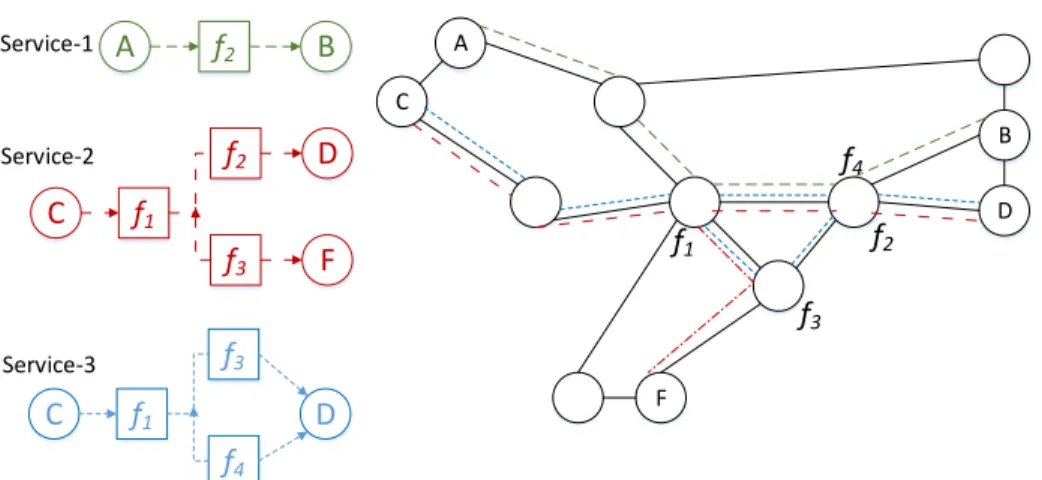
The left side of Fig. 2.2 shows three basic types of VNF chains. Note that they may be combined with one another to form more complex requests. The right side of Fig. 2.2 shows the physical infrastructure as well as an example of VNF deployment on it to fulfill a number of service requests [42].
VNF chain embedding shares many similarities with virtual network embedding (VNE), which can also be divided into two sub-problems: virtual node mapping and virtual link
C A B D F f1 f4 f3 f2 f2 A B C D f1 f2 f3 F C f1 f3 f4 D Service-1 Service-2 Service-3
Figure 2.2: Illustration of VNF chain embedding, the left side shows three basic types of VNF chains, while the right side shows the physical NFV-enabled infrastructure and the VNF chain embedding results.
mapping [48]. Nevertheless, different from VNE where only the ability of processing and switching data packets are considered for all the substrate nodes, in VNF chain embedding, each substrate node can host a set of VNFs of different types. Since each VNF uniquely requires specific physical (computing, storage or networking) resources, a VNF can only be assigned onto a substrate node that has the ability to host it. This makes it harder to embed a VNF chain onto an NFVI than to map a virtual network onto a substrate network in the NV environment. Furthermore, the VNF chain embedding stage needs to deal with dynamic/changing networking condition and varying service description. That is to say, (1) With new services arriving and old services leaving the network, the existing VNF placement scheme may need to be modified to accommodate the newly coming service requests and improve resource utilization; (2) When the data rate entering an existing function chain changes, the orchestrator should notice that and trigger an adjustment algorithm to re-embed the corresponding VNF chain and re-allocate the physical resources to achieve better overall network performance. Lastly, as the middle stage of the NFV-RA problem, VNF chain embedding is closely related to the other two stages. It is particularly important to study VNF chain topology design and VNF chain embedding jointly, VNF chain embedding and VNF scheduling jointly, and even the three stages jointly to obtain the optimal resource allocation solution for the NFV environment, though the problem complexity would also greatly increases.
2.2.2
Centralized Approaches to VNF Chain Embedding
Due to the importance of VNF chain embedding in NFV, many research efforts have been devoted to the development of efficient VNF chain embedding algorithms. A centralized approach usually addresses VNF chain embedding by formulating the embedding process as an optimization problem [39]. The objective can be: 1) to maximize the number of accommodated VNF chains; 2) to minimize the average long-run embedding cost; and 3) to minimize the E2E latency of the flow corresponding to each VNF chain, to name a few. For example, in [42], the VNF chain embedding problem has been formulated as an ILP with the objective of minimizing the number of VNF instances deployed onto the substrate network. In order to improve the scalability of their approach, a binary search based heuristic algorithm has been presented to quickly obtain feasible and high-quality solutions to the ILP model. In [45], VNF placement has been modeled as a combination of the facility location problem and the generalized assignment problem. The objective of their optimiza