using one teacher laptop per class in a multi-grade context:
The case of Intel® Teach – ICT implementation
Brenda Subramanien
using one teacher laptop per class in a multi-grade context:
The case of Intel® Teach
–
ICT implementation
by
Brenda Subramanien
Submitted in fulfilment of the requirements for the degree of
Master in Education to be awarded at the Nelson Mandela
Metropolitan University
November 2013
DECLARATION BY STUDENT
I, Brenda Berenice Subramanien (nee Barendse), student number, 185602370, hereby declare that the dissertation for the degree of M. Ed to be awarded in the Faculty of Education at the Nelson Mandela Metropolitan University (NMMU), Port Elizabeth, South Africa, is my own work and that it has not been previously submitted for assessment or completion of any postgraduate qualification to another University of for another qualification. I further declare that as fas as is known, all sources have been recognised.
This dissertation has been submitted to the online plagiarism detectors, TurnItIn.
Brenda Berenice Subramanien (nee Barendse) March 2014
Official use:
In accordance with Rule G4.6.3,
4.6.3 A treatise / dissertation / thesis must be accompanied by a written declaration on the part of the candidate to the effect that it is his / her own work and that ti has not previously been submitted for assessment to another University or for another qualification. However, material from publications by the candidate may be embodied in a treatise / dissertation / thesis.
LANGUAGE DECLARATION
I, Marthie Nel, Language Practitioner, have undertaken the editing / proof reading of the dissertation entitled:
Exploring teachers’ perceptions of the barriers and solutions to using one teacher laptop per class in a multi-grade context: The case of Intel® TeachICT implementation
SIGNED AT PORT ELIZBETH ON THIS 1stDAY OF December 2013.
ABSTRACT
This interpretive exploratory case study investigated the challenges and barriers to the multi-grade context in general, as well as to Information and Communication Technology (ICT) implementation in a multi-grade context. Possible solutions based on teacher perceptions were generated inductively within a three-level typology. The research took place in three phases. Pre-training data were gathered in the first phase, using an open-ended questionnaire (all participants: n=20); personal interviews (n=9); and two focus group interviews, which consisted of three participants per focus group. Training on the Intel® Teach ICT programme and the provision of laptops (one per teacher) constituted the second phase. The third phase included post-training data generation using an open-ended questionnaire (all participants) and two focus group interviews, which consisted of three participants per focus group, to elicit teacher perceptions of the training programme and their use of the laptops in the classroom after the training.
The findings suggest that first order (school or meso level) challenges pertaining to multi-grade teaching relate to the lack of resources; curriculum challenges; learner related challenges; isolation, impact on communication and teaching; time constraints; and a work overload as a result of the multiple roles. Second order challenges (self or micro level) related to the perceived uncaring attitude of the Department of Basic Education that left teachers feeling hurt and neglected; the unpreparedness for the multi-grade context which demotivated teachers; and the negative perceptions the teachers had about their learners. Third order challenges (system level, beyond the school level or micro level) were related to the lack of Departmental support from officials; the lack of curriculum training for the multi-grade context; and the lack of support on various fronts.
Regarding ICT related challenges, the findings suggest that first order barriers related to the lack of suitable infrastructure for ICT implementation; lack of peer support; lack of access to appropriate hardware and software; and lack of time. Second order barriers related to the negative beliefs in the self; negative perceptions about the learners’ ability to use the laptop; and negative beliefs related to teaching and learning. The third order barriers were related to the lack of support and assistance from the Department of Basic Education for ICT implementation.
The findings suggest that the participants viewed the provisioning of enabling programmes for parents as an important solution to first order challenges, and a change in mindset as the most important solution for second order problems. Third order solutions included a “multi-grade Renaissance” towards a new model for multi-grade teaching; re-thinking the curriculum requirements regarding multi-grade teaching by the Department of Basic Education; increased support and training from the Department; incentives to teach with ICT in the multi-grade context; encouraging further research in
multi-grade teaching; providing sufficient resources; establishing partnerships with stakeholders; and the closure and merger of multi-grade schools.
There was evidence that the laptops provided were used in a variety of ways after the Intel® Teach training by the participants, including email as a tool to communicate with their fellow multi-grade peers, which serve to break their sense of isolation. Quantitative data from the open-ended questionnaire confirmed an increase in the usage of the laptop after the Intel® Teach training intervention. Although the participants generally experienced the Intel teach training intervention as positive, they also identified negative experiences.
These findings enabled the embedding of ‘self and sustainable support from stakeholders’ more explicitly in the professional teacher development ICT implementation framework of Du Plessis and Webb (2012b), which suggests that the Intel® Teach training intervention can be used as a vehicle to address ICT implementation within the multi-grade context. It is suggested that the Department of Basic Education should consider exposing all teachers to the Intel® Teach programme and assist multi-grade teachers by providing better on-going support and putting the necessary policies, implementation and infrastructure in place.
Key words: Barriers, challenges, first, second and third order typology, ICT implementation, ICT integration, Intel® Teach, Multi-grade teaching.
DEDICATION
This work is dedicated to
my parents
The late Pauly and Grace Barendse
who introduced me to the positives that multi-grade teaching holds for learners in a multi-grade classroom. You have ignited and kindled in me a passion to assist those often neglected in the rural, isolated areas, where multi-grade teaching is the only way to provide access to primary education. Your example of selfless love, commitment and dedication to educate and uplift those entrusted in your care has etched a remarkable impression on my life. I will always be grateful for your wisdom, support, encouragement, motivation, guidance, and belief in me and for being my role models and guarding angels throughout my career.
ACKNOWLEDGEMENTS
To God be the Glory and Praise. His Mercy and Grace sustained me and provided me with Hope through difficult times, especially during the loss of my dear father and whenever I felt like giving up. God’s time is perfect and His Grace is more than enough.
My appreciation goes to my supervisor, Dr André Du Plessis, for his wisdom, knowledge, support and guidance. Words cannot express my gratitude for the immense support and encouragement I received throughout my studies. Going the extra mile has found new meaning in your contagious positive and driven spirit.
To my SchoolnetSA and Intel® “family”: Janet Thomson: Executive Director, Intel® Teach Trainers Brenda Hallowes, Karen Sauls, Mlungisi Matana, George Mentoor and Head Office personnel, Dezlin Jacobs and Nomty Gcaba. Thank you for your valuable contribution and support and providing the courses to the participants. You were always just a click away.
To all the participants, who parted with a piece of themselves in this study. Thank you for allowing me into your space and assisting me in gaining a greater understanding and respect for your selfless contributions in the educational arena.
To my husband, Avendra, for supporting and encouraging me throughout the study.
To my daughter, Christen Avena Adrian, and my son, Avendra-Paul, thank you for allowing me to steal time from you and for your encouragement and faith in me.
To my late father, thank you for the advice, encouragement, support and sharing your experiences. Your words of wisdom and example of excellent service will remain my guiding star.
To my Mother, who has always been a great pillar of strength, support and encouragement. Thanks for always being available when I need you.
TABLE OF CONTENTS
DECLARATION BY STUDENT ... ii
LANGUAGE DECLARATION ... iii
ABSTRACT ... iv
DEDICATION ... vi
ACKNOWLEDGEMENTS ... vii
TABLE OF CONTENTS ... viii
LIST OF TABLES ... xx
LIST OF FIGURES ... xxi
ABBREVIATIONS ... xxii
CHAPTER 1 INTRODUCTION AND OVERVIEW ... 1
1.1 INTRODUCTION AND BACKGROUND ... 1
1.2 PROBLEM STATEMENT ... 3
1.3 RESEARCH AIM AND OBJECTIVES ... 4
1.4 RESEARCH QUESTION AND SUB-QUESTIONS ... 4
1.5 RELEVANCE OF STUDY... 5
1.6 BRIEF CLARIFICATION OF CONCEPTS FROM LITERATURE ... 6
1.6.1 Perspectives on mono-grade and multi-grade education ... 6
1.6.2 Perspectives on ICT implementation ... 8
1.7 METHODOLOGY: RESEARCH DESIGN ... 9
1.7.1 Interpretive paradigm ... 9
1.7.2 Qualitative research approach ... 9
1.7.3 Exploratory case study ... 10
1.8 RESEARCH METHOD ... 11
1.8.1 Research context ... 11
1.8.3 Data collection tools ... 12
1.8.4 Research phases ... 14
1.8.5 Researcher’s role ... 15
1.8.6 Ethical considerations and consent ... 15
1.8.7 Data analysis and interpretation ... 15
1.8.8 Ensuring trustworthiness ... 16
1.8.9 Delimitations and limitations ... 17
1.9 CONCLUSION ... 18
CHAPTER 2 LITERATURE REVIEW ... 19
2.1 INTRODUCTION ... 19
2.2 SHORT OVERVIEW OF EDUCATION IN SOUTH AFRICA ... 20
2.2.1 Types of schools ... 20
2.2.2 Short history of the South African educational system ... 21
2.2.3 Urban and Rural Education in South Africa: What is urban and what is rural education? ... 22
2.2.4 Focus areas of rural education ... 23
2.3 MULTI-GRADE EDUCATION CONTEXT: OVERVIEW AND CONCEPTUAL CLARIFICATION ... 24
2.3.1 Defining multi-grade education ... 24
2.3.2 Prevalence of multi-grade education... 25
2.3.3 Focus: Why multi-grade education? ... 25
2.3.4 How teaching looks within the multi-grade classroom ... 26
2.4 MULTI-GRADE TEACHING IN SOUTH AFRICA: A SHORT OVERVIEW ... 26
2.5 CHALLENGES RELATED TO MULTI-GRADE TEACHING CONTEXT ... 28
2.5.1 First order challenges (school or meso level) ... 29
2.5.1.1 Isolation ... 29
2.5.1.2 Work overload due to multiple roles ... 30
2.5.1.3 Community problems ... 30
2.5.2 Second order challenges (individual or micro level) ... 31
2.5.3 Third order challenges (system or macro level) ... 32
2.5.3.1 Lack of system support ... 33
2.5.3.3 Lack of training and professional development ... 34
2.5.3.4 Resource challenges ... 35
2.5.3.5 Lack of finances ... 35
2.6 BARRIERS OR CHALLENGES PERTAINING TO INFORMATION COMMUNICATION TECHNOLOGY (ICT) IMPLEMENTATION AND INTEGRATION ... 36
2.6.1 General overview of barriers from literature ... 37
2.6.2 First and second order barrier typology ... 37
2.6.2.1 First order barriers ... 37
2.6.2.2 Second order barriers ... 38
2.6.3 Micro (teacher or individual level), meso (school level) and macro (system level) typology .... 38
2.7 SUGGESTIONS ON WHAT CAN BE DONE TO AMELIORATE THE BARRIERS ... 41
2.7.1 Ely perspective on addressing barriers or challenges in general ... 42
2.7.2 Suggestions to address barriers through using first order, second order and third order typology ... 42
2.7.2.1 Addressing first order barriers (school level)... 43
2.7.2.1.1 Provision of strong leadership and support from the top ... 43
2.7.2.1.2 Providing opportunities for professional development support ... 43
2.7.2.1.3 Establishing professional learning communities and collaboration ... 44
2.7.2.1.4 Establishing a shared vision ... 45
2.7.2.1.5 Strengthening strategic planning ... 45
2.7.2.1.6 Assisting teachers with time constraint issues ... 46
2.7.2.1.7 Providing appropriate training ... 46
2.7.2.1.8 Improving classroom management ... 46
2.7.2.1.9 Providing adequate resources and access to resources for ICT integration ... 47
2.7.2.1.10 Providing technical support ... 47
2.7.2.2 Addressing second order barriers (teacher or individual level) ... 47
2.7.2.2.1 Improving teacher confidence ... 48
2.7.2.2.2 Developing positive teacher attitudes towards ICT classroom usage ... 48
2.7.2.2.3 Assisting with adoption of new technology – practical aspects from theory ... 49
2.7.2.2.4 Encouraging self-efficacy ... 49
2.7.2.2.5 Motivating to improve performance ... 50
2.7.2.2.6 Developing teacher leadership ... 50
2.7.2.2.7 Embracing change ... 51
2.7.2.3 Addressing third order barriers (system level) ... 51
2.7.2.3.2 Promoting ownership and accountability ... 52
2.7.2.3.3 Developing and improving policies ... 52
2.7.2.3.4 Developing appropriate curricular content ... 52
2.7.2.3.5 Improving administrative support ... 53
2.7.3 Framework and heuristic to assist with implementing and with addressing barriers ... 53
2.7.3.1 RIPPLES Framework as a plan to address challenges or barriers ... 53
2.7.3.2 Heuristic or framework for ICT implementation: South African perspective ... 54
2.8 TEACHER PROFESSIONAL DEVELOPMENT OR TRAINING AS A MEANS TO ADDRESS BARRIERS: GENERAL SUGGESTIONS, THE CRAR3FS2 AND EXTENDED C2RHOAR3FS2R2 HEURISTIC OR FRAMEWORK ... 56
2.9 PERSPECTIVES ON ICT IMPLEMENTATION AND ICT INTEGRATION ... 59
2.9.1 Types or levels of ICT integration: Implementation ... 60
2.9.1.1 Learning about computers: Implementation without integration (computer literacy) ... 60
2.9.1.2 Implementation with integration to achieve traditional goals (Using the computer as a tool: ‘learning from’) ... 61
2.9.1.3 Implementation with full integration to achieve the newly envisaged goals of constructivism (Using the computer as a tool: ‘learning with’) ... 61
2.9.2 Stages of ICT integration: a short perspective ... 61
2.9.3 ICT usage levels: A South African perspective ... 62
2.10 HOW ICT CAN BE USED WITHIN THE EDUCATIONAL CONTEXT ... 63
2.10.1 Behaviouristic usage ... 63
2.10.2 Constructivist usage ... 64
2.11 HOW ONE DESKTOP OR ONE LAPTOP CAN BE USED WITHIN THE EDUCATIONAL CONTEXT ... 66
2.11.1 Possible teacher usage of the one desktop or laptop for teaching and learning ... 66
2.11.2 Possible learner usage of the one desktop or one laptop for teaching and learning ... 68
2.12 USES OF ICT IN MULTI-GRADE CLASSROOM: AN OVERVIEW ... 68
2.12.1 Short overview of projects ... 68
2.12.2 Short report on multi-grade teaching and ICT in Portugal ... 69
2.12.3 One Computer in Multi-grade Classroom Case of Buan Elementary School: Philippines ... 70
2.13 INTEL® TEACH: AN OVERVIEW... 70
2.13.2 Intel® Teach Getting Started ... 71
2.13.3 Intel® Teach Elements... 72
2.13.4 Intel® Teach Essentials ... 72
2.14 POSITIVE ASPECTS AND CHALLENGES PERTAINING TO INTEL® TEACH TRAINING (INTERNATIONAL AND SOUTH AFRICAN PERSPECTIVES) ... 72
2.14.1 Intel® Teach Essentials as a strategy conducted in Chile ... 73
2.14.2 INTEL and South Africa ... 74
2.15 LINKING LITERATURE PERSPECTIVES FOR THIS RESEARCH: A SCHEMATIC THEORETICAL PERSPECTIVE ... 75
2.16 SUMMARY ... 77
CHAPTER 3 METHODOLOGY: RESEARCH DESIGN AND METHODS ... 78
3.1 INTRODUCTION ... 78
3.2 PROBLEM STATEMENT ... 78
3.3 AIMS AND OBJECTIVES OF RESEARCH ... 79
3.4 PRIMARY AND SECONDARY RESEARCH QUESTIONS ... 80
3.5 OVERVIEW OF DIFFERENT PARADIGMS ... 80
3.5.1 Empiricism, also referred to as positivism and post-positivism ... 82
3.5.2 Interpretivism ... 82
3.5.3 Critical theory ... 83
3.5.4 Pragmatism or mixed research ... 83
3.6 RESEARCH APPROACHES ... 83
3.6.1 Quantitative approach ... 83
3.6.2 Qualitative approach ... 84
3.6.3 Mixed method approach ... 84
3.7 RESEARCH DESIGN FOR THIS STUDY ... 85
3.7.1 Interpretive paradigm ... 85
3.7.3 Case study strategy ... 87
3.8 RESEARCH METHODS... 89
3.8.1 Selection of participants and research context ... 89
3.8.2 Ethical considerations ... 91
3.8.3 Research phases and data tools used during phases ... 91
3.8.4 Data gathering tools and data collection ... 93
3.8.4.1 Interviews ... 93
3.8.4.1.1 Individual Semi-structured Interviews ... 96
3.8.4.1.2 Focus group interviews ... 97
3.8.4.2 Open-ended questionnaires ... 98
3.8.4.3 Researcher observations ... 99
3.8.4.4 Quantitative Questionnaire ... 100
3.8.4.5 Literature sources ... 100
3.9 DATA ANALYSIS, PRESENTATION AND INTERPRETATION ... 100
3.10 MEASURES TO ENSURE TRUSTWORTHINESS ... 102
3.10.1 Credibility: Truth-value ... 105
3.10.2 Transferability: Applicability or Generalisability ... 106
3.10.3 Dependability: Consistency or Trustworthiness ... 107
3.10.4 Conformability: Neutrality or Objectivity ... 108
3.11 RESEARCHER’S ROLE ... 108
3.12 DELIMITATIONS AND LIMITATIONS ... 108
3.13 CONCLUSION ... 110
CHAPTER 4 DATA PRESENTATION AND DISCUSSION ... 111
4.1 INTRODUCTION ... 111
4.2 THEME 1: MULTI-GRADE TEACHING CHALLENGES ... 112
4.2.1 FIRST ORDER CHALLENGES ... 112
4.2.1.1 Lack of resources ... 113
4.2.1.2 Curriculum challenges ... 115
4.2.1.4 Isolation impacts on communication, teaching and extra-curricular activities ... 116
4.2.1.5 Time constraints and workload overload as a result of multiple roles ... 118
4.2.2 SECOND ORDER CHALLENGES ... 119
4.2.2.1 Perceived uncaring attitude of the Department of Basic Education hurts teachers ... 120
4.2.2.2 Unpreparedness for multi-grade teaching demotivates teachers ... 120
4.2.2.3 Negative perceptions about multi-grade learners ... 119
4.2.3 THIRD ORDER CHALLENGES ... 122
4.2.3.1 Lack of Departmental support from officials ... 122
4.2.3.2 Lack of curriculum training for multi-grade contexts ... 122
4.2.3.3 Lack of support from parents ... 124
4.3 THEME 2: ICT BARRIERS IN A MULTI-GRADE CONTEXT... 125
4.3.1 FIRST ORDER CHALLENGES ... 126
4.3.1.1 Lack of suitable infrastructure for ICT implementation ... 126
4.3.1.2 Lack of peer support ... 127
4.3.1.3 Lack of access to appropriate ICT hardware and software ... 128
4.3.1.4 Lack of time ... 128
4.3.2 SECOND ORDER CHALLENGES ... 130
4.3.2.1 Negative belief about the Self ... 130
4.3.2.1.1 Lack of confidence as a result of the lack of training ... 130
4.3.2.1.2 Fear of laptops... 131
4.3.2.1.3 Lack of motivation ... 133
4.3.2.2 Negative perceptions about learners’ ability to use the laptop ... 134
4.3.2.3 Negative perceptions related to teaching with the laptop ... 135
4.3.2.3.1 One laptop per classroom is not enough to implement ICT integration in a multi-grade context ... 135
4.3.2.3.2 Difficult to cross over from traditional ‘chalk and talk’ to teaching with technology ... 136
4.3.3 THIRD ORDER CHALLENGES ... 137
4.3.3.1 Support and assistance from the Department of Basic Education is lacking ... 138
4.3.3.1.1 Lack of financial support for ICT implementation ... 138
4.3.3.1.2 Lack of electrical power supply to schools ... 138
4.3.3.1.3 Lack of classroom space ... 139
4.3.3.1.4 Lack of technical support and maintenance ... 139
4.3.3.1.5 Lack of ICT implementation support and leadership ... 140
4.3.3.1.6 Lack of appropriate curricular content ... 141
4.4 THEME 3: POSSIBLE SOLUTIONS FOR MULTI-GRADE TEACHING AND ICT
IMPLEMENTATION ... 142
4.4.1 FIRST ORDER BARRIERS ... 144
4.4.1.1 Provide enabling programmes for parents ... 144
4.4.2 SECOND ORDER BARRIERS... 145
4.4.2.1 Encourage mindset change from the traditional way of doing ... 145
4.4.3 THIRD ORDER BARRIERS ... 146
4.4.3.1 Multi-grade Renaissance: Towards a new model for multi-grade teaching ... 146
4.4.3.1.1 Recognising multi-grade as a separate educational reality ... 146
4.4.3.1.2 Design a different resource model ... 147
4.4.3.1.3 Establish a new teacher-to-learner ratio ... 147
4.4.3.2 Re-think curriculum requirements regarding multi-grade teaching by the Department of Basic Education ... 148
4.4.3.2.1 Provide support with curriculum adaptation ... 148
4.4.3.2.2 Provide suitable Learner and Teaching Support Materials (LTSM) ... 149
4.4.3.2.3 Group two grades per phase together ... 149
4.4.3.3 Support required from the Department of Basic Education ... 150
4.4.3.3.1 Provide on-site support by appointed multi-grade trained official ... 150
4.4.3.3.2 Provide LSEN (learners with special educational needs) support ... 151
4.4.3.3.3 Encourage the establishment of communities of learning or peer support ... 151
4.4.3.4 Provide incentives to teach in the multi-grade context and with ICT ... 152
4.4.3.4.1 Incentives for teachers ... 152
4.4.3.4.2 Incentives for learners ... 153
4.4.3.5 Encourage further research on multi-grade teaching ... 154
4.4.3.6 Provide sufficient resources ... 154
4.4.3.6.1 Provide physical resources and financial support ... 155
4.4.3.6.2 Provide human resources ... 156
4.4.3.6.3 Provide ICT resources ... 158
4.4.3.7 Provide sufficient training in multi-grade teaching and ICT implementation ... 158
4.4.3.7.1 Provide continuous professional development for in-service teachers ... 159
4.4.3.7.2 Provide multi-grade teaching as a module in initial teacher training ... 160
4.4.3.7.3 Provide ICT implementation training ... 162
4.4.3.7.4 Providing follow-up sessions after training ... 163
4.4.3.7.5 Establish partnerships with different stakeholders ... 164
4.5 THEME 4: POSITIVE AND NEGATIVE ASPECTS OF THE INTEL® TEACH
INTERVENTION PROGRAMME ... 165
4.5.1 FIRST ORDER ASPECTS RELATED TO TRAINING CONTEXT ... 166
4.5.1.1 Positive aspects related to training context ... 166
4.5.1.1.1 Variety of training material resources ... 166
4.5.1.1.2 Knowledgeable, supportive and caring facilitators ... 167
4.5.1.1.3 Conducive and supportive training environment ... 169
4.5.1.1.4 Achieving Intel outcomes ... 170
4.5.1.1.5 Breaking the isolation through collaboration and sharing ... 170
4.5.1.2 Negative aspects pertaining to training ... 172
4.5.1.2.1 Unsuitable time of training sessions ... 172
4.5.2 SECOND ORDER ASPECTS RELATED TO THE SELF ... 172
4.5.2.1 Positive aspects related to learning ... 172
4.5.2.1.1 Perceiving learning experiences from a learner’s perspective ... 172
4.5.2.1.2 Experiencing learning as a life-long process ... 174
4.5.2.2 Positive aspects related to the self – attitude and confidence ... 175
4.5.2.2.1 Developing a positive attitude and engendering confidence ... 175
4.5.2.3 Positive aspects related to teaching with technology ... 177
4.5.2.3.1 Assisting teachers with teaching and learning transforming traditional practices ... 177
4.5.2.3.2 Enabling teachers to become supporters of peers ... 179
4.5.2.4 Negative aspects related to the self ... 181
4.5.2.4.1 Different skills levels of participants caused frustration ... 181
4.6 THEME 5: EVIDENCE OF ICT IMPLEMENTATION IN THE MULTI-GRADE CONTEXT ... 182
4.6.1 Evidence of laptop usage after training ... 182
4.6.1.1 Laptop used for general administration ... 182
4.6.1.2 Laptop assists in recording school based assessment and creating worksheets marks ... 183
4.6.1.3 Laptop for sourcing information ... 184
4.6.1.4 Laptop as classroom assistant ... 185
4.6.1.5 Laptop and its capabilities used to enhance teaching and learning ... 186
4.6.1.6 Laptop used for sharing and support via email among teachers ... 187
4.6.1.7 Laptops as tools to communicate with Department of Basic Education ... 189
4.6.1.8 Laptop assists in reflecting and being reflexive about teaching... 190
4.6.1.9 Laptops used to train other teachers and learners in using the laptops ... 190
4.7 DISCUSSION: PULLING IT ALL TOGETHER ... 194
4.7.1 What are the perceived challenges that a sample of teachers experience when teaching in a multi-grade context? ... 195
4.7.2 What are the perceived challenges that a sample of multi-grade teachers experience when attempting to implement ICT in their classrooms? ... 197
4.7.3 What are the teachers’ perceptions of what can be done to meet these challenges?... 199
4.7.4 What did they perceive as the positive and negative aspects of the Intel® Teach training programme? ... 200
4.7.5 Is there evidence that the Intel® Teach system enabled teachers to implement ICT into their teaching and learning in a multi-grade context? ... 201
4.8 REFLECTING ON THE MAIN QUESTION ... 202
4.8.1 Reflecting on multi-grade challenges ... 203
4.8.2 Reflecting on ICT barriers ... 203
4.8.3 Reflecting on proposed solutions ... 204
4.8.4 Reflecting on Intel® Teach training experiences ... 205
4.8.5 Reflecting on laptop usage ... 205
4.8.6 Reflecting on professional ICT teacher development ... 206
4.9 SUMMARY ... 207
CHAPTER 5 CONTRIBUTION, CONCLUSION AND RECOMMENDATIONS ... 208
5.1 INTRODUCTION ... 208
5.2 RATIONALE AND DESIGN ... 209
5.3 MAIN FINDINGS ... 210
5.3.1 THEME 1: Multi-grade teaching challenges ... 210
5.3.2 THEME 2: ICT Implementation barriers in a multi-grade classroom ... 212
5.3.3 THEME 3: Possible solutions to the challenges ... 212
5.3.4 THEME 4: Positives and negatives of the Intervention ... 213
5.3.5 THEME 5: Evidence of the use of the laptop after the Intervention... 214
5.4 THEORETICAL SIGNIFICANCE AND CONTRIBUTION: PROPOSED ADAPTED HEURISTIC ... 214
5.5 PRACTICAL SIGNIFICANCE: IMPLICATIONS AND RECOMMENDATIONS REGARDING THE FINDINGS ... 218
5.6 REFLECTION ON AIMS AND RESEARCH QUESTIONS ... 219
5.6.1 Reflection on subsidiary research question 1: What are the perceived challenges that a sample of teachers experience when teaching in a multi-grade context? ... 219
5.6.2 Reflection on subsidiary research question 2: What are the perceived challenges that a sample of multi-grade teachers experience when attempting to implement ICT in their classrooms? .. 219
5.6.3 Reflection on subsidiary research question 3: What are the teachers’ perceptions of what can be done to meet these challenges? ... 220
5.6.4 Reflection on subsidiary research question 4: What did they perceive as the positive and negative aspects of the Intel® Teach training programme? ... 220
5.6.5 Reflection on Subsidiary research question 5: Is there evidence that the Intel® Teach system enable teachers to implement ICT into their teaching and learning in a multi-grade context? 220 5.7 REFLECTION ON RELEVANCE OF STUDY ... 221
5.8 REFLECTION AND RECOMMENDATIONS FOR RESEARCHERS WANTING TO CONDUCT A SIMILAR STUDY ... 221
5.9 LIMITATIONS ... 222
5.10 SUGGESTIONS FOR FURTHER RESEARCH ... 222
5.11 CONCLUSION ... 223 REFERENCES ... 224 APPENDICES ... 252 APPENDIX A ... 252 Letter to participants ... 252 Appendix B ... 253
Application form to conduct research: Department of Education ... 253
Appendix C ... 254
Request to conduct research in schools in Uitenhage District ... 254
Appendix D ... 256
Permission to conduct research from Department of Education ... 256
Appendix E ... 258
Research proposal acceptance letter HDC ... 258
Appendix F ... 259
Diagram of data gathering tools used ... 259
Appendix G ... 260
Appendix H ... 261
Focus Group interviews – prior to the intervention ... 261
Appendix I ... 262
Questionnaire set 1 – prior to the intervention ... 262
Appendix J ... 265
Focus Group Interviews – after the intervention ... 265
Appendix K ... 266
Open-ended Questionnaire set 2 – after the intervention ... 266
Appendix L ... 274
LIST OF TABLES
TABLE 3.1: Standards of rigour for research ... 104
TABLE 4.1: Multi-grade teaching challenges grouped according to the three-level typology ... 112
TABLE 4.2: ICT barriers in a multi-grade classroom ... 126
TABLE 4.3: Possible solutions: Multi-grade teaching and ICT implementation ... 143
TABLE 4.4: Table of positive and negative aspects of intervention ... 166
TABLE 4.5: Evidence of laptop usage after training ... 182
LIST OF FIGURES
FIGURE2.1: Proposed ICT implementation heuristic for schools in disadvantaged contexts ... 55 FIGURE2.2: Proposed phases and stages for teacher training and development ... 58 FIGURE2.3: Framework for looking at ICT implementation for multi-grade teaching . ... 76 FIGURE5.1: Summary of findings ... 211 FIGURE5.2: Adapted Heuristic ... 216
ABBREVIATIONS
ABET Adult Basic Education and Training
ACOT Apple Classrooms of Tomorrow
ANA Annual National Assessment
APEID Asian Programme for Education Innovation and Development
BCEEA Basic Conditions of Employment of Educators
BECTA British Education Communications Technology Agency
CAI Computer Assisted Instruction
CAMI Computer Aided Maths Instruction
CAPS Curriculum Assessment and Policy Statement
CBAM Concerns Based Adoption Model
CBI Computer Based Instruction
CD Compact Disk
CMGE Centre for Multi-Grade Education
CPD Continuing Professional Development
CPUT Cape Peninsula University of Technology
CRAR3FS2 Care, Relate, Assessment, Reflection, Read, Re-plan, Feedback, Share, Support-ongoing,
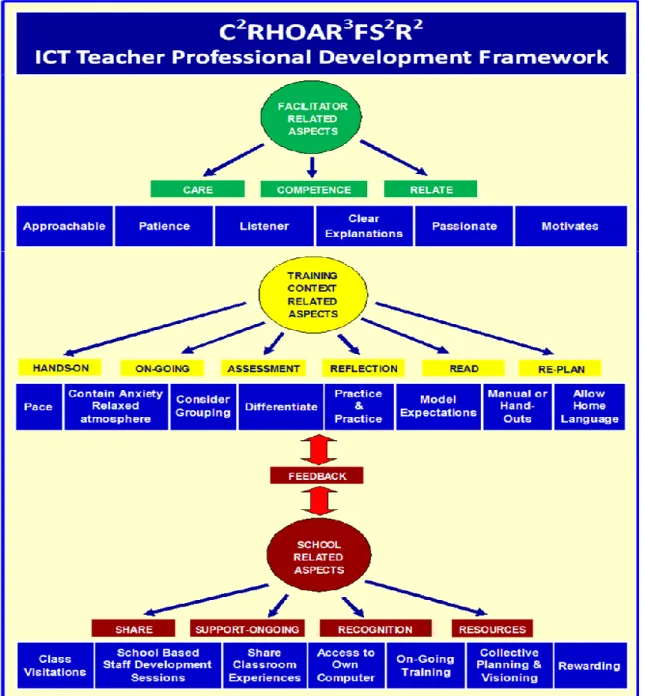
C2RHOAR3FS2R2 Care, Competence, Relate, Hands-on, On-going, Assessment, Reflection, Read, Re-plan, Feedback, Share, Support-ongoing, Recognition and Resources
DoBE Department of Basic Education
EMIS Education Management Information System
EPC Education Policy Consortium
EU European Union
FIFA Fédération Internationale de Football Association
HEI Higher Education Institution
ICT Information Communication Technology
INSET In-Service Training
INTEL Integrated Electronics Corporation
KPL Knowledge Practices Laboratory
LSEN Learners with Special Educational Needs
LTSM Learner and Teacher Support Materials
MDG Millennium Development Goals
MGT Multi-grade Teacher
MS Microsoft
MSC Mind Skill Character
MUSE Multi-grade School Education
NCS National Curriculum Statement
NEMED Network of Multigrade Education
NGO Non-Governmental Organisation
NSF Norms and Standards for Funding
NWREL Northwest Regional Educational Laboratory
PAM Personnel Administration Measure
PFMA Public Finance Management Act (No.1 of 1999 as amended by
Act 29 of 1999)
PSOPP Public Schools on Private Property
RIPPLES Resources, Infrastructure, People Policies, Evaluation Learning new strategies, Support
SA South Africa
SACE South African Council for Educators
SAIDE South African Institute for Distance Education
SASA South African Schools Act (No.84 of 1996)
UNESCO United Nations Educational Scientific and Cultural
Organisation
CHAPTER 1
INTRODUCTION AND OVERVIEW
1.1
INTRODUCTION AND BACKGROUND
The vision and mission of the Department of Basic Education are to provide access to quality education for all, asstipulated in the South African Schools Act 84 of 1996 (Republic of South Africa, 1996b), as well as in the Constitution, Act 108 of 1996 (Republic of South Africa, 1996a). This is further underpinned by the principles of the Department of Education’s Quality Learning and Teaching Campaign (Department of Education, 2009a), as well as the commitment to the Dakar Framework for Action 2000 (World Education Forum, 2000). The role that education plays in the battle against poverty has been re-emphasised and gained world-wide recognition in the 2010 FIFA World Cup launch of the
‘1GOAL: Education for All’ campaign, which aims to harness the power of football to guarantee that
education for all would become a permanent result of the 2010 FIFA World Cup (Global Campaign For Education & 1Goal, 2010).
According to Khan (2008), a UNESCO report highlighted the importance of Information and Communication Technology (ICT) as a tool in shaping the future of teaching and learning within the educational context. The South African Department of Education has realised this claim long before 2008, with the publication of a White Paper in 2004 (Department of Education, 2004). This White Paper on e-Education (2004) states that by 2013 all South African learners have to be ICT capable and that teachers should be using ICT resources in teaching and learning (Department of Education, 2004), thereby emphasising the importance of ICT within the educational context. However, in the year 2012, it seemed that this overzealous goal would not be possible, because the provision of computers via the Eastern Cape Department of Education’s ICT Roll-out Plan was not meeting the demand.
Yet, in September 2005, a governmental report indicated that South Africa was well on track in terms of the Millennium goals1 to be reached by 2015 (Modisane & Masango, 2005). However, it seems that this report might not be portraying a realistic picture (Chetty, 2010). According to Chetty (2010), South Africa is faced with a significant challenge in improving the quality of education,
1 The Millennium Goals to be reached by 2015 are to eradicate extreme poverty; to achieve universal primary education; to promote gender equality and empower women; to reduce child mortality; to improve maternal health; to combat HIV/AIDS, malaria and other diseases; to ensure environmental sustainability; and to develop a global partnership for development.
particularly in the rural areas. The White Paper on e-Education (Department of Education, 2004) suggests that ICT integration has the potential to improve education in terms of teaching and learning.
Prior to 2009, ICT resourcing to multi-grade schools was non-evident within the Uitenhage District in which the researcher resided. However, it seems that regarding the roll-out of ICT within the Uitenhage District, a small ‘about turn’ was noticed in May 2009, when the Eastern Cape Department of Education supplied one laptop each for teaching and learning to 100 educators working within the multi-grade teaching context within the Eastern Cape Province in the Uitenhage, Lusikisiki and Sterkspruit Districts. This one teacher laptop roll-out, should not be confused with the ‘one laptop per
child’ initiative (see http://one.laptop.org/). Although 100 laptops were provided, this was a very small number in comparison with the remaining number of teachers within the District and Province still without ICT resources. A study by Du Plessis (2010) also suggested that the roll-out of ICT resources to disadvantaged schools within the Port Elizabeth District, adjacent to the Uitenhage District, was non-existent. The Department of Education (2004) has also acknowledged that the educational school context is in desperate need, not only for ICT resources, but also for ICT resources to be used by teachers for teaching and learning. The ICT related resource problem was also highlighted by Howie, Muller and Paterson (2005). Data from the Department of Education (2009a) also suggest that ICT access at schools within South Africa and within the Eastern Cape Province is very low, and Education Management Information System (EMIS) 2010 data have also indicated that only 10% of the schools had a computer centre, concurring with Howie, Muller and Paterson (2005) and Du Plessis (2010).
The multi-grade teachers within the Uitenhage District who received the teacher laptops, referred to in the previous paragraph, had received very basic computer literacy training only, in terms of a program that lasted five hours per day over four days through the MSC College, prior to receiving them. The aim of the training was to ensure that the recipients would be able to use the laptops. Teachers were expected to use the computers to promote ICT implementation in their teaching and learning in multi-grade classrooms, but school visits and informal interviews with the multi-grade teachers confirmed that they were not using the laptops that they had been given.
While reading literature related to multi-grade education and ICT, several questions began to arise, such as, ‘Is the Department of Education really aware of the challenges that multi-grade teachers
experience?’ and ‘What are the perceived problems that multi-grade teachers experience within the
Uitenhage District?’ Further questions manifested, such as, ‘Are these barriers similar in nature or
different to those mentioned in the literature?’ Hence, a study concerned with multi-grade teachers’ perceptions about the barriers or challenges could be useful to inform possible future policy, as well as planning for training and assistance.
From the onset, it was clear that the term multi-grade was permeated with problems. The learners from the multi-grade context generally come from poor parents, often farm workers, with low
levels of education. Multi-grade teaching schools are mostly situated on farms and are characterised by neglect (Kruss, 2009), poverty, lack of infrastructure, lack of parental involvement, high drop-out rates, low learner enrolment and absenteeism, and lack of basic services (Ministerial Committee, 2005). Multi-grade is also seen as a temporary intervention for providing access to education for rural learners (Cornish, 2010). It is often difficult to find qualified educators who are willing to teach in these areas. All this has served to create the perception that the quality of the education in schools practising multi-grade education is poor compared to that of schools practising mono-multi-grade in the urban areas, especially when one looks at the funding that multi-grade schools receive.
In view of the above, the researcher grappled and formulated more subsequent questions, such as, ‘What are the challenges that multi-grade teachers face?’; ‘What could be the reasons why the
educators did not use the laptops as was expected of them?’; ‘How can these multi-grade teachers be
assisted to become users of a one-laptop for teaching and learning in their multi-grade classrooms?’; and ‘If training is provided to the multi-grade teachers, will it necessarily result in them using the
laptop for teaching and learning?’. Therefore, it seemed that a study of this nature could provide answers to these above stated questions.
1.2
PROBLEM STATEMENT
The researcher engaged in informal discussions with the multi-grade teachers who received their laptops during 2009. These informal discussions indicated that the teachers in multi-grade schools who each received a laptop, were not utilising their laptops for teaching and learning in the multi-grade classroom. It was also clear that although a short once-off basic training session had been provided, this had not resulted in ICT usage within the multi-grade classroom.
The researcher therefore grappled with how to sensitise the Department of Education and the Uitenhage District Office of these multi-grade teachers’ needs in order to take education forward, as portrayed in section 1.1. Against this backdrop, the researcher decided to embark upon a formal study in order to report the multi-grade teachers’ perceptions regarding the aspects indicated in question format with which the researcher grappled, as indicated in sections 1.1 and 1.2. These issues relate to challenges pertaining to the multi-grade classroom context and ICT usage, what the teachers perceived could be done, and whether something could be done that would yield practical evidence of usage. In view of the above and the aspects discussed in the previous sections, the research questions, as indicated in section 1.4, were formulated.
1.3
RESEARCH AIM AND OBJECTIVES
The overall research aim of this study was to enable teachers to use the laptop in the multi-grade classroom by determining their needs in order to use an existing teacher assistance programme, such as Intel® Teach, for one-laptop implementation within the multi-grade classroom school context. From the main research aim, the following objectives emerged:
To ascertain the challenges and/or barriers that multi-grade teachers experience;
To determine the challenges or barriers that mitigate against the use of a laptop in the multi-grade classroom;
To ascertain what could be done to address the barriers in order to assist with classroom implementation of the laptop for teaching and learning, as perceived by the teachers;
To expose the participating teachers to an existing ICT programme, Intel® Teach, with a view to assist the educators in using the laptop for teaching and learning in the multi-grade classroom;
To determine whether the exposure to the Intel® Teach Programme had promoted a change in the participating teachers’ practice, i.e. whether evidence existed to indicate whether teachers were using the laptop for teaching and learning;
To sensitise and inform the Department of Basic Education regarding the issues that this study investigated and the findings pertaining to these issues; and
To provide recommendations to the Department of Basic Education regarding what could be done to assist multi-grade teachers within similar contexts regarding how they could be assisted to use the laptop for teaching.
1.4
RESEARCH QUESTION AND SUB-QUESTIONS
The main research question that emerged from the problem statement and aims is:
Can the use of the Intel® Teach ICT programme assist multi-grade teachers in promoting ICT implementation in their teaching in the multi-grade context? Regarding the ‘Can’ question, Andrews (2003) states that there seems to be a concern regarding phrasing such a question. However, he argues that this type of question actually does not result in a mere ‘yes’ or ‘no’ response; rather, it provides an opportunity to find ‘answers’ that go beyond a simple ‘yes’ and ‘no’ (Andrews, 2003). In
the light of the above, the following subsidiary questions need to be answered in order to answer the main research question, namely:
What are the perceived challenges that a sample of teachers experience when
teaching in a multi-grade context?
What are the perceived challenges that a sample of multi-grade teachers experience when attempting to implement ICT in their classrooms?
What are the teachers’ perceptions of what can be done to meet these challenges?
What did they perceive as the positive and negative aspects of the Intel® Teach training programme?
Is there evidence that the Intel® Teach Training Programme enabled teachers
to implement ICT into their teaching and learning in a multi-grade context?
1.5
RELEVANCE OF STUDY
Multi-grade teaching is part of education systems in both developed and developing countries all over the world (Little, 2006; Tsolakidis, 2010) and is also practised in South Africa (Brown, 2010; Gardiner, 2008; Jordaan & Joubert, 2008; Joubert, 2010). Various terms are used for the practice of multi-grade teaching, like composite classes in New Zealand (Wilkinson & Hamilton, 2003); multi-age or multi-phase or mixed grades in the United Kingdom (Little, 2006); and multi-grade teaching in South Africa (Jordaan & Joubert, 2008). Gardiner (2008), Kruss (2009), Jordaan and Joubert (2008), Juvane (2007) and Little (2006) have lamented the neglect of multi-grade schools. This sentiment was shared by the multi-grade teachers in the Uitenhage District during informal interviews during school visits prior to the commencement of this study. The teachers indicated that they felt that the support they received from departmental officials was generally inferior and insufficient compared to the support given to mono-grade schools. The teachers indicated that they were seldom visited by departmental officials for on-site support and that the workshops and meetings did not address their challenges and needs.
Whilst it is important for educators to utilise the one-laptop awarded to their school, it is of equal importance to equip the educators with skills to utilise the technology in order to assist them with teaching and learning within their classrooms. The research findings could therefore make a valuable contribution towards a greater understanding of the plight of multi-grade teachers and to ascertain what they suggest could be done to assist them. In addition, the research could also enlighten the Department of Basic Education whether an ICT training programme, such as the Intel® Teach Programme, could assist with ICT implementation within the multi-grade context. Furthermore, the usage of one laptop as
an ICT resource could also expose learners from the poorest communities in which these multi-grade schools are situated to technological resources and provide an opportunity to assist with breaking down the digital divide for teachers and learners within the multi-grade context, an aspect that is also emphasised by the White Paper on e-Education (Department of Education, 2004).
Brown (2010) recognised multi-grade teaching as an “under-researched area in South
Africa” (Brown, 2010, p. 193). Hence, it seems that research within the multi-grade context related to the challenges that multi-grade teachers face within their classrooms, the barriers they are faced with when using ICT for teaching and learning within their multi-grade context, the teachers’ suggestions on what can be done to assist them, and whether the Intel® Teach Training Programme could assist them to start using the laptop for teaching and learning, and that the research findings could be useful to the Department and District Office with a view to future planning and initiatives.
The researcher therefore also envisaged that this research could play a role in assisting, motivating and encouraging multi-grade teachers to use the available technology in order to become part of the on-line and global community of ICT users. At the same time, the findings of this study could inform policy and further assistance related to the multi-grade context, especially within the Uitenhage District.
1.6
BRIEF CLARIFICATION OF CONCEPTS FROM LITERATURE
This research had as its foci the challenges related to the multi-grade classroom and ICT usage, and what the participating teachers envisaged could be done in order to address these challenges. The study also focused on how and what the perceptions of the teachers were related to further Intel® Teach training, as well as whether there was evidence of usage after the further training. At the same time, certain concepts or terminologies were used. It is therefore important to understand the different terminologies involved. Hence, a short overview is provided in the following sub-sections.
1.6.1
Perspectives on mono-grade and multi-grade education
In mono-grade education, one teacher is expected to teach to one grade or one subject in the same classroom. It is the primary and preferred method of instruction in most countries (Brunswic & Valérien, 2004; Little, 2006). Although learners in a mono-grade classroom also have different abilities, they are usually learners of the same age and progress from one grade level to the next. These learners do not usually stay with the same teacher, but move on to the next grade teacher (Berry, 2001b; Little, 2006).
In multi-grade teaching, on the other hand, the teacher is expected to teach all subjects to more than one grade of learners in the same classroom. These learners, who are differentiated in grade, ability, capability and age, sit in the same classroom. This practice occurs mostly in isolated or rural
areas with limited resources (Little, 2001; Berry, 2001b; Juvane, 2007; Joubert, 2010; Tsolakidis, 2010). Joubert (2010) defines multi-grade education in the South African milieu as:
“the situation, where one teacher teaches simultaneously all the learning areas or some of the learning areas to learners who are in two or more grades or in different grades in a combination of different phases. Multi-grade teaching occurs in rural areas, with limited facilities and mostly on farms”
(Joubert, 2010, p. 2).
In South Africa, all public schools ascribe to the National Curriculum Statement (NCS) or the newly introduced Curriculum Assessment Policy Statement (CAPS) as the curriculum that is taught. There is no separate curriculum for multi-grade teaching. It is expected that teachers in multi-grade classrooms must address all expected outcomes for a particular grade. It seems that the preferred method of instruction in South Africa favours mono-grade teaching, in terms of which one teacher is responsible for teaching one grade or one subject to learners in the same classroom.
Multi-grade as an educational reality is not a new idea (Commonwealth Secretariat, 2007; Little, 2006; Mulkeen & Higgins, 2009) and is not confined to the South African context. Multi-grade teaching is a worldwide phenomenon. In Chapter Two, this issue will be further explored. Multi-grade education is seen as a temporary intervention for providing access to education for rural learners (Cornish, 2010). The Commonwealth Secretariat (2007), Little (2006) and Mulkeen and Higgins (2009) agreed on the criteria for prevalence and that the rationale for multi-grade teaching arose from necessity, namely to cater for the needs of all learners. Internationally, it seems that multi-grade schools account for about 30% of all primary schools in the world (Brunswic & Valérien, 2004; Little, 2006; Mulkeen & Higgins, 2009). However, statistics seem not to be accurate (Little, 2006).
Whether multi-grade is implemented as a choice or as necessity, the various literature sources (Commonwealth Secretariat, 2007; Gardiner, 2008; Jordaan & Joubert, 2008; Little, 2006) seem to concur on the conditions that prevail in areas where multi-grade teaching is practised, namely poverty, a lack of basic infrastructure, a lack of parental involvement, high drop-out rates, low learner enrolment, absenteeism and a lack of basic services. These schools are often located in remote, rural surroundings (Brown, 2010; Gardiner, 2008; Joubert, 2010, Juvane, 2007; Little, 2006; Mathot, 1998; Ministerial Committee, 2005; South African Institute for Distance Education, 2003).
International teacher perceptions of multi-grade teaching tend to be negative as it is perceived that teaching multi-grade classes carries a heavier workload and creates more stress for teachers in the work environment (Mulkeen & Higgins, 2009). Informal discussions with educators in the Uitenhage District revealed that these perceptions were also shared by some educators teaching multi-grade classes in the Uitenhage District. The importance of multi-grade education and recent research on multi-grade
education have renewed the focus on rural education and multi-grade education (Joubert, 2010). The 2010 Multi-Grade Conference in Paarl, South Africa, which was attended by the researcher in March 2010, also highlighted the fact that multi-grade education is an important reality that has to be addressed and supported.
1.6.2
Perspectives on ICT implementation
The term ICT (Information Communication Technology) in the South African school context may be described as “The term information and communication technology (generally abbreviated to ICT) [that] includes the technologies which together support people’s ability to manage and communicate information electronically” (Biablobrzeska & Cohen, 2005, p.12). According to the Department of Education (2004):
“ICT’s represent the convergence of information technology and communication technology. ICT's are the combination of networks, hardware and software as well as the means of communication, collaboration and engagement that enable the processing, management and exchange of data, information and knowledge”
(Department of Education, 2004, p.15).
ICT implementation and integration entails more than simply using the computer in traditional ways to support the traditional way of teaching, for example, using the computer as a tutor or teacher (Du Plessis, 2010). It requires new and innovative ways of teaching and introduces a new perspective on learning, where the focus is on learning (Du Plessis, 2010, with reference to Shelley, Cashman, Gunter & Gunter, 2002).
The South African White Paper on e-Education (2004) encourages ICT integration as an enhancement to teaching and learning (Department of Education, 2004). The importance of and support for ICT are further emphasised by the establishment of an educational portal, Thutong (www.thutong.doe.gov.za), as well as in various Curriculum Statements. The White Paper on e-Education recommends using ICT in South African schools through e-Learning as a transformational tool, focusing on interactive learning as an enhancement to teaching and learning (Department of Education, 2004). The Department of Education envisages that ICT will prompt the development of new teaching strategies that depend on collaboration, problem solving and simulation, as the introduction of computers in schools should be supporting the curriculum (Department of Education, 2004).
However, there seems to be many challenges or barriers to ICT implementation and integration (Ertmer, 1999; Du Plessis, 2010; Du Plessis & Webb, 2012a). Ertmer (1999) referred to first order and second order barriers or challenges, whereas Kozma (2003) and Kirkland and Sutch (2009)
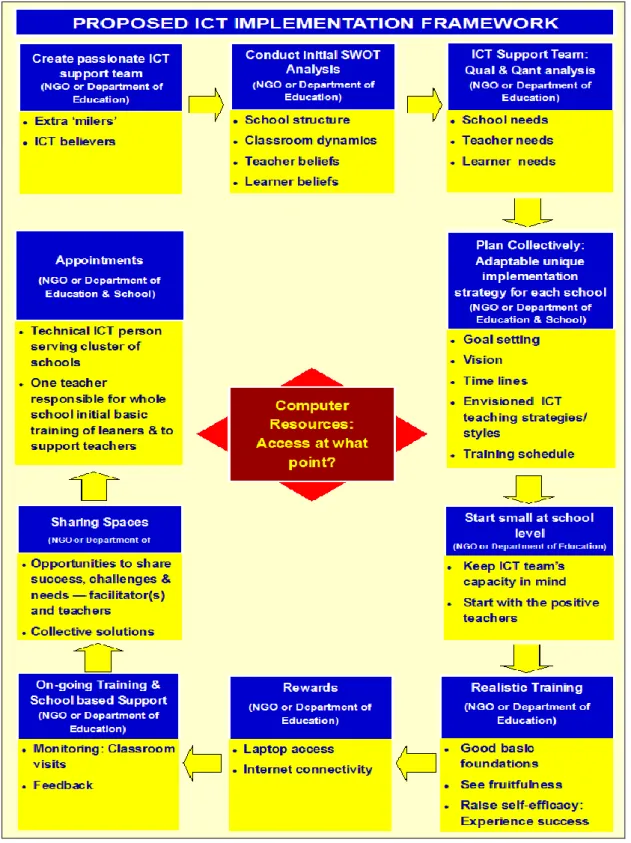
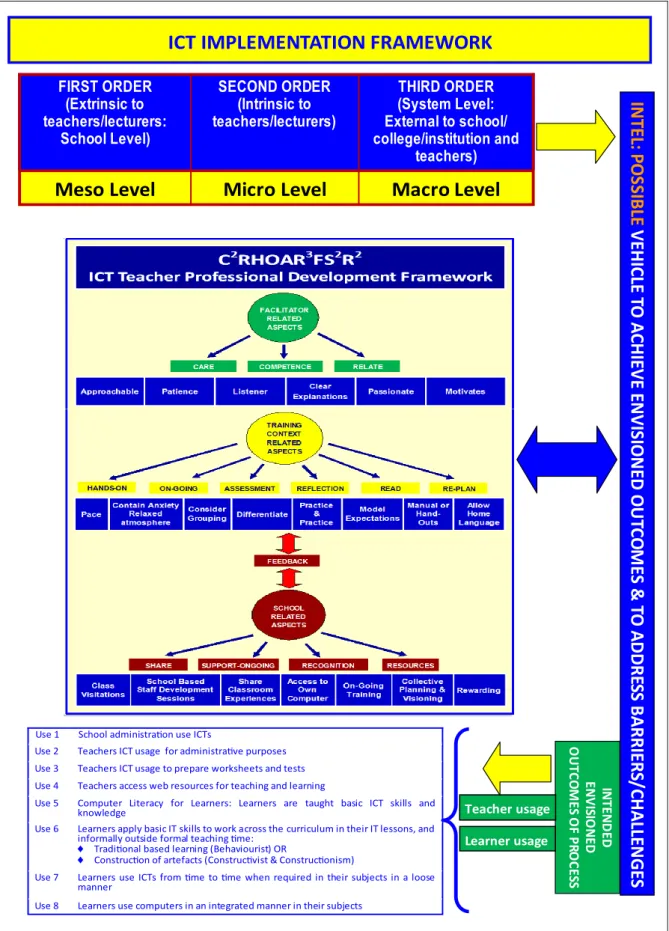
identified barriers on three levels; micro (teacher or individual level), meso (school level) and macro (system level) typology as barriers, hence adding a third order barrier to Ertmer’s (1999) two barrier typology. These aspects and the associated literature will be explored in more depth in Chapter 2 and will form the basis of the analysis and discussion of the data in Chapter 4. In addition, the heuristic of Du Plesssis and Webb (2012b) and the levels of use of Bialobrzeska and Cohen (2005) will be explored in chapter 2, as this formed the basis for the ICT reference when planning, implementing and sustaining teacher professional development.
1.7
METHODOLOGY: RESEARCH DESIGN
Methodology refers to the way in which a person approaches research. It implies that there is, firstly, a research design, underpinned by philosophical principles and, secondly, a research design process (Du Plessis, 2010, with reference to Gibson & Brown, 2009). For example, the research design refers to whether one conducts an experiment, case study or action research, whereas the research design process refers to ethical considerations, participant selection, data gathering tools, when the research occurred and when the data were selected, the phases of the research, the data analysis process and how trustworthiness was established (Gibson & Brown, 2009). From the literature, there are three main research approaches available to a researcher, namely qualitative, quantitative and mixed methods (Creswell, 2003). In the subsequent sections, an overview pertaining to the paradigmatic stance, the research approach and the type of study will be provided.
1.7.1
Interpretive paradigm
The paradigmatic stance of this study lies within the interpretive paradigm, since it aims to explore the participants’ experiences and their inner perspectives (Cohen, Manion & Morrison, 2007) pertaining to ICT related aspects, as indicated in the research aims and research questions. Within the interpretive paradigm, the ontological position is that there are multiple realities (Creswell, 2003; Denzin & Lincoln, 2005); therefore reality is subjective (Johnson & Onwuegbuzie, 2004). Epistemologically, i.e. how we come to know, this study recognises that reality is socially constructed and holds a subjectivist view of reality (Denzin & Lincoln, 2005). This study therefore recognises that there is a degree of subjectivity, based on the interaction and relationship between the researcher and the participants as a result of the subjective interaction and nature of the research.
1.7.2
Qualitative research approach
This research used a qualitative research approach, since it allows more flexibility, is descriptive in nature, allows for exploration, is contextual and offers a holistic perspective (Marshall & Rossmann, 2006). According to Denzin and Lincoln (2005), the interpretivist utilises qualitative data gathering methods. Although qualitative data gathering methods are mostly used in interpretivist
research, Creswell (2003) states that it may also utilise quantitative data gathering tools; therefore, a mixed approach within the interpretive paradigm seems a possibility.
However, qualitative data gathering methods were considered best suited for this study. An open-ended questionnaire, semi-structured qualitative personal interviews and focus group interviews were employed, since they allow for the exploration and probing of participants’ perceptions and experiences (Patton, 2002). According to Bogdan and Biklen (2003), qualitative research has been given various names, such as fieldwork, ethnography, inner perspective, case study, ecological, descriptive and symbolic interactionism.
Some quantitative data were also used to report on the last subsidiary question, but the qualitative data formed the main data source for this last question, too. The rationale for the use of quantitative data for the last subsidiary question was to ascertain whether the participants used the laptop and ICT related products and software subsequent to the training. The quantitative data and qualitative data were gathered in order to provide an overall picture, as not all the participants could be interviewed. However, all participants could complete the open-ended questionnaire, which contained some quantitative responses to indicate pre- and post-usage.
1.7.3
Exploratory case study
The research design for this research project was an intrinsic exploratory case study within the interpretive paradigm, which mainly used qualitative data, except for the last subsidiary question, where some quantitative data were collected. According to Flyvberg (2011), a case study is a rigorous examination of a single entity (as a person or community), highlighting developmental factors related to the setting. Creswell (2003) accentuated the explorative nature of the case study, whereas Picciano (2004) highlighted the descriptive and interpretive elements of the case study. In a case study, there is generally a great deal of interaction between researcher and participants (Creswell, 2003; Pring, 2004). Gerring (2007) viewed a case study as the study of an individual, a small group, a single situation or a specific case, conducted over a period of time. This case study was a study of a relatively small group; twenty multi-grade teachers as a community within the multi-grade context. However, one participant passed away during the research, which resulted in 19 responses in certain data gathering tools. This research enabled the researcher to provide the perceptions of a small group of participants regarding ICT related aspects and whether the participants used ICT in their school context after the Intel training. A great deal of criticism has been levelled against the case study approach, an aspect that will be dealt with in chapter 3. One of the criticisms is that the researcher’s involvement could compromise objectivity (Pring, 2004), with others being the duration of the study as well as the many data sources to be explored (Creswell, 2003). In addition, there is the issue of not being able to generalise (Berg, 1998).
However, Stake (1995) and Merriam (2009) argued that readers were the persons that could or would make the decision whether the findings seemed just and generalisable in their contexts.
Fiedler (2004) and Yin (2009) stated that case studies were ideal for answering questions related to the “who, what, where, how and why?” of a contemporary issue. Yin (2009) suggested that case studies could be explorative, descriptive and explanatory in nature, while Pring (2004) stated that qualitative and quantitative data could be used within the case study approach.
Taking the above into consideration, the intrinsic explorative case study approach was considered best suited to address the research question and sub-questions, as it assisted the researcher in exploring the ‘what’ and ‘how’ issue, namely ‘What are the perceived challenges to the multi-grade?’, ‘What are the perceived challenges to ICT?’, ‘How can the perceived challenges and barriers be addressed according to the participants?’, ‘to ascertain their perceptions to what is positive and negative regarding the Intel intervention’ and ‘to ascertain how they use the laptop and ICT after the training’. Hence, this research provided the participants with a voice regarding their perceptions and
experiences.
The case study approach therefore seems to provide researchers with an opportunity to explore experiences, perceptions and suggestions (Stake, 1995). Therefore, in this study, the case study approach was deemed best suited to explore the issues at hand of the participating multi-grade teachers.
1.8
RESEARCH METHOD
Gibson and Brown (2009) referred to the research method as the research design process, which involves a variety of aspects, such as ethical considerations, participant selection, data gathering tools, when the research occurred and when the data were selected, the phases of the research, the data analysis process, and how trustworthiness was established. The research method can therefore be seen as the procedures followed or the structured way in which the research was conducted. The research method of this study is briefly discussed in sections 1.8.1 to 1.8.9 below.
1.8.1
Research context
This study was conducted with twenty laptop recipient teachers practising multi-grade teaching in the Uitenhage District. Within this research, the unit or group of the study was the laptop recipients and their experiences and perceptions within the multi-grade context.
1.8.2
Participant selection: Population and sample
Sampling refers to a portion of an entire group (Denscombe, 2007) or “reflecting the whole” (Thomas, 2003, p. 102). Hence the sample involves the researcher’s decisions regarding who should be
included, which setting or context should be used, which event should be studied, what should be observed, and what should be looked for.
For the purpose of this interpretive exploratory case study, purposive and convenience sampling was used. The participants were twenty multi-grade teachers from the Uitenhage District in the Eastern Cape Province in South Africa, who had received laptops from the Department of Basic Education. This provided the purposive dimension of the sample. At the same time, the sample was also convenient, as the researcher was a Department of Education official that worked with and visited the participants on a regular basis. In chapter 3, sampling will be explored in more depth.
1.8.3
Data collection tools
Within the interpretive paradigm, qualitative data collection tools are used to gather data. It was indicated in section 1.7.3 that qualitative data provide the researcher with an opportunity to explore the inner perceptions of research participants. In this study, the teachers’ perceptions were explored via an open-ended questionnaire, individual interviews and focus group interviews.
According to Curry (2009), quantitative open-ended questionnaires are widely used as common data collection tools that allow for reliable data. Johnson and Christensen (2004) emphasise that the questionnaire is an appropriate data gathering tool, as it enables researchers to develop predetermined questions they would ask participants. This study employed two open-ended (pre- and post intervention) questionnaires, with some semi-closed questions, which were distributed to all twenty participants to explore their perceptions in their own words. The open-ended questionnaires also ensured anonymity, provided all the participants with an identical set of questions, did not take up as much time as the interviews, and did not need the researcher’s presence when the participants had to answer the questions. In addition, the open-ended questionnaire allowed the participants to complete it without the assistance of the researcher and without any pressure from the researcher or any other participants. The questionnaire provided the participants the freedom to pen down their innermost thoughts, suggestions and reflections (Struwig & Stead, 2001).
The interview is another popular data gathering tool in qualitative research, as it provides opportunities to gain insight or, as Schostak (2006) stated, “opening up the possibility of gaining insight
into the experiences, concerns, interest, beliefs, values, knowledge and ways of seeing, thinking and acting of the others” (Schostak, 2006, p. 10). Gilham (2000) stated that semi-structured interviews were important data collection techniques popularly used in case studies; hence the decision to use this tool within this study.
According to Mc Farlane (2000), the researcher must take into recognition the flexible nature of interviews. Mc Farlane (2000, citing Goodman, 1992, p. 123) posited that one should take
cognisance of the fact that everyone tries to make sense of life experiences. The interview data gathering technique provided the researcher with an opportunity to not only ‘capture’ the interviewees’ perceptions, but also to probe responses.
This study therefore opted for semi-structured interviews to gain insight into the participants’ perceptions (Schurink, Schurink & Poggenpoel, 1998). Individual semi-structured interviews were conducted to gain an in-depth understanding of the perceived challenges as experienced by individual teachers in the multi-grade context. The data provided the researcher with the opportunity to explore the differences and similarities individuals posit as challenges, and possible solutions to these.
The focus group interview was another data gathering tool utilised in this study. Johnson and Christensen (2004) stated that the focus group interview “is a type of group interview in which a
moderator / researcher leads a discussion with a small group of individuals” (Johnson & Christensen, 2004, p. 185). Struwig and Stead (2001) stated that the focus group interview is a well designed conversation constructed to obtain insight into particular aspects within a relaxed atmosphere, while De Vos, Strydom, Fouché and Delport (2005) posited that focus group interviews provided an opportunity to gain an understanding of participants’ perceptions and thoughts. This data gathering technique encourages group interaction on a predetermined topic or aspect (De Vos et al., 2005). Group interaction stimulated the other participants through the prompting of questions, allowed for in-depth discussion and data rich information, which was sometimes not possible to generate through an individual interview (Rossouw, 2003). Hence, the focus group interview aimed to generate data through group participation and was seen as a group conversation (Ritchie & Lewis, 2003).
In this study, the focus group interview was used to gain data-rich information on research questions 4 and 5 from two groups consisting of three to four participants each. It provided the opportunity for the