602
FACE RECOGNITION WITH SINGLE SAMPLE PER
CLASS USING CS-LBP AND GABOR FILTER
1A.USHA RUBY, 2DR.J.GEORGE CHELLIN CHANDRAN
1Research Scholar, Department of CSE, Bharath University
2Principal, CSI College of Engineering, Ketti
E-mail: 1[email protected] , 2[email protected]
ABSTRACT
In face recognition Local appearance based methods has achieved greater performance. In this paper, we have proposed single sample per class using Center Symmetric Local Binary Pattern and Gabor Filter. Gabor Filter extracts the textual feature and generates a binary face templat and the binary face template acts like a mask to extract local texture information using Center Symmetric Local Binary Pattern. Face features which are evaluated from CS-LBP has better performance.
Keywords: Face Recognition, Center Symmetric Local Binary Pattern (CS-LBP), Principle Component Analysis (PCA), Linear Discriminate Analysis (LDA), and Independent Component Analysis (ICA), Binary Face Template, Single Sample Problem.
1. INTRODUCTION
Face recognition is used to identify or verify a person using biometric parameters. Face recognition is successfully applied today in law enforcement, surveillance, entertainment, etc. Most of the face recognition techniques used are Eigen faces [1], Fisher faces [3], Laplacian faces [9], Neural Networks [5,12]. In practice there is some difficulty in dealing with different illumination, pose, facial expressions, ageing. Another important problem is a single sample problem, where we are using only one single sample per class for training. In the case of passport, aadhar card, driving license, voter id, etc. only one image is available for training. Some face recognition algorithms are proposed to solve single sample problem [15,8,6,10,12].
The face recognition method is classified into two: Holistic matching method and local matching method. The entire face image is considered for the holistic matching method. This is based on Principle component analysis (PCA) [1], Linear Discriminate analysis (LDA) [3,4,13], and Independent Component analysis (ICA). PCA is applied to training set based on Eigen faces where each image is represented by Eigen vector. For each image Eigen value is calculated and Eigen vector with the highest value is used to represent a particular image. Comparison is done by Euclidian distance between Eigen vector coefficients. LDA is based on Fisher
Faces. It uses multiple images of a person, it maximizes inter-class and minimizes intra-class scatter. Likewise ICA is used.
Local matching method is suitable for single sample per class than holistic method. In local matching method we will be considering single facial features rather than the whole image. Here, Low dimensional, local vector features represents the original features. Different facial features improve classifiers diversity [15]. Local features can be length, breadth, contrast, brightness etc.
Local Binary Pattern (LBP) method [2] was first proposed in an image texture descriptor [14]. Now it is applied on face-recognition application [15]. LBP method [11] provides better results in terms of speed and discrimination performance [15]. One advantage of using LBP, it is less sensitive to illumination variation and scaling variation.
A Gabor feature-based [15,7] face recognition is used mainly in image processing, pattern recognition, computer vision, etc. Gabor filter exploits spatial localization, orientation selectivity and spatial frequency characteristics [15]. Gabor filter extracts essential features of the face and creates binary face template.
603 In this section, a brief description about LBP and Gabor Filter is given.
2.1 Local Binary Patterns
Local Binary Pattern operation is introduced by Ojale et al in 1996. It summarizes local grey-level structure. The operator takes local neighborhood values around the pixel [1]. It takes the central pixel and considers all the neighborhood values of central pixels. It is defined by 3X3 neighborhood where (2,2) represents the central pixel. It is 8- bit coded based on central pixel.
LBP operator takes LBP (xc, yc) =∑7 n=0 2n s (in-ic)
Here in has eight neighbors over central pixel c,
where in and ic are gray scale values of c and n,
S (x) = 1 x≥0,
0 otherwise
Here on LBP method we divide the face image into a regular grid of cell. And histogram is applied for equalization. At last cell-level histogram concatenation produces uniform results.
Figure 1. Concept of LBP Directionality
Figure 2. Steps involved in calculating 3X3 LBP
Forming Kernal Pixel Values Result, Result Diagram
LBP Calculations Binary Bit Values Summed [0,0] 6>[-1,-1] 7=0 LBP=0
[0,0] 6>[-1,0] 9=0 LBP=00 [0,0] 6>[-1,1] 9=0 LBP=000 [0,0] 6>[0,-1] 5=1 LBP=0001 [0,0] 6>[0,+1] 7=0 LBP=00010 [0,0] 6>[+1,-1] 5=1 LBP=000101 [0,0] 6>[+1,-1) 4=1 LBP=0001011 [0,0] 6>[+1,-1] 7=0 LBP=00010110
LBP Descriptor=00010110(0 X 16 is the Hex Representation of the Binary Value)
Each pixel is compared to its neighbors, according to a forming kernel that allows selection of neighbors for the comparison. In Figure 2, all pixels are used in the forming kernel (all 1s). If the neighbor is greater than the center pixel, the binary pattern is 1, otherwise it is 0. Each LBP descriptor over a face region is recorded in a histogram to describe the cumulative texture feature. Uniform LBP histograms would have 56 bins, since only single-connected regions are histogrammed.
2.2 Gabor Filter
Using Gabor filter textual features is extracted and convert it into the binary face template. And it is used to remove noise from the extracted image. Gabor filter improves the recognition rate. It is a linear filter used for edge detection. It is a band pass filter. Frequency and orientation of Gabor filter are similar to those of the human visual system. This filter is found efficient for textual representation and discrimination. Here 2D Gabor filter ψf,θ(x,y) is represented as a complex
sinusoidal signal. And it is modulated by a Gaussian kernel function.
Ψ
f, ө (x,y)=exp[- ] exp(2πf )
Here f is the central frequency of sinusoidal plane and θ is the orientation of xy plane
.
Where θn is the rotation of xy plane by θn angle
results gabor filter at the orientation θn.
angle =
p is the orientation and n = 1,2,….p.
3. PROPOSED APPROACH
604
3.1 Creation Of Face Template Using Gabor Filter
The convolution process of face image with Gabor filter is performed and Gabor representation of face image is provided. Let I(x,y) be the intensity coordinate in a gray scale image. Convolution of Gabor filter Ψf,θ(x,y) is define by
g f,θ(x,y)=1(x,y) ⊕ ψ f,θ(x,y)
The Gabor kernel filter representation is a complex function with real part η{g f,θ(x,y)} and the
imaginary part is given by {g f,θ(x,y)}.
The magnitude response is expressed as
||g f,θ(x,y) ||= √ R2 {gf,θ(x,y)}+{gf,θ(x,y)}
And finally the Binary Face Template from the real part of complex information is generated
BFT(x,y) = 1 if complex information > 0 BFT(x,y) = 0 if complex information <=0
3.2 Center Symmetric Local Binary Pattern
[image:3.595.337.482.261.376.2]The basic methodology for LBP based face description proposed by Ahonen et al. (2006) is as follows: The facial image is divided into local regions and LBP texture descriptors are extracted from each region independently. The descriptors are then concatenated to form a global description of the face, as shown in Figure 3.
Figure 3. Face description with LBP histogram from each block and Feature histogram
This histogram effectively has a description of the face on three different levels of locality: the LBP labels for the histogram contain information about the patterns on a pixel-level, the labels are summed over a small region to produce information on a regional level and the regional histograms are concatenated to build a global description of the face.
The LBP operator, described produces rather long histograms and is therefore difficult to use in the context of a region descriptor. To address the problem we modified the scheme of how to
compare the pixels in the neighborhood. Instead of comparing each pixel with the center pixel, we compare center-symmetric pairs of pixels as illustrated in Figure 4. This halves the number of comparisons for the same number of neighbors. We can see that for eight neighbors, LBP produces 256 (28) different binary patterns, whereas for CS-LBP this number is only 16 (24). Furthermore, the robustness on flat image regions is obtained by thresholding the gray level differences with a small value T as proposed in Ref. [17].
LBP= s(n0-nc)20+s(n1-nc) 21 + s(n2-nc)22
+s(n3-nc) 23 +s(n4-nc)24+ s(n5-nc)25+ s(n6-nc)26+
s(n7-nc)27+….
CS- LBP = s(n0-n4)20 + s(n1-n5)21 + s(n2-n6)22+
[image:3.595.87.498.480.562.2]s(n3-n7)23 +….
Figure 4. LBP and CS-LBP features for a neighborhood of 8 pixels
CS-LBP R,N,T (x,y)= ni- ni + (N/2))2i
S (x) = 1 x>T,
0 otherwise
where ni and ni+(N/2) correspond to the gray values of
605
[image:4.595.86.503.71.730.2]4. EXPERIMENTAL RESULT
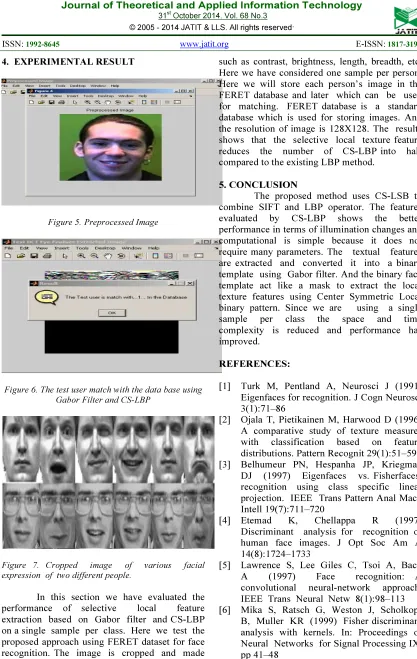
Figure 5. Preprocessed Image
Figure 6. The test user match with the data base using Gabor Filter and CS-LBP
Figure 7. Cropped image of various facial expression of two different people.
In this section we have evaluated the performance of selective local feature extraction based on Gabor filter and CS-LBP on a single sample per class. Here we test the proposed approach using FERET dataset for face recognition. The image is cropped and made into 64X64 from middle of location of the eyes. Here we have considered the local features
such as contrast, brightness, length, breadth, etc. Here we have considered one sample per person. Here we will store each person’s image in the FERET database and later which can be used for matching. FERET database is a standard database which is used for storing images. And the resolution of image is 128X128. The results shows that the selective local texture feature reduces the number of CS-LBP into half compared to the existing LBP method.
5. CONCLUSION
The proposed method uses CS-LSB to combine SIFT and LBP operator. The features evaluated by CS-LBP shows the better performance in terms of illumination changes and computational is simple because it does not require many parameters. The textual features are extracted and converted it into a binary template using Gabor filter. And the binary face template act like a mask to extract the local texture features using Center Symmetric Local binary pattern. Since we are using a single sample per class the space and time complexity is reduced and performance has improved.
REFERENCES:
[1] Turk M, Pentland A, Neurosci J (1991) Eigenfaces for recognition. J Cogn Neurosci 3(1):71–86
[2] Ojala T, Pietikainen M, Harwood D (1996) A comparative study of texture measures with classification based on feature distributions. Pattern Recognit 29(1):51–59 [3] Belhumeur PN, Hespanha JP, Kriegman
DJ (1997) Eigenfaces vs. Fisherfaces: recognition using class specific linear projection. IEEE Trans Pattern Anal Mach Intell 19(7):711–720
[4] Etemad K, Chellappa R (1997) Discriminant analysis for recognition of human face images. J Opt Soc Am A 14(8):1724–1733
[5] Lawrence S, Lee Giles C, Tsoi A, Back A (1997) Face recognition: A convolutional neural-network approach. IEEE Trans Neural Netw 8(1):98–113 [6] Mika S, Ratsch G, Weston J, Scholkopf
B, Muller KR (1999) Fisher discriminant analysis with kernels. In: Proceedings of Neural Networks for Signal Processing IX, pp 41–48
606
[8] Liu C, Wechsler H (2002) Gabor feature based classification using the enhanced Fisher linear discriminant model for face recognition. IEEE Trans Image Process 11(4):467–476
[9] Chen S, Liu J, Zhou ZH (2004) Making FLDA applicable to face recognition with one sample per person. Pattern Recognit 37(7):1553–1555
[10] He X, Yan X, Hu Y, Niyogi P, Zhang H (2005) Face recognition using Laplacian faces. IEEE Trans Pattern Anal Mach Intell 27(3):328–340
[11] Tan X, Chen S, Zhou ZH, Zhang F (2005) Recognizing partially occluded, expression variant faces from single training image per person with SOM and soft k-NN ensemble. IEEE Trans Neural Network 16(4):875–886
[12] Ahonen T, Hadid A, Pietikainen M (2006) Face description with Local Binary Patterns: application to face recognition. IEEE Trans Pattern Anal Mach Intell 28(12):2037–2041
[13] Tan X, Chen S, Zhou ZH, Zhang F (2006) Face recognition from a single image per person: a survey. Pattern Recognition 39(1):1725–1745
[14] Xiang C, Fan AX, Lee HT (2006) Face recognition using recursive fisher linear discriminant. IEEE Trans Image Process 15(8):2097–2105
[15] Ojala T, Pietikainen M, Maenpaa T (2010) Multiresolution grayscale and rotation invariant texture classification with local binary patterns. IEEE Trans Pattern Anal Mach Intell 24(7):971–987
[16] K.Jaya Priya, R.S Rajesh (2011) Selective local texture feature based face recognition with single sample per class. Springer.
[17] Abdallah Mohamed , and Roman Yampolskiy1, Face Recognition Based on Wavelet Transform and Adaptive Local Binary Pattern
[18] M. Ojala, M. Pietikainen, A t