BIROn - Birkbeck Institutional Research Online
Berggren, Nick and Eimer, Martin (2018) Object-based target templates
guide attention during visual search. Journal of Experimental Psychology:
Human Perception and Performance , ISSN 0096-1523. (In Press)
Downloaded from:
Usage Guidelines:
Please refer to usage guidelines at or alternatively
1
Running Head: FEATURE-BASED AND OBJECT-BASED TEMPLATES
Object-based target templates guide attention during visual search
Nick Berggren* and Martin Eimer
Department of Psychological Sciences, Birkbeck College, University of London,
Malet Street, London WC1E 7HX, UK
* Corresponding author
Phone: 0044 20 76316522
Fax: 0044 20 76316312
2
ABSTRACT
During visual search, attention is believed to be controlled in a strictly feature-based fashion,
without any guidance by object-based target representations. To challenge this received view,
we measured electrophysiological markers of attentional selection (N2pc component) and
working memory (SPCN) in search tasks where two possible targets were defined by feature
conjunctions (e.g., blue circles and green squares). Critically, some search displays also
contained nontargets with two target features (incorrect conjunction objects, e.g., blue
squares). Because feature-based guidance cannot distinguish these objects from targets, any
selective bias for targets will reflect object-based attentional control. In Experiment 1, where
search displays always contained only one object with target-matching features, targets and
incorrect conjunction objects elicited identical N2pc and SPCN components, demonstrating that
attentional guidance was entirely feature-based. In Experiment 2, where targets and incorrect
conjunction objects could appear in the same display, clear evidence for object-based
attentional control was found. The target N2pc became larger than the N2pc to incorrect
conjunction objects from 250 ms post-stimulus, and only targets elicited SPCN components.
This demonstrates that after an initial feature-based guidance phase, object-based templates
are activated when they are required to distinguish target and nontarget objects. These
templates modulate visual processing and control access to working memory, and their
activation may coincide with the start of feature integration processes. Results also suggest that
while multiple feature templates can be activated concurrently, only a single object-based
target template can guide attention at any given time.
Keywords: selective attention; top-down control; spatial attention; feature-based attention;
3
PUBLIC SIGNIFICANCE STATEMENT
When we look within our environment for an object (e.g., our cell phone), current
models of attention assume that our visual system adopts strictly feature-specific mental
templates to guide our search (the colour silver, a rectangular shape). Here, we demonstrate
that search templates for objects can also guide visual attention. Using electrophysiological
recordings, we show that during search for two possible target objects (blue circle, green
square), attentional control can distinguish these targets from other objects that contain both
target features in an incorrect combination (e.g., blue squares) within a quarter of a second
after exposure. These results challenge the presumed architecture of early attentional control
4
INTRODUCTION
Visual search for specific target objects is guided by observers’ knowledge about their
properties. In some search tasks, targets are defined by simple features (e.g., colour, size,
shape, or orientation), while in others, targets are objects defined by a conjunction of features.
Such target-defining features or feature conjunctions are assumed to be represented as
attentional templates (e.g., Duncan & Humphreys, 1992) or attentional control sets (e.g., Folk,
Remington, & Johnston, 1992). Once a particular target template is activated, stimuli that
match this template will attract attention, while stimuli with non-matching features will not
(e.g., Folk et al., 1992; Folk & Remington, 1998; Eimer & Kiss, 2008). While the role of
attentional templates in the guidance of visual search is undisputed (e.g., Wolfe, 2007), the way
in which target features and objects are represented in search templates is not yet fully
understood. When targets are defined by a specific feature such as a particular colour, search
templates are necessarily feature-specific. However, in search tasks where target objects are
defined by a conjunction of features, two different types of target templates are conceivable.
On the one hand, templates for feature conjunctions may still be feature-based, operating
independently for each target feature. For example, during search for blue circles among red
circles and blue squares, a colour template will bias attention towards blue objects and a shape
template will produce an attentional bias for circles, but there will not be an additional
object-based guidance process that is selectively tuned to blue circles only. Leading models of
attentional control such as Guided Search (Wolfe, 1994; 2007) assume that the selection of
particular objects during visual search operates in such a feature-based fashion. Once selected,
objects are identified by comparing them to long-term memory representations, before they
are categorised as targets or nontargets by determining whether they match the current
memory set for target objects. This three-stage model has been proposed by Cunningham and
Wolfe (2014) as an account of hybrid visual and memory search tasks with multiple possible
target objects. In this mode, early visual selection is controlled by features, whereas the
subsequent identification and target/nontarget discrimination stages are based on comparisons
5
templates are already involved in the early guidance of attentional selectivity during
conjunction search. If the allocation of attention can be controlled by representations where
individual target features are bound within a single integrated object file (Kahneman, Treisman,
& Gibbs, 1992; Wheeler & Treisman, 2002), attentional biases should emerge for target objects
only (e.g., blue circles), and not for objects with only one target-matching feature (e.g., red
circles or blue squares). The question addressed in this study is whether the guidance of
attention during conjunction search is entirely feature-based, fully object-based, or involves
both feature-based and object-based target templates.
Because search templates bias visual processing towards template-matching features
and objects, the nature of these templates can be identified by measuring their on-line effects
on visual activation. Event-related brain potentials (ERP) offer temporally precise markers of
such template-controlled attentional biases. The most prominent ERP marker of attentional
selectivity is the N2pc component, which is an enhanced negativity that is triggered at posterior
scalp electrodes contralateral to candidate target objects in visual search displays. The N2pc
typically emerges between 180-200 ms after search display onset, is generated in ventral
extrastriate visual areas (Hopf et al., 2000), and is assumed to reflect the allocation of attention
to possible targets (e.g., Luck & Hillyard, 1994; Eimer, 1996; Mazza, Turatto, Umiltà, & Eimer,
2007). The sensitivity of the N2pc to search templates for target features has been
demonstrated in spatial cueing tasks where task-irrelevant colour cues presented prior to
search displays triggered an N2pc only when they matched the current target colour but not
when they had a different non-matching colour (Eimer & Kiss, 2008; Lien, Ruthruff, Goodin, &
Remington, 2008; Leblanc, Prime, & Jolicoeur, 2008; Eimer, Kiss, Press, & Sauter, 2009). While
the N2pc reflects the allocation of attention to possible target objects during visual search (i.e,
the early visual selection stage proposed by Cunningham & Wolfe, 2014), another lateralised
ERP component that is often observed in visual search tasks (sustained posterior contralateral
negativity/SPCN; Mazza, Turatto, Umiltà, & Eimer, 2007; Jolicoeur, Brisson, & Robitaille, 2008)
is linked to the subsequent processing of selected objects in working memory. The SPCN
typically follows the N2pc at around 350-400 ms after search display onset and has a similar
6
of visual working memory representations of potential target objects, analogous to the
contralateral delay activity (CDA) that is observed during the delay period of visual working
memory tasks (e.g., Vogel & Machizawa, 2004).
The roles of feature-based and object-based target templates during visual search can
be investigated in conjunction search tasks by measuring ERPs to targets and to partially
target-matching but task-irrelevant objects. If the guidance of visual selection was entirely
feature-based, all objects with target-matching features should trigger N2pc components. If it was
object-based, N2pcs should only be elicited by fully template-matching target objects, but not
by nontargets with one target feature. Recent ERP studies from our lab that measured
attentional biases during search for feature conjunctions (colour/shape: Eimer & Grubert, 2014;
Jenkins, Grubert, & Eimer, 2017; colour/colour: Berggren & Eimer, 2016a;
colour/alphanumerical category: Nako, Grubert, & Eimer, 2016) obtained converging results. In
these experiments, targets (e.g., blue circles) and partially-matching nontargets (e.g., red circles
and blue squares) both elicited reliable N2pc components, and the target N2pc was initially
identical to the sum of the two N2pc components to each possible partially-matching
nontarget. This suggests that attention was guided independently by search templates for each
target-defining feature, and that these templates operated in parallel, producing additive
attentional biases of visual processing. However, from about 250 ms after search display onset,
the target N2pc became larger than the sum of the N2pcs to partially-matching nontargets,
indicating that attentional processing was now sensitive to the joint presence of multiple
target-defining features within the same object. These findings demonstrate that the selectivity
of template-guided attentional modulations during conjunction search evolves across time, but
do not yet provide unequivocal evidence for an involvement of object-based target templates.
The emergence of superadditive target N2pcs in these earlier studies could mark the point in
time when attentional selectivity starts to be guided by integrated object templates, but it
could also be the result of facilitatory interactions between feature-specific attentional
modulations that happen to be triggered at the same spatial coordinates within visual cortical
maps (e.g., Desimone & Duncan, 1995). In this case, a superadditive target N2pc would simply
7
“blue” and “circle”), but not an object-selective attentional response (“blue circle”) that is
triggered by a match with an object-based target template.
These two alternative possibilities could not be distinguished in these earlier ERP studies
of conjunction search, because only targets had both template-matching features. To dissociate
the effects of feature-based and object-based templates, we designed a search task where
targets were defined by colour/shape conjunctions, and some search displays included objects
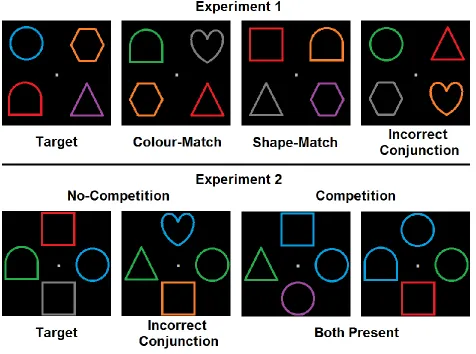
with a target colour and a target shape that had to be recognised as nontargets. In Experiment
1, there were two possible target objects (e.g., blue circles and green squares). Participants’
task was to report the presence or absence of one of these targets on each trial. Targets were
always accompanied by three non-matching distractor objects. On some target-absent trials,
search displays contained a partially target-matching object with one of the two target colours
or shapes among non-matching distractors. Critically, on other target-absent trials, one of two
possible “incorrect conjunction” nontarget objects was presented. These objects had both a
target colour and a target shape, but the combination of these two features did not match
either target object (e.g., blue squares or green circles; see Figure 1, top panel). Because targets
and incorrect conjunction objects both had a target-matching colour and a target-matching
shape, these two types of objects could not be distinguished by independently operating
feature-based attentional guidance processes. Thus, any attentional bias that is selectively
triggered by targets but not by incorrect conjunction objects will reflect an involvement of
genuinely object-based target templates.
EEG was recorded during task performance, and lateralised ERP components (N2pc and
SPCN) were measured for targets, partially-matching nontargets, and, critically, incorrect
conjunction objects, to track the time course of template-guided attentional selection and the
access to visual working memory for these different types of objects. Based on our earlier
findings from conjunction search tasks (see above), it was predicted that all objects with
target-matching features would initially trigger N2pc components, reflecting an early feature-based
phase of attentional selectivity. The critical question was whether and when attentional
modulations of visual processing would become sensitive to the difference between genuine
8
target-defining colour and shape, the N2pcs to these objects should initially be identical. If the
guidance of attention in this two-target conjunction search task was exclusively feature-based,
lateralised ERP waveforms to targets and incorrect conjunction nontargets should remain
identical throughout the N2pc time interval, and possibly also during the subsequent SPCN
period. Such an observation would demonstrate that visual selection and access to visual
working memory are controlled independently by target colours and shapes, and are not
sensitive to the presence versus absence of a target-matching feature combination. In contrast,
if object-based templates were involved in the guidance of attention, target N2pcs should
eventually become larger than the N2pc to incorrect conjunction nontargets. In this case, the
moment where this divergence occurs would mark the point in time where attentional control
processes start to become genuinely object-based. It is also possible that object-based target
templates have no effect on attentional modulations of visual processing, as reflected by N2pc
components, but operate at a later stage where objects are encoded into working memory. In
this case, targets and incorrect conjunction nontargets should trigger identical N2pcs, but only
target objects should elicit SPCN components.
To be able to create nontarget objects with incorrectly combined task-relevant colours
and shapes, we needed to use a task where participants had to search for one of two different
colour/shape conjunction targets. The control of this type of two-object search raises important
additional questions on its own. For example, there is considerable debate about whether
observers can maintain more than a single target template at any given time (e.g., Olivers,
Peters, Houtkamp, & Roelfsema, 2011; Beck, Hollingworth, & Luck, 2012; see below for more
detailed discussion). If participants were able to activate only a single template for one of the
two target objects on each trial, this should affect target N2pc amplitudes, as target objects
would match this template on only half of all trials. To assess this possibility, Experiment 1 also
included a single-target control task where observers searched for only one colour/shape
conjunction target. Because participants had to compare each selected object to only one
memorised target item in this task, but to two different items in the double target task,
9
difference in the demands on memory matching processes might also be reflected by
differences in the amplitude and/or duration of SPCN components between the two tasks.
EXPERIMENT 1
Method
Participants
Twelve participants were recruited for Experiment 1 (M age = 30 years, SD = 6; 6 male; 2 left-handed). All reported normal or corrected-to-normal vision. Desired sample size was a
priori defined at 12 participants, consistent with many previous N2pc and SPCN studies in our
lab and elsewhere (e.g., Berggren & Eimer, 2016a; Luck & Hillyard, 1994). To assess the
sufficiency of this sample size, we assessed the effect size from two previous studies from our
group that were conceptually closest to the current study, which examined differences in N2pc
response to targets defined by a configuration of two features (i.e., versus objects containing
relevant features but task-irrelevant due to their specific configuration; Berggren & Eimer,
2016b, Experiment 3; McCants, Berggren, & Eimer, in press, Experiments 1 and 2). Across these
experiments, effect sizes (based on Cohen’s d; mean difference divided by pooled standard deviation method) for differences in N2pc mean amplitudes for a target alone relative to a
target in competition with a nontarget in an incorrect configuration were used as the basis for
power analyses, where power of 0.8 and an alpha level of 0.05 was assumed. The relevant
effect sizes ranged from 1.25 to 1.61 in these experiments. These findings suggest that a
minimum sample size of 6-8 participants was required to demonstrate effects of feature
configurations on N2pc amplitudes.
10
The experimental task was created and executed using E-Prime 2.0 software
(Psychology Software Tools, Inc.). All stimuli were presented on a 24-inch BenQ monitor (60 Hz;
1920 x 1080 screen resolution) at a viewing distance of approximately 90 cm. The experiment
was run on a SilverStone PC, and manual responses were registered through a standard PC
keyboard. All stimuli were shown on a black background, with a grey fixation dot (0.2° x 0.2° of
visual angle) present throughout blocks. Stimuli shown within search displays were coloured
shapes. The colours used in the experiment were red (CIE colour coordinates: .605/.322),
orange (.543/.409), green (.296/.604), blue (.169/.152), magenta (.270/.134), or grey
(.305/.325). All colours were equiluminant (14 cd/m2). The possible shapes used were square,
circle, hexagon, gate, heart, and triangle (size: 1.40° x 1.40°). Each search display contained four
coloured shape objects, one in each quadrant, at an eccentricity of 2.42° from fixation
(measured relative to the centre of each shape).
Participants completed two tasks. In the double target search task, they had to find one of two possible conjunctively-defined colour/shape targets (e.g., blue circle or green square).
They responded by pressing the ‘1’ key on the numeric keypad if one of these two targets was
present or the ‘2’ key if no target was detected. Search displays appeared for 100 ms followed
by a 1900 ms blank period prior to the next search display, and responses were recorded during
the full 2000 ms following search display onset. Each block began with a 1000 ms blank screen
period prior to the first search display. Each search display contained three objects without
target-matching features and one object that matched one or both target features (see Figure
1, upper panel). On present trials, this object was one of the two targets. On
target-absent trials, this object either matched a target colour (e.g., blue gate), a target shape (e.g.,
magenta circle), or both a target colour and shape but in an incorrect conjunction (e.g., blue
square). Participants were instructed to respond ‘present’ only to exact target matches, and to
respond ‘absent’ to partially-matching objects and to incorrect conjunctions. Following practice,
the task contained nine experimental blocks, each consisting of 80 trials. Each block contained
32 target-present and 48 target-absent trials (16 trials each with a partial colour-match, partial
shape-match, and an incorrect conjunction object). Target-absent trials were more likely than
11
different types of template-matching nontarget objects. The object with target-matching
feature(s) appeared equally often at each of the four possible positions. On target-absent trials,
the four possible partial colour and partial shape matches and the two possible incorrect
conjunction objects were all equiprobable. The single target search task was very similar, except that only a single colour-shape conjunction served as target, and there were therefore
no incorrect conjunction objects. Participants completed nine experimental blocks consisting of
64 trials each. Each block contained 32 target-present and 32 target-absent trials (16 trials each
with a partial colour-match and a partial shape-match). To avoid low-level pop-out of objects
with a unique shape attribute, each search display always contained two angular (square,
hexagon, or triangle) and two curved objects (circle, gate, heart) in both tasks.
Participants completed both tasks within a single session, with task order
counterbalanced across participants. One training block preceded the first experimental block
for each task. The choice of targets was randomised across participants, except that two
colours (orange and grey) and two shapes (triangle and heart) were never used as target
features for any participant. The assignment of the remaining four colours and shapes as target
features in the two tasks was randomised across participants, with the restriction that there
was no feature overlap between any of the targets employed for each participant in the single
and double target search tasks.
EEG Recording and Data Analysis
EEG was DC-recorded at 27 scalp electrodes, mounted on an elastic cap at sites Fpz, F7,
F8, F3, F4, Fz, FC5, FC6, T7, T8, C3, C4, Cz, CP5, CP6, P9, P10, P7, P8, P3, P4, Pz, PO7, PO8, PO9,
PO10, and Oz. A 500-Hz sampling rate was used with a 40 Hz low-pass filter applied. Channels
were referenced online to a left-earlobe electrode, and re-referenced offline to an average of
both earlobes. No other filters were applied. Trials with eye blinks (exceeding ±60 µV at Fpz),
horizontal eye movements (exceeding ±30 µV in the HEOG channels), and muscle movement
artifacts (exceeding ±80 µV at all other channels) were removed as artefacts, in addition to
12
set was 22% (SD = 11). All remaining trials were segmented into epochs from 100 ms before to
600 ms after search display onset, relative to a 100 ms pre-stimulus baseline. Averaged ERP
waveforms were computed separately for the two search tasks (single/double target), for
displays containing a target, a partial colour-match, a partial shape-match, or an incorrect
conjunction object (for the double target task only) on the left or right of fixation. N2pc
amplitudes were calculated based on ERP mean amplitudes obtained at lateral posterior
electrode sites PO7 and PO8 between 200 and 300 ms post-display onset. SPCN amplitudes
were quantified based on ERP mean amplitudes at the same electrode sites between 400-600
ms post-display onset.
Results
Behavioural performance
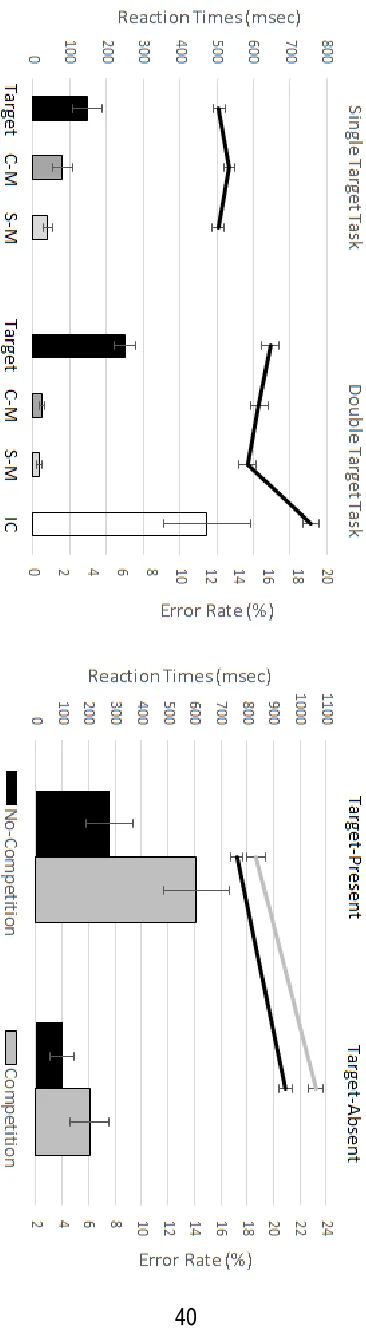
Figure 2 (left panel) shows mean reaction times (RTs) and error rates for the different
display types in both tasks of Experiment 1. RTs on trials with correct responses were initially
analysed separately for the two search tasks. A one-way repeated-measures Analysis of
Variance (ANOVA) for the double target task showed a main effect of Display Type
(target-present, colour-match, shape-match, incorrect conjunction; F(3,33) = 156.73, p < .001, ηp2 = .93). Pairwise comparisons showed that RTs differed significantly between each of the four
different display types (t’s > 4.09, p’s < .005, d’s > 1.18). RTs were fastest for shape-match displays (M = 584 ms), slower for colour-match (M = 616 ms) and target-present displays (M = 646 ms), and were strongly delayed with incorrect conjunction displays (M = 757 ms). In the single target task, the factor Display Type (target-present, colour-match, shape-match) also
showed a significant main effect (F(2,22) = 6.24, p = .007, ηp2 = .36). Pairwise comparisons revealed that RTs were significantly slower for colour-match displays (M = 535 ms) as compared to both target-present (M = 506 ms; t(11) = 2.71, p = .02, d = .78) and shape-match displays (M
13
slower in the double target task relative to the single target task (M = 651 ms vs. 515 ms; t(11) = 12.27, p < .001, d = 3.54).
Matching analyses were conducted on error rates. A significant effect of Display Type on
error rates was present in the double target task (F(3,33) = 14.04, p < .001, ηp2 = .56). Error rates were higher for target-present displays and for displays containing an incorrect
conjunction object (M = 6 % and 12 % respectively) than for colour-match and shape-match displays (M = 1 % and 0 % respectively; t’s > 3.78, p’s < .005, d’s > 1.09). The difference between error rates for target-present versus incorrect conjunction displays only approached
significance (t(11) = 2.04, p = .066, d = .59), and there was no error rate difference between displays with colour versus shape-matches (t < 1). In the single target task, there was also a significant effect of Display Type (F(2,22) = 6.61, p = .006, ηp2 = .38), as participants missed targets more frequently on target-present trials (M = 4 %) than incorrectly reporting the
presence of a target in displays with a colour-match or shape-match (M = 2 % and 1 %; t’s > 2.22, p’s < .05, d’s > .64). The difference in error rates between colour-match and shape-match displays missed significance (M = 2 % vs. 1 %; t(11) = 1.92, p = .08, d = .55). Finally, when collapsing across display types, error rates were significantly higher in the double target versus
single target task (M = 5 % vs. 2 %; t(11) = 4.06, p = .002, d = 1.17).
ERP results
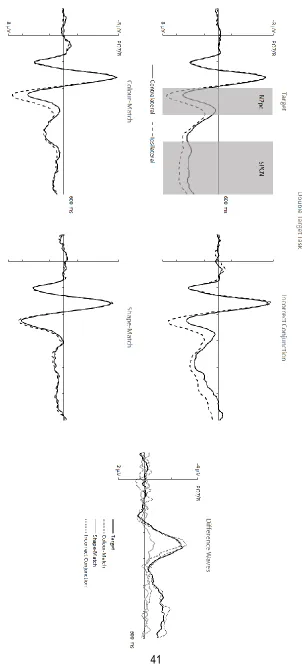
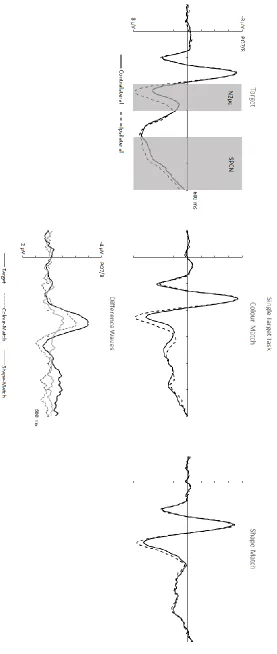
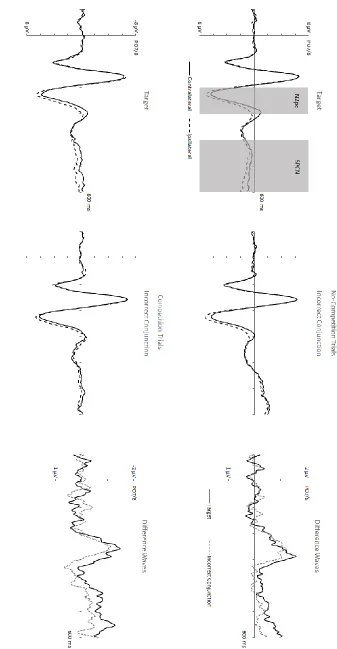
N2pc components. Figures 3 and 4 show grand-averaged ERPs triggered at electrodes PO7/8 contralateral and ipsilateral to the side of the object with target-matching features. ERPs
are shown separately for the different display types in the single and double target tasks,
together with the corresponding contralateral-ipsilateral difference waveforms. ANOVAs of ERP
mean amplitudes obtained 200-300 ms post-stimulus were conducted separately for both
tasks, with the factors Display Type and Laterality (Ipsilateral, Contralateral). In the double
14
seen in Figure 3, the N2pc to shape-matches (M diff = -.47 μV) was strongly attenuated relative to the N2pc components elicited by the other types of displays (t’s > 4.17, p’s < .005, d’s > 1.20).
Importantly, there was no difference in the size of N2pc components triggered by targets and
by incorrect conjunction objects (M diff = -2.15 μV vs. -2.20 μV; t < 1). Relative to these two
N2pcs, the N2pc component elicited by colour-matching nontarget objects was numerically
smaller (M diff = -1.84 μV), but these differences did not reach statistical significance (t’s < 1.89,
p’s > .08, d’s < .55).
In the single target task (Figure 4), a significant main effect of Laterality (F(1,11) = 19.31,
p = .001, ηp2 = .64), indicating the presence of reliable N2pc components, was accompanied by an interaction between Laterality and Display Type (F(2,22) = 8.91, p = .001, ηp2 = .45). Pairwise comparisons between ipsilateral and contralateral ERP amplitudes showed that significant N2pc
components were elicited in response to all three types of displays (t’s > 2.55, p’s < .03, d’s > .73), but that target objects elicited a significantly larger component (M diff = -2.17 μV) relative to colour-matches (M diff = -1.43 μV; t(11) = 3.34, p = .007, d = .96) and shape-matches (M diff = -.58 μV; t(11) = 4.39, p = .001, d = 1.27). There was no significant difference between N2pc
mean amplitudes elicited by colour versus shape-matches (t(11) = 1.38, p = .20, d = .40).
SPCN components. Mean amplitudes obtained 400-600 ms post-stimulus onset were entered into separate ANOVAs for each task. In the double target task, there was a main effect
of Laterality (F(1,11) = 19.84, p = .001, ηp2 = .64) that interacted with Display Type (F(3,33) = 13.24, p < .001, ηp2 = .55). As can be seen in Figure 3, targets as well as incorrect conjunction objects both elicited clear SPCN components (M diff = -1.21 μV vs. -1.43 μV; t’s > 4.78, p’s ≤ .001, d’s > 1.37), while colour-matching and shape-matching nontargets did not (M diff = -.15
μV vs. -.13 μV; t’s < 1). Importantly, there was no difference in SPCN amplitudes between
targets and incorrect conjunction objects (t < 1). In the single target task (Figure 4), the main
15
target objects (M diff = -.68 μV; t(11) = 3.02, p = .012, d = .88), but not by colour- or shape-matching nontargets (M diff = .24 μV vs. -.14 μV; t’s < 1.94, p’s > .05, d’s < .55).
Comparisons between tasks. N2pc components triggered by target objects did not differ
in size between the single target and double target tasks (M diff = -2.17 μV vs. -2.15 μV; t < 1). In contrast, SPCN amplitudes triggered by target objects were significantly larger in the double
target as compared to the single target task (M diff = -1.21 μV vs. -.68 μV; t(11) = 4.49, p = .001, d = 1.30).
Discussion of Experiment 1
The results of the double target task provided no evidence for any involvement of
object-based target templates in the guidance of conjunction search. Reliable N2pc
components were elicited by colour-matching and shape-matching nontargets, demonstrating
that attentional selectivity operated in a feature-based fashion. The critical finding was that
targets and incorrect conjunction objects triggered identical N2pcs in the double target task,
demonstrating that attentional guidance operated in an exclusively feature-based fashion. The
pattern of behavioural and N2pc results obtained in this task suggest that these guidance
processes were dominated by colour signals. N2pc amplitudes to colour-matching nontargets in
the double target task were reliably larger than to shape-matching nontargets. A similar
difference was also present In the single target task, although it was not statistically significant.
These observations are in line with previous N2pc studies of conjunction search where N2pcs
were consistently larger when a nontarget object matched the target colour than when it had a
different target-defining attribute (e.g., Eimer & Grubert, 2014; Nako et al., 2016). This suggests
that colour signals are generally more effective in guiding attention than target-matching
features from other dimensions. Colour-based attentional guidance may dominate guidance by
16
high, as is the case when two conjunctively defined objects both serve as targets. However, the
fact that N2pcs were not only triggered by colour-matching nontargets but were also reliably
present for shape-matching nontargets in both tasks of Experiment 1 shows that even in the
double target task, attentional guidance was not exclusively colour-based.
While significant N2pcs were triggered by all objects with target-matching features in
the double target task, the subsequent SPCN component was elicited only by objects with both
target-defining features in the same object (i.e., targets and incorrect conjunction nontargets).
The absence of SPCN components for colour-matching or shape-matching objects indicates that
objects with only one target feature were not encoded into working memory. It is notable that
this was also the case for colour-matching nontargets, which elicited large N2pc components,
because it suggests that access to visual working memory was regulated by interactions
between colour-based and shape-based guidance processes. The fact that incorrect conjunction
objects elicited clear SPCN components shows that these objects were maintained as candidate
target objects in working memory. This conclusion is also supported by the fact that
target-absent RTs were delayed by more than 100 ms when an incorrect conjunction object was
present. Most importantly, there were no reliable SPCN amplitude differences between targets
and incorrect conjunction nontargets, which strongly suggests that access to working memory
was regulated in an entirely feature-based fashion, and that object-based target templates
were not involved. Overall, the ERP results from the double target task of Experiment 1
demonstrate that for at least 600 ms after search display onset, attentional modulations of
perceptual and memory-related processing were not sensitive to the difference between
genuine targets and incorrect conjunction objects.
If only a single target template can be active at any moment (e.g., Olivers et al., 2011),
participants may have been able to maintain only one colour and one shape template on a
given trial. In this case, the N2pc to target objects in the double target task should have been
smaller than the target N2pcs in the single target control task of Experiment 1, where all target
objects should have matched the currently active feature templates. In fact, target N2pc
amplitudes in these two tasks were virtually identical. This suggests that it is possible to
17
different target shapes, and that the attentional biases triggered by these templates are similar
to the biases elicited when only one colour and one shape template are active (see also Moore
& Weissman, 2010; Beck et al., 2012; Irons, Folk, & Remington, 2012; Grubert & Eimer, 2016 for
further behavioural and ERP evidence for attentional guidance by multiple target features).
However, RTs to targets were delayed in the double target relative to the single target task. As
target N2pc components did not differ between these two tasks, this delay is likely to be
generated not during the initial allocation of attention to particular objects, but at a subsequent
stage where selected objects are encoded into working memory and are compared to the
memory set of current target objects. The duration of this memory matching process is
assumed to increase as the number of possible target objects increases (Cunningham & Wolfe,
2014). It is notable that SPCN amplitudes to target objects was nearly twice as large in the
double target task where a candidate target object had to be matched with two stored target
object representations, relative to the single target task where an attended object had to be
compared with only one target representation. This suggests that the SPCN does not just reflect
the encoding of an attended object into working memory, but also the matching process
between this object and the stored set of target objects, with larger amplitudes for two versus
one memory matching processes. In other words, the SPCN might be an electrophysiological
correlate of the memory search stage postulated by Cunningham and Wolfe (2014).
While the results of Experiment 1 suggest that attentional templates operate in an
entirely feature-based fashion during conjunction search, such a general conclusion should not
be based on the outcome of a single study. It remains possible that object-based target
templates are available for the guidance of search, but that these templates are only employed
when this is required by the demands of a specific selection task. In Experiment 1, search
displays always included only a single object with target-matching features. Under these
conditions, the candidate target object in each display could always be selected on the basis of
feature-based templates, and then be encoded into working memory for identification, without
any need for additional object-based attentional guidance. Experiment 2 was conducted to test
whether object-based attentional templates are activated to guide attention in a task context
18
EXPERIMENT 2
In Experiment 2, all search display objects contained at least one target-matching
feature. Participants again searched for one of two target objects defined by colour/shape
conjunctions. These targets now appeared either together with three partially-matching
nontargets, or with two partially-matching nontargets and one incorrect conjunction object.
Target-absent displays contained one or two incorrect conjunction objects among
partially-matching nontargets (see Figure 1, bottom panel). In all displays, two stimuli were presented on
the left and right side and two on the vertical meridian (above and below fixation). This was
done to measure N2pc and SPCN components to a target or an incorrect conjunction nontarget
object in displays where both of these objects were present, and one of them appeared on the
vertical midline. Because no lateralised N2pc or SPCN is elicited by vertical objects, these
components exclusively reflect the attentional processing of candidate target objects on the
left or right side (e.g., Woodman, & Luck, 2003; Hickey, McDonald, & Theeuwes, 2006; Eimer,
Kiss, & Nicholas, 2011; Eimer & Grubert, 2014). N2pc and SPCN components were measured for
targets and incorrect conjunction objects, separately for no-competition trials where they were
presented together with three partially-matching objects and for competition trials where they
appeared in the same display.
Because all search display objects now contained target-matching features, they should
all trigger feature-based attentional biases, thus increasing the competition for attentional
selection in all displays. The presence of one or two target-colour nontarget objects in each
display should also make it less likely that feature-based guidance was dominated by colour (as
was the case in Experiment 1), as colour signals were now less useful to indicate the location of
candidate target objects. Most importantly, because a target and an incorrect conjunction
object could appear in the same display in Experiment 2, participants could no longer rely
exclusively on feature-based guidance processes to select one candidate target object. The
critical question was whether object-based target templates would now be involved in the
19
attentional control processes even when these templates would be helpful to localise target
objects. In this case, attentional selectivity should remain entirely feature-based, reflected by
identical N2pc and SPCN components to targets and incorrect conjunction objects, as in
Experiment 1. Alternatively, if object-based templates were activated, lateralised ERPs to
targets and incorrect conjunction objects should diverge at some point in time, with larger
N2pc and/or SPCN components for target objects. To preview the main results, this is exactly
what was observed in Experiment 2. However, additional analyses based on RT median splits
revealed that even though participants had to search for two possible target objects, only a
single object-based target template was activated on any given trial.
Method
Participants
Fifteen participants took part in Experiment 2. Three participants were excluded
from analysis due to excessive HEOG artefact rejection (> 50 % of data). The remaining 12
participants (M age = 31 years, SD = 6; 5 male; 1 left-handed) all reported normal or corrected-to-normal vision. To confirm that Experiment 1 had been appropriately powered, we assessed
all effect sizes for significant N2pc mean amplitude differences in both the previous single and
double target task. Cohen’s d effect sizes ranged from .98 to 1.47, suggesting a minimum sample size of between 6-11 participants, and demonstrating that Experiment 1 was not
underpowered. We therefore used the same sample size (N = 12) in Experiment 2, also to
ensure comparable signal-to-noise ratios of the grand-averaged ERP waveforms between these
two experiments.
Stimuli and Procedure
Stimuli and procedure were similar to Experiment 1, with the following exceptions. The
four object locations within each search display were now directly above, below, left, and right
20
panel). Participants now completed only a double target search task. Both possible targets were
again defined by a combination of colour and shape. All display objects contained either one or
two target-defining features.
Each block included 72 trials. On 48 trials, a target was present and was equally likely to
appear on the horizontal midline (to the left or right of fixation) or on the vertical midline
(above or below fixation). The target appeared together with an incorrect conjunction object
and one colour-matching and one shape-matching nontarget on 32 trials (8 trials for each of the
four possible combinations of target location: horizontal/vertical, and incorrect conjunction
object location: horizontal/vertical). On the remaining 16 target-present trials, the target was
accompanied by three partially-matching nontargets (one colour-match and two
shape-matches, or vice versa), and appeared either on the horizontal or vertical midline. There were
24 target-absent trials in each block. On half of these trials, an incorrect conjunction object
appeared either on the horizontal or vertical midline, together with three partially-matching
objects (one colour-match and two shape-matches, or vice versa). In the remaining 12
target-absent trials, displays contained the two different incorrect conjunction objects, one on the left
and one on the right side. Trials where search displays contained two objects with both
target-matching features were labelled competition trials, and trials where a target or an incorrect
conjunction object appeared with three partially-matching nontargets were labelled
no-competition trials. An additional constraint was that no display could contain three objects with
the same colour or shape, to avoid any low-level pop-out for the remaining object. As in
Experiment 1, participants responded to the presence or absence of either target object, and
were instructed to ignore partial matches and incorrect conjunction objects. Following practice,
participants completed 18 experimental blocks.
EEG Recording and Data Analysis
EEG recording and data analysis matched Experiment 1. The average number of trials
removed prior to EEG analyses was 22% (SD = 14). Average ERP waveforms were computed for
trials where a target or an incorrect conjunction object appeared on the left or right side,
21
(no-competition trials) and for displays that also included an incorrect conjunction object or a
target on the vertical midline (competition trials). No ERPs were computed for displays
containing a vertical target or incorrect conjunction object among three partially-matching
nontargets, and displays with two lateral incorrect conjunction objects, because these displays
would not trigger lateralised attentional responses. N2pc and SPCN amplitudes were again
calculated based on ERP mean amplitudes obtained at PO7/PO8 from 200-300 ms and 400-600
ms after display onset, respectively. Three additional sets of analyses were conducted to assess
the point in time when lateralised ERP responses to targets started to differ from responses to
incorrect conjunction objects. First, N2pc mean amplitudes were analysed for three successive
post-stimulus time windows (200-240 ms, 240-280 ms, 280-320 ms). Next, N2pc difference
waves to targets and incorrect conjunction objects were compared with unidirectional
one-sample t-tests conducted for each post-stimulus sampling point (see Jenkins et al., 2017, for
analogous methods). Finally, N2pc difference waves for incorrect conjunction objects were
subtracted from N2pc difference waves for targets, separately for competition and
no-competition trials. The onset of differences in the resulting double subtraction waveforms was
compared using a jackknife-based analysis method (see Miller, Patterson & Ulrich, 1998, for details) with an absolute onset criterion of -0.4 V.
Results
Behavioural performance
Figure 2 (right panel) shows reaction times (RTs) and error rates for the different display
types in Experiment 2. Participants responded slower to targets in displays where they were
accompanied by an incorrect conjunction object than in displays where no such object was
present (M = 761 ms vs. 832 ms). Target-absent responses were faster for displays with one as
compared to two incorrect conjunction objects (M = 945 ms vs. 1061 ms). Correct RT data were entered into a 2x2 repeated-measures ANOVA with the factors Target Presence (present,
22
conjunction or two incorrect conjunction items in the same display). There were main effects of
Target Presence (F(1,11) = 158.21, p < .001, ηp2 = .94), reflecting faster RTs on target-present trials, and Competition (F(1,11) = 34.44, p < .001, ηp2 = .76), demonstrating slower RTs to displays including two objects with both target-matching features. The interaction between
these two factors did not reach significance (F(1,11) = 3.59, p = .085, ηp2 = .25).
A matching analysis of error rates revealed significant main effects of Target Presence
(F(1,11) = 22.33, p = .001, ηp2 = .67), Competition (F(1,11) = 22.10, p = .001, ηp2 = .67), and an interaction between both factors (F(1,11) = 15.63, p = .002, ηp2 = .59). Participants missed targets more often when they were accompanied by an incorrect conjunction object than when
no such object was present (M = 14 % vs. 8 %; t(11) = 5.23, p < .001, d = 1.51). A smaller effect of competition on error rates was also found on target-absent trials, with more False Alarms for
displays with two versus one incorrect conjunction objects (M = 6 % vs. 4 %; t(11) = 2.38, p = .04, d = .69).
ERP results
N2pc components. Figure 5 shows grand-averaged ERPs triggered at electrodes PO7/8 contralateral and ipsilateral to the side of a target object or an incorrect conjunction object on
trials where these objects appeared on the left or right side. ERPs are shown separately for
no-competition trials where displays did not contain another object with both target-matching
features, and for competition trials where a target and an incorrect conjunction object
appeared in the same display (one horizontal, one vertical). The corresponding
contralateral-ipsilateral difference waveforms are also shown. In both competition and no-competition trials,
targets and incorrect conjunction objects initially triggered N2pc components of similar size.
However, and in contrast to Experiment 1, the target N2pc became larger than the N2pc to
incorrect conjunction objects from about 280 ms after display onset.
In an initial analysis, ERP mean amplitudes obtained at PO7/8 during the 200-300 ms
post-stimulus interval were entered into a 2x2x2 ANOVA with the factors Object Type (lateral
23
incorrect conjunction object alone; competition displays: target and incorrect conjunction
object both present), and Laterality. A significant main effect of Laterality (F(1,11) = 27.92, p < .001, ηp2 = .72) confirmed the reliable presence of N2pc components. There was no significant
Competition x Laterality interaction (F(1,11) = 1.99, p = .19, ηp2 = .15), indicating that the presence or absence of a competing object with two target-matching features did not affect the
size of these components. More importantly, there was also no reliable interaction between
Object Type and Laterality (F(1,11) = 2.86, p = .12, ηp2 = .21), suggesting that across the whole 200 – 300 post-stimulus time window, the N2pc to targets was not reliably larger than the N2pc
to incorrect conjunction objects. There was also no three-way interaction between all factors
(F(1,11) = 1.96, p = .19, ηp2 = .15). Pairwise comparisons between ipsilateral and contralateral ERP amplitudes showed that significant N2pc components were elicited in response to all four
types of displays shown in Figure 5 (target alone: -.98 μV; incorrect conjunction item alone: -.94
μV; lateral target and vertical incorrect conjunction object: -.93 μV; lateral incorrect conjunction
object and vertical target: -.58 μV; all t’s > 3.32, all p’s < .01, d’s > .96).
The divergence between N2pc components to targets and incorrect conjunction objects
that emerged around 280 ms after display onset both for competition and no-competition
displays (Figure 5) could suggest that object-based attentional guidance emerges after an early
strictly feature-based phase of attentional selectivity. To assess this statistically, N2pc mean
amplitudes (collapsed across no-competition and competition trials) were analysed separately
across three successive 40 ms time window (200-240, 240-280, and 280-320 ms post-stimulus).
An initial 3x2x2 ANOVA including the factor Time Window showed a significant three-way
interaction (F(2,22) = 4.68, p = .02, ηp2 = .30). Follow-on analyses conducted separately for each
time interval showed that there were no Object Type x Laterality interactions in the first two
intervals (F’s < 1.99, p’s > .19, ηp2‘s < .15), indicating that N2pcs to targets and incorrect
conjunction objects did not differ during these periods. In contrast, this interaction was
significant for the third interval (F(1,11) = 5.46, p = .039, ηp2 = .33), where a reliable N2pc was
24
These N2pc differences between targets and incorrect conjunction objects suggest that
object-based target templates started to modulate attentional biases during the late phase of
the N2pc. However, they do not reveal whether templates for both target objects were
simultaneously activated on each trial. If only a single object-based template can be maintained
at any given time, this template would match the target on half of all target-present trials. On
the other half of trials, a mismatch between the target and the currently active object template
would prevent any object-based guidance, resulting in attentional biases that are entirely
feature-based. To assess this possibility, we performed an RT median split for trials with lateral
target objects (collapsed across competition and no-competition trials), individually for each
participant, and computed ERPs separately for trials with fast and slow responses. If only one
object template was active at any time, trials with fast target-present RTs should primarily be
trials where the target matched this template, while slow RTs should be the result of a
mismatch between the current target and the object template. In this case, the target N2pc on
fast RT trials should be larger than the target N2pcs on trials with slow RTs, which should be
similar to the N2pc to incorrect conjunction objects. This was exactly what was observed. Figure
6 shows N2pc difference waveforms for target-present trials with fast and slow RTs and for
incorrect conjunction objects. An initial analysis of ERP mean amplitudes in the N2pc time
window (200-300 ms post-stimulus) with the factors Laterality and Trial Type (target-present,
fast RTs; target-present, slow RTs; incorrect conjunction object) showed an interaction between
both factors (F(2,22) = 7.16, p = .004, ηp2 = .39). Follow-up paired t-tests confirmed that target
N2pcs on trials with fast RTs were larger than both target N2pcs on slow RT trials (M diff = -1.26 μV vs. -.67 μV; t(11) = 3.07, p = .011, d = .89) and N2pcs to incorrect conjunction objects (M diff = -0.80 μV; t(11) = 2.67, p = .022, d = .77). There was no amplitude difference between the
target N2pcs on slow RT trials and the N2pc to incorrect conjunction objects (t(11) = 1.08, p =
.31, d = .31.
If the N2pc on target-present trials with fast RTs reflects attentional biases that are
affected by an object-based template, the moment where such a template becomes active can
be tracked by analysing when reliable N2pc differences between these trials and trials with
25
produced converging results. First, we compared the amplitudes of these two N2pc
components within successive 40 ms time windows, as described above. There was no Object
Type x Laterality interaction within the first time window (F(1,11) = 1.92, p = .19, ηp2 = .15), but this interaction was reliable within the two later time windows (240-280 ms and 280-320 ms
post-stimulus; F’s > 5.11, p’s < .05, ηp2’s > .32), reflecting larger N2pc amplitudes to targets on trials with fast RTs than to incorrect conjunction objects that emerged at or shortly after 240 ms
after search display onset. Next, a series of unidirectional one-sample t-tests were conducted
for each post-stimulus sampling point to compare N2pc difference waveforms for targets on
fast RT trials and incorrect conjunction objects. The onset of N2pc amplitude differences
between these two N2pcs was defined as the point in time where a significant difference
emerged that remained reliable for at least ten successive sampling points. This procedure
yielded an onset estimate of 250 ms post-stimulus. Finally, a jackknife-based analysis with an
absolute onset criterion of -0.4 μV was conducted for double-subtraction N2pc difference
waveforms (obtained by subtracting the N2pc difference waveform for incorrect conjunction
objects from the N2pc difference wave for targets on trials with fast RTs). This analysis again
suggested that the target N2pcs started to become larger than N2pcs to incorrect conjunction
objects at 250 ms after search display onset.
SPCN components. Mean ERP amplitudes at PO7/8 obtained 400-600 ms post-stimulus were entered into an ANOVA with the factors Object Type, Competition, and Laterality. The
main effect of Laterality only approached significance (F(1,11) = 4.27, p = .063, ηp2 = .28). There was no interaction between Competition and Laterality and no three-way interaction between
all factors (F’s < 1). However, and critically, the interaction between Object Type and Laterality was significant (F(1,11) = 4.85, p = .05, ηp2 = .31). As can be seen in Figure 5, target objects elicited clear SPCN components on both competition and no-competition trials, whereas the
SPCN to incorrect conjunction objects was small or absent. To assess this, pairwise comparisons
between ipsilateral and contralateral ERP mean amplitudes in the SPCN time window were
conducted for targets and for incorrect conjunction objects (collapsed across competition and
26
= 2.37, p = .037, d = .68), whereas incorrect conjunction objects did not (M diff = -.22 μV; t(11) =
1.23, p > .20, d = .35). As shown in Figure 6, SPCN components to targets appear to be present
both on trials with fast and slow RTs. A direct comparison of SPCN mean amplitudes on these
two types of trials revealed no significant difference (M diff = -.58 μV vs. -.75 μV; t < 1), and additional analyses confirmed that target SPCNs were present on both fast and slow RT trials
(t’s > 2.14, p’s < .03, one-tailed, d’s > .62).
Discussion of Experiment 2
The ERP results of Experiment 2 provide novel evidence that object-based attentional
templates are involved in the guidance of attention during conjunction search under conditions
where these templates are required to distinguish between target and nontarget objects.
Importantly, they also suggest that only one object-based target template can be active at any
given time. In contrast to Experiment 1, where targets and incorrect conjunction objects
elicited identical N2pc and SPCN components, lateralised ERP waveforms to these two types of
objects diverged around 280 ms post-stimulus, with larger N2pc amplitudes to targets from this
point onwards, both on no-competition and competition trials (Figure 5). Because targets and
incorrect conjunction objects both had two target-defining features and this could not have
been distinguished by feature-based attentional guidance processes, this divergence of N2pcs
during the late phase of the N2pc time window shows that object-based control mechanisms
affected the allocation of attention. The comparison of target N2pcs elicited on trials with fast
and slow RTs provided additional insights into the nature of these object-based mechanisms.
On trials with fast target-present responses, the target N2pc started to become larger than the
N2pc to incorrect conjunction objects from 250 ms post-stimulus onwards. In contrast, target
N2pc amplitudes on trials with slow responses did not differ from N2pc amplitudes to incorrect
conjunction objects (Figure 6). This pattern of results suggests that participants were able to
maintain only one object-based target template on any given trial. When this template
27
processing rapidly, after about 250 ms. When the target did not match the current object
template, target-present RTs were slow, and attentional biases remained entirely
feature-based, as shown by the fact that target N2pc components were identical to the N2pcs to
incorrect conjunction objects. To rule out the possibility that the larger target N2pc on fast as
compared to slow RT trials was due to factors unrelated to object-based templates, such as
general inattention to the search display on trials with slow RTs, we ran an analogous analysis
of N2pc amplitudes for incorrect conjunction objects. There were no systematic N2pc
differences between fast and slow RT trials for these objects, suggesting that the differences
observed for target N2pcs were indeed associated with a mismatch between a particular target
and the currently active object template.
In contrast to Experiment 1, where identical SPCN components were elicited by targets
and incorrect conjunction objects, only targets elicited reliable SPCN components in Experiment
2, which demonstrates that access to working memory was no longer feature-based, but was
controlled in an object-based fashion. However, results also suggest that there may be
differences between the object-based guidance of attention and the object-based control of
visual working memory. In contrast to target N2pc components, which showed clear amplitude
differences between trials with fast and slow RTs, target objects elicited SPCN components of
similar size regardless of whether responses were fast or slow (Figure 6). This dissociation
suggests that while only a single object template can guide the initial allocation of attention,
access to working memory may be regulated by multiple object templates.
The fact that N2pc amplitudes elicited before 250 ms post-stimulus did not differ
between targets and incorrect conjunction objects in Experiment 2 indicates that up to this
point in time, attention was guided in an entirely feature-based fashion, resulting in identical
feature-based attentional biases for both types of objects. The fact that the presence of an
incorrect conjunction object in the same display delayed target RTs and increased error rates is
28
GENERAL DISCUSSION
The goal of this study was to find out whether attentional guidance processes during
conjunction search are exclusively feature-based, or whether integrated representations of
target objects (object-based attentional templates) are also involved. Results demonstrate that
object-based target templates can guide attention towards target objects, but only under
conditions where purely feature-based templates are insufficient. They also show that the
effects of feature-based control on visual processing emerge earlier than the effects of
object-based guidance mechanisms.
In the double target task of Experiment 1, where search displays only contained a single
object with target-matching features, targets and incorrect conjunction objects triggered
identical N2pc and SPCN components. This demonstrates that both types of objects elicited
equivalent attentional modulations of visual processing, and both gained access to working
memory, suggesting that attentional control was entirely feature-based. In this task,
object-based attentional templates were not required to single out one specific object as a candidate
target, and the identification of such an object as target or nontarget could thus take place at a
later stage once this object was encoded into working memory. This was no longer possible in
Experiment 2 where all objects had target-matching features, and a target and an incorrect
conjunction object could be present in the same display. Here, ERPs revealed that object-based
target templates were now involved in the control of attention. Only targets but not incorrect
conjunction objects elicited reliable SPCN components in Experiment 2, indicating that only
targets were encoded into working memory. Critically, lateralised ERPs for these two types of
objects already diverged earlier, during the N2pc time window. On target-present trials with
fast RTs, target N2pc amplitudes became larger than N2pcs to incorrect conjunction objects
from 250 ms after display onset, demonstrating that object-based attentional control
mechanisms started to affect visual processing from this point in time onwards. Notably, target
N2pcs on trials with slow RTs did not differ from N2pcs to incorrect conjunction objects, which
suggests that only feature-based attentional control processes were active on these trials. This
29
template can be active at any given time. Such a template will result in target N2pc modulations
indicative of object-based attentional guidance for displays that include a template-matching
target object, and purely feature-based N2pc effects for displays with a non-matching target.
These results suggest that while multiple feature-based templates are maintained
concurrently, only a single object-based target template is available to guide attention at any
given moment. This would qualify previous more general suggestions that visual search can be
guided by a single target template only (e.g., Olivers et al., 2011). This may in fact only apply to
genuinely object-based target templates but not to templates for target features. Such a
difference between search templates for features versus objects may be linked to differences in
the attentional demands of maintaining these two types of templates in working memory. In
object-based templates, individual target features are bound and represented in an integrated
fashion (as in the object files proposed by Kahneman et al., 1992). In contrast to the storage of
individual features which can operate in parallel, the maintenance of feature bindings in
working memory requires focal attention (Wheeler & Treisman, 2002), and may therefore be
limited to one object at a time. In the current Experiment 2, where N2pc components revealed
the involvement of object-based templates, participants may have activated templates for all
four target-defining features (e.g., blue, green, circle, square), but only one binding between
two of these features as an object template (e.g., blue circle) on any given trial.
The current study also revealed differences in the time course of the effects of
feature-based and object-feature-based attentional templates. Until 250 ms after search display onset,
attentional guidance was found to be entirely feature-based, and object-based control started
to affect visual processing only after this point in time. This is in line with observations from
previous N2pc studies of conjunction search (Eimer & Grubert, 2014; Berggren & Eimer, 2016a;
Nako et al., 2016; Jenkins et al., in press), which found that target N2pc amplitudes were
initially equal in size to the sum of N2pcs to partially-matching nontargets, but became larger
(i.e., superadditive) around 250 ms after search display onset. The design of these earlier
experiments made it impossible to decide whether the emergence of a superadditive N2pc
reflected object-based attentional control or local facilitatory interactions between