www.nat-hazards-earth-syst-sci.net/14/1965/2014/ doi:10.5194/nhess-14-1965-2014
© Author(s) 2014. CC Attribution 3.0 License.
MEDEX: a general overview
A. Jansa1,*, P. Alpert2, P. Arbogast3, A. Buzzi4, B. Ivancan-Picek5, V. Kotroni6, M. C. Llasat7, C. Ramis1, E. Richard8, R. Romero1, and A. Speranza9
1University of the Balearic Islands (UIB), Palma, Spain 2Tel Aviv University (TAU), Tel Aviv, Israel
3Meteo-France, Toulouse, France
4Institute of Atmospheric Sciences and Climate (ISAC/CNR), Bologna, Italy 5Meteorological and Hydrological Service (DHMZ), Zagreb, Croatia 6National Observatory of Athens (NOA), Athens, Greece
7University of Barcelona (UB), Barcelona, Spain
8Laboratoire d’Aérologie (LA/CNRS and Toulouse University), Toulouse, France 9University of Camerino (UNICAM), Camerino, Italy
*formerly at: Agencia Estatal de Meteorología (AEMET), Palma, Spain
Correspondence to: A. Jansa ([email protected])
Received: 13 December 2013 – Published in Nat. Hazards Earth Syst. Sci. Discuss.: 21 January 2014 Revised: 21 June 2014 – Accepted: 26 June 2014 – Published: 5 August 2014
Abstract. The general objective of the international MEDiterranean EXperiment (MEDEX) was the better under-standing and forecasting of cyclones that produce high im-pact weather in the Mediterranean. This paper reviews the motivation and foundation of MEDEX, the gestation, history and organisation of the project, as well as the main prod-ucts and scientific achievements obtained from it. MEDEX obtained the approval of World Meteorological Organisa-tion (WMO) and can be considered as framed within other WMO actions, such as the ALPine EXperiment (ALPEX), the Mediterranean Cyclones Study Project (MCP) and, to a certain extent, THe Observing System Research and Pre-dictability EXperiment (THORPEX) and the HYdrological cycle in Mediterranean EXperiment (HyMeX). Through two phases (2000–2005 and 2006–2010), MEDEX has produced a specific database, with information about cyclones and se-vere or high impact weather events, several main reports and a specific data targeting system field campaign (DTS-MEDEX-2009). The scientific achievements are significant in fields like climatology, dynamical understanding of the physical processes and social impact of cyclones, as well as in aspects related to the location of sensitive zones for indi-vidual cases, the climatology of sensitivity zones and the im-provement of the forecasts through innovative methods like mesoscale ensemble prediction systems.
1 Introduction
The MEDiterranean EXperiment (MEDEX) has been an in-ternational project oriented to an improved understanding and better forecasting of cyclones that produce high im-pact weather in the Mediterranean. The basic motivation of MEDEX is that at least part of the Mediterranean cyclones produce high impact weather or at least severe weather, thus potentially generating high impacts on exposed and vulnera-ble sectors. It is well known that deep and intense cyclones produce severe weather, in particular strong winds and/or heavy precipitations anywhere, not only in the Mediter-ranean. In the Mediterranean, several examples of intense cyclones associated with severe weather can be cited (Homar et al., 2002b; Hamadache et al., 2003; De Zolt et al., 2006; Genovés et al., 2006; Lagouvardos et al., 1996, 2007, among others). It is almost obvious that severe weather has to ac-company explosive cyclones, which are not so rare in the Mediterranean (Kouroutzoglou et al., 2011).
to particularly intense cyclones. In most such cases a large amount of the precipitation appears to be the result of deep moist convection, in particular that produced by mesoscale convective systems (MCS) that may affect the same area for a relatively long time. The complex topography of the Mediter-ranean area, characterised in many places by steep mountains close to the sea, favours the occurrence of heavy rain and subsequent flash floods. The high population density in the coastal areas, as well as many infrastructures and historical and artistic settlements, make these areas especially vulner-able, easily converting severe weather into socially and eco-nomically high impact weather.
When examining in detail the above cases as well as other similar historical events, in many examples there is no ev-idence of the presence of intense cyclones. Still, weak or moderate cyclones are very often observed in the vicinity of the affected areas, playing a role in the organisation of the heavy precipitating systems. The underlying idea is that the presence of a weak or moderate cyclone is enough to organ-ise a low-level warm and moist inflow towards an area of potential ascending motion and potential convective instabil-ity, where the heavy precipitation occurs in response (Jansa, 1997). This inflow contributes to the precipitation feeding, and, being warm and moist, tends to increase the convective instability. The indirect role of a cyclone in determining the occurrence of heavy precipitation has been stated in Jansa et al. (1991, 2000a) or Ramis et al. (1994), among other papers. From a more systematic point of view, the western Mediterranean basin has been explored, looking for the si-multaneity and possible connection between heavy rain and cyclonic presence (Jansa et al., 2001a). The conclusion is that in more than 80 % of heavy rain cases, a cyclone is found in the vicinity of the affected area, in a proper location for or-ganising a warm and moist inflow of air originally located in the marine boundary layer over the Mediterranean (Jansa, 1997; Berto et al., 2004). Most such cyclones exhibit only weak or moderate intensity.
Regarding the eastern Mediterranean, some studies also relate heavy rain to cyclonic presence (see Xoplaki et al., 2000; Kotroni et al., 2005; Ziv et al., 2006; Houssos et al., 2008; Houssos and Bartzokas, 2006; Tolika et al., 2007; Lagouvardos et al., 2007; among others). Especially over Greece, heavy precipitation amounts and/or heavy snowfall can be related to cold surges that are accompanied by the passage of a fast moving cold front from the north towards the south, and gale force winds, especially in the gaps be-tween mountains in northern Greece and over the Aegean Sea. A sharp temperature decrease over the whole country and a sharp pressure rise are also observed. In the frame-work of these cases, heavy rainfall amounts may exceed 100 mm in 24 h. The lifetime of these surges is normally from 1 to 3 days, extending up to 10 days in exceptional cases (Lagouvardos et al., 1998).
In other papers (Toreti et al., 2010; Reale and Lionello, 2013), the connection between cyclones and heavy
precipitation is considered in general for the whole Mediter-ranean region (east and west).
In summary, heavy precipitation in the Mediterranean, in-cluding heavy snowfall, is in some cases directly related to intense cyclones and in some events indirectly linked to weak or moderate cyclones. In any case, a distinct cyclonic signa-ture is usually found in connection with the onset of this kind of severe weather.
Regarding strong winds, it is clear that in the vicinity of an intense cyclonic centre, large pressure gradients are present and strong winds are generated, but some local disturbances, connected to the complex Mediterranean geography, would also play a key role in the generation and/or intensification of some Mediterranean strong winds, mainly those known as “local winds” (like the Mistral–Tramontane, Bora, Etesian and so on). Many of the local disturbances take the shape of dipolar pressure anomalies (see, for instance, Jansa, 1987, 1997; Campins et al., 1995). On the other hand, although many Mediterranean windstorms can be related to Mediter-ranean cyclones, some of them are mainly associated with external intense cyclones (Nissen et al., 2010).
Obviously there are many weak or moderate cyclones or shallow depressions in the Mediterranean that do not produce any severe or high impact weather. Still, an investigation of Mediterranean cyclone properties is required to understand their potential role in causing severe weather better. In this sense, the general objective of MEDEX is meaningful, and becomes a significant research topic for the Mediterranean area.
This paper, of which all the co-authors have been mem-bers of the MEDEX Science Steering Committee, aims to provide a quick look at what MEDEX has investigated and achieved during its effective time span, namely from 2000 to 2010. The second section provides a succinct history of MEDEX, including aspects of its organisation, and serves to frame this project in the context of the WMO research activi-ties, and also reviews the project organisation. The third sec-tion highlights and describes the main products of MEDEX. The fourth section is devoted to some specific scientific re-sults of MEDEX. The paper ends with a brief conclusion.
2 MEDEX history and organisation
There is a long history of research devoted to Mediterranean cyclones and their consequences. A review of this history is out of the scope of this paper. We only refer here to some steps that can be considered important in the genesis and de-velopment of MEDEX, particularly in the framework of the World Meteorological Organisation (WMO) research on this topic.
the International Council of Scientific Unions (ICSU). The ALPEX field phase took place in 1982. ALPEX intended to obtain experimental documentation of the influence that a pronounced but limited in horizontal extension mountain-ous chain like the Alps exerts on the atmospheric flows. The Alpine region was selected mainly due to the impor-tant phenomenon of lee cyclogenesis. Alpine lee esis is the most prominent type of Mediterranean cyclogen-esis, probably explaining the highest world frequency of cy-clones (Pettersen, 1956). Moreover, at that time, forecasting of lee cyclogenesis was a challenging problem, mainly due to the difficulty in adequately representing the effects of orogra-phy in numerical models. High interest was also raised about the very important wind systems that are more or less directly related to the Alpine lee cyclogenesis, namely the Mistral– Tramontane wind system and the Adriatic Bora.
Less attention was paid at that time to the heavy rain topic. In general, diabatic/moist processes, which involve scales of motion smaller than those characterising cyclones and cyclo-genesis, were the main object of investigation of the MAP field project in 1999 with reference to the Alpine area (see Bougeault et al., 2001).
In the very preliminary volume devoted to ALPEX scien-tific results (ICSU/WMO, 1982), around half of the contri-butions were specifically devoted to the Alpine lee cycloge-nesis and associated winds. Also, a high percentage of con-tributions in these topics were presented at the ALPEX Final Conference, in Venice, in 1985 (ICSU/WMO, 1986). Work on ALPEX, and particularly on the Alpine lee cyclogenesis (including theories and analysis of observations) and its con-sequences, continued for years, and many papers were pub-lished until about the mid-nineties.
At the time of the ALPEX conference in Venice, another project on Mediterranean cyclones had started under the aus-pices of WMO, namely the Mediterranean Cyclones Study Project (MCP), endorsed in the framework of the WMO Programme on Short- and Medium-Range Weather Predic-tion Research (PSMP), later grouped into the Programme on Weather Prediction Research (PWPR). MCP was pro-posed during the Sofia Consultation on Mediterranean Cy-clones (WMO/PSMP, 1984), held in 1983, in response to a decision by the IX WMO Congress. The object of MCP was the study of Mediterranean cyclones in general. MCP was initially conducted by three activity centres (the mete-orological services of Bulgaria, Egypt and Italy); the me-teorological service of Spain (AEMET, Instituto Nacional de Meteorologia, INM, at that time) was soon added as the fourth activity centre. MCP lasted from 1983 to 1995, when PWPR disappeared due to a change in the research organisation within WMO. The project was first headed by N. Godev, and later (from 1991) by D. Radinovic, with A. Jansa and P. Alpert as vice-chairmen. The operating mode included periodic specific meetings, with a wider partici-pation than that of the activity centre members, in which scientific achievements were presented and discussed and
subsequently published (WMO/PSMP, 1986, 1987, 1989, 1991; WMO/PWPR, 1994). D. Radinovic produced a start-up document in 1987 (Radinovic, 1987). An important task in cyclone compilation was performed by the regional cen-tre of INM in the Balearics (INM, 1992–1995), which in 1994 was declared the Regional Research Centre on Mediter-ranean Cyclones.
In the time period between MCP and MEDEX, WMO and INM jointly organised an important “Symposium on Cy-clones and Hazardous Weather in the Mediterranean”, held in Palma de Mallorca in April 1997. The symposium was attended by around 200 people, and 111 contributions were presented (see Bougeault and Jansa, 1997). This symposium can be considered to be the starting point of MEDEX, given that in a parallel meeting, INM (through A. Jansa) was in-vited to prepare a proposal for a project on Mediterranean cyclones (MEDEX) likely to be integrated into the new re-search scheme of WMO.
A first draft of MEDEX was submitted in 1998 to the Sci-ence Steering Committee (SSC) of the new WMO World Weather Research Programme (WWRP). SSC/WWRP en-couraged the development of MEDEX with the help of an interim steering committee (MISC). MISC was formed by eighteen people from several countries, who produced a re-newed “MEDEX Preliminary Research Proposal”, submitted to SSC/WWRP in 2000 (Jansa et al., 2000b). In that session SSC/WWRP approved MEDEX as a “Research and Devel-opment Project (RDP)” within WMO/WWRP. MISC, once reduced in its number of members, became the MEDEX Sci-ence Steering Committee (MSSC). It underwent only small variations in composition and number of members during the entire subsequent MEDEX life (see Appendix, Table A1) chaired by A. Jansa.
In 2001, a further developed MEDEX proposal (Jansa et al., 2001b) was presented to the SSC/WWRP, with the in-dication that it comprised the First Phase of the project, planned until 2005. After the approval of this proposal, the MEDEX First Phase was formally initiated.
During the First Phase, MEDEX was mostly oriented to the improvement of knowledge about the cyclones that pro-duce severe and/or high impact weather in the Mediter-ranean. Four specific objectives were defined for this phase:
1. to build a dynamical climatology of cyclones;
2. to study the factors involved in their genesis and evo-lution (including both the physical understanding and numerical simulation of these factors);
3. identification of sensitive areas where more and/or bet-ter observational data would produce betbet-ter forecasts; 4. analysis of the societal impacts and benefits (an
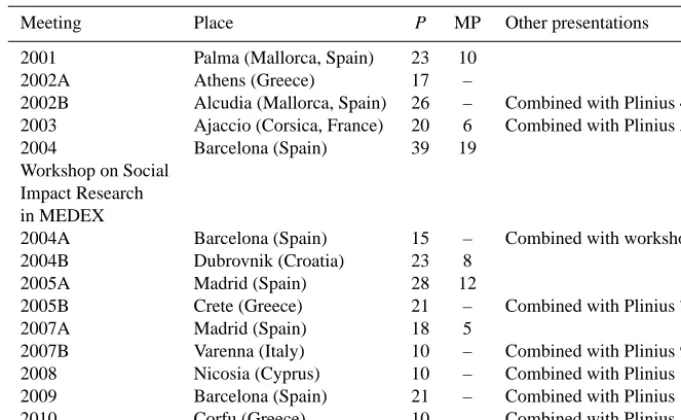
Table 1. MEDEX meetings and associated scientific presentations (P=number of participants; MP=specific MEDEX presentations).
Meeting Place P MP Other presentations
2001 Palma (Mallorca, Spain) 23 10
2002A Athens (Greece) 17 –
2002B Alcudia (Mallorca, Spain) 26 – Combined with Plinius 4 2003 Ajaccio (Corsica, France) 20 6 Combined with Plinius 5
2004 Barcelona (Spain) 39 19
Workshop on Social Impact Research in MEDEX
2004A Barcelona (Spain) 15 – Combined with workshop
2004B Dubrovnik (Croatia) 23 8
2005A Madrid (Spain) 28 12
2005B Crete (Greece) 21 – Combined with Plinius 7
2007A Madrid (Spain) 18 5
2007B Varenna (Italy) 10 – Combined with Plinius 9
2008 Nicosia (Cyprus) 10 – Combined with Plinius 10
2009 Barcelona (Spain) 21 – Combined with Plinius 11
2010 Corfu (Greece) 10 – Combined with Plinius 12
Sections 3 and 4 inform about products and achievements of this phase, related to the former specific objectives.
Progressive involvement of institutions and individual sci-entists in MEDEX occurred during the first years of MEDEX operation. The number of participating institutions reached a maximum above thirty, from eighteen different countries. The institutions were mostly national and regional meteo-rological services, universities and other research organisa-tions. A network of about one-hundred individual scientists was formed, mostly connected with each other through e-mail and a specific MEDEX website. The operating mode included meetings of the MSSC, open to the entire MEDEX community. A summary of the MEDEX meetings (including those held during both the First and Second phases) is pre-sented in Table 1. Many MEDEX meetings were held in com-bination with Plinius Conferences on Mediterranean Storms (a European Geosciences Union, EGU, initiative). The vergence of objectives between MEDEX and the Plinius con-ferences produced a positive synergy: the Plinius concon-ferences provided a good forum to the MEDEX community for pre-senting and discussing the latest scientific results, while the participation of the MEDEX community reinforced the me-teorological branch of the Plinius conferences.
With regards to the specific objective 3, it is noteworthy that a Memorandum of Understanding (MoU) was signed in 2003 between the UK Meteorological Office, represent-ing the EUMETNET–EUCOS programme (see http://www. eumetnet.eu/composite-observing-system-eucos), the Span-ish INM, representing MEDEX, and the University of the Balearics Islands (UIB). According to this MoU, UIB be-came the main executor of studies devoted to the identifi-cation of sensitive areas, defined as the geographical zones where an improved deployment of observational platforms
would improve most significantly our forecasts of cyclones and severe and/or high impact weather in the Mediterranean. EUCOS provided funding to UIB for these specific studies.
About the specific objective 4, a key activity was the organisation of the Workshop on Social Impact Research in MEDEX, held in Barcelona in 2004. The attendance of Roger Pielke Jr. (at that time a member of the SSC/WWRP) was very relevant. It is noteworthy that this workshop pro-moted the creation of a specific Group of Social Impact Re-search within MEDEX, led by M. C. Llasat, mainly focused on the creation of a database and the analysis of the societal impacts of heavy rainfalls, floods and windstorms.
During 2005, a working draft for the MEDEX Second Phase was prepared, discussed and informally approved by the MSSC and the MEDEX community (Jansa et al., 2005). The Second Phase of MEDEX was planned for 2006–2010. Five specific objectives were defined for this phase:
1. climatological aspects of cyclones (continuation); 2. physical understanding and numerical simulation of
processes (continuation);
3. development and testing of methods related to targeted observations, data assimilation and impact calculation; 4. development and testing of forecasting techniques
(EPS, statistical methods, etc.);
5. societal impacts and benefits (continuation).
Table 2. MEDEX databases of cyclones. Four analyses per day.
Analysis model Resolution Period Area Number of
cyclone detections
HIRLAM-INM 0.5◦×0.5◦lat–lon 1 Jun 1995 to 31 May 2004 Western Mediterranean 15 733 ECMWF operational 0.5◦×0.5◦lat–lon 1 Jun 1998 to 31 May 2004 Whole Mediterranean 19 200 ERA-40 1.125◦×1.125◦lat–lon 1 Sep 1957 to 31 Aug 2002 Whole Mediterranean 81 762
practical questions relating to forecasting improvement than the First Phase.
During the MEDEX Second Phase, and in order to support these more applied tasks, the small MEDEX International Core Steering Committee (MICSC) was established in Oc-tober 2005, chaired by Jean Pailleux (Meteo-France), while the MSSC continued to take care of scientific tasks.
It is worth mentioning that during its Second Phase, MEDEX was no longer an RDP depending directly on the WWRP. Since it was considered that the aims of MEDEX were to some extent included among the THORPEX objec-tives, the SSC/WWRP, in its 8th meeting in Kunming, China (October 2005), decided that “the MEDEX representation in WMO will be done through THORPEX rather than directly to the WWRP”. Since then MEDEX activities have been re-ported to THORPEX or the ICSC.
The planning for the MEDEX Second Phase also consid-ered the implementation of field experiments. Some of these would be “low or moderate” intensity field experiments, while the final one was intended as a “high” intensity experi-ment. The low–moderate intensity field experiments were ac-complished through the participation in the 2008 PREVIEW campaign and through the organisation and execution of the 2009 MEDEX campaign (see below). A high intensity exper-iment was not finally organised in MEDEX, but we could say that it was virtually “replaced” by the 2012 and 2013 HyMeX SOPs. In fact, the HyMeX Science Plan (Ducrocq et al., 2010) states that “the idea of a multi-scale large field exper-iment to finalise THORPEX–MEDEX was collected in the MEDEX second phase proposal (2005)”. The HyMeX field experiment (Ducrocq et al., 2013) can be considered a ma-terialisation of this idea even though HyMeX is much larger than MEDEX in terms of disciplines and scales. HyMeX is presently an RDP project within WWRP, and includes some of the MEDEX objectives within its wider scope.
In addition to EUMETNET–EUCOS, THORPEX or HyMeX, MEDEX has maintained contacts and collabora-tions with other international projects. It is worth mentioning the collaboration with the Mediterranean Climate Variabil-ity and PredictabilVariabil-ity project (MedCLIVAR). The Mediter-ranean cyclones that produce high impact weather, which are the main subject of MEDEX, have been analysed by Med-CLIVAR from the climatological point of view. The cooper-ation with MedCLIVAR was agreed to by P. Lionello with
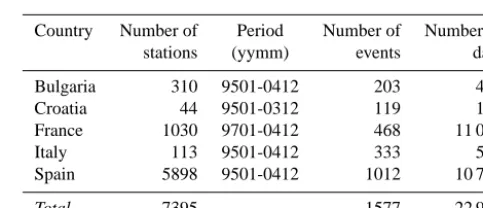
Table 3. Data in the calendars of severe weather events (MEDEX database).
Country Number of Period Number of Number of
stations (yymm) events data
Bulgaria 310 9501-0412 203 432
Croatia 44 9501-0312 119 171
France 1030 9701-0412 468 11 052
Italy 113 9501-0412 333 503
Spain 5898 9501-0412 1012 10 780
Total 7395 1577 22 938
A. Jansa. P. Alpert acted as a link between both projects. Apart from cross-participation in some respective meetings, Lionello et al. (2006) is a tangible result of the MEDEX– MedCLIVAR cooperation.
3 Project results and products
Apart from purely scientific results (see Sect. 4), MEDEX has produced a variety of tangible products. Regarding the MEDEX First Phase, the main output was the MEDEX database, as well as a comprehensive scientific summary (Buzzi et al., 2005) and a report for EUCOS about sensitivity computations (Jansa et al., 2004), besides a number of reports for the SSC/WWRP and for the MEDEX community. During the Second Phase, the main product was the performance of the MEDEX-2009-DTS campaign, as well as a second re-port for EUCOS (Jansa and Homar, 2006) about the results of sensitivity computations.
3.1 MEDEX database
The MEDEX database was established to support both clima-tological and physical process studies (specific objectives 1 and 2 of both MEDEX phases). It was constructed in a pro-gressive way and, although it was never totally completed, most of it was ready for use shortly after the beginning of MEDEX.
In the cyclone database there are listings and basic infor-mation about any kind of cyclone or depression detected in the Mediterranean. There are three lists of cyclones, as ob-tained from three different series of objective analyses (see Table 2). The technique used for cyclone detection and track-ing and for the three-dimensional description of the distur-bances can be found in Picornell et al. (2001) and Campins et al. (2006a). Note that in order to avoid excessive noise in the dynamical description of the cyclones, it was decided that the original fields would need to be smoothed; a Cressman filter (Cressman, 1959) with 200 km of radius was used for that purpose. Correspondingly, all the information that was incorporated into the cyclone database comes from filtered fields. The data for each “detected cyclone” contain almost twenty variables referring to the cyclone as a whole: date, time, code, location, minimum pressure, shift, stability by layers, wind by layers, and almost twenty other variables for every atmospheric layer where the cyclone is still identified (location, minimum geopotential, geostrophic vorticity – in the cyclone centre and average in the whole cyclonic domain –, geostrophic circulation, area, radius – mean and standard deviation –, temperature in the cyclone centre, Laplacian of temperature, temperature gradient – mean and standard devi-ation –, equivalent temperature gradient – mean and standard deviation –, humidity – mean and standard deviation).
The severe weather calendars are in fact calendars of severe or extreme weather. Only heavy rain and strong wind events are considered. To construct the calendars, the Mediterranean territory was divided into territorial units, which correspond either to natural regions (for Bulgaria) or to administrative or political regions or communities (for Italy, France and Spain); in Croatia, only one territorial unit was considered. An event is defined as a day on which pre-defined thresholds for precipitation or for maximum sus-tained wind or gust are exceeded in at least one station of a territorial unit. A datum refers to a single day, territo-rial unit and station; therefore, several data can be included in the same event if the corresponding threshold was ex-ceeded at different stations of the same territorial unit. The MEDEX community adopted a very simple threshold system for precipitation and wind. The threshold for precipitation is unique for the northern Mediterranean, 60 mm day−1. Note that the MEDEX calendar does not include data from the southern Mediterranean, which is climatologically drier; that would demand a lower threshold. The precipitation threshold in MEDEX can be considered a continuation of the thresh-olds used to select events within the former WMO-MCP re-search project, which were 60 mm day−1 for Spain, France and Switzerland, and 30 mm day−1 for Algeria (see INM, 1992–1995). The thresholds for wind do depend on the cli-matological characteristics of the station or the region. The general thresholds are 18 m s−1for maximum sustained wind (ten-minute average) and 25 m s−1 for the maximum daily gust, but for the windiest stations or windiest regions, the thresholds are increased to 25 and 33 m s−1, respectively.
Figure 1. Zones with data in the calendar of high impact weather events included in the MEDEX database. Dark blue corresponds to zones with high density of stations and light blue to zones with low density of stations.
Unfortunately, MEDEX obtained data for only part of the surrounding Mediterranean territories (see Fig. 1). The na-tional meteorological services of Bulgaria, Croatia, France, Italy and Spain and the Catalan Meteorological Service pro-vided these data. Details about data included in the calendars can be seen in Table 3. A significant part of the events include documentation of analysed meteorological fields, direct and derived (from June 1998 to May 2003), and/or satellite pic-tures (since 2002).
Following the example of MEDEX, various databases of high impact weather events were created later. Papagiannaki et al. (2013) namely recently presented a database that covers all the high impact weather events that occurred over Greece during the period 2001–2011 (201 events in total), while it is updated continuously to provide systematic monitoring and the foundation for future long-term impact analysis.
3.2 Scientific summary
By the end of the MEDEX First Phase, Buzzi et al. (2005) had produced a review paper that summarises the scientific progress in the physical and dynamical understanding and numerical modelling of the Mediterranean cyclones and their consequences for weather. The document presents and dis-cusses results of the research performed by members of the MEDEX community under the project scope, mainly with re-gards to the specific objective 2 of the First Phase, but also includes reviews, ideas and achievements on the same matter obtained previously in parallel actions. Buzzi et al. (2005) is available on the MEDEX website. This valuable document contains 110 references.
3.3 MEDEX reports for EUCOS
In connection with objective 3 of the First Phase of MEDEX, and in accomplishment of the EUCOS–MEDEX MoU, two reports were prepared by MEDEX for EUCOS. The first one (Jansa et al., 2004) includes initial studies, made in France and Spain, regarding the sensitivity to the initial conditions (IC) of the prediction of some cases as derived from ad-joint models or indirectly through potential vorticity inver-sion. Other MEDEX studies are also mentioned in this report. The second report (Jansa and Homar, 2006) pursues a cli-matology of forecast sensitivities to IC for a subset of cy-clones that produced severe and/or high impact weather in the Mediterranean. This subset is composed of the intense cyclones included within the MEDEX database. It was eas-ier to centre the analysis on the population of intense cy-clones than on the large variety of severe and/or high impact weather cases related to weak or moderate cyclones, even at the risk of losing many interesting events. Several references about more general climatological studies on Mediterranean cyclones are included in this report.
3.4 DTS campaigns and MEDEX
Objective 3 of the MEDEX Second Phase (Jansa et al., 2005) proposes the “development and testing of observational tar-geting and adaptive strategies (. . . ), oriented to the improve-ment of the forecasting of the cyclones that produce high impact weather in the Mediterranean”, and includes the as-sessment of the forecasting impact of the eventually added observations. The goal was to apply the data targeting (DT) approach to the prediction of severe and/or high impact weather in the Mediterranean, taking into account that the DT
Figure 2. MSP HIRLAM-INM analysis, 11 November 2001 at 06:00 UTC.
approach seeks the identification of sensitive areas where an improvement (in type or number) of the observations is likely to reduce the forecasting error.
This objective was reached through the agreed partici-pation of MEDEX, as a particular voice, during the au-tumn of 2008 in the Eurorisk–PREVIEW campaign. This project used the data targeting system (DTS) facilities, de-veloped by ECMWF in partnership with the UK Met Of-fice for the campaign (Prates et al., 2009). Several cases of particular Mediterranean interest were selected for targeted observations.
The main action of MEDEX in this line was the spe-cific DTS-MEDEX-2009 campaign (see Jansa et al., 2011). This campaign was sponsored by EUCOS, which also pro-vided organisation and facilities. The ECMWF/UK DTS software developed formerly was used in this campaign. As in Eurorisk–PREVIEW, only operational radiosonde stations and commercial aircraft data (AMDAR) provided additional observations. In addition to AMDAR, DTS-MEDEX-2009 involved 50 radio sounding stations of 16 meteorological ser-vices, and 484 extra-soundings were performed. The cam-paign lasted from 30 September to 20 December 2009. All the additional observations have circulated in the WMO-GTS and are available for observational and assimilation experi-ments, including impact studies or sensitivity verifications.
The experience accumulated during DTS-MEDEX-2009 has been used fully in the preparation and execution of the SOP1 (Special Observing Period number 1) of HyMeX, the first field phase of this more recent Mediterranean project.
4 Scientific achievements
part of the MEDEX production. Part of this work was per-formed by groups external to MEDEX, and even part of the research developed by members belonging or connected to the MEDEX community may have been done even if MEDEX had not existed, but at the same time some work was motivated by MEDEX and probably would not have been done without MEDEX.
The contributions directly presented to some of the MEDEX meetings (see Table 1) can be considered strict MEDEX production, although preliminary or informal; the same holds for many contributions to the Plinius Confer-ences on Mediterranean Storms (Table 1), as already men-tioned in Sect. 2. Part of both sets of informal scientific con-tributions later became formal literature. Papers elaborated in this way can be considered MEDEX production, and many of them, according to their relevance, have been included in the following subsections. These subsections also include as MEDEX production other papers that have used MEDEX data explicitly, including the list of selected cases, or that are closely related to the MEDEX objectives and whose authors or co-authors are MEDEX community members.
In order to facilitate a more comprehensive view to the reader, the following sections also mention some papers that are clearly not MEDEX products, but which represent a nec-essary antecedent of the MEDEX work or serve to frame or complement the MEDEX activities appropriately. As far as possible, MEDEX and non-MEDEX contributions are dis-tinguished in the text.
In the following subsections, the papers that are men-tioned, both genuine MEDEX work and connected studies, are grouped according to the specific objectives of the two phases of MEDEX.
4.1 Climatological aspects
Before MEDEX and simultaneously with it, although in-dependently of this project, important work has been done concerning the climatology of the Mediterranean cyclones. Prior to describing the climatological work done within MEDEX, it is worth mentioning some of the more relevant non-MEDEX papers. Some pioneering papers were collected in Radinovic (1987). Several others can also be mentioned, like the works done by Berenger (1955, 1960, among oth-ers). Still apart from MEDEX, since 1990 we can highlight Alpert et al. (1990a, b), Flocas and Karacostas (1996), Trigo et al. (1999, 2002), Flocas et al. (2001, 2010), Maheras et al. (2001, 2002), and Kouroutzoglou et al. (2011). It is also relevant to mention climatological MedCLIVAR work, par-tially done in collaboration with MEDEX (see Lionello et al., 2006, and Ulbrich et al., 2012, for a review).
The MEDEX database, in particular the databases of cy-clones and the calendars of severe weather, have made possi-ble or at least inspired most of the climatological work done in the framework of MEDEX. Apart from an initial effort devoted to the development of methods for the detection,
tracking and description of cyclones, some work has dealt with the analysis of the frequency, distribution and charac-teristics of Mediterranean cyclones. A preliminary work in this sense is that of Campins et al. (2000), but Picornell et al. (2001) is allegedly the first climatological MEDEX pa-per in that line. Note that the tracking procedure is based on the Alpert et al. (1990a) method and that some of the ideas about the detection and description of the cyclones are inspired by Radinovic (1997). In Picornell et al. (2001), the analysis method was applied without any filtering. Gil et al. (2003) used analyses from the operational ECMWF model, and compared results on cyclones between the west-ern and eastwest-ern Mediterranean, with and without filtering the used fields of departure. Apart from some unpublished work, comparing Mediterranean and Atlantic cyclones, the study by Campins et al. (2006a) represents an important step in this line of research, providing a careful three-dimensional description of western Mediterranean cyclones. The most complete and ambitious paper about the frequency, distri-bution and description of cyclones for the whole Mediter-ranean is that of Campins et al. (2011). From all the above papers, several interesting conclusions can be extracted. It can be stressed that some areas are characterised by a high concentration of cyclones, namely Cyprus, Genoa and some secondary zones. Some of these areas are active throughout the year, particularly Genoa, but some tend to present a very marked seasonal behaviour, like the interior of the Iberian Peninsula or Saharan areas, with cyclones occurring almost exclusively during summer (and spring). On the contrary, the Ionian Sea has a minimum of activity during summer. In Cyprus the maximum activity is during summer, but the activity remains important the rest of the year. Partial sea-sonality can also be found in the Aegean Sea or the Adri-atic Sea, with relative maximum activity during winter, or in the maritime zone situated between the southeastern Iberian Peninsula and the African coast, with maximum activity dur-ing summer. The seasonality and the genesis location deter-mine the characteristics of the cyclones, such as their thermal structure or their vertical depth. For instance, most of the summer cyclones are warm and shallow depressions, while most of the winter-time disturbances are deep cyclones. Most of the Genoa or Tyrrhenian Sea cyclones are deep lows, while most of the disturbances in Cyprus, Saharan areas, and the in-terior of the Iberian Peninsula or Algerian Sea are warm and shallow depressions.
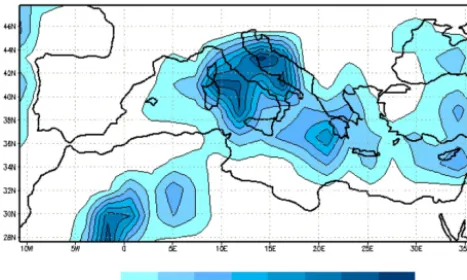
Particular aspects like special attention to intense cyclones are considered in other studies (Genovés et al., 2006) or are included in other papers (like Homar et al., 2007). Figure 3 shows the geographical distribution of intense Mediterranean cyclones, defined as having a total geostrophic circulation greater than 7×10⁷m2s−1(Homar et al., 2007).
Figure 3. Geographical distribution of intense cyclones; that is, cy-clones with a geostrophic circulation larger than 7×10⁷m2s−1 and with a duration of at least 24 h. The isolines refer to the average number of cases per year, in 2.25◦×2.25◦lat–lon squares. The data are based on ECMWF-ERA-40 reanalysis, 1957–2002 (Homar et al., 2007; courtesy of Joan Campins, AEMET; Uppala et al., 2005).
Bruno Joly, Alain Joly and Philippe Arbogast. A recent cli-matology of cyclones based on the 850 hPa vorticity max-imum tracks shares common features with the aforemen-tioned works (see Fig. 4 and Joly and Arbogst, 2010).
In Croatia, operational analyses of the ECMWF were used to evaluate the cyclonic activity over the Adriatic Sea (Horvath et al., 2008). These analyses identified four types of cyclogenesis over the Adriatic. These cyclones pro-duce a chain of weather phenomena on the Adriatic coast, where Jugo winds and mountain-induced precipitation pre-cede strong Bora winds.
In MEDEX, some attention was paid to the question of the time evolution of the frequency and characteristics of the Mediterranean cyclones in connection with climatic change (Guijarro et al., 2006). If the total cyclonic circulation in a region is defined by the sum of the geostrophic circulations associated with all detected cyclonic centres (intense, mod-erate or weak) during the 45 years of the ERA-40 period, the annual total cyclonic circulation shows a significant de-crease in the western Mediterranean, mostly in winter and spring, and an increase in the eastern Mediterranean, mainly due to the summer and autumn growth in the frequency of Cyprus weak (thermal?) lows. The decrease in circulation in the western Mediterranean can mostly be associated with the decline in the frequency of all Genoa gulf cyclones. No sig-nificant changes are detected in the frequency of cyclones in the maritime zone situated between the southeastern Iberian Peninsula and the African coast, for instance.
Another group of papers focuses on the link between cy-clones and severe weather. A point of departure for the con-cepts used in some of these papers is Jansa et al. (2001a), while Campins et al. (2006b, 2007) present examples for specific regions. Other approaches to the same idea are
1
1
1
1
1
2
3
ERA-I - Autumns 1989 to 2009
Figure 4. Density of cyclone tracks in autumn. A cyclone location is defined by the 850 hPa vorticity maximum. Only cyclones with a vorticity of at least 1×10⁻⁴s−1 are considered. The tracking has been made on 1◦resolution lat–lon grid vorticity fields, using ERA-Interim reanalyses, over the 1989–2009 period. The counting is normalised to periods of two months. The arrows are average displacement velocities (barbs, in knots); only average velocities of at least 10 kt are plotted; in areas with high cyclone track density, the average becomes lower (courtesy of Bruno Joly, Météo-France; Dee et al., 2011).
found in Speranza and Tartaglione (2006) and Tartaglione et al. (2006).
Another way to face the high impact weather from the cli-matological point of view is the identification, through sta-tistical methods like principal component and cluster analy-sis, of the atmospheric patterns that are associated with this kind of weather. In Météo-France some unpublished work in this sense was done by Bruno Joly and other researchers. Later, already in the process of transition from MEDEX to HyMeX, the work by Nuissier et al. (2011) can be men-tioned. Tartaglione et al. (2009) deal with similar aspects, but with reference to Italy. Analogous research lines were explored in Spain, with papers referring to atmospheric pat-terns related to heavy rain in the Balearics (Lana et al., 2007) and for the whole Spanish and French Mediterranean area (Martinez et al., 2008). For Bulgaria, the work by Tsonevsky et al. (2010) can be cited.
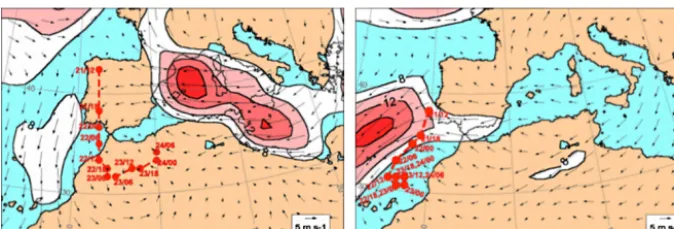
Figure 5. Left panel: position of the cutoff low centre at 300 hPa (circled), from 12:00 UTC to 06:00 UTC (21–24 October 2000), as simulated in the control run. Vector field and shaded contours show the 48 h averaged wind and wind speed (m s−1) greater than 8 m s−1at 1000 hPa from 00:00 UTC to 00:00 UTC (22–24 October 2000). Right panel: the same but for the weakened cutoff low experiment (from Homar et al., 2002a).
it can be inferred that the largest impact regarding strong winds is found over specific areas affected by local winds such as the Mistral or Tramontane, rather than being directly tied to strong 850 hPa vorticity centres, as observed for At-lantic mid-latitude cyclones.
4.2 Dynamical and physical mechanisms – numerical modelling
A variety of studies have been performed in this field with regard to the cyclones that produce severe weather in the Mediterranean. Many of these can be considered as gen-uinely belonging to the MEDEX orbit, and some (cited also in this section) were included in the analysis by Buzzi et al. (2005), but before and after 2005 there has also been significant work on the analysis of dynamical and physical mechanisms of Mediterranean cyclones that produce severe weather, and on numerical modelling.
In fact, studies done before 2000 encouraged and inspired some strategies for facing the second specific objective of MEDEX. By applying the factor separation method of Stein and Alpert (1993), an analysis of four different factors in an ALPEX cyclone development, illustrating the significant role of double, triple, and quadruple synergies, was performed by Alpert et al. (1996). Romero et al. (1997) studied quantita-tively the influence of the orography and evaporation factors and their synergy on a heavy precipitation case of northeast-ern Spain, and demonstrated the leading role of the interac-tion between both factors.
Later, the consideration for other cases of a dynamic vari-able such as potential vorticity (PV) as another factor in play in the separation method (by applying PV inversion) per-mitted the isolation of the role of middle to upper tropo-spheric dynamics on the cyclone formation and on the con-vective triggering (Tsidulko and Alpert, 2001; Homar et al., 2002a). In Tsidulko and Alpert (2001), PV and orography are the factors considered in an Alpine lee cyclogenesis. Also, Flocas (2000) had used the PV inversion to diagnose cyclo-genetic processes. In Homar et al. (2002a), the modification
via PV inversion of the initial and boundary conditions of mesoscale numerical simulations, by incorporating slightly smoothed upper-level PV anomalies, allowed the identifica-tion of the importance of the high-level disturbance in the development of a quasi-stationary low-level jet (LLJ) that provided a continuous moisture supply towards the Spanish coast. Figure 5 displays the difference between the low-level flow in a simulation nested in the unperturbed ECMWF anal-yses and the simulation initialised with the inverted fields ob-tained from the slightly smoothed PV field.
The roles of boundary factors (e.g. orography and sea sur-face evaporation) and physical factors (e.g. latent heat re-lease in the cloud systems) were found to be even more crit-ical when the heavy precipitation episode on the Spanish Mediterranean coast was governed by shallow and/or small-size cyclones. For instance, the numerical simulations of two different mesoscale convective systems (MCS) in Romero et al. (2000) showed that the extreme stationarity and effi-ciency of both systems can be attributed to the leading role of both kinds of factors within a dynamically weak meteoro-logical setting. Also with regards to the prediction of a quasi-stationary MCS, Davolio et al. (2007) used high-resolution modelling to study the influence of the initial conditions, the assimilation of surface data and the orographic factor.
Romero et al. (2005), Martín et al. (2006) and Argence et al. (2006, 2008, 2009) studied the influence of uncertainties associated with the location and intensity of the upper-level trough in cases of heavy rain in the western Mediterranean area. Both PV values and the specific shape and position of the disturbance appear to be critical in determining the amount of precipitation, the location of the maximum rain-fall, and the strength and position of the responsible low-level cyclones. They also found that too deep disturbances at high levels are not excessively favourable for the development of shallow cyclones and heavy rains, since they greatly reduce the stationarity of the weather pattern.
the analysis of an intense cyclone that produced extremely strong Bora winds. This cyclone was generated in the lee of the Atlas Mountains and fully developed over the cen-tral Mediterranean. The orography blocking is responsible for the generation of a low-level shallow vortex in the first phase of the lee development, while an upper-level poten-tial vorticity anomaly is the principal ingredient of this event, responsible for a dominant deepening effect in the later stage of lee formation.
Romero (2008) further exploited the capabilities of the PV inversion approach and the factor separation method in a di-agnostic system that implements the concepts of “PV think-ing” (Hoskins et al., 1985) of cyclones quantitatively. By switching on and off the PV anomalies of interest, the cor-responding solutions to the system of equations can be com-bined algebraically to isolate the magnitude of both the in-dividual and the synergistic effects of the PV anomalies on the spatial pattern of geopotential-height tendency (and verti-cal motion) around the cyclone. The potential of the method to elucidate the relative importance of physically meaningful PV anomalies associated with the undulating tropopause, the low-level thermal field and the latent-heat release, was illus-trated for a prototypical intense Mediterranean cyclone: the upper-level PV anomalies contributed very significantly dur-ing its whole lifecycle; surface thermal anomalies were fun-damental during the development period and for the move-ment of the system during the later stages; the interaction be-tween the two types of anomalies became the dominant effect during the mature stage of the cyclone, and all other contri-butions, including the individual and synergistic effects of di-abatically generated PV, were generally most relevant during the mature phase of the cyclone.
The presence of small thermal lows has proved to be de-cisive in the development of convection that tends to pro-duce hail in the northeastern Iberian Peninsula in summer. Tudurí et al. (2003) showed, through numerical simulations, that the action of the thermal low that developed around the Ebro Valley is to inflow moist air from the Mediterranean and then to promote severe convection. Sánchez et al. (2003) numerically investigated the same subject, with similar re-sults. Analogously, convergence produced by Mediterranean cyclones over the maritime areas can lead to organised con-vective developments like squall lines, often linked to se-vere weather (Ramis et al., 2009). Non-hydrostatic numer-ical models have proven their ability to reproduce quite ac-curately the spatial and temporal distribution of convection and the associated strong winds (Cohuet et al., 2011). In this respect, an analysis and model reconstruction of the histor-ical event of a high impact weather cyclone that hit Italy in November 1966 was tackled by Malguzzi et al. (2006), using a full chain of numerical tools, from a global model to a high-resolution, convection-permitting non-hydrostatic model.
The relative influence of latent heat release and other dia-batic factors on the genesis and intensification of cyclones in the Mediterranean as compared to the baroclinic mechanism
has also been analysed through numerical simulations. Note that this influence has been shown to be very important for the rapid development of both synoptic-scale cyclones (Homar et al., 2002b; Genoves and Jansa, 2003) and smaller mesoscale cyclones (diameter of about 300 km) known as medicanes or “Mediterranean hurricanes” (Lagouvardos et al., 1999; Homar et al., 2003; Chaboureau et al., 2012). Nu-merical simulations have also demonstrated how sensible and latent heat surface fluxes become influential in medi-cane deepening and trajectory (Tous et al., 2013; Davolio et al., 2009). Without direct connection with MEDEX, the processes involved in Mediterranean explosive cyclogenesis have been studied by Kouroutzoglou et al. (2012).
The quantity and variety of works related to the under-standing and numerical simulation of the physical processes involved in the Mediterranean cyclogenesis and eventually in the subsequent adverse weather make it difficult to sum-marise the main scientific results in this field. However, very synthetically, an idea that can be highlighted is that signifi-cant cyclogenesis in the Mediterranean only occurs with the concurrence of a large-scale baroclinic or upper-level distur-bance, although the geographical factors (orography and the land–sea contrast) redirect the process to some preferential areas. In a certain way, this is a validation of the old idea of considering the Mediterranean cyclogenesis as a secondary cyclogenesis with regard to the oceanic storm tracks. The shape, intensity and exact location of the resulting surface cyclone can be decisive in triggering or locating strong wind and/or heavy rain.
4.3 Location of sensitive zones and climatology of the sensitivity
weather. In order to manage a large number of cases, the in-tense cyclones were classified by principal components (PC) and cluster analysis in groups (clusters), and the methodol-ogy was applied to the cluster centroid, applying later weight coefficients to construct the total climatology. The starting point for the PC and cluster analysis was the MEDEX project cyclone climatology, particularly the intense cyclone clima-tology (Jansa and Homar, 2006; Homar et al., 2007).
Other methods for sensitivity computation were tested, such as adjoint methods taking into account analysis uncer-tainties (called KFS, Doerenbecher and Bergot, 2001), or the method of ensemble sensitivity (Garcies and Homar, 2009, 2010). The ensemble sensitivity was used to construct the cli-matology of sensitivities for intense Mediterranean cyclone prediction (Garcies and Homar, 2009, 2010).
An indirect approach to the climatology of the sensitivity is through the DTS-MEDEX-2009 campaign (Jansa et al., 2011): the “lead user” had to issue a consensus using the sen-sitivities computed objectively for the campaign, taking into account the feasibility of additional observations. The distri-bution of this combined sensitivity defined an approximation to the most sensitive zones for the set of selected cases in the campaign, which not only were intense cyclones, but also heavy rain or strong wind events.
Another aspect that has been studied is the verification of the sensitive information as computed by different methods (adjoint model, ensemble sensitivity or even subjective esti-mation; Garcies and Homar, 2011).
As a general result, we can confirm that, as expected, the highest sensitivities tend to be located upstream of the main development zones of Mediterranean cyclones, that is many times in the open ocean or inland Africa, where the opera-tional observing network is scarce.
4.4 Targeted observation and impact of additional observations
The targeted (or adaptive) observations (for cases of Mediter-ranean cyclones and/or severe and/or high impact weather in the region) were tested in the Eurorisk–PREVIEW campaign (2008) and in the DTS-MEDEX-2009 campaign, as already mentioned in Sect. 3.4. By using the ECMWF/UK DTS soft-ware (Prates et al., 2009), the most sensitive zones, where additional observations had to be deployed, were identified by means of several methods, mostly the ECMWF singular vector method, with the help of other methods and the sub-jective modulation (see Jansa et al., 2011).
Concerning targeting observations, the main scientific ob-jective was rather to verify the correctness and usefulness of the sensitivity computations and the additional deployed observations.
A way to verify the derived sensitivity information is the introduction of artificial perturbations in the estimated most sensitive zones and to study their evolution throughout the numerical prediction (Garcies and Homar, 2014).
Another way is to analyse the direct impact on the forecast of the additional observations or even of the additional assim-ilation of some available and unused data, like high-density satellite data (Campins et al., 2013). The results obtained un-til now are not conclusive, but indicate the partial usefulness of some additional data. It should be stressed that the impact of the targeted observations was here found to be not negli-gible with respect to the first experiment of that kind called TREC2003 (for Thorpex Regional Campaign; Fourrie et al., 2006).
4.5 Forecasting methods: testing ensemble prediction systems (EPS)
It is now recognised by many meteorological services that the application of high-resolution ensemble prediction systems (EPS) is valuable in the framework of severe and/or high im-pact weather forecast, even on a small scale (Bouttier et al., 2012).
In parallel to MEDEX, several institutions have been working on EPS or statistical forecasting methods. The multimodel–multiboundary ensemble system developed at AEMET (AEMET-SREPS, García-Moya et al., 2011) has been presented to the MEDEX community (in different MEDEX meetings) and discussed. AEMET-SREPS has been tested in cases of Mediterranean severe and/or high impact weather (Callado et al., 2011).
More specifically connected to MEDEX is the work done on EPS at the University of the Balearic Islands. They took practical advantage of the body of knowledge acquired dur-ing the course of the project with regards to the roles of dy-namical and physical factors in Mediterranean cyclones and heavy rain by designing and testing for MEDEX events three different short-range EPS (Vich et al., 2011a, b): a multi-physics EPS that uses different sets of model physical pa-rameterisations; an ensemble based on perturbing the three-dimensional PV features of the input analyses that exhibit intense values and gradients (PV gradient); and an analogous system whose perturbation zones are guided by the model adjoint-derived sensitivity zones (PV adjoint). A thorough verification of the results showed that even though all EPS are skilful and advantageous over a deterministic approach, both PV-perturbed systems beat a multiphysics approach, the PV gradient being the best. Vich et al. (2012) introduced a novel concept consisting of building the ensemble members with the previous approach plus subjectively defined pertur-bations, drawn by a forecaster or an expert.
4.6 Social impact studies
Although most of the papers about case studies usually in-troduce briefly the main impacts produced by the respective event, the Societal Impact Research (SIR) group of MEDEX focused its work (presented every year since its birth in the Plinius conferences) along three main research lines. The first one was the compilation of socio-economic data on impacts produced by the events included in the database al-ready mentioned in Sect. 4.1, and the completion of it for the period 1990–2006. As a result of this work and in collabora-tion with the European FLASH project, Llasat et al. (2010) published a preliminary cartography and temporal analysis of flood events that have affected the Mediterranean countries. The fruit of this initiative has been the FLOODHYMEX database (Llasat et al., 2013); attending that, the SIR group was followed by the Working Group on Societal Impacts (WG5) of the HYMEX project. Based on the experience gained and following the pioneering initiatives of MEDEX, a database (that is continuously updated) containing all the major events with important socio-economic impacts that oc-curred since 2000 in Greece has been constructed recently (Papagiannaki et al., 2013).
The second research line was centred on the analysis of re-quests received by meteorological services as a consequence of the impacts of heavy rains and windstorms, and was devel-oped in collaboration with the regional centre of AEMET in the Balearic Islands and the Meteorological Service of Cat-alonia (Amaro et al., 2010). The idea, followed by other com-munications presented at different Plinius conferences, was to take advantage of the hard work developed regularly by meteorological services, as sources of data serve as indica-tors of societal impact.
In the third one, Llasat et al. (2008) introduced the influ-ence of the changing vulnerability and the perception of pop-ulation into the evaluation of the high impact weather risk as well as into the observed trends. This task was systematically improved with the creation of a database containing press news relating to floods, heavy rainfalls and severe weather that was published in a newspaper during the period 1982– 2007 (Llasat et al., 2009).
MEDEX has been the birthplace of the current group of HyMeX dedicated to the analysis of the social impact caused by meteorological and hydrometeorological hazards. It was one of the first bets for interdisciplinary work between the so-cial sciences and the natural sciences for assessing impacts.
Finally, we can mention some MEDEX research on fore-cast verification, which is a horizontal topic, with connec-tions to the social impact research and to the research on forecast methods and numerical modelling. A particular ob-jective in this sense was the development of a tool to mea-sure the quality of the cyclone forecast (Picornell et al., 2003, 2011).
5 Conclusions
This paper has reviewed the main results of the MEDEX in-ternational project. These results can be grouped into two cat-egories: the tangible products and the scientific findings.
The tangible products comprise (i) the MEDEX database, with a rich and useful content about cyclones and severe weather in the Mediterranean, (ii) three main written reports, on scientific achievements during the First Phase of MEDEX, on sensitivity computations and on sensitivity climatology, and (iii) the stored sensitivity computations and the addi-tional observations obtained during the DTS-MEDEX-2009 campaign and in association with the Eurorisk–PREVIEW campaign (2008). Additionally, the reports on the project submitted to WMO (SSC/WWRP or ICSC/THORPEX) can also be considered to be tangible MEDEX products.
With regards to scientific achievements, plentiful literature has emerged from MEDEX, concerning several aspects, in particular: (i) climatological aspects (like the characterisation of Mediterranean cyclones, atmospheric patterns associated with severe and/or high impact weather, or the relationship between cyclones and severe and/or high impact weather), (ii) aspects related to the knowledge about the processes in-volved in the formation and evolution of the cyclones that produce severe and/or high impact weather and in the high impact weather itself (with regards to the factors involved, including dynamical and diabatic forcing, or numerical mod-elling capabilities), and (iii) the location of high sensitiv-ity areas for the prediction of cyclones that produce severe and/or high impact weather, as well as the climatology of these sensitivities, have been the objects of another series of papers. Some others are relative to the verification of the sen-sitivity and to the impact of additional observations in the forecasting. (iv) There is also the MEDEX literature on pre-diction methods, particularly about the use or the improve-ment of ensemble prediction systems. (v) Finally, a group of MEDEX papers deals with the social impact of the Mediter-ranean cyclones and associated weather, and with the fore-casting verification. Some particularly significant scientific results have been highlighted on each of these aspects in the corresponding subsection under Sect. 4.
The documents associated with MEDEX meetings (such as presentations or minutes) can also be considered to be MEDEX products. In this sense, the Workshop on Social Impact Research in MEDEX (Barcelona, 2004) was an out-standing event, with interdisciplinary contributions coming from different kinds of individuals and organisations. Nine-teen papers were presented there.
Appendix A
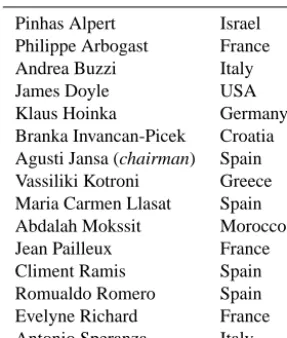
Table A1. Members of the MEDEX Science Steering Committee (at least part of the time during the MEDEX life).
Pinhas Alpert Israel Philippe Arbogast France
Andrea Buzzi Italy
James Doyle USA
Klaus Hoinka Germany
Branka Invancan-Picek Croatia Agusti Jansa (chairman) Spain Vassiliki Kotroni Greece Maria Carmen Llasat Spain Abdalah Mokssit Morocco
Jean Pailleux France
Climent Ramis Spain
Acknowledgements. Many institutions have contributed to the MEDEX accomplishment by giving support, funding activities or providing data and human resources. Some of the most significant institutions are in some way represented by the authors of this pa-per. Special mention has to be made of AEMET, which, together with the University of the Balearic Islands, has constructed and maintained the MEDEX database. The work associated with this ac-tivity has mostly been undertaken by Ana Genovés, Joan Campins and Maria Angeles Picornell (AEMET), all of them authors or co-authors of scientific MEDEX literature and very active participants in the MEDEX campaigns.
The organisational, technical and financial support given by EUMETNET–EUCOS to MEDEX has been very important, par-ticularly for sensitivity studies and for running the MEDEX campaigns. From the management of EUCOS, James Caughey, Bruce Scott and Stefan Klink have provided special help to MEDEX. Most of the work on sensitivity studies has been un-dertaken or directed by Victor Homar, from the University of the Balearic Islands. Victor Homar has also contributed to this paper through a collaborative reading and improvement of the manuscript. Jean Pailleux (Météo-France) provided a very effective push for the second phase of MEDEX.
Support, encouragement and guidance have been received from WMO, both from the Secretary (Dr. Du, Dr. Lei) and from the mem-bers of the SSC/WWRP.
Some of the participant institutions, not represented by the au-thors of this paper, have been especially constant and effective in their support to MEDEX. The meteorological services of Catalonia (Montse Aran), Italy (Alessandro Fuccello and Teodoro La Rocca) and Bulgaria (Christo Georgiev) are particularly acknowledged in this respect.
The authors are also very grateful to Piero Lionello (referee), to an anonymous referee and to Uwe Ulbrich (editor) for the corrections and suggestions they formulated during the review of our manuscript. Their contributions have substantially improved the paper.
Edited by: U. Ulbrich
Reviewed by: P. Lionello and another anonymous referee
References
Alpert, P., Neeman, B. U., and Shay-El, Y.: Climatological analysis of Mediterranean cyclones using ECMWF data, Tellus A, 42, 65– 77, 1990a.
Alpert, P., Neeman, B. U., and Shay-El, Y.: Intermonthly Variability of Cyclone Tracks in the Mediterranean, J. Climate, 3, 1474– 1478, 1990b.
Alpert, P., Tzidulko, M., Krichak, S., and Stein, U.: A multi-stage evolution of an ALPEX cyclone, Tellus A, 48, 209–220, 1996. Amaro, J., Gayà, M., Aran, M., and Llasat, M. C.:
Pre-liminary results of the Social Impact Research Group of MEDEX: the request database (2000–2002) of two Meteoro-logical Services, Nat. Hazards Earth Syst. Sci., 10, 2643–2652, doi:10.5194/nhess-10-2643-2010, 2010.
Amengual, A., Romero, R., Gómez, M., Martín, A., and Alonso, S.: A hydro-meteorological modeling study of a flash flood event over Catalonia, Spain, J. Hydrometeorol., 8, 282–303, 2007.
Amengual, A., Romero, R., and Alonso, S.: Hydrometeorological ensemble simulations of flood events over a small-size basin of Majorca Island, Spain, Q. J. Roy. Meteorol. Soc., 134, 1221– 1242, 2008.
Argence, S., Lambert, D., Richard, E., Söhne, N., Chaboureau, J.-P., Crépin, F., and Arbogast, P.: High resolution numerical study of the Algiers 2001 flash flood: sensitivity to the upper-level potential vorticity anomaly, Adv. Geosci., 7, 251–257, doi:10.5194/adgeo-7-251-2006, 2006.
Argence, S., Lambert, D., Richard, E., Chaboureau, J.-P., and Söhne, N.: Impact of initial condition uncertainties on the pre-dictability of heavy rainfall in the Mediterranean: a case study, Q. J. Roy. Meteorol. Soc., 134, 1775–1788, 2008.
Argence, S., Lambert, D., Richard, E., Pierre Chaboureau, J., Arbo-gast, P., and Maynard, K.: Improving the numerical prediction of a cyclone in the Mediterranean by local potential vorticity modi-fications, Q. J. Roy. Meteorol. Soc., 135, 865–879, 2009. Ayrault, F. and Joly, A.: The genesis of mid-latitude cyclones over
the Atlantic ocean: a new climatological perspective, Compt. Rend. Acad. Sci. Paris, Earth Planet. Sc. Lett., 330, 173–178, 2000.
Berenger, M.: Essai d’etudes meteorologiques du Bassin Mediter-raneen – Memorial de la Meteorologie Nationale No. 40, Meteo-rologie Nacional, Paris, 1955.
Berenger, M.: Les types de temps en Mediterranee – METMAR no. 29, Meteorologie Nationale, Paris, 1960.
Berto, A., Buzzi, A., and Zardi, D.: Back-tracking water vapour contributing to precipitation events over Trentino: a case study, Meteorol. Z., 13, 189–200, 2004.
Bougeault, P. and Jansa, A. (Eds.): INM/WMO International Sym-posium on Cyclones and Hazardous Weather in the Mediter-ranean, Universitat de les Illes Balears and Ministerio de Medio Ambiente, Palma de Mallorca, 841 pp., 1997.
Bougeault, P., Binder, P., Buzzi, A., Dirks, R., Kuettner, J., Houze, R., Smith, R. B., Steinacker, R., and Volkert, H.: The MAP spe-cial observing period, B. Am. Meteorol. Soc., 82, 433–462, 2001. Bouttier, F., Vie, B., Nuissier, O., and Raynaud, L.: Impact of stochastic physics in a convection-permitting ensemble, Mon. Weather Rev., 140, 3706–3721, doi:10.1175/MWR-D-12-00031.1, 2012.
Buzzi, A., Tartaglione, N., and Malguzzi, P.: Numerical simulations of the 1994 Piedmont Flood: role of orography and moist pro-cesses, Mon. Weather Rev., 126, 2369–2383, 1998.
Buzzi, A., Richard, E., and Romero, R.: Summary Report on MEDEX Studies and Scientific Results on Mediterranean Cy-clones Causing High Impact Weather, available at: http://medex. aemet.uib.es (last access: 2013), 2005.
Callado, A., Santos, C., Escribà, P., Santos-Muñoz, D., Simarro, J., and García-Moya, J. A.: Performance of multi-model AEMET-SREPS precipitation probabilistic forecasts over Mediterranean area, Adv. Geosci., 26, 133–138, doi:10.5194/adgeo-26-133-2011, 2011.
Campins, J., Jansà, A., Benech, B., Koffi, E., and Bessemoulin, P.: PYREX Observation and Model Diagnosis of the Tramontane Wind, Meteorol. Atmos. Phys., 56, 209–228, 1995.
Campins, J., Jansa, A., and Genoves, A.: Three-dimensional struc-ture of Western Mediterranean cyclones, Int. J. Climatol., 26, 323–343, 2006a.
Campins, J., Jansà, A., and Genovés, A.: Heavy rain and strong wind events and cyclones in the Balearics, Adv. Geosci., 7, 73– 77, doi:10.5194/adgeo-7-73-2006, 2006b.
Campins, J., Aran, M., Genovés, A., and Jansà, A.: High impact weather and cyclones simultaneity in Catalonia, Adv. Geosci., 12, 115–120, doi:10.5194/adgeo-12-115-2007, 2007.
Campins, J., Genoves, A., Picornell, M. A., and Jansa, A.: Clima-tology of Mediterranean cyclones using the ERA-40 dataset, Int. J. Climatol., 31, 1596–1614, 2011.
Campins, J., Navascués, B., Santos, C., and Amo-Baladrón, A.: Influence of targeted observations on short-term forecasts of high-impact weather events in the Mediterranean, Nat. Hazards Earth Syst. Sci., 13, 2891–2910, doi:10.5194/nhess-13-2891-2013, 2013.
Chaboureau, J.-P., Pantillon, F., Lambert, D., Richard, E., and Claud, C.: Tropical transition of a Mediterranean storm by jet crossing, Q. J. Roy. Meteorol. Soc., 138, 596–611, 2012. Cohuet, J. B., Romero, R., Homar, V., Ducrocq, V., and Ramis, C.:
Initiation of a severe thunderstorm over the Mediterranean Sea, Atmos. Res., 100, 603–620, 2011.
Cressman, G.: An operational objective analysis system, Mon. Weather Rev., 87, 367–374, 1959.
Davolio, S., Buzzi, A., and Malguzzi, P.: High resolution sim-ulations of an intense convective precipitation event, Meteo-rol. Atmos. Phys., 95, 139–154, doi:10.1007/s00703-006-0200-0, 2007.
Davolio, S., Miglietta, M. M., Moscatello, A., Pacifico, F., Buzzi, A., and Rotunno, R.: Numerical forecast and analysis of a tropical-like cyclone in the Ionian Sea, Nat. Hazards Earth Syst. Sci., 9, 551–562, doi:10.5194/nhess-9-551-2009, 2009. Dee, D. P., Uppala, S. M., Simmons, A. J., Berrisford, P., Poli,
P., Kobayashi, S., Andrae, U., Balmaseda, M. A., Balsamo, G., Bauer, P., Bechtold, P., Beljaars, A. C. M., van de Berg, L., Bid-lot, J., Bormann, N., Delsol, C., Dragani, R., Fuentes, M., Geer, A. J., Haimberger, L., Healy, S. B., Hersbach, H., Hólm, E. V., Isaksen, L., Kållberg, P., Köhler, M., Matricardi, M., McNally, A. P., Monge-Sanz, B. M., Morcrette, J.-J., Park, B.-K., Peubey, C., de Rosnay, P., Tavolato, C., Thépaut, J.-N., and Vitart, F.: The ERA-Interim reanalysis: configuration and performance of the data assimilation system, Q. J. Roy. Meteorol. Soc., 137, 553– 597, doi:10.1002/qj.828, 2011.
De Zolt, S., Lionello, P., Nuhu, A., and Tomasin, A.: The disastrous storm of 4 November 1966 on Italy, Nat. Hazards Earth Syst. Sci., 6, 861–879, doi:10.5194/nhess-6-861-2006, 2006. Doerenbecher, A. and Bergot, T.: Sensitivity to observations
ap-plied to FASTEX cases, Nonlin. Processes Geophys., 8, 467– 481, doi:10.5194/npg-8-467-2001, 2001.
Ducrocq, V., Roussot, O., Béranger, K., Braud, I., Chanzy, A., Del-rieu, G., Drobinski, P., Estournel, C., Ivancan-Picek, B., Josey, S., Lagouvardos, K., Lionello, P., Llasat, M. C., Ludwig, W., Lutoff, C., Mariotti, A., Montanari, A., Richard, E., Romero, R., Ruin, I., Somot, S., with the contributions from Amiridis, V., Anagnos-tou, E., Anav, A., Andersson, A., Anquetin, S., Arbogast, P., Ar-tale, V., Atencia, A., Auclair, F., Austin, G., Avolio, E., Bajic, A., Bakan, S., Baldi, M., Baldini, L., Barthe, C., Barthes, L., Bastin, S., Belamari, S., Bellecci, C., Bennett, A., Berne, A., Betz, H.-D.,