ISSN
2230- 9373
Volume-IX , Issue-1
January-March, 2019
Dynamic Stability under Parametric Excitation of Functionally Graded
Timoshenko FG beam
Abhijit Mohanty1 , Prof. R.R.Dash2
Department of Mechanical Engineering, College of Engineering and Technology, Bhubaneswar, E-mail: [email protected]
ABSTRACT
Many failures of engineering structures have been attributed to structural instability, in which large deformations of the structures are observed. It is the nature of loading that characterizes the nature of the problem of structural stability to be solved. The loading may be either static or dynamic. Laminated composite materials attract the attention of designers due to their characteristics of high stiffness and strength to weight ratio. FGMs having gradual variation of properties are out of the problems of laminated composite materials and can replace them successfully. The conventional armours are manufactured having compromised with toughness. FGMs can be used for manufacturing modern armours without compromising with hardness of ceramics and toughness of metals. In this article an analysis involving critical buckling load, free vibration and dynamic stability of a functionally graded Timoshenko beam having properties along thickness of beam according to exponential and power law.
Key words: FGM, Timoshenko beam, parametric excitation, FEM, Stability
INTRODUCTION
The dynamic stability of structures is a subject of considerable engineering importance and many investigations have been carried out in this regard. The study of behaviour of functionally graded materials (FGMs) has been an interesting topic of considerable research interest during the past decade. The intensity and rapid growth of research on this class of materials is actually due to their continuously varying material properties, which give great advantages over the conventional homogeneous and layered materials. The weakness of conventional laminated composite materials, such as debonding, huge residual stress, locally large plastic deformations can be eliminated by using FGM. FGMs are regarded as one of the most promising candidates for advanced composites in many engineering sectors such as the aerospace, aircraft, automobile and defence industries and most recently the electronic and the biomedical sectors. Application of FGM is gaining increasing importance in the aforesaid sectors, wherein, these components are subjected to vibration and dynamic stability. The blades of turbine, helicopter and spacecraft, rail etc. can be modelled as beams to investigate their dynamic behaviour.
internal and external damping on stability of the column are also determined. Abbas and Thomas [1], Briseghella et. al. [5] and Ozturk and Sabuncu [9] have used finite element method to study the dynamic stability of beams. Shastry and Rao [11] have compared the stability parameter of simply supported beam and clamped beam for different locations of two symmetrically placed intermediate supports. It is found that the stability parameter of simply supported beam approaches that of clamped beam when the intermediate supports are placed at a distance equal to one eighth of beam length from ends. Zhu and Shankar [12] have developed a method to solve two-dimensional elasticity equations for an FGM beam. Fourier series method along with Galerkin method is used for the analysis. It has been shown that the choice of polynomial for the variation of properties along the direction of thickness enables the method to be applied to the functionally graded structures with arbitrary variation of properties. Lim et. al. [8] have studied the static failure modes and load capabilities of foam core composite sandwich beams both analytically and experimentally. Timoshenko beam has been derived from which the governing equation for Rayleigh as well as for Euler-Bernoulli beam can be deduced analytically. Babai et. al. [3], Gharib et. al. [6], and Benatta et. al. [4] have studied the static response of a functionally graded beam under external excitation. Salai et. al. [10] have presented a theoretical analysis of FGM beams using sigmoid function. Alshorbagy et. al. [6] have studied the dynamic characteristics of a functionally graded Euler-Bernoulli beam applying principle of virtual work. Several models have been compared by Arnaldo and Richard [11] have studied the effect of functionally graded materials on resonance of bending shafts under time dependent axial loading.It is observed that metal-ceramic FGM beams show substantial improvement in parametric resonance compared to metallic beams. The effects of material composition, temperature dependent properties, slenderness ratio on thermal buckling and vibration of functionally graded beams are investigated by Wattanasakulpong et al. [13]. The third order shear deformation theory is considered by the authors.
It is learnt from the reported literature that FGMs have scope for numerous applications in diversified fields. These materials should be predictable as regards their behaviour under parametric resonance before use in related applications. The present chapter is devoted to the study of dynamic stability of FG beams under parametric excitation.
FORMULATION
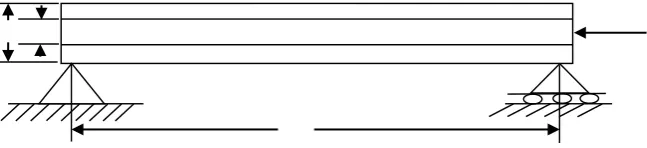
A functionally graded sandwich beam with top skin as alumina, bottom skin as steel and core as FGM is shown in figure 1.(a). The beam, hinged at both the ends is subjected to a pulsating axial force P(t) = Ps + Ptcost, acting along its un-deformed axis. The static component of the axial force is Ps. The
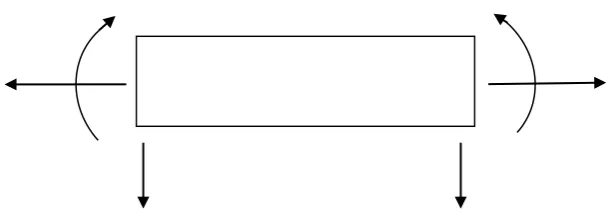
amplitude and frequency of the dynamic component of the force are Pt and respectively, and t is time. The coordinate system of a typical two noded finite element used to derive the governing equations of motion is shown in figure 1.(b). The mid-longitudinal(x-y) plane is chosen as the reference plane for expressing the displacements as shown in figure 1.(b).
The thickness coordinate is measured as z from the reference plane. Figure 1.(c) shows the beam element with three degrees of freedom per node. The axial displacement, the transverse displacement, and the rotation of the cross-section are
u
,w
and
respectively.
Figure 1(b) The coordinate system with generalized forces and displacements for the FGSW beam element.
Figure 1.(c) Beam element showing generalized degrees of freedom for ith element.
The element matrices for the functionally graded beam element are derived. Moreover the same element can be used for the analysis of a functionally graded ordinary beam by making the thickness of the skins equal to zero.
Shape functions
The displacement fields considering first order shear deformation (Timoshenko beam theory) is expressed as ), , ( ) , , , ( ), , ( ) , ( ) , , ,
(x y z t u x t z x t W x y z t w x t
U
(1)The corresponding linear strains are expressed as
. , x w x z x u xz xx
(2)The stress-strain relation in matrix form can be given by
xz xx xz xxz
G
k
z
E
)
0
0
)
(
(3)where
xxand
xxare normal stress and normal strains inx
direction,
xzand
xzare shear stress andshear strain in x-z plane. E(z), G(z) and k are Young’s modulus, shear modulus along thickness and shear correction factor respectively. The material properties of the FGM that varies along the thickness of the beam are assumed to follow exponential law given by
b t tR
R
e
h
z
e
R
z
R
log
2
1
)),
/
2
1
(
exp(
)
(
(4)and power law given by
b n b t R h z R R z
R
2 1 ) ( )
where, R(z) denotes a material property such as, E,
G
,
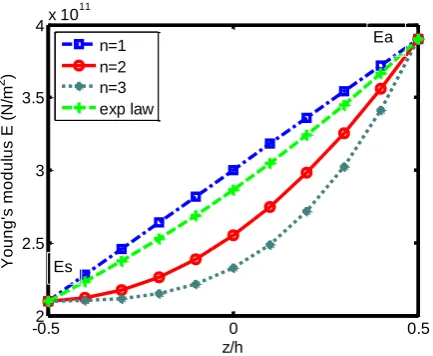
etc., Rt and Rbdenote the values of theproperties at topmost and bottommost layer of the beam respectively, and n is an index. The variation of Young’s modulus along the thickness is shown in Figure 1.(d) for different laws and other properties follow the same type of variation.
Figure 1.(d) Variation of Young’s modulus along thickness of steel-alumina FGM with steel-rich bottom according to different laws
The kinetic energy T and the strain energy
S
of the beam element can be expressed asdAdx
t
W
t
U
z
T
l A
2 2 0)
(
2
1
(6)
l A xz xz xx xxdAdx
S
02
1
(7)
Using above equations the governing differential equation can be derived by applying Hamilton’s principle which states that
2 1 0 t t dt S T
(8)The governing differential equations in terms of the degrees of freedom u, w and
can be written as0 ) ( 2 2 11 2 2 11 2 2 1 2 2 0 x B x u A t I t u I u S
T
,
0
)
(
2 2 55 2 20
x
x
w
A
t
w
I
w
S
T
, and (9
0
)
(
55 2 2 11 2 2 11 2 2 1 2 22
x
w
A
x
D
x
u
B
t
u
I
t
I
S
T
-0.52 0 0.5
2.5 3 3.5
4x 10
where,
A
B
D
E
z
z
z
dA
A
211 11
11
(
)
1
,
I
I
I
z
z
z
dA
A
22 1
0
(
)
1
, and (10)dA
z
G
k
A
A
(
)
55
The shape functions for the displacement field for finite element formulation are obtained by solving the static part of the eq. (8) with the following consideration.
,
2 3 21
a
x
a
x
a
u
,
3 7 2 6 5
4 a x a x a x
a
w
.
2 10 98
a
x
a
x
a
Using above equations an FEM model is developed by satisfying the imposed conditions. Three shape functions for the axial, transverse and rotational degree of freedom is found out.
It is seen above that unlike the conventional elements the shape function not only depends on x and l but it also depends on cross-sectional area and material properties which ensures better accuracy. Moreover, better convergence can be achieved as the shape functions are obtained from the exact solution of static part of the governing differential equation.
Similarly the Element elastic stiffness matrix and Element mass matrix are created using the general force boundary conditions for the element can be given as
A xx
x
B
x
u
A
dA
N
11 11
A xx z
x
w
A
dA
V
55
A xx y
x
D
x
u
B
dA
z
M
11 11
(12)where,
N
,V
z,M
yare axial force, shear force and bending moment respectively acting at the boundary nodes.When the axial load P
t is applied on the beam element, the work done by the load can be expressed as
lp
dx
x
w
t
P
W
0
2
2
1
(13)
The periodic solutions characterize the boundary conditions between the dynamic stability and instability zones. So the periodic solution can be expressed as Fourier series.
.. 3 , 12
cos
2
sin
ˆ
K k kt
K
d
t
K
c
t
U
(14)A solution with period T is represented by:
.. 4 , 2 02
cos
2
sin
ˆ
K k kt
K
d
t
K
c
c
t
U
(15)On Simplification and Substitution the governing equation the condition for existence of these boundary solutions with period 2T is given by
ˆ
0
4
2
/
2
U
M
K
P
K
ef
d g (16)Equation (48) represents an eigen value problem for known values of
,
d, and P. This equation gives two sets of eigen values
binding the regions of instability due to the presence of plus and minus sign. The instability boundaries can be determined from the solution of the equation
0
4
2
/
2
M
K
P
K
ef
d g (17)Free vibration
When
=0,
d=0, and 2
, eq. (17) is reduced to a problem of free vibration as
Ke
2
M 0 (18)The solution of eq. (16) gives the value of natural frequencies
.
Static stability
When
=1,
d=0, and
0
, eq. (17) is reduced to the problem of static stability as
Ke P
Kg 0 (19)The solution of eq. (19) gives the values of buckling loads.
Regions of instability
The fundamental natural frequency
1 and the critical buckling load P of an isotropic steelbeam with similar geometrical dimensions and end conditions as that of FGO beam are calculated from eq. (18) and eq. (19) respectively.
Choosing 1
1
, eq. (17) can be rewritten as
0
4
2
/
2 1 2 1
M
K
P
K
e d g
(20)The solution of eq. (20) gives two sets of values of
1
for given values of
,
d,
P , and
1.The plot between
d and
1RESULT AND DISCUSSION
The numerical study is carried out for a beam with pinned-pinned end conditions. An FG beam with steel and alumina as its constituent phases is considered for the analysis followed by the investigation of an FGSW beam made up of steel and alumina.
Validation of the formulation
In order to establish the correctness of calculation, the first five natural frequencies of a steel aluminum FG beam are calculated. The dimensions of the beam are, Length, L=0.5m, breadth, b=0.1m and thickness h=0.125m.
The FG beam reduces to a homogeneous beam when the value of power law index (n) is made equal to zero. The critical buckling load parameter for various (
L
/
r
) ratios is computed and compared with the result available in literature. Here, ‘r’ corresponds to radius of gyration.Functionally graded beam
A steel-alumina FG beam with steel-rich bottom is considered for vibration and dynamic stability analysis. The properties of constituent phases are:
Steel: E=2.1x10¹¹ Pa, G=0.8x10¹¹ Pa
=7.85x10³kg/m3,Alumina: E=3.9x10¹¹ Pa, G=1.37x10¹¹ Pa,
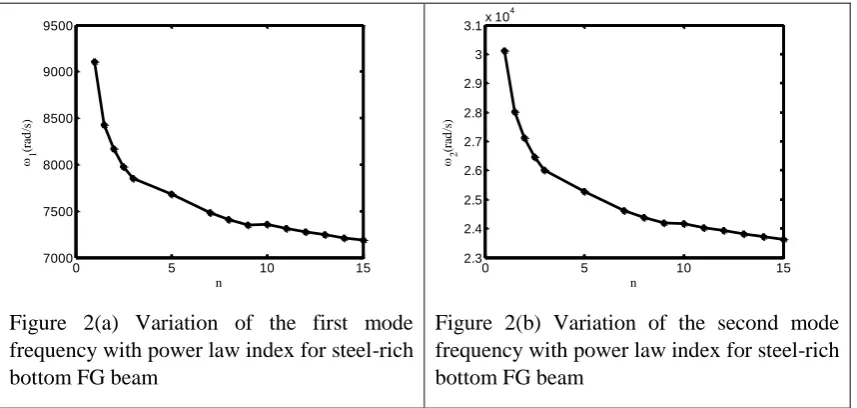
=3.9x10³kg/m3, k=0.8667.The effect of variation of power law index on first two natural frequencies of FG beam are presented in figures 2(a) and 2(b). The corresponding data are presented in table 1. It is found for both the modes that the frequency decreases as the power law index (n) increases from one to fifteen. This may be attributed to the following fact. The composition of the constituent phases at a given point changes as the power law index varies. The material properties at the point such as E ,
andG
are dependent on composition of the phases. As the elements of stiffness and mass matrices are functions of these coordinate dependent properties, so variation in power law index alters the stiffness matrix [K] and mass matrix [M] and hence the natural frequencies.Figure 2(a) Variation of the first mode frequency with power law index for steel-rich bottom FG beam
Figure 2(b) Variation of the second mode frequency with power law index for steel-rich bottom FG beam
The effect of variation of power law index on critical buckling load is evaluated and is presented in Tables 2. It is found that, the critical buckling load decreases with increase in the value of power law index. This is due to the fact that the FG beam with steel-rich bottom becomes richer in steel as the power law index becomes higher. FG beam rich in steel implies beam with lower effective material properties as steel has got lower E and
G
as compared to alumina. The lower values of effective material properties of the beam reduce its stiffness which in turn decreases the critical buckling load.0 5 10 15
7000 7500 8000 8500 9000 9500
n
1
(r
ad
/s
)
0 5 10 15
2.3 2.4 2.5 2.6 2.7 2.8 2.9 3 3.1x 10
4
n
(r2
ad
/s
Table 1 Variation of natural frequencies with power law index for steel-alumina FG beam (steel-rich bottom).
Power index (n) Natural frequencies (rad/s)
1
2
31 9106.78 30117.72 55123.50
1.5 8424.07 28007.59 51402.84
2 8168.70 27120.25 49694.54
2.5 7979.96 26468.72 48490.07
3 7850.75 26005.89 47659.08
5 7683.84 25270.87 46180.58
7 7481.00 24613.57 45015.09
8 7412.18 24388.93 44630.19
9 7352.96 24198.53 44306.63
10 7356.02 24169.83 44215.63
11 7314.84 24037.99 43992.39
12 7278.29 23922.06 43796.71
13 7245.71 23819.61 43624.67
14 7210.69 23715.94 43445.77
15 7185.05 23635.69 43311.06
Table 2 Critical buckling loads for FG beam (steel-rich bottom). Power law index (n) Critical buckling load P(x107 N)
1 16.561
2 14,908
5 14.166
10 13.412
25 12.552
The additional data for dynamic stability analysis are taken as follows. P=11.37x10⁷ N, 1
=6724.9 rad/s. P and
1 corresponds to the critical buckling load and fundamental natural frequency of a homogenous steel beam of same dimensions and end conditions as of the FG beam.The effect of property distribution laws on the dynamic stability of FG beam is studied. The first two principal regions of instability are shown in figure 3(a) and figure 3(b) respectively. The static load factor,
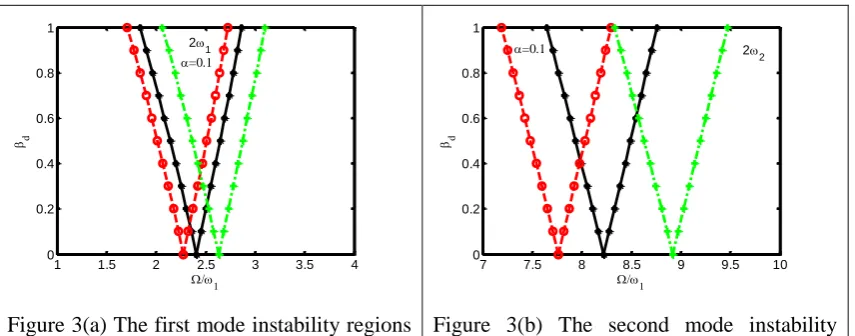
=0.1 is used for the analysis. The instability regions of beam having properties along thickness according to power law with index n=1.5 (FG-1.5) beam, with index n=2.5 (FG-2.5) beam and properties according to exponential law (e-FG) beam are superimposed for the purpose of comparison. It is clear from the figures 3(a) and 3(b) that the e-FG beam is the most stable among the three as its instability region is located at farthest from the dynamic load factor axis. The first and second mode instability regions are shifted towards the dynamic load factor axis as the power law index increases from 1.5 to 2.5 thereby enhancing the chance of parametric instability. The relative amount of alumina is highest in e-FG beam and this causes the beam’s stiffness to be of highest magnitude. As the stiffness of the e-FG beam happens to be the highest, the dynamic instability occurs at the highest excitation frequency thereby reducing the chance of instability. Similarly, as the value of power law index increases, the stiffness of the beam reduces and hence the excitation frequency to cause instability decreases making the beam more prone to instability.Figure 3(a) The first mode instability regions of FG (steel-rich bottom) beam, +exp. law, *n=1.5 On=2.5.
Figure 3(b) The second mode instability regions of FG (steel-rich bottom) beam, +exp. law, *n=1.5, On=2.5.
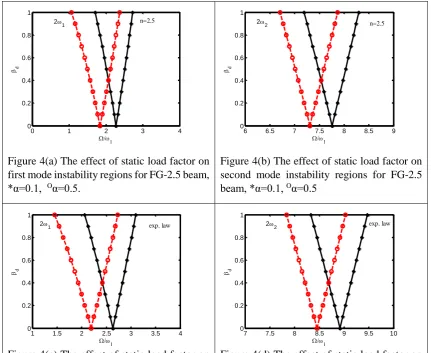
Figures 4(a) and 4(b) depict the effect of static load factor
on the first and second principal regions of instability of the FG-2.5 beam respectively. The values of static load factor are taken as 0.1 and 0.5. Figures 4(c) and 4(d) show the corresponding plots for e-FG beam. It is observed that more the static load factor, more prone to dynamic instability is the beam and it happens for both the laws of property distribution. This is expected as the increase of static load factor means the increase of the time independent component of the axial load.1 1.5 2 2.5 3 3.5 4
0 0.2 0.4 0.6 0.8 1
/1
d
=0.1
21
7 7.5 8 8.5 9 9.5 10
0 0.2 0.4 0.6 0.8 1
/1
d
Figure 4(a) The effect of static load factor on first mode instability regions for FG-2.5 beam, *α=0.1, Oα=0.5.
Figure 4(b) The effect of static load factor on second mode instability regions for FG-2.5 beam, *α=0.1, Oα=0.5
Figure 4(c) The effect of static load factor on first mode instability regions of e-FG beam, Oα=0.1, Oα=0.5.
Figure 4(d) The effect of static load factor on second mode instability regions of e-FG beam, *α=0.1, Oα=0.5.
CONCLUSION
The effect of various system parameters on dynamic stability behaviour of both FG beams have been studied using finite element method. The important conclusions are outlined below.
(i) Critical buckling load decreases with increase of power law index for FG beam with steel-rich bottom.
(ii) The natural frequencies of first two modes decrease with increase in the value of power law index. (iii) The FG beam with properties along thickness according to exponential law is found to be the most stable beam.
(iv) The stability of FG beam decreases as the value of power law index increases from 1.5 to 2.5. It may be concluded that the material properties and their distribution laws in the constituent phases of FG beam play a dominant role on their dynamic stability behaviour.
REFERENCE
1. Abbas, B. A. H. and Thomas, J., Dynamic stability of Timoshenko beams resting on an elastic foundation. Journal of sound and vibration, 60, 33 – 44, 1978.
0 1 2 3 4
0 0.2 0.4 0.6 0.8 1
/1
d
n=2.5
21
6 6.5 7 7.5 8 8.5 9
0 0.2 0.4 0.6 0.8 1
/1
d
n=2.5
22
1 1.5 2 2.5 3 3.5 4
0 0.2 0.4 0.6 0.8 1
/1
d
exp. law
21
7 7.5 8 8.5 9 9.5 10
0 0.2 0.4 0.6 0.8 1
/1
d
exp. law
2. Aristizabal-Ochoa, J. D., Statics stability and vibration of non-prismatic beams and columns. Journal of Sound and Vibration, 162(3), 441-455, 1993.
3. Babai, M. H., Abhasi, M. and Eslami, M. R., Coupled thermoelasticity of functionally graded beam. Journal of Thermal Stresses, 31 (8), 680-697, 2008.
4. Benatta, M. A., Mechab, I., Tounsi, A. and Adda Bedia, E. A., Static analysis of functionally graded short beams including warping and shear deformation effect. Computational Materials Science, 44, 765-773, 2008.
5. Briseghella, L., Majorana, C. E. and Pellegrino, C., Dynamic stability of elastic structures: a finite element approach. Computers and Structures, 69, 11-25, 1998.
6. Gharib, A., Salehi, M. and Fazeli, S., Deflection control of functionally graded material beams with bounded piezoelectric sensors and actuators. Material Science and Engineering A, 498, 110-114, 2008.
7. Iwatsubo, T., Sugiyama, Y. and Ogino, S., Simple and combination resonances of columns under periodic axial loads. Journal of sound and vibration, 33, 211 – 221, 1974.
8. Lim, T. S., Lee, C. S. and Lee, D. G., Failure modes of foam core sandwich beams under static and impact loads. Journal of Composite Materials, 38, 1639-1662, 2004.
9. Ozturk, H. and Sabuncu, M., Stability analysis of a cantilever composite beam on elastic support. Composite Science and Technology, 65, 1982-1995, 2005.
10. Sallai, B. O., Tounsi, A., Mechab, I., Bachir B. M., Meradjah, M. and Adda, B. E. A., A theoretical analysis of flexional bending of Al/Al2O3 S-FGM thick beams. Computational Materials Science, 44(4), 1344-1350, 2009.
11. Shastry, B. P. and Rao, G. V., Dynamic stability of columns with two symmetrically placed intermediate supports. Journal of Sound and Vibration, 104(3), 524-527, 1986.
12. Young, T. H. and Gau, C. Y., Dynamic stability of spinning pretwisted beams subjected to axial random forces. Journal of sound and Vibration, 268, 149-165, 2003.