JFLEG: A Fluency Corpus and Benchmark for Grammatical Error
Correction
Courtney Napoles,1Keisuke Sakaguchi,1 and Joel Tetreault2 1Center for Language and Speech Processing, Johns Hopkins University
2Grammarly
{napoles,keisuke}@cs.jhu.edu, [email protected]
Abstract
We present a new parallel corpus, JHU
FLuency-Extended GUG corpus (JFLEG)
for developing and evaluating grammati-cal error correction (GEC). Unlike other
corpora, it represents a broad range of lan-guage proficiency levels and uses holistic
fluency editsto not only correct grammati-cal errors but also make the original text more native sounding. We describe the types of corrections made and benchmark four leadingGEC systems on this corpus,
identifying specific areas in which they do well and how they can improve. JFLEG
fulfills the need for a new gold standard to properly assess the current state ofGEC. 1 Introduction
Automatic grammatical error correction (GEC)
progress is limited by the corpora available for developing and evaluating systems. Following the release of the test set of the CoNLL–2014 Shared Task on GEC (Ng et al., 2014), systems
have been compared and new evaluation tech-niques proposed on this single dataset. This cor-pus has enabled substantial advancement in GEC
beyond the shared tasks, but we are concerned that the field is over-developing on this dataset. This is problematic for two reasons: 1) it represents one specific population of language learners; and 2) the corpus only containsminimal edits, which cor-rect the grammaticality of a sentence but do not necessarily make itfluentor native-sounding.
To illustrate the need for fluency edits, consider the example in Table 1. The correction with only minimal edits is grammatical but soundsawkward
(unnatural to native speakers). The fluency cor-rection has more extensive changes beyond ad-dressing grammaticality, and the resulting
sen-Original: they just creat impression such well that people are drag to buy it .
Minimal edit: They just create an impression so well that people are dragged to buy it .
Fluency edit:They just create such a good impres-sion that people are compelled to buy it.
Table 1: A sentence corrected with just minimal edits com-pared to fluency edits.
tence sounds more natural and its intended mean-ing is more clear. It is not unrealistic to expect these changes from automatic GEC: the current
best systems use machine translation (MT) and
are therefore capable of making broader sentential rewrites but, until now, there has not been a gold standard against which they could be evaluated.
Following the recommendations of Sakaguchi et al. (2016), we release a new corpus forGEC, the JHU FLuency-Extended GUG corpus (JFLEG),
which adds a layer of annotation to theGUG
cor-pus (Heilman et al., 2014). GUG represents a
cross-section of ungrammatical data, containing sentences written by English language learners with different L1s and proficiency levels. For each of 1,511 GUG sentences, we have collected four
human-written corrections which contain holistic fluency rewrites instead of just minimal edits. This corpus represents the diversity of edits that GEC
needs to handle and sets a gold standard to which the field should aim. We overview the current state ofGECby evaluating the performance of four
lead-ing systems on this new dataset. We analyze the edits made inJFLEG and summarize which types
of changes the systems successfully make, and which they need to address.JFLEGwill enable the
field to move beyond minimal error corrections.
2 GECcorpora
There are four publicly available corpora of non-native English annotated with corrections, to our
Mean chars Sents. Mean Corpus # sents. per sent. changed LD
AESW 1.2M 133 39% 3
FCE 34k 74 62% 6
Lang-8 1M 56 35% 4
NUCLE 57k 115 38% 6
[image:2.595.75.290.62.136.2]JFLEG 1,511 94 86% 13
Table 2: Parallel corpora available forGEC.
knowledge. The NUSCorpus of Learner English
(NUCLE) contains essays written by students at
the National University of Singapore, corrected by two annotators using 27 error codes (Dahlmeier et al., 2013). The CoNLL Shared Tasks used this data (Ng et al., 2014; Ng et al., 2013), and the 1,312 sentence test set from the 2014 task has be-comede rigueurfor benchmarkingGEC. This test
set has been augmented with ten additional anno-tations from Bryant et al. (2015) and eight from Sakaguchi et al. (2016). The Cambridge Learner Corpus First Certificate in English (FCE) has
es-says coded by one rater using about 80 error types, alongside the score and demographic information (Yannakoudakis et al., 2011). The Lang-8 corpus of learner English is the largest, with text from the social platform lang-8.com automatically aligned to user-provided corrections (Tajiri et al., 2012). Unlimited annotations are allowed per sentence, but 87% were corrected once and 12% twice. The
AESW2016 Shared Task corpus contains text from
scientific journals corrected by a single editor. To our knowledge, AESWis the only corpus that has
not been used to develop aGECsystem.
We considerNUCLE1andFCEto contain
mini-mal edits, since the edits were constrained by er-ror codes, and the others to contain fluency ed-its since there were no such restrictions. English proficiency levels vary across corpora: FCE and NUCLE texts were written by English language
learners with relatively high proficiency, but Lang-8 is open to any internet user.AESWhas technical
writing by the most highly proficient English writ-ers. Roughly the same percent of sentences from each corpus is corrected, except forFCEwhich has
significantly more. This may be due to the rigor of the annotators and not the writing quality.
The following section introduces theJFLEG
pus, which represents a diversity of potential cor-rections with four corcor-rections of each sentence. Unlike NUCLE and FCE, JFLEG does not restrict
corrections to minimal error spans, nor are the
er-1Not including the additional fluency edits collected for the CoNLL-2014 test set by Sakaguchi et al. (2016).
rors coded. Instead, it contains holistic sentence rewrites, similar to Lang-8 and AESW, but
con-tains more reliable corrections than Lang-8 due to perfect alignments and screened editors, and more extensive corrections than AESW, which contains
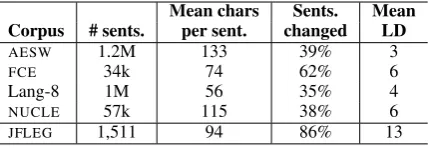
fewer edits than the other corpora with a mean Levenshtein distance (LD) of 3 characters. Table 2 provides descriptive statistics for the available cor-pora. JFLEG is also the only corpus that provides
corrections alongside sentence-level grammatical-ity scores of the uncorrected text.
3 TheJFLEGcorpus
Our goal in this work is to create a corpus of fluency edits, following the recommendations of (Sakaguchi et al., 2016), who identify the short-falls of minimal edits: they artificially restrict the types of changes that can be made to a sentence and do not reflect the types of changes required for native speakers to find sentencesfluent, or nat-ural sounding. We collected annotations on a pub-lic corpus of ungrammatical text, theGUG
(Gram-matical/Ungrammatical) corpus (Heilman et al., 2014). GUG contains 3.1k sentences written by
English language learners for the TOEFLR exam,
covering a range of topics. The originalGUG
cor-pus is annotated with grammaticality judgments for each sentence, ranging from 1–4, where 4 is perfect or native sounding, and 1 incomprehen-sible. The sentences were coded by five crowd-sourced workers and one expert. We refer to the mean grammaticality judgment of each sentence from the original corpus as theGUGscore.
In our extension, JFLEG, the 1,511 sentences
which comprise the GUG development and test
sets were corrected four times each on Amazon Mechanical Turk. Annotation instructions are in-cluded in Table 3. 50 participants from the United States passed a qualifying task of correcting five sentences, which was reviewed by the authors (two native and one proficient non-native speak-ers of American English). Annotators also rated how difficult it was for them to correct each sen-tence on a 5-level Likert scale (5 being very easy and 1 very difficult). On average, the sentences were relatively facile to correct (mean difficulty of
3.5±1.3), which moderately correlates with the
GUG score (Pearson’s r = 0.47), indicating that
Please correct the following sentence to make it sound natural and fluent to a native speaker of (American) En-glish. The sentence is written by a second language learner of English. You should fix grammatical mistakes, awkward phrases, spelling errors, etc. following stan-dard written usage conventions, but your edits must be conservative. Please keep the original sentence (words, phrases, and structure) as much as possible. The ultimate goal of this task is to make the given sentence sound nat-ural to native speakers of English without making unnec-essary changes. Please do not split the original sentence into two or more. Edits are not required when the sen-tence is already grammatical and sounds natural.
Table 3: JFLEGannotation instructions.
Error type in original Awkward Ortho. Grammatical
Edit type FluencyMinimal 38%82% 35%89% 32%85% Table 4: Percent of sentences by error type that were changed with fluency or minimal edits.
The mean LD between the original and cor-rected sentences is more than twice that of existing corpora (Table 2). LD negatively correlates with theGUGscore (r=−0.41) and the annotation
dif-ficulty score (−0.37), supporting the intuition that less grammatical sentences require more extensive changes, and it is harder to make corrections in-volving more substantive edits. Because there is no clear way to quantify agreement between an-notators, we compare the annotations of each sen-tence to each other. The mean LD between all pairs of annotations is greater than the mean LD between the original and corrected sentences (15 characters), however 36% of the sentences were corrected identically by at least two participants.
Next, the English L1 authors examined 100 ran-domly selected original and human-corrected sen-tence pairs and labeled them with the type of er-ror present in the sentence and the type of edit(s) applied in the correction. The three error types are sounds awkward or has an orthographic or
grammatical error.2 The majority of the original
sentences have at least one error (81%), and, for 68% of these sentences, the annotations are error free. Few annotated sentences have orthographic (4%) or grammatical (10%) errors, but awkward errors are more frequent (23% of annotations were labeled awkward)—which is not very surprising given how garbled some original sentences are and the dialectal variation of what sounds awkward.
The corrected sentences were also labeled with
2Due to their frequency, we separate orthographic errors (spelling and capitalization) from other grammatical errors.
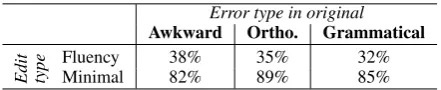
the type of changes made (minimal and/or fluency edits). Minimal edits reflect a minor change to a small span (1–2 tokens) addressing an immedi-ate grammatical error, such as number agreement, tense, or spelling. Fluency edits are more holistic and include reordering or rewriting a clause, and other changes that involve more than two contigu-ous tokens. 69% of annotations contain at least one minimal edit, 25% a fluency edit, and 17% both fluency and minimal edits. The distribution of edit types is fairly uniform across the error type present in the original sentence (Table 4). Notably, fewer than half of awkward sentences were cor-rected with fluency edits, which may explain why so many of the corrections were stillawkward.
4 Evaluation
To assess the current state of GEC, we collected
automated corrections ofJFLEGfrom four leading GECsystems with no modifications. They take
dif-ferent approaches but all use some form of MT.
The best system from the CoNLL-2014 Shared Task is a hybrid approach, combining a rule-based system with MT and language-model reranking
(CAMB14; Felice et al., 2014). Other systems
have been released since then and report improve-ments on the 2014 Shared Task. They include a neuralMT model (CAMB16; Yuan and Briscoe,
2016), a phrase-based MT (PBMT) with sparse
features (AMU; Junczys-Dowmunt and
Grund-kiewicz, 2016), and a hybrid system that incor-porates a neural-net adaptation model into PBMT
(NUS; Chollampatt et al., 2016).
We evaluate system output against the four sets of JFLEG corrections with GLEU, an automatic
fluency metric specifically designed for this task (Napoles et al., 2015) and the Max-Match met-ric (M2) (Dahlmeier and Ng, 2012). GLEU is
based on the MTmetricBLEU, and represents the
n-gram overlap of the output with the human-corrected sentences, penalizing n-grams that were been changed in the human corrections but left un-changed by a system. It was developed to score fluency in addition to minimal edits since it does not require an alignment between the original and corrected sentences. M2 was designed to score
minimal edits and was used in the CoNLL 2013 and 2014 shared tasks on GEC (Ng et al., 2013;
Ng et al., 2014). Its score is the F0.5 measure of
origi-Sentences System TrueSkill GLEU M2 changed
Original -1.64 38.2 0.0 –
CAMB16 0.21 47.2 50.8 74%
NUS -0.20∗ 46.3 52.7 69%
AMU -0.46∗ 41.7 43.2 56%
CAMB14 -0.51∗ 42.8 46.6 58%
[image:4.595.310.525.56.213.2]Human 2.60 55.3 63.2 86%
Table 5: Scores of system outputs.∗indicates no significant
difference from each other.
nal and corrected sentences. Since bothGLEUand
M2have only been evaluated on the CoNLL-2014
test set, we additionally collected human rankings of the outputs to determine whether human judg-ments of relative grammaticality agree with the metric scores when the reference sentences have fluency edits.
The two native English-speaking authors ranked six versions of each of 150 JFLEG sentences: the
four system outputs, one randomly selected hu-man correction, and the original sentence. The absolute human ranking of systems was inferred using TrueSkill, which computes a relative score from pairwise comparisons, and we cluster sys-tems with overlapping ranges into equivalence classes by bootstrap resampling (Sakaguchi et al., 2014; Herbrich et al., 2006). The two best ranked systems judged by humans correspond to the two best GLEU systems, but GLEU switches the order
of the bottom two. The M2ranking does not
per-form as well, reversing the order of the top two systems and the bottom two (Table 5).3 The upper
bound is GLEU = 55.3 and M2 = 63.2, the mean
metric scores of each human correction compared to the other three.CAMB16andNUSare halfway to
the gold-standard performance measured byGLEU
and, according to M2, they achieve approximately
80% of the human performance. The neural meth-ods (CAMB16 and NUS) are substantially better
than the other two according to both metrics. This ranking is in contrast to the ranking of systems on the CoNLL-14 shared task test against mini-mally edited references. On these sentences,AMU,
which was tuned to M2, achieves the highest M2
score with 49.5 andCAMB16, which was the best
on the fluency corpus, ranks third with 39.9. We find that the extent of changes made in the system output is negatively correlated to the
qual-3No conclusive recommendation about the best-suited metric for evaluating fluency corrections can be drawn from these results. With only four systems, there is no significant difference between the metric rankings, and even the human rank has no significant difference between three systems.
0 15
% sents.
1 2 3 4 5 6 7 8 9 10
Character edit distance 0
10 20 30 40 50 60
[image:4.595.76.286.61.147.2]GLEU score AMUCAMB14 CAMB16 NUS
Figure 1: GLEUscore of system output by LD from input.
Original Human AMU CAMB14 CAMB16 NUS 0
20 40 60 80 100
% of sentences with error type
Awkward Orthographic Grammatical
Figure 2: Types of errors present in the original, annotated, and system output sentences.
Error type in original Awkward Ortho. Grammatical
AMU MF 60%2% 60%2% 64%2% CAMB14 MF 64%2% 69%0% 65%2%
CAMB16 MF 82%8% 85%7% 79%6%
NUS MF 68%4% 81%4% 79%3%
Table 6: Percent of sentences by error type changed in sys-tem output with fluency (F) and minimal (M) edits.
ity as measured by GLEU (Figure 1). The
neu-ral systems have the highest scores for nearly all edit distances, and generate the most sentences with higher LDs. CAMB14 has the most consis-tent GLEU scores. The AMU scores of sentences
with LD> 6are erratic due to the small number of sentences it outputs with that extent of change.
5 Qualitative analysis
[image:4.595.310.521.240.344.2] [image:4.595.307.525.382.485.2]Original First , advertissment make me to buy some thing unplanly . Human First , an advertisement made me buy something unplanned . AMU First , advertissment makes me to buy some thing unplanly . CAMB14 First , advertisement makes me to buy some things unplanly . CAMB16 First , please let me buy something bad .
NUS First , advertissment make me to buy some thing unplanly .
Original For example , in 2 0 0 6 world cup form Germany , as many conch wanna term work . Human For example , in the 2006 World Cup in Germany, many coaches wanted teamwork . AMU For example , in the 2 0 0 6 world cup from Germany , as many conch wanna term work . CAMB14 For example , in 2006 the world cup from Germany , as many conch wanna term work .
CAMB16 For example , in 2006 the world cup from Germany , as many conch , ’ work .
[image:5.595.115.490.61.203.2]NUS For example , in 2 0 0 6 World Cup from Germany , as many conch wanna term work . Table 7: Examples of how human and systems corrected GUG sentences.
than any of the systems. The models with neural components,CAMB16followed byNUS, make the
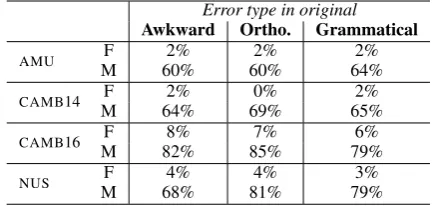
most changes and produce fewer sentences with errors. Systems often change only one or two er-rors in a sentence but fail to address others. Min-imal edits are the primary type of edits made by all systems (AMUandCAMB14made one fluency
correction each,NUStwo, andCAMB16five) while
humans use fluency edits to correct nearly 30% of the sentences.
Spelling mistakes are often ignored: AMU
cor-rects very few spelling errors, and evenCAMB16,
which makes the most corrections, still ignores misspellings in 30% of sentences. Robust spelling correction would make a noticeable difference to output quality. Most systems produce corrections that are meaning preserving, however, CAMB16
changed the meaning of 15 sentences. This is a downside of neural models that should be consid-ered, even though neural MT generates the best
output by all other measures.
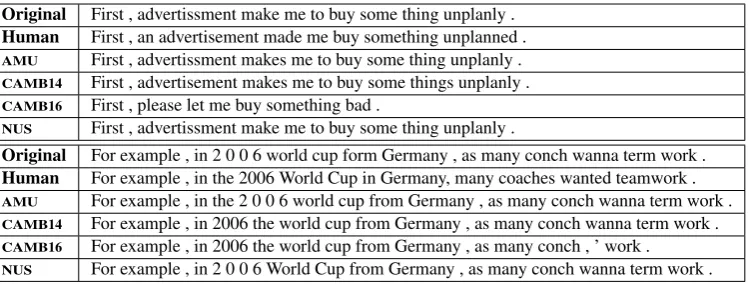
The examples in Table 7 illustrate some of these successes and shortcomings. The first sentence can be corrected with minimal edits, and both
AMU andCAMB14 correct the number agreement but leave the incorrect unplanly and the infiniti-val to. In addition, AMU does not correct the
spelling ofadvertissementorsome thing.CAMB16
changes the meaning of the sentence altogether, even though the output is fluent, and NUS makes
no changes. The next set of sentences contains many errors and requires inference and fluency rewrites to correct. The human annotator deduces that the last clause is about coaches, not mollusks, and rewrites it grammatically given the context of the rest of the sentence. Systems handle the sec-ond clause moderately well but are unable to cor-rect the final clause: onlyCAMB16attempts to
cor-rect it, but the result is nonsensical.
6 Conclusions
This paper presents JFLEG, a new corpus for
de-veloping and evaluatingGECsystems with respect
to fluency as well as grammaticality.4 Our hope
is that this corpus will serve as a starting point for advancingGECbeyond minimal error corrections.
We described qualitative and quantitative analysis ofJFLEG, and benchmarked four leading systems
on this data. The relative performance of these systems varies considerably when evaluated on a fluency corpus compared to a minimal-edit corpus, underlining the need for a new dataset for evalu-atingGEC. Overall, current systems can
success-fully correct closed-class targets such as number agreement and prepositions errors (with incom-plete coverage), but ignore many spelling mistakes and long-range context-dependent errors. Neural methods are better than other systems at making fluency edits, but this may be at the expense of maintaining the meaning of the input. As there is still a long way to go in approaching the perfor-mance of a human proofreader, these results and benchmark analyses help identify specific issues thatGECsystems can improve in future research. Acknowledgments
We are grateful to Benjamin Van Durme for his support in this project. We especially thank the following people for providing their respective system outputs on this new corpus: Roman Grund-kiewicz and Marcin Jnuczys-Dowmunt for the
AMUsystem outputs, Mariano Felice forCAMB14, Zheng Yuan forCAMB16, and Shamil Chollampatt
and Hwee Tou Ng forNUS. Finally we thank the
anonymous reviewers for their feedback.
References
Christopher Bryant and Hwee Tou Ng. 2015. How far are we from fully automatic high quality grammati-cal error correction? InProceedings of the 53rd An-nual Meeting of the Association for Computational Linguistics and the 7th International Joint Confer-ence on Natural Language Processing, pages 697– 707, Beijing, China, July. Association for Computa-tional Linguistics.
Shamil Chollampatt, Duc Tam Hoang, and Hwee Tou Ng. 2016. Adapting grammatical error correction based on the native language of writers with neural network joint models. In Proceedings of the 2016 Conference on Empirical Methods in Natural Lan-guage Processing, pages 1901–1911, Austin, Texas, November. Association for Computational Linguis-tics.
Daniel Dahlmeier and Hwee Tou Ng. 2012. Better evaluation for grammatical error correction. In Pro-ceedings of the 2012 Conference of the North Amer-ican Chapter of the Association for Computational Linguistics: Human Language Technologies, pages 568–572, Montr´eal, Canada, June. Association for Computational Linguistics.
Daniel Dahlmeier, Hwee Tou Ng, and Siew Mei Wu. 2013. Building a large annotated corpus of learner english: The NUS Corpus of Learner English. In Proceedings of the Eighth Workshop on Innovative Use of NLP for Building Educational Applications, pages 22–31, Atlanta, Georgia, June. Association for Computational Linguistics.
Mariano Felice, Zheng Yuan, Øistein E. Andersen, He-len Yannakoudakis, and Ekaterina Kochmar. 2014. Grammatical error correction using hybrid systems and type filtering. In Proceedings of the Eigh-teenth Conference on Computational Natural Lan-guage Learning: Shared Task, pages 15–24, Bal-timore, Maryland, June. Association for Computa-tional Linguistics.
Michael Heilman, Aoife Cahill, Nitin Madnani, Melissa Lopez, Matthew Mulholland, and Joel Tetreault. 2014. Predicting grammaticality on an ordinal scale. In Proceedings of the 52nd Annual Meeting of the Association for Computational Lin-guistics, pages 174–180, Baltimore, Maryland, June. Association for Computational Linguistics.
Ralf Herbrich, Tom Minka, and Thore Graepel. 2006. TrueSkillTM: A Bayesian skill rating system. In
Proceedings of the Twentieth Annual Conference on Neural Information Processing Systems, pages 569– 576, Vancouver, British Columbia, Canada, Decem-ber. MIT Press.
Marcin Junczys-Dowmunt and Roman Grundkiewicz. 2016. Phrase-based machine translation is state-of-the-art for automatic grammatical error correction. In Proceedings of the 2016 Conference on Empiri-cal Methods in Natural Language Processing, pages
1546–1556, Austin, Texas, November. Association for Computational Linguistics.
Courtney Napoles, Keisuke Sakaguchi, Matt Post, and Joel Tetreault. 2015. Ground truth for grammati-cal error correction metrics. InProceedings of the 53rd Annual Meeting of the Association for Compu-tational Linguistics and the 7th International Joint Conference on Natural Language Processing, pages 588–593, Beijing, China, July. Association for Com-putational Linguistics.
Hwee Tou Ng, Siew Mei Wu, Yuanbin Wu, Christian Hadiwinoto, and Joel Tetreault. 2013. The CoNLL-2013 Shared Task on grammatical error correction. In Proceedings of the Seventeenth Conference on Computational Natural Language Learning: Shared Task, pages 1–12, Sofia, Bulgaria, August. Associa-tion for ComputaAssocia-tional Linguistics.
Hwee Tou Ng, Siew Mei Wu, Ted Briscoe, Christian Hadiwinoto, Raymond Hendy Susanto, and Christo-pher Bryant. 2014. The CoNLL-2014 Shared Task on grammatical error correction. InProceedings of the Eighteenth Conference on Computational Natu-ral Language Learning: Shared Task, pages 1–14, Baltimore, Maryland, June. Association for Compu-tational Linguistics.
Keisuke Sakaguchi, Matt Post, and Benjamin Van Durme. 2014. Efficient elicitation of annota-tions for human evaluation of machine translation. InProceedings of the Ninth Workshop on Statistical Machine Translation, pages 1–11, Baltimore, Mary-land, USA, June. Association for Computational Linguistics.
Keisuke Sakaguchi, Courtney Napoles, Matt Post, and Joel Tetreault. 2016. Reassessing the goals of matical error correction: Fluency instead of gram-maticality.Transactions of the Association for Com-putational Linguistics, 4:169–182.
Toshikazu Tajiri, Mamoru Komachi, and Yuji Mat-sumoto. 2012. Tense and aspect error correction for ESL learners using global context. In Proceed-ings of the 50th Annual Meeting of the Association for Computational Linguistics, pages 198–202, Jeju Island, Korea, July. Association for Computational Linguistics.
Helen Yannakoudakis, Ted Briscoe, and Ben Medlock. 2011. A new dataset and method for automatically grading ESOL texts. InProceedings of the 49th An-nual Meeting of the Association for Computational Linguistics: Human Language Technologies, pages 180–189, Portland, Oregon, USA, June. Association for Computational Linguistics.