UV-VISIBLE SPECTROPHOTOMETER METHOD DEVELOPMENT
AND VALIDATION OF CITICOLINE IN SYRUP FORMULATION
Atif Ali*1, Anza Sulemani2, Awais Shabir3, Muhammad Naseem4, Sayed Muzahir Hussain5, Muhammad Kamal Khan6 and Abdul Basit Muhammad7
1,2,3
Department of Biochemistry, Hazara University Mansehra.
4
University College of Pharmacy, Punjab University Lahore.
5
Department of Pharmaceutical Sciences, Riphah International University Islamabad.
6
Departement of Pharmacy, Gandhara University Peshawar.
7
Institute of Chemical Sciences, University of Peshawar.
ABSTRACT
An accurate, simple and specific UV-Vis spectrophotometer method
has been developed for the quantitative estimation of citicoline in bulk
syrup. The wavelength was set to 280 nm. The correlation coefficient
of citicoline (0.9990) and the regression equation (y = 1.0302×-2.2688)
were shown by a linear calibration curve ranging from 16 μg/ml to 24 μg/ml. The %RSD result is less than 2%. The method has been
validated against USP and ICH guidelines to verify method validation
parameters such as linearity, accuracy, recovery and robustness.
Therefore, a validated method can be used to quantify citicoline in the form of bulk syrup.
KEYWORDS: Calibration curve, Analytical Method, Citicoline, UV spectroscopy.
INTRODUCTION
Citicoline sodium is a complex organic particle, also known as cytidine 5'
(dihydrotriphosphate) P'[2-trimethylamino]ethyl]ester internal salt. Citicoline is an
intermediate that produces brain phosphatidylcholine from choline. It acts on the level of
neurotransmitters and behaves like a presynaptic cholinergic agent.[1],[2] The action of citicoline can also be explained by decreasing phospholipase A2 activity.[3] Citicoline increases the synthesis of phosphatidylcholine.[4],[5],[6]
Citicoline is used as a psychostimulant, a stimulant and a dietary supplement.[7],[8]
Volume 8, Issue 5, 599-605. Research Article ISSN 2277– 7105
Article Received on 12 Feb. 2019,
Revised on 04 March 2019, Accepted on 24 March 2019
DOI: 10.20959/wjpr20195-14585
*Corresponding Author
Atif Ali
Department of Biochemistry,
It is mainly manifested in cognitive disorders, nerve regeneration, heart stroke, cerebral
ischemia, brain and spinal cord injury, and diseases of the nervous system. Citicoline has low
toxicity drug characteristics, so it can also be used as an alternative drug. Alzheimer's disease,
Parkinson's disease, Huntington's disease in 6 cases, dementia in 7 cases, dyslexia in 8 cases,
epilepsy and cerebral hemorrhage.[9,10]
Chemical and reagents: The working standard for citicoline was from Global Pharmaceutical. All chemical reagents and instruments was of analytical grade. Hydrochloric
acid and diethylether were purchased from E. Merck Ltd of Pakistan.
Instrumentation and UV spectral conditions: Digital electronic balance, Hitachy 5300 UV spectrometer and 1 cm quartz cell, measurement characteristic wavelength range (200-800)
nm.
Standard stock solution preparation: Accurately weighed citicoline sodium working standard equivalent of 100 mg citicoline and is transferred to a 100 ml volumetric flask. It
was dissolved in 0.1 N HCl and made up volume up to mark with the same solvent.
Sample Preparation: A sample containing 100 mg of citicoline was transferred in a separator funnel, and 20 ml of 0.1 N HCl was added to the sample and shaked vigorously. It
was extracted with 30-40 ml of diethyl ether.
This process was repeated three times.
The upper ether layer was discarded and the lower aqueous layer was collected in a 100 ml
volumetric flask and the volume was adjusted to the mark with 0.1 N HCl.
Absorbance spectrum of Citicoline: 2 ml of the standard stock solutions and sample were dispensed into 0.1 N HCl in a 100 ml volumetric flask separately, and diluted to the mark
with 0.1 N HCl. The 20 μg/ml solution measured in the range (200-400 nm) using 0.1 N HCl
as a blank showed an absorbance spectrum and λmax at 280 nm.
Method development: From standard stock solution of citicoline (1000 μg/ml), series of solutions were prepared by diluting different volumes having different concentrations of
METHOD VALIDATION PARAMETERS
ICH guideline was followed for validation of developed method.
Specificity: The specificity of the method for determining citicoline is determined by comparing the spectrum of the sample solution with the spectrum of the standard solution. An
aliquot of the stock solution was further diluted to obtain a solution of 20 μg/ml concentration
with and without excipients, respectively. The resulting solution was measured at 280 nm.
(Figure 1 a&b).
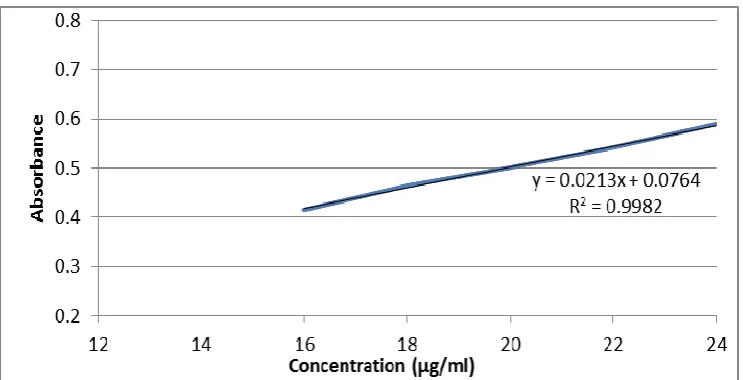
Linearity: The linearity of the analytical program is its ability to obtain test results that are directly proportional to the concentration of the analyte in the sample. Six different
concentrations corresponding to 16-24 μg/ml citicoline were prepared from working standard
solutions (1000 μg/ml). A calibration curve was drawn on the citicoline concentration range
(1624 μg/ml) at 280 nm. Regression analysis of the line equation found is y = 1.0302 ×
-2.2688 and reported the correlation coefficient (R2 = 0.9990). (Table 1) (Figure 2).
Precision
Repeatability: The aliquots of the stock solution were further diluted with 0.1N HCl to obtain six solutions (20 μg/ml) of the same concentration. The resulting solution was
measured at 280 nm using 0.1N HCl as a blank. (Table 2).
Intermediate Precision: Determined by evaluating it once in two consecutive days. From standard stock solution 2ml of sample were added to 100ml volumetric flask and volumed up
by 0.1N HCl having concentration of 20μg/ml citicoline solution, and was measured at 280
nm every day for two consecutive days. (Table 3).
Robustness: In Robustness, the process variables are slightly changed (normality of HCl) during the validation study to observe the variation in results. (Table 4).
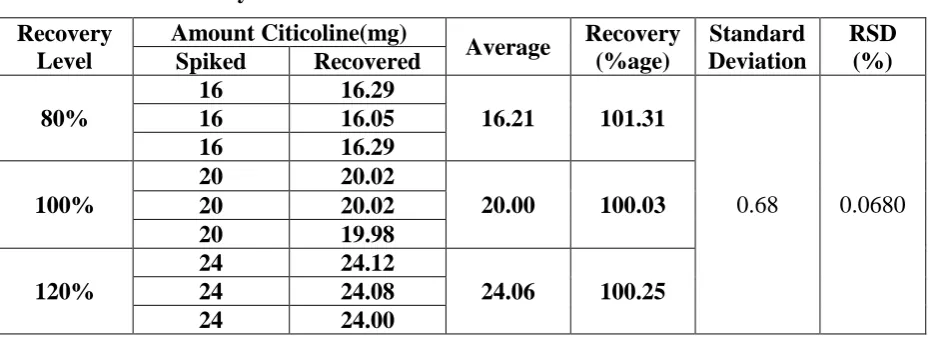
Accuracy: The accuracy of the method was determined by the recovery of the standard. A known amount of the pure drug having concentration of 16 μg/ml, 20 μg/ml, and 24 μg/ml
citicoline was added to the solution and the sample was analyzed. Recovery studies were
performed at three different concentration levels that were 80%, 100%, and 120%,
RESULTS AND DISCUSSION
Citicoline syrup is a mixture of different excipients and citicoline, and the mixture of
citicoline and excipient must be separated. To do this, we used the extraction method.
Extraction was carried out using diethyl ether and the procedure was modified three times.
Based on the solubility, 0.1 N HCl was used. The drug followed the Beer-Lambert law at a
concentration range of 16-24 μg/ml and showed a maximum absorbance at 280 nm with a
correlation coefficient of 0.999.
The recovery rate of the proposed method is between 98 and 102. The accuracy of
repeatability and intermediate precision %RSD is less than 2.
[image:4.595.87.270.287.426.2]
Figure 1: (a) Spectrum of Placebo. (b) Chromatogram of Citicoline.
Table 01: Linearity.
Concentration (μg/ml)
Absorbance at 280nm
16 0.415
18 0.464
20 0.502
22 0.542
[image:4.595.329.501.288.426.2]Figure 02: LINEARITY.
Table 02: Repeatability.
Level Absorbance of Replicate
absorbance of Standard
Assay
% Mean
Standard
Deviation %RSD
100%
0.504
0.503
100.15
100.38 0.52 0.5267
0.507 100.74
0.509 101.14
0.502 99.75
0.503 99.94
0.506 100.54
Table 03: Intermediate precision.
Day 1 Day 2
Analyst I & Equipment I
Analyst III & Equipment II
(%age Assay)
100.94 100.54
100.34 100.34
100.34 100.34
Mean 100.54 100.41
RSD
(Analyst to Analyst) 0.3445%
RSD (Day to Day) 0.1154%
Table No. 04: Robustness.
Factor Variation Level Assay (%)
Normality of HCl
0.09N 100.75
0.1N 100.34
0.11N 99.75
Table No. 05: Recovery. Recovery
Level
Amount Citicoline(mg)
Average Recovery (%age)
Standard Deviation
RSD (%) Spiked Recovered
80%
16 16.29
16.21 101.31
0.68 0.0680
16 16.05
16 16.29
100%
20 20.02
20.00 100.03
20 20.02
20 19.98
120%
24 24.12
24.06 100.25
24 24.08
24 24.00
CONCLUSION
On behalf of the above experimental results, the method was verified according to the ICH
guidelines. The method developed is simple, inexpensive, accurate, fast, and validated in
terms of linearity, accuracy, precision and recovery. Therefore, the developed spectroscopy
method was used to routinely estimate citicoline in syrup formulation.
REFERENCES
1. Adibhatla RM, Hatcher JF, Dempsey RJ. Citicoline: neuroprotective mechanisms in
cerebral ischemia. Journal of neurochemistry, 2002 Jan 1; 80(1): 12-23.
2. SY. Reddy, A. Dinakar, L. Srinivas, Design development and evaluation of Citicoline
controlled-release tablets, Journal of Der Scholar Research Library, 2013; 5: 296-311.
3. Lipton SA, Rosenberg PA. Excitatory amino acids as a final common pathway for
neurologic disorders. New England Journal of Medicine, 1994 Mar 3; 330(9): 613-22.
4. Belayev L, Saul I, Curbelo K, Busto R, Belayev A, Zhang Y, Riyamongkol P, Zhao W,
Ginsberg MD. Experimental intracerebral hemorrhage in the mouse: histological,
behavioral, and hemodynamic characterization of a double-injection model. Stroke, 2003
Sep 1; 34(9): 2221-7.
5. Pathan AB, Pawar NB, Shaikh A, Pathan AJ. Development and validation of uv-visible
spectrophotometric method for simultaneous estimation of citicoline and piracetam from
tablet formulation. Indo American Journal of Pharmacy, 2017 Nov; 3(5): 254-259.
6. Patel BK, Raj HA, Jain VC. Simultaneous estimation of edaravone and citicoline sodium
by ratio derivative spectroscopic method in synthetic mixture. Pharma Science Monitor,
2014 Apr 2; 5(2): 118-128.
8. Fioravanti M, Yanagi M. Cytidinediphosphocholine (CDP choline) for cognitive and
behavioural disturbances associated with chronic cerebral disorders in the elderly.
Journal of Willey, 2005 Apr 18.
9. Belayev L, Saul I, Curbelo K, Busto R, Belayev A, Zhang Y, Riyamongkol P, Zhao W,
Ginsberg MD. Experimental intracerebral hemorrhage in the mouse: histological,
behavioral, and hemodynamic characterization of a double-injection model. Stroke, 2003
Sep 1; 34(9): 2221-7.
10.Pathan AB, Pawar NB, Shaikh A, Pathan AJ. Development and validation of uv-visible
spectrophotometric method for simultaneous estimation of citicoline and piracetam from