Safer@home
—
Simulation and training:
the study protocol of a qualitative action
research design
Siri Wiig,1Veslemøy Guise,1Janet Anderson,1,2Marianne Storm,1
Anne Marie Lunde Husebø,1Ingelin Testad,1,3Elsa Søyland,4Kirsti L Moltu5
To cite:Wiig S, Guise V, Anderson J,et al. Safer@home—Simulation and training: the study protocol of a qualitative action research design.BMJ Open2014;4:e004995. doi:10.1136/bmjopen-2014-004995
▸ Prepublication history for this paper is available online. To view these files please visit the journal online (http://dx.doi.org/10.1136/ bmjopen-2014-004995).
Received 4 February 2014 Revised 4 June 2014 Accepted 10 July 2014
1Department of Health Studies, University of Stavanger, Stavanger, Norway 2Florence Nightingale School of Nursing and Midwifery, King’s College, London, UK 3Regional Centre for Age-related Medicine, SESAM, Stavanger University Hospital, Stavanger, Norway
4Stavanger Acute Medicine Foundation for Education and Research, Stavanger, Norway 5Stavanger Municipality, Stavanger, Norway
Correspondence to
Dr Siri Wiig; [email protected]
ABSTRACT
Introduction:While it is predicted that telecare and other information and communication technology (ICT)-assisted services will have an increasingly important role in future healthcare services, their implementation in practice is complex. For
implementation of telecare to be successful and ensure quality of care, sufficient training for staff (healthcare professionals) and service users ( patients) is fundamental. Telecare training has been found to have positive effects on attitudes to, sustained use of, and outcomes associated with telecare. However, the potential contribution of training in the adoption, quality and safety of telecare services is an under-investigated research field. The overall aim of this study is to develop and evaluate simulation-based telecare training programmes to aid the use of videophone technology in elderly home care. Research-based training programmes will be designed for healthcare professionals, service users and next of kin, and the study will explore the impact of training on adoption, quality and safety of new telecare services.
Methods and analysis:The study has a qualitative action research design. The research will be undertaken in close collaboration with a multidisciplinary team consisting of researchers and managers and clinical representatives from healthcare services in two Norwegian municipalities, alongside experts in clinical education and simulation, as well as service user ( patient) representatives. The qualitative methods used involve focus group interviews, semistructured interviews, observation and document analysis. To ensure trustworthiness in the data analysis, we will apply member checks and analyst triangulation; in addition to providing contextual and sample description to allow for evaluation of transferability of our results to other contexts and groups.
Ethics and dissemination:The study is approved by the Norwegian Social Science Data Services. The study is based on voluntary participation and informed written consent. Informants can withdraw at any point in time. The results will be disseminated at research conferences, peer review journals, one PhD thesis and through public presentations to people outside the scientific community.
INTRODUCTION
The number of individuals in Norway over the age of 80 will have doubled within the next 20–25 years1 while the predicted number of healthcare professionals available to deliver healthcare services will be far fewer than those needed to cope with demand.2 3 The rapidly growing population of elderly people in Norway and across the world increases healthcare needs, with more services expected to be delivered at home.4 5 In order to handle the aging population, sig-nificant changes are needed in the way healthcare is delivered.4 5Telecare, meaning the use of technology that enables health-care professionals to remotely health-care and support home dwelling individuals, promises to be an important solution to the many challenges facing future healthcare services.6 While it is predicted that telecare and other information and communication technology (ICT)-assisted services will have an increas-ingly important role in future healthcare ser-vices, their implementation in practice is complex.7 8 There are ergonomics-related barriers and risks associated with the imple-mentation and adoption of telecare, such as healthcare professionals lacking the attitudes, knowledge and skills needed to use the tech-nology as part of healthcare delivery.9–11This may result in poor quality and safety of health-care services.12–14 For implementation to be successful and ensure quality of care, staff15 and organisations16 17 must be ready to change and adopt innovation. Accordingly, it is widely acknowledged that training of staff (healthcare professionals) and service users ( patients) is fundamental to successful tele-care implementation.9 11 18
Telecare training has been found to have positive effects on attitudes to, sustained use of and outcomes associated with tele-care.10 19–21 Training is recommended as a fundamental part of telecare implementation
on September 22, 2020 by guest. Protected by copyright.
processes, but there is a lack of targeted staff and service user training programmes for this purpose, and training is not always offered10 or it is inadequate.22 A review of telecare education initiatives by Basu et al23 identified only 10 training courses, none of which were for profes-sionals working in elderly home care services. This lack of pedagogical and professional development models related to telecare applications led Basuet al23 conclude that education for telecare is an emergent field. Their findings further highlight that telecare training is not simply about learning a new technology; it is about adapting practice to engage with new technology.23 In addition to technical skills training, it is important, therefore, to focus on the development of the knowl-edge, skills, attitudes and experiences required for the new ways of working associated with telecare use.11 22 Awareness raising and training can help motivate health professionals to adopt telecare in their clinical prac-tices.11 24Previous research has also demonstrated a lack of training activities focusing on how simulation can be developed and used to improve adoption of technology in the home context.25 Simulation is considered a powerful tool for the teaching of a range of knowledge and skills necessary for sound clinical practice. Simulation has long been in use within education and training for healthcare professionals to foster both tech-nical and non-techtech-nical skills, including communication and interpersonal skills and decision-making abilities.26 Simulation is largely underpinned by active learning principles that requires participation in and reflection on meaningful activities.27 The value of simulation as an educational tool that promotes an overall culture of safety and underscores safe and reflexive clinical pro-cesses to improve healthcare is acknowledged by many.28–31 In an effort to encourage high-quality prac-tices related to new telecare services in the home care arena, it therefore makes sense to utilise simulation in telecare training, as this is lacking in current practice.
The potential contribution of training in the adoption, quality and safety of telecare services is an under-investigated researchfield.23 25More research is therefore needed on development, implementation and evaluation of practice focused telecare training to explore the impact of such training on healthcare professionals’ adoption of safe and effective telecare services. Research is also needed to address implementation and training challenges from the service users’ perspective, in order to develop targeted training programmes for service users and next of kin. Currently, service users or next of kin are often not included or consulted in development of telecare technology and the redesign of healthcare processes, implying that their attitudes, needs and skills are not given proper attention.
Aim
The Safer@Home—Simulation and training study (August 2011–December 2016) forms part of an interdisciplinary research project called ‘Smart systems to support safer
independent living and social interaction for elderly at home’ (Safer@Home). Our study protocol is limited to the work package concerned with simulation and train-ing. The aim of the Safer@Home—Simulation and training
study is to develop and evaluate simulation-based tele-care training programmes for use with videophone tech-nology in elderly home care services, based on stakeholder experiences and needs. Specifically, we will develop simulation-based training programmes for health professionals ( providers), service users ( patients) and next of kin, and explore the impact of such training on adoption, quality and safety of new telecare tools that allow for virtual visits in the elderly home care services.
A key feature of the study is its methodological approach, relying on cyclic action research32and simula-tion as a pedagogical training tool.26 Despite previous recommendations and the promising fit of the action research approach to research on implementation and adoption of healthcare innovations, application in research on telecare has been limited.33 Our study will therefore contribute new knowledge on the use of action research and simulation-based training in imple-mentation and adoption of telecare services.
METHODS AND ANALYSIS Design and context
Action research is a participative, process-oriented meth-odology grounded in experience, which aims to facilitate social change and innovation. It is the ideal method-ology for identifying and improving problems in prac-tice34 and is increasingly employed in healthcare settings.35 This study is designed as a cyclic action research project32 with the aim of developing and evalu-ating a pilot telecare training programme for elderly service users living at home, their next of kin, and healthcare professionals working in home-based elderly care services. The training programme development depends on problem identification and problem solving, with involvement and input from multiple stakeholders involved in service provision and service use. Action research is participatory research where researchers work with people rather than doing research on them.35 36 This is crucial in our study as it depends on collaboration and stakeholder involvement, and focuses on generating solutions to practical problems in relation to how to best establish and use a videophone service in home care settings. The videophone will allow for virtual visits in home care services. Not only technical aspects of training related to how to use the equipment are necessary, but health professionals also need to learn about and train for managing ergonomic barriers and risks that may occur as a result of new ways of providing care at home.
The research context of our project is the municipal home care environment. Norwegian municipalities are responsible for delivering primary healthcare for elderly people living at home. By implementing telecare in its
on September 22, 2020 by guest. Protected by copyright.
home care services, the involved municipalities aim at providing healthcare services of high quality and safety and to enable elderly people to live longer at home. By applying an action research design, the municipalities alongside the technology vendor and university research-ers are approaching the phenomena in a collaborative way to identify and solve upcoming educational chal-lenges in implementation and training of videophone services in home care settings.
The design of the action research approach32 features five cyclical study phases which allow for a variety of research and evaluation methods to be used within the approach. Thefive phases are:
▸ Diagnosis: identify and define the problem and collect data for further investigation;
▸ Action planning: consider courses of action based on initial diagnosis;
▸ Implementation: take action according to the speci-fied plan;
▸ Evaluation: assess the actions and their consequences; and
▸ Learning and refinement: document and interpret cycle outcomes to aid improvement.
Although the research process might appear linear and instrumental and conducted step by step in separated phases, it will be in practice a cyclic and iterative process. As described by Susman and Evered32the action research approach is characterised by cyclical iterations, with overlap and feedback between thefive phases. This cyc-lical approach implies an openness to for example, change the course of the actions taken to solve the problem based on the evaluation findings, and to con-sider how unsolved problems from an initial cycle can be taken into account in later iterations of the problem solving process. Research findings will be continuously integrated in the research process in close collaboration between the researchers, representatives from the muni-cipalities and the technology vendor. The munimuni-cipalities and technology vendor involved in implementing the technology and training programme, will collaborate with researchers in all phases. Consequently, there will be a sound basis for revealing barriers and success factors in the technology design and development, implementation and refinement of the training programme.32
The following overarching research questions will guide the study:
▸ What does the literature identify as risks and chal-lenges associated with the implementation and use of telecare services in home-based elderly care?
▸ How can identified training needs of telecare users guide design and development of a simulation-based training programme for service users, next of kin and healthcare professionals working in home care ser-vices for the elderly?
▸ How can a simulation-based training programme for healthcare professionals, service users and next of kin best be implemented to enable adoption of high-quality telecare services in home-based elderly care?
▸ What is the impact of simulation-based training for healthcare professionals, service users and next of kin on adoption, quality and safety of new telecare ser-vices in home-based elderly care?
Study sample
The study is executed in five phases, with the first four phases (diagnosis, action planning, implantation, evalu-ation) involving collection of data. Data collection started in July 2013 and is ongoing. Two municipalities are involved in all phases and videophone technology will be implemented and tested in their home care ser-vices. The sample from these two municipalities will include service users, next of kin, healthcare profes-sionals, managers and other key personnel.
In phase 1 the sample will also include informants from two to four additional municipalities which have applied videophone or similar technology in their home care services. Here we will collect data on experience, knowledge and training needs, from healthcare profes-sionals, service users and next of kin with telecare or videophone technology experience in elderly home care services. It is also relevant to explore experiences from certain specialised healthcare services where telemedi-cine solutions involving screen-based communication between the hospital and patient have been used, as the use of videophone tools in home care settings in Norway is currently limited.
The recruitment will be strategic and purposive in all phases, in order to include informants with specific knowledge, experience and needs related to telecare use and training. The recruitment of healthcare profes-sionals will be led by University of Stavanger (UiS) researchers in collaboration with municipality represen-tatives. Healthcare professionals involved in this study are mainly nurses, and enrolled nurses working in home healthcare. We may also include physiotherapists and ergonomists in the sample, as these are healthcare pro-fessionals in the municipal primary healthcare services who are considered potential users of technology to allow virtual visits in the project. When recruiting service users a representative from the respective municipality will be responsible for approaching potential partici-pants as other project members will not have access to personal information about users of municipal primary healthcare services. Formal agreement with involved municipalities will be obtained before approaching any informants or services.
Data collection
Phase 1: Diagnosis
Training cannot be effective unless it meets the identi-fied needs of trainees.37 The diagnosis phase focuses on identifying and defining the problem under investiga-tion and entails an analysis of the educainvestiga-tional needs of healthcare professionals, service users and next of kin. First, two systematic literature reviews will be conducted to (1) identify and map key patient safety risks associated
on September 22, 2020 by guest. Protected by copyright.
with telecare use in home care settings, and map if and how patient safety risks have been addressed in training activities; and (2) to identify and map technology use, to explore experiences with and types of training related to virtual visits in home healthcare for elderly people. This will clarify conditions that may help or hinder safe and successful adoption of videophones in elderly home care services and identify previously used training activities.
Moreover, a purposive sample of around 10–15 service users and next of kin will be recruited for individual interviews to gain insights into their real-life experiences and identified needs associated with telecare use. Themes to be covered are: technology experiences and atti-tudes; quality and safety issues; training and user support; self-care ability. Furthermore, a sample of around 15–20 healthcare professionals and service development man-agers from the municipal healthcare services will be recruited for individual and focus group interviews. Themes to be covered are: technology experience in home care services; implementation of a videophone service; quality and safety; and training needs. A sample of around 5–10 informants identified as key actors in developing or implementing telecare tools will be recruited from the municipalities and the technology vendor. Specific topics for this data collection are: the implementation process and involved actors; quality and safety; training and user support issues; leadership, culture and funding. Aspects related to organisational processes will also be covered via observation in meetings between the municipalities and the technology vendor, and in internal municipal meetings. The observation guide covers: involved organi-sations/professions/professional communities; order of speaking, meeting topics and atmosphere; decision-making, collaboration and collaboration barriers; power issues; training.
Phase 2: Action planning
Action planning is concerned with the design and devel-opment of a pilot simulation-based training programme. The training programme will be informed by analysis of the results from the diagnostic phase. Action planning will feature the development of simulation scenarios in collaboration with the project partners and healthcare professionals working in clinical practice. Once the format and content of the training programmes have been established, a plan for the implementation and evaluation will befinalised.
In this phase a reference group of about 8–10 partici-pants will be established to give advice and input on the form and content of the different training programmes. Members of the reference group will be key individuals from the involved municipalities, healthcare profes-sionals and user representatives (eg, members from the municipal elderly council).
Phase 3: Implementation
Phase 3 involves implementation of the simulation-based pilot training programme in practice. Simulation
scenarios will provide opportunities for practicing the videophone technology in real-life settings. The simula-tion will involve the actual technology, and will be held in a high-fidelity simulation centre with possibilities for videotaping and debriefing. It will possibly involve both individual and group training. The sample in the imple-mentation and evaluation phase will involve service users, next of kin and healthcare professionals who will be trained in using the videophone technology. The new videophone equipment will be implemented and will allow for virtual home visits in the two municipalities involved. A purposive sampling approach will be used to recruit an anticipated sample of 20 nurse and enrolled nurse participants from municipal elderly home care services, and 20 service users and next of kin who will test the simulation-based training programme and the virtual visits as part of their home care services. Focus group interviews will be carried out in aid of training programme evaluation.
Phase 4: Evaluation
Phase 4 entails an in-depth exploratory evaluation process to explore the impact of the pilot simulation-based training programmes on adoption, quality and safety of new telecare technologies in home care services for the elderly. The theoretical framework adopted for the evaluation is the Integrated Model of Training Evaluation and Effectiveness (IMTEE).37 According to the IMTEE, the purpose of training evaluation is to examine learning outcomes and the extent to which training programmes meet intended goals.37 Chosen evaluation approaches will thus depend on stated train-ing goals and can include measures of traintrain-ing content and design, changes in learners’ knowledge, attitudes or skills or organisational benefits of training. Understandings of evaluation outcomes can be enhanced by attention to the effectiveness of training, that is, measures of individual, training and organisa-tional variables likely to influence outcomes at various stages of the training process.37 Our evaluation is inter-ested in assessing training content and design, as well as exploring possible changes in knowledge, attitudes or skills. Effects ascribable to individual and training vari-ables before, during and after training will also be assessed, focusing on participant demographics, experi-ence and abilities, attitudes and expectations, as well as instructional style, practice and feedback.37 Evaluation will thus focus on participants’ opinions on course form and content, whether the training programmes meet needs and expectations, and whether it impacts on per-ceptions of telecare services, intention to adopt such ser-vices in practice and service quality and safety. The evaluation process will run in three stages before, during and after training implementation and will feature quali-tative research methods including focus group interviews with healthcare professionals and service users/next of kin, and observation of healthcare professionals and service users during the training sessions.
on September 22, 2020 by guest. Protected by copyright.
The focus group interview guides will be developed based on results from the diagnostic phase and action planning phase. Possible topics to be covered are: knowl-edge and reflections about patient safety risk; attitudes towards new means of service provision; trust in services; technical skills; communication skills; patient empower-ment; and cost-effectiveness. Observations of the train-ing sessions with all healthcare professionals and service users will be conducted and inform the evaluation and improvement of the training programmes. An observa-tion guide will be developed in the acobserva-tion planning phase. There will not be observation of real-time service provision via virtual visits, as this would involve patient sensitive information not included in our ethical approval.
Expected outcomes of the training programme for healthcare professionals will be related to knowledge, skills and attitudes regarding the use of new technolo-gies. Outcomes are expected to include positive attitudes towards using new telecare tools in home care services; improved communication skills with elderly in a new healthcare provider situation via videophone; and increased awareness of patient safety risks in applying virtual visits as part of providing home care. These ele-ments will be incorporated in the training programme and simulation scenarios. Similarly, expected outcome for the elderly service users are related to knowledge, skills and attitudes regarding the use of new technolo-gies, alongside improved care quality and safety; increased patient empowerment and ability to live longer at home; and maintained trust in healthcare
services. However, we can also expect that some service users and healthcare professionals will hold negative atti-tudes towards these new ways of providing services. All results will be included in the training programme devel-opment process according to the cyclical action research approach, to improve the design and content of the training programmes for all involved groups.
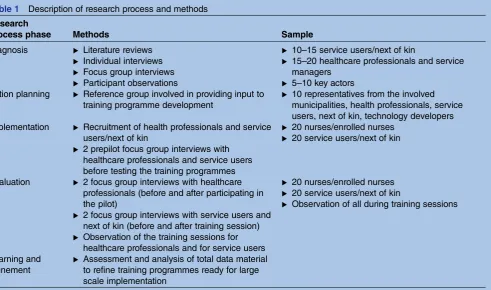
Data collection methods and samples related to all research phases are described in table 1. Data collection started in August 2013 and will continue until second quarter of 2015.
Phase 5: Learning and refinement
The final phase will assess the evaluation outcomes in aid of the refinement and improvement of the training programmes and their implementation. The outcomes of the entire initial cycle will be documented, focusing on both theory and practice, for further possible study and improvement.
Data analysis and quality of research
To ensure quality of research and trustworthiness in terms of credibility, in the analysis we will apply analyst triangulation and member checks. Also, the reference group will be involved so that credibility of the findings will be enhanced in the different research phases.38The research team will be involved in discussions and refi ne-ment of the undertaken analysis. The analytical process will follow the aforementioned research steps and the material will be categorised and analysed to inform the next phase of the research process. There will also be
Table 1 Description of research process and methods
Research
process phase Methods Sample
Diagnosis ▸ Literature reviews
▸ Individual interviews
▸ Focus group interviews
▸ Participant observations
▸ 10–15 service users/next of kin
▸ 15–20 healthcare professionals and service managers
▸ 5–10 key actors Action planning ▸ Reference group involved in providing input to
training programme development
▸ 10 representatives from the involved municipalities, health professionals, service users, next of kin, technology developers Implementation ▸ Recruitment of health professionals and service
users/next of kin
▸ 2 prepilot focus group interviews with healthcare professionals and service users before testing the training programmes
▸ 20 nurses/enrolled nurses
▸ 20 service users/next of kin
Evaluation ▸ 2 focus group interviews with healthcare professionals (before and after participating in the pilot)
▸ 2 focus group interviews with service users and next of kin (before and after training session)
▸ Observation of the training sessions for healthcare professionals and for service users
▸ 20 nurses/enrolled nurses
▸ 20 service users/next of kin
▸ Observation of all during training sessions
Learning and refinement
▸ Assessment and analysis of total data material to refine training programmes ready for large scale implementation
on September 22, 2020 by guest. Protected by copyright.
feedback between thefive phases in our cyclic approach to ensure continuous corrections and improvement. All transcribed data material from interviews and observa-tions will be uploaded and systemised by using the soft-ware program QSR International NVivo V.10.39
The data analysis is a combination of induction and deduction. In the diagnosis phase we will apply induc-tion to establish the overall impression of the data mater-ial according to Malterud’s40 systematic text condensation approach. This will involve the Norwegian speaking members of the research team. All team members will individually read the data material and come together in an analysis seminar to discuss the main themes40 emerging from the data and which are most important to incorporate in the training pro-gramme content and methods. This total impression along with the systematic literature reviews will form the basis for the action planning phase where the training programmes will be designed. The analysis of the data material from the implementation and evaluation phases will also be analysed according to the systematic text condensation approach. This analysis is deductive and theory40driven as it will apply predefined categories based on Alvarezet al’s37theoretical framework IMTEE.
Research quality in terms of transferability to other contexts is key in qualitative research.38 Generalisability in the sense of exact replication of results across studies is not the goal of action research inquiries. According to Susman and Evered,32 the basis of generalisation in action research is narrow, situational and bound by context.32This is also true for our study; however action research encourages transferability of project outcomes to similar settings when appropriate. Depending on con-textual similarity, it is possible to judge the relevance of findings from our study and whether they can be applied to another study setting. There is a potential conflict between our purposive sampling and transfer-ability of results to other settings. This will be addressed by providing details of the context in which our research occurs in our publications. Also, we will collect data about our sample regarding for example, their experi-ence with technology, age, gender and education, which we consider of relevance for other studies and popula-tions. This information will also be provided in our pub-lications and enable a better ability to evaluate if our results are transferable to other contextual settings.38
ETHICAL CONCERNS AND DISSEMINATION
The study is based on informed written consent, and informants and service users can withdraw at any point during the project. Interview and observation data will be managed confidentially. Tape recordings will be deleted after transcription. Each interview and observa-tion will be marked with a code, and the list matching the person identification and code will be securely stored (locked cabinet or password-protected PC at the university) by the research group ( project manager: SW,
and principal researcher: VG). Anonymised transcribed data material will be stored at the research institution for 3 years after the project ends.
Results will be disseminated at several research confer-ences, one PhD thesis (VG), and in articles published in peer reviewed journals. Moreover, we will present the study to audiences outside the academic community through public presentations and popular scientific publications.
DISCUSSION
The rationale for choosing an action research approach in our study is found in action research’s characteristics of being participatory,41 collaborative,42 empowering43 and suitable for contextualisation44 of problems facing processes of development and implementation of tele-care solutions in healthtele-care. Involving a multistake-holder partnership in the research team and participation from health professionals and user repre-sentatives in the reference group is expected to increase the likelihood of an effective practice innovation in terms of training programmes well-suited for health pro-fessionals, service users and next of kin intended to use videophone technology to conduct virtual visits in elderly home care.
While the action research approach is seen to have strong potential within telecare projects45–47 there is little documented use. The reasons for its limited use in telecare studies are unclear but could be related to per-ceived methodological problems associated with the approach. Issues of context, roles, politics, dynamics and ethics are deeply embedded in the action research method and influence its emergent process, quality and outcomes.48 The primary strength of the action research methodology as applied to telecare studies is however its ability to actively engage people in research and empower them35 and it has long been advocated for in telecare studies.49 It is not uncommon that new telecare technologies fail to see sustained adoption in prac-tice24 50 51because intended users seldom get to contrib-ute to development and implementation.45 The main contribution of our study is therefore new knowledge and experience regarding application of action research in telecare projects. By taking advantage of a combin-ation of user experience, user involvement, collaborcombin-ation and research evidence, we will develop research-based training programmes more suited for developing both technical and non-technical skills related to use of video-phone technology.
Telecare can be considered to be one important solu-tion for future healthcare challenges.6 However, differ-ent parties may have differdiffer-ent views and perception of how healthcare services can benefit from implementing new technological tools and changed ways in how healthcare is provided. In this study we need to carefully consider these different views and the fact that partici-pants in both the service user and healthcare
on September 22, 2020 by guest. Protected by copyright.
professional sample may regard the video telephone as a too complicated tool with an inadequate design, or that communication and service provision via virtual visits is not increasing care quality. Since we have close collabor-ation with the technology vendor, we will be able to give input to improve technology design, functionality and sound and picture quality based on actual user experi-ence (health professionals and patients). We need to be aware of the contested nature of implementing ICTs in healthcare and we believe our research design opens the way for a continuous dialogue between researchers, tech-nology users and the techtech-nology vendor, minimising the risk for low uptake and sustainability in practice.24 50 51
There is a need to consider both the benefits, chal-lenges and limitations of action research applied to tele-care projects and reflect on the role of the action researcher. The action researcher is a researcher acting to increase knowledge and understanding while simul-taneously being a facilitator for organisational change. Action research thus implies an inherently dual role for the researcher52 who needs to be able to move between different roles when needed.53 This is a possible research challenge and limitation in our project and will require good knowledge of the action research process, alongside comprehensive research skills and an overall flexible and pragmatic approach. It also necessitates the personal skills necessary to foster and handle diverse interpersonal relationships; ability to communicate and negotiate; social and cultural demands; and realistic time keeping.54As collaborative problems, such as differ-ent assumptions, values and world views between stake-holders,55 have been demonstrated by others as very disruptive and time consuming to the action research process, they need to be anticipated and openly dis-cussed and managed by participants in the project.41 This will be solved by organising regular meetings involv-ing all project partners, includinvolv-ing the technology vendor, the municipalities and the researchers. In struc-tured meetings we will provide opportunities to discuss and overcome disagreement and collaborative problems in the multistakeholder team. An additional challenge and possible limitation relates to municipal decision-making processes not involving research team members but with possible relevance for the project. Decisions related to technology development, technology costs and organisational change processes could emerge as critical for the project. Possible future decisions in the involved municipalities could affect our research project, such as those related to new telecare solutions, new tele-care strategies and choice of vendors or IT-related deci-sions that might interfere with the chosen videophone solution in this project. Moreover, a possible challenge is related to the development of the videophone technol-ogy. This is not in the hands of the project team and challenges such as a delay in the production might inter-fere with our design of training programmes in the action planning phase and the pilot testing in the imple-mentation phase. However, in an attempt to pre-empt
such a problem, there are collaborative meetings with members from all work packages in the overall project. In addition, a project team member ( principal researcher: VG) is part of the videophone development group working to guide the development of the final videophone tool, together with representatives from the municipalities and the technology vendor. The research team member was invited by the development team to coordinate the videophone development group, a coord-inator role that extends to managing communications between our research project team and the videophone development project, in order to keep both project goals and deadlines coordinated, as both projects depend on each other for success.
Acknowledgements The authors would like to thank the funders and Department of Health Studies, University of Stavanger, for the possibility for carrying out this research. The authors would like to thank both reviewers for constructive and helpful comments that improved the study protocol. The authors would also like to thank partners in the overallSafer@homeproject: Lyse; Department of Electronical Engineering and Computer Sciences at University of Stavanger; Stavanger municipality; Cisco; DevoTeam; VS-Safety; SINTEF; SAFER/Laerdal Medical; Stavanger University hospital/SESAM.
Contributors SW planned the study design and study protocol, contributed to the development of data collection tools, drafted and revised this manuscript. VG contributed to the study design, was responsible for the development of data collection tools and ethical approval and contributed to drafting and revision of the manuscript. JA, IT, AMLH, MS, ES, KLM contributed to study design and commented on the manuscript draft and revision. All authors have read and approved the final manuscript.
Funding TheSafer@home—simulation and trainingstudy is part of the project‘Smart systems to support safer independent living and social interaction for elderly at home’(Safer@Home). This project is supported by the Norwegian Research Council grant number 210799.
Competing interests None.
Patient consent Obtained.
Ethics approval The study has been approved by the Norwegian Social Science Data Services (NSD) (Ref 32934, 16 April 2013).
Provenance and peer review Not commissioned; externally peer reviewed.
Open Access This is an Open Access article distributed in accordance with the Creative Commons Attribution Non Commercial (CC BY-NC 3.0) license, which permits others to distribute, remix, adapt, build upon this work non-commercially, and license their derivative works on different terms, provided the original work is properly cited and the use is non-commercial. See: http:// creativecommons.org/licenses/by-nc/3.0/
REFERENCES
1. Teknologirådet.Fremtidens alderdom og ny teknologi. Oslo: Teknologirådet, 2009.
2. Helse- og omsorgsdepartementet.Stortingsmelding nr.25. Mestring, muligheter og mening—Framtidas omsorgsutfordringer. Oslo: Det Kongelige Helse- og omsorgsdepartement. Helse- og
omsorgsdepartementet, 2005–2006.
3. Arbeidsdepartementet.Stortingsmelding nr. 29. Felles ansvar for eit godt og anstendig arbeidsliv. Arbeidsforhold, arbeidsmiljø og sikkerheit. Oslo: Det Kongelege Arbeidsdepartement, 2010–2011. 4. Koch S, Hägglund M. Health informatics and the delivery of care to
older people.Maturitas2009;63:195–9.
5. Milligan C, Roberts C, Mort M. Telecare and older people: who cares where?Soc Sci Med2011;72:347–54.
6. Solli H, Bjørk I, Hvalvik S,et al. Principle-based analysis of the concept of telecare.J Adv Nurs2012;68:2802–15.
7. Greenhalgh T, Robert G, Bate P,et al.Diffusion of innovation in health service organiastions: a systematic literature review. Oxford: Blackwell Publishing Ltd, 2005.
on September 22, 2020 by guest. Protected by copyright.
8. May C. A rational model for assessing and evaluating complex interventions in health care.BMC Health Serv Res2006;6:86. http://www.biomedcentral.com/1472-6963/6/86
9. Hawley M. Implications for health and social care. In: Brownsell S, Bradley D, eds.Assistive technology and telecare: forging solutions for independent living. Bristol: The Policy Press, 2003:67–72. 10. Magnusson L, Hanson E, Borg M. A literature review study of ICT as
a support for frail older people living at home and their family carers.
Technol Disabil2004;16:223–35.
11. Boddy D, Henderson D.Implementing telecare: an action guide. Edinburgh: The Scottish Government, 2009.
12. Stanberry B. Telemedicine: barriers and opportunities in the 21st century.J Intern Med2000;247:615–28.
13. Stanberry B. Legal ethical and risk issues in telemedicine.Comput Methods Programs Biomed2001;64:225–33.
14. Sheikh A, McLean S, Cresswell K,et al.The impact of ehealth on the quality and safety of healthcare: an updated systematic overview and synthesis of the literature. Final report for the NHS Connecting for Health Evaluation Programme. Edinburgh: The University of Edinburgh, 2011.
15. Browning S, Tullai-McGuinness S, Madigan E,et al. Telehealth: is your staff ready to implement? A descriptive exploratory study of readiness for this technology in home health care.Home Healthc Nurse2009;27:242–8.
16. Sjögren L, Törnqvist H, Schwieler A,et al. The potential of telemedicine: barriers, incentives and possibilities in the
implementation phase.J Telemed Telecare2001;7(Suppl 1):12–13. 17. Jennett P, Yeo M, Pauls M,et al. Organizational readiness for
telemedicine: implications for success and failure.J Telemed Telecare2003;9(Suppl 2):27–30.
18. Helsedirektoratet.Velferdsteknologi: Fagrapport om implementering av velferdsteknologi i de kommunale helse og omsorgstjenestene 2013-2030. Oslo: Helsedirektoratet, 2012.
19. Atack L, Luke R, Sanderson D. Development of an online, team-based programme in telecare.J Telemed Telecare
2004;10:355–60.
20. Czaja S, Charness N, Fisk A,et al. Predicting the use of technology: findings from the Center for Research and Education on Aging and Technology Enhancement (CREATE).Psychol Aging
2006;21:333–52.
21. Woodward A, Freddolino P, Blaschke-Thompson C,et al.
Technology and aging project: training outcomes and efficacy from a randomized field trial.Ageing Int2011;36:46–65.
22. Anderson J, Horton K. Evaluation of the effectiveness of telecare for independent living in Surrey. In: Bust P. edContemporary
ergonomics. Proceedings of the international conference on contemporary ergonomics (CE2008), 1–3 April 2008. Nottingham, Wiltshire: Taylor and Francis, 2008:8–13.
23. Basu A, Seaton P, Kirk R,et al.Review of the effectiveness of educational tools for teaching telehealth care. Christchurch: University of Canterbury, 2010.
24. Zanaboni P, Wootton R. Adoption of telemedicine: from pilot stage to routine delivery.BMC Med Inform Decis Mak2012;12:1.
25. Wiig S, Husebø A.Using simulation-based training to ensure safe implementation processes of new technology in the home context— a literature review.Presentation at 2nd Nordic Conference on Research in Patient Safety and Quality in Healthcare, Copenhagen 2012.
26. Guise V, Chambers M, Välimäki M. What can virtual patient simulation offer mental health nursing education?J Psychiatr Ment Health Nurs2012;19:410–15.
27. Bonwell C, Eison J.Active learning: creating excitement in the classroom. ASHEERIC Higher Education Report No. 1. Washington, DC: George Washington University, 1991.
28. Ziv A, Small S, Wolpe P. (2000) Patient safety and simulation-based medical education.Med Teach2000;22:489–95.
29. Salas E, Wilson K, Burke C,et al. Using simulation-based training to improve patient safety: what does it take?J Qual Patient Saf
2005;31:363–71.
30. Nishisaki A, Keren R, Nadkarni V. Does simulation improve patient safety? Self-efficacy, competence, operational performance, and patient safety.Anesthesiol Clin2007;25:225–36.
31. Aggarwal R, Mytton O, Derbrew M,et al. Training and simulation for patient safety.Qual Saf Health Care2010;19(Suppl 2):34–i43. 32. Susman G, Evered R. An assessment of the scientific merits of
action research.Adm Sci Q1978;23:582–603.
33. Waterman H, Marshall M, Noble J,et al. The role of action research in the investigation and diffusion of innovations in health care: the PRIDE project. Qual Health Res2007;17:373–81.
34. Winter R, Munn-Giddings C.A handbook for action research in health and social care. London: Routledge, 2001.
35. Meyer J. Action research. In: Gerrish K, Lacey A, eds.The research process in nursing. 5th edn. Oxford: Wiley-Blackwell, 2010:257–70. 36. Reason P, Bradbury H.Handbook of action research: participative
inquiry and practice. London: SAGE, 2001.
37. Alvarez K, Salas E, Garofano C. An integrated model of training evaluation and effectiveness.Hum Resource Dev Rev
2004;3:385–416.
38. Seale C.The quality of qualitative research. London: Sage Publications, 1999.
39. QSR International Pty Ltd.NVivo software, Version 10. QSR International Pty Ltd, 2012.
40. Malterud K.Kvalitative metoder i medisinsk forskning. Oslo: Universitetsforlaget, 2011:91–112.
41. Williamson G. Discussion, debate and controversy surrounding action research. In: Williamson G, Bellman L, Webster J, eds.Action research in nursing and healthcare. London: SAGE, 2012:31–75. 42. Bellman L, Webster J. Collaborative working in clinical settings. In:
Williamson G, Bellman L, Webster J, eds.Action research in nursing and healthcare. London: SAGE, 2012:119–45.
43. Stringer E. (2010) Action research in education. In: Peterson P, Baker EMcGaw B, eds.The international encyclopedia of education. 3rd edn. Amsterdam: Elsevier, 2010.
44. Hart E, Bond M.Action research and health and social care: a guide to practice.Buckingham: Open University Press. Hoboken, NJ: John Wiley, 1995:1–79.
45. Hansen S, Robertson T, Wilson L,et al.Using an action research approach to design a telemedicine system for critical care: a reflection.OZCHI‘08: Proceedings of the 20th Australasian Conference on Computer-Human Interaction: Designing for Habitus and Habitat: Cairns, 2008:255–8.
46. Callén B, Doménech M, López D,et al. Telecare research: (cosmo) politicizing methodology.ALTER, Euro J Disabil Res2009;3:110–12. 47. Dinesen B, Seeman J, Gustafsson J. Development of a program for
tele-rehabilitation of COPD patients across sectors: co-innovation in a network.Int J Integr Care2011;11:e012. http://www.ijic.org URN: NBN:NL:UI:10-1-101374, ijic2011-12
48. Coghlan D, Shani A. Roles, politics, and ethics in action research design.Syst Pract Action Res2005;18:533–46.
49. Finch T, Mort M, Mair F,et al. Future patients? Telehealthcare, roles and responsibilities.Health Soc Care Community2008;16:86–95. 50. May C, Harrison R, MacFarlane A,et al. Why do telemedicine
systems fail to normalize as stable models of service delivery?
J Telemed Telecare2003;9(Suppl 1):25–6.
51. Mair F, May C, Finch T,et al. Understanding the implementation and integration of e-health services.J Telemed Telecare2007;
13(Suppl 1):36–7.
52. Trondsen M, Sandaunet A. The dual role of the action researcher.
Eval Program Plann2009;32:13–20.
53. Webster J. Developing one’s own professional practice. In: Williamson G, Bellman L, Webster J, eds.Action research in nursing and healthcare. London: SAGE, 2012:97–118. 54. Bellman L. Clinical action research to advance patient care.
In: Williamson GR, Bellman L, Webster J. edsAction research in nursing and healthcare. London: SAGE, 2012:66–93.
55. Greenhalgh T, Procter R, Wherton J,et al. The organising vision for telehealth and telecare: discourse analysis.BMJ Open2012;2: e001574.
on September 22, 2020 by guest. Protected by copyright.