Vol. 10, No.2, 2015, 191-198
ISSN: 2279-087X (P), 2279-0888(online) Published on 12 October 2015
www.researchmathsci.org
191
Annals of
Ranking of Generalized Dodecagonal Fuzzy Numbers
Using Centroid of Centroids
Jatinder Pal Singh*1 and Neha Ishesh Thakur2 1
Department of Mathematics, Desh Bhagat University Mandi Gobindgarh-147301, Punjab, India. 2
Department of Mathematics, G.S.S.D.G.S. Khalsa College Patiala -147001, Punjab, India.
*
Corresponding author. E-mail address: [email protected]
Received 4 September 2015; accepted 22 September 2015
Abstract. The fuzzy set theory has been applied in many fields such as management, engineering etc. In modern management applications ranking using fuzzy numbers is the most important aspect in decision making process. In this paper, we proposed the ranking of generalized dodecagonal fuzzy numbers (DoFN). The proposed approach is based on rank, mode, divergence and spread.
Keywords: Ranking function; centroid points; generalized dodecagonal fuzzy numbers. AMS Mathematics Subject Classification (2010): 03E72, 62F07.
1. Introduction
Ranking of fuzzy number play an important role in decision making. Zadeh [23] introduced the concept of fuzzy sets to deal with imprecision, vagueness in real life situations. The method for ranking was first proposed by Jain [9]. Yager [21] first used horizontal coordinate of the centroid point in ranking fuzzy numbers. Murakami et al. [14] have used both the horizontal and vertical coordinates of the centroid point as the ranking index. In Kaufmann and Gupta [12] proposed an approach for the ranking of fuzzy numbers.
Campos and Gonzalez [1] proposed a subjective approach for ranking fuzzy numbers. Cheng [6] presented a method for ranking fuzzy numbers by using the distance method. Chu and Tsao [7] proposed a method for ranking fuzzy numbers with the area between the centroid point and original point. Deng and Liu [8] presented a centroid-index method for ranking fuzzy numbers. Chen and Chen [3] presented a method for ranking generalized trapezoidal fuzzy numbers. Wang and Lee [20] used the centroid concept in developing their ranking index.
Jatinder Pal Singh and Neha Ishesh Thakur
192
ordering fuzzy numbers based on Area, Mode, divergence, Spreads and Weights of generalized (non-normal) hexagonal fuzzy numbers. Rajarajeswari and Sudha [15] proposed a new method on the incentre of centroids and uses of Euclidean distance to ranking generalized hexagonal fuzzy numbers.
2. Preliminaries 2.1. Fuzzy set [9]
A fuzzy set is defined by = {(x, µA(x)) : x ϵ A, µA(x) ϵ [0,1] }. In the pair (x, µA(x)), the first element x belong to the classical set A, the second element µA(x), belong to the interval [0, 1] called Membership function.
2.2. Fuzzy number [9]
A fuzzy set on R must possess at least the following three properties to qualify as a fuzzy number,
(i) must be a normal fuzzy set; (ii) αà must be closed interval for every α ϵ [0,1] (iii) the support of , 0+Ã, must be bounded.
2.3. Dodecagonal fuzzy numbers [18]
A fuzzy number is a DoFN denoted by = (a1,a2,a3,a4,a5,a6,a7,a8,a9,a10,a11,a12) where a1,a2,a3,a4,a5,a6,a7,a8,a9,a10,a11,a12 are real numbers and its membership function is given below
0 x ≤ a1
k1
a1 ≤ x ≤ a2
k1 a2 ≤ x ≤ a3 k1 + (k2 - k1)
a3 ≤ x ≤ a4
k2 a4 ≤ x ≤ a5 k2 + (1- k2)
a5 ≤ x ≤ a6
() = 1 a6 ≤ x ≤ a7 k2 + (1- k2)
a7 ≤ x ≤ a8
k2 a8 ≤ x ≤ a9 k1 + (k2 – k1)
a9 ≤ x ≤ a10
k1 a10 ≤ x ≤ a11 k1
a11 ≤ x ≤ a12
0 a12 ≤ x where 0 < k1 < k2 < 1
2.4. Generalized dodecagonal fuzzy number
193 0 x ≤ a1
u
a1 ≤ x ≤ a2
u a2 ≤ x ≤ a3 u + (v - u)
a3 ≤ x ≤ a4
v a4 ≤ x ≤ a5 v + (w- v)
a5 ≤ x ≤ a6
() = w a6 ≤ x ≤ a7 v + (w- v)
a7 ≤ x ≤ a8
k2 a8 ≤ x ≤ a9 u + (v – u)
a9 ≤ x ≤ a10
u a10 ≤ x ≤ a11
u
a11 ≤ x ≤ a12
0 a12 ≤ x where 0 < u < v < w ≤ 1
3. Proposed ranking method of dodecagonal fuzzy number
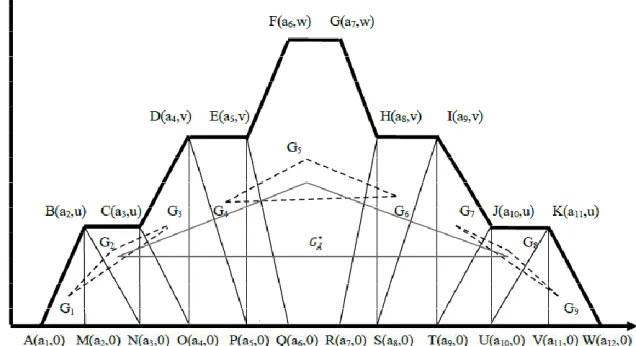
The centroid of a DoFN is considered to be the balancing point of the dodecagon (Fig. 1). Divide the dodecagon into eight triangles and one hexagon ABM, BCN, CDO, DEP, HIS, IJT, JKU, KWV and EFGHRQ respectively. Let the centroids of nine trapezoids be G1, G2, G3, G4, G6, G7, G8, G9 and G5 respectively.
Figure 1: Generalized dodecagonal fuzzy number
The centroid of the nine plane figure is
G1= , ; G2= , ; G3= , ;
G4= , ; G5=(), ; G6=, ;
Jatinder Pal Singh and Neha Ishesh Thakur
194
(a) G1, G2 and G3 are non-collinear and they form triangle. We define the centroid !"∗ of the triangle with vertices G1, G2 and G3 as !"∗= ($ ),%$ .
(b) G4, G5 and G6 are non-collinear and they form triangle. We define the centroid !∗ of
the triangle with vertices G4, G5 and G6 as !∗= ("')&(),& $
(c) G7, G8 and G9 are non-collinear and they form triangle. We define the centroid !∗ of
the triangle with vertices G7, G8 and G9 as !∗= ($),%$
Also,!"∗, !∗ and !∗ are non-collinear and they form triangle. We define the centroid !∗ of the triangle with vertices !"∗, !∗ and !∗ as
!∗= ()()&()
&% ,
'( (
If we take u = and v = then
!∗= ()()&()
&% ,
&
'" (1)
The ranking function of the generalized DoFN A* = (a1,a2,a3,a4,a5,a6,a7,a8,a9,a10,a11,a12;w), which maps the set of all fuzzy number to a set of real numbers is defined as
R(A*) = ()(&%)&() & '" (2) This is the area between the centroid of the centroids !∗ as defined in (1) and (2) the original point.
The mode of the generalized DoFN A* = (a1,a2,a3,a4,a5,a6,a7,a8,a9,a10,a11,a12;w) is
Mode = (a + a() (3) The divergence of the generalized DoFN A* = (a1,a2,a3,a4,a5,a6,a7,a8,a9,a10,a11,a12;w) is Divergence = w(a" - a") (4) The left spread of the generalized DoFN A* = (a1,a2,a3,a4,a5,a6,a7,a8,a9,a10,a11,a12;w) is Left spread = (a - a") (5) The right spread of the generalized DoFN A* = (a1,a2,a3,a4,a5,a6,a7,a8,a9,a10,a11,a12;w) is Right spread = (a" - a() (6)
4. Some important results
In this section some important results, that are useful for the proposed approach, are proved.
Proposition 4.1. Let A*=(a1,a2,a3,a4,a5,a6,a7,a8,a9,a10,a11,a12;w1) and
B*= (b1,b2,b3,b4,b5,b6,b7,b8,b9,b10,b11,b12;w2) be two generalized dodecagonal fuzzy numbers such that
(i) R(A*) = R(B*), (ii) mode (A*) = mode (B*) and (iii) divergence (A*) = divergence (B*) then
(a) Left spread (A*) ˃ Left spread (B*) iff a6w1 ˃ b6w2 (b) Left spread (A*) < Left spread (B*) iff a6w1 < b6w2 (c) Left spread (A*) = Left spread (B*) iff a6w1= b6w2
Proof: We have
195
i.e.,()(&%)&() &-'" =
(0000)(000000)&(00)
" &-'" (7)
(ii) mode (A*) = mode (B*)
i.e.,-(a6+a7) = -(b6+b7) (8) (iii) divergence (A*) = divergence (B*)
i.e.,(a12-a1)w1=(b12-b1)w2 (9) Solving(7), (8) and (9) we get
a1w1= b1w2
(a2+a3+ a4+a9+a10+a11)w1=( b2+b3+b4+b9+b10+b11)w2 (a5+a8)w1=(b5+b8)w2
(a) Left spread (A*) ˃ Left spread (B*) iff (a6-a1)-˃ (b6-b1)-
iff (a6-a1)w1˃ (b6-b1)w2
iff a6w1 ˃ b6w2 (∵ a1w1= b1w2)
Hence, Left spread (A*) ˃ Left spread (B*) iff a6w1 ˃ b6w2 (b) Left spread (A*) < Left spread (B*)
iff (a6-a1)- < (b6-b1)- iff (a6-a1)w1< (b6-b1)w2
iff a6w1 < b6w2 (∵ a1w1= b1w2)
Hence, Left spread (A*) < Left spread (B*) iff a6w1 < b6w2 (b) Left spread (A*) = Left spread (B*)
iff (a6-a1)- = (b6-b1)- iff (a6-a1)w1= (b6-b1)w2
iff a6w1 = b6w2 (∵ a1w1= b1w2)
Hence, Left spread (A*) = Left spread (B*) iff a6w1 = b6w2
Corollary 4.1. All the results of proposition 4.1 also hold for right spread.
Proposition 4.2. Let A*=(a1,a2,a3,a4,a5,a6,a7,a8,a9,a10,a11,a12;w1) and
B*=(b1,b2,b3,b4,b5,b6,b7,b8,b9,b10,b11,b12;w2) be two generalized dodecagonal fuzzy numbers such that
(i) R(A*) = R(B*), (ii) mode (A*) = mode (B*) and (iii) divergence (A*) = divergence (B*) then
(a) Left spread (A*) ˃ Left spread (B*) iff Right spread (A*) ˃ Right spread (B*) (b) Left spread (A*) < Left spread (B*) iff Right spread (A*) < Right spread (B*) (c) Left spread (A*) = Left spread (B*) iff Right spread (A*) = Right spread (B*)
Proof: From proposition 4.1, we have
a1w1= b1w2
(a2+a11)w1=(b2+b11)w2 (a3+a10)w1=(b3+b10)w2 (a4+a9)w1=(b4+b9)w2 (a5+a8)w1=(b5+b8)w2
Jatinder Pal Singh and Neha Ishesh Thakur
196 iff a6w1 ˃ b6w2 (from proposition 4.1)
iff a7w1 < b7w2 (∵-(a6+a7) = -(b6+b7) or w1(a6+a7) = w2(b6+b7)) iff -a7w1 ˃ -b7w2
iff (a12-a7)w1 ˃ (b12w2-b7)w2 (∵ a12w1 = b12w2) iff Right spread (A*) ˃ Right spread (B*)
Similarly (b) and (c) can be proved.
5. Proposed approach for ranking of generalized dodecagonal fuzzy numbers
Let A*=(a1,a2,a3,a4,a5,a6,a7,a8,a9,a10,a11,a12;w1) & B*=(b1,b2,b3,b4,b5,b6,b7,b8,b9,b10,b11,b12;w2) be two generalized dodecagonal fuzzy numbers then use the following steps to compare
A* and B*
Step 1: Find R (A*) and R (B*)
Case (i) If R (A*) ˃ R (B*) then A*≻ B* Case (ii) If R (A*) < R (B*) then A*≺ B* Case (ii) If R (A*) = R (B*) then go to step 2. Step 2: Find mode (A*) and mode (B*)
Case (i) If mode (A*) ˃ mode (B*) then A*≻ B* Case (ii) If mode (A*) < mode (B*) then A*≺ B* Case (ii) If mode (A*) = mode (B*) then go to step 3. Step 3: Find divergence (A*) and divergence (B*)
Case (i) If divergence (A*) ˃ divergence (B*) then A*≻ B* Case (ii) If divergence (A*) < divergence (B*) then A*≺ B* Case (ii) If divergence (A*) = divergence (B*) then go to step 4. Step 4: Find Left Spread (A*) and Left Spread (B*)
Case (i) If Left Spread (A*) ˃ Left Spread (B*) i.e. a6w1 ˃ b6w2 then A*≻B* (from proposition 4.1) Case (ii) If Left Spread (A*) < Left Spread (B*) i.e. a6w1 < b6w2 then A*≺B* (from proposition 4.1) Case (ii) If Left Spread (A*) = Left Spread (B*)
i.e. a6w1 < b6w2 then go to step 5. (from proposition 4.1) Step 5: Find w1 and w2
Case (i) If w1 ˃ w2 then A*≻B* Case (ii) If w1 < w2 then A*≺B* Case (ii) If w1 = w2 then A* ~ B*.
6. Numerical problems
Example 6.1. Let A* = (0.1,0.2,0.3,0.4,0.5,0.6,0.7,0.8,0.9,1,1.1,1.2;0.7) and
B* = (0.2,0.4,0.6,0.8,1,1.2,1.4,1.6,1.8,2,2.2,2.4;0.35)
Step 1: R (A*) = 0.14 and R (B*) =0.14. Since R (A*) = R (B*) go to step 2
Step 2: Mode (A*) = 0.455 and Mode (B*) =0.455. Since Mode (A*) = Mode (B*) go to step 3 Step 3: Divergence (A*) = 0.77 and Divergence (B*) = 0.77.
Since Divergence (A*) = Divergence (B*) go to step 4 Step 4: Left Spread (A*) = 0.117 and Left Spread (B*) = 0.117.
197
Step 5: w1 = 0.7 and w2 = 0.35. Since w1 ˃ w2 then A*≻B*
Example 6.2. Let A* = (0.15,0.2,0.21,0.26,0.29,0.31,0.33,0.37,0.39,0.45,0.48,0.49;0.4) and B* = (0.45,0.49,0.51,0.55,0.57,0.6,0.62,0.67,0.69,0.72,0.73,0.79;0.8)
Step 1: R (A*) = 0.041 and R (B*) = 0.152. Since R (A*) < R (B*), A*≺B*
Example 6.3. Let A* = (0.43,0.45,0.5,0.6,0.7,0.8,1,1.1,1.2,1.35,1.4,1.5;1) and B* = (0.28, 0.45,0.5,0.6,0.75,0.8,0.9,1.15,1.2,1.3,1.45,1.5;1)
Step 1: R (A*) = 0.283 and R (B*) = 0.283. Since R (A*) = R (B*), go to step 2 Step 2: Mode (A*) = 0.9 and Mode (B*) = 0.85. Since Mode (A*) ˃ Mode (B*), A*≻B*
Example 6.4. Let A* = (0.2,0.4,0.6,0.8,1.15,1.2,1.4,1.65,1.8,2,2.2,2.4;1) and B* = (0.1,0.4, 0.7,0.8,1,1.2,1.4,1.6,1.8,2.1,2.2,2.4;1)
Step 1: R (A*) = 0.407 and R (B*) = 0. 407. Since R (A*) = R (B*) go to step 2
Step 2: Mode (A*) = 1.3 and Mode (B*) = 1.3. Since Mode (A*) = Mode (B*) go to step 3 Step 3: Divergence (A*) = 2.2 and Divergence (B*) =2.3.
Since Divergence (A*) < Divergence (B*), A*≺B*
Example 6.5. Let A* = (0.2,0.3,0.6,0.8,1,1.3,1.4,1.6,1.8,2,2.2,2.3;1) and B* = (0.2,0.4,0.6,0.8,1,1.2,1.5,1.6,1.8,2,2.1,2.3;1)
Step 1: R (A*) = 0.403 and R (B*) = 0.403. Since R (A*) = R (B*) go to step 2
Step 2: Mode (A*) = 1.35 and Mode (B*) = 1.35. Since Mode (A*) = Mode (B*) go to step 3 Step 3: Divergence (A*) = 2.1 and Divergence (B*) = 2.1.
Since Divergence (A*) = Divergence (B*) go to step 4 Step 4: Left spread (A*) = 0.36 and Left Spread (B*) = 0.33. Since Left Spread (A*) ˃ Left Spread (B*), A*≻B*
7. Conclusion
In this paper, we proposed a simpler and easier approach for ranking of generalized dodecagonal fuzzy number by using centroid of centroids. Also, proposed method is illustrated with the help of numerical example.
REFERENCES
1. L.Campos and A.Gonzalez, A subjective approach for ranking fuzzy numbers, Fuzzy
Sets and Systems, 29 (1989) 145-153.
2. S.H.Chen, Rank in fuzzy numbers with maximizing set and minimizing set, Fuzzy
Sets and Systems, 17 (1985) 113–129.
3. C.C.Chen and H.C.Tang, Ranking nonnormal p-norm trapezoidal fuzzy numbers with integral value, Computers and Math. with Applications, 56 (2008) 2340-2346. 4. S.J.Chen and S.M.Chen, Fuzzy risk analysis based on the ranking of generalized
trapezoidal fuzzy numbers, Applied Intelligence, 26 (2007) 1-11.
5. S.M.Chen and J.H.Chen, Fuzzy risk analysis based on ranking generalized fuzzy numbers with different heights and different spreads, Expert Systems with
Jatinder Pal Singh and Neha Ishesh Thakur
198
6. C.H.Cheng, A new approach for ranking fuzzy numbers by distance method, Fuzzy
Sets and Systems, 95 (1998) 307-317.
7. T.C.Chu and C.T.Tsao, Ranking fuzzy numbers with an area between the centroid point and original point, Computers and Math. with Applications, 43 (2002) 111-117.
8. Y.Deng and Q.Liu, A TOPSIS-based centroid-index ranking method of fuzzy numbers and its applications in decision making, Cybernetics and Systems, 36 (2005) 581-595.
9. A.N.Gani, R.Baskaran and S.N.M.Assarudeen, Improved Vogel’s Approximation Method to Solve Fuzzy Transshipment Problem, International Journal of Fuzzy
Mathematical Archive,4 (2014) 80-87.
10. A.N.Gani and V.N.Mohamed, Solution of a Fuzzy Assignment Problem by Using a New Ranking Method, Int. Journal of Fuzzy Mathematical Archive,2 (2013) 8-16. 11. R.Jain, Decision-making in the presence of fuzzy variables, IEEE Transactions on
Systems, Man and Cybernetics, 6 (1976) 698-703.
12. A.Kaufmann and M.M.Gupta, Fuzzy mathematical models in engineering and management science, Elsevier Science Publishers, Amsterdam, Netherlands, 1988. 13. A.Kumar, P.Singh, A.Kaur and P.Kaur, Ranking of generalized trapezoidal fuzzy
numbers based on rank, mode, divergence and spread, Turkish journal of Fuzzy
Systems, 1 (2010) 141-152.
14. S.Murakami, S.Maeda and S.Imamura, Fuzzy decision analysis on the development of centralized regional energy control: system, IFAC symposium on Fuzzy
information, knowledge representation and decision analysis, 1983.
15. P.Rajarajeswari and A.S.Sudha, Ordering generalized hexagonal fuzzy numbers using rank, mode, divergence and spread, ISOR Journal of Mathematics, 10 (2014) 15-22.
16. P.Rajarajeswari and A.S.Sudha, A new approach for ranking of fuzzy numbers using the incentre of centroids, International Journal of Fuzzy Mathematical Archive,4 (2014) 52-60.
17. P.P.B.Rao and N.Shankar, Ranking fuzzy numbers with a distance method using circumcenter of centroids and Index of modality, Adv. in Fuzzy systems, (2011) 1-7. 18. J.P.Singh and N.I.Thakur, An approach for solving fuzzy transportation problem
using dodecagonal fuzzy number, Int. J. of Math. Archive, 6 (2015) 105-112.
19. Y.L.P.Thorani, P.Phani Bushan Rao and N.Ravi Shankar, Ordering generalized trapezoidal fuzzy numbers, Int. J. Contemp. Math. Sciences, 7 (2012) 555-573. 20. Y.J. Wang and H.S. Lee, The revised method of ranking fuzzy numbers with an area
between the centroid and original points, Computers and Mathematics with
Applications, 55 (2008) 2033-2042.
21. R.R. Yager, On a general class of fuzzy connectives, Fuzzy Sets and Systems, 4 (1980) 235-242.
22. J. Yao and K. Wu, Ranking fuzzy numbers based on decomposition principle and signed distance, Fuzzy Sets and Systems, 116 (2000) 275-288.